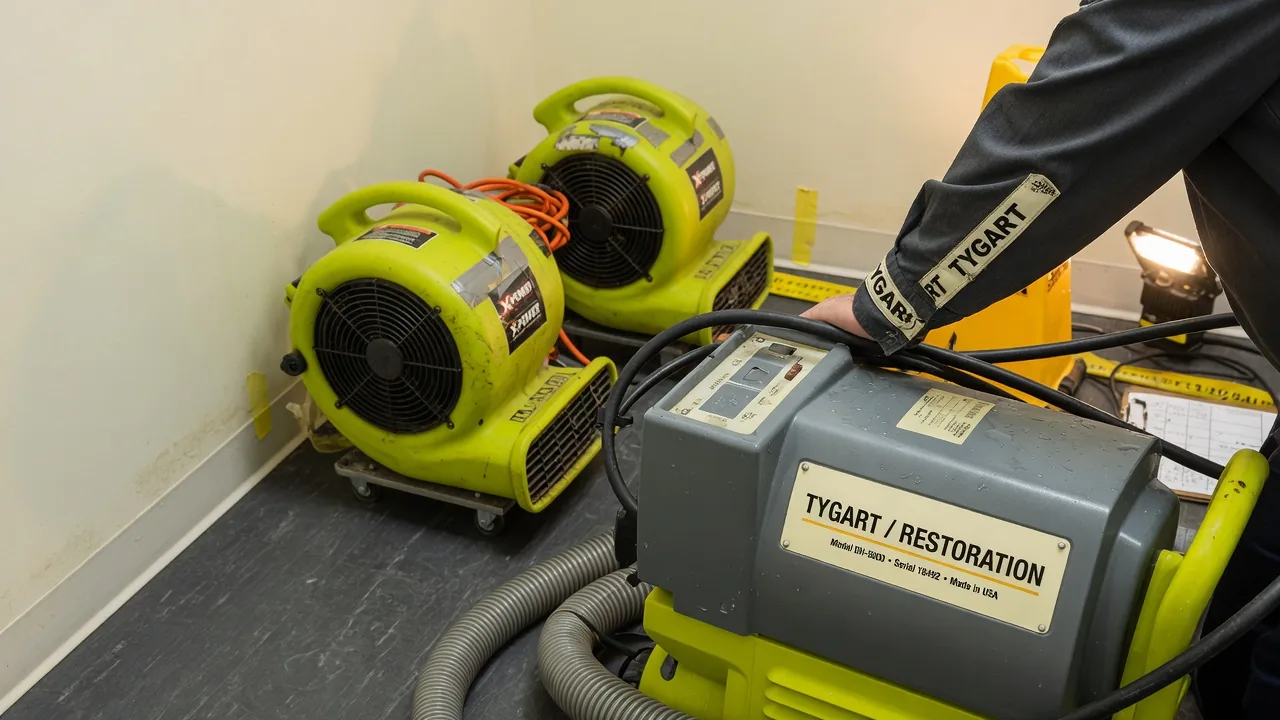
Direct answer: Roofers are one of the cleanest scope-lane partnerships available to a restoration company because their work ends at the roof deck and yours begins with every drop of water that made it inside the envelope. A roofer who fixes a leak or replaces a storm-damaged roof almost never has the IICRC training, insurance, or equipment to handle interior drywall, insulation, attic, or ceiling damage — and they don’t want to. The homeowner who just spent $12,000 on a new roof does not want to chase a separate contractor for their stained ceiling, wet insulation, or mold behind the bedroom wall. The restoration company that becomes the named interior mitigation partner for three or four quality roofers in a market unlocks a high-frequency referral channel that spikes hard during storm season and delivers steady volume year-round. Storm-chaser roofers are a different beast — watch the insurance claim dynamics carefully — but local roofers with strong reputations are the most natural scope-lane partner outside of plumbers.
The roofing channel sits at an underappreciated intersection in the restoration business. Every roof leak produces interior water damage. Every hail, wind, and storm event produces roof damage and often simultaneous interior damage. Every aging roof replacement uncovers prior leak evidence that somebody needs to remediate. Roofers handle the exterior scope. The interior scope is yours by design — but only if the roofer has your name in their phone and has been trained to hand the homeowner to you the same day.
This article is the operational view of how roofing companies actually make money, why storm chasers require a different playbook than local roofers, the six moments where interior water and mold damage gets discovered on a roofing job, why most restoration-to-roofer partnerships fail at the handoff, and the specific ninety-day program to make yourself the default interior partner. It is the tenth article in The Restoration Operator’s Playbook partner-industries series.
How a Roofing Company Actually Makes Money
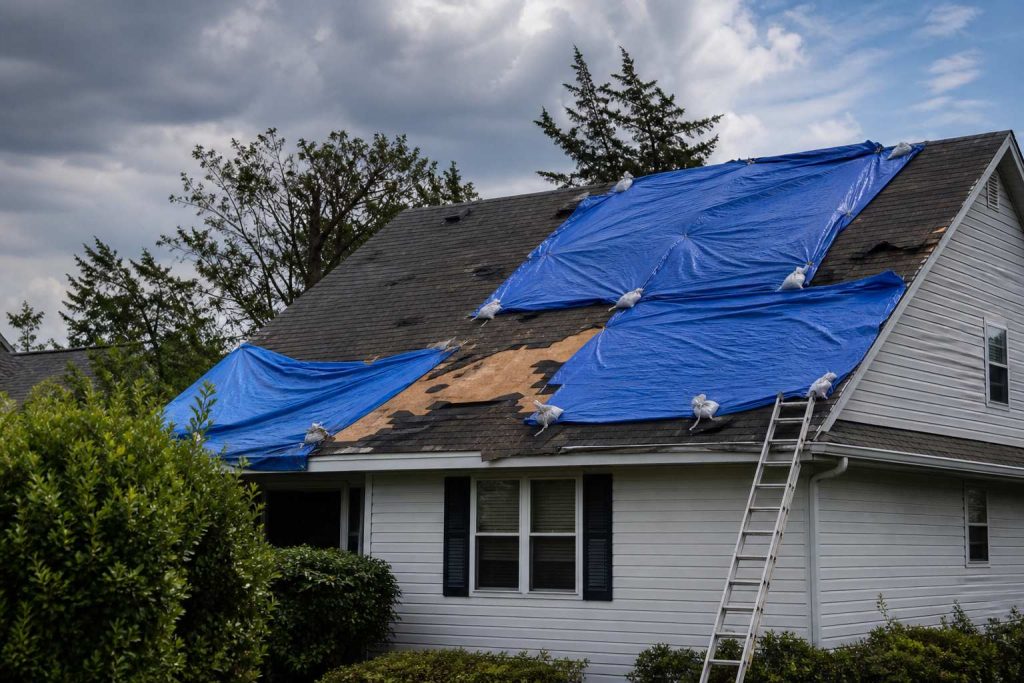
The revenue mix. A mid-market residential roofing company runs between $1M and $15M in annual revenue. Revenue composition is typically 60–80 percent residential replacement, 10–25 percent repair, 5–25 percent commercial, and a trickle of new construction in some markets. Storm-chaser operations (companies that deploy into hail and hurricane zones) can run 90 percent insurance-funded residential replacement during event years.
Margin structure. Gross margins sit in the 35–40 percent range on typical residential replacement jobs — materials around 35 percent of revenue, labor around 18 percent, sales commission 6–10 percent. Net margins for healthy roofing contractors run 10–20 percent, with one-third of the industry reporting EBITDA margins between 6 and 15 percent according to 2026 ServiceTitan data. Commercial roofing has tighter gross margins but larger per-project revenue, with commercial contracts typically running $25,000 to $250,000+ per job.
Pricing structure. Residential pricing is typically per-square (one square = 100 square feet of roof surface). A standard asphalt shingle replacement on a 20–25 square house in the U.S. runs $10,000–$25,000. Premium materials (architectural shingles, metal, tile) run 2–5x. Commercial TPO, EPDM, and modified-bitumen work is typically priced per square foot with a minimum mobilization cost. Storm and hail work is priced against insurance scope rather than retail pricing — which is where the ethics and relationship dynamics get complicated.
Get The Signal
What we actually ran, what it measured, and what it means for a restoration shop — every week, including the flops.
The operational engine. Mid-market roofers run with a small office (owner, production manager, estimator, office admin), a sales team paid on commission, and either W-2 crews or subcontractor crews. Software stack: AccuLynx, JobNimbus, Roofr, CompanyCam for photo documentation, Eagleview and Hover for aerial measurement. Insurance work adds Xactimate, carrier portals, and supplement workflow to the stack. Their business rhythm is storm-season-driven — spring and summer hail, late summer and fall hurricanes, winter ice and wind in northern markets.
The commercial maintenance book. Quality commercial roofers build recurring revenue through maintenance contracts on TPO, EPDM, and modified-bitumen roofs. Typical annual maintenance fees run $500–$5,000 per building. These contracts keep technicians on roofs all year looking at the same buildings — which makes them a rich source of interior-damage discovery on commercial property.
Storm Chasers vs Local Roofers: Why the Playbook Is Different
This is a section most restoration content skips.
A storm-chaser roofing company deploys crews into markets immediately after hail, hurricane, or major wind events. They knock doors, offer free inspections, sign homeowners to contingency agreements, file and negotiate the insurance claim on behalf of the homeowner, and replace the roof paid entirely or nearly entirely through the insurance claim. Some storm chasers are legitimate businesses with offices in multiple states. Others are transient operations that vanish after the season, leaving warranty issues and litigation behind.
What matters for the restoration partnership. Legitimate local roofers who handle insurance work do it within ethical guardrails — they inspect, document, submit the scope, and collect from the carrier the same way restoration companies do. Transient storm chasers often push ethically gray tactics that can expose a restoration partner to reputational damage: assignment-of-benefits abuse in states where AOB has been restricted, public-adjuster-style claim negotiation without proper licensing, inflated scope fights, and high-pressure door-to-door sales that irritate homeowners and regulators.
The partnership rule. Partner with local roofers who have been in market three-plus years, carry real addresses, have strong Google reviews and GBP longevity, maintain manufacturer certifications (GAF Master Elite, Owens Corning Platinum, CertainTeed ShingleMaster), and can produce license and insurance documentation immediately. Be wary of out-of-state operators running door-to-door campaigns after the last hail event. Your reputation rides on theirs when you become their named interior partner.
The AOB and claim-handling line. In the states that still permit assignment of benefits on roof claims, a roofer holding AOB has significant control over the claim. Some roofers will try to attach restoration interior scope to their claim under the same AOB. Read your state’s statute — in states like Florida (after reforms), AOB on property claims is substantially restricted. In other states it’s still permitted but increasingly scrutinized. Your posture: the interior mitigation scope is yours, priced and invoiced directly to the homeowner or their carrier, under your own documentation. Never accept a roofer’s AOB as the mechanism for billing your work.
How Roofing Companies Acquire Customers
Storm-response canvassing. Door-to-door after hail and wind events. Still the largest single channel for residential replacement in many markets. Some of this is high-quality work by good local operators; some is predatory. Regulators watch it closely.
Google LSA and paid search. “Roof replacement near me” and “roof leak repair” are high-CPC terms. Residential roofers spend aggressively on LSA, PPC, and SEO.
Insurance carrier preferred networks. Some large roofers sit on carrier preferred-vendor lists for direct assignment on claims. These are procurement relationships with fixed pricing and SLA requirements.
Commercial sales teams. Dedicated B2B reps calling on property managers, facilities directors, building owners, and general contractors. Commercial roofing relationships are relationship-based and long-cycle — a roofer might call on a facility for three years before winning the replacement bid.
Referrals. Past clients, realtors, home inspectors, and trade partners. Strong local roofers run 40–70 percent referral-driven volume.
Home shows and brand marketing. Parade of Homes, local builder associations, remodeler expos, and sponsorships.
The takeaway: roofers compete on speed, warranty, and trust. They value trade partners who protect their reputation with the homeowner and don’t create problems on the job.
The Six Interior-Damage-Discovery Moments on a Roofing Project
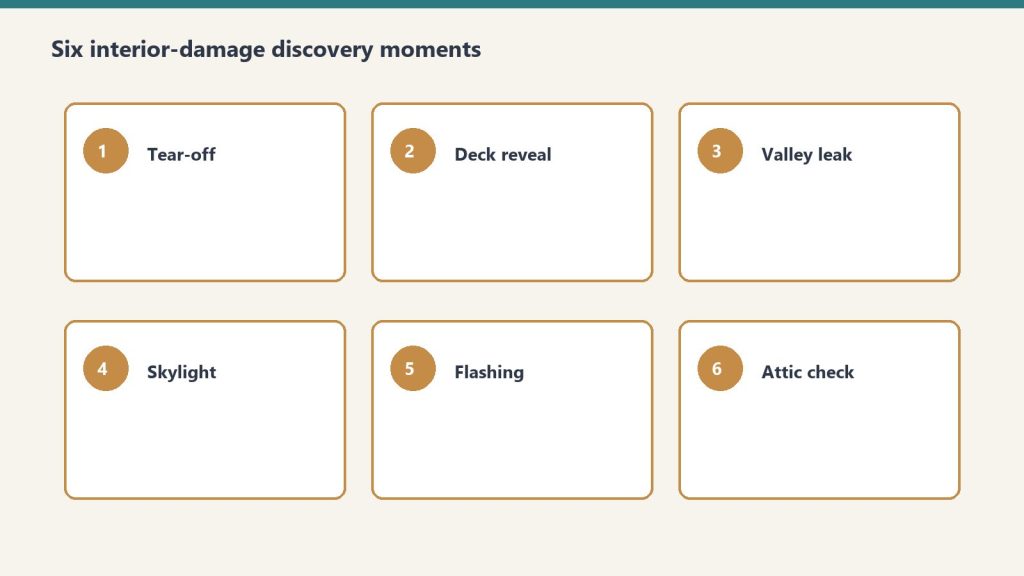
Moment 1: The active leak call. Homeowner calls the roofer because water is actively dripping through the ceiling during a storm. Roofer tarps the roof same-day, inspects, and books the repair or replacement. The interior is already wet — stained drywall, wet insulation, possibly pooled water in a ceiling cavity. This is a same-day mitigation call. Minutes matter.
Moment 2: The post-storm inspection. After a hail or wind event, the roofer is on the roof assessing damage. From the attic access during the inspection, they see wet insulation, water-stained sheathing, and visible mold colonies from prior unrepaired leaks. The homeowner didn’t know.
Moment 3: The replacement tear-off. During a replacement, crews pull the old shingles and underlayment. They find rotted decking, failed flashing, stained sheathing, and evidence of sustained leak activity that never reached a visible interior ceiling stain. Parts of the interior need mitigation even though the homeowner never saw water damage.
Moment 4: The attic walk during a maintenance inspection. Commercial or high-end residential roofer doing a scheduled inspection walks the attic and finds compromised flashing, daylight around a penetration, wet insulation, or mold growth. Exterior fix is on the estimate. Interior mitigation is a separate scope.
Moment 5: The commercial roof replacement uncovering legacy damage. Commercial TPO or EPDM replacement finds saturated insulation boards, wet deck substrate, and legacy mold under the old membrane. Commercial mitigation scopes are large and high-dollar — this is where the roofing partnership pays off most.
Moment 6: The failed skylight, chimney, or penetration detail. Chronic leaks at roof penetrations produce long, narrow mold tracks down interior walls, inside chimney chases, or along skylight wells. The roofer fixes the detail; the interior scope often involves demo, drying, containment, and remediation across multiple rooms.
Train your intake, your PMs, and your conversations with roofing partners around these six moments. Each one is a playbook.
Why Most Restoration-to-Roofer Partnerships Fail
1. Slow response on the active leak call. A roofer calling you at 2pm on a Saturday because water is pouring through a ceiling needs you there in two hours with a tarp, containment, and dry-out equipment. If you can’t get there same-day, the homeowner’s perception of both companies is already damaged before you arrive.
2. Confusing scope lanes on the insurance claim. A storm-damage claim with a roof scope and an interior scope requires careful coordination. If your interior scope is priced or documented in a way that creates supplement fights with the carrier over what’s roof versus what’s interior, the roofer’s claim gets dragged into your documentation problems. You lose the relationship.
3. Accepting AOB from the roofer instead of contracting directly with the homeowner. This is an ethics and compliance mistake. Your contract is with the homeowner or with the carrier under standard restoration authorization. The roofer’s AOB covers their scope. If you let the roofer bundle your work into their AOB, you’re ceding control of your billing, your scope, and your liability. Don’t.
4. No commercial mitigation capability when the roofer’s book is commercial. Many quality roofers have a substantial commercial book. If you can’t produce commercial-scale mitigation — large dehumidifiers, HEPA air scrubbers at scale, commercial contents handling, document reconstruction capability — you become the residential-only partner and miss the high-dollar work.
5. Bad communication during the overlap window. On a full roof replacement with interior mitigation, your work and the roofer’s work overlap. If the roofer tears off the roof on Tuesday and you’re supposed to dry the attic starting Wednesday but don’t show, the entire schedule collapses. Tight coordination with the roofer’s production manager is non-negotiable.
6. Sending storm-chaser-style pitches to local roofers. A long-tenured local roofer with manufacturer certifications does not want a partnership with a restoration company that looks like an aggressive storm chaser in any way. Your sales posture should look like theirs: professional, documentation-focused, warranty-minded, and reputation-protective.
Ten Operational Disciplines for a Roofer Referral Channel That Works
1. Same-day response on active-leak calls. Standard operating policy. Any time a roofing partner calls with “water’s coming in,” you have a tech and containment equipment on site within four hours in business daylight, six hours after dark.
2. Tarp, containment, and interior dry-out as a standard scope. Flat-rate pricing for standard active-leak mitigation: tarping assistance if needed, interior containment, water extraction, affected-material demo, drying equipment setup, moisture mapping. Price it so the roofer can quote it to the homeowner alongside their roof work without negotiation.
3. Commercial mitigation capability advertised explicitly. If you have commercial-scale equipment and can respond to $10,000–$150,000 mitigation scopes on commercial roofs, put it on the one-pager you hand the roofer’s commercial sales team.
4. Dedicated intake line that knows roof terminology. “Decking,” “underlayment,” “flashing,” “ice-and-water shield,” “ridge cap,” “penetration boot,” “step flashing,” “valley,” “drip edge” — your intake should be able to triage the call without a vocabulary lesson.
5. Xactimate-standard interior documentation. For insurance-funded interior mitigation, your scope language and line items have to align with the roofer’s carrier-facing documentation.
6. Photo documentation coordinated with the roofer’s production. Use CompanyCam or equivalent with the roofer’s project folder shared where possible. Before/during/after on both sides in a single shared album means the claim file reads cleanly to the adjuster.
7. Strict separation of billing and contracts. Your contract is with the homeowner or carrier. You do not bill through the roofer. You do not accept AOB that bundles your work into their claim.
8. Commercial maintenance-contract awareness. Know which of your roofing partners have active commercial maintenance contracts and on which buildings. When a leak happens on a maintained building, both trades mobilize together — and your name is already in the customer’s file from prior coordination.
9. Joint post-loss follow-up at 72 hours. Call the homeowner together (roofer and restoration PM) 72 hours after the initial event to confirm the roof fix is holding and the interior dry-down is progressing. Customers talk about this experience for years.
10. Quarterly business review with the roofer’s production manager. Recurring 60-minute meeting. Review jobs completed, response time, customer satisfaction, outstanding documentation, and reciprocity. Adjust.
The Two-Way Reciprocity Model for Roofers
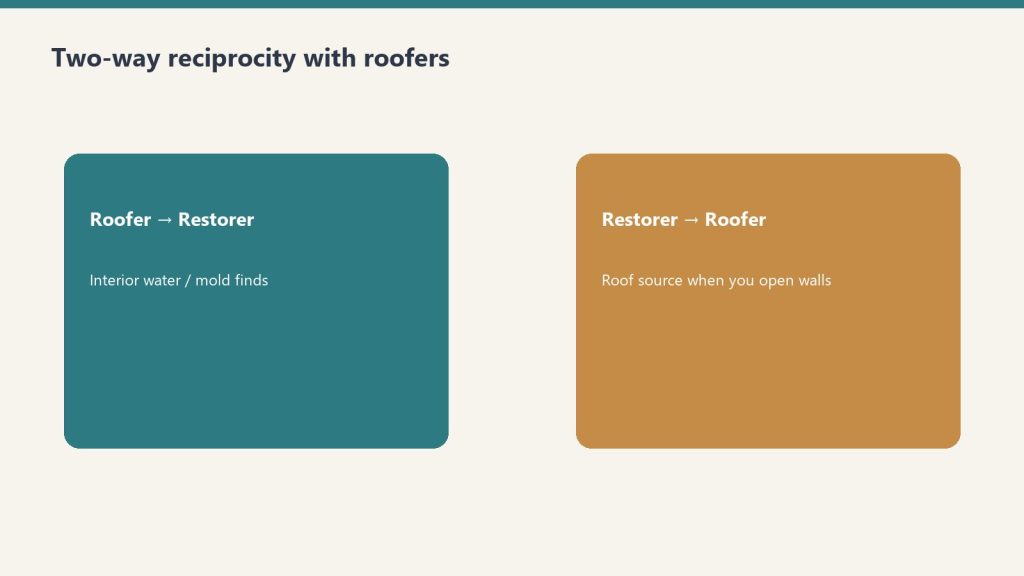
Flow 1: Roofer → restoration. Roofer calls on an active leak, post-storm inspection, replacement tear-off discovery, or commercial maintenance finding. You respond within the committed window, execute the interior mitigation scope, document cleanly, close with clearance. The roof work and interior work finish on compatible timelines.
Flow 2: Restoration → roofer. On any mitigation scope you handle where the source was roof-related and the customer needs roof work after your mitigation closes, you name the roofing partner as the default recommendation. Warm introduction, contact info handoff, and written introduction email. You do not accept compensation for the referral — the reciprocity is the referral.
Flow 3: Commercial account introductions. If your roofing partner has commercial maintenance contracts on buildings and you have mitigation capability on those same buildings, propose a joint sales conversation with the facilities director at the next opportunity. Two-trade, single-point-of-contact coverage is a real differentiator to facilities directors.
Flow 4: Storm-season emergency response protocol. Pre-season agreement: when a storm hits your market, both companies deploy on coordinated schedules. Roofer handles roof assessments and tarping; you handle interior mitigation triage. Shared response channel (group text, Slack, or simple email chain). Customer experience is unified even when two trades are on site.
Track referrals both directions. If the reciprocity drifts, fix it before it becomes silence.
The Ninety-Day Roofer Partnership Program
Week 1: Target selection. Identify the four to six local roofing companies in your market with three-plus years of tenure, strong GBP review profiles, manufacturer certifications (GAF Master Elite, Owens Corning Platinum, CertainTeed ShingleMaster, Tamko Pro Certified), and either a meaningful residential replacement book or a commercial maintenance book. Avoid anyone with patterns that look like transient storm-chase operations.
Week 2: Scope-lane agreement drafted. One page. Your work = interior water, moisture, mold, drywall, insulation, attic, ceiling, and related scopes downstream of roof-source damage. Their work = roof replacement, repair, and exterior envelope. No billing crossover, no AOB bundling. Signed by both parties.
Week 3: Rate sheet for active-leak mitigation finalized. Standard tarping-assistance fee, interior containment, extraction, small/medium/large drying scopes, attic insulation removal pricing, ceiling and drywall demo pricing. Published. Email-ready.
Week 4: First meeting with the roofer’s production manager. Not the owner first — the production manager who dispatches. Same reason as with property managers. Bring the scope-lane agreement, the rate sheet, the response-time commitment, the photo-documentation protocol, and sample closeout package.
Week 5: First active-leak call. Execute at standard. Four-hour site visit in business daylight, tarp-and-contain within eight hours, dry-down documentation inside 24, clearance package at the end. Debrief with the production manager inside 72 hours.
Week 6: Commercial sales team meeting. If the roofer runs a commercial book, meet the commercial sales manager. Walk through your commercial mitigation capability. Ask which maintained buildings are in the portfolio and what the emergency response protocol currently looks like.
Week 7: Joint CompanyCam folder setup. Shared project folders for overlapping jobs. Set it up on the next live job.
Week 8: Storm-season protocol drafted. If you’re heading into storm season, draft the coordinated emergency response protocol. Pre-season coordination beats storm-day improvisation every time.
Week 9: Second roofer opened. Repeat the program on a second target. Two to four roofing partners is the sustainable max per market.
Week 10: Quarterly business review cadence set. Calendared for the next twelve months.
Week 11: Co-branded homeowner education piece. “What to do when water comes through your ceiling” — short one-pager, both logos, both numbers. Lives on both websites, in the roofer’s leave-behind packet, and on your call-out trucks.
Week 12: Referral ledger first review. Count inbound and outbound. Any imbalance gets addressed in the Q1 QBR.
By day ninety, you should have two active roofing partners, a storm-season protocol ready, and ten to thirty jobs executed on shared scope.
Where to Start This Week
- Build the active-leak rate sheet before calling anyone.
- Draft the scope-lane agreement. Have your attorney review the AOB-refusal language.
- Identify the three or four local roofers with three-plus years of tenure, manufacturer certifications, and strong GBP profiles.
- Decide who on your team owns roofer accounts. Must be comfortable with same-day response and roof terminology.
- Get the storm-season emergency protocol drafted before the next weather event.
- Co-brand the active-leak homeowner one-pager.
- Book the first production-manager meeting.
If you’re stuck on step one, the active-leak rate sheet is the single most valuable artifact in the whole program. No roofer in your market is getting this from any other restoration company.
Where This Article Fits in the Larger Playbook
This is the tenth article in The Restoration Operator’s Playbook partner-industries series. The scope-lane discipline here extends the general contractor partnership. The response-time and rate-sheet mechanics build on the property manager partnership. The documentation standards echo the adjuster relationship strategy. The upstream-trade discovery pattern pairs with plumbers, HVAC, pest control, and carpet cleaners. For the channel that funnels transaction-timed roof leaks into your inbox, see the realtor partnership. For the commercial-channel leverage behind maintained-roof portfolios, revisit the facility services partnership.
Next in the queue: pool and spa service, appliance installers.
Frequently Asked Questions
Should I work with storm-chaser roofing companies? With extreme caution or not at all. Legitimate out-of-state roofers with multi-state operations and real office addresses can be responsible partners during catastrophe years. Transient storm-chase operations without local presence, manufacturer certifications, or tenured review history create reputational risk that outlasts the event. The default posture: build the partnership program with local roofers who have three-plus years of tenure and high manufacturer certifications first, and extend only to out-of-state operators during a deployed event if their credentials, insurance, and references check out completely.
What’s the right way to handle interior billing on an insurance-funded roof replacement? Your contract is with the homeowner and your billing goes through either direct payment or carrier authorization under your own documentation. The roofer’s scope and billing go through their own contract and their own carrier workflow. The two scopes are coordinated in the claim file but invoiced separately. Never accept an AOB from the roofer that bundles your work into their claim. Your insurance, your license, your documentation — your billing.
How do I handle the commercial maintenance-roof channel? Ask your roofing partners for a list of buildings under active maintenance contracts. For each, request an introduction to the facilities director. Offer a joint no-charge “emergency preparedness review” on the building — a thirty-minute walk where the roofer inspects the roof and you inspect the interior for vulnerability. The facilities director gets free due diligence, you both get mental real estate, and when a leak happens the response is coordinated from day one. This is where the high-dollar commercial mitigation work lives.
What response-time standard is realistic on an active-leak call? Four-hour on-site in business daylight. Six hours after dark. Customers dripping water through their ceiling will forgive nothing slower than that. If your operational model can’t support same-day response on leak calls, the roofer channel is not the right primary channel for you — but it might still be a secondary channel with a different commitment level honestly communicated to the roofing partner.
How is this different from the plumber partnership? Plumber partnerships run on plumbing events — burst pipes, water heater failures, overflow. The first-call pattern is very similar to roofers (active emergency, fast response, interior mitigation). The difference: roofers produce far more seasonal volume spikes (storm events, freeze events, hail events) than plumbers, who produce a steadier year-round flow. Roofers also carry more commercial maintenance-book leverage than most plumbers, which creates a higher-dollar commercial mitigation channel. Many restoration companies run both channels with the same PM owning both relationships — the operational stack overlaps substantially.
Can I rely on the roofer referral channel if I’m only residential-capable? Yes, and it will work well — but you cap your upside. The residential-only operator captures every active-leak call and every post-storm interior discovery through their residential roofing partners. To access the commercial maintenance-book channel, you need commercial-scale equipment, commercial contents handling, and commercial-scale response capability. Many restoration companies scale up commercial capability specifically because their commercial-oriented roofing partner gave them visibility into how much volume was unreachable at residential scale.
Get The Signal
What we actually ran, what it measured, and what it means for a restoration shop — every week, including the flops.
Leave a Reply