Restoration pricing is the most misunderstood part of running a restoration company. Owners argue about Xactimate rates, complain about insurance carriers, and chase competitor pricing — while quietly losing money on jobs they think are profitable. The problem isn’t usually the rates. It’s that most restoration companies don’t actually know what their work costs them.
This guide walks through how restoration pricing actually works in 2026: Xactimate fundamentals, when to use time and material versus fixed bids, where margin leaks happen, what healthy profit margins look like, and the financial math that separates the operators who scale from the ones who stay stuck.
The two pricing systems restoration uses
Almost all restoration work is priced one of two ways. Xactimate pricing dominates insurance work — line items at published unit rates, with regional pricing that updates quarterly, plus overhead and profit added on top. Time and material (T&M) is used for non-insurance work, certain commercial losses, and emergency mitigation where scope is unknown — billed by labor hour and materials at marked-up cost.
Most restoration companies use both depending on the job. Residential insurance mitigation and reconstruction is almost always Xactimate. Commercial losses with sophisticated buyers often allow T&M or hybrid pricing. Out-of-pocket residential work (mold remediation that isn’t covered, biohazard cleanup, certain reconstruction) is typically T&M or fixed-bid.
How Xactimate pricing actually works
Xactimate is a software platform owned by Verisk that contains a database of construction line items priced by region. Each line item has a labor component, a material component, and an equipment component. Pricing updates quarterly and is based on regional cost surveys. The pricing the carrier sees and the pricing you see should be identical — Xactimate is “single price database” for both sides.
The actual price of a job is the sum of all line items, plus overhead and profit (O&P), typically 10% and 10% (for 21% combined when multiplied), added on top when the job involves three or more trades or specific complexity criteria carriers recognize. Whether O&P is approved is one of the most contested issues in restoration pricing — many carriers and TPAs push back hard, and operators need to know the documentation to defend it.
Get The Signal
What we actually ran, what it measured, and what it means for a restoration shop — every week, including the flops.
Time and material pricing
T&M pricing bills labor at an hourly rate and materials at a marked-up cost. Healthy restoration T&M rates in 2026 run $75-$110/hour for technicians, $95-$140/hour for lead technicians, and $135-$195/hour for project managers, depending on market and certification level. Material markup typically runs 25-50% over cost. Equipment rental (dehumidifiers, air movers, HEPA filtration) is billed by day at established rates.
The advantage of T&M is no price disputes — you bill what it actually took. The disadvantage is the customer needs to trust your hours, and you need rigorous time tracking. Without disciplined timekeeping, T&M jobs become arguments about “what could it have possibly taken that long for?”
The two big places margin gets lost
Restoration companies don’t lose margin on the rates — they lose it in two specific places. First, missed scope. The job estimate doesn’t capture all the affected materials. The carrier pays the original estimate. The actual work takes longer and uses more material than estimated. Loss.
Second, weak supplements. When additional damage is discovered (almost always the case in restoration), supplements need to be written, documented, and submitted. Companies with weak estimating and slow supplement processes leave 5-15% of revenue on the table on every insurance job. Companies with disciplined supplement processes capture every dollar of legitimate scope.
Healthy profit margin benchmarks
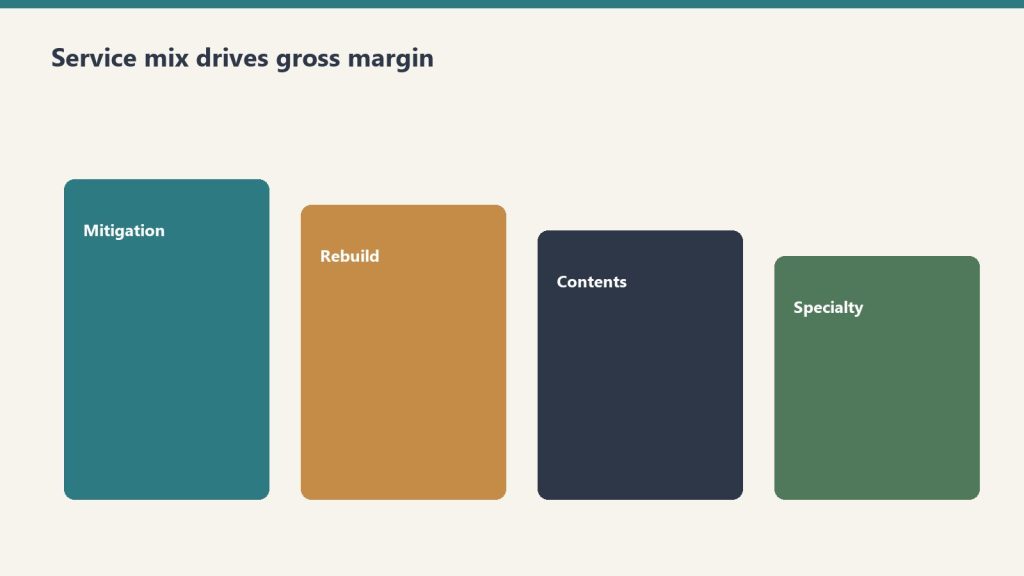
Industry-healthy gross margins by service line: water mitigation 45-60%, reconstruction 25-40%, mold remediation 50-65%, fire and smoke restoration 35-50%, contents cleaning and pack-out 40-55%, commercial large loss highly variable but generally 20-35%. Net margin (after overhead) for a healthy restoration company runs 8-15% of revenue. Companies under 5% net are usually one bad month away from cash crisis. Companies above 18% are either very small, very specialized, or under-investing in growth.
The job costing discipline most restorers skip
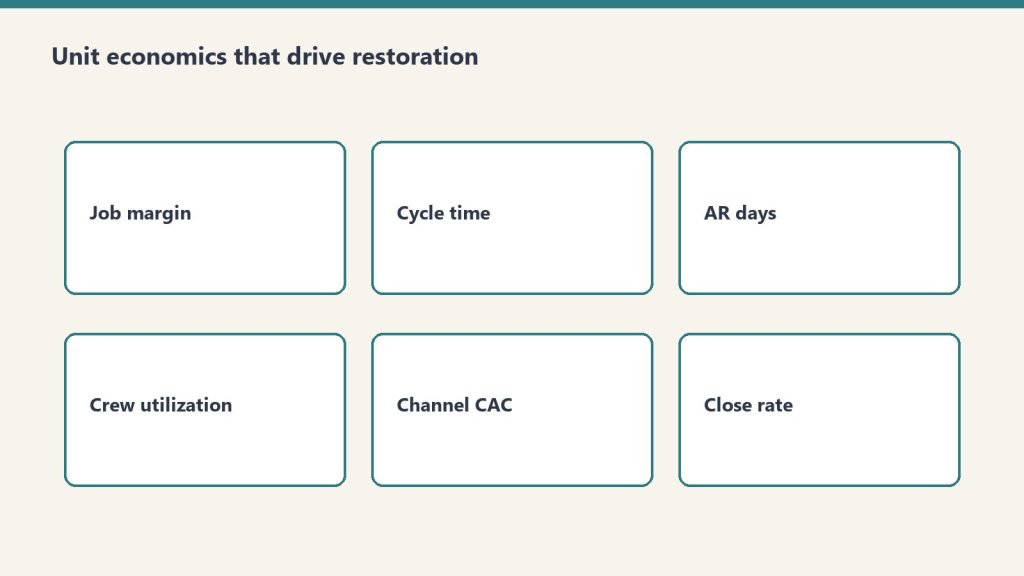
You cannot manage profit margins you can’t measure. Real job costing means tracking, per job: estimated revenue, actual revenue (including supplements), labor hours and dollars actually spent, material costs actually incurred, equipment days and rental cost, subcontractor cost, and overhead allocation. The output is a per-job gross margin number. Pulling this report monthly and identifying jobs that lost money — and why — is how operators improve pricing over time.
Most restoration companies skip this because the data is messy and the spreadsheets are painful. The companies that automate it (with restoration-specific software like Restoration Manager, Xactimate, Encircle, or DASH) have a structural advantage that compounds.
How to handle the “your competitor charges less” objection
This objection appears constantly. The honest answer: most price differences in restoration are scope differences, not rate differences. Xactimate rates are the same across all contractors in a region — your competitor isn’t using a cheaper Xactimate. They’re either writing less scope, missing items that you’d catch, or planning to supplement aggressively later. Walk the customer through the scope comparison line by line. Often the price gap closes or reverses.
Pricing strategy by service line
Water mitigation is almost always Xactimate. The leverage is in writing complete drying chamber configurations, accurate equipment days, and complete demolition scope. Reconstruction is Xactimate with discipline around overhead and profit, change orders, and supplements. Mold remediation can be Xactimate when insurance covers it, T&M or fixed bid when it doesn’t — pricing requires careful scope documentation due to liability. Fire and smoke is Xactimate, with significant supplement opportunity around contents, deodorization, and structural cleaning. Biohazard and trauma cleanup is typically T&M or fixed bid with hazard premiums.
Related on Tygart Media: Starlink on a water job · S500 in the van · local SEO for restoration.
Frequently Asked Questions
How much does water damage restoration cost?
The national average for residential water damage restoration in 2026 ranges from $1,500 for a small Category 1 (clean water) loss to $40,000+ for a large Category 3 (sewage) loss requiring extensive demolition and reconstruction. Most insurance-covered water mitigation jobs fall in the $3,000-$8,000 range. Pricing is calculated using Xactimate line items based on affected square footage, equipment days, demolition scope, and reconstruction needs.
What profit margin should a restoration company make?
Healthy gross margin benchmarks: water mitigation 45-60%, reconstruction 25-40%, mold remediation 50-65%, fire restoration 35-50%, commercial large loss 20-35%. Net margin (after overhead) for a profitable restoration company typically runs 8-15% of revenue. Companies below 5% net margin are at financial risk; companies above 18% are usually small, specialized, or under-investing in growth.
What is overhead and profit in restoration?
Overhead and profit (O&P) is typically a 10% + 10% addition on top of the line-item subtotal in Xactimate, applied when a job involves three or more trades or meets carrier complexity criteria. The 10% overhead covers indirect costs like supervision, office, and equipment depreciation; the 10% profit is the contractor’s profit margin. Whether O&P is approved is frequently disputed by carriers and TPAs, and proper documentation is required to defend it.
Should restoration jobs be priced T&M or Xactimate?
Insurance work is almost always Xactimate because that’s what carriers will adjust to. Out-of-pocket residential work, certain commercial losses, and unscoped emergency mitigation are often better priced as time and material. The dividing line is typically whether a third-party payer (insurance carrier or TPA) is involved.
What is the labor rate for restoration technicians?
Healthy 2026 T&M billing rates: technicians $75-$110/hour, lead technicians $95-$140/hour, project managers $135-$195/hour. These vary by region and certification level. Insurance work uses Xactimate’s regional labor rates rather than billed hourly rates, with the labor component embedded in each line item.
How do restoration companies make more money on jobs?
The two highest-leverage activities are complete initial scoping (capturing every affected material in the original estimate) and disciplined supplementing (writing and submitting supplements promptly when additional damage is discovered). Companies with rigorous estimating and supplement processes capture 5-15% more revenue per insurance job than companies that don’t.
Get The Signal
What we actually ran, what it measured, and what it means for a restoration shop — every week, including the flops.
Leave a Reply