We Asked AI Who to Call for Water Damage in Puyallup. Here's What It Said.
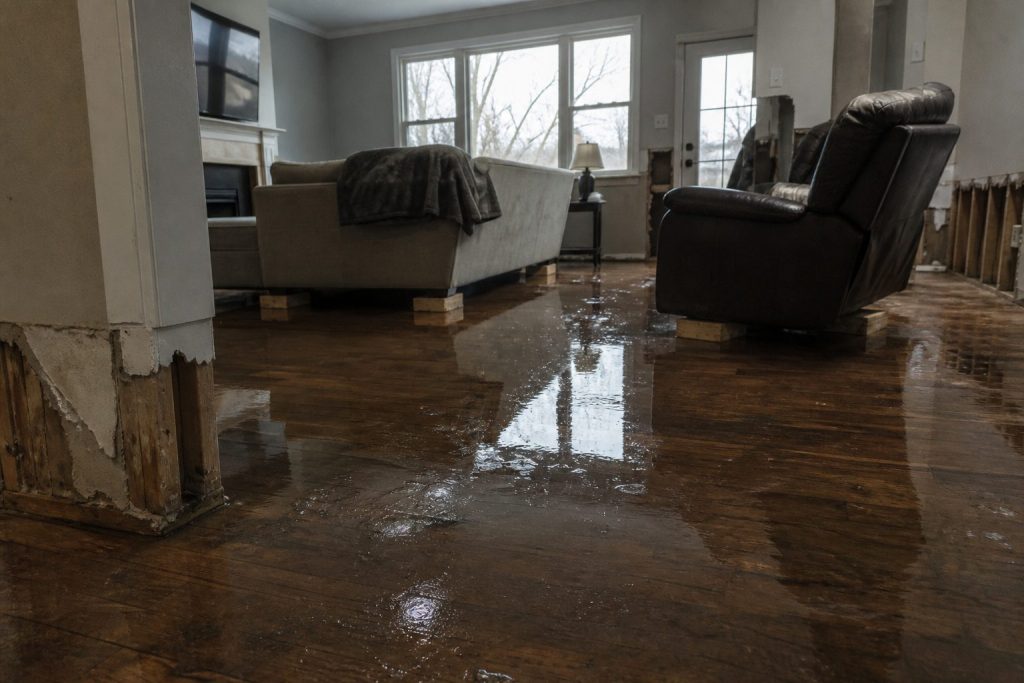
It's 2 a.m. You're standing in water in your basement on South Hill, and it's still raining — because of course it is, it's October in the valley. You grab your phone. You don't Google like it's 2015. You ask.
"Who do I call for a flooded basement in Puyallup?"
That's the moment that matters. Not your website. Not your trucks. That question, asked to a machine, at 2 a.m., by a neighbor with water coming in. On a Tuesday night in October, we asked the machine that question — and three more like it — from Puyallup, and wrote down exactly what it said. Here's what came back.
How we ran it
Four questions, one at a time, in a fresh incognito session of Google's AI Mode, location set explicitly to Puyallup, Washington: "Who do I call for a flooded basement in Puyallup, Washington?", "Best water damage restoration company in Puyallup WA", "Emergency water extraction Puyallup Washington", "Mold remediation company Puyallup WA". Tuesday, October 6, 2026, around 11 p.m. Pacific.
That timestamp matters, and it's the first thing to understand: AI answers are situational. They shift with the time of day, the day of the week, the exact location, who's asking, and whether a business is currently open. A Tuesday-at-11-p.m. answer is a snapshot, not a permanent ranking. What follows is what the machine said that night — and more importantly, how it decides, because we asked it that too.
Finding 1: The shortlist reshuffles every query. Only the franchise is permanent.
This is the headline, and it surprised us. Four questions, four different winners' circles:
"Who do I call for a flooded basement?" → Five names: the franchise, plus four others. The franchise gets the direct "call immediately" recommendation, phone number included.
"Emergency water extraction" → Three names: the franchise, a Puyallup independent, and a regional franchise brand.
"Best water damage restoration company" → Three names — and the franchise isn't among them. Two local independents and a Tacoma shop sweep it.
"Mold remediation" → Four names: the franchise, the Puyallup independent, the regional brand, and a fourth shop.
One company appears in every answer. Everyone else is renting their spot one question at a time.
Let's name the pattern without naming names. Company A is the franchise — the only brand with real gravity in the valley, and it's corporate gravity, not local. Four-point-six stars, hundreds of reviews, IICRC-certified, open 24/7. The machines hand it the emergency answer with the phone number.
Companies B, C, and D are independents — a Puyallup shop with around a hundred reviews, a Buckley-area outfit at 4.9 stars, a family-owned Tacoma company at 4.9 across 240 reviews with a named master restorer. Good operators, by every visible signal. They win the "best" query outright. They vanish from the emergency query. The machine's memory of them lasts exactly one question.
Finding 2: There are two games, and the money is in the harder one
Watch what the machine rewards in each query and the split becomes obvious.
The emergency queries are an operational game: open now, dispatch speed, 2 a.m. availability. The "best" query — asked at 11 p.m. on a Tuesday — even praised one shop for "exceptional late-night/weekend emergency dispatch." The machine is weighting for right now. Content can't win that game. Only being actually open and actually fast can. That's why the franchise owns it.
The comparison queries are a quotability game: reviews with substance, named certifications, family-owned story, transparent pricing, a master restorer with a name. The independents sweep this game. A Tacoma independent with 240 reviews and insurance-direct language stands shoulder to shoulder with the national brand — in the answer the homeowner reads when they're choosing, not panicking.
Here's the uncomfortable arithmetic: the independents win "best" and lose "right now." And "right now" — the 2 a.m. basement — is where the money is. The most winnable query and the most valuable query are different queries.
Finding 3: Part of what looks like the answer is an ad
In the AI Mode results, business cards with Call/Directions/Website buttons sit inside the answer — the Local Services Ads format, blended into the AI's response. At 11 p.m., most homeowners can't tell the ad layer from the earned layer.
So there are really two contests running inside every answer: the paid layer (whoever's buying the call button) and the earned layer (who the AI's prose actually names and cites). Money can buy the first. It can't buy the second — which is exactly why the second is worth winning.
Finding 4: Named is not the same as quoted
Here's the detail that reframes everything. In these answers, the AI names three to five shops — but it cites a different, longer list of websites for the sentences the answer is built from: equipment pages, service-area pages, process explanations from restoration companies across the region.
Named and quoted are two different games. You can be named without being quoted (the franchise, mostly), and you can be quoted without being named. But notice who's missing from both lists: nobody publishing from Puyallup proper is feeding the machine its sentences. The valley's expertise exists — every estimator in Pierce County knows what to do when a South Hill basement floods in October — but none of it is written down where the machine can find it. The trade's knowledge is trapped in trucks.
Finding 5: We asked the machine how it picks. It told us.
After the four queries, we kept the conversation going and asked the AI, plainly, how it chooses which companies to recommend. It gave us its rubric:
Technical certifications — IICRC S520 / AMRT on the actual crew (not just the owner), active Washington contractor license, pollution and hazardous-material coverage.
Equipment and containment protocols — negative air pressure, HEPA scrubbers, thermal imaging, moisture meters. "Spray and wipe" outfits are disqualified outright.
Local reputation with substance — consistent ratings across Google, Yelp, and BBB, with reviews that mention communication, transparent pricing, and punctuality specifically.
Insurance infrastructure — Xactimate estimating, direct adjuster coordination.
Ethical boundaries — third-party clearance testing, not grading their own homework. The machine has opinions about conflicts of interest.
Read that list again. Every item on it is publishable. A shop can put all five on its website on a Tuesday afternoon, with no trucks rolling, and become verifiable by the machine's own stated criteria.
And where does the machine verify? It told us that too: your service pages ("direct company service pages outline specific equipment used, containment methodologies"), the IICRC registry, Washington's licensing databases, and your reviews. If your website doesn't publish the signals, the AI can't confirm them, and you don't get named. That's not a metaphor. It's the literal mechanism.
AI answers don't rank you. They quote you.
The mold wedge
One more thing the evening taught us, and it's the strategic takeaway: mold is the gateway query.
Mold remediation isn't an emergency — it's schedulable. The homeowner isn't panicking at 2 a.m.; they're reading, comparing, choosing. That's the quotability game, the one content can win from a keyboard. Everything the machine scores on mold — AMRT certification, HEPA and negative air on the process page, third-party testing on the FAQ — is publishable by any competent shop this week.
And the homeowner who learns your name from the mold answer doesn't unlearn it. Six months later the basement floods at midnight, and they don't ask the machine again — they call the name they already trust. Mold is the KNOW that feeds the 2 a.m. BUY. Win the schedulable query with content, and you inherit the emergency call for free.
The funnel, Puyallup edition
KNOW — "What do I do about water in my basement?" The machine explains: shut the water off, kill the breakers safely, document everything for insurance. The advice is solid. Nobody local is cited for it, because nobody local published it.
PROVE — "Are these companies legit?" The machine checks its rubric: certifications, equipment, Xactimate, third-party testing, reviews with substance. The shops that publish these signals get verified. The shops that don't are unverifiable — which reads the same as invisible.
CHOOSE — "Who's the best?" The shortlist moment, and the independents' best event. Reviews, story, credentials — this is where Company B, C, and D win. The franchise doesn't even make this particular shortlist.
BUY — "Who do I call right now?" The 2 a.m. call. Operational game. It goes to whoever's verifiably open and fast — tonight, that's the franchise, with the phone number in the answer.
GO — "Are they actually here?" The stage the machines are weakest at and humans are strongest. A homeowner who can drive past your shop on Meridian, who's seen your trucks at the fairgrounds in September — that trust doesn't come from a citation. But you have to survive the first four stages to get the meeting. Nobody meets the unverifiable.
What separates the named from the invisible
It's not budget. It's not the franchise's national marketing team. It's whether the machine's rubric appears on your website:
The certifications, named precisely. Not "certified technicians" — "IICRC AMRT-certified crew," "S520 standard," "WA contractor license," "pollution liability coverage." The machine checks registries. Give it the exact strings to check.
The equipment, specified. Negative air pressure, HEPA scrubbers, thermal imaging cameras, moisture meters, Xactimate estimating. These are the words the machine's rubric is written in. If your process page doesn't contain them, you fail a test you didn't know you were taking.
The ethics, stated. Third-party clearance testing. Direct insurance coordination. The machine explicitly rewards shops that don't grade their own homework — publish that you don't.
Reviews with substance. Not fifty "great service!!" reviews — ten that mention response time, communication, and a real job. "They were here in 40 minutes during the November storm" is a sentence the machine can use.
Local proof in the copy. Name the valley. Name the season. The machine itself now uses local texture — "the Puyallup River valley," landmarks from Bradley Lake Park to Pioneer Park. "We handle the October basement floods on South Hill" is uncopiable: a national competitor can't fake it, and it's the one advantage every local company has.
Company A wins by default. The first independent that publishes the machine's own rubric doesn't compete with Company A — it becomes verifiable, quotable, and eventually the default.
The deeper standard
There's a caveat that matters more than any tactic. AI answers are situational — time, day, place, asker, who's open. The variables multiply past anything gameable. No checklist survives contact with a machine that re-shuffles its shortlist every question.
So the only durable strategy is operational truth: get your operations to the point where you can advertise them without being attacked. Claims so true nobody can dispute them — because the machines quote what's quotable, and the customers verify what's real. The checklist gets you into the answer. The work keeps you there.
This is the free version of our AI Citation Quick-Scan. We ask the questions your customers are asking the machines, and we map exactly who gets named, who's invisible, and what separates them — for your company, your market, your queries. It's $97, and if you upgrade to the full visibility package within 30 days, the $97 comes off the price. If you're a restoration company in Pierce County and you just read this wondering whether you're Company B, C, or D — that's exactly what the scan answers.
Inspired by a September 13 carousel from Matteo Barletta’s local-SEO account @gmbcrush, walking foundation repair contractors through Google Business Profile optimization. The playbook ports straight to restoration. Here is the translation.
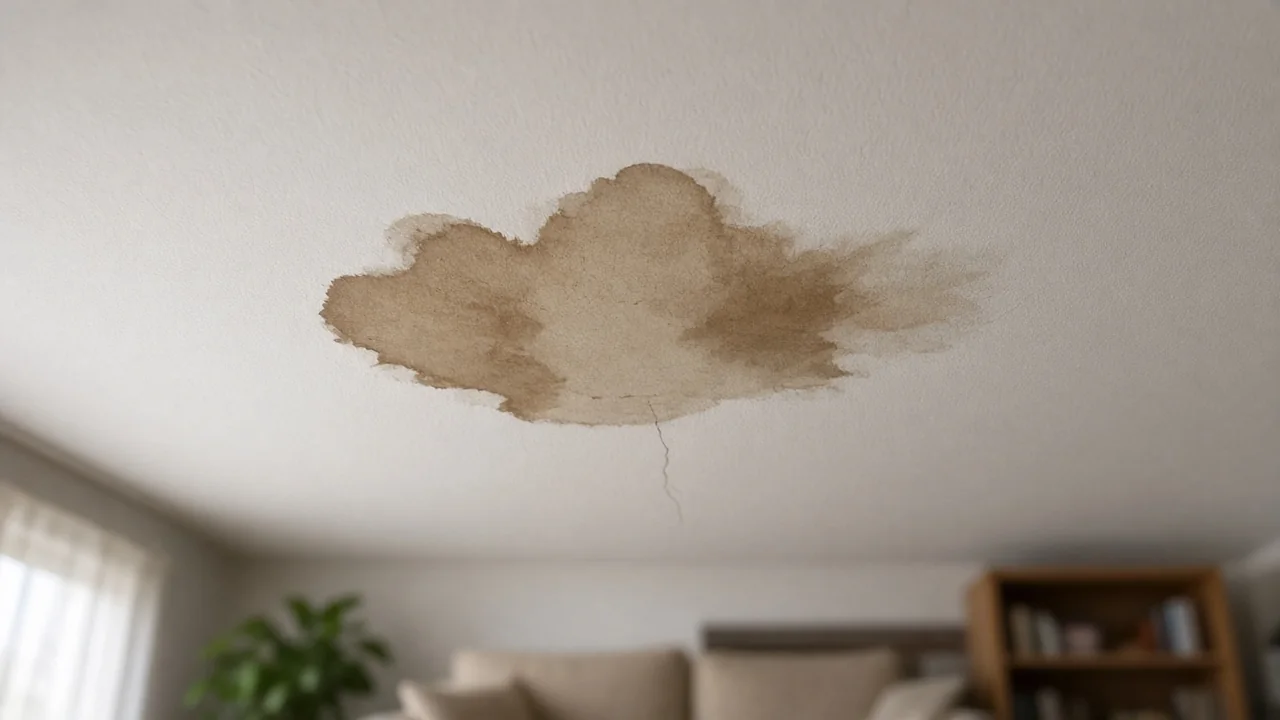
Your customer’s ceiling has a brown stain shaped like Texas. They don’t search “structural drying.” They search “brown stain on ceiling” or “ceiling stain from leak.”
That gap, between what homeowners type and what contractors write on their Google Business Profile, is the whole game. Barletta’s insight for foundation repair was symptom language: homeowners search for doors that won’t latch and cracks in brick, while most profiles answer in “piering” and “underpinning” that nobody types. Restoration has the same disease, and ours might be worse.
The restoration symptom dictionary
Every estimate you’ve ever written started with what the homeowner noticed, not what you did about it. That’s your keyword list. It’s already in your head:
They search
You want to write
Write this instead
musty smell in basement
microbial remediation
musty basement smell, where it comes from and what fixes it
brown stain on ceiling
structural drying
ceiling water stain repair
floor feels spongy
psychrometric drying chamber
warped or buckling floor from water damage
black spots on wall
HEPA-filtered containment
black spots on drywall after a leak
house smells after rain
building envelope failure
musty house smell when it rains
They search "floor feels spongy." The profile should say warped floor from water damage.
Nobody has ever typed “psychrometry” into Google looking for help. Your GBP should read like the conversation at the kitchen table, not the invoice.
Where symptom language lives on your profile
Business description. Lead with the problems you solve, in the words customers use. “We find where the water’s coming from, dry it out, and put it back together” beats a list of certifications. Certifications still belong on the profile. They just don’t belong in the first sentence.
Services. Google gives you service entries with descriptions. Most contractors list “Water Damage Restoration” with an empty description. That’s a wasted ranking asset. Each service description is a place to put two or three symptom phrases: “Ceiling stains, warped flooring, and musty smells after leaks or flooding. We locate the source, dry the structure, and restore the room.”
Posts. Barletta’s other sharp point: post against moisture cycles, not calendar dates. Restoration demand follows water, not months. When the spring rains start, post about basement seepage. When freeze season hits, post about burst pipes. A post titled “What that brown ceiling stain is telling you” published the week after a storm will outperform a generic “Call us for water damage!” post every time.
Q&A. Seed your own Q&A with the questions customers actually ask on the phone: “Do you handle the insurance claim?” “How long does drying take?” “Will I have to leave the house?” Every one of those is a search query wearing a question mark.
Review responses. When you reply to reviews, echo the symptom: “Glad we got that musty basement dried out for you.” You’re writing ad copy that ranks, disguised as good manners.
Pick your primary category by revenue
Barletta’s rule, and it’s the one most contractors get wrong: your primary category should be the thing that makes you the most money, not the thing you do the most of. If water mitigation pays the bills, “Water damage restoration service” is your primary category even if you also do mold, fire, and carpet cleaning. The primary category carries the most ranking weight. Spend it on revenue.
The operator's edge
Here’s why this playbook favors actual contractors over marketers: you already know the symptoms. You’ve stood in a thousand living rooms and heard a thousand versions of “there’s this smell.” No keyword tool knows what your customers say at the kitchen table. You do. Write it down the way they said it, put it on the profile, and you’ve done the thing most agencies charge for.
This is a living playbook. As we audit client profiles and learn what moves, the internal version grows. The GBP Audit Kit scores every listing against the same 40-point standard we hold our own clients to.
“The best marketing a contractor can do is a lesson.”
It’s 11pm. There’s water where it shouldn’t be, and a homeowner is searching “is this mold dangerous” with one thumb while the other holds a flashlight. Whoever taught that lesson — in plain words, on a page that reads like a human wrote it — is getting the call in the morning.
Not the contractor with the biggest ad budget. The one who taught.
The 11pm search
Every job starts as a question. Not “who should I hire” — that’s the last question. The first ones are fear questions: is this dangerous, is this urgent, did I cause this, what happens if I wait until Monday.
The contractor who answers those questions in public owns the beginning of the job. By the time the homeowner is comparing bids, the teacher is already the trusted one — the others are strangers with prices. Trust compounds faster than discounts ever will.
Teaching doesn’t give away the trade
The objection is always the same: “if I teach them, they’ll do it themselves.”
They won’t. Nobody reads a post about flood cuts and then goes and does their own mitigation. What the lesson actually does is the opposite — it shows how much there is to know. The homeowner reads three paragraphs about moisture mapping and thinks “I had no idea it was this involved,” and that thought is worth more than any ad. The lesson doesn’t create DIYers. It creates respect for the trade, and respect books jobs.
You can’t give away what takes ten thousand hours to learn. You can only prove you learned it.
The job site is the classroom
Here’s the part nobody believes until they try it: every single job has three lessons in it.
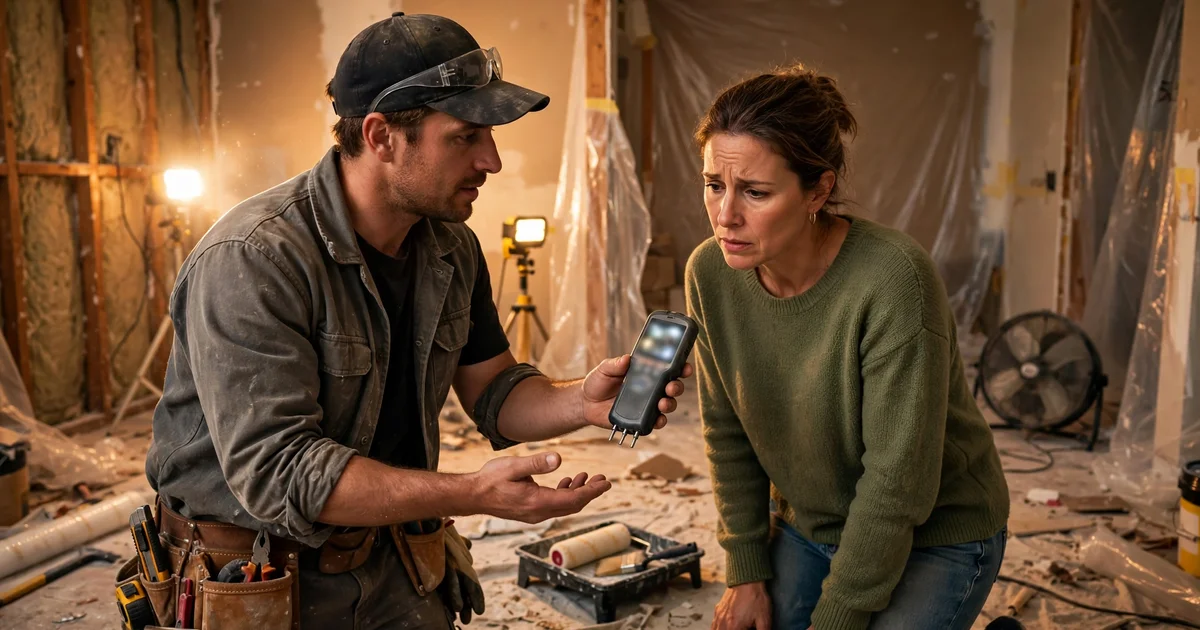
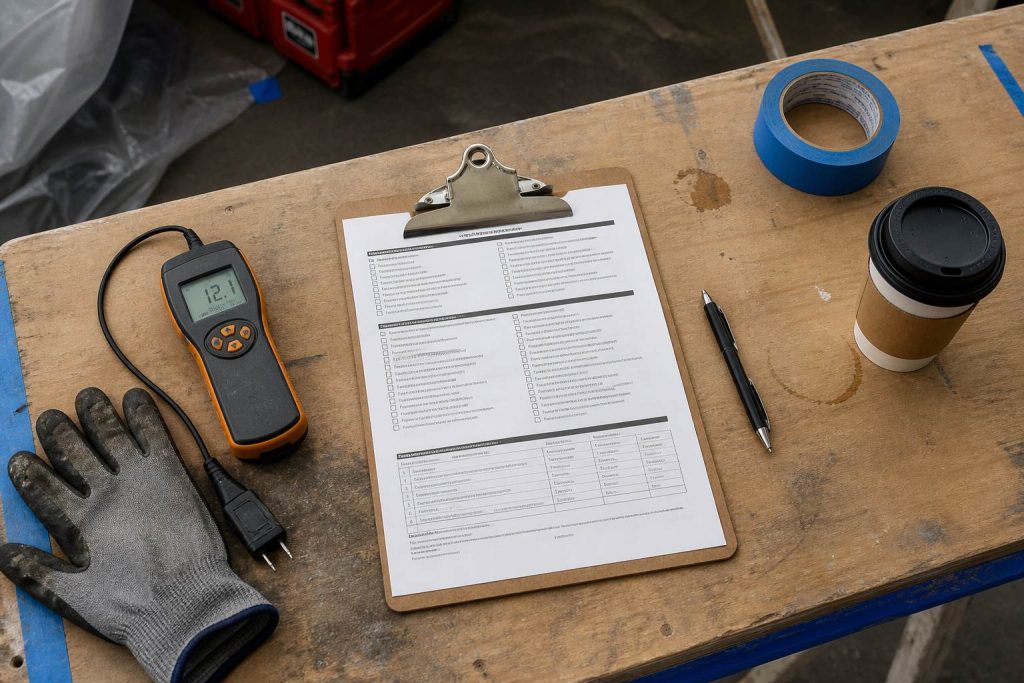
The moisture meter photo — what the number means and why the wall that looks dry isn’t. The flood cut — why it stops exactly there, and what happens when it doesn’t. The thing the homeowner did that made it worse — the fan pointed at the wrong wall, the bleach on the porous surface, the week of waiting. Each one is a lesson someone is searching for tonight.
You don’t need a content calendar. You need a habit: finish the job, teach one thing. The classroom is wherever the work happened.
The cadence
One job, one lesson. That’s the whole system.
Not three posts a week — that’s a marketing department, and you don’t have one. One lesson per job, written the way you’d explain it leaning on the tailgate. A photo from the site, a few plain paragraphs, the thing you wish every homeowner knew before they called. Fifteen minutes, while the job is still fresh enough to teach honestly.
Miss a week and nothing breaks. The lessons don’t expire — a flood cut works the same in 2029. The only cadence that matters is: never let a good lesson die in the truck.
The compound
Lessons stack. That’s the whole game.
Ten lessons is a resource. Fifty is a library. A hundred is the site homeowners find at 11pm, the one the search engines cite, the one the AI answers quote when someone asks what’s happening inside their wall. Teachers get cited. Teachers get called. Teachers get trusted before the bid ever goes out.
And every lesson is a neuron in the knowledge base — yours first. The contractor who teaches for a year doesn’t just have better marketing. He has a better-organized head: the trade, distilled, searchable, in his own words.
The close
Teach what you know. Sell what you do.
The lesson is the marketing; the job is the product. Every job site is a classroom, every fearful 11pm search is a student, and the contractor who teaches is the one who gets the call in the morning.
Your website used to be the front door. A homeowner with a problem found you, walked in, looked around.
Now the front door is an answer. And the answer lives somewhere else.
What changed
Picture the homeowner with water on the kitchen floor. Five years ago she Googled “water damage restoration Tacoma,” opened six tabs, and compared websites. Your homepage mattered. Your design mattered. Your “welcome to our family-owned business” paragraph mattered.
Today she asks her phone who to call. She gets one name — maybe two — spoken back with confidence, plus a number. She calls. She never sees your homepage. She never sees anyone’s homepage.
The website didn’t die. It got demoted. It’s not the destination anymore; it’s the reference library the answer reads before it speaks.
The library, not the lobby
That’s not bad news. Libraries get cited. Lobbies get walked through.
But it changes what the building is for. A lobby is designed to impress visitors. A library is designed to be read by something that isn’t you — quickly, accurately, and with enough trust to repeat what it found.
Every page on your site is now a candidate for exactly one job: being the page an AI pulls when somebody asks the question that page answers. If a page can’t do that job, it’s not underperforming — it’s unemployed.
What the answer reads
The pages that get cited aren’t the prettiest. They’re the most answerable. After watching this for a year, the pattern is consistent:
One question, one answer. The page that wins “who do I call for a flooded kitchen in Tacoma” is the page that answers exactly that — not the page that also covers mold, fire, and the company’s founding story.
Proof you can’t fake. Real job photos. Real street names. Real before-and-afters from real houses in the towns you serve. An AI cross-checks everything against the rest of the web; verifiable detail is the whole game.
The same story everywhere. Business name, service area, phone number — identical on your site, your Google profile, and every directory that matters. Trust is a pattern. Patterns need repetition.
Notice the theme: nothing here is about design. The answer doesn’t care what your homepage looks like. It cares whether it can trust your emergency page at 2 AM when a pipe bursts.
Your Monday-morning playbook
Five moves. No agency required for the first four.
Own your Google Business Profile like it’s your storefront — because it is. Correct hours, correct service area, real photos of real work, reviews answered. The answer checks here first.
One money page per service, per city. Not one “services” page with a dropdown. “Kitchen flood cleanup in Tacoma” gets its own page. “Mold remediation in Puyallup” gets its own page. Each one answers one question completely.
Put the phone question on the page. Write the question your customer actually asks — “who do I call when my water heater floods the garage” — and answer it in the first paragraph. Plain words. Their words, not industry words.
Real proof on every page. A photo from a job in that city. The street, the outcome, what it took. Stock photos are invisible to trust.
Say the same thing everywhere. Pick one business name, one service-area list, one phone number. Put them identically on every surface you control. Boring. Essential.
Do those five and you’ve done more for your AI visibility than a redesign, a blog schedule, and a keyword report combined.
What not to do
Don’t chase traffic. Traffic was the metric of the lobby era — how many people walked in. The library era has a different metric: how often you’re cited as the answer. A page with forty visitors a month that gets cited weekly is worth more than a page with four thousand visitors nobody quotes.
Don’t blog for Google. The weekly “5 Tips for Preventing Water Damage” post was written for an algorithm that ranked pages. The new reader doesn’t rank — it answers. One true answer beats fifty tips.
Don’t redesign for visitors who aren’t coming. If your homepage gets a tenth of the eyeballs it used to, that’s not a design problem. That’s the era. Spend the redesign money on proof: more job photos, more real answers, more pages that each do one job.
The judgment call you can’t outsource
Here’s the part no tool does for you: deciding which questions are yours to win.
“Water damage restoration” is everyone’s question. “Who do I call when the crawlspace floods in Fircrest” might be yours — if you’re the company with three Fircrest crawlspace jobs photographed, documented, and answered in plain English. The riches are in the specific. The specific is a decision, not a tactic.
Ask yourself: what are the ten questions your best customers asked right before they hired you? Those are your ten pages. Everything else is optional.
The close
The homepage isn’t dead. It’s just not the front door anymore.
The front door is the moment somebody asks — out loud, to a machine, water on the floor — and your name comes out of its mouth. Every page you publish, every photo you post, every review you answer is either earning you that moment or it isn’t.
Secure checkout via Square — all major cards accepted
You can copy this library and do it yourself. The full article is already live. Paste a prompt into claude.ai, fill the brackets, edit the draft, send it. Buy Now is the packaged Claude Skill so the library lives in the project instead of a browser tab.
Who it is for: anyone at the company who writes emails. Owner, office manager, whoever runs the CRM touch calendar. No technical background. A free Claude account at claude.ai is enough. No API key. No code.
The workflow
CRM prompt workflow: paste facts → draft → human send.
Go to claude.ai. Create a free account if you need one.
Open a new conversation.
Paste a prompt. Fill the bracketed fields with real information.
Claude drafts the email.
Review it. Edit anything that does not sound like you. Copy it into your email platform.
That is the entire workflow. Specific beats generic. “Write a hiring email for a restoration company” is weak. “Write a hiring email for a 12-person water and fire restoration company in Tacoma, WA that’s been in business for eight years and is known for fast response times and honest communication with insurance adjusters” is usable.
Strategy lives in Your CRM Is Not a Lead Database. Timing lives in The 12-Month Outreach Calendar. This library is the words.
Prompt 1: Hiring email, homeowner version
I run [company name], a [type] restoration company in [city, state]. We’ve been in business [X] years and are known for [one or two specific things your company does well]. We currently have [number] employees and serve the [geographic area] area.

I need to write a short, plain-text email to past homeowner clients who we’ve done [water damage / fire damage / mold / storm] work for. We’re currently hiring for [job title]. The goal of the email is to ask if they know anyone — family, friends, people in the trades — who might be a great fit for a company like ours. We want to reach out to trusted contacts before posting the job publicly.

Tone: Personal and warm, like a note from a real person. Not corporate, not salesy. The recipient should feel like we remembered them and value their opinion specifically.

Requirements: Under 150 words. Plain text (no HTML). Sign it from [owner first name] at [company name]. Include a phone number as the only contact info. No subject line needed — just the body.
Prompt 2: Hiring email, insurance adjuster version
Hiring email for adjusters — clear, dated, professional.
I run [company name], a restoration company in [city, state]. I need to write a short email to insurance adjusters I’ve worked with on claims. We’re hiring a [job title].

The tone should be collegial — peer to peer, professional but not formal. We want to reach out to trusted colleagues before posting publicly, and we’d appreciate any recommendations they might have. Keep it under 120 words. Plain text. From [owner name]. Include phone number.

Do not use any of these phrases: “I hope this email finds you well,” “I wanted to reach out,” “touch base,” “circle back,” or “leverage.” Write it how a real contractor would talk to an adjuster they’ve worked with for years.
Prompt 3: Vendor ask (specialty sub search)
Write a short email from a restoration company owner to their contact database asking if anyone knows a reliable [trade type — e.g., drywall sub, flooring contractor, HVAC tech] in [city/region]. We have a larger project coming up and want to find a quality sub through our network before going the cold-search route.

Context about our company: [2–3 sentences about your company — size, how long you’ve been in business, your service area]. The recipients are a mix of past homeowner clients, insurance industry contacts, and trade partners.

Tone: Casual and direct. Like asking a trusted colleague. Under 100 words. Plain text. From [owner name]. Phone number only.

Optional addition: Add one sentence at the end that invites the recipient to reach out directly if the description matches their own business.
Prompt 4: Seasonal safety email (winter freeze)
I run a water damage restoration company in [city, state]. I want to send a helpful, non-promotional email to past homeowner clients before freeze season. The goal is to give them genuinely useful information about preventing the kind of water damage we see most commonly in [our region] in winter.

Specific things to cover: [list 3–4 real things relevant to your region]. These should be specific to [region] winters, not generic national advice.

Tone: Knowledgeable and helpful, like a trusted expert checking in on a neighbor. No sales pitch, no CTA other than “if you have questions, we’re here.” Under 200 words. Include a link placeholder for [blog post URL] if they want to read more. From [owner name].
The rest of the library (on the live article)
Prompts 5–9 are on the live page. Use that URL. Do not treat this SKU page as a rewrite of that article.
Prompt 5: Post-storm check-in to past homeowners. Warm, community-focused, not a pitch. Under 120 words.
Prompt 6: Company anniversary or milestone. Thank the people who have been part of the journey. No CTA. No offer. Under 175 words.
Prompt 7: Brand-voice rewrite. Paste two real emails you have sent, then the draft, and ask Claude to make it sound like you.
Prompt 8: Eight subject-line options. Personal, no click-bait, no exclamation points, no “Quick question for you!”
Prompt 9: Batch personalization. CSV of past clients. One opening sentence per row that references job type and, if the job is older than 18 months, that it has been a while. Up to 20 rows at a time.
Better drafts still need a human check before send.
Name the phrases you do not want: “I hope this finds you well,” “reaching out,” “touch base,” “leverage.”
Give two sentences of real company context. History, reputation, service area, typical client.
Iterate in the same conversation. “Good, but make it shorter.” Do not start a new chat for every revision.
Ask for three versions: shorter, more formal, more casual.
Review everything before it sends. Claude will sometimes assume details you did not provide.
A free claude.ai account is enough for a full annual campaign calendar. Claude Pro is not required for this use case. Store the filled-in prompts in Notion so you are not hunting them before each send. Using AI to draft is fine if you review and approve every email. The relationship still has to be yours.
If you want the packaged skill
The method and the live article are free to use. Buy Now is the Claude Skill package, delivered by email after checkout, so the library is installed instead of copy-pasted from the article each time. Same Square button at the top of this page.
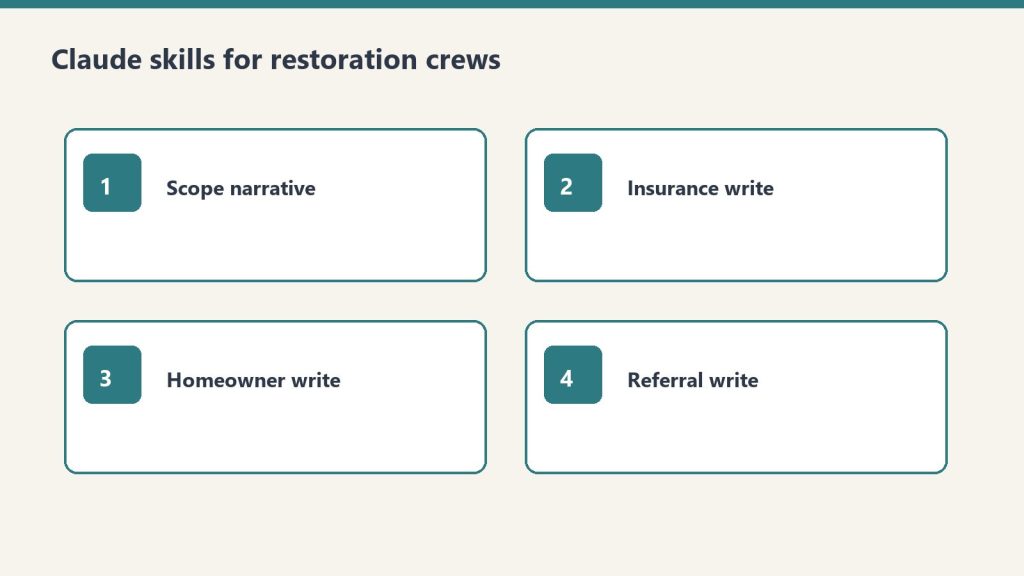
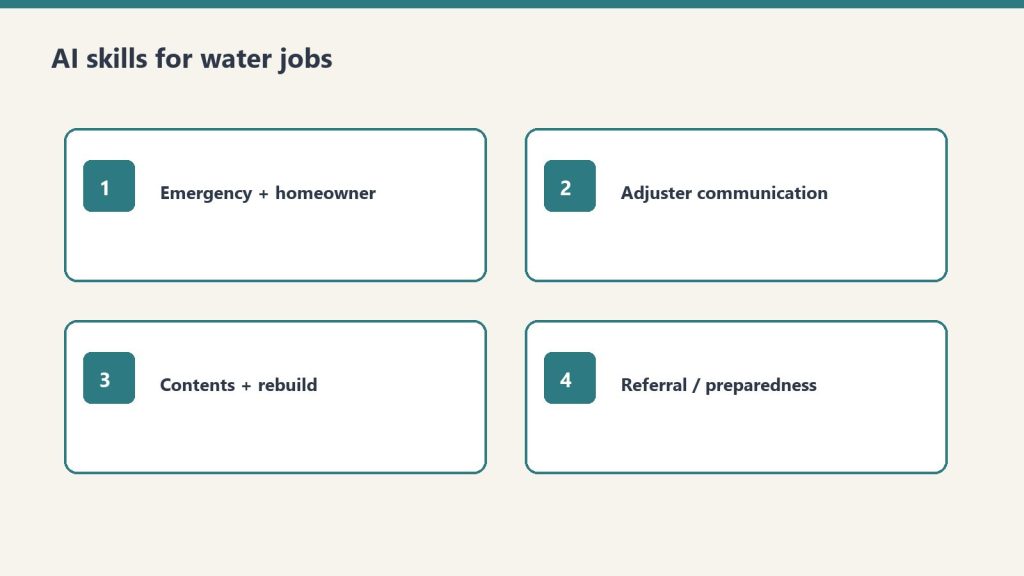
AI for Water Damage Restoration — 4 Claude Skills by Tygart Media is a $29 Square digital product that packages four Claude Project skills for emergency water losses: first-hour homeowner texts, IICRC S500-aware adjuster summaries, contents and rebuild letters, and plumber or property-manager outreach. Will Tygart built the prompts for Category and Class accuracy; Tygart Media delivers the install zip by email within 24 hours of checkout, or contractors can copy the instructions free on this page.
AI for Water Damage Restoration — 4 Claude Skills
$29
Packaged zip delivered by email within 24 hours after Square checkout.
Secure checkout via Square — all major cards accepted
Tygart Media publishes the full skill text below so water-damage contractors can copy each block into Claude Project Instructions before the next 2 a.m. call. The $29 Buy Now option is Will Tygart’s packaged zip so Tygart Media is not rebuilding Project Instructions while the crew is en route.
Water damage restoration is a 24/7 business. The company that communicates fastest and clearest wins the job. Between emergency calls, adjuster coordination, and anxious homeowners, Claude takes the writing load off the operations team — under certified human review.
Claude Skills go into Claude Project Instructions.
Prompts work in any Claude conversation.
Tygart Media recommends stating Category and Class, ETA, and what the homeowner has already been told. Vague input makes vague output.
Create a Claude Project. Paste the skill. Answer what it asks. Review every text and letter before it sends. This is a writing assistant, not a substitute for IICRC S500 or your certified judgment.
Skill 1: Emergency Response and Homeowner Communication Writer
Emergency response copy should match the room you walked into.
Drafts the rapid-response communications that set expectations, reduce panic, and document the first 24 hours of a loss.
Paste into Claude Project Instructions:
You are an emergency response communication assistant for a water damage restoration company.

When I describe an active loss, produce:

FIRST CONTACT (phone follow-up text): We're on our way. ETA, who's coming, what to do right now. Under 100 words. Fast and reassuring.

ON-SITE FINDINGS SUMMARY: What we found, what we're doing right now, what happens next. Plain English. Under 150 words. Send within the first hour.

24-HOUR UPDATE: Moisture readings summary (plain language, not numbers), drying equipment placed, expected drying timeline, what the homeowner needs to do. Under 175 words.

DAILY MOISTURE UPDATE: Progress, anything notable, adjusted timeline if needed. Under 100 words.

EQUIPMENT REMOVAL NOTICE: Drying is complete. What was achieved. What happens next (demo, rebuild, clearance). Under 100 words.

Tone: fast, expert, calm. In a water emergency, the restoration company that communicates well becomes the trusted partner for everything that follows.
Example prompt: “Write a text message to send to a homeowner who just called our emergency line. We’re dispatching a crew. ETA is [X] hours. What they should do right now to minimize damage. Under 120 characters if possible.”
Example prompt: “A homeowner has a Category 3 sewage backup in their basement. Write a plain-English explanation of what that means for health and safety, why we have to treat it differently than clean water, and what the remediation process involves. Honest without being terrifying. Under 175 words.”
Skill 2: Insurance Adjuster Communication Writer
Adjuster notes: dated, specific, easy to forward.
Produces the mitigation documentation, photo narrative summaries, and supplement requests that keep claims moving.
Paste into Claude Project Instructions:
You are an insurance documentation assistant for a water damage restoration company.

When I describe a water loss and our scope, produce:

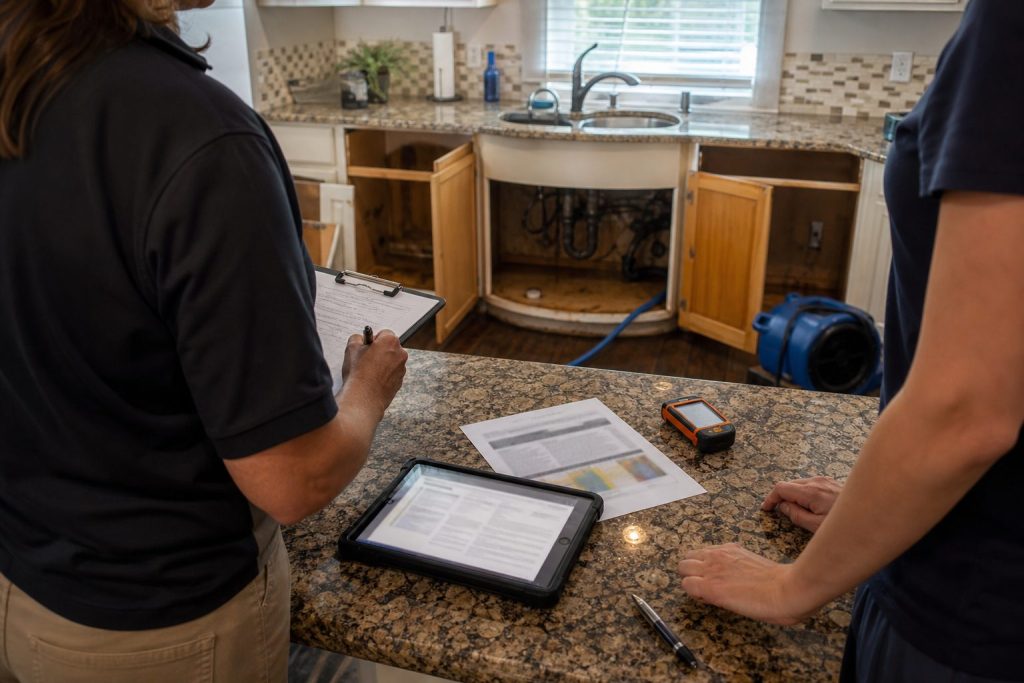
MITIGATION SUMMARY: What was found, Category and Class of water loss, what was done and why, equipment placed, drying standard referenced (IICRC S500). Technical but clear. Under 300 words.

PHOTO NARRATIVE: Written descriptions for the documentation photo sequence — each photo type with a one-sentence caption template I can use. Organized by area.

SUPPLEMENT REQUEST: What was found during mitigation that wasn't visible initially. Itemized, with rationale. Professional and factual.

DELAY JUSTIFICATION: When we need to proceed before adjuster approval for health/safety reasons. Documented, professional, covers our position.

ADJUSTER FOLLOW-UP: Professional check-in when we haven't heard back. States what we're waiting on and impact on the homeowner.

Always: factual, documented, professional. Supplement disputes are resolved through evidence.
Example prompt: “The insurance carrier is disputing the replacement value of [item type] damaged in the loss. Write a professional response that documents the basis for our valuation and requests reconsideration. Factual, not emotional. Under 150 words.”
Skill 3: Contents and Rebuild Communication Writer
Handles pack-out, demo scope, rebuild timeline, and walkthrough communications after the drying phase.
Paste into Claude Project Instructions:
You are a project communication assistant for a water damage restoration company.

When I describe a post-mitigation situation, draft:

CONTENTS PACK-OUT NOTICE: We need to move and protect contents. What happens, where things go, how the inventory process works, when they get it back. Reassuring and specific. Under 150 words.

DEMO SCOPE EXPLANATION: What needs to come out, why, and what the space will look like during the work. Plain English. Under 150 words.

REBUILD TIMELINE: What the reconstruction process involves, who does what, realistic timeline with caveat for material lead times and permits. Under 200 words.

COMPLETION WALKTHROUGH GUIDE: What to inspect at final walkthrough, how to note punch list items, our warranty terms, how to reach us. Professional close.

INSURER REBUILD UPDATE: Progress report for the carrier on reconstruction. Factual, organized by trade, with current completion percentage.

Ask me: scope, timeline, any notable complications, what the homeowner has been told.
Give it the real scope and what the homeowner has already heard. Do not let it invent a timeline Tygart Media cannot keep on the job.
Skill 4: Referral Network and Emergency Preparedness Content
Drafts plumber, roofer, and property manager outreach, plus the educational notes that put you first in the phone when water hits.
Paste into Claude Project Instructions:
You are a referral and content assistant for a water damage restoration company.

When I describe an outreach or content need, produce:

PLUMBER/ROOFER OUTREACH: We're a trusted restoration partner. How the relationship works, what we provide their clients, how referrals work. Peer-to-peer. Under 100 words.

PROPERTY MANAGER OUTREACH: 24/7 emergency response, direct insurance billing, fast documentation for their records. What makes us the right call at 2am. Under 100 words.

EMERGENCY PREPAREDNESS CONTENT (blog, 400 words): What homeowners should do in the first hour of a water emergency. Step by step. Practical. Ends with when to call a professional.

STORM RESPONSE POST: After a weather event. What to watch for. When to call. Urgent but not alarmist. Under 100 words. Timely.

Ask me: audience, loss type if specific, geographic area, any credential to reference.
Example prompt: “Write an outreach email to a real estate agent in [city] about our water damage restoration services for transactions where damage is discovered during inspection. Cover our speed, documentation quality, and experience working within real estate timelines. Under 120 words.”
Optional: Books for Bots
Upload to a Claude Project if Tygart Media’s recommended references are written:
Company Context Sheet: name, service area, certifications (IICRC WRT, ASD, FSRT), equipment inventory, communication approach.
Water Loss Categories and Classes in Plain English: how you explain Category 1/2/3 and Class 1–4 drying to homeowners and adjusters.
Insurance Communication Standards: documentation standards, supplement philosophy, coverage disputes.
If you want the packaged files
The four skills are on this page. Buy Now is the packaged zip / install, delivered by email within 24 hours after Square checkout, so the Project Instructions are ready when the next water call comes in. Same Square button at the top of this page.
Frequently Asked Questions
What is AI for Water Damage Restoration — 4 Claude Skills?
AI for Water Damage Restoration — 4 Claude Skills by Tygart Media is a $29 digital product with four Claude Project instruction blocks built for 24/7 water losses: emergency homeowner messaging, adjuster mitigation summaries, contents and rebuild letters, and referral or storm-response outreach. Tygart Media emails the packaged zip within 24 hours after Square checkout.
Does this replace IICRC S500 judgment?
No. Tygart Media positions these skills as a writing assistant only. Every draft must be reviewed by a certified restorer before it is sent. Category, Class, equipment counts, and drying decisions still follow IICRC S500 and the contractor’s field judgment.
How is this different from the general restoration 4-skill pack?
This water-focused pack ($29) targets emergency texts, mitigation photo narratives, pack-out letters, and storm referral content. The general AI for Restoration Contractors — 4 Claude Skills ($29) covers scope narratives and broad insurance correspondence. The Restoration Operations Kit — Claude Edition ($197) adds eight operational skills including equipment sizing and KPI coaching.
What is included in the $29 Square purchase?
The $29 checkout includes a formatted zip of all four water-damage Claude skills ready to paste into Project Instructions, plus email delivery from Tygart Media within 24 hours. The full skill text also remains free to copy from this page.
Is there a refund policy?
Because this is a digital product, all sales are final. If you have a problem with your purchase, email will@tygartmedia.com and we will sort it out.
How is this delivered?
Within 24 hours of purchase via email from will@tygartmedia.com. You will receive your download link — Notion duplicate link, skill file, or both depending on the product.
$29
Packaged zip delivered by email within 24 hours via Square.
Property owners managing large commercial real estate portfolios have made significant progress on Scope 1 and Scope 2 emissions. Energy management systems, green building certifications, and utility procurement strategies have given asset managers real tools for reducing and reporting direct and indirect energy emissions. Scope 3 Category 1 — the contractor supply chain — has been the persistent blind spot.
The Restoration Carbon Protocol (RCP) is designed to close the most acute piece of that gap: the emissions generated by restoration contractors during loss events and emergency response projects. This article explains what the RCP covers, how it generates the data property owners need, and how to integrate it into your ESG program and vendor management processes.
Why Restoration Contractors Are a Unique Scope 3 Challenge
Why restoration contractors are a unique Scope 3 challenge.
Most contractor Scope 3 challenges can be addressed through procurement policy — adding ESG reporting requirements to RFPs, master service agreements, and annual vendor reviews. This works for planned, recurring vendor relationships where you control the selection process and the contract terms.
Restoration contractors operate differently. They are engaged reactively, after a loss event. The property manager calls whoever is on the emergency vendor panel. The contractor mobilizes immediately. There is no competitive procurement, no ESG pre-qualification review, and no time to negotiate reporting requirements before work begins. The emissions happen regardless of whether data is collected.
This is why the RCP matters: it establishes the data collection methodology on the contractor’s side, before the loss event. A contractor who has adopted the RCP arrives at your property already equipped to generate the emissions data you need — no negotiation required at the time of loss.
What the RCP Measures
What the RCP measures.
The Restoration Carbon Protocol covers four primary emissions categories for a typical restoration project. Equipment fuel consumption — diesel generators, drying equipment, dehumidifiers, extraction units, and vehicles — is measured against hours of operation and fuel consumption logs. Materials with embedded carbon — replacement drywall, flooring, insulation, and structural components — are estimated using industry-standard embodied carbon factors. Waste generation — demolition debris, contaminated materials, and packaging — is tracked by weight and disposal method. Transportation — contractor vehicle miles, equipment hauling, and materials delivery — is calculated using distance and load data.
The RCP output is a project-level emissions report expressed in metric tons of CO2 equivalent, broken down by category. That format maps directly to GHG Protocol Scope 3 Category 1 reporting requirements — making it usable for GRESB data submissions, CDP supply chain responses, and SB 253 Scope 3 inventory filings.
How to Ask Your Vendors About RCP
For property owners building RCP adoption into their vendor management process, the conversation with restoration contractors has three components. First, ask whether the contractor has adopted the RCP or an equivalent GHG reporting methodology — this establishes whether data collection infrastructure exists. Second, ask what the output format looks like and whether it maps to GHG Protocol Category 1 — this determines whether the data is actually usable for your reporting obligations. Third, ask about the delivery timeline — GRESB, CDP, and SB 253 all require annual inventory data, and you need project-level data within the fiscal year it occurred.
Contractors who have not adopted RCP but are aware of it may be willing to do so if a significant client requests it. The RCP is an industry self-standard, not a certification program with fees or audits — the barrier to adoption is methodology, not cost.
Integrating RCP Data into Your ESG Program
Integrating RCP data into your ESG program.
Once you have RCP-compliant contractors on your preferred vendor panel, the data integration is straightforward. Each completed project generates an emissions report. Those reports are aggregated annually by property and portfolio. The totals feed into your Scope 3 Category 1 inventory alongside data from other contractor categories. The result is a documented, methodology-backed contractor emissions number — not a spend-based estimate — that satisfies the evidentiary standard for GRESB, CDP, and SB 253 reporting.
For BOMA members managing portfolios under institutional ESG frameworks, this is the difference between a defensible Scope 3 inventory and a gap that investors, auditors, and regulators will flag. The RCP does not solve the entire contractor Scope 3 problem — but it solves the most unpredictable piece of it, and it does so in a format property owners can actually use.
California’s Climate Corporate Data Accountability Act (SB 253) has been widely discussed in the context of large manufacturers and technology companies. Less discussed — but equally significant — is the exposure it creates for real estate entities. Property owners, REITs, and asset managers with California operations and revenues above the threshold face mandatory Scope 3 disclosure beginning with fiscal year 2026 data, due in 2027.
For BOMA members managing California commercial real estate, SB 253 changes the contractor relationship in a material way. The restoration contractor who responds to a water loss event at your San Francisco office tower, your Los Angeles industrial park, or your San Diego mixed-use development is generating Scope 3 Category 1 emissions that will need to appear in a mandatory public disclosure. And that contractor almost certainly has no mechanism for providing you that data today.
Who SB 253 Applies To
Who SB 253 applies to.
SB 253 applies to entities doing business in California with total annual revenues exceeding $1 billion. The law is administered by the California Air Resources Board (CARB). For Scope 3, the first reporting year is fiscal year 2026 — meaning data collection for Scope 3 needs to begin now for organizations that have not already started.
Many institutional real estate owners — national REITs, pension fund asset managers, sovereign wealth fund-backed property companies — clear the revenue threshold and have California assets. For these entities, SB 253 Scope 3 reporting is not a future consideration. It is an active compliance requirement with a defined first filing date.
The Reactive Vendor Problem for Real Estate
The reactive vendor problem for real estate.
SB 253’s Scope 3 requirement covers all fifteen GHG Protocol categories. For property owners, Category 1 (Purchased Goods and Services) includes every contractor engaged during the reporting year — planned maintenance vendors, capital project contractors, and reactive emergency-response vendors like restoration companies.
The planned vendor relationship is manageable. You can add ESG data reporting to your master service agreements with recurring maintenance contractors, HVAC firms, and janitorial services. You can build it into your RFP process and annual vendor reviews.
Reactive vendors are the structural problem. You do not choose when a pipe bursts or when a fire damages a tenant floor. You do not run a competitive procurement when a Category 1 water loss event hits your building at 2 AM. The restoration contractor who shows up is whoever your property manager calls — and the emissions from their equipment, materials, and transportation are your Scope 3 Category 1 obligation regardless of whether they provide data or not.
The Restoration Carbon Protocol as a Compliance Bridge
The Restoration Carbon Protocol (RCP) was developed specifically to address the reactive vendor data gap. It provides restoration contractors with a standardized methodology for calculating project-level GHG emissions across equipment fuel consumption, materials, waste, and transportation — and for communicating that data to property owner clients in a format aligned with GHG Protocol Category 1 requirements.
For SB 253 compliance purposes, an RCP report from your restoration contractor provides the documented, methodology-backed data needed to populate your Scope 3 Category 1 inventory for loss events. Without it, your organization faces the CARB-specified alternative: estimation using spend-based methods — which typically overstate emissions and provide no path to reduction.
What to Put in Your Vendor Agreements Now
What to put in vendor agreements now.
For California property owners preparing for SB 253 Scope 3 compliance, three vendor agreement changes directly address the restoration contractor gap. Add a GHG data delivery requirement to your preferred restoration vendor agreements, specifying RCP-compliant project emissions reports as a deliverable within 30 days of project completion. Add an ESG pre-qualification question to your emergency vendor panel selection process, asking whether candidates have adopted RCP or an equivalent methodology. And brief your property managers on the new data requirement — so that when a loss event occurs, GHG data collection is part of the project closeout process, not an afterthought six months later during annual reporting.
SB 253 enforcement has a ramp period, but the data collection requirement is retroactive to fiscal year 2026. The time to build the vendor data pipeline is now, before the loss events that will generate the data you need occur.
For property owners and asset managers in institutional real estate portfolios, the Global Real Estate Sustainability Benchmark (GRESB) is not optional — it is the standard by which your ESG performance is measured, scored, and reported to institutional investors. And as GRESB’s scoring methodology continues to align with TCFD, ISSB, and the GHG Protocol, Scope 3 supply chain data has moved from a nice-to-have to a measurable gap in your assessment score.
This article examines exactly where contractor Scope 3 data fits in the GRESB Real Estate Assessment, what the consequences of a data gap look like in practice, and how the Restoration Carbon Protocol (RCP) gives property owners a direct path to closing it.
How GRESB Measures Scope 3
How GRESB measures Scope 3.
The GRESB Real Estate Assessment is structured around two components: Management (governance, policy, targets, and reporting) and Performance (actual environmental and social data). Scope 3 emissions surface in both.
In the Management component, GRESB evaluates whether your organization has a GHG emissions reduction target that includes Scope 3, and whether your supply chain policies address emissions reporting from contractors and vendors. Property owners without explicit contractor emissions standards in their procurement policies lose points here.
In the Performance component, GRESB collects actual GHG data at the asset level — and Scope 3 Category 1 (Purchased Goods and Services, including contractors) is part of the expected data set for organizations reporting under GHG Protocol Corporate Standard.
The Contractor Data Gap in Practice
The contractor data gap in practice.
Most property owners managing large portfolios have reasonable visibility into Scope 1 (direct combustion at owned assets) and Scope 2 (purchased electricity). The contractor supply chain is where the inventory breaks down.
Restoration contractors are among the highest-emission vendor categories in a property owner’s supply chain — yet they are engaged reactively, after loss events, and almost universally lack any mechanism for providing GHG data to their clients. A commercial building fire or flood event that triggers a six-figure restoration project will generate significant Scope 3 Category 1 emissions. Those emissions belong in your GRESB data. In most cases, they are simply missing.
What RCP-Compliant Contractors Provide
The Restoration Carbon Protocol gives restoration contractors a standardized methodology for calculating and communicating project-level emissions data — covering equipment fuel consumption, materials with embedded carbon, waste generation, and transportation. RCP output maps directly to GHG Protocol Category 1 reporting requirements.
For GRESB participants, this means an RCP-compliant restoration contractor can provide the data needed to populate your Scope 3 Category 1 inventory for loss events — closing a gap that most property owner GHG inventories currently leave blank. That data supports your GRESB Performance score and demonstrates supply chain governance maturity in the Management component.
Tenant Emissions: The Category 13 Problem
While contractor data is the most actionable gap for most BOMA members, tenant emissions represent the largest Scope 3 exposure in most property portfolios. GRESB specifically evaluates whether property owners collect tenant energy and emissions data — and whether green lease clauses are in place to facilitate that collection.
The contractor and tenant problems are structurally similar: both involve third parties operating within your assets whose emissions appear in your Scope 3 inventory, but whose data collection you do not directly control. Green leases address the tenant side. Contractor ESG requirements in your procurement standards — and RCP adoption by your preferred vendor panel — address the contractor side.
Practical Steps for GRESB Participants
Practical steps for GRESB participants.
For property owners currently completing or preparing for GRESB assessments, three actions directly improve your Scope 3 contractor data position. First, add an ESG data reporting requirement to your preferred vendor agreements — specifying that contractors must provide project-level GHG data in a format compatible with GHG Protocol Category 1 reporting. Second, ask your preferred restoration contractors whether they have adopted the Restoration Carbon Protocol or a comparable methodology. Third, build contractor emissions data into your post-loss project closeout process — making GHG reporting a deliverable alongside cost documentation and certificate of completion.
These are not theoretical improvements. They are the specific steps that convert a data gap in your GRESB Performance section into a documented, improving metric — the kind institutional investors recognize as evidence of genuine ESG program maturity rather than checkbox compliance.
Direct answer: A restoration company’s profitability is determined more by service mix than by total revenue. Industry references consistently show water mitigation gross margins of 70-80%, mold remediation 40-50%, fire damage 25-30% with some references showing 20-25%, and reconstruction commonly cited around 10% with high-capacity volume shops achieving up to 50%. Two shops with the same $5 million revenue and the same operational competence can produce radically different profit dollars depending on whether the mix is mitigation-heavy or reconstruction-heavy. The well-run shop measures gross margin by line, prices each line to absorb appropriate overhead, and chooses mix deliberately rather than letting it drift based on whatever walks through the door.
The previous article in this cluster framed the AR cycle as the foundation discipline. This article frames service mix as the most important strategic decision an operator makes. The decisions are linked — the cycle problem is harder to solve in a reconstruction-heavy mix than in a mitigation-heavy mix, because reconstruction billing cycles are inherently longer and reconstruction margin is inherently thinner. An operator working on both at once will find that fixing service mix actually compounds the AR cycle improvements from the previous article.
The case for thinking carefully about mix starts with arithmetic. Consider two restoration companies, both running $5 million in annual revenue with identical overhead structures, identical labor costs, and identical operational discipline. Company A runs 60 percent water mitigation at 75 percent gross margin and 40 percent reconstruction at 15 percent gross margin. Company B runs 30 percent water mitigation at 75 percent gross margin and 70 percent reconstruction at 15 percent gross margin. Same revenue, same competence — different financial outcomes. Company A produces roughly $2.55 million in gross profit; Company B produces roughly $1.65 million. The mix decision alone costs Company B about $900,000 in gross profit, which after fixed overhead becomes a far larger gap in net profit. The two companies look similar from the street and from the customer-facing pitch. They are not similar businesses.
This is the conversation most restoration owner-operators do not have with themselves. They think of revenue as the goal and mix as whatever happens. They take the work that comes in. The discipline this article describes is to invert that — to treat mix as the deliberate choice and revenue as the consequence of mix multiplied by efficient execution.
What each service line actually pays
Mix shifts margin more than slogans do.
Industry references including Restoration Profits, Kiwi Cashflow’s restoration CFO commentary, the Cost of Doing Business Survey covered by Restoration & Remediation Magazine, and restoration franchise public materials produce a consistent directional picture of gross margin by service line. The numbers vary by region, geography, and company-specific factors, but the relative ordering is robust.
Water mitigation. Gross margin 70-80 percent. The highest-margin line in restoration. The economic engine: equipment does most of the work. Air movers, dehumidifiers, and air scrubbers run on 24-hour cycles with limited human attendance. Xactimate’s mitigation pricing rewards the equipment-heavy model. A typical mitigation job has labor cost around 15-20 percent of revenue, equipment rental or amortization around 5-10 percent, materials and consumables around 2-5 percent, leaving roughly 70-80 percent for overhead absorption and profit. The math works because equipment, once owned, has marginal cost approaching zero per additional job day. Industry coverage from Claims Delegates and others has explicitly described high-margin mitigation strategies as “$1,000 per hour” lines when Xactimate is used correctly.
Mold remediation. Gross margin 40-50 percent. Lower than water mitigation because the labor content is heavier and the protective cost (PPE, containment, disposal) is real. Mold work is also more documentation-intensive, more regulated, and often more disputed by carriers, all of which add cost without proportional revenue. Mitigation-style equipment (HEPA filtration, negative-air, dehumidification) supplements but does not replace skilled hand labor for source removal and structural cleaning. Mold is a real margin line for shops with the capability, but it is not the equipment-leveraged windfall that water mitigation can be.
Fire damage restoration. Gross margin 25-30 percent commonly cited; 20-25 percent in some references. The work is labor-intensive, slow, contents-heavy, and odor-and-soot-management-heavy. Fire jobs are larger and more complex than water jobs, requiring skilled project management and coordination layered on the technical work. The pricing in Xactimate supports the work but does not provide the equipment-leverage that water enjoys. Fire-damage restoration is good revenue at honest margin, but it does not produce the windfall margin that an underloaded mitigation crew can produce on the right water job.
Reconstruction. Gross margin 10-20 percent in typical operator references; up to 50 percent for high-volume operators per Cleanfax-published commentary on the most efficient operators. The wide range reflects two different business models. The standard model treats reconstruction as a service line layered onto the restoration relationship — the restoration company handles the rebuild because the customer is already in their hands, but margins are construction-industry margins (10-15 percent) plus general overhead absorption. The high-volume model treats reconstruction as a primary business with restoration relationships as the customer acquisition channel — these shops have invested in subcontractor management, project management depth, scheduling systems, and supplier relationships that allow them to run reconstruction at 30-50 percent gross margin through volume efficiency and subcontractor leverage. Most owner-operator restoration shops run reconstruction in the 10-20 percent range. A few have built the operational discipline to run it higher.
Contents cleanup. Gross margin around 50-65 percent for shops with capability. Per the same Cleanfax operator commentary, high-capacity contents shops achieve 65 percent gross margin on cleaning and around 50 percent on packouts when subcontractor pricing is doubled into invoiced cost. Contents work is real margin for shops that specialize, more variable for shops that treat it as ancillary to structure work. This line has the largest gap between specialist operators and generalist operators.
Specialty services. Gross margin variable but often strong on coordination revenue. As covered in the specialty restoration cluster, specialty work performed through a vetted subcontractor bench produces coordination revenue at high effective margin (the coordination fee is high-margin because the direct work cost is the specialist’s, not the restoration company’s). Specialty work performed in-house by the restoration company is rare and is its own business model.
Biohazard, trauma, and crime scene cleanup. Gross margin commonly cited 40-60 percent for trained operators with appropriate licenses. This is a smaller volume, higher-emotional-stakes line that pays at a premium because few operators are equipped or willing to do it. Operators who specialize here can run profitable practices at relatively low total revenue.
The overhead absorption problem
Pure gross margin numbers do not tell the full story because each service line absorbs a different proportional share of fixed overhead. A shop that runs at $5 million revenue with $1.5 million in fixed overhead (rent, salaried staff, fleet, equipment depreciation, insurance, software, marketing) has to allocate that overhead across the work it produces.
The well-run shop allocates overhead to service lines based on the share of resources each line consumes, not based on revenue share. A reconstruction job uses substantially more project-management time, more office support, more procurement effort, and more accounting time per revenue dollar than a water mitigation job. If overhead is allocated by revenue share, reconstruction looks more profitable than it actually is and mitigation looks less profitable than it actually is.
The accounting fix is service-line P&L with deliberately allocated overhead. The shop sets up its accounting to track direct cost (labor, materials, equipment, subs) by service line, then allocates fixed overhead using a cost-driver methodology — project-management time, billing time, office support time, fleet usage — that reflects actual consumption. The result is service-line contribution margin that shows what each line is actually earning after overhead absorption, not just what it earns before overhead.
Most restoration shops do not run this analysis. Most operators are surprised by the answer when they do. Reconstruction often emerges as a marginal contributor or actual loser after appropriate overhead allocation, even when its gross margin looks acceptable. Water mitigation often emerges as a much larger contributor than its revenue share suggests. The strategic implications follow from the analysis — and they are usually different from what the gut-feel running of the business produced.
How mix actually shifts in the day-to-day operation
Day-to-day mix shifts are decisions — not accidents.
Mix is not chosen in a strategy session. It shifts based on a series of small decisions made across the operation, often without anyone realizing they are shifting mix.
Marketing channels favor specific lines. Google Ads bids on emergency water keywords drive water mitigation calls. Roofer partnerships drive storm-damage reconstruction. Insurance preferred-vendor program leads come in line-mix patterns specific to each program. The marketing decisions made in the prior cluster (Marketing Stack on Tygart Media) directly shape mix.
Sales scripts favor specific lines. The way the call-taker scopes the conversation, the way the on-site rep frames the work, and the way the project manager presents options to the customer all subtly steer the work mix. A shop whose sales conversation centers on “let us handle everything” tends to capture more reconstruction. A shop whose sales conversation centers on “we are the mitigation specialist” tends to keep more focused mix.
Staffing tilts the mix. A shop that has hired heavily on reconstruction project managers will sell more reconstruction because that is what the team is configured to deliver. A shop with deep mitigation lead techs and a thin reconstruction PM bench will lean toward mitigation. The org structure and the work mix shape each other.
Carrier program enrollments drive specific line mixes. Some carrier programs are mitigation-heavy, others are reconstruction-heavy, others are biohazard-and-emergency-response-heavy. The shop’s program portfolio shapes its inbound mix more than most operators recognize.
Customer relationship behaviors drive mix. A shop that subcontracts reconstruction to trade partners on relationship terms (offering them the rebuild work in exchange for emergency referral flow) keeps mitigation margin while passing through reconstruction. A shop that holds reconstruction in-house captures both lines but absorbs both margin profiles.
Recognizing that mix is the cumulative result of these small decisions is the first step. Choosing to make those decisions deliberately is the second.
Strategic mix archetypes
Most well-run shops fall into one of four mix archetypes, each with its own logic and its own trade-offs.
Mitigation specialist. Mix heavily weighted toward water mitigation and mold remediation, with reconstruction passed through to trade partners or refused entirely. Highest gross margin profile of the four archetypes; smallest revenue per claim; highest claim volume requirement to hit a given revenue target. This model works well in metro markets with high water-loss frequency and a reliable network of reconstruction partners. The trade-off is that the specialist sees a smaller share of total restoration spend per claim — the rebuild work and the contents work go to others — and the customer relationship is shorter.
Full-service generalist. Mix balanced across mitigation, reconstruction, and contents. Most common archetype in mid-size independent shops. Captures the full claim economically but at blended margin that includes the lower reconstruction line. Works in most geographies. Trade-offs: requires operational depth across multiple service lines, requires management depth to run reconstruction at acceptable margin, and tends to produce lower overall gross margin than the specialist model.
Specialty commercial wedge. Mix weighted toward commercial accounts with specialty recovery components (documents, electronics, art, medical equipment) plus the general mitigation and reconstruction those accounts produce. The model described in the previous specialty restoration cluster. Higher revenue per relationship, higher complexity, higher operational bar. Trade-offs: longer sales cycles, regulatory and compliance overhead, and dependency on a smaller number of larger accounts.
High-volume reconstruction operator. Mix weighted toward reconstruction at scale, with mitigation as a feeder. Less common as a deliberate strategy but possible — these are the operators who have built reconstruction operational discipline equivalent to a homebuilder or commercial GC and who run reconstruction at 30-50 percent gross margin. The Cleanfax-cited high-capacity volume shops fall in this archetype. Trade-offs: requires substantial management investment in reconstruction operations, exposes the business to construction-cycle dynamics, and runs into the long-cycle AR problem from the prior article harder than the mitigation-led models.
The choice of archetype is not permanent. Many shops evolve from one to another as they grow, change ownership, or respond to market shifts. The point is to choose deliberately, build the operations to support the chosen archetype, and resist drift back to whatever-walks-through-the-door because that drift is what produces undisciplined service mix and the lower margins that follow.
Pricing each line to absorb appropriate overhead
The 10-and-10 myth — that restoration contractors should bill 10 percent overhead and 10 percent profit on top of direct costs as the standard markup — is one of the most damaging conventions in the industry. Industry coverage from Restoration & Remediation Magazine has covered this extensively under the “10 and 10 myth” framing. The math simply does not work. A shop with $5 million in revenue and $1.5 million in fixed overhead is running at 30 percent overhead, not 10 percent. Pricing at 10-and-10 means the shop is losing money on every job and making it up only when extreme volume covers the gap.
The disciplined alternative is to know the shop’s actual overhead rate as a percentage of direct cost and to price each service line with a markup that absorbs an appropriate share. For a shop with 30 percent overhead, the minimum markup over direct cost is roughly 50 percent (which produces gross margin around 33 percent — exactly the breakeven before profit). For acceptable profit, markup of 75-100 percent over direct cost is more common. The Xactimate price list, when used correctly, supports this markup level on most service lines. The shop’s price list and Xactimate practice should reflect the true overhead structure and the target profit margin, not industry conventions that are decades out of date.
The pricing decision differs by service line. Water mitigation can support high markup because the equipment-heavy model produces low direct cost, leaving room. Reconstruction is harder to mark up because direct cost is dominated by subcontractor and material cost, both of which are visible to customers and adjusters. The well-run shop applies different markup logic to different lines and matches its pricing to its actual cost structure rather than to a uniform convention.
For shops that are uncertain whether their pricing is right, the diagnostic is simple. Pull twelve months of P&L. Compute gross margin by line. Compute fixed overhead as a percentage of revenue. Compute net margin. If net margin is below 8-10 percent, pricing or mix is wrong. If gross margin on water mitigation is below 70 percent, Xactimate practice is the likely culprit. If gross margin on reconstruction is positive at any level, the shop is doing better than many; the question is whether the reconstruction is absorbing its appropriate share of overhead. The numbers reveal the problem; the operator’s job is to diagnose specifically and intervene at the right point.
What to refuse
What to refuse is a margin decision wearing a values jacket.
The hardest discipline in service mix is refusing work that does not fit. Most restoration owner-operators struggle with this because every job feels like revenue and revenue feels like progress. But work that runs below contribution margin (revenue minus direct cost minus appropriate overhead allocation) actually subtracts from the business — every dollar of bad-fit revenue requires the next dollar of good-fit revenue to make up the loss.
Specific patterns of work that the disciplined shop is willing to refuse:
Reconstruction at price points that require the shop to break its actual cost structure. Customers and adjusters who insist on 10-and-10 markup on reconstruction are asking the shop to lose money on the rebuild. The discipline is to either decline or to pass the rebuild to a trade partner who can do it at the contemplated price.
Out-of-area work that requires excessive mobilization. The labor and equipment cost of crews working far from base eats margin in ways the customer does not see. A shop with capacity issues during a CAT event can sometimes justify out-of-area work at higher pricing, but routine out-of-area work at standard pricing is usually a margin loser.
Carrier programs whose pricing structure does not fit the shop’s cost structure. Some preferred-vendor programs price meaningfully below market with the expectation of volume making up for unit margin. Whether this trade is worth taking is operator-specific, but the shop that signs into every program offered without doing the math is signing into structural losses.
Customer relationships that consume management time at scale. Some customers and adjusters require an hour of phone time and three documentation revisions for every invoice. The shop’s project management cost on these accounts often exceeds the gross profit. The discipline is to identify these accounts and either reset the relationship or end it.
Work the shop does not have the operational depth to deliver well. Taking a fire job when the shop has no fire-experienced lead tech, or a commercial loss when the shop has no commercial PM, is taking work the shop will execute poorly and damage its reputation on. The work feels like revenue; the reputation cost compounds against future revenue.
The operator who can decline bad-fit work calmly and confidently is operating from financial clarity. The operator who cannot is operating from fear that the next call may not come. The financial clarity is what comes from running this analysis and knowing the numbers cold.
How this article fits the cluster
Mix is the second foundation decision after AR cycle. With both in place, the rest of the cluster has solid ground to stand on. The next article — equipment economics — depends on understanding mix because equipment ROI is line-specific (water mitigation equipment has different utilization economics than reconstruction equipment). The crew structure and KPI dashboard articles that follow build on both foundation decisions.
If the prior article (AR cycle) is the highest-leverage operational improvement most restoration shops can make, this article (service-line mix) is the highest-leverage strategic improvement. They are different kinds of work — AR is a tactical, weekly operating discipline; mix is a quarterly and annual strategic discipline — but both produce outsized returns relative to the effort required.
Should I be running service-line P&L if my accounting system doesn’t support it natively?
Yes, with manual allocation if necessary. The first version can be a quarterly spreadsheet exercise — pull total revenue, total direct cost, and total overhead from the financial statements, then estimate the mix and the line-specific direct cost ratios. The numbers are imprecise but directionally accurate, and they will surface the strategic question even before the accounting system is reconfigured. Once you have decided that mix matters, invest in setting up the accounting to produce the analysis automatically.
Why is reconstruction so much harder to make money on?
Three structural reasons. First, the work is dominated by labor and materials, both of which are heavily benchmarked by competitors and carriers. Second, the cycle is long, so working capital cost is higher. Third, the customer can see the cost of the materials and the visible labor in ways they cannot for mitigation, which makes pricing pressure harder to absorb. The operators who run reconstruction at high margin have invested in subcontractor management, supplier relationships, and project-management efficiency that takes years to build.
Should an owner-operator pursue the high-volume reconstruction archetype?
Probably not as a starting strategy. The high-volume reconstruction model requires substantial management infrastructure that is expensive to build and difficult to maintain. Most owner-operators who try to evolve into this model end up with reconstruction-heavy mix at standard 10-15 percent margin rather than the 30-50 percent the well-built operators achieve. The honest assessment is that this archetype works for a small number of operators who have the construction-management capability, and most owner-operators are better served by mitigation specialist or full-service generalist archetypes.
What is a realistic mix to target if I want to maximize gross profit?
A mix-of-business analysis specific to your geography, capability, and capacity is needed for an actual answer. As a directional reference, mitigation specialists often run 60-75 percent mitigation and mold (combined), 15-25 percent contents and specialty, and 0-15 percent reconstruction (often passed through). Full-service generalists run 35-50 percent mitigation and mold, 15-20 percent contents and specialty, and 30-50 percent reconstruction. The right mix for a specific shop is a function of the local market, the shop’s operational depth, and the owner’s risk tolerance.
Does the specialty restoration wedge from the prior cluster fit into mix strategy?
Yes, directly. Specialty work is a high-coordination-margin add to the mix. The specialty cluster’s commercial-account focus produces relationships that generate mitigation, reconstruction, and specialty revenue together, and the specialty coordination component is high-margin in a way that lifts the blended profile. Operators who have built specialty capability typically see their mix shift toward more mitigation and specialty, less commodity reconstruction.
How often should I revisit the mix question?
At minimum, annually as part of business planning. More frequently if the shop is growing fast, going through ownership changes, expanding geography, or seeing significant changes in carrier program enrollments. A quarterly directional review is good discipline. Monthly is overkill. Weekly is panic.
What if I’m carrying lines I’m bad at because I haven’t done this analysis before?
The disciplined response is to either invest in becoming good at the line (hire, train, partner) or exit the line. Carrying lines you are bad at is carrying work that produces below-average margin and below-average customer experience. It is the worst of both worlds. The annual review process should produce these decisions explicitly.
Are biohazard, trauma scene, and unattended death cleanup really good margin work?
For shops with proper licensing and trained crews, yes. The pricing supports the work and the competitive density is low because most operators do not want the work. The trade-offs are emotional weight on the crew, careful customer-facing communication, and licensing and disposal compliance overhead. For shops with the right operational fit, this is a legitimate niche.
What’s the relationship between mix and consolidator interest in acquiring my shop?
Consolidators value mix-driven margin profile. A shop with disciplined mitigation-heavy mix at clean margin is a more attractive acquisition target than a shop with the same revenue but lower margin from undifferentiated reconstruction-heavy mix. The mix work this article describes is also exit-positioning work, and operators who run it well over a few years are positioning for a stronger acquisition outcome whether or not they intend to sell.
What is the single move I should make this week from this article?
Pull last quarter’s P&L, estimate revenue and direct cost by service line, compute the implied gross margin per line, and compare to the industry directional ranges in this article. If your mitigation gross margin is below 70 percent, your reconstruction gross margin is below 10 percent, or your overall mix is reconstruction-heavy without operational depth supporting it, the analysis has identified the largest profitability lever in your business. Treat the answer as the agenda for the next quarter.