Tag: Restoration Content

  • How Restoration Companies Are Winning Commercial Accounts in 2026

    How Restoration Companies Are Winning Commercial Accounts in 2026

    Commercial restoration sales no longer rewards the most aggressive cold caller. It rewards the operator who has mapped the building, named every decision-maker, and arrived with a written plan before the loss happens.

    The restoration companies gaining commercial market share in 2026 are not necessarily the ones with the largest equipment fleets. They are the ones who treat commercial accounts like enterprise sales — with named accounts, multi-year cultivation cycles, and a recognition that the buyer is rarely the property manager you first meet.

    Why Commercial Restoration Sales Looks Different in 2026

    Three structural shifts have rewritten the commercial restoration playbook over the last 24 months. First, third-party administrators (TPAs) and program work now route a larger share of insurance-driven commercial losses, which means the carrier relationship matters as much as the property relationship. Second, large property management groups have consolidated, which concentrates buying power into fewer hands. Third, post-loss litigation pressure has made documentation discipline a sales asset rather than a back-office expense.

    Operators who treat commercial restoration as a transactional, lead-by-lead business are losing ground to firms that treat it as a relationship discipline. The difference shows up in close rates, average job size, and the willingness of property managers to call before they tender to a competitor.

    The Five Buyer Personas in Commercial Restoration

    Most restoration sales reps pitch the property manager and stop there. The firms winning commercial work in 2026 are pitching all five of the following decision-makers, often simultaneously, and tailoring their materials to each:

    • Property manager. Operates the building day to day. Cares about disruption, tenant complaints, and being able to say the response is handled.
    • Asset manager or owner representative. Owns the financial outcome. Cares about loss-of-use exposure, capital preservation, and avoiding insurance disputes.
    • Risk manager or insurance buyer. Often a corporate function. Cares about preferred-vendor compliance, carrier relationships, and standardized documentation.
    • Facilities or chief engineer. Holds the technical relationships. Cares about contractor competence, building system knowledge, and clean handoffs.
    • TPA case manager. Routes the work after the FNOL. Cares about responsiveness, daily updates, and clean billing.

    A quote, a brochure, or a referral sheet that speaks to one of these personas does not move the other four. Operators with mature commercial sales programs maintain at least three persona-specific decks and tailor their account-development outreach accordingly.

    The Account Map Is the Sales Asset

    The most undervalued tool in commercial restoration sales is the written account map. It is not a CRM record. It is a one-page document for each target account that captures the building portfolio, current vendor relationships, known pain points, the people in each of the five personas above, and the trigger events that would create a buying moment.

    Account maps are how a sales rep stops chasing leads and starts cultivating a territory. They are also how restoration company owners answer the most important commercial sales question: do we actually know who buys at this account, or are we just hoping the property manager remembers our name?

    The TPA Channel: Asset, Liability, or Both

    Third-party administrators have become a structural feature of commercial restoration. For some operators they represent 30% or more of revenue. The honest assessment in 2026 is that TPA work is a sustainable channel only if you understand its tradeoffs.

    The benefit is volume and predictability — once a TPA program approves you, the work flows. The cost is margin compression, scope-of-work constraints, and the risk that the TPA, not the property owner, becomes the customer who can fire you. Operators with the strongest commercial sales results in 2026 use TPA programs as a base load for crew utilization, while building a parallel direct-to-owner pipeline at higher margin.

    What a Commercial Restoration Sales Cycle Actually Looks Like

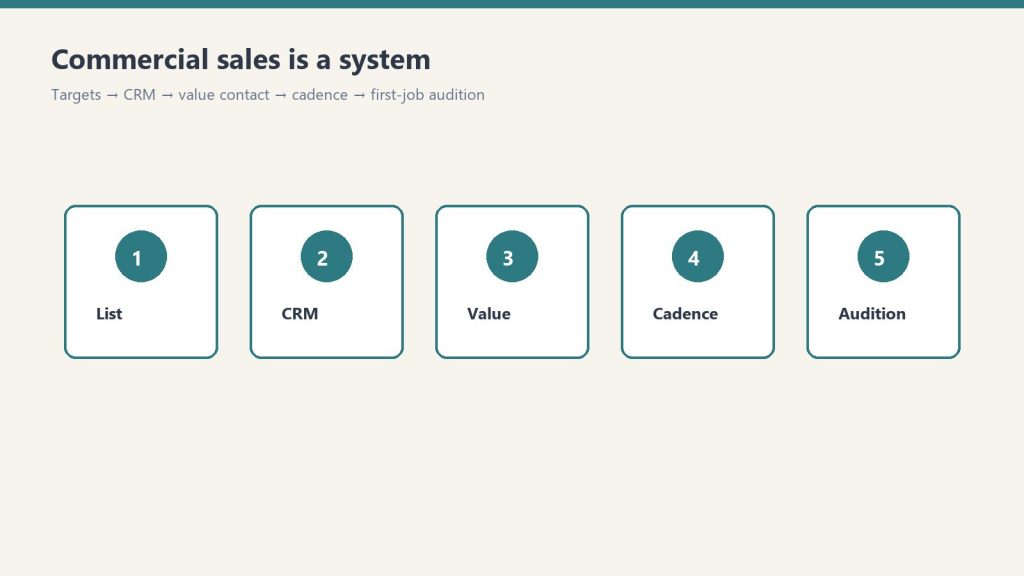
    A residential water-loss sales cycle can close in hours. A commercial sales cycle — meaning the path from first introduction to a preferred-vendor agreement or program enrollment — typically runs six to eighteen months. The sales activity that fills that window matters more than the pitch itself. A representative cycle includes:

    • Initial introduction, often through a chamber, BOMA event, or warm referral.
    • Educational meeting framed around a specific risk the property faces — not a capabilities pitch.
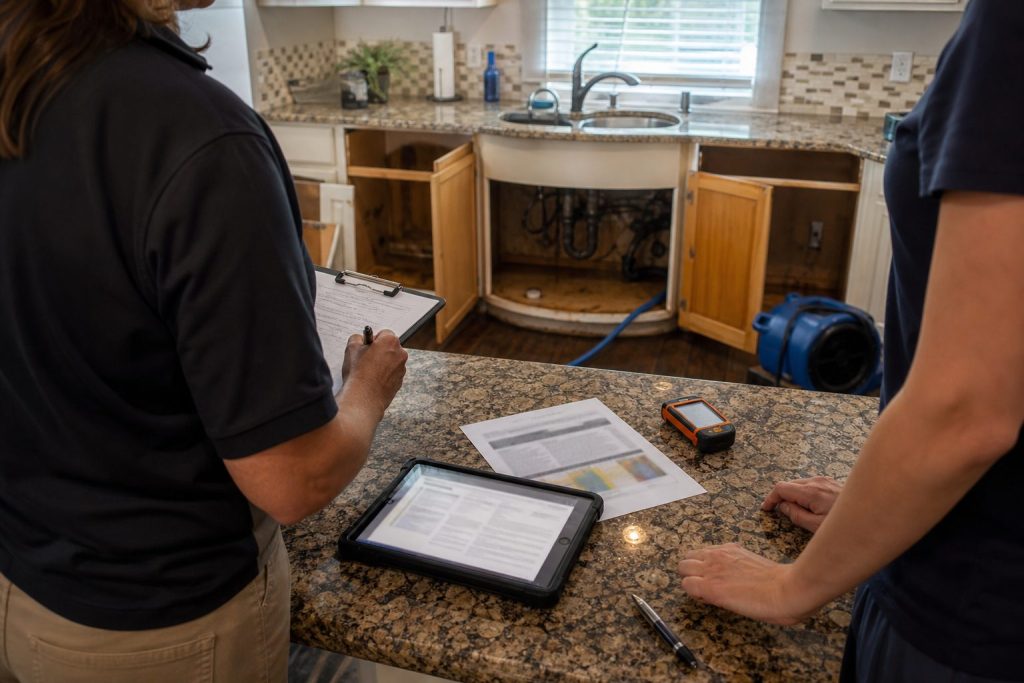
    • Pre-loss site walk and documentation of building systems relevant to water, fire, and biohazard response.
    • Tabletop exercise or response-plan review with facilities and risk teams.
    • Vendor onboarding, insurance and safety document submission, master service agreement.
    • First small job or after-hours response that proves out the operational claims made during the cycle.

    Operators who try to compress this cycle into a single quote almost always lose to the firm that walked the building twelve months earlier.

    What to Measure

    The commercial pipeline metrics that matter are not the same as residential. The four that the strongest sales programs track in 2026 are:

    • Named accounts in active cultivation — a target list with quarterly touchpoint cadence.
    • Pre-loss site walks completed — a leading indicator of pipeline health 6–12 months out.
    • MSAs and preferred-vendor agreements signed — the conversion event that actually moves revenue.
    • Average commercial job size and gross margin trend — the proof that the cultivation is producing the right kind of work.

    The 2026 Commercial Restoration Sales Stack

    Putting it together, the operators winning commercial accounts in 2026 share a recognizable stack: a named-account target list reviewed monthly by ownership; a CRM with persona-tagged contacts at each account; a documented sales cycle with stage exit criteria; pre-loss documentation as a standard sales motion; a TPA program strategy that complements rather than replaces direct sales; and clear ownership of which leader on the team drives commercial pipeline health.

    The firms missing one or more of these elements tend to describe their commercial revenue as inconsistent or referral-dependent. The firms that have all of them describe their pipeline as crowded.

    Frequently Asked Questions

    How long does it take to win a commercial restoration account?

    The full sales cycle from introduction to first paid work typically runs six to eighteen months for direct-to-owner accounts. TPA program enrollment can move faster, often 60 to 120 days from application to first dispatch.

    What is the most common reason restoration companies lose commercial bids?

    Single-threaded relationships. Most losses come from selling only to the property manager and missing the asset manager, risk manager, or facilities engineer who actually controls vendor selection.

    Should restoration companies pursue TPA work?

    TPA work is a viable revenue channel if treated as a base-load contributor, not the entire pipeline. Margin is compressed, but volume is predictable. The risk is becoming dependent on a single TPA program, which can revoke status with little notice.

    What is a preferred-vendor agreement worth?

    A signed MSA or preferred-vendor agreement does not guarantee work, but it removes the procurement and onboarding friction that would otherwise block dispatch when a loss occurs. Operators report that conversion from MSA to actual revenue typically takes another 90 to 180 days.

    How many named accounts should a commercial sales rep manage?

    Most restoration sales programs in 2026 cap active named accounts at 40 to 75 per rep, with a quarterly touchpoint cadence. Higher counts dilute the relationship depth that the commercial sales motion depends on.

    For more on the operational side of running a commercial restoration business, see the Restoration Operator’s Playbook archive on Tygart Media.


  • Restoration Niche Pack — IICRC Entity Injection and FAQPage Schema on 10 Posts

    Restoration Niche Pack — IICRC Entity Injection and FAQPage Schema on 10 Posts

    What Is the Restoration Niche Pack?
    A targeted optimization pass on your 10 highest-traffic restoration posts — injecting IICRC standards references, RIA industry entity signals, EPA mold guidelines, and OSHA citations throughout your content, then adding FAQPage JSON-LD schema on every post. The result: your content reads (and ranks) like it was written by someone who actually knows restoration, not a generic SEO copywriter.

    Generic restoration content has a tell: it mentions “water damage” and “mold remediation” without ever referencing the IICRC S500 standard, the RIA, class 3 water losses, psychrometric calculations, or EPA 402-K-02-003. Google and AI systems both recognize entity-rich industry content as more authoritative than keyword-stuffed generic copy — and so do adjusters and property managers reading it.

    The Restoration Niche Pack injects the named entities that separate expert content from generic content — then adds FAQPage schema so your posts are eligible for the featured snippet placements that restoration queries are increasingly winning.

    What the Pack Covers (Per Post)

    • IICRC entity injection — Relevant standards (S500, S520, S540, S600) referenced naturally within content based on post topic
    • RIA references — Restoration Industry Association signals where applicable
    • EPA citations — Mold remediation guidelines (EPA 402-K-02-003) and relevant environmental standards
    • OSHA references — Worker safety standards for applicable content (asbestos, mold, confined space)
    • Local entity reinforcement — Service area, local licensing bodies, and regional climate/building context
    • FAQPage section + JSON-LD — 5–6 Q&As covering the questions adjusters, homeowners, and property managers actually ask
    • Speakable schema — Key paragraphs marked for voice search and AI synthesis

    Pricing

    Package Posts Price
    Standard Pack 10 posts — entity injection + FAQPage schema $399
    Deep Pack 10 posts — entity injection + FAQPage + speakable + content expansion where thin $699

    Who This Is For

    Restoration companies with an existing WordPress site and at least 10 published posts who are ranking but not converting, or ranking page 2 for queries where page 1 competitors have entity-rich content. Also the right move after a taxonomy rebuild when your content foundation is clean and ready for entity-level optimization.

    Get IICRC Entities and FAQPage Schema on Your Top 10 Posts

    Share your restoration site URL. We’ll identify your 10 best candidates and confirm the pack scope before you commit.

    will@tygartmedia.com

    Email only. No commitment to reply. Turnaround quoted within 1 business day.

    Frequently Asked Questions

    Does this work for all restoration verticals (water, fire, mold, asbestos)?

    Yes — the entity set is adapted by vertical. Water damage posts get IICRC S500 and psychrometric references. Mold posts get EPA 402-K-02-003 and IICRC S520. Fire/smoke posts get IICRC S700. Asbestos posts get OSHA and EPA NESHAP references.

    Will this change the readability of my existing content?

    Entity injection is contextual — we add entities where they fit naturally, not as a keyword list. Most readers won’t notice the additions. What they’ll notice is that the content sounds more authoritative.

    Does the FAQ content get written fresh or pulled from existing content?

    For the Standard Pack, FAQs are written fresh based on the post topic and the questions your target audience actually searches. For posts that already have Q&A sections, we upgrade the existing questions and add schema rather than replacing them.


    Last updated: April 2026