Tag: Restoration Content

  • Your CRM Is Not a Lead Database — It’s a Community That Doesn’t Know It’s a Community Yet

    Your CRM Is Not a Lead Database — It’s a Community That Doesn’t Know It’s a Community Yet

    The Restoration Industry Spends $400 a Lead and Then Never Talks to Those People Again

    PPC campaigns. Direct mail. Google Local Services Ads. Storm chasers working neighborhoods after a weather event. The average restoration company spends somewhere between $150 and $500 to acquire a single qualified lead — and in some markets, especially water and fire, that number climbs higher. The industry has an entire ecosystem built around lead generation: lead brokers, referral networks, preferred vendor programs, adjuster relationships cultivated over years of lunches and golf rounds.

    And then a homeowner files a claim, you do the work, you get paid, and you never talk to them again.

    Not because you don’t want to. Because nobody told you what to say.

    That is the problem this article is going to solve — not just for homeowner re-engagement, but for your entire database. Adjusters, agents, vendors, subs, referral partners, past employees, community contacts. Every person who has ever touched your business in any way is sitting in a CRM that you treat like a ledger instead of a community. This article is about changing that, and it starts with the most counterintuitive entry point in restoration marketing: your next job posting.


    What Is a CRM Community and Why Restoration Companies Don’t Have One

    A community is a group of people who feel connected to something beyond a single transaction. Your past homeowner clients paid you, possibly during the worst week of their year. They watched your crew work. They saw how you handled their insurance company. They know your company name. If you did good work, they have a positive association with your brand that most businesses spend years trying to build.

    That is not a lead. That is a community member who doesn’t know they’re in a community.

    The reason restoration companies don’t leverage this is structural. The industry is built around reactive demand — you don’t have time to do relationship marketing when the phone is ringing after a storm. Your sales process is built around the claim cycle, not around the customer lifetime. And when it’s quiet, the instinct is to spend on advertising to generate the next job, not to re-engage the people you already served.

    But there’s a second reason, and it’s more fundamental: most restoration companies don’t believe they have a valid, non-salesy reason to contact past clients.

    They do. They just don’t know it yet.


    The Hiring Email: The Best Marketing Touch You’re Not Sending

    Here is the scenario. You need to hire a crew lead. You post on Indeed. You get 40 applications, most of which don’t match what you need, and you spend three hours screening.

    Now here is the alternative. You open your CRM. You pull every contact in your service area — homeowners, adjusters, agents, vendors, subs, anyone local. You send a single email. The subject line is something like: “We’re growing — know anyone looking for a great job in the trades?”

    The email is short. It says you’re hiring for a specific position. It says you value the relationship you have with them. It says if they know anyone — a family member, a friend, someone in the trades looking for a stable company with a good culture — you’d love a direct introduction. No application portal. Just an email back to you.

    That email does four things simultaneously that no advertising spend can replicate:

    1. It reminds your past clients you exist — without selling them anything
    2. It makes them feel respected — you’re asking their opinion, not their money
    3. It positions your company as growing and healthy — companies that are struggling don’t hire
    4. It creates a genuine two-way relationship moment — they can actually help you

    For your insurance contacts — adjusters and agents — it signals something even more powerful. It says you’re a company that is serious about quality people, that you care about your workforce, and that you think of them as partners in your business rather than just referral sources to be harvested.

    The cost of this email campaign: the time it takes to write one email and hit send. The leads you generate from the replies and referrals: free. The brand impression you leave on every person who opens that email: priceless in an industry where word-of-mouth still drives a significant percentage of residential work.


    The Vendor and Supplier Ask: Operational Needs as Community Touchpoints

    The hiring email is the entry point. But once you internalize the underlying principle — that your database wants to help you when asked the right way — you realize how many legitimate reasons you have to contact them.

    You’re looking for a reliable drywall sub in your market. You need a specialty cleaning supplier for a specific job type. You’re trying to source a vendor for an event you’re hosting. You’re looking for a trusted electrician or HVAC contractor to refer to clients after the remediation is done.

    Every one of these is a real business need. And every one of them is a valid reason to reach out to your database.

    “Hey, we’ve got a large commercial project coming up and we’re looking for a reliable drywall sub who does quality work. Do you know anyone in the area?”

    That message, sent to 500 people in your CRM, will generate responses. Some of them will be recommendations. Some of them will lead to subcontractor relationships that serve you for years. But every single one of them will reinforce that your company is active, growing, and doing interesting work — and that you value the people in your network enough to ask them first.

    Your adjusters and agents will forward that message to people they know. Your past homeowners will think of you as a company that is embedded in their community. Your vendors and subs will feel like partners rather than line items.


    Why Past Homeowner Clients Are Your Most Underutilized Asset

    This is the one that most restoration companies are leaving the most money on the table with, and it deserves its own focus.

    A homeowner who used your services has a profile that no amount of advertising can manufacture. They experienced a property damage event. They navigated a claim. They worked with a restoration company — yours — and if it went well, they came out the other side with a specific, emotional memory of your brand. They are also, statistically, likely to experience another property damage event in their lifetime. Water damage recurs. Roofs age. Mold finds new moisture sources.

    And they have neighbors, family members, and friends who will experience property damage events and who will ask them: “Do you know a good restoration company?”

    That referral question is the single most valuable marketing moment in residential restoration. And the answer depends entirely on whether your company is still alive in that homeowner’s memory when the question gets asked.

    The hiring email keeps you alive. The vendor ask keeps you alive. The event invitation keeps you alive. Any legitimate, non-salesy touchpoint that reminds them you exist — without asking them for anything except their opinion or their help — keeps you alive in that mental file where they store “companies I trust.”

    Most restoration companies let that file go cold within six months of project completion. The ones who don’t are the ones with referral pipelines that their competitors can’t explain.


    The Full Taxonomy of Legitimate Outreach Triggers

    Once you start thinking this way, the opportunities multiply. Here is a working list of reasons you can legitimately contact your entire database — not a fake reason, not a manufactured excuse, but a genuine business moment that also happens to be a marketing touch:

    People Needs

    • Hiring for any position (crew, admin, estimator, project manager)
    • Looking for a skilled subcontractor in a specialty trade
    • Seeking someone who speaks a specific language for a growing market segment
    • Looking for a part-time administrative or customer service person

    Vendor and Supplier Needs

    • Sourcing a new supplier for a product line you’re adding
    • Looking for a caterer or venue for a company event
    • Seeking a vendor for branded merchandise or uniforms
    • Looking for a commercial cleaning partner for office maintenance

    Community and Knowledge Needs

    • Asking for feedback on a new service you’re considering
    • Sharing an educational resource (storm prep checklist, winter maintenance guide) with no CTA other than “thought you’d find this useful”
    • Inviting them to a community event, open house, or educational workshop
    • Asking them to be a case study or share their experience (with their permission)

    Recognition and Relationship

    • Congratulating them on something (new business, local award, personal milestone you’re aware of)
    • Checking in after a major weather event in your area to make sure they’re okay
    • Sharing a company milestone (anniversary, certification, new service area) that reflects positively on your brand

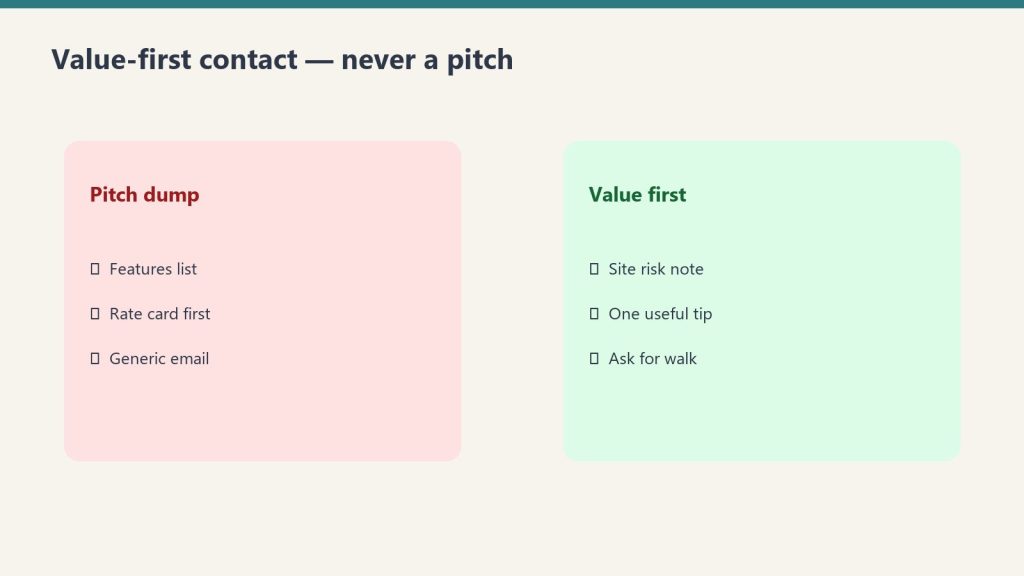
    None of these require a sales pitch. None of them should have a sales pitch. The moment you attach a CTA to a relationship email, you’ve converted it from a community touch into a marketing email, and people feel the difference immediately.


    The Math That Makes This a Strategy, Not a Tactic

    Let’s run a simple scenario. A restoration company has been operating for five years. They’ve completed 600 jobs. Their CRM has 600 homeowner contacts plus 200 industry contacts (adjusters, agents, vendors, subs) — 800 total, all local, all warm.

    They send a hiring email. Open rate for a warm, local database is typically 30–45%. That’s 240–360 people who see your company name, read that you’re growing, and think about you for 30 seconds. Some reply. A handful refer someone. Maybe you hire one person from a referral.

    But here’s what actually happened: 300 people just got a brand impression from your company for free. Some percentage of those people will have a neighbor ask them about restoration services in the next 12 months. Some of them are adjusters who are looking at your brand name right as they’re assigning a claim. Some of them are agents who are going to recommend a restoration company to a client next week.

    Now do this four times a year. Hiring email in Q1. Vendor ask in Q2. Educational resource in Q3. Company milestone or community event in Q4. You’ve touched your entire warm database four times in twelve months for the cost of an email platform and a few hours of writing time.

    Your $400-per-lead PPC campaign cannot buy what that touch cadence builds.


    The System: Building a CRM Touch Calendar for Restoration

    The reason most companies don’t do this is not lack of intention. It’s lack of system. When you’re running jobs, managing crews, handling supplements, and fighting with adjusters, a quarterly email to your database is not going to happen unless it is on a calendar with an owner and a template.

    Here is the minimum viable system:

    Step 1: Segment your CRM. You need at minimum three segments: past homeowner clients (local), industry contacts (adjusters, agents, PAs), and trade contacts (vendors, subs, partners). Each segment gets slightly different framing on the same message. The homeowner version of the hiring email is warmer and more personal. The adjuster version is more professional. The sub version is peer-to-peer.

    Step 2: Build a 12-month touch calendar. Map out the four to six touches you’ll make this year before the year starts. Assign each one a trigger type from the taxonomy above. Some will be tied to real business events (when you actually hire); others can be evergreen (the educational resource can go out every January before storm season).

    Step 3: Write the templates. The hiring email template takes 30 minutes to write and can be reused every time you hire. The vendor ask template takes 20 minutes. Once these exist, the execution cost per touch is near zero.

    Step 4: Track the signal. Every reply is signal. Every referral is data. Every response from an adjuster who says “hey, I was just thinking about you” is a relationship that needed warming. Build a simple log of who responded and what they said. Over time, this becomes the most valuable intelligence you have about which contacts are actually in your community.


    What This Builds Over Time

    The companies in the restoration industry that win long-term referral pipelines are not necessarily the ones with the best Google rankings or the highest review counts. They are the ones whose name comes to mind first when someone needs to make a recommendation.

    Top-of-mind awareness in a local market is not built by advertising. It is built by presence. Consistent, relevant, human presence in the lives of people who already know you.

    Your CRM is not a list of people who used you once. It is a network of people who have direct, personal experience with your company — and who, with the right cultivation, will become the distributed sales force that no lead broker can compete with.

    The next time you post a job opening, send the email. See what happens. Then do it again with the vendor ask. Then again with the educational resource. By the time you’ve done it four times, you will have a community. And your competitors will still be paying $400 a lead to meet people who have never heard of them.


    Frequently Asked Questions

    Is it appropriate to email past homeowner clients for non-service reasons?

    Yes, provided the contact is warm (they’ve done business with you), the reason is genuine (you actually are hiring), and there’s no sales pitch attached. A hiring email or a vendor referral ask is a human, peer-level communication — not marketing spam. Most recipients appreciate being asked for their opinion or their help.

    How often should a restoration company contact their CRM?

    A minimum of four times per year is enough to maintain top-of-mind awareness without overwhelming contacts. Six times per year is sustainable if each touch has a genuine trigger. More than monthly for a non-service communication risks feeling like a marketing list rather than a community relationship.

    What email platform should I use for CRM outreach?

    Any standard email marketing platform (Mailchimp, Constant Contact, HubSpot, or even your CRM’s built-in email) works for this. The key is segmentation capability (homeowners vs. industry contacts vs. trade contacts) and basic analytics (open rate, click rate) so you can see who’s engaging.

    What if we don’t have a formal CRM?

    Start with what you have. Even an exported list of completed jobs from your job management software, sorted by zip code and filtered to local contacts, is a CRM. The strategy works with a spreadsheet and a Mailchimp free account. Build the system around the behavior, not the tool.

    Should the hiring email come from the owner or from HR?

    From the owner, always, for homeowner and industry contacts. The personal relationship was built on the owner’s credibility. A generic HR communication breaks the human connection that makes this work. For trade contacts, a project manager or ops lead can send it credibly.

    What happens if someone unsubscribes?

    Respect it, honor it immediately, and don’t worry about it. Unsubscribes from a warm database are typically low (under 2%) when the content is relevant and non-salesy. The people who unsubscribe were unlikely to refer you anyway. The people who stay are your community.

    Can this strategy work for commercial restoration clients as well?

    Yes, with modified framing. Commercial contacts (property managers, facility directors, HOA boards) respond well to vendor sourcing requests, educational content on maintenance and prevention, and event invitations. The hiring email works in commercial too — facility managers often know trades workers in their buildings or communities.


  • Two Fights, One Job: Why RH and GPP Belong in Your Documentation (Just Not Where You Think)

    Two Fights, One Job: Why RH and GPP Belong in Your Documentation (Just Not Where You Think)

    Andy McCabe published something sharp recently, and my first instinct was to push back.

    His post was direct: RH and GPP have nothing to do with your dehumidifier calculation. The ANSI/IICRC S500 doesn’t use them. TPAs are weaponizing them to deny equipment that’s legitimately justified by the actual standard. His argument is airtight, and I told him so in the comments — after I pushed back on one thing.

    Here’s the double take I had to do.

    What McCabe Got Right About Equipment Justification

    The S500 Simple Method is not ambiguous. Dehumidifier calculations start with the cubic footage of affected air in each drying chamber, the class of water loss, and the type of equipment on the truck. A Class 2 loss with an LGR uses a factor of 50 to establish a minimum pint-per-day baseline. A Class 1 uses 100. A Class 3 uses 40. Desiccants are calculated in air changes per hour entirely.

    What you will not find anywhere in that calculation: a field for relative humidity. Or grains per pound.

    When a TPA tells you they won’t approve a dehumidifier because RH isn’t at 70%, they’ve invented a threshold that doesn’t exist in any published standard. McCabe’s response to that Liberty Mutual TPA was exactly right: “What standard is that?” They pointed to their own internal guidelines. Not the S500. Not IICRC. Their guidelines.

    That’s the game — and leading your documentation with atmospheric readings as the justification for your equipment is handing them the tool they use to deny you.

    Stop justifying equipment with RH and GPP. The S500 math is your argument. Use it.

    What I Pushed Back On — and Then Reconsidered

    When I responded to McCabe’s post, I drew on years at Polygon/Munters doing large-loss drying — aircraft carrier decks, document archives, new high-rise commercial construction mid-build. In those environments, RH, GPP, and temperature weren’t optional reads. They were the difference between a completed job and a catastrophic materials failure.

    I’ve seen what happens when you dry too aggressively. And I’ve seen the liability that follows.

    The more I sat with it, the more I realized McCabe and I weren’t in conflict. We were talking about two completely different fights happening on the same job.

    The Two-Track Documentation Standard

    Every water loss has two defensible positions that require documentation. Most contractors are only building one of them.

    Track 1: Equipment Justification (McCabe’s Lane)

    Show your dehu calculation per the S500 — cubic footage, drying class, equipment type, the published factor. Show your air mover count based on affected square footage and materials above dry standard. Show moisture readings proving materials haven’t yet reached the established dry standard.

    This documentation defends your equipment billing against TPA denials based on invented atmospheric thresholds. It’s the argument that holds up in a dispute because it’s grounded in a published ANSI standard — not your opinion, not the adjuster’s internal policy.

    Track 2: Materials Science Documentation (The Lane McCabe Didn’t Cover)

    Here’s where atmospheric readings earn their place in your job file — just not as equipment justification.

    Flooring manufacturers explicitly tie warranty coverage to ambient RH maintenance. Hurst Hardwoods voids their warranty if ambient RH drops below 35% during the life of the floor, citing cracking, delamination, and shrinkage as direct consequences of low humidity. Engineered hardwood manufacturers commonly require 30–50% RH maintenance and list surface checking from improper humidity as an explicit warranty exclusion. Even SERVPRO’s own published guidance notes that rapid drying can cause wood to split.

    This isn’t theoretical. When you dry too aggressively — pushing humidity below manufacturer-specified ranges, running heat drying beyond material tolerances, pulling GPP down faster than the materials can handle — you can void the warranty on floors, adhesives, and engineered wood products that weren’t even damaged by the water event itself.

    Now the homeowner has a materials failure claim three months after you packed out. And the carrier has a documented argument that the damage was caused by the restoration, not the loss.

    Your atmospheric logs are your proof that you didn’t do that.

    What This Looks Like in Practice

    The documentation standard that protects you on both tracks looks like this:

    For equipment: S500 dehu calculation showing class, cubic footage, equipment type, and the published factor. Air mover count tied to affected square footage and material readings above dry standard. Nothing about RH or GPP as justification.

    For materials: Continuous atmospheric logs showing that ambient RH stayed within the manufacturer-specified range for every material type on-site throughout the dry. Temperature logs showing you didn’t apply excessive heat. A record that proves you dried professionally, not just fast.

    One set of data protects you from equipment denials. The other protects you from being blamed for the cracked hardwood, delaminated adhesives, and voided warranties that surface after you’re gone.

    The Bottom Line

    Andy McCabe is doing important work calling out the TPA game of inventing atmospheric thresholds to deny legitimately justified equipment. Every restoration contractor should read his post and internalize the S500 math.

    But don’t stop taking atmospheric readings. Stop leading with them as equipment justification — and start filing them as materials science documentation that proves the quality of your work.

    Two fights. Two documentation tracks. Both matter.

    Find more from Andy McCabe at WaterDamageProfit.com.

    Frequently Asked Questions

    Do RH and GPP belong in a dehu calculation?

    No. Per the ANSI/IICRC S500, dehumidifier calculations use cubic footage of affected air, drying class, and equipment type. RH and GPP are not inputs in the S500 Simple Method and should not be used to justify equipment placement.

    Why should restoration contractors still log RH and GPP?

    Atmospheric readings serve as materials science documentation — proof that drying conditions stayed within manufacturer-specified humidity ranges to protect warranty coverage on hardwood floors, adhesives, and engineered wood products. They protect against post-job liability claims, not equipment denials.

    Can aggressive drying void a flooring warranty?

    Yes. Multiple hardwood flooring manufacturers explicitly void warranties when ambient RH drops below 35%, citing cracking, delamination, and shrinkage as direct results. Drying below those thresholds can create a liability exposure on materials that were undamaged by the original water event.

    What is the S500 Simple Method for dehu calculations?

    The ANSI/IICRC S500 Simple Method calculates minimum dehumidifier capacity by dividing the cubic footage of the drying chamber by a factor based on equipment type and drying class. Class 1 uses a factor of 100, Class 2 uses 50, and Class 3 uses 40 for LGR units.

    What should restoration contractors say when a TPA denies equipment based on RH?

    Ask them to cite the published standard their threshold comes from. If they reference an internal guideline rather than the ANSI/IICRC S500, that threshold has no technical standing. Present your S500-based calculation as the documented industry standard for equipment justification.

  • Restoration Niche Pack: IICRC Entity Injection and FAQPage Schema for Restoration Contractors

    Restoration Niche Pack: IICRC Entity Injection and FAQPage Schema for Restoration Contractors

    What Is the Restoration Niche Pack?
    A targeted optimization pass on your 10 highest-traffic restoration posts — injecting IICRC standards references, RIA industry entity signals, EPA mold guidelines, and OSHA citations throughout your content, then adding FAQPage JSON-LD schema on every post. The result: your content reads (and ranks) like it was written by someone who actually knows restoration, not a generic SEO copywriter.

    Why Generic Restoration Content Fails

    Generic restoration content has a tell: it mentions “water damage” and “mold remediation” without ever referencing the IICRC S500 standard, the Restoration Industry Association (RIA), Class 3 water losses, psychrometric calculations, or EPA 402-K-02-003. Google and AI systems both recognize entity-rich industry content as more authoritative than keyword-stuffed generic copy — and so do adjusters and property managers reading it.

    The search engines and AI systems that increasingly control discovery have trained on authoritative industry sources. When your content references the same entities those sources use — IICRC standards, RIA guidelines, ANSI/IICRC S520, EPA remediation thresholds — it reads as part of the same knowledge graph. When it doesn’t, it reads as filler.

    The Restoration Niche Pack injects the named entities that separate expert content from generic content — then adds FAQPage schema so your posts are eligible for the featured snippet placements that restoration queries are increasingly winning.

    What the Pack Covers (Per Post)

    • IICRC entity injection — Relevant standards (S500, S520, S540, S600) referenced naturally within content based on post topic
    • RIA references — Restoration Industry Association signals where applicable
    • EPA citations — Mold remediation guidelines (EPA 402-K-02-003) and relevant environmental standards
    • OSHA references — Worker safety standards for applicable content (asbestos, mold, confined space)
    • Local entity reinforcement — Service area, local licensing bodies, and regional climate/building context
    • FAQPage section + JSON-LD — 5–6 Q&As covering the questions adjusters, homeowners, and property managers actually ask
    • Speakable schema — Key paragraphs marked for voice search and AI synthesis

    The Entity Stack by Restoration Vertical

    Entity injection is not one-size-fits-all. Each restoration vertical has its own authoritative standards body, regulatory framework, and industry terminology. Here is what gets injected by vertical:

    Water Damage

    The IICRC S500 Standard for Professional Water Damage Restoration is the primary reference — specifically its water damage classification system (Class 1 through Class 4) and contamination categories (Category 1, 2, and 3 water). Content references psychrometric principles, evaporation rates, grain depression calculations, and the role of LGR (Low Grain Refrigerant) dehumidifiers. The Restoration Industry Association (RIA) is cited as the industry advocacy body.

    Mold Remediation

    The IICRC S520 Standard for Professional Mold Remediation provides the remediation protocol framework. EPA 402-K-02-003 (the EPA Mold Remediation in Schools and Commercial Buildings guide) is cited for regulatory context. Content references containment protocols, HEPA air filtration, negative air pressure chambers, and post-remediation verification testing requirements.

    Fire and Smoke Damage

    The IICRC S700 Standard for Professional Fire and Smoke Damage Restoration is the primary standard. Content references smoke residue types (wet, dry, protein, fuel oil), pH-balanced cleaning chemistry, and deodorization protocols including thermal fogging and hydroxyl generation.

    Asbestos and Environmental

    OSHA 29 CFR 1926.1101 governs asbestos work in construction. EPA NESHAP (National Emission Standards for Hazardous Air Pollutants) regulations apply to demolition and renovation work. Content references proper notification procedures, air monitoring, and disposal requirements under applicable state regulations.

    Why FAQPage Schema Matters for Restoration

    Restoration queries are intent-rich and question-heavy. “How long does water damage remediation take?” “What does a Category 2 water loss mean?” “Is mold remediation covered by homeowners insurance?” These are not informational queries — they are pre-decision queries from homeowners and property managers about to make a hiring decision.

    FAQPage schema makes your answers eligible for Google’s featured snippets and People Also Ask placements. When your answer appears in position zero for “how long does water damage restoration take,” you have captured the attention of a prospect who hasn’t clicked your competitors yet. The Restoration Niche Pack writes these FAQs around the actual questions your target customers ask — not generic SEO-filler questions.

    AI systems including ChatGPT, Claude, and Perplexity also preferentially cite structured, entity-rich content when answering user questions about restoration topics. A post that references IICRC S500, uses proper industry terminology, and includes a structured FAQ section is significantly more likely to appear in AI-generated answers than generic content covering the same topic.

    Pricing

    Package Posts Price
    Standard Pack 10 posts — entity injection + FAQPage schema $399
    Deep Pack 10 posts — entity injection + FAQPage + speakable + content expansion where thin $699

    Who This Is For

    Restoration companies with an existing WordPress site and at least 10 published posts who are ranking but not converting, or ranking page 2 for queries where page 1 competitors have entity-rich content. Also the right move after a taxonomy rebuild when your content foundation is clean and ready for entity-level optimization.

    The pack works best for companies that have invested in content volume but haven’t yet differentiated it from competitors — the dozens of restoration sites that all say “24/7 emergency water damage restoration” without the entity density that separates expert content from boilerplate.

    What the Pack Does Not Include

    The Restoration Niche Pack optimizes existing content — it does not write new posts. It does not include technical SEO audits, site speed optimization, or link building. It is specifically an entity injection and schema markup operation on your existing highest-traffic posts. If your site needs new content, the Fractional AI Content Infrastructure service covers the full content production stack.

    Get IICRC Entities and FAQPage Schema on Your Top 10 Posts

    Share your restoration site URL. We’ll identify your 10 best candidates and confirm the pack scope before you commit.

    will@tygartmedia.com

    Email only. No commitment to reply. Turnaround quoted within 1 business day.

    Frequently Asked Questions

    Does this work for all restoration verticals (water, fire, mold, asbestos)?

    Yes — the entity set is adapted by vertical. Water damage posts get IICRC S500 and psychrometric references. Mold posts get EPA 402-K-02-003 and IICRC S520. Fire/smoke posts get IICRC S700. Asbestos posts get OSHA and EPA NESHAP references.

    Will this change the readability of my existing content?

    Entity injection is contextual — we add entities where they fit naturally, not as a keyword list. Most readers won’t notice the additions. What they’ll notice is that the content sounds more authoritative.

    Does the FAQ content get written fresh or pulled from existing content?

    For the Standard Pack, FAQs are written fresh based on the post topic and the questions your target audience actually searches. For posts that already have Q&A sections, we upgrade the existing questions and add schema rather than replacing them.

    How long does the Restoration Niche Pack take to complete?

    Standard Pack turnaround is 3–5 business days after site access is provided. Deep Pack turnaround is 5–7 business days. All work is done via WordPress REST API — no plugin installs or CMS access required beyond application password credentials.

    Do I need a specific SEO plugin for the schema to work?

    No plugin is required. Schema is injected as JSON-LD script blocks in post content, which is the method Google recommends and which works independently of Yoast, RankMath, or any other SEO plugin. If you have an SEO plugin, we check for conflicts before injection.


    Last updated: June 2026

  • How to Write Restoration Content That Captures Insurance Claim Research Traffic

    How to Write Restoration Content That Captures Insurance Claim Research Traffic


    Tygart Media — Restoration Content Strategy

    How to Write Restoration Content That Captures Insurance Claim Research Traffic

    By Tygart Media Updated: April 12, 2026
    The insurance research funnel: A homeowner who has just filed a water damage claim spends days researching before making a second call. They search “will insurance pay for all of my water damage,” “what does RCV vs ACV mean on my claim,” “how does a public adjuster work,” and “what happens if the adjuster underpays my claim.” The restoration company whose content answers these questions during that research window earns trust before the supplement, before the scope dispute, and before the next job referral.

    Why Insurance Claim Content Is the Highest-Value Restoration Content Type

    Most restoration company blogs publish content about their services — what they do, how they do it, why they’re certified. This content attracts homeowners at the moment of crisis. But the homeowner who is three days into an insurance claim — already through the emergency phase, now navigating the adjuster, the scope, the depreciation schedule — is searching for information that almost no restoration company provides.

    That gap is a significant content opportunity. Insurance claim research content is longer in the research cycle, higher in trust-building value, and more likely to produce referral relationships with the homeowner’s network because the homeowner who felt educated and supported during a confusing claim process tells everyone about it.

    What insurance claim content should restoration companies publish on WordPress?
    Restoration companies should publish insurance claim content addressing the questions homeowners research after filing: RCV vs ACV coverage (replacement cost value vs actual cash value), the supplemental claim process for additional damage discovered during restoration, how Xactimate estimating software determines scope of work, what documentation IICRC S500-compliant drying reports provide to support claims, the difference between a staff adjuster and an independent adjuster, and when a public adjuster might be appropriate. This content addresses the high-intent research phase that separates trusted restoration contractors from generic vendors.

    The Five Insurance Claim Content Topics That Build Restoration Authority

    1. RCV vs ACV — What Your Policy Actually Covers

    Replacement Cost Value (RCV) vs Actual Cash Value (ACV) is the most-searched insurance term by homeowners with active water damage claims. An article explaining the difference — with specific examples of how depreciation is applied to flooring, drywall, and personal property — using precise insurance terminology (recoverable depreciation, holdback, recoverable vs non-recoverable depreciation) earns both Google entity signals and AI citation probability for high-intent insurance research queries.

    2. What Xactimate Means for Your Claim

    Xactimate is the industry-standard estimating software used by most insurance adjusters. Homeowners who have received an Xactimate estimate and don’t understand it search for explanations. A restoration company article explaining how Xactimate line items work, what “F9” notes mean, how equipment hours are documented, and why IICRC S500-compliant drying logs support the equipment line items on the estimate — this is high-value, low-competition content that no generic SEO agency for restoration companies is writing.

    3. The Supplemental Claim Process

    Supplemental claims — additional damage discovered after initial scope — are common in restoration and confusing to homeowners. An article explaining when supplemental claims are legitimate, how they’re documented, and what a restoration contractor’s role is in supporting the supplement creates authority at a point in the process where homeowners are especially uncertain and especially likely to trust a contractor who demonstrates knowledge.

    4. IICRC Documentation and What Adjusters Require

    Homeowners often don’t know that IICRC S500-compliant documentation — moisture maps, psychrometric logs, equipment placement records, drying verification reports — is what adjusters use to approve and validate restoration scopes. An article explaining this connection, written from a contractor’s perspective, signals E-E-A-T expertise and answers a question homeowners search but rarely find answered on a restoration company’s website.

    5. How to Read and Respond to an Adjuster’s Estimate

    This is the content homeowners search most during the claims process, and the content that produces the most direct calls to a restoration contractor who has earned trust through the article. Explaining what line items are commonly missed, what depreciation is recoverable, and how a contractor’s scope compares to an adjuster’s estimate positions the restoration company as a knowledgeable advocate — not just a vendor.

    Insurance claim entity injection — Xactimate, RCV/ACV, IICRC documentation references — is part of the GEO layer in WordPress content optimization for restoration companies through SiteBoost. Applied to existing articles without changing factual content.

    Frequently Asked Questions

    Is writing about insurance claims appropriate for restoration companies?

    Yes, from an educational and informational perspective. Restoration contractors regularly interface with insurance claims as part of their work and have genuine expertise about the documentation, process, and standards involved. Educational content explaining how claims work from a contractor’s perspective — not as legal or insurance advice, but as informed industry guidance — is appropriate, valuable, and builds the kind of E-E-A-T authority that both Google and homeowners respect. Content should always disclaim that it is educational and not legal or insurance advice.

    What insurance entities should restoration content reference?

    High-value insurance entities for restoration content include: Xactimate (Verisk’s estimating platform used by most adjusters), RCV and ACV (defined insurance coverage types), IICRC S500 documentation standards as claim support material, the National Flood Insurance Program (NFIP) for flood-specific claims, and independent adjuster vs staff adjuster distinction. These named entities signal that the content reflects genuine contractor knowledge of the insurance claim process rather than generic homeowner advice.

    How does insurance claim content build restoration company referrals?

    Homeowners who feel educated and supported during a confusing insurance claim process are significantly more likely to refer the contractor who helped them understand it. Insurance claim research content creates touchpoints during the high-anxiety research phase — when the homeowner is most receptive to trusting a knowledgeable contractor — and positions the restoration company as an advocate rather than a vendor. This trust translates into referrals to neighbors, family members, and property managers who experience future water damage.

    Sources: Blueprint Digital, “Water Damage Restoration SEO” (2026); Xactimate documentation (Verisk Analytics); IICRC S500 Standard for Professional Water Damage Restoration; Whitespark Local Search Ranking Factors Study (2025)
  • Why Restoration Company Blog Posts Don’t Generate Calls (And What to Fix)

    Why Restoration Company Blog Posts Don’t Generate Calls (And What to Fix)


    Tygart Media — Restoration Content Strategy

    Why Restoration Company Blog Posts Don’t Generate Calls (And What to Fix)

    By Tygart Media Updated: April 12, 2026
    The restoration blog problem: A homeowner discovers water damage at 11pm. They search “what to do after a pipe burst” or “how fast does mold grow after water damage.” If your blog article exists but has no meta description, no FAQ schema, and no IICRC entity references, Google has no reason to surface it — and neither does ChatGPT. The article exists. It just never gets found.

    Restoration Searches Are Emergency Searches — Optimization Has to Match

    Water damage restoration is one of the few industries where the customer’s timeline is minutes, not days. According to Blueprint Digital’s 2026 water damage SEO analysis, high-intent searches like “water damage repair near me” or “emergency water extraction” often convert to calls within minutes of the search. That urgency creates a specific content requirement: the article needs to appear, answer the question directly, and provide a clear next step — all before the homeowner finds a competitor.

    Most restoration company WordPress blogs fail at all three. The posts exist but don’t appear because they lack optimization. They don’t answer questions directly because they were written as general service descriptions. And they don’t provide a clear next step because the CTA was an afterthought.

    Why don’t restoration company blog posts rank despite regular publishing?
    Restoration company blog posts fail to rank when they lack the optimization signals Google uses for emergency local content: a title tag that matches the homeowner’s actual search query (“what to do after a pipe bursts” not “our water damage services”), a written meta description with a direct action signal, FAQPage schema targeting the questions homeowners ask during a water damage crisis, and IICRC certification and RIA membership entity references that signal industry authority. Without these signals, the article competes for positions it has no basis to win.

    The Four Fixes — In Order of Impact

    1. Rewrite Titles for Emergency Intent

    Restoration content titles almost universally describe the company’s service rather than matching the homeowner’s search query. “Our Water Damage Restoration Process” describes your operation. “What to Do Immediately After Water Damage (First 24 Hours)” matches a homeowner searching in a crisis. Emergency intent keywords — “immediately,” “fast,” “what to do,” “how long,” “is it safe” — are the search triggers that precede a call. The title needs to capture those triggers first.

    2. Add IICRC and RIA Entity References

    Google’s quality evaluators assess restoration content for named industry credentials. An article about water damage that references “IICRC S500 Standard for Professional Water Damage Restoration,” mentions the “Restoration Industry Association (RIA)” as the industry body, and cites “ANSI/IICRC S520 Standard for Professional Mold Remediation” signals genuine restoration expertise. These named entities are also what AI systems use to determine whether a restoration article represents real industry knowledge or generic homeowner advice.

    3. Add FAQ Schema Targeting the Crisis Questions

    Restoration homeowners ask very specific questions during a crisis: “How long before water damage causes mold?”, “Will insurance cover my water damage?”, “How long does water damage restoration take?”, “Is my house safe after water damage?” A FAQ section with direct answers to these questions, combined with FAQPage JSON-LD schema, positions your article for People Also Ask placements — which appear above organic results for these exact emergency queries.

    4. Add a 24/7 Emergency CTA in the Article Body

    Blog posts that generate calls have a visible, urgent CTA embedded in the article body — not just in the footer. “Water damage worsens every hour. Call [number] for 24/7 emergency response.” This CTA converts the reader who found your article at 2am and is ready to call right now — not the reader who completes the article, navigates to your contact page, and calls during business hours.

    All four fixes — emergency-intent title rewrites, IICRC entity injection, FAQPage schema, and CTA optimization — are part of WordPress content optimization for restoration companies through SiteBoost. Applied to your existing article library, pushed live via WordPress REST API.

    Frequently Asked Questions

    What restoration keywords actually drive calls, not just traffic?

    Emergency-intent keywords drive calls: “water damage repair near me,” “emergency water extraction,” “flooded basement cleanup,” “burst pipe water damage,” “sewage backup cleanup.” These phrases signal active crisis — someone searching them is ready to call within minutes. Research keywords like “how long does water damage restoration take” drive lower-urgency traffic but build trust during the insurance claim research phase. Both matter, but emergency keywords should be prioritized on service pages and emergency CTAs.

    Should restoration companies blog about prevention or restoration?

    Both, but for different funnel stages. Prevention content (“how to prevent pipes from freezing,” “signs of hidden water damage”) attracts homeowners before a crisis and builds brand awareness. Restoration content (“what to do after a pipe bursts,” “how long does mold take to grow after water damage”) captures homeowners in an active crisis — the highest-converting traffic. Prioritize restoration process and crisis content first, then build prevention content as a secondary funnel.

    How does IICRC certification help restoration company SEO?

    IICRC certification signals credibility to both Google’s quality evaluators and homeowners evaluating contractors. In content, referencing specific IICRC standards — S500 for water damage, S520 for mold, S770 for sewage — by name creates named entity anchors that Google associates with genuine restoration industry expertise. This entity signal is also what AI systems like ChatGPT use when evaluating whether a restoration article represents real industry knowledge worth citing.

    Sources: Blueprint Digital, “Water Damage SEO: How to Rank Higher and Win More Local Jobs” (2026); Aziel Digital, “Water Damage SEO Secrets: How Restoration Companies Rank #1” (2026); Peterson SEO Consulting, “Water Damage SEO for Restoration Contractors” (2025); IICRC S500 Standard for Professional Water Damage Restoration