Tag: Restoration Content

  • Tiered Approval Authority: The SOP That Protects Your Margin on Night-and-Weekend Calls

    Tiered Approval Authority: The SOP That Protects Your Margin on Night-and-Weekend Calls

    What is tiered approval authority in a restoration company? Tiered approval authority is a documented SOP that defines, by dollar amount and job type, who on the team can commit the company to start work, sign a change order, or approve a scope change. It gives operators the authority to respond fast on small jobs and enforces scope discipline on large ones.


    A restoration owner I was talking to recently described his approval process like this: “Anything big, it comes to me. Anything small, the PM handles it.”

    That is not an approval structure. That is the absence of one. And it is costing his company money at both ends of the spectrum.

    At the big end, scope decisions on commercial losses — the ones that should be pressure-tested by an estimator, a senior PM, and ideally the carrier contact before the commitment — get made by the owner alone because “anything big comes to me.” At the small end, the Sunday-afternoon emergency call — the one that needs a yes-or-no inside of fifteen minutes before the customer calls the next name on the carrier’s list — sits waiting for the PM to check with the owner because “anything unusual comes to me.”

    Both ends leak money. A documented, tiered approval authority closes both leaks with the same SOP.

    Why the Small-Dollar Tier Is Where the Margin Actually Hides

    The instinct among restoration owners is to treat approval authority as a tool for protecting the company from big, expensive mistakes on large losses. It is that. It is also much more than that.

    The margin that leaks out of restoration companies at the small end is harder to see because it does not show up as a loss. It shows up as revenue that never arrived.

    Consider the Sunday afternoon during a football game. A property manager calls the after-hours line. A water loss, not an enormous one, maybe $2,500 of emergency services before a carrier is even involved. The operator on call has two choices. Roll a crew. Don’t roll a crew. If there is no documented tier that gives the operator the authority to commit to that dollar amount without calling the owner, one of two things happens.

    The call gets bounced up to voicemail, a text, a “let me try to reach the owner.” Forty-five minutes go by. The property manager calls the next restoration company on the carrier’s list. That crew rolls. That revenue is gone, and — more consequentially — that property manager now has a new primary relationship.

    Or the operator commits without authority, rolls the crew, and the owner finds out on Monday. The revenue gets captured but the company has just learned that it cannot trust its own on-call operator to hold a line. Which means the next time, the owner is going to try to be on every call personally. Which means the owner becomes the bottleneck. Which caps the company.

    Both failure modes are versions of the same disease: the absence of a written, enforced, trained-to tier that says the operator on call can commit the company up to $X for this kind of work, without asking, and the company will back that commitment.

    The SOP does not exist to protect the company from the operator. It exists to give the operator the authority to act at the speed the business requires.

    Why the Large-Dollar Tier Protects Scope Discipline

    At the other end of the spectrum, a $500,000 commercial loss needs the opposite kind of discipline. That number should not be committed to by one person. Not by the owner alone. Not by the senior PM alone. Not by anyone alone.

    The reason is not fear of the decision being wrong. The reason is that large-loss scope is the single most consequential document a restoration company writes, and scope written by one person is scope that reflects one person’s blind spots.

    A documented approval tier for large work requires that specific roles participate before the commitment is made. Estimator verifies scope against job type benchmarks. Senior PM pressure-tests the operational assumptions. Someone on the commercial side — owner, VP, whoever plays that role — signs off on carrier positioning and payment structure. The approval is not a rubber stamp. It is the forcing function that catches the margin errors before they are baked into the job.

    The companies that consistently hold margin on large loss work are not the ones with the best estimators. They are the ones with the best documented approval discipline. Multiple eyes on the scope before it leaves the building. Every time. Without the approval SOP, every large loss is a one-person decision and every one-person decision eventually produces a miss.

    What the Tier Structure Actually Looks Like

    A working tier structure has a few consistent properties across every restoration company I have seen it deployed in, even though the specific dollar thresholds vary by size and market.

    Tier 1 — Operator authority. Emergency services commitment up to a defined dollar amount, by job type, during on-call hours. No approval required. Logged in the documentation layer at time of commitment, reviewed on the next business day by the PM and operations lead. The operator has the authority to act. The system has the visibility to catch a pattern if one emerges.

    Tier 2 — PM authority. Standard job scope commitment, change orders up to a defined dollar amount, subcontractor engagement within approved panel, scope extensions within scope benchmarks. PM owns the decision. Estimator and ops lead have visibility via the documentation layer.

    Tier 3 — Ops and estimating collaboration. Jobs above the PM tier, change orders that move the job outside original scope benchmarks, carrier escalation decisions. Requires estimator and ops lead both to sign off before the commitment is formalized.

    Tier 4 — Executive approval. Large loss commitments above a defined threshold, program work with rate implications, exceptions to payment terms. Requires owner or designated executive plus the operating team that would carry the job. Multiple eyes. Always.

    The specific numbers are bespoke. A $3M restoration company and a $30M restoration company will not use the same thresholds. What matters is that the tiers exist, are written down, are known by every person in the approval chain, and are enforced when tested.

    The Tier Only Works Because the Documentation Layer Exists

    A tiered approval matrix is a piece of paper. A piece of paper that nobody follows is worse than no piece of paper at all, because it produces the illusion of discipline without the substance.

    The reason a tier structure holds in practice is the documentation layer underneath it. Every commitment — Tier 1 through Tier 4 — gets captured in a central system at time of commitment, with amount, scope, job type, and the person who authorized it. That capture makes the tier auditable. It makes the review in the WIP Board meeting possible. It makes the feedback loop real.

    Without the documentation layer, the tier is aspirational. With it, the tier is a live operating discipline. This is why the documentation layer article comes before this one. The tier is downstream of the layer.

    What Owners Usually Get Wrong

    A few consistent mistakes show up when restoration owners try to build approval authority without documenting it properly.

    They set the thresholds too low. The PM has authority up to $5,000 in a company where the average residential water loss runs $8,500. That means every average job bounces to the owner. The bottleneck reopens immediately.

    They do not train to the SOP. The document exists but the operator on call does not know what their tier actually is, or does not trust that the company will back the commitment they make inside their tier. So they do not use it. The SOP dies in the field.

    They do not enforce it at the top end. Large loss work keeps getting committed by one person because the tier is inconvenient to follow when speed matters. The discipline erodes. Every quarter the gap between the approval SOP and what actually happens gets a little wider until the SOP is fiction.

    They treat the tier as a static document. The thresholds never adjust to match job cost inflation, the company’s growth, or the patterns the documentation layer reveals. The tier that worked three years ago now produces the wrong incentives. Without an annual review, the SOP calcifies.

    Building the Tier — Where to Start

    If you do not have a tiered approval authority today, here is the minimum first pass.

    Define two tiers, not four. Operator authority for after-hours emergency services up to a defined dollar amount. Everything else routes to the PM or owner until you have visibility into the pattern.

    Document the operator tier as a one-page SOP: amount, job type, scope, logging requirement, review cadence. Put it in the documentation layer. Train every on-call operator to it. Back the commitment when it gets tested the first time — that first test is where the SOP either gets internalized or gets abandoned.

    Run the tier for ninety days. At review, look at how many commitments hit the limit, how many were right calls, how many produced margin problems. Use the pattern to adjust the threshold, extend the tier to a second category of work, and build Tier 2 on top.

    You are not trying to build the perfect approval matrix on day one. You are trying to install the operating discipline of committing on behalf of the company by documented authority, not by ad hoc conversation. Once that discipline exists, extending it to additional tiers is incremental.

    What This Is Worth

    A restoration company with a well-tuned tier structure captures emergency revenue it would otherwise lose to slower competitors, holds scope discipline on large losses it would otherwise leak, moves the owner out of the decision chain on routine work, and produces the raw data that makes the every-job post-mortem meaningful.

    The math on this is not complicated. A single lost after-hours call is $2,500 to $15,000 of revenue. Three of those a month in a market where the on-call response is marginal is a quarter-million a year in unrealized revenue. A single blown scope on a large loss is often more than that in a single job.

    The tier is one of the highest-leverage SOPs a restoration company can install. It costs almost nothing to build. It requires discipline to hold. And the companies that hold it outcompete the ones that do not — not because they have better operators, but because their operators have the authority to operate.


    Frequently Asked Questions

    What is tiered approval authority in a restoration company?
    A documented SOP that defines, by dollar amount and job type, who on the team can commit the company to start work, sign a change order, or approve a scope change. It gives operators authority to act fast on small jobs and enforces scope discipline on large ones.

    Why does a restoration company need approval tiers for small jobs?
    Because the Sunday-afternoon emergency services call needs a yes inside fifteen minutes before the customer calls the next restoration company on the carrier’s list. Without a documented tier giving the on-call operator authority to commit the company, that revenue is lost to slower decision-making.

    Why does a restoration company need approval tiers for large jobs?
    Large loss scope is the single most consequential document the company writes. Scope written by one person reflects one person’s blind spots. A documented tier that requires estimator, senior PM, and executive sign-off before commitment catches the margin errors before they are baked into the job.

    What are typical tier structures in restoration?
    Four tiers is common: operator authority for after-hours emergency services; PM authority for standard job commitments and change orders within scope; collaborative authority for jobs that exceed PM limits or move outside scope benchmarks; executive authority for large loss commitments and exceptions to standard terms. The specific dollar thresholds are bespoke to company size and market.

    What happens if a restoration company has no documented approval tiers?
    Every decision either bottlenecks on the owner or gets made ad hoc without financial discipline. Emergency revenue leaks to faster competitors. Large loss margin leaks to under-reviewed scope. The owner becomes the cap on the company’s growth because nothing can move without them.

    How often should approval tiers be reviewed?
    At least annually, and any time the company’s size, service mix, or operating environment changes materially. Tiers that are not refreshed drift out of alignment with the job cost reality they were built for.


    Tygart Media on restoration — an analyst-operator body of work on the systems that separate compounding restoration companies from busy ones. No client names. No brand placements. Just the operating standard.


  • The Documentation Layer Is the Financial Foundation of a Restoration Company

    The Documentation Layer Is the Financial Foundation of a Restoration Company

    What is the financial foundation of a restoration company? The financial foundation of a restoration company is not its P&L, its pricing, or its banking relationship — it is the documentation layer that captures what is actually happening across mitigation, reconstruction, billing, sales, and vendor coordination in one place every team can see. Without that layer, every downstream financial number is a guess.


    Most restoration owners who ask me why they aren’t making more money want to talk about pricing, about Xactimate compression, about carriers paying slow, about labor cost going up. Those are real. They are almost never the actual problem.

    The actual problem is that they do not have a documented, centrally-tracked operating standard for how the company does things. Everything else is downstream of that.

    This is the one piece of financial advice for restoration owners that almost no one wants to hear, because it sounds operational instead of financial. It isn’t. A restoration company that cannot see its own work in a single place cannot price it, cannot invoice it on time, cannot hand it off cleanly between departments, cannot learn from it, and cannot defend it when a carrier pushes back. The documentation gap is the financial gap. Every other leak is a symptom.

    Without Documentation, You Don’t Know What Is Happening

    The first failure mode is simple: if nothing is written down, nothing is visible. And if nothing is visible, nobody is operating from the same picture of the job.

    A restoration business is at minimum five distinct functions — ops, sales, content and communications, billing, vendors — and usually more. Most mid-market restoration companies run those functions in five different tools, in five different inboxes, in five different heads. The tech on the job site knows one thing. The PM knows another. The estimator knows a third. The billing clerk is waiting on a signed change order that was verbally approved two weeks ago and never captured.

    When the mitigation crew does not communicate cleanly with the reconstruction team — even when reconstruction is inside the same company — the job leaks money. Content damage that should have been itemized on day one does not make it onto the scope. A cabinet lead time that should have been placed the day of loss is placed three weeks later. A homeowner is told one thing by mitigation and something different by the rebuild PM, and the relationship that was going to produce the referral is already damaged.

    None of those failures show up as a line item on a P&L. They show up as a gross margin three points lower than last quarter, and nobody can tell you exactly why.

    Documentation Is a Visibility System, Not a Filing Cabinet

    When restoration owners hear “documentation,” most of them picture a shared drive full of PDFs nobody reads. That is not the system we are describing.

    The documentation layer is the live, shared operating picture of the business. It is the place where the ops team, the sales team, the billing team, the content team, and the vendors can all see what is happening on every active job and on every SOP that governs how those jobs get run. It is not a filing cabinet. It is a scoreboard.

    A working documentation layer has three properties that a filing cabinet does not:

    It is central, meaning one system of record rather than email threads, text chains, whiteboards, and one-off spreadsheets. Everyone is looking at the same version of the truth.

    It is live, meaning it is updated as the job moves, not after the fact. Documentation that is only written up after a job closes is archival. Documentation that is updated in real time is operational.

    It is recursive, meaning the documentation generates feedback that adjusts the SOPs. Every job teaches the next job. The system gets sharper every week because the information captured this week shapes next week’s standard.

    Filing cabinet documentation does not change behavior. A live, central, recursive documentation layer is what turns a restoration company into a compounding business instead of a busy one.

    The Mitigation-to-Reconstruction Proof

    The fastest way to see whether a restoration company has a working documentation layer is to look at the handoff between mitigation and reconstruction.

    If mitigation wraps, the dry-out certificate is signed, and the reconstruction PM has to re-interview the homeowner to find out what happened — the documentation layer does not exist. If the reconstruction team has to re-photograph the damage because the mitigation photos were never shared in a usable form — the documentation layer does not exist. If the rebuild scope gets written from scratch without visibility into what mitigation did, what carrier questions came up, or what the homeowner actually wants — the documentation layer does not exist.

    The money leak is obvious once you name it: every one of those gaps is time, labor, or margin that you are paying for twice. And the fix is not more software. The fix is a standard that says a mitigation job is not closed until specific artifacts are in a specific place, in a specific format, ready for the rebuild team to operate from on day one. Write that down, train to it, enforce it, and every dollar of margin the handoff currently costs you comes back.

    That is a companion article to this one: the documented mitigation prep standard and the mitigation-to-reconstruction handoff margin cover that specific SOP. It is one of many. But it is the one most owners can feel in their bank account within a quarter of fixing it.

    Tiered Approval Authority: The SOP Most Owners Skip

    One of the most financially consequential SOPs a restoration company can build is a tiered approval structure — and most owners do not have one.

    The mistake is thinking about approvals as a thing you need for a $500,000 commercial loss. You do need one there. You also need one for a $2,500 emergency services call that comes in on a Sunday afternoon during a football game. The operator on call needs to know, without calling you, what dollar authority they have to commit the company to show up and start work. Without a documented tier, one of two things happens: the work does not get committed fast enough and the customer calls the next name on the carrier’s list, or it gets committed without any financial discipline and you find out what happened on Monday.

    A documented approval matrix — amount, job type, conditions, who can authorize — is a piece of paper that makes you money. It turns speed-of-response from a chaotic strength into a repeatable system. It protects margin on large jobs by forcing scope discipline before the commitment. It protects responsiveness on small jobs by putting authority at the right level.

    A full treatment of the approval tier SOP is in a companion article; what matters here is that the approval matrix only exists because the documentation layer exists. Without a central operating picture, the matrix is just a memo nobody follows.

    The WIP Board: Where Documentation Becomes Recursive

    The reason documentation is a financial system rather than an administrative chore is the feedback loop.

    The highest-leverage operating practice I recommend to restoration owners is the cross-functional job review — the WIP Board meeting (Work In Progress), call it whatever your team will actually attend — where representatives from ops, sales, PM leadership, estimating, and billing sit together and walk through the jobs that moved this week. Not just the bad jobs. Every job. A tech. A PM. An ops manager. A billing representative. Whoever on your team can speak for each part of the business without having to go look it up.

    The job review is where estimates get compared to actuals. Where scope creep gets caught before the invoice goes out. Where the subcontractor who missed a deadline gets flagged before the same thing happens on the next job. Where the carrier question that tripped up the PM becomes a new line in the scoping SOP. Where pricing on a category of work gets adjusted because three jobs in a row came in under target margin.

    The WIP Board is the recursive loop. It only works if the documentation layer is there to feed it. If nothing is captured, there is nothing to review. If the captures are in five different systems, the meeting spends its time reconciling data instead of drawing conclusions. A working documentation layer makes the WIP Board a thirty-minute margin clinic. A broken one makes it a two-hour status update that produces nothing.

    The related practice — calling the client after the job, recording the conversation, and capturing the honest feedback — is part of the same system. It is another input into the loop. A full breakdown is in the every-job post-mortem companion piece.

    Why This Is the Financial Foundation, Not the Operations Foundation

    Restoration owners resist calling documentation a financial practice because it does not look like money. It is not a credit facility. It is not a pricing move. It is not an insurance relationship. It is an operating discipline.

    Here is the reframe: the financial outcome of a restoration company — margin, cash conversion, customer lifetime value, enterprise value at exit — is produced by the same five or ten operating behaviors happening on every job. You do not improve the financial outcome by improving the P&L. You improve it by improving the behavior. And behavior is improved by capturing it, documenting the standard, reviewing it against actuals, and adjusting the standard when you find something better.

    That is the financial foundation. Everything else sits on top of it.

    A restoration company with a working documentation layer can raise prices without losing customers because its scope discipline is visible and defensible. It can extend lines of credit at better rates because its DSO and collections practice is documented. It can sell for a higher multiple because the business runs without the owner having to be in every decision. It can pass a carrier program audit without losing a week of billable time. It can train a new PM in ninety days instead of eighteen months. None of those are financial moves. All of them produce financial outcomes.

    Where Owners Start

    If you do not have a documentation layer today, do not try to install one across every function at once. Pick one handoff that bleeds. For most restoration companies that is mitigation-to-rebuild. For some it is estimate-to-invoice. For others it is new-job-intake-to-dispatch.

    Document that one handoff as a written SOP with specific artifacts, formats, and deadlines. Put those artifacts in one central system. Train the people on both sides of the handoff to operate from that standard. Run your WIP Board against it for ninety days. Watch what happens to margin on that job type.

    Then do the next handoff. You are not building a manual. You are building a live scoreboard that the entire company operates from. The financial results follow — they do not lead.

    The restoration companies that compound over a decade have a documentation layer. The ones that plateau at $3 million or $8 million or $15 million and never break through do not. It is very close to that simple. The cost of building one is mostly discipline and a few weeks of focused design. The cost of not building one is everything the company could have been.


    Frequently Asked Questions

    What is the documentation layer in a restoration company?
    The documentation layer is the central, live, recursive system of record for how a restoration company operates — covering SOPs, job-level artifacts, handoffs, approvals, and the feedback loop between functions. It is the shared operating picture every team works from, not a filing cabinet of static documents.

    Why is documentation a financial practice, not an operational one?
    Because every financial outcome — margin, cash conversion, customer retention, valuation at exit — is produced by the behaviors a documentation layer governs. Improve the behavior, the financials follow. Without the documentation layer, the behaviors drift and the financials drift with them.

    What is the first SOP a restoration owner should document?
    Usually the handoff that is costing the most money. For most restoration companies that is mitigation-to-reconstruction. Document that one end-to-end with specific artifacts, formats, and deadlines, put it in a central system, and train to it before moving to the next SOP.

    What is a tiered approval matrix in restoration?
    A documented approval structure that defines, by dollar amount and job type, who on the team can commit the company to start work, sign a change order, or approve a scope change. It gives operators the authority to respond fast on small jobs and protects margin discipline on large ones.

    What is a WIP Board meeting?
    A cross-functional job review where representatives from ops, sales, estimating, PM leadership, and billing walk through every job that moved during the week, compare estimates to actuals, catch scope issues, and adjust SOPs based on what the week revealed. It is the recursive loop that turns documentation into a compounding financial practice.

    Do I need restoration-specific software to build a documentation layer?
    No. The documentation layer is a discipline, not a product. It works in dedicated restoration platforms, general job management tools, or well-structured shared workspaces. What matters is that it is central, live, and recursive — not which vendor’s logo is on the login screen.


    Tygart Media on restoration — an analyst-operator body of work on the systems that separate compounding restoration companies from busy ones. No client names. No brand placements. Just the operating standard.


  • Restoration Crew Onboarding & Training Tracker

    Restoration Crew Onboarding & Training Tracker

    Give every new tech a structured path from day one — and never lose track of who is certified.

    Who This Is For

    Built for restoration owners who are growing their crew but onboarding is chaotic, certifications are tracked in someone’s head, and no one is sure who is cleared to run what equipment.

    The Problem

    Restoration technician turnover is real. When you hire someone new, the first 90 days determine whether they stay. Chaotic onboarding — no clear expectations, no structured training, no visibility into their progress — accelerates the exit. Meanwhile, certification lapses create liability. Knowing who holds WRT, who is overdue for renewal, and who is cleared to operate specific equipment should not require asking around.

    What You Get

    • New hire checklist: day 1, week 1, and month 1 milestones with owner sign-off
    • Certification tracker: WRT, ASD, FSRT, AMRT, CCT, and any custom certs you add
    • IICRC course progress log: completion dates and renewal reminders built in
    • Training module library: add your own procedures, videos, and field guides
    • Equipment sign-off tracker: who is cleared to operate what, with sign-off date
    • Performance notes log for structured 30/60/90 day reviews

    Restoration Crew Onboarding & Training Tracker

    $19

    Delivered to your inbox within 24 hours — no shipping, no waiting

    Buy Now →

    Secure checkout via Square — all major cards accepted

    Frequently Asked Questions

    How is this delivered?

    Within 24 hours of purchase via email from will@tygartmedia.com. You will receive a download link for the ZIP file and/or Notion duplicate link immediately.

    Do I need any special software?

    A free Notion account is required. No other software needed.

    Can I customize this for my specific business?

    Yes — that is the point. Everything is built to be edited. Swap in your company name, add your specific workflows, remove anything that does not apply. It is a starting point, not a locked template.

    Is there a refund policy?

    Because this is a digital product, all sales are final. If you have a problem with your purchase, email will@tygartmedia.com and we will sort it out.

  • Restoration Business KPI Dashboard

    Restoration Business KPI Dashboard

    Know your numbers. Run your business on data instead of gut feel.

    Who This Is For

    Built for restoration owners who are making decisions from memory and instinct because they have no clean view of what is actually happening in their business.

    The Problem

    Most restoration owners can tell you roughly how many jobs they have going. They cannot tell you their average job cycle time, their close rate by lead source, which equipment categories are underutilized, or whether this month is actually better than last year. Running a business without this data is not a strategy — it is luck management. The owners who grow intentionally know their numbers.

    What You Get

    • Revenue tracker: monthly totals by job type and lead source
    • Job count and average job value trending over time
    • Cycle time tracking: from FNOL to final invoice, average and by job type
    • Lead source attribution: where are your best jobs actually coming from
    • Equipment utilization rate by asset category
    • Crew productivity metrics
    • Weekly and monthly summary views — one glance, full picture

    Restoration Business KPI Dashboard

    $29

    Delivered to your inbox within 24 hours — no shipping, no waiting

    Buy Now →

    Secure checkout via Square — all major cards accepted

    Frequently Asked Questions

    How is this delivered?

    Within 24 hours of purchase via email from will@tygartmedia.com. You will receive a download link for the ZIP file and/or Notion duplicate link immediately.

    Do I need any special software?

    A free Notion account is required. No other software needed.

    Can I customize this for my specific business?

    Yes — that is the point. Everything is built to be edited. Swap in your company name, add your specific workflows, remove anything that does not apply. It is a starting point, not a locked template.

    Is there a refund policy?

    Because this is a digital product, all sales are final. If you have a problem with your purchase, email will@tygartmedia.com and we will sort it out.

  • Restoration Company SOP Library

    Restoration Company SOP Library

    Every procedure your crew needs, documented and accessible — not a PDF that lives in a drawer.

    Who This Is For

    Built for restoration owners who know their company needs documented procedures but have never had time to build them.

    The Problem

    Most restoration companies run on institutional knowledge — what the senior tech knows, what the owner remembers, what got passed down verbally on the first job. That works until the senior tech leaves, or a new hire does something wrong, or an adjuster asks for your remediation protocol documentation. Every serious restoration company needs written procedures. Almost none of them have them.

    What You Get

    • Water damage SOPs: intake documentation, extraction, drying setup, daily monitoring, dry-out sign-off
    • Fire and smoke damage SOPs: damage assessment, pack-out procedure, cleaning and deodorization protocols
    • Mold remediation SOPs: containment setup, removal procedure, clearance testing, documentation chain
    • Contents procedures: pack-out, cleaning, storage, and return
    • Biohazard response protocols: PPE requirements, disposal procedures, documentation
    • All editable in Notion — add your company name, add your standards, make it yours

    Restoration Company SOP Library

    $19

    Delivered to your inbox within 24 hours — no shipping, no waiting

    Buy Now →

    Secure checkout via Square — all major cards accepted

    Frequently Asked Questions

    How is this delivered?

    Within 24 hours of purchase via email from will@tygartmedia.com. You will receive a download link for the ZIP file and/or Notion duplicate link immediately.

    Do I need any special software?

    A free Notion account is required. No other software needed.

    Can I customize this for my specific business?

    Yes — that is the point. Everything is built to be edited. Swap in your company name, add your specific workflows, remove anything that does not apply. It is a starting point, not a locked template.

    Is there a refund policy?

    Because this is a digital product, all sales are final. If you have a problem with your purchase, email will@tygartmedia.com and we will sort it out.

  • Restoration Insurance Claims Command Center

    Restoration Insurance Claims Command Center

    Track every claim, supplement, authorization, and payment — nothing falls through the cracks.

    Who This Is For

    Built for restoration contractors who spend hours chasing adjusters, re-sending supplement requests, and discovering unpaid claims at month end.

    The Problem

    Insurance work is where restoration companies make their money — and lose it. A missed supplement, a forgotten authorization, an unanswered depreciation dispute. These are not small errors. Most restoration contractors are managing claims across spreadsheets, sticky notes, and email threads, hoping nothing slips. Something always slips.

    What You Get

    • Claims database: every active and closed claim with full status from FNOL to final payment
    • Supplement log: every request, every response, every pending item tracked
    • Authorization tracker: what has been approved, what is pending, what was denied and needs appeal
    • Payment reconciliation: expected vs. received, outstanding balance visible at a glance
    • Adjuster directory: contacts linked directly to their claims
    • Communication templates: pre-written supplement requests and depreciation dispute language

    Restoration Insurance Claims Command Center

    $29

    Delivered to your inbox within 24 hours — no shipping, no waiting

    Buy Now →

    Secure checkout via Square — all major cards accepted

    Frequently Asked Questions

    How is this delivered?

    Within 24 hours of purchase via email from will@tygartmedia.com. You will receive a download link for the ZIP file and/or Notion duplicate link immediately.

    Do I need any special software?

    A free Notion account is required. No other software needed.

    Can I customize this for my specific business?

    Yes — that is the point. Everything is built to be edited. Swap in your company name, add your specific workflows, remove anything that does not apply. It is a starting point, not a locked template.

    Is there a refund policy?

    Because this is a digital product, all sales are final. If you have a problem with your purchase, email will@tygartmedia.com and we will sort it out.

  • The Financial Visibility Gap: Why Most Restoration Owners Are Flying Blind on Job Economics

    The Financial Visibility Gap: Why Most Restoration Owners Are Flying Blind on Job Economics

    This is the first article in the Restoration Financial Operations cluster under The Restoration Operator’s Playbook. The previous clusters describe the operational disciplines that produce excellent restoration work. This cluster is about whether those disciplines are actually producing the financial results the owner needs — and how to see the answer clearly.
    The financial visibility gap is the most common operational blind spot in restoration

    Most restoration owners can answer a simple set of financial questions at any given time. What was last month’s revenue. What was last quarter’s gross margin, approximately. How much cash is in the account today. Whether the company is profitable this year, roughly. These are the numbers most owners track, and tracking them feels like financial management.

    It is not financial management. It is financial reporting, delivered at a cadence and a level of detail that tells the owner what happened in the past but not what is happening now. The gap between what the owner can see and what the owner needs to see is the financial visibility gap, and it is the most common operational blind spot in the restoration industry.

    The visibility gap is not about accounting. Most restoration companies have competent accountants who produce accurate financials on a reasonable cadence. The gap is about operational financial visibility — the ability to see, in something approaching real time, what each active job is doing to the company’s financial health, where margin is being gained or lost, which decisions are producing which financial consequences, and whether the trajectory of the active book of work is heading toward a profitable quarter or a disappointing one.

    Most owners cannot answer these questions with any specificity until weeks or months after the relevant period has closed. By then, the opportunity to change the outcome has passed. The owners who can answer these questions in real time are the ones making different decisions, producing different outcomes, and building different companies across years.

    This article is about what the financial visibility gap actually looks like, why it persists even in companies that are otherwise operationally serious, and what closing it requires.

    What the gap actually looks like

    To see the gap clearly, consider the specific financial questions that matter most for a restoration company’s operating decisions and how long each question takes to answer under the typical setup versus the ideal setup.

    The first question is: what is the current margin on each active job? In the typical setup, this question cannot be answered with confidence until the job is closed and the final costs have been tallied. During the life of the job, the project manager may have a rough sense of whether the job is running profitably, but the rough sense is usually based on intuition rather than on live cost data. In the ideal setup, this question can be answered at any moment, for any active job, because the costs incurred to date are tracked against the approved scope in a system that the project manager and the operations leader can access.

    The second question is: across all active jobs, what is the aggregate margin trajectory? In the typical setup, this question cannot be answered at all during the period. It can be reconstructed after the quarter closes by the accountant. In the ideal setup, this question can be answered at any time, because the job-level margin data feeds into a portfolio-level view that shows the aggregate picture.

    The third question is: where is margin being lost? In the typical setup, this question can be answered only in retrospect and only with significant detective work. The accountant can identify that margin was lower than expected across the quarter, but tracing the underperformance to specific decisions on specific jobs requires pulling files, talking to project managers, and reconstructing what happened. In the ideal setup, this question can be answered in real time, because margin variances are flagged as they occur and attributed to specific causes.

    The fourth question is: what is the company’s cash position going to look like in thirty, sixty, and ninety days? In the typical setup, this question is answered through the owner’s informal mental model of what is coming in and what is going out, supplemented by whatever the accountant can project. In the ideal setup, this question is answered by a cash flow projection that draws on the active job data, the expected payment timing, and the known obligations across the coming months.

    The fifth question is: are the operational investments we are making — in documentation, in AI, in training, in the operating system as a whole — producing measurable financial returns? In the typical setup, this question cannot be answered at all because the financial data is not granular enough to connect operational investments to financial outcomes. In the ideal setup, this question can be answered, at least approximately, because the financial data is organized in a way that allows the comparison.

    Each of these questions matters for operational decision-making. Each of them is unanswerable in the typical setup and answerable in the ideal setup. The gap between the two setups is the financial visibility gap.

    Why the gap persists

    The financial visibility gap persists even in companies that are otherwise operationally serious for several specific reasons.

    The first reason is that the accounting function and the operations function are usually separate and operate on different cadences. The accountant works on a monthly or quarterly cycle, producing financials that are accurate but that reflect the past. The operations team works on a daily cycle, making decisions that affect the financial future. The two cycles are not connected in real time, which means the operations team is making financial decisions without current financial data.

    The second reason is that job-level cost tracking is hard. Tracking the cost of every line item on every job as it is incurred, in a way that can be compared against the approved scope in real time, requires operational discipline and software integration that most restoration companies have not invested in. The alternative — waiting until the job closes to calculate the margin — is dramatically simpler and has been the industry default for decades.

    The third reason is that most restoration owners came up through operations, not finance. The operational instincts that make a great PM or a great GM are not the same instincts that make a great financial operator. The owner who is operationally brilliant may be financially competent but not financially disciplined in the way that closing the visibility gap requires. The gap persists because the owner’s natural attention goes to the operational work rather than to the financial visibility that would make the operational decisions better.

    The fourth reason is that the software tools available to restoration companies have historically been poor at operational financial visibility. Most restoration operations software is designed around job management, not financial management. The financial features that exist are typically bolt-ons rather than core capabilities, and they often require manual data entry that the operations team does not consistently perform. Better tools are emerging but are not yet universally adopted.

    The fifth reason is that closing the gap requires behavior change across the team, not just a software purchase. The project manager has to enter cost data as it is incurred. The supervisor has to track labor hours against job budgets. The estimator has to maintain the scope-versus-cost comparison throughout the life of the job. Each of these behaviors is additional work for people who are already busy. Without owner commitment to the behavior change and sustained enforcement, the gap persists regardless of what software is in place.

    What closing the gap requires

    Closing the financial visibility gap requires investment across three dimensions simultaneously. Software alone is not sufficient. Behavior change alone is not sufficient. Process redesign alone is not sufficient. All three together produce the visibility.

    The first dimension is the system. The company needs a system — whether operations software, a financial overlay, or a purpose-built reporting capability — that can track job-level costs in real time, compare them against approved scope, and surface variances as they occur. The system does not need to be expensive. It does need to be designed for operational use rather than for accounting use, which means it needs to be fast to update, easy to query, and integrated into the tools the operations team already uses.

    The second dimension is the process. The company needs a defined process for how financial data gets into the system. Who enters labor hours. When material costs are recorded. How sub invoices are matched to jobs. How scope changes are reflected in the financial model. Each of these process questions has to be answered specifically and the answers have to become part of how the company operates. The process is what makes the system usable.

    The third dimension is the behavior. The team has to actually follow the process. This requires owner commitment, sustained enforcement, and cultural reinforcement that the financial visibility matters. The first few months of any financial visibility initiative are the hardest, because the behaviors are new and the team is uncertain about whether the effort is worth it. The companies that push through the initial resistance and establish the behaviors as normal produce the visibility. The companies that let the initiative fade produce a partly-populated system that no one trusts.

    The owner’s role in closing the gap is to commission the system, design the process, and sustain the behavior. The owner does not need to do the data entry. The owner does need to visibly use the data the system produces, in daily and weekly decisions, so that the team understands the data matters. Owners who commission the system but do not use the data produce teams that enter the data grudgingly and eventually stop.

    What visibility produces when it exists

    Companies that have closed the financial visibility gap describe a consistent set of effects.

    The first effect is better in-flight decision-making on active jobs. Project managers who can see the margin position of their active jobs in real time make different decisions than project managers who are guessing. They intervene earlier when a job is trending toward margin erosion. They prioritize differently when multiple jobs are competing for attention. They negotiate scope changes with more confidence because they know what the financial stakes are.

    The second effect is earlier identification of systemic margin problems. When the aggregate portfolio view shows a pattern of margin compression across a category of jobs — a specific type of work, a specific carrier, a specific geography — the operations leader can investigate the cause while it is still actionable. Without the aggregate view, the same pattern continues for months or quarters before it becomes visible in the accounting reports, by which time significant margin has been lost.

    The third effect is better operational investment decisions. When the company can connect operational investments to financial outcomes — the documentation improvement that reduced estimator rework, the training investment that improved first-pass quality, the AI deployment that accelerated scope review — the owner can make rational decisions about where to invest next. Without the connection, operational investments are made on instinct and defended on faith.

    The fourth effect is better conversations with stakeholders. Owners who can speak to the financial performance of their companies in real time have better conversations with bankers, investors, carriers, and anyone else who cares about the company’s financial health. The conversations are more credible, more detailed, and more productive.

    The fifth effect is reduced financial stress. Owners who can see what is happening financially in real time experience less anxiety than owners who are guessing until the quarterly reports arrive. The psychological benefit of financial visibility is real and affects the owner’s decision quality across every other dimension of the business.

    Each of these effects is meaningful. Together they produce a company that operates with a financial sophistication that the typical restoration company does not have. The sophistication does not require the owner to become a financial expert. It requires the owner to invest in the system, process, and behavior that produce the visibility and to use the visibility in their decisions.

    Where to start

    If you run a restoration company and you recognize the financial visibility gap in your own operations, the starting point is smaller than the full ideal described above.

    The first step is to implement job-level margin tracking on the next ten jobs the company opens. Not the full book. Ten jobs. The goal is to learn what the tracking process needs to look like, what data needs to be captured, and what the barriers to consistent capture are. The ten-job pilot produces lessons that inform the broader rollout.

    The second step is to build the aggregate portfolio view from the pilot data. What does the margin picture look like across the ten jobs? Where is margin being gained or lost? What patterns emerge? The aggregate view, even on a small sample, demonstrates the value of the visibility and generates the organizational energy to expand the pilot.

    The third step is to expand the tracking to the full book of active work, with the process and behavior refinements that the pilot surfaced. The expansion takes sustained owner attention across several months. By the end of the expansion period, the company has financial visibility that the typical competitor does not, and the decisions that flow from the visibility start producing measurable financial benefits.

    The financial visibility gap is the most common operational blind spot in restoration. Closing it is not technically difficult. It requires sustained investment in system, process, and behavior. The companies that close it operate with a financial sophistication that their competitors cannot see and cannot easily replicate. The companies that do not are making their most important decisions in the dark.

    Next in this cluster: job-level WIP discipline — the specific financial practice that separates growing companies from treading-water companies, and what it takes to implement it well.

    Related: How Claude Cowork Can Train Every Role on a Restoration Team — estimators, PMs, admins, technicians, and sales managers each learn different project management skills.

  • The Sub Bench: Building the Reserve Capacity That Lets a Restoration Company Say Yes

    The Sub Bench: Building the Reserve Capacity That Lets a Restoration Company Say Yes

    This is the fifth and final article in the Crew & Subcontractor Systems cluster under The Restoration Operator’s Playbook. It builds on the previous four articles in this cluster.
    The companies that say yes have something the others do not

    In any restoration market, two kinds of companies coexist. The first kind says yes to opportunities as they arrive. The storm event that requires immediate response. The complex commercial loss that requires rapid scaling. The carrier program expansion that requires capacity in a new geography. The high-value residential job that requires specialized capabilities. The first kind of company finds a way to take on the work, executes it well, and benefits from the strategic positioning that follows.

    The second kind of company says no, regretfully, because it does not have the capacity. The opportunity goes to the first kind of company. The relationship that would have followed from saying yes never develops. The strategic positioning that the first kind of company captures becomes a positioning the second kind of company will need to compete against for years.

    The difference between the two kinds of companies is not necessarily quality. Both can do excellent work when staffed appropriately. The difference is reserve capacity. The first kind of company has built the sub bench that allows it to surge when conditions demand surging. The second kind of company has not, and the absence is the structural reason it cannot say yes.

    The sub bench is one of the most strategically important capabilities a restoration company can build, and it is also one of the most underdiscussed. This article is about what the sub bench actually is, why it cannot be assembled in the moment when capacity is needed, and what the long-term work to build one looks like.

    What the sub bench actually is

    The sub bench is the collection of qualified subcontractors that a restoration company can call on, beyond its inner-circle network described in the end-in-mind subcontracting article, when the work volume exceeds what the inner circle can handle. The bench is structured. It is intentional. It is maintained. It is not a list of phone numbers in a project manager’s contacts that happen to be subs the company has worked with.

    The bench has several specific characteristics that distinguish it from a casual sub list.

    The first characteristic is qualified relationships. Every sub on the bench has been worked with previously, has met the company’s standards on prior jobs, and has a documented track record that the company can refer to when assessing whether to deploy them on a particular job. The bench is not aspirational. It is empirical.

    The second characteristic is layered structure. The bench has tiers. The inner circle is one tier. The next tier is the second-call subs — qualified, capable, used regularly enough to be trusted but not deeply integrated into the company’s operating system. The next tier is the third-call subs — qualified for specific kinds of work but used infrequently enough that significant briefing is needed when they are called. The next tier is the surge tier — subs identified through reputation or vetting but not yet deployed, available for emergency capacity scaling. Each tier has different deployment protocols, different oversight requirements, and different roles in the bench’s overall capacity.

    The third characteristic is geographic and capability coverage. The bench includes subs across the company’s geographic footprint and across all the trades the company performs work in. The coverage is deliberate. Gaps in the coverage are recognized and worked on. The company knows where its bench is thin and where it is deep.

    The fourth characteristic is active maintenance. Subs on the bench are deployed with some frequency, even when capacity is not the constraint, to keep the relationship warm and to maintain the company’s familiarity with their work. A bench that is not exercised becomes stale. Subs lose the working relationship with the company. The company loses confidence in the sub’s current capability. By the time capacity is needed, the bench that was not maintained is no longer functional.

    The fifth characteristic is professional administration. Subs on the bench are paid promptly, communicated with respectfully, and treated as professionals whose work matters. The administrative discipline is what keeps subs willing to be on the bench. Subs who are paid late, communicated with poorly, or treated transactionally drop off the bench, often without telling the company. By the time capacity is needed, the bench has eroded silently.

    Each of these characteristics requires deliberate work to maintain. The work is not large in any single moment. It is constant in aggregate. Companies that do the work have benches that can be deployed when needed. Companies that do not have lists of phone numbers that may or may not produce capacity when called.

    Why the bench cannot be assembled in the moment

    The most common reason restoration companies do not have functional benches is that they expect to assemble capacity reactively when needed. The expectation is that when a major loss event happens, the company can call subs they have heard of, vet them quickly, and bring them onto the job. The expectation is wrong, and the reasons are structural.

    The first reason is that good subs are busy when capacity is most needed. The storm event that creates the surge demand for the restoration company also creates surge demand for every other restoration company in the region, all of whom are calling the same potentially available subs. Subs with strong reputations are committed to longstanding customers first. The casual caller without an existing relationship is at the back of the line.

    The second reason is that vetting takes time the surge moment does not allow. Confirming that a sub has the right insurance, the right certifications, the right capability for the specific work, the right references, and the right alignment with the company’s standards takes hours or days. The surge moment requires capacity now. Companies trying to vet subs in the moment either deploy unvetted subs and accept the quality risk or fail to deploy capacity and lose the work.

    The third reason is that briefing takes time and trust. A sub who has worked with the company before knows the company’s standards, the documentation expectations, the communication norms, and the operational rhythm. A sub who is being deployed for the first time has to be briefed on all of these, in a moment when the company’s senior team is least able to provide thorough briefing. The brief that should have happened over months of normal-volume work is being attempted in a single conversation under time pressure, and the result is predictably uneven.

    The fourth reason is that the operational integration that makes sub work go well does not exist on first deployment. The familiarity with the company’s processes. The relationships with the company’s project managers. The understanding of what the company’s customers expect. The knowledge of how the company handles common situations. These are built through repeated interaction, not through a single emergency deployment.

    The companies that have figured out reserve capacity have understood that the bench has to exist before it is needed. The work to build the bench is done in normal-volume periods, when the company has time and attention to invest in the relationships. The bench then exists when the surge moment arrives, and the company can deploy it confidently rather than trying to assemble it on the fly.

    What building the bench looks like in practice

    Building a real sub bench is a multi-year discipline that follows a specific pattern in the companies that have done it well.

    The first piece is identifying the subs to invest in. The senior team identifies, across each trade and each geography, the subs who would be valuable to have on the bench. The identification draws on existing relationships, on industry reputation, on referrals from other contractors, and on direct outreach to subs the company has not previously worked with. The list is curated rather than indiscriminate.

    The second piece is initial deployment on appropriate work. New subs are deployed first on jobs that are not high-stakes — work that allows the company to evaluate the sub’s quality, communication, and reliability without exposing the company to significant risk if the sub does not perform. The initial deployments produce data about whether the sub belongs on the bench at all and at what tier.

    The third piece is deliberate progression up the tiers. Subs who perform well on initial deployments are moved to more frequent and more significant work. The progression continues across months and years, with each successful deployment building the relationship deeper and earning the sub a higher position in the bench structure.

    The fourth piece is documentation of the bench itself. Each sub on the bench has a documented record — what trades they perform, what geographies they serve, what their capacity looks like, what jobs they have completed for the company, what their performance has been, what their preferences are about communication and coordination, what their pricing looks like, what notes are relevant from the senior team’s experience with them. The documentation lives in a system that the operations team can access, not in any single person’s head.

    The fifth piece is regular review of the bench’s overall health. The senior team reviews the bench periodically — usually quarterly — to identify gaps, to assess whether subs at each tier are being deployed appropriately, to identify subs whose performance has slipped and who need to be addressed, and to identify new subs who should be added to the development pipeline. The review keeps the bench from drifting into staleness.

    The sixth piece is investment in the relationships beyond the immediate work. The same investment patterns that build the inner-circle network apply to the broader bench, scaled appropriately. Inner-circle subs warrant the deepest investment. Bench subs warrant proportionally lighter but still real investment. The investment is what keeps the bench warm and functional over years.

    The seventh piece is realistic expectations about bench depth. The bench does not need to include every possible sub in the local market. It needs to include enough subs in each trade and each geography to absorb the kinds of surge demand the company expects to face. Companies that try to build infinite benches dilute their attention and produce thin relationships across many subs rather than strong relationships across the right number. The right number is bench-by-bench specific and depends on the company’s typical work volume and surge patterns.

    The strategic value of having the bench

    For companies that have built strong benches, the bench represents a strategic asset whose value shows up in specific ways across the year.

    The asset enables saying yes to surge opportunities. Storm events. Catastrophe response. Carrier program expansions. Large commercial losses. Each of these creates moments when the company can either capture significant strategic value by saying yes or watch the value go to a competitor. The bench is what makes the yes possible.

    The asset enables predictable cycle times even during peak demand. Companies without benches see cycle times stretch dramatically when work volume rises. Carriers and TPAs notice the cycle time degradation. Customer satisfaction declines. Companies with benches absorb the volume with less cycle time impact and preserve the operational metrics that drive program standing.

    The asset enables strategic geographic expansion. Companies considering opening in a new geography can use bench relationships in the new market to get started without immediately building a full inner circle. The bench provides the bridge capacity while the inner circle is being developed. Companies without bench relationships in new markets have to build everything from scratch, which slows expansion considerably.

    The asset enables strategic vertical expansion. Companies considering entering a new service line — historic restoration, large-loss commercial, specialty work — can use bench subs with the relevant capabilities to test the market without immediately building the in-house capability. The bench is the optionality that allows the company to explore.

    The asset enables resilience during inner-circle disruption. When an inner-circle sub goes through a period of difficulty — staffing problems, financial stress, owner transition — the bench provides backup capacity until the inner-circle relationship recovers or until a replacement is identified. Companies without bench depth experience inner-circle disruption as immediate operational pain.

    The asset enables negotiating leverage with all subs, including the inner circle. Subs who know the company has alternatives operate differently than subs who know the company has no alternatives. The bench’s existence keeps every sub relationship healthy in ways that the company-with-no-alternatives cannot replicate.

    None of these benefits is captured by simply having phone numbers for additional subs. All of them require the bench to be real, vetted, maintained, and ready for deployment.

    What this means for owners

    If you run a restoration company and your sub capacity is essentially the inner circle plus whoever you can call in an emergency, the practical implication of this article is that the absence of a real bench is constraining what your company can say yes to and what strategic positioning you can capture.

    The starting point is to recognize the bench as a strategic asset that deserves deliberate investment, not as something that exists incidentally. The recognition itself is often the missing piece.

    The medium-term work is to begin building the bench through the practices described above. Identify the subs to invest in. Deploy them on appropriate work. Document the bench. Maintain the relationships. Review the bench’s health regularly. The work takes years to produce a fully functional bench, and the work has to start now if the bench is going to exist when it is needed.

    The long-term result is a company that can say yes to opportunities other companies have to decline. The strategic value of being the company that can say yes compounds across years and produces market positions that the perpetually-stretched companies cannot easily reach.

    The cluster ends here

    The five articles in this cluster describe the labor and execution layer of the restoration operating system. The labor environment has changed structurally. Field retention is its own discipline. Scheduling is an operating system problem. Quality is a continuous practice. The sub bench is what allows the company to say yes.

    Each of these capabilities can be built deliberately. None of them is built quickly. All of them compound across years into a company that operates measurably differently from competitors who have not invested in them.

    The Crew & Subcontractor Systems cluster is closed. The remaining clusters in The Restoration Operator’s Playbook address financial operations and the modern restoration marketing stack. Each cluster compounds with the others. The full body of work, when complete, gives operators a durable mental architecture for the most consequential decade in the industry’s history.

    The companies that read this body of work and act on it will know what to do. The rest will find out later.

    Related: How Claude Cowork Can Train Every Role on a Restoration Team — estimators, PMs, admins, technicians, and sales managers each learn different project management skills.

  • Photo and Documentation Discipline for Two Audiences: Mitigation’s Most Underrated Operational Lever

    Photo and Documentation Discipline for Two Audiences: Mitigation’s Most Underrated Operational Lever

    This is the third article in the Mitigation-to-Reconstruction Intelligence cluster under The Restoration Operator’s Playbook. It builds on the handoff piece and the prep standard piece.
    The mitigation crew is photographing for two audiences. They only know about one.

    Watch a mitigation tech document a water loss and you will see them taking photos with one audience in mind: the adjuster. Wide shots of the affected area. Close-ups of the moisture meter readings. The hose entry point. The water source. A few establishing shots that prove the loss happened, that prove the work was done, and that defend the bill if the carrier ever pushes back.

    Those photos are necessary. They are not sufficient.

    There is a second audience for those photos that almost no mitigation tech is trained to think about: the reconstruction estimator who will open the file two days later and try to scope the rebuild from a cold read. That estimator needs an entirely different set of photos to do their job well. They need to see things the adjuster does not need to see and does not care about. They need to see them at angles, in lighting, and at distances that the adjuster shoot will never produce.

    The mitigation crew is photographing for two audiences and only being trained for one. The result is that the rebuild estimator either has to send someone back to the site to take the photos that should have been taken on day one, or they have to scope the job from incomplete information and absorb the cost of every guess that turns out to be wrong.

    This is one of the cleanest, lowest-cost, highest-leverage operational fixes in the entire industry. It also requires precisely zero new technology. It requires a documented protocol and a half-day of training.

    What the adjuster needs to see

    To make the two-audience problem concrete, start with what the adjuster needs and what they do not need.

    The adjuster needs proof of loss, scope of damage, evidence of mitigation work performed, and documentation of any pre-existing conditions that bear on the claim. Their visual diet is wide shots that establish the room and the affected area, close-ups that document moisture readings and visible damage, equipment placement shots that prove drying was performed appropriately, and any photos that protect the file against pre-existing condition disputes.

    The adjuster does not need photos that capture the specific finish profile of the baseboard, or the exact pattern of the LVP, or the texture rake on the ceiling, or the cabinet kick reveal, or the trim casing at the door jambs. None of that is relevant to validating the claim. None of it gets shot, in most companies, because the tech is shooting for the audience they have been trained to serve.

    What the rebuild estimator needs to see

    The rebuild estimator opening the file two days later needs an almost entirely different set of images.

    They need finish profile shots. The exact baseboard profile, captured at an angle that lets them identify the manufacturer or, if the trim is custom, lets them estimate what it would cost to mill a match. They need close-ups of the casing, the crown, and any specialty trim that the homeowner will expect to be matched at the rebuild.

    They need texture shots. Ceiling texture is the single most argued-about finish detail in residential reconstruction. A close-up of the existing ceiling texture under raked lighting, captured before any demo begins, is the difference between a clean texture match and a callback. Wall texture matters less but is not zero. The estimator needs both.

    They need flooring shots that capture pattern, plank width, color, and the pattern interruption at any transition the rebuild team is going to have to handle. A photo of an LVP floor that shows where the existing pattern would terminate at a rebuild seam is worth ten phone calls during the rebuild.

    They need cabinet shots that capture not just the face but the construction. The reveal at the kick. The hinge style. The door overlay. The drawer slide type, captured from inside the drawer. Whether the boxes are face-frame or frameless. Whether the finish is paint, stain, thermofoil, or laminate. Each of these affects whether a partial repair is possible and what it would cost.

    They need door and casing photos at every door inside the affected area, captured before any baseboard or casing is removed. The photo set should include the casing profile, the door slab, any hardware detail that is a notable spec, and the threshold or transition at the floor.

    They need fixture shots. Light fixtures, switch and outlet plate styles, any specialty hardware that will need to be matched. Most of these do not get touched by mitigation, but the rebuild often involves restoring a finished space that includes them, and the estimator who has photos of the existing condition writes a tighter scope than the one who is guessing.

    They need reference shots from unaffected areas. A photo of the same flooring in the next room, captured before the mitigation crew works the affected area, gives the rebuild team a continuity reference that becomes invaluable when matching transitions.

    And they need the worst-case shot for every condition that is going to be a question. If there is any doubt about whether subfloor will need to be replaced, an extra shot of the subfloor through the mitigation cut is cheap. If there is any doubt about whether wall insulation is wet or dry behind a partial removal, an extra shot is cheap. The cost of a few extra photos is zero. The cost of being wrong about a condition six weeks later is real.

    The protocol that solves both audiences

    The companies that have addressed this problem have written and trained on a single combined photo protocol that satisfies both the adjuster and the rebuild estimator. The protocol typically organizes around four moments in the job lifecycle, with a defined photo set at each moment.

    The first moment is on arrival, before any work begins. This is the largest set, because the structure is being captured in its pre-mitigation state, which is the only state in which finish details, undamaged reference areas, and pre-existing conditions can be documented. The arrival set includes wide establishing shots of every affected room, finish profile close-ups for every category of finish present, reference shots from unaffected areas, and any pre-existing condition documentation. The arrival set is the one that, if neglected, can never be recovered. Once mitigation begins, the original conditions are gone.

    The second moment is during demo, capturing what is being removed and the conditions revealed underneath. This set serves both audiences — the adjuster needs evidence of the work and the conditions, and the rebuild team needs to see what is behind the walls, under the floors, and inside the cabinet cavities. The during-demo set should always include shots of any unexpected condition discovered during demo, captured before anything is altered.

    The third moment is post-demo, with the structure exposed and equipment in place. This set is mostly for the adjuster file, but the rebuild team uses it to confirm what was actually removed and what was left, and to plan the rebuild scope against the now-visible substrate.

    The fourth moment is at the close of mitigation, before equipment is removed and the file is handed to the rebuild team. This set captures the final dried state, the moisture readings that document successful dryout, and a clean condition photo of the structure as it is being passed off. The final set is the rebuild team’s starting condition, and a clean version saves hours of confusion at the start of the rebuild.

    Each moment in the protocol has a checklist. The checklists are short — usually six to twelve items per moment — and they are oriented around the categories of decisions the rebuild team will have to make. The crew runs the checklist on every job. Over time, the checklist becomes habit and the protocol becomes invisible.

    Documentation discipline beyond photos

    Photos are the most visible part of the documentation problem, but they are not the only part. The handoff package the mitigation team leaves for the rebuild team has several components, and each one matters.

    Moisture readings have to be captured in a way that gives the rebuild estimator confidence that the structure is genuinely dry, not just signed off as dry. Date-stamped readings at the close of mitigation, organized by location, are the standard. Companies that maintain this discipline rarely get into rebuild-side disputes about hidden moisture. Companies that do not, regularly do.

    Equipment placement records — what was placed where, for how long, and what readings each piece produced — serve both the carrier file and the rebuild team’s confidence that the dryout was complete.

    The mitigation supervisor’s notes are the most underrated document in the entire handoff. A few paragraphs, written by the supervisor at the close of mitigation, summarizing what was found, what was done, what surprised them, and what the rebuild team should know going in, is worth more than the entire automated dryout report. Most companies do not require these notes, and most rebuild teams have learned to do without. The companies that do require them have a different kind of handoff.

    The pre-existing condition log is its own document. Every condition observed on arrival that is not part of the loss but that the rebuild team needs to know about — the prior repair in the corner, the settled floor, the existing crack, the homeowner-installed surface that does not meet code — gets logged with photo references. This protects the company against post-rebuild disputes and gives the rebuild team a clear understanding of what is theirs to fix and what is not.

    The training that makes it stick

    None of this matters without training, and the training has a specific shape. Sending the protocol document to the crew and asking them to follow it produces no behavior change. The companies that have implemented working photo discipline have done it through field training led by someone who has done both sides of the job.

    The training is not classroom. It is on a real job, with a real loss, with the senior trainer walking the crew through each photo moment as it happens, explaining the audience and the reasoning. The crew shoots the protocol shots and the trainer reviews them, calls out the ones that miss the rebuild estimator’s needs, and has them reshoot. After two or three jobs done this way, the protocol becomes the crew’s habit.

    The reinforcement comes from the rebuild side. When a rebuild estimator opens a file and finds it complete, they say so to the mitigation team. When they open one and find it incomplete, they flag it specifically — not as a complaint, but as feedback that goes into the next training rev. The two functions sharing accountability for documentation quality is what keeps the protocol alive over years.

    Why this is more important now than it was three years ago

    The two-audience photo problem is not new. The reason to address it now is that the cost of getting it wrong is rising faster than most operators have noticed.

    Carrier and TPA scrutiny on documentation has tightened. Files with thin documentation get more pushback than they used to. Files with rich documentation get faster approvals, fewer reopenings, and better program standing.

    Homeowners have higher expectations than they did five years ago about what a competent restoration job looks like. The rebuild that misses a finish detail because the mitigation crew did not capture it gets noticed and reviewed publicly.

    And the companies that are putting AI-assisted tooling on top of their operations need photo and documentation discipline to make those tools work. An AI system asked to help scope a rebuild from a cold file performs as well as the file allows. Companies with tight documentation discipline can put modern tools on top of it and get force multiplication. Companies with loose documentation discipline can buy the same tools and get nothing, because the tools have nothing to work with.

    The crew taking the photos does not need to know any of that. They need a protocol, training, and feedback. The owners and operators above them need to know why it matters and need to invest in making the protocol the standard. The companies that do the investment are quietly building one of the most durable operational advantages available in the industry. The ones that don’t are about to keep paying for guesses for the rest of the decade.

    Next in this cluster: the feedback loop architecture that turns rebuild discoveries into the next revision of the prep standard, and the shared metrics that hold the mitigation and reconstruction functions accountable to the same scoreboard.

  • The Documented Mitigation Prep Standard: The Operational Artifact Almost No Restoration Company Actually Has

    The Documented Mitigation Prep Standard: The Operational Artifact Almost No Restoration Company Actually Has

    This is the second article in the Mitigation-to-Reconstruction Intelligence cluster under The Restoration Operator’s Playbook. It builds on the handoff piece — read that first if you haven’t.
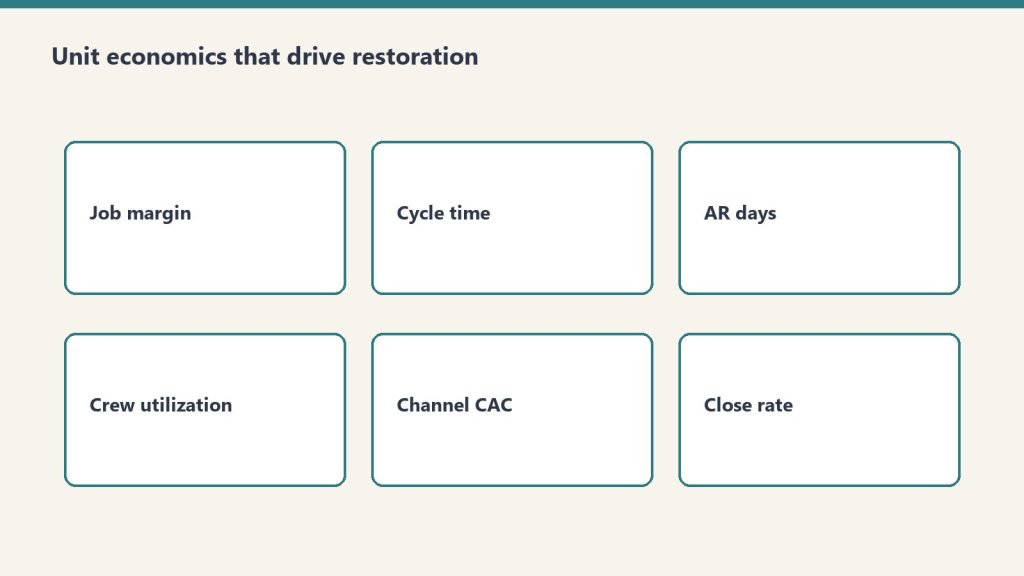
    The standard is the moat

    If the mitigation-to-reconstruction handoff is the most expensive moment in restoration, the documented mitigation prep standard is the operational artifact that converts that expense into an advantage. It is also the artifact that almost no one in the industry actually has.

    Operators talk about prep standards all the time. They mean different things by the phrase. Some mean a set of unwritten norms that the senior crew carries in its head. Some mean a few pages in an employee handbook that nobody references after the first day of orientation. Some mean a software workflow that captures dryout readings and calls itself a standard. None of those are the thing.

    The thing is a written, version-controlled, operationally specific document that tells a mitigation tech how to make the cut, demo, removal, and documentation decisions that have downstream reconstruction consequences. It is the single most important operational document a restoration company will ever produce, and the companies that have built one know it.

    This article is a description of what such a standard actually contains, how it gets written, and why most attempts to build one fail.

    What a real prep standard contains

    A working prep standard is not a manual. It is a decision aid for the moments when a mitigation tech is standing in a structure with a utility knife in their hand and a sixty-second window to make a choice that the rebuild team will live with for the next ninety days. The standard has to be specific enough to produce a different decision than the tech’s instinct would, in the cases where the tech’s instinct is wrong.

    The categories of decisions it has to address fall into a predictable pattern across most water and fire losses.

    The first category is cut decisions on drywall. How high to cut. Whether to cut along a stud line or use a flood cut. How to handle the meeting points between affected and unaffected areas in a way that produces a clean rebuild seam. How to handle ceilings where the cut decision interacts with insulation and texture matching. The standard names the default choice for each of these, the conditions under which the default changes, and the conditions under which the tech is expected to call a supervisor before cutting.

    The second category is removal decisions on baseboards, trim, casing, and crown molding. Whether to remove and reuse, remove and discard, or leave in place and treat. The default choice is rarely the same across all conditions — paint-grade and stain-grade trim warrant different defaults, modern composite trim warrants a third, and historical or custom-milled trim warrants a fourth. The standard documents which is which and how to identify each in the first ten minutes on site.

    The third category is flooring. Where the cut line goes, how to handle transitions to unaffected areas, when to remove pad versus pad and carpet, when to remove tile versus dry in place, how to handle engineered hardwood versus solid, how to handle LVP and the specific question of whether to lift to a natural transition. This is the category where the rebuild team is most often blindsided by mitigation decisions, because flooring rebuild aesthetics are entirely a function of where the mitigation crew chose to stop cutting.

    The fourth category is cabinetry, vanities, and built-ins. When to remove the kicks. When to pull cabinets entirely. When to drill weep holes. When to dry in place with cavity drying. The standard has to acknowledge that these decisions are partly a function of the cabinet construction, partly a function of how the rebuild team prefers to receive the job, and partly a function of carrier expectations. The default choices and the override conditions need to be specified.

    The fifth category is documentation: photo angles, lighting conditions, what to capture before any work begins, what to capture during demo, what to capture after demo, how to label, how to organize for both the carrier file and the rebuild estimator. This is the category most undervalued by operators who have never been the rebuild estimator opening the file two days later. Documentation discipline that is built around the rebuild estimator’s needs prevents the largest single source of wasted estimator hours in the industry.

    The sixth category is communication: when the mitigation supervisor calls the rebuild team, when the rebuild team is brought to site, when the homeowner is told what to expect about the rebuild, who owns each conversation. Communication failures account for a surprising fraction of the friction the rebuild team encounters, and most of those failures are fixable with a written protocol about who talks to whom when.

    How a real prep standard gets written

    The standard cannot be written by a single person sitting in an office. It also cannot be written by a committee. The companies that have produced working standards have followed a specific pattern.

    The work begins with one operator who has done both sides of the job — mitigation and reconstruction — and who has the credibility internally to make decisions stick. That operator is the author. Not a committee chair. The author. They are responsible for the document being good and for it being adopted.

    The author starts not with their own knowledge but with the recent failure log. The last ninety days of completed jobs, walked one by one with the reconstruction estimator and the mitigation supervisor. For each job, the question is the same: where did the rebuild team have to do extra work, eat margin, or take a homeowner concession because of a mitigation decision? Each instance gets logged, categorized, and converted into a decision rule that, if it had been in place at the time, would have prevented the problem.

    The first draft of the standard emerges from this exercise. It is not comprehensive. It is not elegant. It addresses the specific failure modes the company has actually experienced. That focus is a feature, not a bug. A standard that tries to cover every conceivable scenario gets ignored. A standard that addresses the twenty things that go wrong most often gets used.

    The first draft then gets pressure-tested in two ways. The mitigation crew leads read it and challenge anything that seems impractical, slow, or based on a misunderstanding of how the work actually happens in the field. The rebuild estimators read it and flag anything that does not actually solve the rebuild problem they were complaining about. Both groups have to feel ownership before the standard ships.

    Then it ships. Not as a binder. As a short, scannable document — usually ten to twenty pages — that lives in the company’s operational system, is referenced in every job kickoff, and is the basis for the company’s mitigation training program.

    And then, critically, it gets revised every quarter. The companies that have done this for several years describe their current standard as “version eleven” or “the November rev.” It is a living document. The day it stops being revised is the day it starts being ignored.

    Why most attempts to build one fail

    Most companies that try to build a prep standard fail. The failure modes are predictable.

    The first failure mode is committee authorship. A standard written by consensus reads like a treaty. It hedges every decision, includes too many exceptions, and produces no behavior change. The author has to be one accountable person.

    The second failure mode is starting from theory instead of failure. Standards written from first principles or from industry best practices end up being too generic to change anything in the field. The standard has to come out of the company’s actual recent failures, because those are the failures the field crew will recognize and accept guidance on.

    The third failure mode is over-comprehensiveness. A two-hundred-page standard does not get read. A standard that addresses the twenty most common decision points and is honest about not addressing the rest is the one that gets used. Coverage is not the goal. Behavior change on the highest-value decisions is the goal.

    The fourth failure mode is publishing without training. A document that is sent out with a memo gets ignored. A document that is the basis for a half-day field training, with the senior author walking the crew through each decision and the reasoning behind it, gets adopted. The training is part of the standard, not a follow-up to it.

    The fifth failure mode is no revision cadence. Standards that ship and then sit on the server for two years stop matching the current state of the work. The crew learns to disregard them. A quarterly revision cycle, even if most quarters only produce small updates, keeps the document credible.

    The sixth failure mode is treating the standard as the property of the operations function alone. A standard that the mitigation crew owns but that the rebuild team does not actively use as a quality scorecard is half a standard. The rebuild team has to be empowered to flag deviations, and the flags have to feed back into the next revision. Without that loop, the standard ossifies.

    What the standard does to the company

    The companies that have built and maintained a real prep standard for several years tend to describe similar effects. None of the effects are about the standard itself. They are about what the standard makes possible.

    The first effect is on training. A new mitigation tech can be brought from green to credibly autonomous in a fraction of the time a similar tech would take in a company without a standard. The standard is the curriculum. The senior tech who would have been burned mentoring one apprentice at a time can mentor a whole class against the standard, with much higher consistency in the output.

    The second effect is on rebuild margin. The rebuild estimators stop encountering the surprises that used to eat their hours. Estimates get written faster, get approved faster, and produce fewer scope arguments. The margin recapture from this effect alone usually pays for the standard work many times over within the first year.

    The third effect is on customer experience. The handoff feels different to the homeowner. The mitigation crew leaves a job that the rebuild team can pick up cleanly, which means the rebuild starts faster, runs cleaner, and finishes with a homeowner who feels the company knew what it was doing the whole way through. Five-star reviews go up. Complaints go down.

    The fourth effect is on the relationship with carriers and TPAs. The pattern of clean files, clean scope discussions, and rare disputes gets noticed. Program placement improves. Referral flow improves. The carrier-side reputation compounds in a way that takes years to build but is durable once built.

    The fifth effect is on the company’s ability to absorb new technology. A documented standard is the substrate that makes AI-assisted operations possible. Software that is asked to apply judgment to new situations performs as well as the documented judgment it has access to. Companies with a real standard can plug new tools in and get force multiplication. Companies without a standard buy tools and watch them fail to deliver, because the tools have nothing to ground their decisions in.

    Where to start if you don’t have one

    If you run a restoration company and you do not have a prep standard, the work to produce one is genuinely hard, but the starting point is not. Pick the operator on your team who has done both mitigation and reconstruction and who has the credibility to make decisions stick. Have them block one full afternoon with the rebuild lead and the mitigation supervisor. Walk the last ten completed jobs file by file, asking the failure question described above and in the handoff piece.

    That afternoon will produce a list of fifteen to twenty-five recurring failure modes. Each of those failure modes is a decision rule waiting to be written. The first draft of the standard is just those rules, written down, in the voice of the author, with the conditions and the override criteria specified.

    That first draft is not the finished product. But it is the artifact that, more than any other single thing the company will produce in the next twelve months, determines whether the company is on the operating-system side of the industry split described in the pillar piece — or the side that wakes up in 2028 wondering what happened.

    The standard is the moat. The companies that build it know it. The companies that don’t are about to find out.

    Next in this cluster: photo and documentation discipline built around what the rebuild estimator actually needs to see. After that: the feedback loop that turns rebuild discoveries into the next revision of the standard, and the shared metrics that hold both teams accountable to the same scoreboard.