Last refreshed: August 30, 2026
Your estimator just scoped a fire damage job at $47,000. Your PM disagrees. Your admin is chasing the adjuster. Your technician already started demo. Your sales manager is quoting the next job before the first one is closed out. Sound familiar?
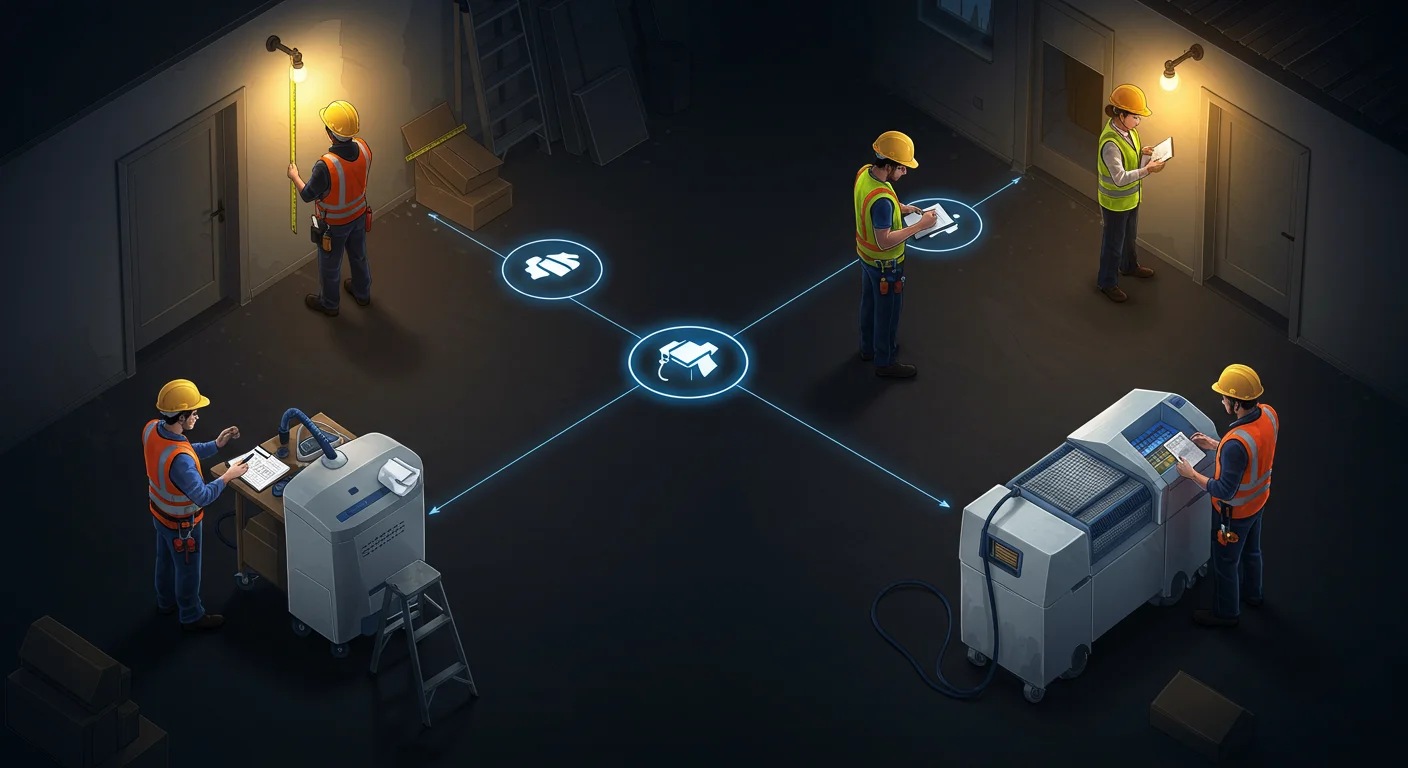
Restoration companies run on controlled chaos. Every job is a mini-project with overlapping roles, shifting timelines, and constant dependencies — and the people filling those roles were rarely trained in structured project thinking. They learned by doing. That is fine until the volume outpaces what tribal knowledge can hold.
Why Restoration Teams Need This More Than Most
A restoration job is not a single task. It is a cascade: initial assessment, scope documentation, insurance communication, material ordering, crew scheduling, demo, mitigation, rebuild coordination, final walkthrough, invoicing. Every step depends on something upstream, several steps can run in parallel, and new information lands constantly — the adjuster changes the scope, the homeowner adds a room, the subcontractor pushes back a date.
This is exactly the kind of work that Claude Cowork was built to handle. And watching how Cowork handles it teaches your team how to think about it.
What Each Role Learns From Watching Cowork
The Estimator
An estimator’s job is fundamentally a decomposition exercise: walk a property, break the damage into line items, sequence the repair logic, and price each piece. When you run a Cowork task like “build a comprehensive scope for a Category 2 water loss in a 2,400 sq ft ranch with finished basement,” you can watch the lead agent break that into sub-tasks — structural assessment, contents inventory, moisture mapping zones, material takeoffs, labor estimates. The estimator sees their own mental process made visible, and more importantly, they see what steps they might be skipping.
The Project Manager
This is the role Cowork maps to most directly. A restoration PM juggles the timeline, the crew, the adjuster, and the homeowner simultaneously. Cowork’s lead agent does the same thing — it holds the master plan, delegates to sub-agents, manages dependencies, and absorbs mid-flight changes without losing the thread. When a PM watches Cowork queue a new requirement that came in during execution and slot it into the plan at the right moment, that is a live lesson in change order management.
The Admin and Job Coordinator
Admin staff are the connective tissue. They are tracking certificates of completion, chasing supplement approvals, scheduling inspections, and making sure nothing falls through the cracks. Cowork shows how a lead agent maintains awareness of all parallel workstreams and flags when one is blocking another. For an admin learning to manage a board of active jobs, watching Cowork’s progress view is a masterclass in status tracking.
The Technician
Technicians often focus on execution — set the equipment, run the demo, do the work. But the best techs think upstream and downstream: what do I need before I start, and what does my work unlock for the next person? Cowork makes these dependencies visible. When a sub-agent finishes a task and the lead immediately kicks off the next dependent task, a technician can see how their piece connects to the whole.
The Sales Manager
Sales in restoration is about managing the pipeline while jobs are still in flight. A sales manager watching Cowork tackle a complex multi-step task sees how a good orchestrator never loses sight of the big picture even while individual pieces are being executed. It is the same skill needed to track leads, follow up on referrals, and manage relationships while active jobs demand attention.
A Training Exercise You Can Run Tomorrow

Pick a real scenario your team handled last month — a complex water loss, a fire damage job with contents, a mold remediation with an access issue. Strip the confidential details and feed it to Cowork as a planning task: “Break down the full project plan for a Category 3 water loss in a two-story commercial building with active tenant occupancy.”
Then sit with your team and watch it work. Pause at each stage. Ask: did Cowork sequence this the way we would? Did it catch a dependency we might have missed? Did it run things in parallel that we run sequentially? Did it handle the mid-task change the way our PM would?
The conversation that follows is worth more than most training seminars.
The Conductor Metaphor Hits Different in Restoration
In our original article on Cowork as a training tool, we compared Cowork’s lead agent to an orchestra conductor — one agent directing the whole ensemble without playing any instrument itself. In restoration, the metaphor becomes concrete: the PM is the conductor, the estimator is first chair, the admin is keeping score, the technician is the section player, and the sales manager is booking the next gig before the curtain call.
When everyone on the team can see the conductor’s score — which is exactly what Cowork’s plan view gives you — the whole operation tightens up.
More in This Series
Frequently Asked Questions
Can Claude Cowork handle restoration-specific scenarios?
Yes. Cowork decomposes any complex, multi-step task you describe to it. You can input a restoration scenario like a water loss scope, a fire damage project plan, or a mold remediation coordination task and watch it break the work into sequenced, dependency-aware subtasks. The output is a structured plan, not industry-specific software, but the planning logic transfers directly.
Which restoration roles benefit most from Cowork training?
Project managers benefit most directly because Cowork’s lead agent mirrors their core function — holding the master plan and managing dependencies. But estimators learn scope decomposition, admins learn status tracking across parallel workstreams, technicians see how their work connects to the full project chain, and sales managers learn pipeline orchestration.
Does this replace restoration project management software?
No. Cowork is not a replacement for tools like Xactimate, DASH, or jobber platforms. It is a training and planning tool that helps your people think in structured, decomposed, dependency-aware ways. Better thinking produces better use of whatever PM software you already run.
How do I run a Cowork training session with my restoration team?
Pick a real job your team completed recently, strip confidential details, and input it as a Cowork task. Watch together as Cowork decomposes the plan. Pause and discuss at each stage — compare Cowork’s sequencing to how your team actually handled it. Focus on dependencies, parallel workstreams, and how mid-task changes were absorbed.
Is Claude Cowork available for restoration companies?
Cowork is available through the Claude desktop app on Pro, Max, Team, and Enterprise plans. It is not industry-specific — any team that handles complex, multi-step work can use it. Restoration companies are a natural fit because every job is essentially a project with overlapping roles and shifting dependencies.
Leave a Reply