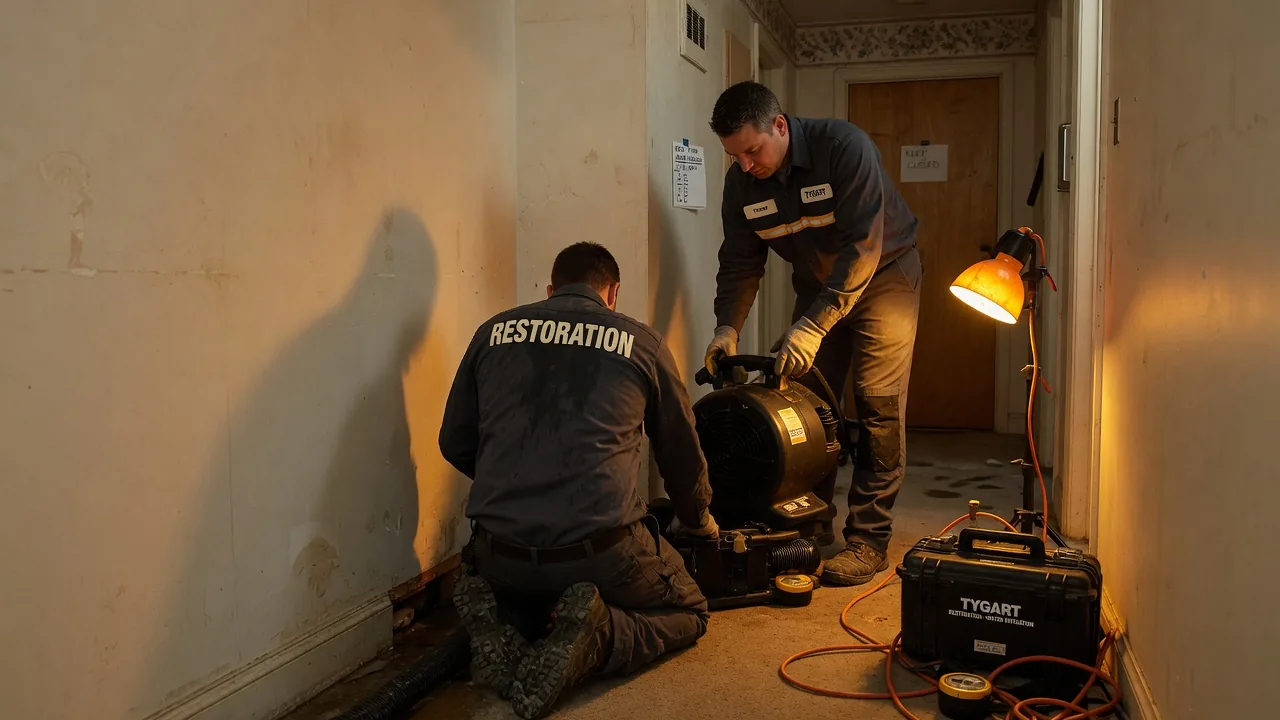
Restoration marketing is not home services marketing. The buying cycle is broken — most homeowners don’t shop until water is on the floor, and most commercial accounts don’t buy a restorer until they need one at 2 a.m. Generic marketing playbooks designed for HVAC, roofing, or landscaping fall apart when applied to a category where 80% of demand is reactive emergency work and the other 20% is relationship-driven preferred-vendor placement.
This guide is the complete restoration marketing playbook for 2026: every channel that matters, the math behind each one, and the prioritization framework that separates restoration companies that grow from the ones stuck at the same revenue line for five years running.
What restoration marketing actually has to accomplish
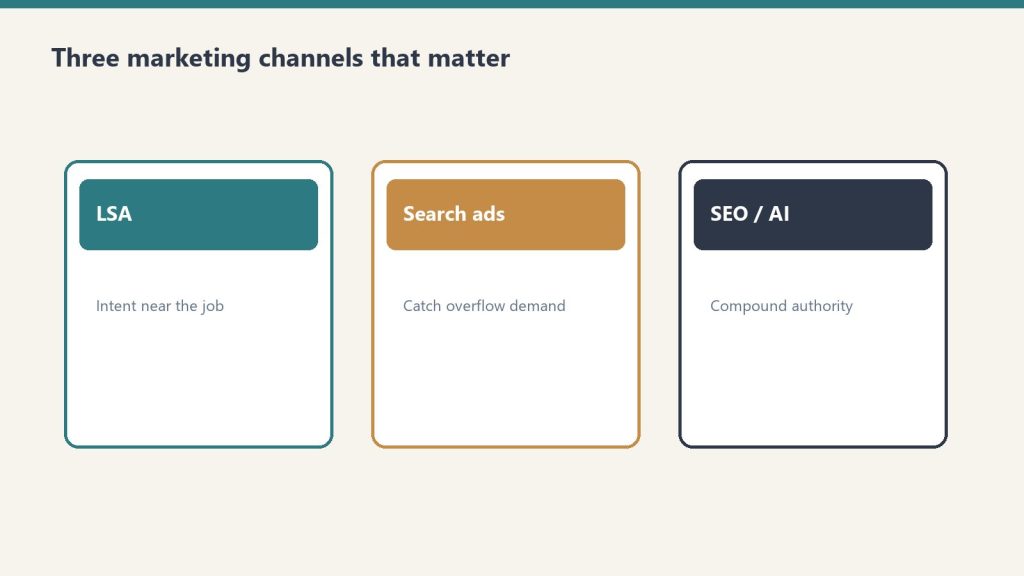
Most marketing strategies aim for one job: generate leads. Restoration marketing has to do four things simultaneously, and most companies only get one or two right.
The four jobs are capture emergency demand (be the first call when a pipe bursts), build commercial preferred-vendor pipeline (get on lists at facilities, property management firms, and TPAs), maintain referral momentum (stay top of mind with plumbers, agents, adjusters, and past customers), and build the brand asset (so when an insurance carrier or commercial buyer Googles you, what they find sells the relationship). A program that generates emergency leads but ignores commercial pipeline gets stuck at residential ceiling. A program that builds a great brand but ignores Local Service Ads loses the late-night calls that pay the rent.
The restoration marketing channel stack
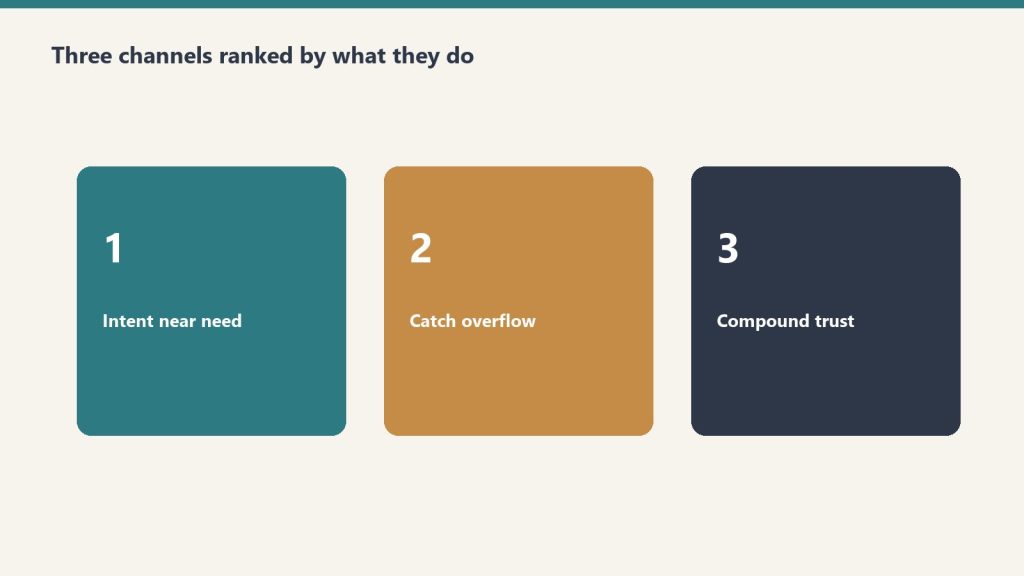
Here is the complete channel inventory for a modern restoration company, ranked by typical contribution to revenue for an established multi-truck operation.
1. Local Service Ads (LSAs)
LSAs are pay-per-lead Google products that appear above the map pack on local emergency searches. For restoration, this is the single most ROI-positive channel that exists. A “water damage near me” lead from LSAs typically costs between $35 and $85 in most US markets, and converted jobs run $3,000 to $15,000+ in revenue. Setup requires Google Guarantee verification, license uploads, insurance documentation, and review velocity. Most restoration companies underinvest in LSAs because the dashboard is unfamiliar — that’s the opportunity.
Get The Signal
What we actually ran, what it measured, and what it means for a restoration shop — every week, including the flops.
2. Local SEO and Google Business Profile
The map pack is where emergency restoration searches convert. Optimizing your Google Business Profile, building genuine review velocity (target 4.7+ stars with 100+ reviews per location), publishing service-area landing pages with city-level intent, and earning local citations is the second pillar. Local SEO compounds — a company that builds it for two years has a moat competitors can’t buy.
3. Google Ads (paid search)
Outside LSAs, paid search on terms like “water damage restoration [city],” “mold remediation,” and “fire damage cleanup” remains a workhorse. Tight match-type discipline, location targeting at the ZIP level, call extensions, and aggressive negative keyword lists are non-negotiable. Without those, Google will happily spend $200 a day on irrelevant queries.
4. Content marketing and SEO
Long-form content does two things at once: it captures top-of-funnel research traffic (“what to do after water damage,” “how to dry out a wet basement”) and it builds the authority signals that move your map pack rankings. The mistake most restorers make is publishing thin 400-word service pages and calling it SEO. Real content marketing means 1,500+ word answers, expert-reviewed posts, original photos, and a publishing cadence the operator can actually sustain.
5. Commercial business development
Commercial restoration is a relationship business that masquerades as a marketing problem. The “marketing” here is structured outreach to property managers, facility directors, REITs, healthcare facilities, and commercial insurance brokers — combined with branded sales collateral, capabilities decks, and a website that looks like a commercial vendor rather than a residential carpet cleaner.
6. Referral programs (plumbers, agents, adjusters)
The classic restoration referral playbook is alive and well. Structured plumber programs (with co-branded marketing, fast response promises, and clear referral tracking), insurance agent breakfast meetings, and independent adjuster relationships still produce 20-40% of revenue at most established restoration shops.
7. TPA and carrier preferred vendor programs
Joining programs like Contractor Connection, Code Blue, Sedgwick, Crawford, and Allstate’s preferred vendor lists is its own marketing channel — applications, audits, performance metrics, and ongoing scorecard management. The work is high-volume but margin-compressed, so this channel needs to be planned, not stumbled into.
8. Social media and brand content
Social is mostly a brand and recruiting channel for restoration, not a direct lead channel. LinkedIn for commercial business development, Facebook for community presence and reviews, and Instagram for technician recruiting and culture content. Don’t expect TikTok to fill your truck.
9. Email marketing
Often ignored, email is the cheapest way to stay top of mind with referral partners and past customers. Quarterly newsletter to plumber partners, monthly tips to agents, and seasonal reminders to past customers keep the referral engine warm.
How to allocate the marketing budget
For a restoration company doing $1M to $5M in annual revenue, the typical healthy budget allocation looks like: 35-45% LSAs and Google Ads, 15-20% local SEO and content, 15-20% commercial business development (sales rep cost, collateral, events), 10-15% referral program maintenance, and the rest to brand and recruiting. Companies under $1M should weight more heavily into LSAs and direct response — brand spending before you have the operational base to handle volume is wasted budget.
The KPIs that actually matter
Most restoration marketing dashboards track vanity metrics. The numbers that predict whether a marketing program is working are cost per qualified lead (not raw lead — qualified means the customer answered the call and the job has insurance or out-of-pocket budget), lead-to-job conversion rate (industry healthy range is 35-55% for residential, 15-30% for commercial), average ticket by source (LSAs and Google Ads jobs typically run smaller than referral or commercial jobs), and marketing ROI by channel (revenue divided by marketing spend, calculated quarterly).
The 90-day restoration marketing audit
If you inherited a restoration marketing program or you’re not sure where you stand, here’s the audit framework. Pull your last 90 days of leads. Tag each by source. Calculate cost per qualified lead by channel. Calculate revenue produced by channel. Identify the single best-performing channel and the single worst. Cut the worst, double down on the best, and pick one new channel to test for the next quarter. That’s the entire program.
Related on Tygart Media: Starlink on a water job · S500 in the van · local SEO for restoration.
Frequently Asked Questions
How much should a restoration company spend on marketing?
Healthy restoration marketing spend ranges from 6% to 12% of revenue, depending on growth stage and market competitiveness. Companies in startup or rapid-growth mode often spend 10-15%; mature operators with strong referral pipelines may run as low as 4-6% because referral and TPA channels carry more of the load.
What is the best marketing channel for restoration companies?
For emergency residential work, Local Service Ads typically deliver the best cost per acquired job. For commercial restoration, structured business development to property managers and facility directors outperforms any digital channel. The right answer depends on which side of the business you’re trying to grow.
How long does restoration SEO take to work?
Local SEO and Google Business Profile optimization can move map pack rankings within 60-120 days for less competitive markets. Organic blog content takes 6-12 months to mature and produce consistent traffic. Companies expecting immediate organic results will be disappointed; companies that commit to a 12-month horizon usually see meaningful results.
Are Local Service Ads worth it for restoration?
Yes, in most markets. LSAs typically deliver the lowest cost per acquired customer of any digital channel for emergency restoration services. The exceptions are extremely competitive metros where lead pricing has been bid up significantly, or service areas where Google Guarantee verification is delayed.
Should I hire a restoration marketing agency or do it in-house?
Companies under $2M in revenue typically benefit from a specialized restoration marketing agency that already knows the channels and pitfalls. Companies above $5M often hire an in-house marketing director and use agencies tactically for SEO, paid media, or content. The middle range is the hardest — that’s where most restoration marketing money gets wasted.
What does a restoration marketing plan look like?
A real plan has four components: a channel mix and budget allocation, a 12-month content and publishing calendar, a quarterly business development plan for commercial pipeline, and a measurement framework that tracks cost per qualified lead and revenue per channel. Anything less is a wish list.
Get The Signal
What we actually ran, what it measured, and what it means for a restoration shop — every week, including the flops.
Leave a Reply