Xactimate is the operating system of insurance restoration in North America. Every major insurance carrier, almost every TPA, and the majority of preferred vendor programs require it. If you can’t write a defensible Xactimate estimate, you can’t run a serious insurance restoration business.
This guide is the operator-level Xactimate strategy for 2026: how the pricing actually works, the sketch discipline that produces approvable estimates, the supplement workflow that captures the 5-15% of revenue most companies leave on the table, and how to defend your scope when carriers push back.
What Xactimate actually is
Xactimate is a software platform owned by Verisk that combines a regional pricing database, a sketch-based scope builder, and an estimating workflow. The pricing database contains line items priced by metropolitan statistical area, updated quarterly based on labor and material cost surveys. Carriers, adjusters, contractors, and TPAs all use the same database, which means there’s no negotiation over rates — only over scope and applicability of line items.
The product comes in three editions: Xactimate online (X1), the modern web-based version most contractors use today; Xactimate desktop (X28), the legacy desktop client still used in some workflows; and Xactimate mobile, for on-site sketching and photo capture. Most active restoration contractors today work primarily in X1 with mobile capture in the field.
The Xactimate pricing logic
Each Xactimate line item has three components: a labor component (the labor cost to perform the task), a material component (the material cost), and an equipment component (rental or use cost). Every line item is priced for a specific region using current local labor rates, material costs from supplier surveys, and equipment rental data. Because the carrier sees the same prices the contractor sees, the rates themselves aren’t disputed — disputes are about scope.
On top of the line item subtotal, contractors add overhead and profit (typically 10% + 10%) when the job qualifies — historically defined as work involving three or more trades or meeting other complexity criteria. O&P is one of the most contested elements in restoration estimating. Carriers and TPAs frequently push back on it, especially on smaller jobs. Documenting the trade count, complexity, and supervisory burden is how restorers defend it.
Get The Signal
What we actually ran, what it measured, and what it means for a restoration shop — every week, including the flops.
Sketch discipline: the foundation of approvable estimates
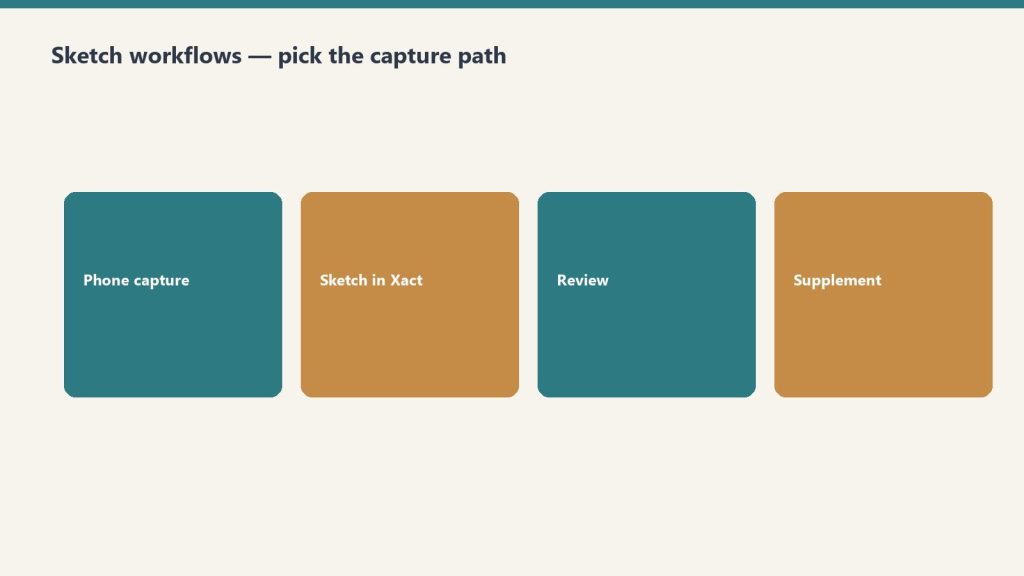
The single biggest predictor of estimate approval is sketch quality. A clean sketch with accurate room dimensions, properly labeled rooms, correct ceiling heights, openings (doors, windows, cased openings) drawn to scale, and labeled affected materials is approved with minimal questions. A messy sketch — wrong dimensions, missing rooms, unlabeled openings, no notes — generates rejection cycles and supplements.
The sketch discipline that produces clean estimates: measure every room (laser measurer, then verify), draw to scale at the loss site (don’t sketch from memory back at the office), label every room with its purpose (kitchen, bathroom, master bedroom — not just “Room 1”), draw all openings with width and height, label affected materials room by room (drywall, flooring type, baseboards, ceiling), and capture matching photo documentation tied to each room.
The estimating workflow that produces complete scope
Most missed scope in restoration comes from a rushed initial estimate. The disciplined workflow: walk the entire affected area first (don’t start writing scope until you’ve seen everything), photograph every affected room from every corner, identify and document all hidden damage (pull baseboards, lift carpet corners, check behind cabinets, scope the floor structure), document moisture readings on a moisture map, write the scope room by room with photos referenced, then review the estimate against the photo set before submitting.
This takes longer on the front end. It saves significant time and revenue on the back end because the supplement burden is dramatically lower.
Supplements: the 5-15% revenue most companies leave on the table
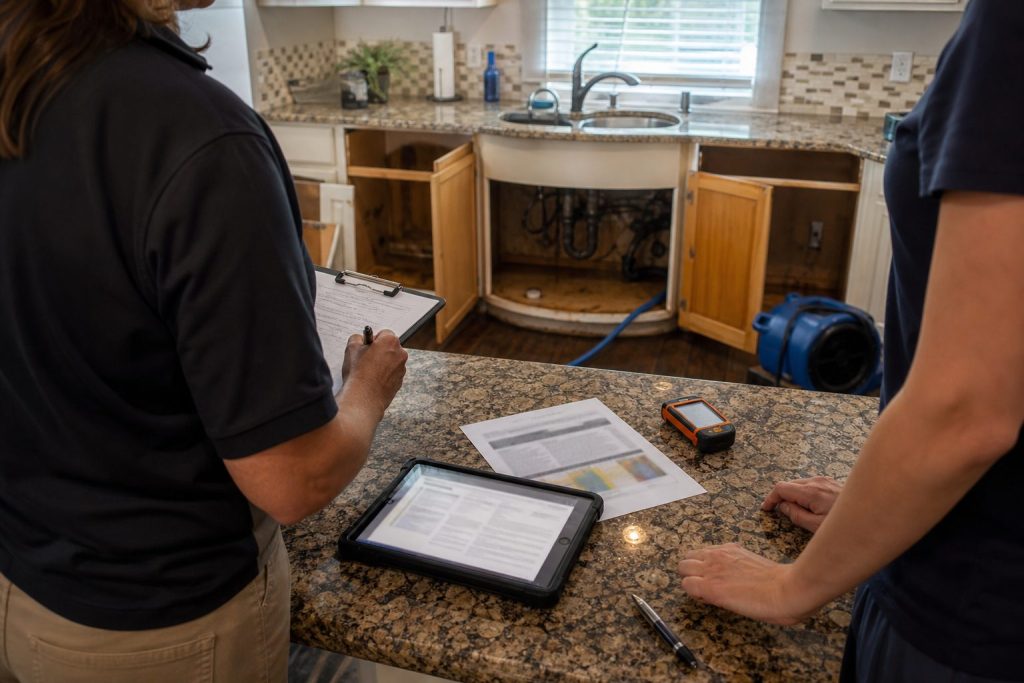
Supplements are revisions to the original estimate when additional damage is discovered, scope changes, or items were missed. In legitimate restoration work, supplements are normal — almost every job will have at least one. Companies with weak supplement processes leave 5-15% of revenue on the table on every insurance job. Companies with disciplined supplement workflows capture every dollar of legitimate scope.
The supplement workflow that works: document the additional damage with photos and notes immediately upon discovery, write the supplement in Xactimate within 48 hours, submit through the proper channel (carrier portal, adjuster email, TPA system), follow up on approval status weekly, and track every supplement to closure. Supplement revenue should appear on the job costing report alongside original revenue so you can measure the discipline.
Defending scope against pushback
Adjusters and TPAs push back on scope routinely — sometimes legitimately, sometimes reflexively. The defense is documentation. For each contested line item: photo evidence of the affected material, moisture readings or other measurable damage indicators, IICRC standard reference (S500 for water, S520 for mold, S700 for fire, S800 for HVAC), and clear notes about why the scope is necessary. A line item with photos and a standard reference is hard to dismiss. A line item with no documentation is dismissed routinely.
The Xactimate certifications that matter
Xactimate offers user certification at three levels: Level 1 (basic functionality), Level 2 (advanced sketch and estimating), and Level 3 (advanced supplements, complex scope, dispute resolution). Level 1 should be a minimum requirement for any estimator at a restoration company. Level 2 is appropriate for senior estimators and project managers. Level 3 is the standard for owners, lead estimators, and anyone who handles disputed scope.
Common Xactimate mistakes that cost real money
The most common margin-killing mistakes: using regional default rates instead of pulling current quarterly pricing, missing equipment days on water mitigation jobs, failing to add proper drying chamber configuration, forgetting matching where required by IICRC standard, missing demolition scope on Cat 3 losses, not adding cleaning of unaffected areas where smoke or odor migrated, missing contents pack-out and cleaning, and submitting estimates without overhead and profit when they qualify.
Related on Tygart Media: Starlink on a water job · S500 in the van · local SEO for restoration.
Frequently Asked Questions
How does Xactimate pricing work?
Xactimate pricing is built from a regional database of line items, each containing labor, material, and equipment cost components. Pricing updates quarterly based on local cost surveys. Both contractors and carriers use the same pricing database, so disputes are about scope (which line items apply) rather than rates (what each line item costs).
How much does Xactimate cost?
Xactimate online (X1) subscription costs vary based on tier and seat count, with most restoration contractors paying $200-$500/month per seat. Xactimate mobile is typically included or available as an add-on. Pricing changed significantly with the move to X1 — contractors should request a current quote directly from Verisk.
What is overhead and profit in Xactimate?
Overhead and profit (O&P) is typically a 10% + 10% addition applied on top of the line-item subtotal when a job involves three or more trades or meets other complexity criteria. The 10% overhead covers indirect costs like supervision and office burden; the 10% profit is the contractor’s profit on the work. O&P is frequently disputed by carriers and requires documentation to defend.
How do you write a Xactimate supplement?
The disciplined supplement workflow: document additional damage with photos and notes upon discovery, write the supplement in Xactimate within 48 hours, submit through the proper channel (carrier portal, adjuster email, TPA system), follow up on approval status weekly, and track every supplement to closure. Companies with disciplined supplement processes capture 5-15% more revenue per insurance job.
Do I need Xactimate certification to be a restoration contractor?
You don’t need certification to use Xactimate, but most TPAs and many carriers require certified users on the account, and certification is increasingly the norm for any serious estimating role. Level 1 is a baseline; Level 2 or 3 is appropriate for owners, lead estimators, and dispute handlers.
How do I dispute a Xactimate estimate?
Disputes are won with documentation: photo evidence of the affected material, moisture readings or measurable damage indicators, IICRC standard references (S500, S520, S700, S800), and clear notes explaining why the scope is necessary. The most common adjustment requests succeed when supported by IICRC standards and visual evidence; unsupported requests are dismissed routinely.
Get The Signal
What we actually ran, what it measured, and what it means for a restoration shop — every week, including the flops.
Leave a Reply