Conference Starter Pack
$97
Delivered by email after checkout.
Secure checkout via Square — all major cards accepted
You can copy this method and do it yourself. Score where you are still the bottleneck. Install 1-3-1 so the next problem comes back as a recommendation. Walk the 5 Ds as a what-if-tomorrow check. Buy Now is the packaged bundle: three Notion tools plus the matching Claude skills, so you are not assembling the starter pack from blank pages.
The grab-and-go pack from the Restoration Leadership Toolkit. Three of the most-used tools, bundled. For restoration owners who just heard the doer-to-leader message and want something they can run this week, not a 12-week program on day one.
What’s in the pack
- 1-3-1 Delegation Worksheet
- Owner Bottleneck Self-Assessment
- 5 Ds Succession Risk Checklist
The matching skills from the Leadership AI plugin: delegation-1-3-1, owner-bottleneck-assessment, succession-5ds-checklist.
Run them in this order. The bottleneck names the constraint. 1-3-1 is the first habit. The 5 Ds is the exposure you do not want to discover the hard way.
1. Owner Bottleneck Self-Assessment
Find out where your company still depends on you. An owner bottleneck exists when growth, decision speed, and consistency are limited by your personal involvement in day-to-day decisions. You become both the most important and the most constraining person in the business.
Check the box for each statement that is true today. Count the checks in each section, then total them. Range is 0-25. Be honest. The value is in the truth.
- Decisions only you make. Estimate / pricing approvals over a set dollar amount. Hiring and firing. Vendor choices. Which jobs you take. Refunds, credits, concessions.
- Interruptions by department. Production calls daily. Office pulls you into billing or scheduling. Sales checks pricing before quoting. Techs call from job sites. Customer complaints land on you.
- Recurring questions. The same operational questions every week. People wait for you. “Ask the owner” is the default. You re-explain the same processes. Things stall when you are unavailable.
- Tasks that should be delegated. Estimates you could hand off. Scheduling / dispatch. Collections / AR. Ordering equipment. Work others could produce.
- Areas with no backup. No one else can run production. Only you hold key carrier relationships. Only you see the full financial picture. No written SOPs for the things you do. If you are gone a week, something breaks.
Bands: 0-6 Mild (tighten the remaining gaps). 7-13 Moderate (you are the bottleneck in one or two areas; fix the worst one first). 14-19 Heavy (the business runs through you; start delegating now, deliberately). 20-25 Severe (you ARE the business; this is the #1 risk to growth and to an exit).
Write your top 3 to delegate first. For one full week after you score, log every interrupt for a decision. Sort into Delegate now / Delegate after training / Keep (truly owner-only). The department with the most checks is this quarter’s target. Install 1-3-1 there first.
2. 1-3-1 Delegation Worksheet
The old way (escalation): “Hey boss, the dehu on the Maple St job died. What do you want me to do?” You just took back the problem, the thinking, and the decision. That is three jobs.
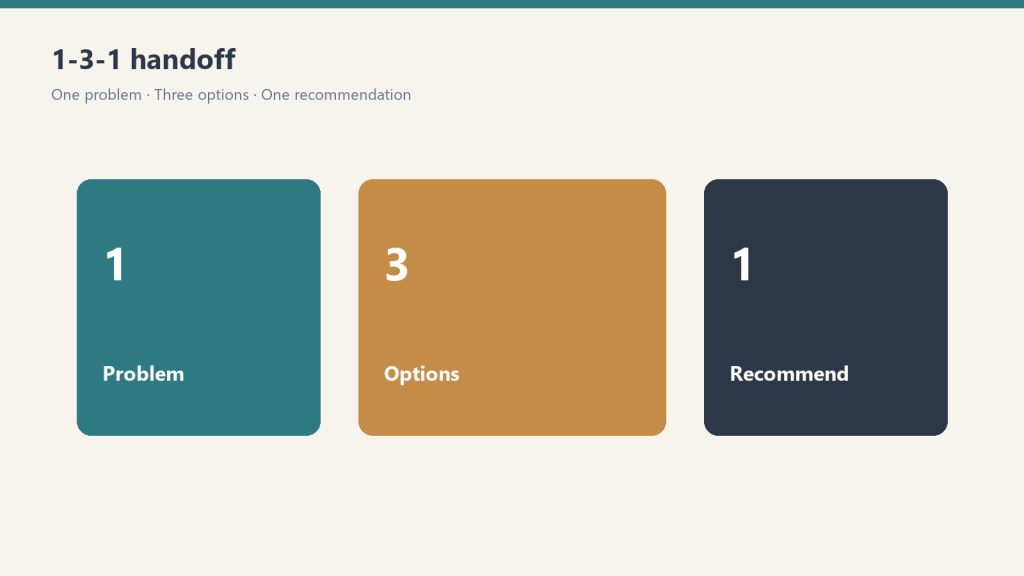
The 1-3-1 way (delegation): “The dehu on Maple St died. Here are three options I looked at, here is the cost of each, and here is what I would do. Just need your yes.” You own one job: the decision.
- 1. One issue. The decision that is actually needed, in one or two sentences. Not the whole story. The fork in the road.
- 3. Three real options. Each with pros, cons, and a rough cost or effort. “Do nothing” can be one when it is honest. Stuck at two? Push for a third. Even “do nothing and revisit Friday” or “escalate to the carrier.”
- 1. One recommendation. The option they would pick if it were their call, and why in one line.
- A default. What they will do if they do not hear back by a deadline, so the job does not stall waiting on you.
Explain the rule once, out loud. Pin the format where decisions get made (truck, office, group chat). When someone brings a raw problem, ask: “What are your three options, and which do you recommend?” Then wait. Run at least five real conversations. Approve the recommendation whenever it is reasonable. Resist solving it yourself, even when you are faster. Note who takes to it quickly. That is a signal for a future-manager pick.
The first few 1-3-1s will be lopsided. Three fake options, or a recommendation with no reasoning. Coach it. Do not grade it. Phase done when at least one person is bringing 1-3-1s without being reminded.
Worksheet fields if you are copying it: prepared by, date, job / account, urgency (Today / This week / No rush); the issue; three options (what it is, two pros, two cons, rough cost); the recommendation and what they need from you; the default deadline; owner sign-off (Approved as recommended / Approved with changes / Chose a different option / Let’s talk).
Owner gut-check before you sign: could this person have made this call without me? If yes, tell them so, and next time push it all the way down.
3. 5 Ds Succession Risk Checklist
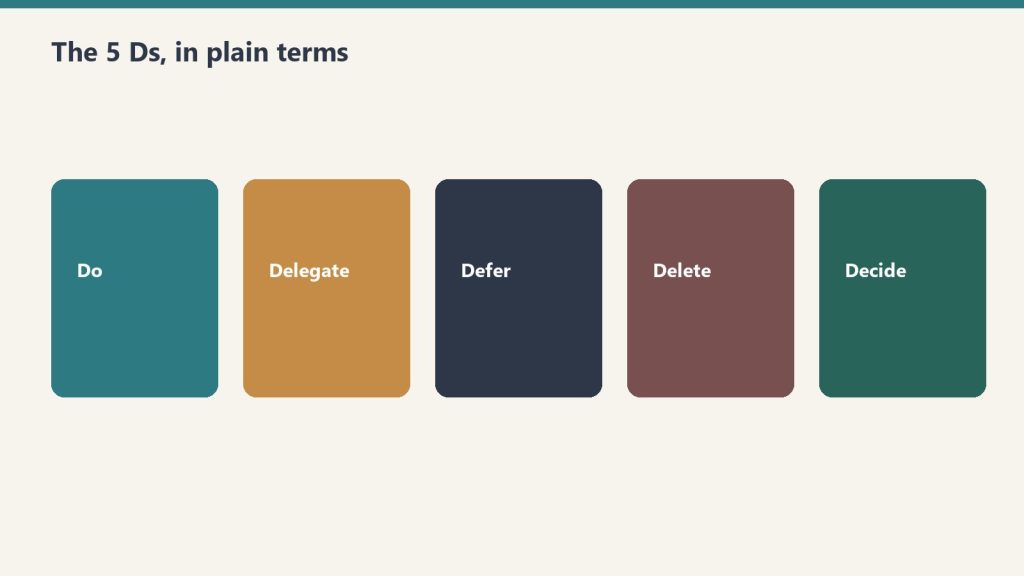
Succession is not a retirement problem. It is a what-if-tomorrow problem. Check a box only if it is true and current today. Not “mostly.” Not “we talked about it once.” A box you want to be true is still a blank box. Half-true protections fail exactly when the D hits.
- Death. Current signed will that names the business. Funded buy-sell if there are partners. Key-person life payable to the company. A second check-signer on file at the bank. Someone who can legally bind the company. Passwords in a recoverable place. A named person who can run production 30+ days. Spouse / heirs know who to call.
- Divorce. Separate vs marital property actually confirmed, not guessed. Prenup, postnup, or buy-sell provision. Books not commingled. A valuation method in writing. Operating cash structured so a personal dispute cannot freeze payroll.
- Disease. Someone has actually run production on a vacation test. Backup estimator. Payroll / AP / AR without your hands. Carrier relationships that will not collapse if you are unreachable. Disability and business-overhead coverage. A one-page interim chain-of-command with dollar thresholds.
- Drugs / dependency. Dual approval over a dollar threshold. A second set of eyes on the books. No single point of failure, including you. A trusted advisor allowed to tell you the truth. Key roles documented and cross-covered.
- Departure / disaster. Tribal knowledge written down. Relationships not owned by one person. Off-site backups you have test-restored. A continuity plan for your own shop. Backup vendor / equipment list.
Count the blanks. Published bands on the scored sheet: 0-6 resilient; 7-15 moderate; 16-27 high; 28+ you are the company. Pick the three blank boxes that would hurt most if the D hit tomorrow. Name an owner and a date. Re-run it every year, and after any life or business change. This is an awareness tool, not legal, financial, or insurance advice. Use it to walk into the attorney, agent, and CPA prepared.
What to do after the three
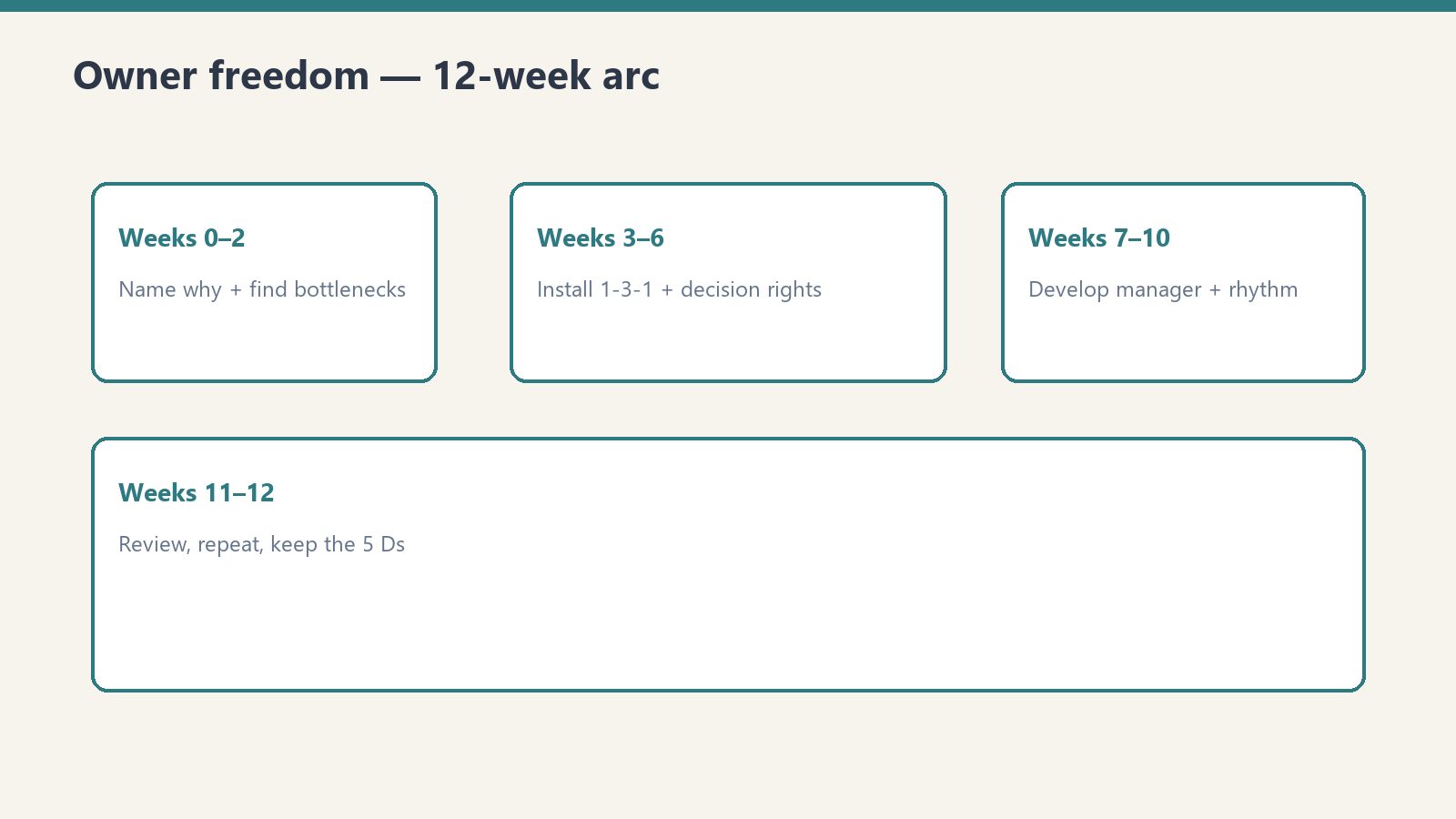
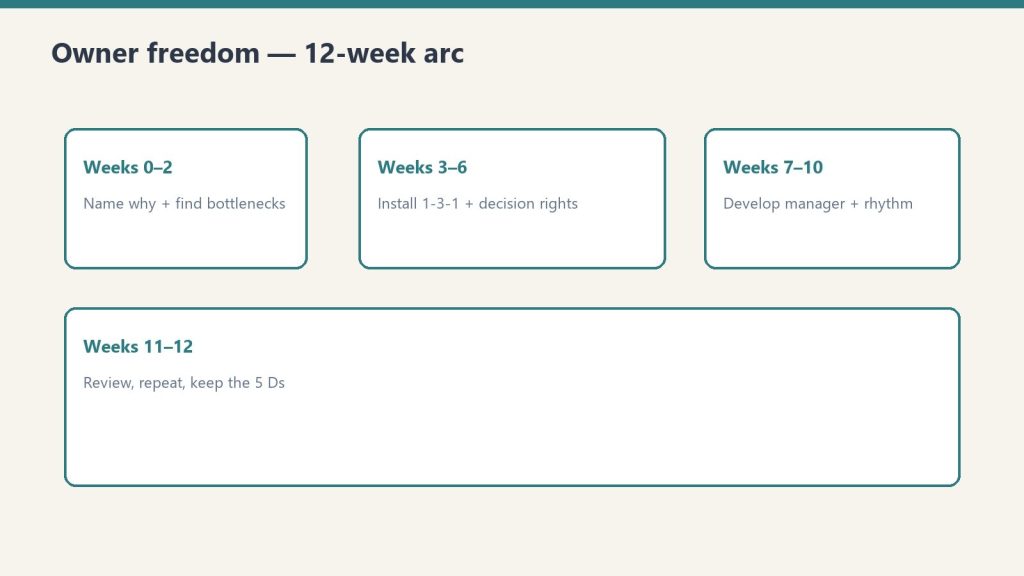
Take the top-3 bottleneck list into a 90-day doer-to-leader plan (Weeks 1-2 are this assessment). After 1-3-1 sticks, write decision rights so people stop defaulting to you out of habit. The 5 Ds blanks that are also “no backup” boxes on the bottleneck assessment are the same exposure. Name them once.
If you want the next layer after this pack: Leadership Readiness Kit (checklist, scorecard, planner, 1-3-1) or Owner Freedom Kit (audit, bench, 90-day, 5 Ds, 1-3-1).
If you want the packaged pack
You can run the three tools from the outline above. Buy Now is the bundle delivered by email after checkout: the three Notion pages (duplicate each so the master stays clean), plus the matching skills if you want the interviews walked. Same Square button at the top of this page.
Coaching and operational tools only. Not legal, financial, insurance, or HR advice.
Related on Tygart Media: leadership OS · owner freedom kit.
Leave a Reply