Owner Freedom Kit
$397
Delivered by email after checkout.
Secure checkout via Square — all major cards accepted
You can copy this method and do it yourself. Audit where the business depends on you. Build a bench. Run a 12-week plan to step back. Buy Now is the packaged bundle: five Notion tools plus the matching Claude skills, so you are not assembling the doer-to-leader system from blank pages.
This is the premium tier of the Restoration Leadership Toolkit. For owners serious about getting out of the truck, and eventually building something they can sell. The full system: audit, bench, 90-day plan, succession stress test, and the 1-3-1 handoff.
What’s in the kit
- Owner Dependency Audit
- Restoration Leadership Bench Builder
- 90-Day Doer-to-Leader Transition Plan
- 5 Ds Succession Risk Checklist
- 1-3-1 Delegation Worksheet
The matching skills from the Leadership Claude Edition: owner-dependency-audit, leadership-bench-builder, doer-to-leader-90-day, succession-5ds-checklist, delegation-1-3-1.
Run them in this order. The 90-day plan is the spine. The other four feed it.
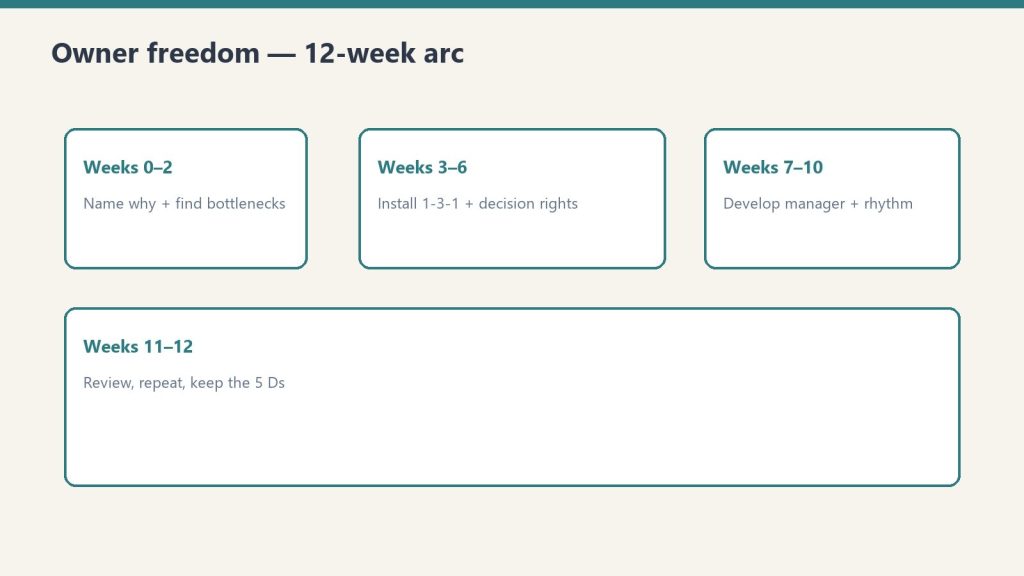
Week 0: name why you are stepping back
Before Week 1, write three lines:
- My #1 reason to step back (what I would do with the time)
- The one person I am betting on as my first real manager
- Start date / target Week-12 date
Block 30-45 minutes every Friday. Do not skip ahead. Each phase sets up the next.
Weeks 1-2: identify the bottlenecks
Run the Owner Dependency Audit. Rate Low / Med / High across nine areas: sales, production, finance, customer-issue resolution, hiring, vendor relationships, estimating / project management, emergency response, decision rights. Scoring: Low = 1 (runs without you; a real backup has done it), Med = 2 (limps; backup needs you on call), High = 3 (stops cold). Total is 9-27.
For each area write: what happens if you are gone 30 days, who the backup is today, and what would have to be true for this to be Low.
Then fill a Decision-Rights Map. Starter rows: approve a job estimate over $25k; authorize overtime / call-in crew; issue a refund or credit; hire or fire; approve a vendor / sub payment; take an out-of-area or unusual job; sign a contract or insurance scope; pull a crew off one job for another; spend on new equipment; set or discount a price. Who decides today vs who should.
End of the phase: a written top-3 bottleneck list, and the team knows the shift is coming. Tell them: “I’m working a 90-day plan to push decisions down. Expect me to hand more back to you.”
For one full week, tally every interrupt for a decision. Sort into Delegate now / Delegate after training / Keep (truly owner-only).
Weeks 3-4: install 1-3-1
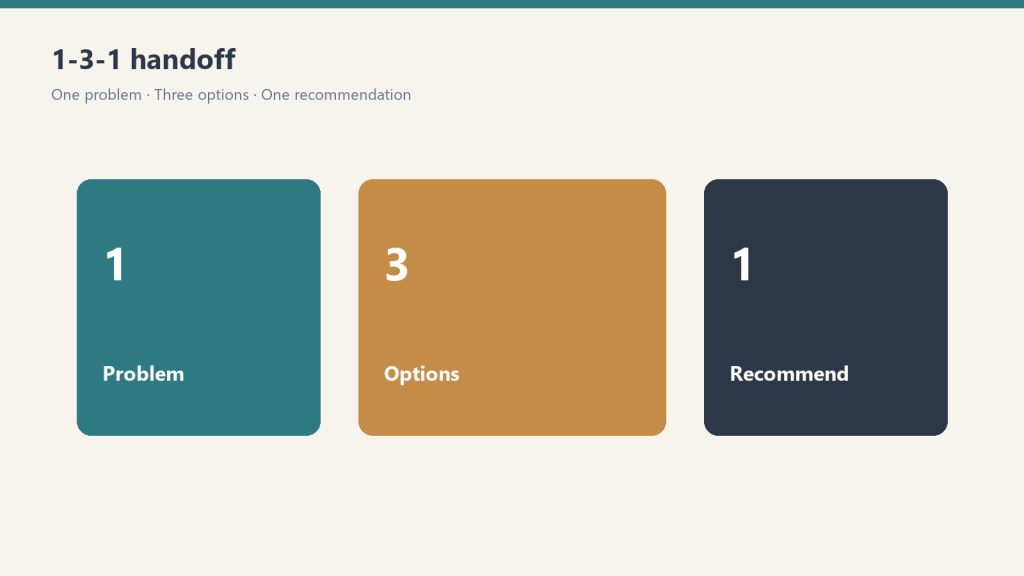
Stop being the answer key. The old way: “The dehu on Maple St died. What do you want me to do?” You just took back the problem, the thinking, and the decision.
The 1-3-1 way:
- 1 issue. The fork in the road, one or two sentences. Not the whole story.
- 3 real options. Each with pros, cons, and rough cost or effort. “Do nothing” can be one when it is honest.
- 1 recommendation. The option they would pick if it were their call, and why in one line.
- A default. What they will do if they do not hear back by a deadline, so the job does not stall.
When someone brings a raw problem, ask: “What are your three options, and which do you recommend?” Then wait. Run at least five real 1-3-1 conversations this phase. Approve the recommendation whenever it is reasonable. Note who takes to it. That is a signal for your manager pick.
Phase done when at least one person is bringing 1-3-1s without being reminded.
Weeks 5-6: write decision rights
List the 10-15 recurring decisions (refunds, equipment, scheduling, scope changes, hiring, pricing exceptions). For each: a dollar or scope threshold people can decide under without asking you, and who owns it when you are not in the room. Walk the team through it: “Under this line, you don’t need me. Decide and tell me after.”
Hand off one decision completely this phase. Do not take it back.
Weeks 7-8: develop one manager
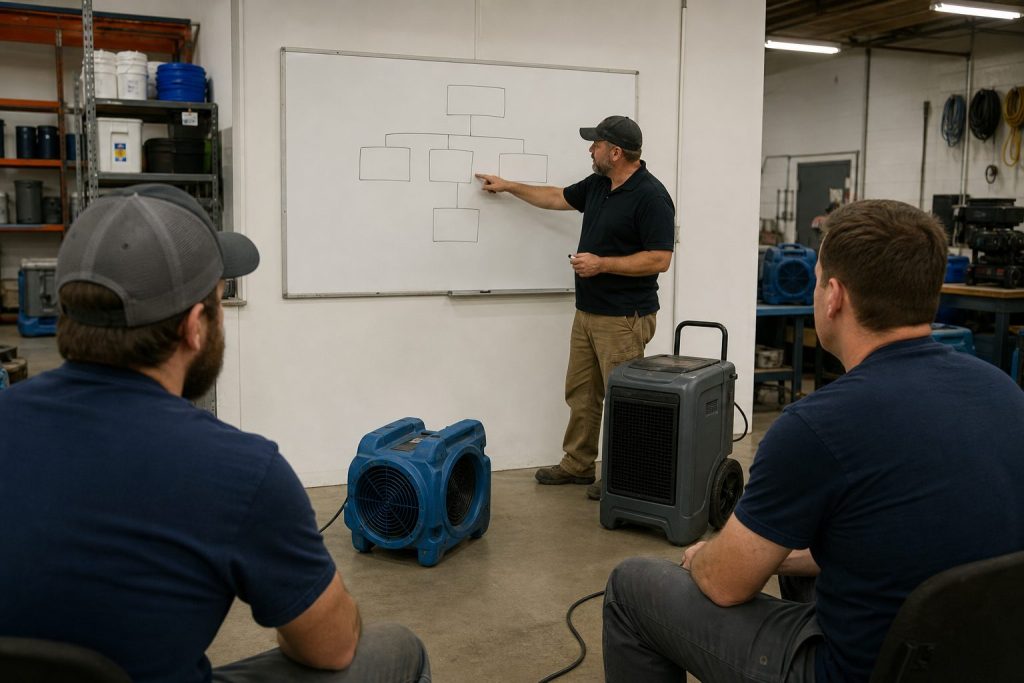
Open the Bench Builder. One row per key function. Fields: Role, current owner, future-leader candidate, backup depth (None / Thin / Solid), key skill gaps, 90-day development action (observable: shadow X, own Y file end-to-end, run Monday huddle), delegation plan, accountability rhythm (Weekly / Biweekly / Monthly), status (Identified / Developing / Ready). A blank candidate is itself a finding.
Go deep on ONE person. A single real manager beats five people you are “keeping an eye on.” Have the conversation: “I want to grow you into running X.” Hand them one area end-to-end. Set a weekly 30-minute 1-on-1 and protect it. Let them make a real decision. Coach the outcome instead of grading it.
Weeks 9-10: accountability rhythm
Stand up a weekly 15-minute huddle with a fixed agenda: numbers, jobs at risk, who needs what. Pick 3-5 numbers the team reviews every week (jobs in WIP, days-to-dry, AR, callbacks, leads). Someone other than you owns each number. Have your developing manager run the huddle at least once while you sit in.
Hold one real accountability conversation this phase. Issue, behavior that needs to change, what has already been allowed, the expectation, the consequence or support, what success looks like in 30 days. About the work, not the person.
Weeks 11-12: review and repeat
Re-run the Dependency Audit and compare to Week 1. Take a planned half-day fully off and note what broke. That is the next bottleneck. List what got delegated vs what bounced back, and why. Give the developing manager direct feedback. Raise one decision-rights threshold. Duplicate the 90-day page and start the next cycle.
Success at 90 days: a full day off without the phone melting; the team brings 1-3-1s; a written decision-rights list; one person owns one area end-to-end; a huddle someone else can run; a lower dependency score; next quarter’s target already named.
Run the 5 Ds while you are in it
Succession is a what-if-tomorrow problem, not a retirement problem. Check a box only if it is true and current today. The five:
- Death. Will, funded buy-sell, key-person life, second check-signer, someone who can legally bind the company, a recoverable password place, a named person who can run production 30+ days.
- Divorce. Separate vs marital property actually confirmed, commingling cleaned up, a valuation method in writing, operating cash structured so a personal dispute cannot freeze payroll.
- Disease. Someone has actually run production on a vacation test. Backup estimator. Payroll / AP / AR without your hands. Disability and business-overhead coverage. A one-page interim chain-of-command.
- Drugs / dependency. Dual approval over a dollar threshold. A second set of eyes on the books. No single point of failure, including you. A trusted advisor allowed to tell you the truth.
- Departure / disaster. Tribal knowledge written down. Relationships not owned by one person. Off-site backups you have test-restored. A continuity plan for your own shop. Backup vendor / equipment list.
45 boxes. Count the blanks. 0-6 resilient; 7-15 moderate; 16-27 high; 28+ you are the company. Pick the three blank boxes that would hurt most if the D hit tomorrow. Name an owner and a date. This is an awareness tool, not legal, financial, or insurance advice. Use it to walk into the attorney, agent, and CPA prepared.
If you want the packaged kit
You can run this from the outline above. Buy Now is the bundle delivered by email after checkout: the five Notion pages (duplicate each so the master stays clean), plus the matching Claude skills if you want the interviews walked. Same Square button at the top of this page.
Coaching and operational tools only. Not legal or HR advice.
Related on Tygart Media: owner dependency audit · leadership OS · operations kit AI edition.
Leave a Reply