
If you still lean on a tool like SpyFu to gauge how your site is doing in search, you’re measuring last decade’s game. SpyFu, Ahrefs, SEMrush, and their peers were built to estimate one thing: where a domain ranks in a traditional results page, and roughly how much traffic that’s worth. Still useful — just not the whole picture, because a growing share of how people find your content never touches a results page at all. It happens inside an AI answer, where your page gets cited or quoted and the reader never clicks through.
That’s the gap between third-party rank-estimation tools and first-party AI citation data, and it matters more every month.
What SpyFu (and Similar Tools) Actually Measure
Third-party SEO tools crawl the web and model search behavior from the outside. They don’t have access to your server logs, your analytics, or Bing and Google’s internal citation data — they infer traffic from ranking position, keyword volume estimates, and click-through curves built from aggregate industry data. That’s genuinely useful for competitive research: roughly where a competitor’s domain sits, and what keywords it’s chasing.
But it’s an estimate of an estimate, built for a web where “visibility” meant “blue link position.” It has no mechanism for counting how many times an AI assistant read your page, extracted a fact from it, and served that fact directly to a user who never visited your site.
What First-Party AI Citation Data Shows That Estimators Can’t
Bing Webmaster Tools now separates two very different signals: traditional web search performance (impressions, clicks, position) and AI performance — how often your pages get surfaced inside Copilot and other AI-generated answers. Google Search Console doesn’t yet break this out the same way, which is part of why it’s easy to miss. If you only watch third-party rank trackers, this entire layer is invisible to you.
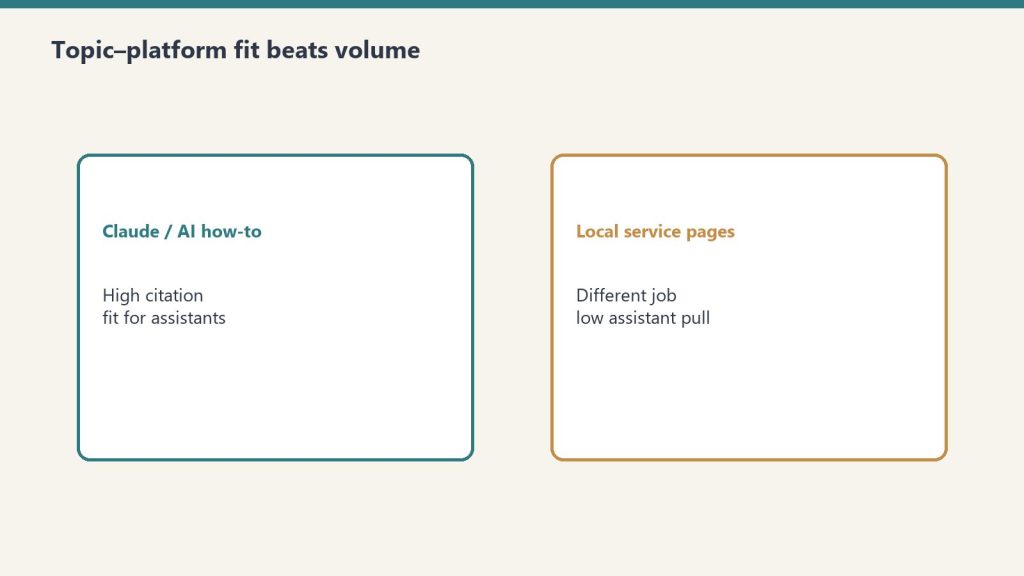
The practical difference: a page can have modest, even declining, click-through performance in classic web search while its AI-citation count climbs steadily. Judged only by a SpyFu-style estimate, that page looks flat or fading. Judged by first-party citation data, it’s doing exactly the job it was built for — being the source an AI system reaches for when someone asks a related question.
The Blind Spot: Zero-Click Visibility
The uncomfortable part for site owners is that AI citation is, by design, mostly a zero-click channel. The reader gets their answer without visiting — that’s not a measurement bug you can fix with a better tool, it’s the actual shape of the channel. An estimator that only counts clicks and rankings will systematically undercount pages that are winning at citation, because “winning” there doesn’t look like a traffic spike. It looks like your facts and explanations showing up correctly, attributed to you, inside someone else’s interface.
Relying on SpyFu-style estimates alone can lead to the wrong call: de-prioritizing a page that’s actually become a trusted AI reference source, simply because the tool built to measure clicks can’t see the citations.
Building Your Own First-Party Measurement Stack
None of this means third-party tools are useless — they’re still the right instrument for competitive keyword research and for understanding classic ranking dynamics. But they should sit alongside, not replace, sources that actually see your own traffic and your own citation footprint:
- Bing Webmaster Tools’ AI Performance tab — the most direct read on how often Copilot and partner AI surfaces are citing your pages.
- Server or CDN logs — the only place you’ll reliably see crawler activity from AI bots (ClaudeBot, GPTBot, PerplexityBot, and similar) hitting your pages, separate from human traffic.
- Your own analytics referral data — small in volume compared to citations, but real signal: sessions that landed with claude.ai, chatgpt.com, or perplexity.ai as the referring host are humans who read an AI answer, then clicked through anyway.
Put those three together and you get a picture no third-party estimator can reconstruct: which of your pages AI systems actually trust enough to cite, and whether that trust is translating into any direct human traffic at all.
Practical Takeaway

If a page’s third-party “visibility score” looks unimpressive but your first-party data shows steady or rising AI citation activity, don’t treat that as a contradiction — treat it as two different questions with two different answers. The estimator tells you about classic rank. Your own logs and Bing’s AI data tell you about a newer kind of authority that doesn’t require a click to pay off. Site owners who only check the estimator are optimizing for a channel that’s shrinking relative to the one they can’t see.
FAQ
Do I need to abandon tools like SpyFu?
No. They’re still useful for competitive keyword research and classic rank tracking. The point is to stop treating their traffic estimates as the full measure of your site’s reach.
Can I get AI-citation data for Google’s AI features the way I can for Bing?
Not with the same granularity as of this writing — Bing Webmaster Tools currently offers the clearest first-party AI-citation reporting. Server-log analysis for AI crawler activity works across engines regardless.
How do I know if AI citations are actually worth anything to my business?
Track it as its own funnel stage, not a proxy for revenue. Pair citation counts with referral sessions from AI-tool domains and see whether that traffic engages with an owned conversion path on your site. Citation volume alone tells you about reach, not value.
Related on Tygart Media: read Bing AI citations · AI citation monitoring · GEO tactics.
Leave a Reply