Everybody is selling “agentic AI” right now, and most of the selling is conference talk — slides about autonomous everything, written by people who don’t run anything with it. I run a small media company with it. Every day. So here’s the definition from the floor of the shop instead of the stage.
Agentic AI is AI that doesn’t just answer. You give it a job — with boundaries, tools, and a way to report back — and it carries the work through the steps itself, without a person pushing each one along.
That’s the whole distinction. A chatbot waits for your next prompt. An agent takes a commission and goes and does the work: reads what it needs, uses the tools it’s been handed, makes the small decisions inside its lane, and comes back with the finished thing and the proof. Whether that works or falls apart depends entirely on how the shop around it is arranged — and the arrangement is the part nobody puts on the slide.
The seats: nobody here does everything
The first arrangement decision: the work is split across named seats, and each seat has a lane.
- The chief-of-staff seat holds the context. It keeps the memory of what’s been decided, what’s owed, who’s who, and what I said on a clear-headed day — and it turns my direction into written work the other seats can run. It’s the filter, not the boss.
- The code seat builds. When something needs to be made — a tool, a page, a fix — that seat writes it and shows its record. I keep the code seat’s record in public for a reason: a seat that builds should be able to show what it built.
- Scout seats go and look. Research, censuses, reading a market or a competitor end to end and coming back with what’s actually there — not what the summary said was there.
- The executor seat runs work orders on the machine where the work lives. It does the hands work: publishes, edits, uploads, the long multi-step runs I don’t have the hours to sit inside.
I wrote up how I run six AI seats on this business — the governance, the lanes, and the rule that matters most: a seat does not freelance outside its lane. The moment an agent starts deciding on its own what else might be a good idea, you don’t have a staff. You have a rumor mill with write access.
The work order is the unit of trust
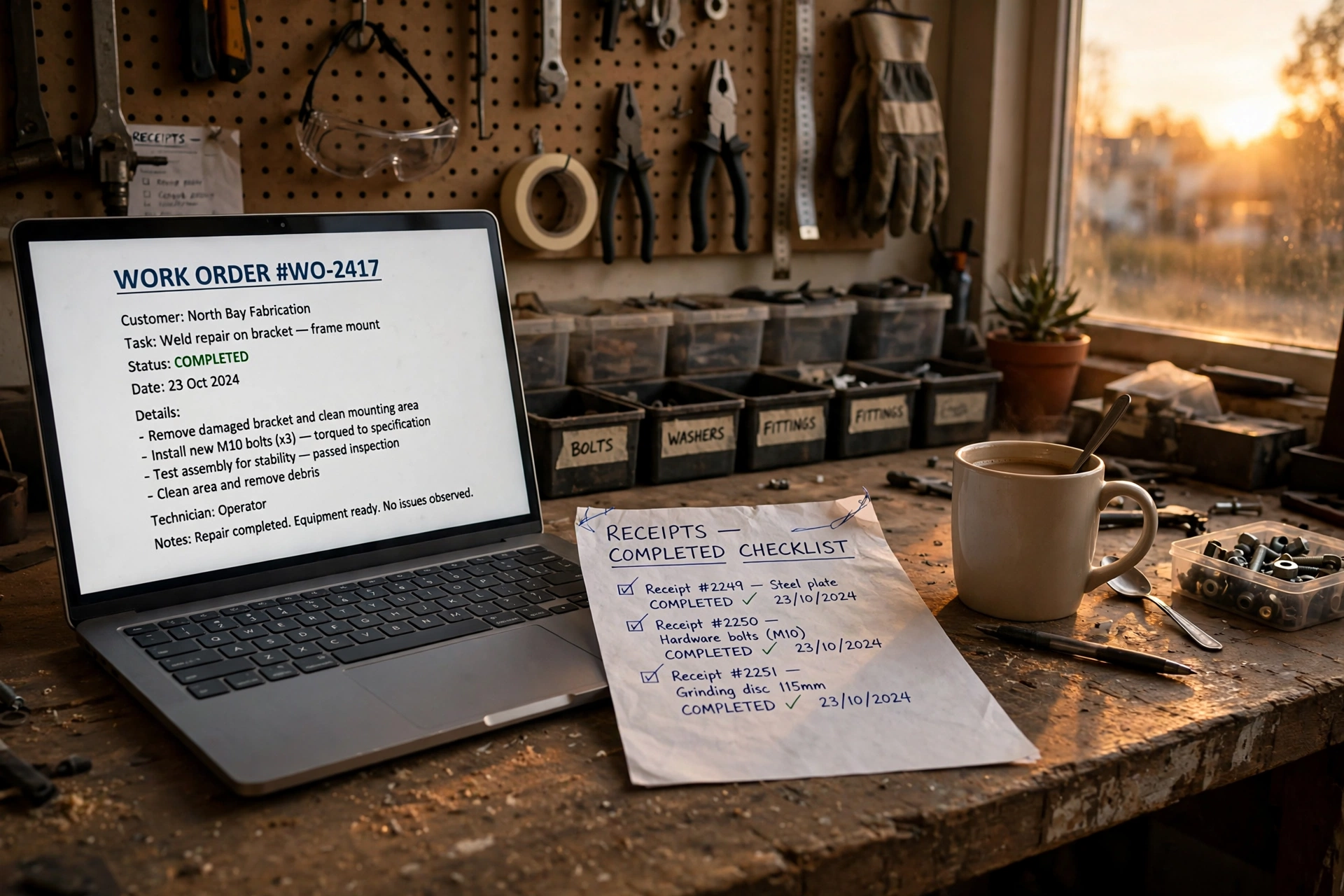
Seats don’t get vibes. They get work orders — written commissions, one job each, built before anything runs. A work order in this shop carries four things:
Get The Signal
What we actually ran, what it measured, and what it means for a restoration shop — every week, including the flops.
- The whole price, stated once, up front. Everything the job will touch, everything it might cost in time or taps from me, named before it starts. Nothing gets discovered as a surprise blocker halfway through — or if it does, that’s a defect in the order, and we say so.
- The context, baked in. The executor shouldn’t have to guess who I am, what the site is for, or how I talk. The order carries it, so the work comes back sounding like this shop and not like a template.
- The boundaries. Some doors are mine alone: money, credentials, anything that sends to another person, anything that can’t be undone. Those are drawn as lines in the order itself. Inside the lines, the seat has real latitude. Across them, it stops and comes back to me.
- The receipt standard. Exactly what proof comes back with the finished work — measured values, live links, counts — written into the order before the run, not negotiated after it.
Think of it like commissioning a piece of furniture. I don’t stand over the maker’s bench. I write the commission well enough that the piece can only come back right — and then I do the finish work when it arrives.
Receipts are the proof, because “done” is a claim
Here is the part of agentic work the demos skip: an agent can tell you work happened that did not happen. Not out of malice — out of the same confident fluency that makes it useful. It will describe the email it sent, the page it fixed, the file it saved, in perfect detail, and some of the time it will be describing a thing it only intended to do.
So in this shop, nothing is done because a seat says so. It’s done when the live thing checks out. The published page gets fetched and read. The number gets tied back to the source it came from. The export gets counted, not described. Every run comes home with receipts, and a second seat does the finish check against the live result before I ever hear the word “done.”
That’s not paranoia; it’s the load-bearing wall. The whole Receipts series on this site exists because citation claims kept turning out to need a second look — the piece where half the citations sat on three pages started as a seat’s confident summary and ended as a very different story once somebody counted. The receipt discipline exists because of that failure mode. Not despite it.
What the human does all day
People ask what I do if the agents do the work. The honest answer: the parts that were always the job.
I bring the direction and the instinct — which door is worth walking through, which idea smells wrong even when the reasoning sounds fine. I make the judgment calls: pricing, commitments, anything with another person’s name on it. And I hold the one-way doors. A send, a payment, a deletion, a credential — those wait for my tap, every time, by design and not by limitation.
What the system holds for me is the context I can’t: every decision, every receipt, every open loop, across more projects than one head carries. I don’t have to remember where things stand. I have to decide what happens next — and when I’m tired or emotional and about to make a call my clear-headed self wouldn’t make, the system holds the line with what I said when I was thinking straight. That’s the trade, and it’s a good one.
The honest limits
Anybody who runs agents for real can tell you the failure list, so here’s mine. Agents drift off the brief when the brief has a soft spot in it. They conflate two similar jobs — same-shaped folder, different work — and run the wrong one beautifully. They price the start of a job and not the finish, so a run looks cheap until you count the stalls, the re-reads, and the tap it needed from me at the worst moment.
The craft isn’t pretending the seats are flawless. The craft is the guardrails and the checking: the input manifest verified before the run starts, the step-zero check that clears a suspect before anyone calls it broken, the receipt read against the live thing instead of against the report. Every scar on the process here is a rule now. That’s how a shop gets good at this — not by buying a smarter seat, but by writing down what the last failure taught it.
What “agentic” means with the talk stripped off
Strip the conference language away and agentic AI is this: a small business running like it has a staff. Research that actually gets done. Pages that actually get published. Records that actually get kept. A two-person company doing the carrying work of a much bigger one — with the receipts to show for it, because the receipts are the only version of the story worth telling.
We’ve published dozens of pieces from inside this work — the failures included, especially the failures — because the shop is the argument. If agentic AI is going to mean anything outside a demo, it’ll mean shops like this one: named seats, written orders, hard boundaries, and proof at the end.
Questions people ask me
What is agentic AI in simple terms?
It’s AI you give a job instead of a question. You set the boundaries, hand it tools, and tell it how to report back — then it does the steps itself and returns the work with proof, instead of sitting there waiting for your next prompt.
What is an AI agent vs a chatbot?
A chatbot answers and stops. An agent acts: it reads, decides small things inside its lane, uses tools, and works through a multi-step job over time. The chatbot is a conversation. The agent is a commission — and commissions need boundaries and receipts in a way conversations don’t.
How do multiple AI agents work together?
The same way a small staff does: split lanes and written handoffs. One seat holds context and writes the work orders, specialist seats build or research, an executor runs the job where the work lives, and a second set of eyes checks the result against the live thing. The coordination isn’t magic — it’s the paperwork, done properly.
Do AI agents replace employees?
In this shop, there’s no version where a seat makes the judgment calls, holds the relationships, or takes responsibility for a one-way door — that’s my job and it stayed my job. What the seats replaced is the carrying: the hours of execution between a decision and a finished, checked piece of work. For a small business, that’s the difference between ideas that die in a notebook and work that ships.
Get The Signal
What we actually ran, what it measured, and what it means for a restoration shop — every week, including the flops.
Leave a Reply