
Notes from the Bot Lab · November 28, 2026 · By Will Tygart
Ask most marketing teams what the Model Context Protocol (MCP) is and they will tell you it is an engineering gimmick developers use to connect Slack to a database inside a startup office. On November 27, we opened our 24-hour REST endpoint breakdown on tygartmedia.com and found one frontier lab talking directly to our public WordPress site like a live software integration.
Across 24 continuous hours of non-operator traffic, WordPress REST API paths drew 1,913 requests spanning 557 distinct endpoints. Right behind embedded oEmbed lookups (736 hits), the second busiest REST path on the entire website was our MCP endpoint — drawing 430 protocol hits alongside 58 OAuth and handshake checks from xAI-Grok-Connectors.
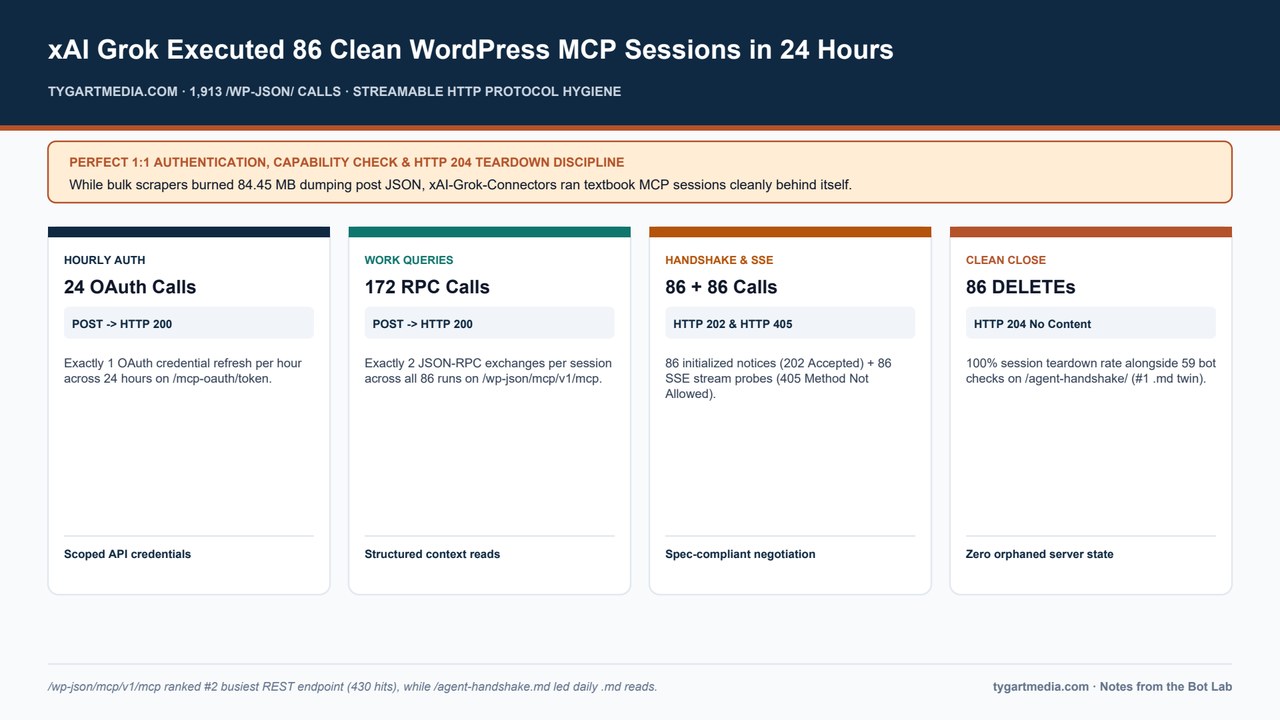
Even better than seeing a major AI platform connect cleanly to WordPress was seeing how politely it behaved once inside: 86 sessions started, 86 sessions torn down cleanly, down to the exact HTTP DELETE call.
Anatomy of 86 Textbook Streamable HTTP MCP Sessions
Under the Streamable HTTP MCP specification, a compliant client negotiates sessions through explicit HTTP verbs and lifecycle calls rather than hammering HTML pages with brute-force GET loops. Look at the exact arithmetic recorded by xAI-Grok-Connectors over 24 hours on tygartmedia.com:
| MCP Lifecycle Step & Endpoint | 24h Count | HTTP Status Returned | Exact Ratio & Protocol Meaning |
|---|---|---|---|
| POST OAuth Token Endpoint | 24 | HTTP 200 OK | Exactly 1 OAuth credential refresh per hour across 24 hours. |
| POST /wp-json/mcp/v1/mcp (RPC Calls) | 172 | HTTP 200 OK | Exactly 2 JSON-RPC capability/query calls per MCP session (2 x 86 = 172). |
| POST /wp-json/mcp/v1/mcp (Initialized) | 86 | HTTP 202 Accepted | Formal notifications/initialized handshake on every single session. |
| GET /wp-json/mcp/v1/mcp (SSE Check) | 86 | HTTP 405 Method Not Allowed | 1:1 probe checking optional Server-Sent Events streaming support. |
| DELETE /wp-json/mcp/v1/mcp (Teardown) | 86 | HTTP 204 No Content | 100% clean explicit session closure — zero orphaned sessions left open. |
Look at those numbers again: 24, 172, 86, 86, 86. Not 85 teardowns, not 140 stuck retry loops — every single session opened via xAI’s connector ran two clean RPC exchanges, checked once whether an optional server-sent stream existed under RFC 9110 HTTP status semantics, and explicitly fired an HTTP 204 DELETE to close the door behind itself when finished.
For anyone who maintains a public web server, that contrast is night and day. On the exact same afternoon, sloppy scrapes were hammering random URLs without trailing slashes or sending fake Chrome headers just to harvest plain paragraphs. Meanwhile, an MCP client spoke to our WordPress door using crisp, typed authentication tokens and polite session cleanup.
How Legacy REST Scrapers Compare Against Agent Handshakes
Looking across all 1,913 WordPress REST requests inside that 24-hour slice reveals two completely different eras of machine-to-website traffic colliding at once:
In one corner, traditional scrapers hit /wp-json/wp/v2/posts 524 times (draining 84.45 MB, including a single Python script paginating 53.74 MB across 38 bulk requests), while WordPress RSS feeds saw 396 requests (60.39 MB) and oEmbed saw 736 requests.
In the other corner sits purposeful agent negotiation. Alongside Grok’s 86 MCP sessions, major search and citation bots — PerplexityBot, ClaudeBot, GPTBot, and ExaSearchBot — made 59 hits across 39 distinct networks specifically inspecting our public Agent Handshake door. Even more telling: in our 24-hour audit of 1,020 Markdown-twin fetches across the entire site, /agent-handshake.md ranked No. 1 out of every Markdown document on tygartmedia.com (15 fetches in a single day).
Two Lessons for Publishers Running WordPress in Late 2026
You do not need to re-architect your whole company around MCP tomorrow morning — as we wrote in Billboards, Bots, and Heading Toward the Mountain, most operators just need clean answers and durable fundamentals first. Still, watching 86 live MCP sessions execute cleanly teaches two clear operational rules:
| Traffic Pattern on WordPress | Legacy Scraper Approach | MCP / Handshake Agent Approach | What Logs Let You Verify |
|---|---|---|---|
| Discovery & Auth | Blindly crawls HTML/REST pagination or spoofs desktop Chrome. | Uses hourly OAuth refreshes and reads explicit handshake/Markdown endpoints. | Verify exact 200 vs 401 behavior instead of fighting fake browser farms. |
| Payload Efficiency | 84.45 MB pulled from full WordPress JSON dumps. | Tiny targeted RPC payloads + 8.5 KB Markdown specs. | Measure exact bytes per answer rather than blocking all /wp-json/ blind. |
| Session Hygiene | Leaves abandoned sockets and broken redirects behind. | Closes 86/86 sessions with explicit HTTP 204 DELETE requests. | Confirm clean server teardown rates in your daily origin rollups. |
First, never sweep all of /wp-json/ behind a blanket firewall rule without checking what lives inside it. Locking down sensitive user-enumeration paths works cleanly while still allowing legitimate oEmbed, structured handshakes, and MCP connections to negotiate properly.
The Web Is Quietly Growing Doors Alongside Storefronts
Between our infrastructure thesis, our Direct traffic autopsy, and watching four different frontier labs query /agent-handshake.md and WordPress MCP endpoints in the wild, one pattern keeps repeating: websites are no longer just brochures waiting for human clicks.
The front showroom still matters for buyers who walk in from memory. Right beside it, clean API doors and Markdown twins let software clients walk in, pull verified context, and shut the door politely behind themselves.
Frequently Asked Questions
How many MCP sessions did xAI Grok run on tygartmedia.com in 24 hours?
xAI-Grok-Connectors executed 86 complete Streamable HTTP MCP sessions in 24 hours on tygartmedia.com: 24 hourly OAuth token refreshes, 172 RPC calls (HTTP 200), 86 initialized notices (HTTP 202), 86 SSE checks (HTTP 405), and 86 DELETE teardowns (HTTP 204).
Why did GET requests to the MCP endpoint return HTTP 405?
Under the Streamable HTTP Model Context Protocol transport specification, clients send an optional GET probe to check Server-Sent Events streaming support; returning HTTP 405 Method Not Allowed signals stateless request/response mode cleanly.
Are major AI crawlers already inspecting agent handshake specs on WordPress?
Yes. On tygartmedia.com, PerplexityBot, ClaudeBot, GPTBot, and ExaSearchBot logged 59 requests across 39 networks hitting /agent-handshake/, making /agent-handshake.md the #1 Markdown twin requested site-wide that day.
Leave a Reply