Tag: AI Search

  • Law Firm SEO: WordPress & AI Optimization via SiteBoost

    Law Firm SEO: WordPress & AI Optimization via SiteBoost

    SiteBoost — Vertical Series

    SiteBoost for Law Firms: WordPress SEO, AEO & AI Optimization for Attorneys

    By Tygart Media — This page is built using the same SEO, AEO, and GEO techniques we apply through SiteBoost. The optimization you see here is the product.

    Law Firm WordPress Optimization: The process of applying SEO (Search Engine Optimization), AEO (Answer Engine Optimization), and GEO (Generative Engine Optimization) to a law firm’s existing WordPress content — improving title tags, meta descriptions, FAQ sections, schema markup, and entity density so the firm ranks in Google, wins People Also Ask placements, and gets cited by AI systems like ChatGPT, Perplexity, and Google AI Overviews.

    The Law Firm SEO Problem: Paying $8–$500 Per Click While Your Blog Sits Unoptimized

    Law firms pay the highest average CPC of any industry — $8.58 on core terms, with personal injury and truck accident keywords hitting $150–$500 per click. A single signed case can be worth $50,000 to several million dollars, which is why firms keep bidding. But most of those same firms have WordPress blogs full of articles with no FAQ sections, no schema markup, missing meta descriptions, and zero AI visibility — organic traffic they’re leaving entirely on the table.

    SiteBoost connects directly to your WordPress site and optimizes every existing article for the three layers that matter in 2026: traditional search rankings, People Also Ask placements, and AI citation by ChatGPT, Perplexity, and Google AI Overviews. No plugins. Changes pushed live via the WordPress REST API. Results measured at 60 days.

    What is the ROI of SEO for law firms compared to Google Ads?
    Law firms paying $8–$500 per click on Google Ads can reduce paid dependency by ranking organically for the same high-intent keywords. A single law firm blog post optimized for “personal injury lawyer FAQ” can generate consistent organic impressions at zero marginal cost per click — compared to $8–$150 per click on Google Ads for the same terms. SEO compounds over time; paid ads stop the moment the budget runs out.

    The Three Optimization Layers Applied to Every Law Firm Article

    Each post receives three passes. Here’s what happens to a typical law firm WordPress article:

    Layer What We Do What It Wins
    SEO Rewrite title tag (primary keyword front-loaded, 50–60 chars), clean slug, write meta description (140–155 chars), fix H2/H3 structure Higher rankings, better CTR from SERPs
    AEO Add 40–60 word definition box, inject 6–8 FAQ pairs targeting People Also Ask, add FAQPage JSON-LD schema Featured snippets, PAA placements, voice search
    GEO Inject named legal entities (practice areas, regulations, courts, case types), add speakable blocks, embed LLMS.txt comment Citations in ChatGPT, Perplexity, Google AI Overviews

    Real Before & After: Law Firm WordPress Article

    Here is a hypothetical demonstration of what SiteBoost applies to a typical law firm article about personal injury claims — the kind of content most firms have sitting unoptimized for years:

    Before SiteBoost
    Title: “Personal Injury Claims | a Regional Law Firm”

    Meta: (empty)

    Word count: 312 words

    FAQ section: None

    Schema: None

    AI visibility: Zero — ChatGPT and Perplexity have no reason to cite this page

    Google ranking: Page 4–6 for “personal injury lawyer FAQ”

    After SiteBoost
    Title: “Personal Injury Claims Explained: What You Need to Know | a Regional Law Firm”

    Meta: “Injured? Learn how personal injury claims work, what damages you can recover, and how our attorneys build your case. Free consultation.” (148 chars)

    Word count: 890 words (expanded)

    FAQ section: 7 questions targeting PAA: “How long do I have to file?”, “What is comparative negligence?”, “Do I pay upfront?”

    Schema: FAQPage + Article JSON-LD injected

    AI visibility: Speakable blocks + legal entity injection (ABA, negligence, statute of limitations, contingency fee)

    Google ranking: Structured for page 1 targeting across multiple long-tail terms

    Why Law Firm Content Needs GEO Optimization in 2026

    According to iLawyer Marketing, law firms should be optimizing for both Google and answer engines in 2026. When someone asks ChatGPT “what should I know before filing a personal injury claim?” or asks Perplexity “how do contingency fees work for lawyers?” — the AI pulls answers from the most entity-rich, structured, authoritative WordPress content it can find. Most law firm blogs are invisible to these systems because they lack named entities, speakable blocks, and the structural signals AI crawlers use to identify citable content.

    What legal entities should law firm WordPress content include for AI citation?
    Law firm content optimized for AI citation should reference named legal entities including: the American Bar Association (ABA), specific practice area statutes (e.g., 28 U.S.C. § 1332 for diversity jurisdiction), named legal doctrines (contributory negligence, res ipsa loquitur, respondeat superior), court systems (U.S. District Court, state circuit courts), and relevant regulatory bodies. Entity density — not keyword density — is what signals authority to AI systems like ChatGPT, Perplexity, and Google Gemini.
    How does AEO help law firms win People Also Ask placements?
    Answer Engine Optimization for law firms focuses on restructuring existing blog content so the first 40–60 words after each H2 heading directly answer the implied question. Adding a FAQPage schema block with 6–8 question-and-answer pairs targeting high-intent legal queries — “How long do I have to file a personal injury claim?”, “What does contingency fee mean?”, “Can I sue if I was partially at fault?” — positions the page for Google’s People Also Ask box, which appears above organic results for most legal searches.

    The Competitive Gap: What Servpro Has That Your Law Firm Doesn’t

    SpyFu data shows Servpro.com ranking for 178,900 organic keywords with an estimated monthly SEO value of $5.8 million — achieved through systematic content optimization at scale. Meanwhile, the typical law firm WordPress site ranks for fewer than 500 keywords with an SEO value under $50,000. The gap isn’t budget. It’s optimization depth: title tags, meta descriptions, FAQ schema, internal linking, and entity saturation — applied systematically across every post.

    SiteBoost Pilot for Law Firms: What You Get

    Deliverable Details
    Site Connection & Audit Secure WordPress REST API connection, full content inventory, schema gap report, FAQ gap report, Before Baseline Report
    10 Post Optimizations SEO + AEO + GEO + Schema on 10 of your highest-opportunity existing articles — your approval before we start
    60-Day Impact Report Before vs. after comparison: rankings, impressions, AI visibility, traffic delta
    No plugins installed All changes via WordPress REST API — nothing added to your site
    Price $597 pilot — $767 value

    Interested in the SiteBoost Pilot for Your Law Firms Site?

    We onboard sites personally. Email Will with your site URL and he’ll follow up within one business day.

    → Email Will — Start the Pilot

    Email only. No sales call required. No commitment to reply.

    Frequently Asked Questions: SiteBoost for Law Firms

    How is SiteBoost different from a traditional law firm SEO agency?

    Traditional law firm SEO agencies charge $1,500–$5,000+ per month for long-term retainers, often with 6–12 month commitments. SiteBoost is a per-article, per-post service with no retainer required to start. The pilot is $597 for 10 optimized posts and a 60-day impact report. You pay for work done, not time on retainer. We also apply AEO and GEO layers that most traditional SEO agencies don’t offer — optimizing for People Also Ask and AI citation systems, not just traditional Google rankings.

    What WordPress hosting providers does SiteBoost work with for law firms?

    SiteBoost connects via the WordPress REST API using an Application Password — the same security standard used by Yoast, AIOSEO, and Rank Math plugins. We work with any self-hosted WordPress installation: WP Engine, Flywheel, SiteGround, Cloudflare-proxied sites, GCP Compute Engine, DigitalOcean, Kinsta, and bare-metal servers. The only requirement is that WordPress REST API is enabled, which it is by default on all standard installations.

    Will SiteBoost changes affect our attorney bio pages or service pages?

    No. SiteBoost optimizes blog posts and articles — not Pages, service pages, or attorney bio pages. WordPress distinguishes between Posts (post_type=post) and Pages (post_type=page). We operate exclusively on Posts unless you explicitly request a specific Page be included. Your core firm pages, practice area pages, and attorney profiles are never modified without direct written approval.

    How long does it take to see SEO results for a law firm WordPress blog?

    Traditional SEO changes typically take 60–90 days to surface in Google rankings for competitive legal keywords. However, AEO and GEO changes can appear faster — FAQPage schema can earn People Also Ask placements within 2–4 weeks, and AI systems like Perplexity crawl and update their citation index more frequently than Google’s organic index. The SiteBoost 60-Day Impact Report measures changes across all three: traditional rankings, PAA placements, and AI citation visibility.

    What makes SiteBoost suitable for E-E-A-T optimization for law firms?

    Google’s E-E-A-T framework (Experience, Expertise, Authoritativeness, Trustworthiness) is especially important for law firm content, which falls under Google’s YMYL (Your Money or Your Life) category. SiteBoost’s GEO layer injects named legal entities — specific statutes, regulatory bodies, case law concepts, and bar association references — that signal domain expertise to Google’s quality evaluators. We also add structured author references and practice area schema that reinforce attorney credentials within the content itself.

    Can SiteBoost help with local SEO for law firms?

    Yes. Local SEO for law firms — targeting searches like “personal injury attorney in [city]” or “divorce lawyer near me” — depends heavily on the content signals from your blog posts. SiteBoost injects geo-specific entities, city and county references, and locally relevant legal context into your articles. Combined with FAQPage schema and direct-answer formatting, this creates the content authority signals that reinforce your Google Business Profile and local pack rankings.

    Is SiteBoost appropriate for solo attorneys and small boutique firms?

    SiteBoost is specifically designed for small to mid-size law firms and solo attorneys who can’t justify a $3,000/month SEO agency retainer but still have WordPress blogs that need systematic optimization. The pilot bundle at $597 covers 10 posts — enough to demonstrate real results across your highest-opportunity content before committing to ongoing service. Solo attorneys often have significant organic growth potential precisely because their niche practice area content is highly specific and low-competition.


  • AI-Ready Content: How to Structure Expert Knowledge

    AI-Ready Content: How to Structure Expert Knowledge

    Tygart Media / Content Strategy
    The Practitioner JournalField Notes
    By Will Tygart · Practitioner-grade · From the workbench

    The Human Distillery: A content methodology that extracts tacit expert knowledge — the patterns and insights practitioners carry from experience but have never written down — and structures it into AI-ready content artifacts that cannot be produced from public sources alone.

    There is a version of content marketing where the input is a keyword and the output is an article. Feed the keyword into a system, get 1,200 words back, publish. The content is technically correct. It covers the topic. And it looks exactly like every other article on the same keyword, produced by every other operator running the same system.

    This is the commodity trap. It is where most AI-native content operations end up, and it is the ceiling for operators who never solved the knowledge sourcing problem.

    The operators who break through that ceiling have one thing the others do not: access to knowledge that cannot be retrieved from a training dataset.

    The Knowledge Sourcing Problem

    Language models are trained on what has already been published. The insight that every expert in an industry carries in their head — the pattern recognition built from thousands of real jobs, the calibrated intuition about when a situation is about to get worse, the shorthand that professionals use because long-form explanation would be inefficient — none of that makes it into training data.

    It does not make it into training data because it has never been written down. The estimator who can walk through a water-damaged building and know within minutes what the final scope will look like. The veteran adjuster who can read a claim and identify the three questions that will determine how it resolves. This knowledge is the most valuable content asset in any industry. It is also, by definition, missing from every AI-generated article that cites only what is already public.

    The Distillery Model

    The human distillery is built around a simple idea: the knowledge is in the expert. The job of the content system is to extract it, structure it, and make it accessible — to both human readers and AI systems that will index and cite it. The process has three stages.

    Stage 1: Extraction

    You sit with the expert — or review their recorded calls, their written communication, their field notes. You are not looking for quotable statements. You are looking for the patterns underneath the statements. The things they say that cannot be found in any manual because they were learned from experience rather than taught from documentation.

    Extraction is the editorial intelligence layer. It requires a human who can distinguish between “interesting” and “actionable,” between common knowledge and rare insight. The extractor is asking: what does this expert know that their industry does not know how to say yet?

    Stage 2: Structuring

    Raw expert knowledge is not content. It is material. The second stage takes the extracted insight and builds it into a form that is both readable and machine-parseable — a clear argument, a logical progression, named frameworks where the expert’s mental model deserves a name, specific examples that ground the abstraction, FAQ layers that translate the insight into the questions real people search for.

    The structuring stage is where SEO, AEO, and GEO optimization intersect with editorial work. The insight gets the right headings, the definition box, the schema markup, the entity enrichment. It becomes content that a machine can parse correctly and a reader can actually use.

    Stage 3: Distribution

    Structured expert knowledge goes into the content database — tagged, categorized, cross-linked, published. But distribution in the distillery model means something more than publishing. It means the knowledge is now an addressable artifact: a URL that can be cited, a structured data object that AI systems can parse, a piece of writing that future content can reference and build on.

    The expert’s knowledge, which existed only in their head this morning, is now part of the searchable, indexable, AI-queryable record of what their industry knows.

    Why This Produces Content That Cannot Be Commoditized

    The commodity trap that AI content falls into is a sourcing problem. If every operator is pulling from the same training data, every output approximates the same answers. The differentiation is in the writing quality and the optimization — not in the underlying knowledge.

    Distilled expert content has a different raw material. The insight itself is proprietary. It reflects what one expert learned from one specific set of experiences. Even if the structuring and optimization layers are identical to every other operator’s workflow, the output is different because the input was different.

    This is the only durable competitive advantage in content marketing: knowing something that the algorithms cannot retrieve because it was never written down. The distillery’s job is to write it down.

    The AI-Readiness Layer

    AI search systems — when synthesizing answers from web content — are looking for the most authoritative, specific, well-structured answer to a given query. Generic content that rephrases what is already in training data adds little value to the synthesis. Content that contains specific, verifiable, experience-grounded insight — with named entities, factual specificity, and clear semantic structure — is the content that gets cited.

    The human distillery, properly executed, produces exactly that kind of content. The expert’s knowledge is inherently specific. The structuring layer makes it machine-readable. The optimization layer makes it findable.

    What This Looks Like in Practice

    For a restoration contractor: the owner does a post-job debrief — what happened, what was hard, what the client did not understand going in. That debrief becomes the raw material for three articles: one technical reference, one how-to, one FAQ layer. The contractor’s real-world experience is the input. The content system structures and publishes it.

    For a specialty lender: the loan officer walks through how they evaluate a piece of collateral — the factors they weight, the signals they look for, the common errors first-time borrowers make in presenting assets. That walk-through becomes a decision framework article that no competitor has published, because no competitor has extracted it from their own experts.

    For a solo agency operator managing multiple client sites: every client conversation surfaces knowledge — about their industry, their customers, their operational context. The distillery captures that knowledge before it evaporates, structures it into content, and publishes it under the client’s authority. The client gets content that reflects actual expertise. The operator gets a differentiated product that AI cannot replicate.

    The Strategic Position

    The operators who understand the human distillery model are building content assets that will hold value regardless of how AI search evolves. AI systems are trained to identify and cite authoritative, specific, experience-grounded knowledge. Content that already meets that standard is always ahead.

    Generic content produced from generic inputs will always be at risk of being outcompeted by the next model with better training data. Distilled expert knowledge will always have a provenance advantage — it came from someone who was there.

    Build the distillery. The knowledge is already in the room.

    Frequently Asked Questions

    What is the human distillery in content marketing?

    The human distillery is a content methodology that extracts tacit expert knowledge — patterns and insights practitioners carry from experience but have never written down — and structures it into AI-ready content artifacts. The three stages are extraction, structuring, and distribution.

    Why is expert knowledge valuable for SEO and AI search?

    AI search systems are looking for authoritative, specific, experience-grounded content when synthesizing answers. Generic content adds little value to AI synthesis. Expert knowledge contains verifiable insight that both search engines and AI systems recognize as more authoritative than commodity content.

    What is tacit knowledge and why does it matter for content?

    Tacit knowledge is expertise that practitioners carry from experience but have not explicitly documented — calibrated intuitions, pattern recognition, and professional shorthand that come from doing rather than studying. It cannot be retrieved from public sources or training data, making it the only genuinely differentiated content input available.

    What makes content AI-ready?

    AI-ready content is specific, factually grounded, structurally clear, and semantically rich. It contains named entities, concrete examples, direct answers to real questions, and schema markup that helps machines parse its type and context. AI systems cite content that adds something to the synthesis.

    How does the human distillery model create a competitive advantage?

    The competitive advantage comes from the raw material. If all content operations draw from the same public sources and training data, their outputs converge. Distilled expert knowledge has a proprietary input that cannot be replicated without access to the same expert. The optimization layers can be copied; the knowledge cannot.

    Related: The system that distributes distilled knowledge at scale — The Solo Operator’s Content Stack.

  • Why SEO Impressions Beat Social Impressions Every Time

    Why SEO Impressions Beat Social Impressions Every Time

    Tygart Media / Content Strategy
    The Practitioner JournalField Notes
    By Will Tygart · Practitioner-grade · From the workbench

    Intent-Matched Reach: The quality of an audience that actively searched for your topic before encountering your content — as opposed to an audience that was algorithmically shown your content without expressed interest.

    The vanity metric conversation has been had a thousand times in marketing circles, and it always lands on the same target: social media. Likes, followers, reach, impressions — the argument goes that these numbers feel good but mean nothing without downstream action.

    That argument is correct. But it is only half the story.

    The other half is that not all impressions are created equal. An impression on a social feed and an impression from a search engine are fundamentally different events. One is a person being shown something. The other is a person asking for something. That difference is the entire ballgame.

    The Anatomy of a Social Impression

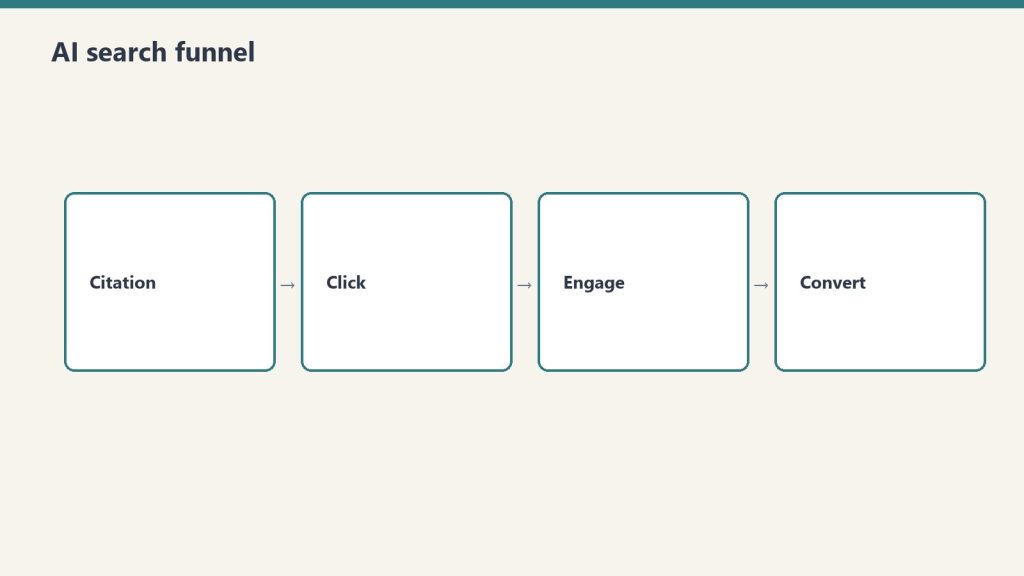
    Four-stage funnel: citation, click, engage, convert
    The anatomy of a social impression.

    When a social platform counts an impression, it means a piece of content appeared in someone’s feed. The person may have been scrolling at speed. They may have glanced at it for less than a second. They may have been looking at their phone while watching television. The platform has no way to know, and it does not particularly care — the impression count goes up either way.

    This is push distribution. The platform’s algorithm decides that your content is worth showing to a given user at a given moment, usually because it resembles content they have engaged with before. The user did not ask for your content. They did not express any intent. They were simply in the path of the content as it moved through the feed.

    Push distribution can build awareness. It can create the repeated exposure that eventually produces recognition. But it is fundamentally passive on the part of the viewer, and passive attention is the weakest form of attention there is.

    The Anatomy of a Search Impression

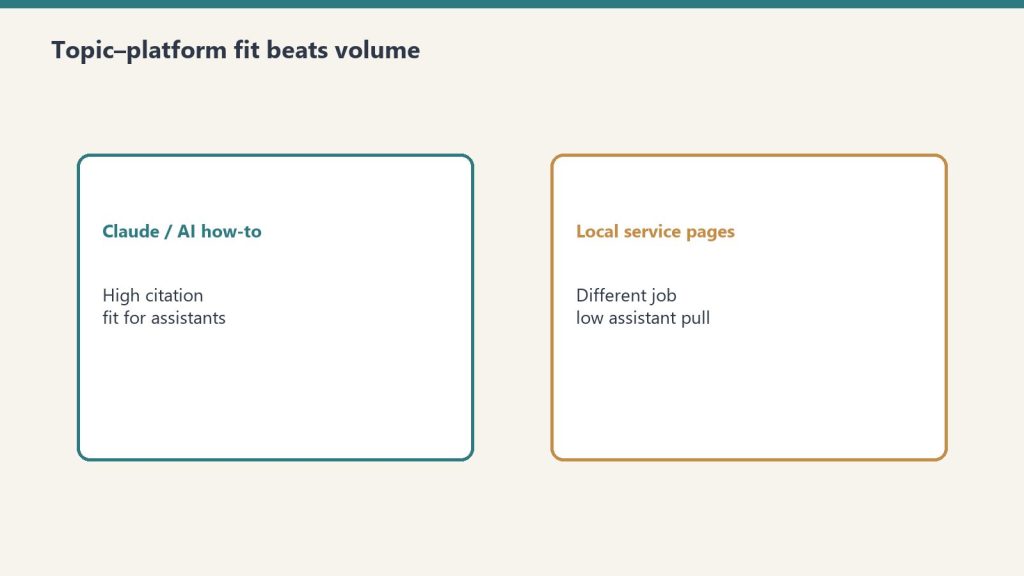
    Comparison of Claude how-to fit versus local service page fit for assistants
    The anatomy of a search impression.

    A search impression is a different creature entirely. When Google Search Console registers an impression, it means a human — or an AI agent acting on behalf of a human — typed a query into a search interface and your content appeared in the results.

    That query represents intent. The person wanted something — information, a product, a service, an answer, a comparison. They articulated that want in the form of a search. Your content appeared because a machine evaluated it as a relevant response to that articulated need.

    This is pull distribution. The user came to the interface with a purpose. They expressed that purpose explicitly. Your content was surfaced as a potential answer. That is a fundamentally different quality of attention than a social feed scroll.

    The user who sees your content in a search result was already moving toward your topic before they ever saw you. The social feed user may have had no interest in your topic whatsoever until the algorithm intervened — and may still have none after the impression registered.

    Why Intent-Matched Reach Compounds Differently

    Desk with laptop, checklist notebook, and billing card ready before creating an Anthropic API key
    Why intent-matched reach compounds differently.

    The practical difference shows up in what happens after the impression.

    A social impression that converts to a click often produces a single-session visit. The user saw something, clicked, consumed it, and returned to the feed. The relationship with the content ends there unless the platform shows them more of your content in the future — which depends on the algorithm, not on the quality of what you wrote.

    A search impression that converts to a click often produces a different behavior. The user was in research mode. They clicked your result. They read your content. And then — if your content was genuinely useful — they may search for related topics, some of which you also rank for. They may bookmark your site. They may return directly. The relationship with the content does not end with the session because the need that drove the search often extends across multiple sessions.

    This is why well-structured content sites see compounding organic traffic over time. Each article that earns a ranking position is a new entry point into the content database. Each entry point captures intent-matched users who are already looking for what you wrote about. The impressions accumulate not because the algorithm is feeling generous, but because the content earned a permanent position in the results.

    The AI Layer Changes the Equation Further

    Search impressions just got more valuable, not less.

    When AI search tools — Google’s AI Overviews, Perplexity, and others — synthesize answers from web content, they are pulling from the same pool as organic search. They query the content database. They find the best-structured, most authoritative sources. They cite them in the generated answer.

    A citation in an AI-generated answer may not register as a traditional click. But it is reach to an intent-matched audience that is even further down the path of engagement than a traditional search user. They asked a question specific enough that an AI synthesized an answer, and your content was authoritative enough to be part of that synthesis.

    This is the next evolution of the SEO impression. It is not just “someone searched and your result appeared.” It is “someone asked a question and your writing was the answer.”

    No social impression comes close to that.

    The Vanity Metric Reframe

    SEO impressions are also a vanity metric if you treat them that way.

    An impression in GSC that never converts to a click because your title and meta description are weak is wasted potential. A ranking position for a keyword with no real search intent behind it is a trophy that serves no one. The metric is only as good as the strategy behind it.

    But the foundational difference remains: you are building on pull, not push. The person chose to look. You earned the position. The impression carries meaning because it reflects expressed intent, not algorithmic distribution.

    What This Means for How You Write

    If you accept that SEO impressions represent intent-matched reach, then writing for search is not the sanitized, keyword-stuffed exercise it has been caricatured as. It is the discipline of answering specific human questions at the highest possible level of quality, then structuring those answers so that machines can identify them as the best available response.

    Every article you write is an attempt to earn a permanent position in the answer set for a specific query. Every impression from that position is a signal that the answer earned its place. Every click is a person who was already looking for what you know.

    That is not a vanity metric. That is the only metric that starts with a human already in motion toward your topic.

    The goal is not more impressions. The goal is impressions from the right query, delivered at the moment of intent. Everything else is noise moving through a feed.

    Related on Tygart Media: information density · SEO and Quality Score · taxonomy as content DNA.

    Frequently Asked Questions

    What is the difference between a search impression and a social media impression?

    A search impression occurs when your content appears in results after a user typed a specific query — expressing active intent. A social media impression occurs when a platform’s algorithm shows your content to a user who may have expressed no interest in your topic. Search impressions are pull; social impressions are push.

    Why are search impressions more valuable than social impressions?

    Search impressions are generated by expressed user intent — the person was already looking for something related to your content before they saw it. Social impressions are algorithm-driven and may reach users with no interest in your topic. Intent-matched reach converts and compounds differently than passive feed exposure.

    What is Google Search Console and what does it track?

    Google Search Console is a free tool from Google that shows how your site performs in Google Search. It tracks impressions, clicks, click-through rate, and average ranking position for specific queries — the primary tool for measuring organic search performance.

    How do AI search tools affect SEO impressions?

    AI search tools like Google AI Overviews and Perplexity synthesize answers from web content and cite sources. Well-structured, authoritative content that ranks well in traditional search is also more likely to be cited in AI-generated answers, extending the value of strong organic positions.

    Are SEO impressions ever a vanity metric?

    Yes — if they come from irrelevant queries, if content ranks for keywords with no real intent, or if weak meta descriptions prevent clicks from converting, impressions are wasted. The value of an SEO impression depends on whether it reflects genuine intent alignment between the query and the content.

    What does intent-matched reach mean in content marketing?

    Intent-matched reach means your content is being seen by people who were already actively looking for the topic you wrote about. Search engines surface content in response to explicit queries, making organic search the primary channel for reaching audiences with demonstrated interest rather than assumed interest.

    Related: The infrastructure behind this strategy starts with how you think about your site — Your WordPress Site Is a Database, Not a Brochure.

  • WordPress Site Database: Why It Beats a Static Brochure

    WordPress Site Database: Why It Beats a Static Brochure

    Tygart Media / Content Strategy
    The Practitioner JournalField Notes
    By Will Tygart · Practitioner-grade · From the workbench

    WordPress as a Database: Treating every WordPress post as a structured content record with queryable fields — taxonomy, schema, meta, internal links, and freshness signals — rather than a static page in a digital brochure.

    Most businesses treat their WordPress site like a brochure — something you print once, hand out, and update when the phone number changes. That mental model is costing them rankings, traffic, and revenue. The sites that win in search treat WordPress for what it actually is: a structured database of content records, each one a queryable, indexable, linkable data object.

    This distinction is not semantic. It changes everything about how you build, maintain, and scale a content operation.

    The Brochure Mindset (And Why It Fails)

    A brochure exists to describe. It has a homepage, an about page, a services page, and a contact form. It gets built once and left. Updates happen when someone complains that the address is wrong or the logo changed.

    Search engines do not care about brochures. They care about signals — freshness, depth, internal link structure, topical coverage, entity density, schema markup. A brochure has none of these things because a brochure was never designed to be read by a machine.

    The brochure mindset produces sites with a handful of published posts, no category structure, missing meta descriptions, zero internal linking, and content that was written once and never touched again. These sites rank for almost nothing, and the business owner wonders why.

    The Database Mindset (How Search Winners Think)

    When you treat your site as a database, every post is a record. Every record has fields: title, slug, excerpt, categories, tags, schema, internal links, author, publish date, last modified date. Every field matters. Every field is an opportunity to send a signal.

    A database mindset produces sites where:

    • Every post has a clean, keyword-rich slug
    • Every post has a meta description written for both humans and machines
    • Categories are not random buckets — they are a deliberate taxonomy that maps to how search engines understand topical authority
    • Tags are not afterthoughts — they are semantic connectors between related records
    • Internal links are not random — they form a hub-and-spoke architecture that concentrates authority where it matters
    • Schema markup tells machines exactly what type of content each record contains

    This is not a content strategy. This is content infrastructure.

    What Changes When You Adopt the Database Model

    Publishing Becomes Systematic, Not Creative

    You are not waiting for inspiration. You are filling gaps in a content map. Keyword research tools show you what topics exist in near-miss positions — those are content records waiting to be written. You write them, optimize them, and push them live. Repeat.

    Taxonomy Design Becomes the First Decision

    Before you write a single post, you map your category architecture. What are the major topical clusters? What are the sub-clusters? How do they relate? This is a database schema design exercise, not a content brainstorm.

    Every Post Connects to Every Relevant Post

    Orphan pages — posts with no internal links pointing to them — are database records that no one can find. The crawler hits a dead end. The reader hits a dead end. Internal linking is the JOIN statement that connects your records into a coherent knowledge graph.

    Freshness Becomes a Maintenance Operation

    A database record goes stale. You run an audit. You identify which records have not been updated in over a year, which records are missing fields, which records have thin content. You update them systematically, the same way a database administrator runs maintenance queries.

    The Practical System for Solo Operators

    You do not need a team of writers to run a database-model content operation. You need a system with four components:

    1. A Keyword Map

    Pull your target keywords, cluster them by topic, assign each cluster to a category, and identify which posts need to be written for full coverage. This is your content schema — the blueprint before anything gets built.

    2. A Publishing Pipeline

    Every article moves through the same stages: write, SEO-optimize, add structured data, assign taxonomy, add internal links, publish, verify. The pipeline is the same whether you are publishing one article or one hundred. Consistency is the point.

    3. An Audit Cadence

    Every quarter, run a site-wide audit. Identify gaps: missing meta descriptions, thin posts, posts with no internal links, categories with no description, tags that have drifted from your taxonomy design. Fix them systematically.

    4. A Freshness Protocol

    Every post over 12 months old gets reviewed. Some get minor updates. Some get full rewrites. Some get merged into stronger posts. The point is that the database never goes fully stale.

    Why This Matters More Now

    AI search systems — Google’s AI Overviews, Perplexity, and other generative search tools — are essentially running queries against the web’s content database. They are looking for well-structured, authoritative, entity-rich records that directly answer the question being asked.

    A brochure site does not get cited by AI. A database site does.

    When your posts have clean schema markup, speakable metadata, FAQ sections structured as direct answers, and authoritative entity references, you are making your records machine-readable in the way AI search systems prefer. You are not just optimizing for the ten blue links. You are building citations in a world where the search result is increasingly a synthesized answer pulled from the best-structured sources available.

    The Mental Shift That Precedes Everything

    Your WordPress site is not a place people visit. It is a dataset that machines query and humans consult.

    Every time you publish a post without a meta description, you are leaving a required field blank. Every time you publish a post with no internal links, you are inserting an orphan record into your database. Every time you ignore your taxonomy architecture, you are letting your schema drift.

    A well-maintained database compounds. Records reference each other. Authority accumulates. Coverage expands. Machines learn to trust the source.

    A brochure just sits there and ages.

    Build the database.

    Frequently Asked Questions

    What is the difference between a brochure website and a database website?

    A brochure website is static, rarely updated, and built for human readers only. A database website treats every page and post as a structured content record with fields that send signals to search engines and AI systems — including taxonomy, schema markup, meta descriptions, internal links, and freshness signals.

    Why does taxonomy matter for WordPress SEO?

    Taxonomy — your categories and tags — is the organizational architecture that tells search engines what topics your site covers and how they relate. A deliberately designed taxonomy creates topical clusters that concentrate authority around your key subjects, improving rankings across the entire cluster.

    How often should I update my WordPress content?

    Posts over 12 months old should be reviewed for freshness and accuracy. Thin posts should be expanded or merged. The goal is a site where every published record is complete, current, and connected to related content.

    What is schema markup and why does it matter?

    Schema markup is structured data in JSON-LD format that tells machines exactly what type of content a page contains. It improves how content appears in search results and increases the likelihood of being cited by AI search systems.

    What does internal linking do for SEO?

    Internal links connect your content records so search engines can understand your site architecture and distribute authority across posts. Posts with no internal links are orphans — they receive no authority from the rest of your site.

    How does treating WordPress as a database improve AI search visibility?

    AI search systems query the web looking for well-structured, authoritative content that directly answers questions. Sites with schema markup, FAQ sections, entity-rich prose, and clean taxonomy are more likely to be cited in AI-generated answers than sites with thin, unstructured content.

    Related: If this reframe resonates, the companion piece goes deeper on the quality of reach — Why SEO Impressions Beat Social Impressions Every Time.

    Visual summary

    Editorial illustration for Your Website Is a Database, Not a Brochure - Tygart Media AI-generated visual
    AI-generated editorial illustration — Vertex AI Imagen 4 Standard

    About this image. This image was generated by Google’s Vertex AI Imagen 4 model as the featured visual for Your Website Is a Database, Not a Brochure. Every image in the Tygart Media visual library is AI-generated, converted to WebP for optimal performance, and enriched with IPTC/XMP metadata for search engine discoverability.

    • Model: Vertex AI Imagen 4 Standard (imagen-4.0-generate-001)
    • Format: WebP (quality 90)
    • Aspect Ratio: 16:9
    • Metadata: IPTC/XMP injected (title, description, creator, rights, location)
    • Creator: Tygart Media — tygartmedia.com

    Part of The Studio collection — AI-generated visuals powering the Tygart Media content engine.

  • Jared Kaplan: The Physicist Who Discovered AI Scaling Laws

    Jared Kaplan: The Physicist Who Discovered AI Scaling Laws

    Updated September 30, 2026.

    Claude AI · Fitted Claude

    Jared Kaplan is Anthropic’s co-founder and Chief Science Officer and the physicist who co-authored OpenAI’s 2020 scaling-laws paper, which showed language-model performance improves predictably with parameters, data, and compute. He also co-authored the GPT-3 paper, left OpenAI in 2021 with six colleagues to start Anthropic, and now leads science plus Responsible Scaling Policy release calls (including Claude 4). Forbes estimated his net worth at about $15.5 billion after Anthropic’s May 2026 funding round.

    Entity bios like this get compressed into AI answers; clean dates and citation-rate measurement matter as much as the headline.

    Academic background

    Physics first, then empirical laws for ML systems.

    Kaplan is a theoretical physicist with a Stanford BS and a Harvard PhD (2009, thesis on holography). He is an associate professor at Johns Hopkins University, on leave while at Anthropic. The through-line is compact laws for messy systems—quantum gravity first, language models second.

    The discovery that changed AI: scaling laws

    Compute, data, and model size tied to predictable loss improvements.

    In January 2020 Kaplan and colleagues at OpenAI published “Scaling Laws for Neural Language Models”. Cross-entropy loss improves as a power law when parameters, dataset size, and training compute grow—often across many orders of magnitude. Labs could estimate returns before a full cluster run.

    The paper underwrote the compute-heavy playbook behind GPT-4, Claude, and later frontier stacks. Later work added constraints (data quality, alignment cost), but the core bet—scale buys capability on a curve—still organizes capital in 2026.

    OpenAI years and GPT-3

    Kaplan joined OpenAI in 2019. He co-authored “Language Models are Few-Shot Learners” (2020)—the GPT-3 paper—and worked on early Codex-related research alongside Sam McCandlish, Tom Brown, Dario Amodei, and others who would co-found Anthropic.

    Co-founding Anthropic

    Seven OpenAI researchers founded Anthropic in 2021.

    Kaplan was one of seven OpenAI researchers who left in 2021 to found Anthropic. As Chief Science Officer he shapes Claude’s research direction. In October 2024 Anthropic named him responsible scaling officer for safety assessments under the Responsible Scaling Policy—work TIME cited when it put him on the TIME100 AI list for 2025 after his Claude 4 safety call.

    Washington and public policy

    CEO Dario Amodei has testified orally before Senate committees; Kaplan’s on-record policy work includes a December 2023 written statement to a Senate AI Insight Forum on risk and alignment, where he walked through scaling trends and Anthropic’s safety framing.

    Track how those sources surface in answers with an AI citation monitoring guide and LLM visibility measurement if you publish expert bios competitors scrape.

    Net worth and Forbes 400

    Forbes estimated Kaplan at roughly $3.7 billion in 2025, below that year’s Forbes 400 cutoff. After Anthropic’s $65 billion May 2026 round at about a $965 billion valuation, Forbes put each co-founder at about $15.5 billion, with Kaplan on the 2026 Forbes 400 tied near No. 75. See Forbes’s profile for the live estimate; reported IPO timing into late 2026 would move the number again.

    Why this profile matters for AI search

    Answer engines compress entity pages with primary links (OpenAI, Senate PDFs, Forbes, TIME) into one-line bios. Stale net-worth lines and vague “testified before Congress” wording drop out of GEO case studies. For citation mining on search surfaces, see the Bing citation mining experiment.

    Related on Tygart Media: Dario Amodei · Anthropic IPO · how to use Claude.

    Frequently Asked Questions

    What is Jared Kaplan known for?

    Jared Kaplan is best known for co-authoring AI scaling laws—the mathematical relationships that predict how language-model performance improves with more parameters, data, and training compute. His 2020 OpenAI paper “Scaling Laws for Neural Language Models” is widely treated as foundational for frontier model planning.

    What is Jared Kaplan’s role at Anthropic?

    Kaplan is Anthropic’s co-founder and Chief Science Officer. He also oversees Anthropic’s Responsible Scaling Policy process as the company’s responsible scaling officer, deciding safety assessments before major model releases.

    What is Jared Kaplan’s net worth?

    Forbes estimated Kaplan’s net worth at about $15.5 billion after Anthropic’s May 2026 funding round, when he joined the Forbes 400. Estimates move with private-market valuations and can change quickly.

    Did Jared Kaplan work at OpenAI?

    Yes. Kaplan joined OpenAI in 2019 and co-authored “Scaling Laws for Neural Language Models” (2020) and “Language Models are Few-Shot Learners” (2020), the paper behind GPT-3. He left with six colleagues to co-found Anthropic in 2021.

    What are AI scaling laws?

    Scaling laws are empirical power-law relationships showing that language-model loss improves smoothly as you scale model size, dataset size, and compute. Kaplan’s team showed labs could forecast capability gains before spending full training budgets—a logic that still drives frontier training in 2026.

    What is Jared Kaplan’s academic background?

    Kaplan trained as a theoretical physicist. He earned a PhD in physics from Harvard University in 2009 and is an associate professor at Johns Hopkins University (on leave while at Anthropic).


    Need this set up for your team?
    Talk to Will →

  • AI Agents vs Chatbots & Automations: Key Differences

    AI Agents vs Chatbots & Automations: Key Differences

    These terms get used interchangeably. They’re not the same thing. Here’s the actual distinction between each one, where the lines get genuinely blurry, and which category fits what you’re actually trying to build.

    Chatbots

    A chatbot is a software interface designed to simulate conversation. The defining characteristic: it’s stateless and reactive. You send a message; it responds; the exchange is complete. Each interaction is largely independent.

    Traditional chatbots (pre-LLM) operated on decision trees — “if the user says X, respond with Y.” Modern LLM-powered chatbots use language models to generate responses, which makes them dramatically more capable and flexible — but the fundamental architecture is the same: you ask, it answers, you ask again.

    What chatbots are good at: answering questions, providing information, routing conversations, handling defined service scenarios with natural language flexibility. What they’re not: action-takers. A chatbot can tell you how to cancel your subscription. An agent can cancel it.

    Automations

    Automations are rule-based workflows that execute when triggered. Zapier, Make, and similar tools are the canonical examples. When event A happens, do B, then C, then D.

    The key characteristic: the path is predefined. Every step is specified by the person who built the automation. If an unexpected situation arises that the automation wasn’t built for, it either fails or skips the step. There’s no reasoning about what to do — there’s only executing the specified path or not.

    Automations are highly reliable for well-defined, stable processes. They break when edge cases arise that weren’t anticipated. They scale perfectly for the exact task they were built for; they don’t generalize.

    APIs

    An API (Application Programming Interface) is a communication contract — a defined way for software systems to talk to each other. APIs are infrastructure, not agents or automations. They’re the mechanism through which agents and automations take action in external systems.

    When an AI agent “uses Slack,” it’s calling Slack’s API. When an automation “posts to Twitter,” it’s calling Twitter’s API. The API is the door; agents and automations are the things that open it.

    Conflating APIs with agents is a category error. An API is a tool, not a behavior pattern.

    AI Agents

    An AI agent takes a goal and figures out how to accomplish it, using tools available to it, handling unexpected situations along the way, without a human specifying each step.

    The distinguishing characteristics versus the above:

    • vs. Chatbots: Agents take action in the world; chatbots respond to messages. An agent can book the flight, not just tell you how to book it.
    • vs. Automations: Agents reason about what to do next; automations execute predefined paths. When an unexpected situation arises, an agent adapts; an automation fails or skips.
    • vs. APIs: APIs are tools an agent uses; they’re not the agent itself. The agent is the reasoning layer that decides which API to call and what to do with the result.

    Where the Lines Actually Blur

    In practice, real systems often combine these categories:

    LLM-powered chatbots with tool access: A customer service chatbot that can look up your order status, initiate a return, and send a confirmation email is starting to look like an agent — it’s taking actions, not just responding. The boundary between “advanced chatbot” and “limited agent” is genuinely fuzzy.

    Automations with AI decision steps: A Zapier workflow with an OpenAI or Claude step in the middle isn’t purely rule-based anymore — the AI step can produce variable outputs that affect what the automation does next. This is a hybrid: mostly automation, partly agentic.

    Agents with constrained scopes: An agent restricted to a single tool and a narrow task class starts to look like a sophisticated automation. The more constrained the scope, the more the distinction collapses in practice.

    The useful question isn’t “what category is this?” but “is this system reasoning about what to do, or executing a predefined path?” That’s the actual distinction that matters for how you build, monitor, and trust it.

    Why the Distinction Matters Operationally

    Reliability profile: Automations fail predictably — when an edge case hits a path that wasn’t built. Agents fail unpredictably — when their reasoning goes wrong in a way you didn’t anticipate. Different failure modes require different monitoring approaches.

    Maintenance overhead: Automations require explicit updates when processes change. Agents adapt to process changes automatically — but may adapt in unexpected ways that need to be caught and corrected.

    Auditability: Automations are fully auditable — you can read the workflow and know exactly what it does. Agents are less auditable — you can inspect their actions, but not fully predict them in advance. For compliance-sensitive contexts, this matters significantly.

    Build cost: Automations are faster to build for well-defined, stable processes. Agents are faster to deploy when the process is complex, variable, or not fully specified — because you’re specifying a goal rather than a procedure.

    For what agents can actually do in production: What AI Agents Actually Do. For a business owner’s introduction: AI Agents Explained for Business Owners. For hosted agent infrastructure: Claude Managed Agents FAQ.


    Hosted agent infrastructure pricing: Claude Managed Agents Pricing Reference.

  • What AI Agents Do: Real Production Examples Explained

    What AI Agents Do: Real Production Examples Explained

    Not the version where AI agents are going to replace all human jobs by 2030. The actual version, right now, based on what’s deployed in production.

    The Actual Definition

    What an AI agent is

    Software that takes a goal, breaks it into steps, uses tools to execute those steps, handles errors along the way, and keeps working without you directing every action. The distinguishing characteristic is autonomous multi-step execution — not just answering a question, but completing a task.

    The Key Distinction: One-Shot vs. Agentic

    Most people’s experience with AI is one-shot: you type something, the AI responds, the exchange is complete. That’s a language model doing inference. An AI agent is different in one specific way: it takes actions, checks results, and takes more actions based on what it found — often dozens of steps — without you approving each one.

    Example of one-shot AI: “Summarize this document.” You paste the document, the AI returns a summary. Done.

    Example of an AI agent doing the same task: “Research this topic and produce a summary with verified sources.” The agent searches the web, reads multiple pages, identifies conflicts between sources, runs additional searches to resolve them, synthesizes findings, and returns a summary with citations — without you specifying each search query or each page to read. You gave it a goal; it handled the steps.

    What Agents Can Actually Do

    The tools an agent can use define its capability surface. Common tool categories in production agents:

    • Web search: Query search engines and retrieve current information
    • Code execution: Write and run code in a sandboxed environment, use results to inform next steps
    • File operations: Read, write, and modify files — documents, spreadsheets, data files
    • API calls: Interact with external services — CRMs, databases, project management tools, communication platforms
    • Browser control: Navigate web pages, fill forms, extract information
    • Memory: Store and retrieve information across steps within a session, sometimes across sessions

    The combination of these tools is what makes agents capable of genuinely autonomous work. An agent that can search, write code, execute it, check the results, and write findings to a document can complete a research and analysis task that would otherwise require hours of human work — without you steering each step.

    What “Autonomous” Actually Means in Practice

    Autonomous doesn’t mean unsupervised indefinitely. Production agents are typically configured with:

    • Defined scope: The tools the agent can use, the systems it can access, the actions it’s allowed to take
    • Guardrails: Actions that require human confirmation before proceeding — making a payment, sending an email externally, modifying a production database
    • Reporting: Checkpoints where the agent surfaces what it’s done and asks whether to continue

    Autonomy is a dial, not a switch. You set how much the agent handles independently versus checks in. Most production deployments start more supervised and reduce oversight as trust in the agent’s behavior is established.

    Real Production Examples (Not Hypotheticals)

    Concrete examples from confirmed public deployments as of April 2026:

    • Rakuten: Deployed five enterprise Claude agents in one week on Anthropic’s Managed Agents platform — handling tasks across their e-commerce operations including data processing, content tasks, and operational workflows
    • Notion: Background agents that autonomously update workspace pages, synthesize database content, and process meeting notes into structured summaries without manual triggers
    • Sentry: Agents integrated into developer workflows — monitoring error streams, triaging issues, and surfacing relevant context to engineers
    • Asana: Project management agents that update task statuses, synthesize project health, and move work items based on defined triggers

    These are not pilots. These are production systems handling real operational load.

    How They’re Built

    An agent is built from three components:

    1. A language model: The reasoning layer — the part that decides what to do next, interprets tool results, and determines when the task is complete
    2. Tools: The action layer — APIs, code execution environments, file systems, or anything else the model can call to take action in the world
    3. Orchestration: The loop that connects them — manages the sequence of model calls and tool executions, maintains state between steps, handles errors

    Historically, builders had to construct the orchestration layer themselves — a significant engineering investment. Hosted platforms like Claude Managed Agents handle the orchestration layer, letting builders focus on defining the agent’s goals, tools, and guardrails rather than the mechanics of running the loop.

    What Agents Are Not Good At (Yet)

    Honest calibration on current limitations:

    • Long-horizon planning with many unknowns: Agents perform best on tasks with relatively defined scope. Open-ended exploratory work over many days with fundamentally uncertain requirements is still better handled by humans in the loop at each major decision point.
    • Tasks requiring physical world interaction: No production general-purpose physical agent exists. Software agents operating through APIs and interfaces are the current state.
    • Tasks where errors are catastrophic: Agents make mistakes. For any irreversible, high-stakes action — financial transactions, production data modifications, external communications to important relationships — human confirmation steps should remain in the loop.

    For how hosted agent infrastructure works: Claude Managed Agents FAQ. For the difference between agents and chatbots: AI Agents vs. Chatbots, Automations, and APIs. For an SMB-focused explanation: AI Agents Explained for Business Owners.


    For pricing specifics on hosted agent infrastructure: Claude Managed Agents Complete Pricing Reference.

  • AI Citation Optimization: How to Get Cited by AI Systems

    AI Citation Optimization: How to Get Cited by AI Systems

    Tygart Media / Content Strategy
    The Practitioner JournalField Notes
    By Will Tygart
    · Practitioner-grade
    · From the workbench

    Being cited by AI systems is not luck and it’s not purely a domain authority game. There are structural characteristics of content that make AI systems more or less likely to pull from it. Here’s what those characteristics are and how to build them in deliberately.

    Why Content Structure Determines Citation Likelihood

    AI systems — whether Perplexity, ChatGPT with web search, or Google AI Overviews — are trying to answer a question. When they search the web and retrieve candidate content, they’re looking for the passage or page that most directly and reliably answers the query. The content that wins is the content that makes the answer easiest to extract.

    This has direct structural implications. A 3,000-word narrative essay that eventually answers a question on page 2 loses to a 600-word page that answers the question in the first paragraph, provides supporting evidence, and includes a definition. Not because shorter is better, but because clarity of answer placement is better.

    The Structural Characteristics That Drive Citation

    1. Direct Answer in the First 100 Words

    Every piece of content you want AI systems to cite should answer the primary question it’s targeting before the first scroll. AI retrieval systems don’t read like humans — they identify the most relevant passage, and that passage needs to contain the answer, not just lead toward it.

    Test: take your target query and your first 100 words. Does the answer exist in those 100 words? If not, restructure until it does. The rest of the piece can develop nuance, context, and supporting evidence — but the answer must be front-loaded.

    2. Explicit Q&A Formatting

    Question-and-answer structure signals to AI systems that the content is explicitly organized around answering queries. H3 headers phrased as questions, followed by direct answers, are one of the most reliable patterns for citation capture.

    This is why FAQ sections work — not because of FAQPage schema specifically, but because the underlying structure gives AI systems a clean extraction target. Schema reinforces it; the structure is the foundation.

    3. Defined Terms and Named Concepts

    Content that defines terms clearly — “X is Y” statements — becomes citable for queries looking for definitions. AI systems frequently answer “what is X” queries by pulling the clearest definition they can find. If your content doesn’t include a crisp definitional sentence, it’s not competing for definition queries even if you’ve written a thorough treatment of the topic.

    Add definition boxes. State “AI citation rate is the percentage of sampled AI queries where your domain appears as a cited source.” Don’t bury the definition in the third paragraph of an explanation.

    4. Specific, Verifiable Facts

    AI systems weight specificity. “$0.08 per session-hour” gets cited. “A relatively modest fee” does not. “60 requests per minute for create endpoints” gets cited. “Limited rate limits apply” does not.

    Replace hedged language with concrete numbers and specific claims wherever your content supports it. Don’t fabricate specificity — wrong specific numbers are worse than honest hedging. But wherever you have real, verifiable data, make it explicit and prominent.

    5. Entity Clarity

    Content that makes clear who is speaking, what organization they represent, and what their basis for authority is gets cited more reliably. This is the E-E-A-T signal applied to AI citation: the system needs to assess whether this source is credible enough to cite.

    Name the author. State the organization. Link to primary sources. Include dates on time-sensitive claims (“as of April 2026”). These signals tell the AI system this content has an accountable source, not anonymous text.

    6. Freshness on Time-Sensitive Topics

    For any topic where recency matters — product pricing, regulatory status, current events — AI systems heavily weight recently indexed, recently updated content. A page published April 2026 beats a page published January 2025 for queries about current status, even if the older page has higher domain authority.

    Update time-sensitive content. Add “last updated” dates. Re-publish with fresh timestamps when the underlying facts change. Freshness signals are real citation drivers for volatile topic areas.

    7. Speakable and Structured Data Markup

    Speakable schema explicitly marks the passages in your content best suited for AI extraction. It’s a direct signal to AI retrieval systems: “this paragraph is the answer.” Combined with FAQPage schema, Article schema, and HowTo schema where relevant, structured markup makes your content more parseable.

    Schema doesn’t replace the underlying structure — it reinforces it. A well-structured page with schema beats a poorly structured page with schema. But a well-structured page with schema beats a well-structured page without it.

    8. Internal Link Architecture

    AI systems that crawl the web assess topical depth partly through link structure. A page that sits within a tight cluster of related pages — all cross-linking around a topic — signals topical authority more strongly than an isolated page, even if the isolated page’s content is comparable.

    Build the cluster. The hub-and-spoke architecture is as relevant for AI citation as it is for traditional SEO. Every spoke article should link to the hub; the hub should link to every spoke.

    What Doesn’t Work

    A few patterns that are intuitively appealing but don’t translate to citation lift:

    • More content for its own sake: 5,000 words of padded content is not more citable than 900 words of dense, accurate content. AI retrieval is looking for passage quality, not page length.
    • Keyword density: Traditional keyword repetition strategies don’t make content more citable. The query match is handled at retrieval; the citation decision is about answer quality, not keyword frequency.
    • Generic authority claims: “We’re the leading experts in X” is not citable. A specific data point that demonstrates expertise is.

    The Compound Effect

    These characteristics compound. A page with a direct front-loaded answer, Q&A structure, defined terms, specific facts, clear entity signals, fresh timestamps, and schema markup sitting within a well-linked cluster is materially more citable than a page with only two or three of these characteristics. The full stack produces disproportionate results.

    For the monitoring layer: How to Track When AI Systems Cite You. For the metrics: What Is AI Citation Rate?. For the full citation monitoring guide: AI Citation Monitoring Guide.


    For the infrastructure layer: Claude Managed Agents Pricing Reference | Complete FAQ Hub.

  • AI Citation Monitoring Tools — What Exists, What Doesn’t, What We Built

    AI Citation Monitoring Tools — What Exists, What Doesn’t, What We Built

    The Lab · Tygart Media
    Experiment Nº 570 · Methodology Notes
    METHODS · OBSERVATIONS · RESULTS

    You want to monitor whether AI systems are citing your content. What tools actually exist for this, what they do, what they don’t do, and what we’ve built ourselves when nothing on the market fit.

    The Market as of April 2026

    Four-stage funnel: citation, click, engage, convert
    The market as of April 2026.

    The AI citation monitoring category is real but nascent. Here’s an honest inventory:

    Established SEO Platforms Adding AI Visibility Metrics

    Several major SEO platforms have added “AI visibility” or “AI search” modules in the past 6–12 months. These generally track:

    • Whether your domain appears in AI Overviews for tracked keywords (via SERP scraping)
    • Brand mentions in AI-generated snippets
    • Comparative visibility versus competitors in AI search results

    Ahrefs, Semrush, and Moz have all moved in this direction to varying degrees. Verify current feature availability — this has been an active development area and capabilities have changed rapidly.

    Mention Monitoring Tools Expanding to AI

    Brand mention tools like Brand24 and Mention have begun tracking AI-generated content that includes brand references. The challenge: they’re tracking brand name occurrences in crawled content, not necessarily AI citation events. Useful for brand visibility in AI-generated content that gets published, less useful for tracking in-session citations.

    Purpose-Built AI Citation Tools (Emerging)

    Several purpose-built tools targeting AI citation tracking specifically have launched or raised funding in early 2026. This category is moving fast. As of our last check:

    • Tools focused on tracking specific brand or entity mentions across AI platforms
    • API-first tools targeting developers who want to build citation monitoring into their own workflows
    • Dashboard tools with pre-built query sets for common industry categories

    Treat any specific product recommendation here as a starting point for your own research — the category will look different in 6 months.

    Google Search Console

    The strongest existing tool, and it’s free. AI Overviews that cite your pages register as impressions and clicks in GSC under the relevant queries. This is first-party data from Google itself. Limitation: covers only Google AI Overviews, not Perplexity, ChatGPT, or other platforms.

    What We Built

    Desk with laptop, checklist notebook, and billing card ready before creating an Anthropic API key
    What we built.

    When no existing tool covered the specific workflows we needed, we built our own. The stack:

    Perplexity API Query Runner

    A Cloud Run service that runs a predefined query set against Perplexity’s API on a weekly schedule. It parses the citations field from each response, checks for domain appearances, and writes results to a BigQuery table. Total engineering time: roughly one day. Ongoing cost: minimal (Cloud Run idle cost + Perplexity API usage).

    The output: a weekly BigQuery record per query showing which domains Perplexity cited, with timestamps. Trend queries show citation rate over time by query cluster.

    GSC AI Overview Monitor

    Not a custom build — just systematic review of GSC data. We check weekly which queries are generating AI Overview impressions for our tracked sites. The signal: if a page is generating AI Overview impressions on new queries, that’s a citation event.

    Manual ChatGPT Sampling

    For highest-priority queries, manual weekly sampling of ChatGPT with web search enabled. We log results to a shared spreadsheet. Less scalable than the API approach, but ChatGPT’s web search activation is inconsistent enough that API automation adds complexity without proportional reliability gain.

    What Doesn’t Exist (That Would Be Useful)

    Comparison of Claude how-to fit versus local service page fit for assistants
    What doesn’t exist that would be useful.

    The tool gaps that we still feel:

    • Cross-platform citation dashboard: A single view showing citation rate across Perplexity, ChatGPT, Gemini, and AI Overviews for the same query set. Nobody has built this cleanly yet.
    • Historical citation rate database: Knowing your citation rate is useful. Knowing whether it improved after you published a new piece of content is more useful. The temporal correlation is hard to establish with spot-check sampling.
    • Competitor citation tracking at scale: Easy to check manually for specific queries; hard to monitor systematically across a large competitor set and query space.

    These gaps exist because the category is new, not because the problems are technically hard. Expect the tool landscape to fill in significantly over the next 12 months.

    How to calculate citation rate: What Is AI Citation Rate?. How to set up tracking: How to Track When ChatGPT or Perplexity Cites Your Content. How to optimize for citations: How to Write Content That AI Systems Cite.

    Related on Tygart Media: AI citation monitoring guide · track citations · citing sources.


    The Perplexity API monitoring stack we built runs on Claude. For the hosted infrastructure context: Claude Managed Agents Pricing Reference | Complete FAQ.

  • What Is AI Citation Rate? (And How to Calculate Yours)

    What Is AI Citation Rate? (And How to Calculate Yours)

    Updated September 30, 2026.

    Citation rate for AI-generated responses: (queries in your sample where the model cited your domain or URL) ÷ (total queries you sampled) × 100. That is a rate you own. Bing Webmaster Tools AI Performance reports total citations, page-level counts, and—since the June 2026 preview—Citation Share, Intents, Topics, and Compare for grounding queries. None of those Bing numbers is your sampled rate until you pick a denominator.

    Direct Answer: AI citation rate is cited queries divided by sampled queries, times 100, measured per platform. Bing’s total citations measure volume; Citation Share is your site’s percentage of all citations shown for one grounding query—not the same fraction. Define 20–100 target queries, log cited yes/no, then track the line after you refresh content on the URL that already earns citations.

    Definition

    AI citation rate

    The percentage of sampled AI queries where a specific domain or URL appears as a cited source.

    Formula: (queries where your domain or URL appeared as a source) ÷ (total queries sampled) × 100

    This is observational math on a sample you control. It is not a ranking, a traffic metric, or Bing’s Citation Share.

    Citations vs citation rate (the Bing trap)

    Microsoft clarified the AI Performance vocabulary in 2026. Treat each metric as a different question.

    • Total citations — how often your URLs were shown as sources in AI answers across Copilot, Bing AI summaries, and supported partner surfaces in the date range you select.
    • Citation Share — your citations for a specific grounding query divided by all citations shown for that same query, times 100. High volume can still mean low share when many domains split the citation space.
    • Grounding query — the phrase Bing associates with retrieval that led to citations. Use it to cluster your manual sample, not as a substitute for running the sample.
    • Citation rate (yours) — cited queries in your log ÷ queries you actually ran (or a defined export window you label) × 100.

    For how to read the dashboard without treating citations as clicks, see how to read Bing Webmaster Tools AI citations. For ongoing logging across ChatGPT, Claude, Perplexity, and AI Overviews, use the AI citation monitoring guide.

    How to calculate it

    1. Define the sample

    Pick 20–100 queries that match how you win work—not vanity prompts. Sample separately on Perplexity, ChatGPT with browsing/search enabled, Google AI Overviews, and Bing/Copilot. Do not blend platforms into one headline rate.

    2. Log every run

    Record query text, platform, date, cited yes/no, exact URL cited vs domain-only mention, and which competitor URL appeared if you were absent. A spreadsheet is enough; the discipline is what matters.

    3. Compute and segment

    Rate = cited ÷ sampled × 100, by platform and by query cluster (service + geo, software comparison, pricing, etc.). Pair the rate with LLM visibility measurement so you see mentions that never become footnotes.

    4. Baseline, then patch in place

    Run a 4–6 week baseline, then measure the delta after you update the slug that already has citation history. Do not mint a twin URL for the same intent—RE-BITE pages keep their addresses for a reason. When citations stall after a quiet period, check whether crawlers are seeing the refresh; our IndexNow speed test compares how fast Bing, Google, and GPT-oriented crawlers pick up a changed URL.

    Worked example (Tygart Media, Bing export)

    In a trailing ~30-day Bing AI Performance export pulled 9 September 2026, this domain showed 913 grounding queries and about 126,700 total citations. On the grounding family around “citation rate calculation AI-generated responses,” one line read 11,123 citations at 34.06% Citation Share. Share describes Bing’s slice for that query; it is not the cited ÷ sampled rate from a manual audit. Re-pull your own window in Bing—counts move with demand, model updates, and partner refresh cycles.

    Vertical example: a $1–10M restoration shop

    Do not use Tygart Media’s software-pricing Citation Share as the shop’s KPI. Sample the ~20 queries that mirror dispatch: “water damage restoration [city],” Xactimate supplement disputes, emergency dry-out vs rebuild scope. Count whether the contractor domain, Google Business Profile, or a managed spoke was cited. One citation on a generic AI tooling query is not a booked job. Patterns from GEO case studies show lifts when answer boxes match how estimators and adjusters actually ask questions—not when marketing copies SaaS keywords.

    When a citation does convert, model value with calculating the value of an AI citation and tie outcomes to restoration job profitability dashboards instead of citation counts alone.

    FAQ

    How do you calculate citation rate for AI-generated responses?
    Cited queries ÷ sampled queries × 100. Run the math separately for each platform and query cluster.

    Is a Bing AI Performance citation count a citation rate?
    No. Total citations are a volume count. Citation Share is your site’s share of citations for one grounding query. Your rate still needs a denominator you choose.

    What is the difference between citation share and citation rate?
    Citation Share is Bing’s fraction of all citations shown for a single grounding query that went to your domain. Citation rate is your cited-query count divided by a sample you ran (or defined), times 100.

    What is a good AI citation rate?
    There is no published benchmark. Track your own line after content and structure changes.

    Should I combine ChatGPT, Perplexity, and Google AI Overviews into one rate?
    No. Each system picks sources differently. A blended rate hides where you are actually winning or losing.

    How often should I recalculate citation rate?
    Baseline for 4–6 weeks, then recalculate after you patch a ranking slug or publish a material update—not daily.