Tag: AI Search

  • GEO Case Studies: Teardown of 5 Published AI Search Wins

    GEO Case Studies: Teardown of 5 Published AI Search Wins

    If you want to know whether generative engine optimization actually moves the needle, stop reading think pieces and look at what shipped. The case-study record from 2025 and early 2026 is now thick enough to draw practitioner conclusions: which interventions correlate with citation lift, how fast the curve bends, and what the conversion side of the funnel does once AI traffic shows up. This is a working teardown of the published case studies — what was done, what changed, and what the implementation pattern looks like underneath.

    Case 1: B2B SaaS — 575 to 3,500 AI-referred trials in roughly seven weeks
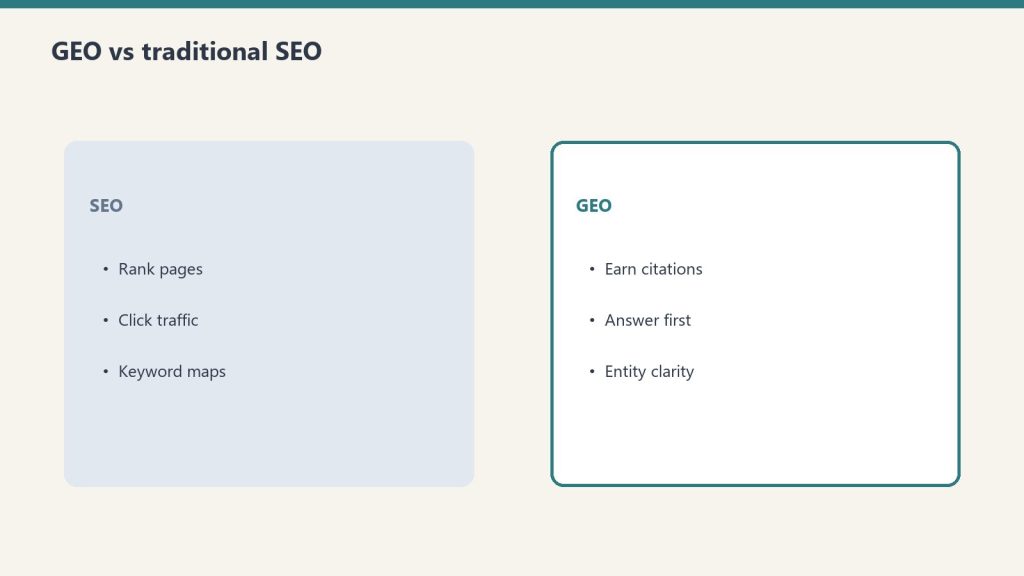
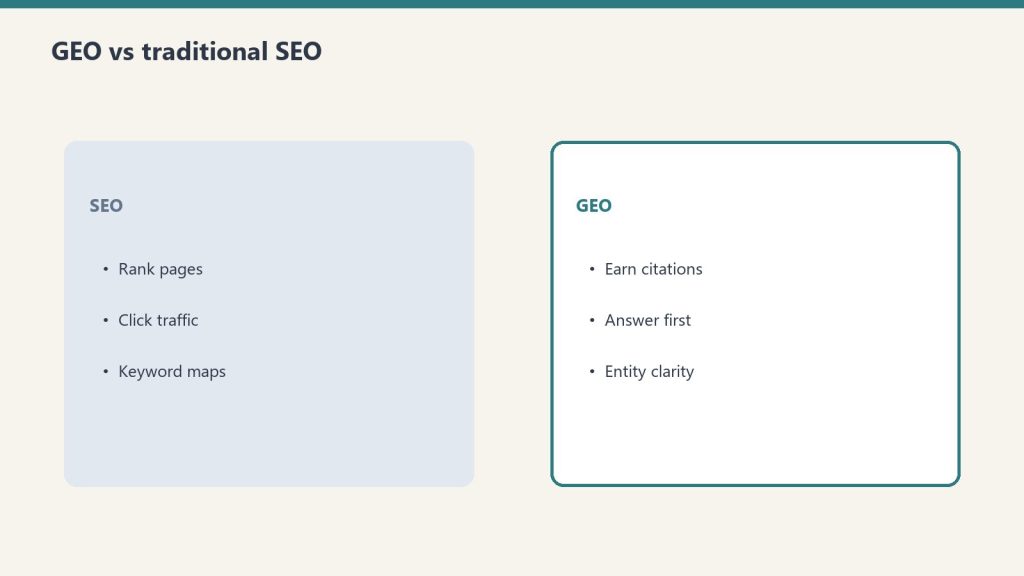
    GEO versus SEO comparison cards
    GEO case teardown — B2B SaaS AI-referred trials.

    A $30M+ ARR B2B SaaS company documented in Digital Agency Network’s GEO case study roundup moved from 575 AI-referred free trials per period to over 3,500 in about seven weeks. The intervention sequence was content restructuring for citability — clear one-sentence definitions at the top of each section, statistics and comparisons rendered as tables rather than buried in prose, and step-by-step frameworks that LLMs can extract verbatim. The first 40–60 words under every H2 carried the answer to that H2’s implicit question.

    The implementation pattern under this win is what matters: the company did not write new articles. It rebuilt existing articles to surface the answer first. That is the cheapest possible GEO intervention — restructure, do not republish.

    Case 2: B2B SaaS — citation rate from 8% to 12% in four weeks
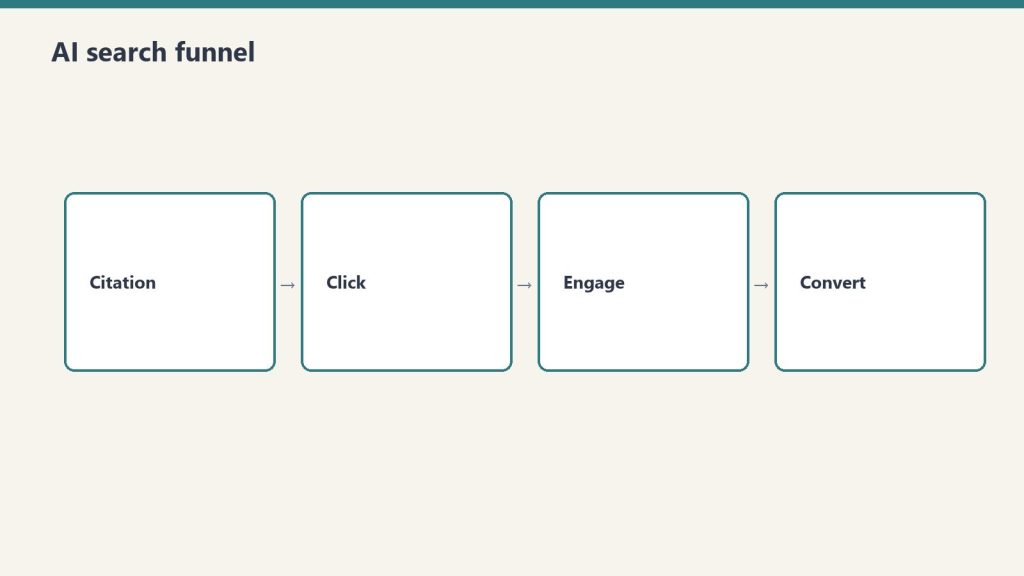
    Four-stage funnel: citation, click, engage, convert
    Citation-rate lift case — four weeks.

    Discovered Labs documented a B2B SaaS case where ChatGPT citation rate on tracked queries moved from 8% to 12% by week four of an engagement, with the company’s VP of Marketing noting they had been “invisible for 18 months despite solid SEO work.” The 50% relative lift came from the same restructuring pattern plus aggressive entity-binding — explicit company name, product name, and category definition repeated in citation-friendly positions throughout each asset.

    The data point worth carrying: traditional SEO authority does not automatically translate to LLM citation. The two systems read pages differently, and the page-level rewrite is what closes the gap.

    Case 3: CloudEagle — 33 pages optimized, 33% increase in AI citations

    CloudEagle’s published GEO result, cited across multiple 2026 case study summaries including AlphaP’s real-world GEO examples, is one of the cleanest dose-response curves in the public record. Optimize 33 pages → 33% increase in AI citations. The ratio is suspicious as a coincidence but tells the practitioner the right thing: GEO is a per-page intervention, and aggregate lift scales roughly with how many pages you treat. There is no site-wide tag you can flip. Each asset gets its own restructure.

    Case 4: HubSpot — template rebuild, not content rebuild
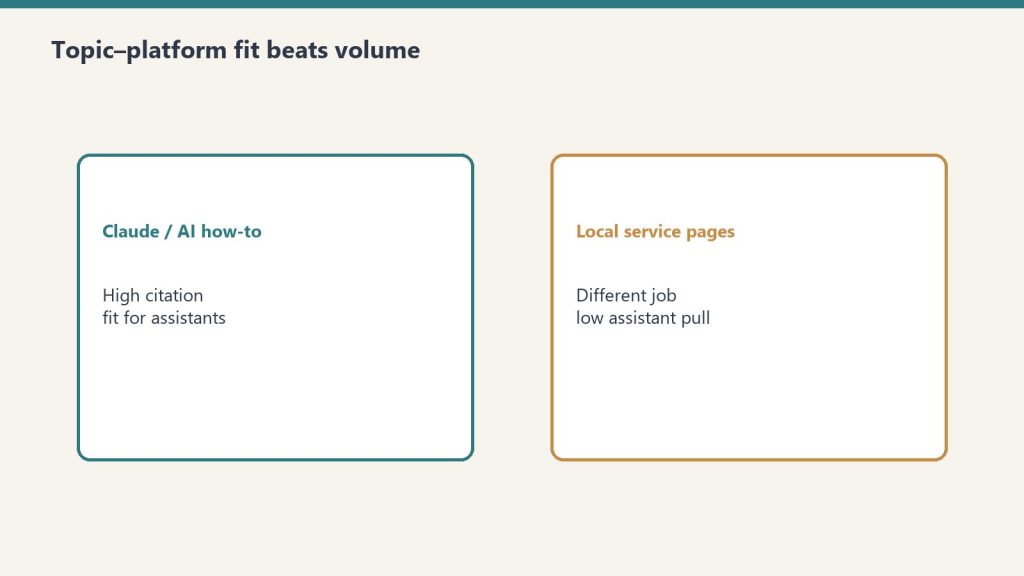
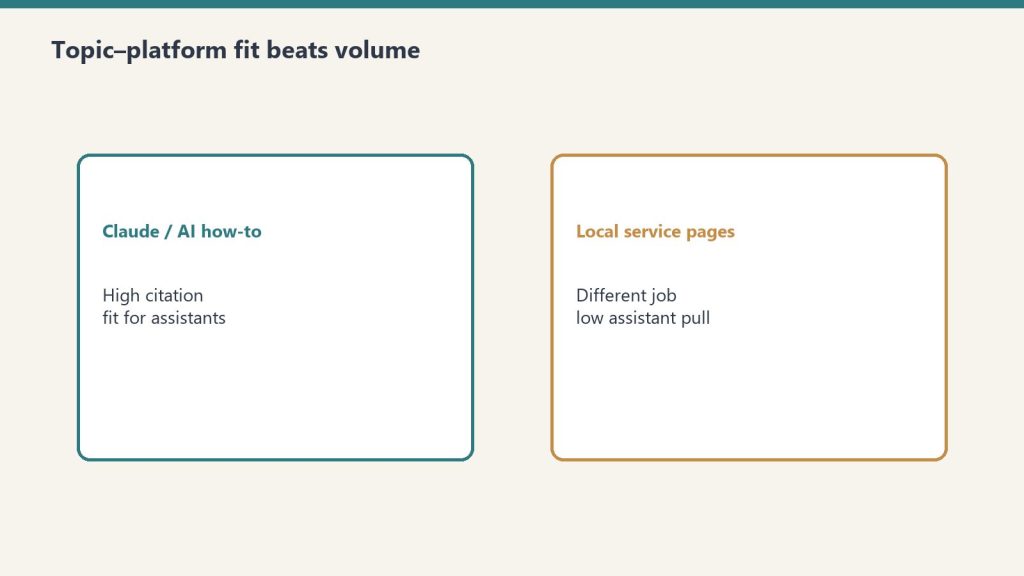
    Comparison of Claude how-to fit versus local service page fit for assistants
    HubSpot — template rebuild, not content rebuild.

    HubSpot’s internal AEO case study, summarized in HubSpot’s own AEO case study writeup, is the cleanest illustration of the structural fix. HubSpot already ranked for thousands of marketing queries — the volume was there. The barrier was that answers were buried multiple paragraphs deep, written in traditional long-form. The fix was a template rebuild: every article restructured so the first 40–60 words under each H2 or H3 directly answered the implicit question of that heading.

    This is the playbook to copy. If your site has any existing traffic, restructuring beats writing new content. The audit question is: under every H2 on every page, do the first three sentences answer the question that H2 raises?

    Case 5: Netpeak USA — 120% revenue lift, 693% AI traffic growth

    Stackmatix’s AEO case study compilation documents Netpeak USA’s conversational ecommerce GEO campaign producing +120% revenue and +693% AI traffic growth. The mechanism: product and category pages restructured around buyer questions (“what is the best X for Y?”, “X vs Y comparison”, “how do I choose X?”) with direct, hedged answers up top and detailed reasoning below. The pattern works because AI search engines synthesize buying decisions from extractable answer fragments, and ecommerce pages historically bury the answer under marketing copy.

    The structural pattern under every win

    Read the five cases together and one implementation discipline emerges. Every published GEO win in the public record traces back to the same physical change to the page:

    1. Answer first. The first 40–60 words under every H2 directly answer the question that heading raises. No setup, no transition paragraph, no scene-setting.
    2. Tables over prose for comparison data. Articles with 15+ data points receive measurably more AI citations than those with fewer than five, per the research synthesized in Marketing LTB’s 2026 GEO statistics roundup. Tables make those data points extractable.
    3. Entity binding. Company name, product name, and category definition explicitly stated in citation-friendly positions, not just implied through context.
    4. Stepwise frameworks. Procedural content rendered as numbered steps that LLMs can extract verbatim into responses.
    5. Citable sources inline. Authoritative external citations placed adjacent to claims, not banished to a references section at the bottom.

    What the cases do not prove

    The published record has selection bias the size of a building. Every case study you can read is a published win. The agencies and SaaS companies that ran a GEO campaign and got nothing are not writing blog posts about it. Read the cases for the structural patterns, not the percentage lifts — the lifts are a function of starting baseline, vertical, and how invisible the brand was before the intervention.

    Two other limits worth naming. First, conversion-rate claims about AI-referred traffic (“converts at a higher rate than organic” appears in over half of marketer surveys per the 2026 HubSpot State of Marketing report) come from self-reporting, not third-party measurement. The directional point is probably right — qualified intent behind an LLM query — but the magnitude is unverifiable. Second, AI citation rates are measured against the agencies’ own tracked query sets. Those sets are chosen for relevance to the client, which means baseline visibility is artificially low. The 8% → 12% case is real; whether it generalizes to a random query set is unknown.

    What to do tomorrow if you are starting from zero

    Pick ten pages on your site that already rank in positions 4–15 for queries with commercial intent. Open each one. Under every H2, rewrite the first 40–60 words so they directly answer the question that heading raises. Convert any prose comparison into a table. State your company name, product category, and the specific problem you solve in the opening paragraph. Add a sources list with authoritative citations.

    That is the intervention every published GEO case study reduces to. Ten pages, one week of writing work. The case study record suggests you will see citation movement in three to six weeks if the queries you care about already have AI Overview or LLM citation surface area at all. If they do not, the intervention is still right — you are positioning for when they do.

    FAQ

    How long until GEO interventions show measurable lift?

    Published cases show citation movement at the four-week mark (the 8% → 12% B2B SaaS case) and traffic movement at six to eight weeks (the 575 → 3,500 trials case at roughly seven weeks). Three months is the standard window quoted in agency case studies for material citation rate change.

    Does traditional SEO authority help GEO?

    Partially. Pages that already hold featured snippets are disproportionately pulled into Google AI Overviews, per multiple 2026 AEO summaries. But the B2B SaaS case where the company was “invisible for 18 months despite solid SEO work” shows that authority alone does not produce citations — page-level structural changes are the missing ingredient.

    How many pages do I need to optimize before I see results?

    CloudEagle’s case (33 pages → 33% citation lift) suggests the dose-response is roughly linear at small scale. Most published case studies show meaningful aggregate movement starting around 10–30 pages restructured. Below that, you are testing the methodology rather than expecting measurable lift.

    Is the citation rate lift actually translating to revenue?

    The published evidence says yes for ecommerce (Netpeak USA’s +120% revenue) and trial-driven SaaS (the 575 → 3,500 trials case). For brand and consideration-stage content the answer is murkier — AI citations probably influence brand recall and assisted conversion, but the attribution chain to revenue is harder to draw cleanly and the case study record is thin on this slice.

    What is the cheapest GEO intervention with the highest published return?

    Restructuring existing pages that already rank. The HubSpot template rebuild and the 575 → 3,500 trials case both used this approach. No new content, no new authority work, no link building — just rewriting the first 40–60 words under every H2 and converting prose comparisons into tables.

    Related on Tygart Media: GEO case studies 2026 · GEO tactics · chunk-first GEO.

  • Measure LLM Visibility: The GA4 & Response-Side Stack

    Measure LLM Visibility: The GA4 & Response-Side Stack

    Traditional analytics platforms can’t see the most important impression you’re making in 2026. When a user asks ChatGPT, Perplexity, Gemini, or Claude about your category, your brand either shows up in the answer or it doesn’t — and your GA4 dashboard has no idea either way. This is the measurement blind spot at the center of generative engine optimization. If you can’t measure LLM visibility, you can’t optimize for it.

    This guide walks through the measurement stack that actually works in 2026: the GA4 channel grouping that catches AI referral traffic, the manual verification protocol that costs nothing, and the dedicated LLM visibility platforms that automate prompt monitoring at scale. By the end, you’ll have a measurement framework you can run starting today.

    Why GA4 alone is not enough

    Four-stage funnel: citation, click, engage, convert
    Why GA4 alone is not enough.

    Standard web analytics measures what happens after the click. LLM visibility is what happens before the click — or instead of one. According to widely cited industry reporting, a large share of AI search sessions end without the user ever clicking through to a source, which means the brand impression inside the AI response is often the only impression you get. GA4 cannot see that impression. It cannot see when ChatGPT recommends you in a comparison. It cannot see when Perplexity cites your article as a source for an answer.

    You still need GA4 — AI referral traffic is real, growing, and converts well — but you need it as one layer of a two-layer stack. Layer one is referral-side measurement, which captures the users who actually click through from AI platforms. Layer two is response-side measurement, which monitors what AI platforms are saying about you whether anyone clicks or not.

    Layer one: catching AI referrals in GA4

    Topic platform fit visual for first-party AI citation measurement
    Catching AI referrals in GA4.

    GA4 does not have a built-in “AI” channel. By default, traffic from ChatGPT, Perplexity, Claude, and Gemini gets bucketed into the generic Referral channel, where it disappears next to social and partner sites. The fix is a custom channel group that uses a referrer regex to peel AI traffic out into its own bucket.

    In GA4, go to Admin → Data Settings → Channel Groups, create a custom channel group, and add a new rule above the default Referral rule. Set the conditions to Source matches regex and use a pattern like this:

    chatgpt\.com|openai\.com|perplexity\.ai|claude\.ai|anthropic\.com|gemini\.google\.com|copilot\.microsoft\.com|deepseek\.com|you\.com|meta\.ai|poe\.com

    The order matters. Your AI Traffic rule must sit above the Referral rule in the priority list, or AI traffic will be captured by Referral first and never reach your custom channel. Once the rule is live, you can build Explorations that segment AI traffic by source, page, conversion rate, and engagement time — and compare that segment against organic, direct, and social.

    The referrer attribution gap

    One caveat: not every AI click passes a referrer. ChatGPT’s free tier in particular has been reported to strip referrer headers in many configurations, meaning a meaningful share of ChatGPT traffic shows up as Direct in GA4 rather than as a chatgpt.com referral. This is a known limitation across the industry. Treat your AI referral numbers as a floor, not a ceiling, and use response-side monitoring to fill in the gap.

    Layer two: response-side monitoring

    This is the measurement that traditional SEO never needed. You’re no longer just asking “did anyone visit?” — you’re asking “what is the AI saying about me?” There are two ways to answer that question.

    The manual verification protocol

    The free, no-tool approach is a structured query log. Build a list of 15 to 25 prompts that a buyer in your category would realistically type into an AI assistant. Be specific. “Best CRM for small B2B teams” is a prompt. “What is a CRM” is not — that’s a research query, not a buyer query.

    Once a week, run every prompt through each AI platform you care about — typically ChatGPT, Perplexity, Gemini, and Claude — and record three things per query: whether your brand was mentioned, whether your domain was cited as a source, and what position your brand appeared in if it was named alongside competitors. A simple spreadsheet with prompt, date, platform, mention (yes/no), citation (yes/no), and position is enough to start. Week-over-week deltas on this sheet will tell you whether your GEO and AEO work is moving the needle.

    This is slow and manual but it’s the only method that gives you ground truth. The dedicated platforms below are essentially automating this protocol — running the same kind of prompt log against the same APIs on a daily schedule. If you’re under $1,000/month in marketing spend, run it manually. If you’re past that, automate it.

    Dedicated LLM visibility platforms

    A new category of tools emerged in 2025 and matured in 2026 specifically to monitor LLM responses. They all do roughly the same thing — run your target prompts daily across multiple AI engines, score visibility, track which sources the AIs cite, and surface competitor gaps — but they segment by price point.

    At the budget end, Otterly.AI offers monitoring plans starting around $29/month, with a Share of AI Voice metric and time-to-first-data of under ten minutes after signup. It’s the simplest entry point for teams that just want a citation-frequency dashboard. In the mid-market, Peec AI starts around €89/month and emphasizes multilingual coverage and actionable recommendations — it doesn’t just tell you you’re invisible, it suggests what to change. At the enterprise tier, Profound starts around $499/month and adds Prompt Volumes, which estimates real AI search demand by topic with demographic breakdowns. SOC 2 compliance and dedicated onboarding generally start at the $1,000+ enterprise tiers across this category.

    Other platforms in active use this year include Semrush’s AI Toolkit, SE Ranking’s SE Visible, Goodie AI, Rankscale, Nightwatch, AirOps, and Searchable. The category is moving fast — pricing and features change quarterly — so verify the current state of any platform before committing.

    The six KPIs to track

    Whatever measurement stack you use, the same handful of metrics will tell you whether GEO is working. Organize them into leading and lagging indicators:

    Leading indicators (response-side, change first):

    • Mention Rate — the percentage of monitored prompts where AI responses mention your brand name. This is the broadest signal.
    • Citation Rate — the percentage of monitored prompts where your domain is cited as a source, not just named. Citation is stronger than mention because it implies the AI is treating your content as authoritative.
    • Position — when your brand is named alongside competitors, where in the list does it appear. First-named brands get disproportionate attention.

    Lagging indicators (referral and revenue-side, change later):

    • AI Referral Sessions — total sessions from your AI Traffic channel group in GA4.
    • AI Referral Engagement — engagement rate and average engagement time for the AI segment, compared to organic. Strong AI referral traffic typically engages longer because the user arrived with intent already framed by the AI.
    • AI-Influenced Conversions — conversions where AI was part of the attribution path, even if not the last touch.

    Tier-one metrics move first because content changes affect what AIs say within days to weeks. Tier-two metrics lag because they require enough traffic to be statistically meaningful, which can take a quarter or more to develop.

    The minimum viable setup

    Desk with laptop, checklist notebook, and billing card ready before creating an Anthropic API key
    The minimum viable setup.

    If you do nothing else this week, do these three things:

    1. Add the AI Traffic channel group to GA4 using the regex above and move it above Referral in priority.
    2. Build a 15-prompt spreadsheet of buyer-intent queries for your category and run them once across ChatGPT, Perplexity, Gemini, and Claude. Record mention, citation, and position.
    3. Set a calendar reminder to repeat step two every Friday for four weeks. After four weeks you’ll have a real trendline.

    That setup costs nothing and produces the measurement layer that lets you tell whether your GEO, AEO, and LLMs.txt work is actually compounding — or whether you’re guessing. Once the trendline is stable, evaluate whether automating with Otterly, Peec, or Profound is worth the spend. For most operators, the manual protocol gets you 80% of the insight at 0% of the budget.

    Related on Tygart Media: LLM visibility measurement · citation monitoring · Bing Webmaster AI tab.

    Frequently Asked Questions

    What is LLM visibility?

    LLM visibility is the measurement of how often, and how prominently, a brand or website appears in responses generated by large language models like ChatGPT, Perplexity, Gemini, and Claude. It is the response-side counterpart to traditional search ranking — instead of measuring where you appear in a results page, you’re measuring whether AI assistants mention or cite you when answering questions in your category.

    Can GA4 track AI traffic from ChatGPT and Perplexity?

    GA4 can track AI referral clicks if you create a custom channel group with a referrer regex matching AI domains and place it above the default Referral rule. It cannot track impressions inside AI responses where the user doesn’t click through, and ChatGPT’s free tier often strips referrers entirely, so a portion of AI traffic still lands in Direct. Treat GA4 numbers as a floor.

    What is the difference between mention rate and citation rate?

    Mention rate measures the percentage of monitored AI prompts where your brand name appears anywhere in the response. Citation rate measures the percentage where your specific domain or URL is referenced as a source. Citation is a stronger signal because it indicates the AI is treating your content as authoritative, not just naming you in passing.

    Which LLM visibility tool should I use in 2026?

    For budget-conscious teams, Otterly.AI starts around $29/month and gets you to first data in minutes. For mid-market needs with multilingual coverage and recommendations, Peec AI starts around €89/month. For enterprise teams that need prompt-volume demand data and SOC 2 compliance, Profound starts around $499/month. Verify current pricing before purchasing — the category moves quickly.

    How often should I check my LLM visibility?

    For manual tracking, weekly is the right cadence — frequent enough to catch movement, infrequent enough to avoid noise. Dedicated platforms typically run automated checks daily and let you review weekly. Don’t expect day-to-day stability; AI responses have inherent variance, so look at week-over-week and month-over-month trends rather than single data points.

  • Perplexity Everything App: The $21B Ad-Free Trust Moat

    Perplexity Everything App: The $21B Ad-Free Trust Moat

    Nobody expected the answer engine to build a browser. Nobody expected the search startup to drop advertising entirely to protect user trust. Nobody expected a company founded in 2022 to reach a $21 billion valuation in 30 months. Perplexity AI is the everything-app candidate nobody saw coming — and their path is unlike any other company in this series.

    Where Perplexity Sits in This Series This is the sixth piece in our everything-app series. We’ve covered Microsoft, Google, Notion, the everything database frame, and OpenAI. Perplexity is the dark horse — smaller than all of them, faster-moving than most, and making bets that the incumbents aren’t willing to make.

    The Numbers Nobody Expected

    Start with the trajectory because it reframes everything else. Perplexity was valued at $121 million in April 2023. By early 2026 that number is $21.2 billion — a roughly 175x increase in 30 months. Total funding raised exceeds $1.5 billion, from Nvidia, Jeff Bezos, SoftBank, IVP, Accel, and Databricks. Monthly active users crossed 45 million. The company is processing 170 million global visitors per month. ARR climbed from $35 million in mid-2024 to over $450 million annualized by March 2026.

    Those aren’t hype numbers. ARR of $450M annualized on 45M users, with 800% year-over-year growth, signals genuine product-market fit. People are paying for this. Repeatedly. That matters for the everything-app thesis in a way that a free-tier user count doesn’t.

    The Trust Bet That Changes the Game

    Topic platform fit visual for first-party AI citation measurement
    The trust bet that changes the game.

    In February 2026, Perplexity made a decision that every other company in this series should take note of: they dropped advertising entirely and moved to a subscription-first model. The stated reason was simple — leadership said the move was intended to preserve user trust in the answer engine, prioritizing objective results over ad revenue.

    Think about what that means as a strategic signal. Google’s entire business model is advertising. Microsoft’s Bing is ad-supported. Every other search surface is optimized, at least partially, for ad revenue. Perplexity looked at that landscape and decided that trust — verifiable, uncompromised trust in the answer — was worth more than ad dollars.

    For an everything app, that’s a profound differentiator. The everything app, by definition, will know more about you than any individual tool currently does. It will see your projects, your research, your questions, your habits. The company that earns the right to that level of access is the one that can credibly say: we are not monetizing your data or your attention. We are working for you.

    Perplexity made that bet explicitly. Nobody else has.

    What Perplexity Has Actually Built

    The product expansion from “AI search” to “everything app candidate” happened fast enough that most people are still thinking of Perplexity as a search box. Here’s what it actually is in mid-2026.

    Perplexity Computer — launched in early 2026 and available on the Max plan ($200/month) — is an autonomous agent that executes complex workflows on your behalf. It uses 19 different AI models, picks the best model for each step of a task, and creates subagents to handle parallel parts of a workflow simultaneously. That’s not a search enhancement. That’s an operating system for work — one that orchestrates multiple frontier models the way a conductor runs an orchestra, without asking you which instrument should play which note.

    Comet — Perplexity’s AI-native browser built on Chromium — launched on Windows and macOS in July 2025, came to iOS in March 2026, and is free on all platforms. It looks like Chrome. But it has an AI assistant built into every page — in-page research, page summarization, autonomous multi-step tasks. It books flights, manages email, fills forms, and translates pages automatically. Comet is the browser as an agent, not a browser with a chatbot bolted on the side.

    Deep Research and Model Council — available now — let you run three frontier models simultaneously, compare outputs, and synthesize a higher-confidence answer. Deep Research is powered in part by Claude Opus 4.6 — Anthropic’s previous flagship model, accessed through Perplexity’s $750M Microsoft Azure commitment which gives them access to OpenAI, Anthropic, and xAI systems. (Note: Anthropic’s current flagship as of April 2026 is Claude Opus 4.7, with Claude Mythos Preview beyond that — Perplexity’s model routing will update as newer versions become available through the Azure pipeline.) Model Council is the first mainstream consumer feature that makes multi-model reasoning accessible without requiring you to run models yourself.

    Perplexity Connectors let users search across linked file systems — Google Drive natively — for answers that pull from both cloud files and the live web. This is the beginning of the enterprise data layer: Perplexity as a unified search surface across your internal knowledge and the public internet simultaneously.

    Commerce integration with PayPal in conversational search means Perplexity has a purchase flow built into the answer layer. You don’t search for a product, click through to a store, and buy it there. You ask, get an answer with citations, and complete the purchase in the same conversational thread. Amazon took 20 years to get search and commerce this close together. Perplexity did it in three.

    The 19-Model Architecture: Why This Is Different

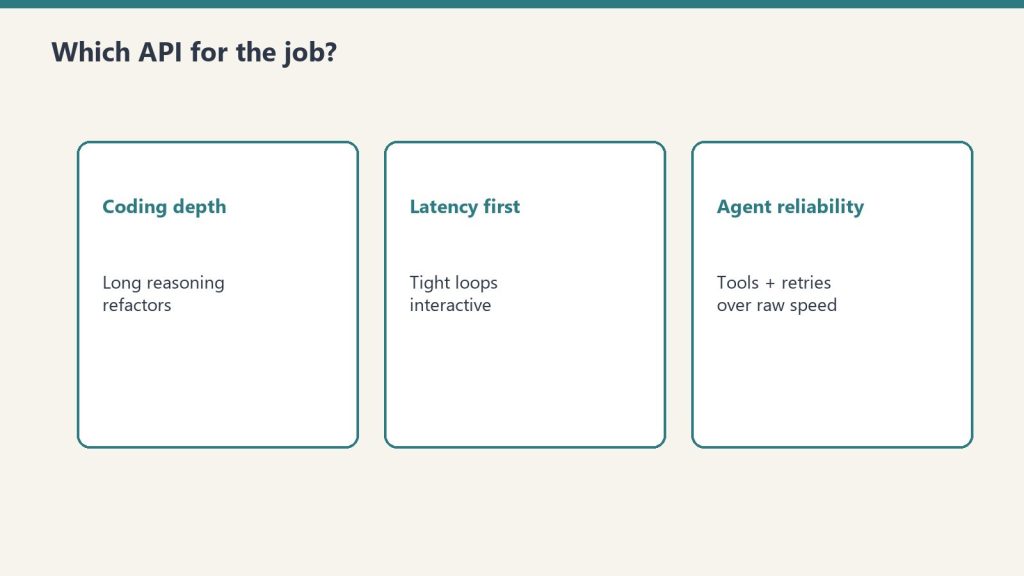
    Three cards: coding depth, latency first, agent reliability
    The 19-model architecture.

    The Perplexity Computer’s 19-model architecture deserves its own section because it represents a genuinely different philosophy from every other everything-app candidate.

    Microsoft runs Copilot on OpenAI’s models. Google runs Workspace on Gemini. OpenAI runs ChatGPT on GPT-5.5. Notion runs on Claude. Each company has picked a model family and is building their everything app around it. There’s logic to this — it simplifies the architecture, creates pricing leverage, and ensures consistency.

    Perplexity’s bet is the opposite: model neutrality. They use the best model for each task, from whichever provider produces it. Need deep reasoning? Pick o3. Need fast synthesis? Pick Claude Flash. Need computer use? Pick GPT-5.5 Operator. The user doesn’t choose and doesn’t need to know. The system routes to the best tool automatically.

    This is the “everything database” principle applied to models instead of data. Instead of betting on one model family, Perplexity is building the orchestration layer above all of them. If a new model from Mistral or xAI or any other provider becomes best-in-class for a specific task, Perplexity can route to it without rebuilding their product. The platform compounds regardless of which model wins any individual benchmark.

    The Honest Weakness: No Data Moat, No OS, No Inbox

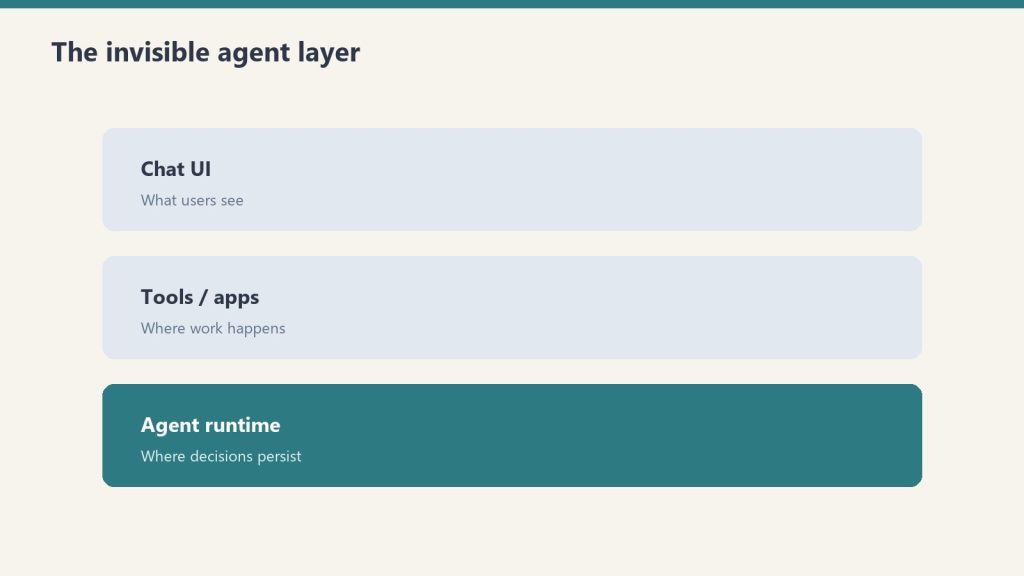
    Three stacked layers: chat UI, tools, agent runtime
    Honest weakness — no data moat, no OS, no inbox.

    Perplexity doesn’t own an operating system. They don’t own an email platform. They don’t have a professional network. Their Connectors are real but limited compared to the native data access Microsoft and Google have by default. Their 45 million users, while impressive for a three-year-old company, is dwarfed by ChatGPT’s 500 million and Google’s three billion Workspace users.

    The $750M Azure commitment — while providing access to frontier models — also creates a dependency that model-owning competitors don’t have. If Microsoft decides Azure pricing changes, or if access to specific models is restricted, Perplexity’s multi-model architecture gets more expensive and more fragile simultaneously.

    The Max plan at $200/month for Perplexity Computer is expensive for what it is relative to alternatives. Enterprise adoption at 11% of organizations using generative AI is real but still a minority position. The path from answer engine to everything app requires trust-building and behavioral habit formation at a scale Perplexity hasn’t yet demonstrated for enterprise workloads.

    Why Perplexity Might Win Anyway

    Here’s the contrarian case, and it’s more credible than it sounds.

    The everything app that wins will be the one people trust with their most important questions. Not their files — their questions. The difference between a search engine and an everything app is that an everything app is the place you go when you genuinely don’t know what to do next. When you’re trying to figure out a business problem. When you need to research something critical. When you’re making a decision that matters.

    Perplexity is building specifically for that moment. Cited answers, not generated hallucinations. Subscription trust, not ad-influenced results. Multi-model consensus through Model Council, not single-model confidence. Deep Research for the questions that take hours, not seconds. They are optimizing for the highest-stakes use cases in knowledge work, not the highest-volume use cases.

    If your everything app is defined by “where I go when I need to know something important” — Perplexity has a credible claim on that moment that no other company in this series is directly competing for. Microsoft is competing for enterprise workflow. Google is competing for the native stack. OpenAI is competing for behavioral habit. Perplexity is competing for epistemic trust. That’s a different race.

    How Perplexity Connects to Your Notion Everything Database

    Perplexity’s Connectors currently support Google Drive natively, with more file system connections expanding through their enterprise roadmap. Via the Sonar API — Perplexity’s developer API for embedding answer-engine capabilities in external applications — you can build a bridge between Perplexity’s research layer and your Notion database structure.

    The practical architecture: Perplexity handles the live-web research and synthesis layer (the questions where you need current, cited, real-world information). Your Notion everything database stores the structured outputs — the decisions made, the research conclusions, the action items triggered. A Notion Worker fires the Perplexity query via the Sonar API, receives the response, and writes the structured result back to the relevant database row. Perplexity becomes your research engine. Notion becomes the memory that persists what you learned.

    That’s the hybrid that makes each tool better than it would be alone — and it’s the kind of architecture that only becomes possible when you stop asking which platform wins and start asking which platforms work best together.

    Frequently Asked Questions

    What is Perplexity Computer?

    Perplexity Computer is an autonomous AI agent launched in early 2026, available on the Max plan ($200/month). It uses 19 different AI models, routing each step of a task to the best available model and creating parallel subagents for complex workflows. It represents Perplexity’s most direct move toward an AI operating system for knowledge work.

    What is the Comet browser?

    Comet is Perplexity’s AI-native browser built on Chromium, launched on Windows and macOS in July 2025 and iOS in March 2026. It’s free on all platforms. It builds an AI assistant into every page — summarizing content, conducting in-page research, and executing multi-step tasks like booking flights, managing email, and filling forms autonomously.

    Why did Perplexity drop advertising?

    In February 2026, Perplexity discontinued its AI-integrated advertising strategy and moved to a subscription-first model. Leadership stated the decision was made to preserve user trust in the answer engine — prioritizing objective, uninfluenced results over ad revenue. This positions Perplexity as the only major AI search platform explicitly working for the user rather than for advertisers.

    What is Perplexity’s Model Council?

    Model Council lets users run three frontier AI models simultaneously, compare their outputs, and synthesize a higher-confidence answer. Combined with Deep Research (powered in part by Claude Opus 4.5/4.6 via Perplexity’s Azure access), it makes multi-model reasoning accessible without requiring users to choose or manage individual models.

    What is the Perplexity Sonar API?

    The Sonar API is Perplexity’s developer API for embedding answer-engine capabilities — cited, real-time web research — into external applications. It’s the integration layer for connecting Perplexity’s research capabilities to systems like Notion databases, CRMs, or custom workflows via Notion Workers or other trigger architectures.

  • Google AI Overviews: The May 2026 Citation Playbook

    Google AI Overviews: The May 2026 Citation Playbook

    Google shipped one of the most consequential AI Overviews updates of the year on May 6, 2026 — and most SEO teams still have not adjusted their content templates to match. The update changed what gets cited, where citations are drawn from, and how users decide which links to actually click. This is the practitioner walkthrough: what shifted, the data behind it, and the on-page changes that move the needle in the new system.

    What Google Actually Changed on May 6, 2026

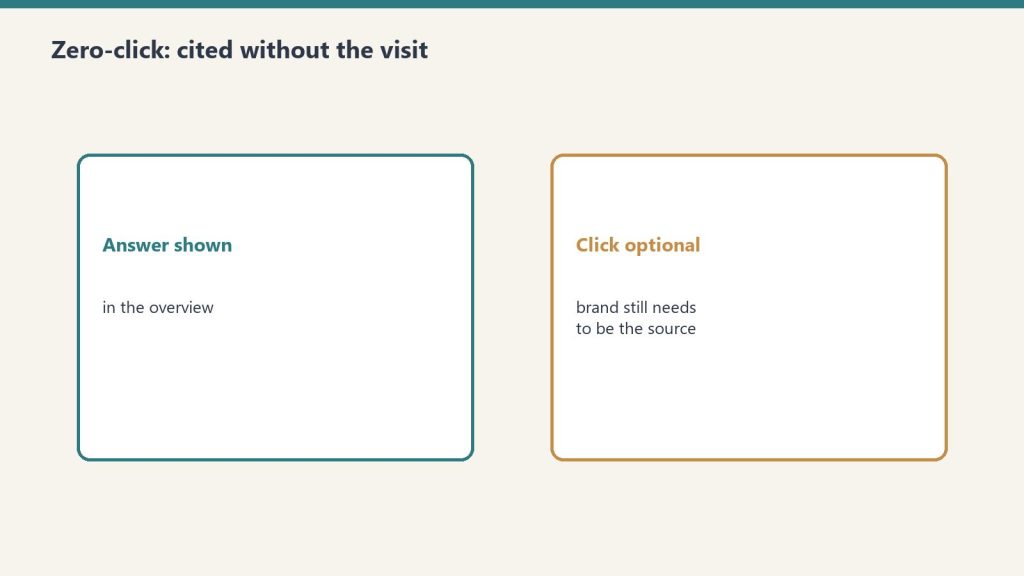
    Two cards: answer shown in overview versus optional click
    What Google actually changed for AI Overviews.

    Google’s own announcement (How AI Mode and AI Overviews help you explore the web) named five shifts to the Overviews surface:

    1. Forum and social perspective blocks — Overviews now embed direct quotes from Reddit, WordPress blogs, and public forums in a dedicated “perspectives” section.
    2. Subscription-aware citation highlights — links from news outlets the searcher is logged in to are visually flagged. Google’s internal test data showed those flagged links were “significantly more likely” to be clicked.
    3. Suggested exploration topics — bulleted follow-up queries now render at the end of many AI responses, which means downstream traffic flows depend on whether your domain ranks for the fan-out queries, not just the head term.
    4. Further Exploration section — a bulleted-link cluster plus an “Expert Advice” snippet pulling from articles, reviews, and forum threads.
    5. Hover-to-preview link cards — hovering a citation now triggers a card showing site name, page summary, and metadata before the click.

    Two of those five — perspectives blocks and Further Exploration — are net-new citation slots. The other three change which citations users actually convert on.

    The Citation Math Has Shifted

    Side-by-side SEO rank/click versus GEO citation/answer-first
    The citation math has shifted.

    The most important measurement from the last 60 days: in March 2026, the share of AI Overview citations pulled from pages ranking in Google’s organic top 10 dropped to 38%, down from 76% in July 2025 (500M-keyword analysis). 31% of cited sources now rank in positions 11–100, and another 31% rank outside the top 100 entirely for the query they get cited on.

    Translation for practitioners: Overviews are no longer a rank-amplifier. They are an independent retrieval layer. A page that ranks #47 with the right passage structure can outcompete a page that ranks #3 with the wrong structure. Domain Authority correlation with citation selection is now r=0.18 — effectively noise. Semantic completeness correlation is 0.87.

    The Passage That Gets Cited

    AI Overview extracts cluster tightly around 134–167 words per passage, with 62% of featured content falling in the 100–300 word range. Position inside the article matters: 44.2% of citations are pulled from the first 30% of the body, 31.1% from the middle, 24.7% from the conclusion (Wellows ranking factor study). Lead-heavy structure is no longer a copywriting preference — it is the extraction surface.

    The structural pattern that wins, repeatable across H2 sections:

    <h2>[Specific question phrased as a noun phrase]</h2>
    <p><strong>[One-sentence direct answer with a named entity or number.]</strong></p>
    <p>[Supporting detail with verifiable source attribution.]</p>
    <p>[Nuance, caveat, or contrast — kept under the 167-word ceiling.]</p>

    Each H2 block becomes a standalone extractable unit. If your article only answers the headline question, you compete for one citation. If five H2 blocks each answer a distinct fan-out question, you compete for five.

    Schema That Earns Citations Now

    Properly marked-up pages show 73% higher selection rates in AI Overviews versus unmarked content. The three schema types doing the most work in the May 2026 surface:

    • FAQPage — feeds the Further Exploration section directly. Each Question/Answer pair is treated as a passage candidate.
    • Article with author and datePublished — freshness is now a citation factor. Content under three months old is 3× more likely to be cited.
    • HowTo with step-level markup — extracted into the Expert Advice snippet when the query is procedural.

    A minimal Article block that hits the freshness and authorship signals Google’s extractor now reads for:

    {
      "@context": "https://schema.org",
      "@type": "Article",
      "headline": "...",
      "author": { "@type": "Person", "name": "...", "url": "..." },
      "datePublished": "2026-05-14",
      "dateModified": "2026-05-14",
      "publisher": { "@type": "Organization", "name": "...", "logo": {...} }
    }

    How to Show Up in the New Perspectives Block

    The forum-quote section is the biggest opportunity nobody is optimizing for yet. Reporting from TechCrunch’s coverage of the rollout confirmed Google is pulling from Reddit, public forums, and WordPress blogs explicitly tagged as personal perspective.

    Three practitioner moves:

    1. Author bylines with first-person framing on at least one article per topic cluster. Personal-perspective phrasing (“In our deployment of …”, “What surprised us was …”) signals firsthand experience to the extractor.
    2. Engage in the relevant subreddit with substantive comments under your real handle, then link your bylined article from your profile. Reddit threads are now a primary retrieval source for perspectives blocks.
    3. Tag personal-perspective posts with Person schema alongside Article schema. The Person entity is what Google ties to the firsthand-experience signal.

    What to Measure Starting This Week

    Four-stage funnel: citation, click, engage, convert
    What to measure starting this week.

    Citation share by query is the only metric that matters in this surface, and traditional analytics will not give it to you. Two practitioner approaches:

    • Manual citation logging — pull your 20 highest-value head terms and 50 fan-out queries, query them weekly in an incognito session, log whether your domain appears in the Overview, the perspectives block, or the Further Exploration list. Track citation share, not just rank.
    • Server-log analysis — Google’s Overview generator hits your pages with a distinct user agent and crawl signature. Filtering for those signatures gives you a leading indicator: pages getting hit by the extractor are pages being evaluated for citation.

    Cited pages earn 35% more organic clicks and 91% more paid clicks than uncited peers (Averi.ai citation study). Uncited pages on triggering queries lose 61% of their normal CTR. The gap between cited and uncited is now wider than the gap between position #1 and position #5 in classical SEO. Treat citation as the primary KPI.

    The Update in One Sentence

    Google has decoupled AI Overview citation from organic rank, opened two new citation slots (perspectives and Further Exploration), and is now rewarding firsthand-experience signals at the page and author level — the practitioners who restructure for passage-level extraction and earn citation in the new slots will pick up the traffic that used to flow to position-#1 pages.

    Related on Tygart Media: citation monitoring · SEO vs GEO vs AEO.

  • LLMs.txt Spec: 2026 Guide, Robots.txt Rules & Verification

    LLMs.txt Spec: 2026 Guide, Robots.txt Rules & Verification

    If you publish an llms.txt file this week, no major model is going to fetch it tonight. That is the honest 2026 read on the spec — and yet the file is still worth shipping for narrow, specific reasons. This guide covers the 4-element specification published at llmstxt.org, the robots.txt pairing that actually controls AI crawler behavior right now, and a server-log filter you can run to verify whether anyone is reading the file you just shipped.

    What llms.txt actually is (and what it isn’t)

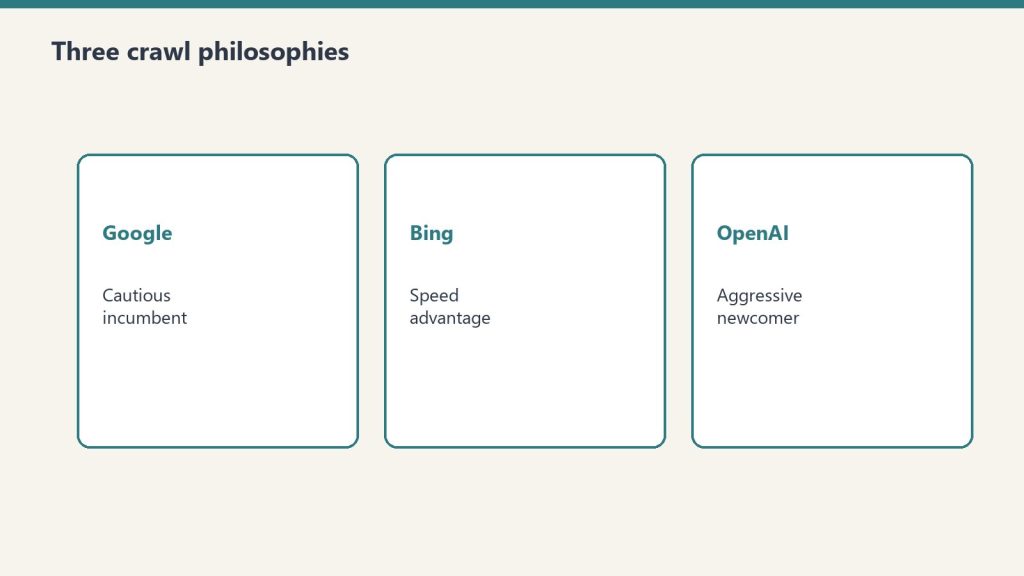
    Three cards for Google cautious, Bing speed, OpenAI aggressive crawl styles
    What llms.txt actually is — and isn’t.

    llms.txt is a Markdown file served at the site root — /llms.txt — proposed by Jeremy Howard of Answer.AI on September 3, 2024. The spec at llmstxt.org defines four elements: a required H1 with the project or site name; a blockquote summary; zero or more Markdown content sections (no headings); and zero or more H2-delimited file-list sections containing annotated Markdown links to deeper content. That is the entire specification. There is no header convention, no schema requirement, no robots-style allow/deny syntax.

    What llms.txt is not: it is not a substitute for robots.txt, it is not an access-control mechanism, and as of May 2026 it is not consumed at inference time by ChatGPT, Claude, Gemini, Perplexity, or Copilot in any documented production system. Server-log audits across multiple independent practitioners show GPTBot, ClaudeBot, and Google-Extended do not request /llms.txt in meaningful volume during routine crawls.

    The realistic 2026 use case is developer tooling. AI coding assistants and IDE agents — Cursor, GitHub Copilot, Claude Code, and similar tools — retrieve docs in real time, and a curated llms.txt cuts token waste by pointing them at canonical Markdown sources instead of HTML-rendered pages bloated with nav and tracking. Companies like Anthropic, Stripe, Cursor, Cloudflare, Vercel, Mintlify, Supabase, and LangGraph ship llms.txt for that reason.

    The 4-element template — a working example

    Here is a real, valid llms.txt for a hypothetical SaaS docs site. Copy this structure, change the project name, and you have a shippable file in under 30 minutes:

    # Acme Analytics
    
    > Acme Analytics is a self-hosted product analytics platform for SaaS teams. This file points AI assistants and IDE agents at canonical Markdown documentation, not the rendered HTML.
    
    Authoritative Markdown sources for product, API, and SDK documentation. Use the `.md` variant of any docs page (append `.md` to the URL) for a clean, agent-friendly version.
    
    ## Getting Started
    
    - [Quickstart](https://acme.example/docs/quickstart.md): 10-minute setup, install through first event.
    - [Concepts](https://acme.example/docs/concepts.md): events, properties, identities, sessions — definitions and examples.
    
    ## API Reference
    
    - [REST API Reference](https://acme.example/docs/api/rest.md): every endpoint, request/response schema, rate limits.
    - [Webhook Reference](https://acme.example/docs/api/webhooks.md): payload contracts and retry behavior.
    
    ## SDKs
    
    - [JavaScript SDK](https://acme.example/docs/sdk/js.md): browser and Node, including server-side rendering notes.
    - [Python SDK](https://acme.example/docs/sdk/python.md): server-side ingestion patterns.
    
    ## Optional
    
    - [Changelog](https://acme.example/docs/changelog.md): version history, breaking changes flagged inline.
    

    Two practitioner notes. First, the spec uses an “Optional” H2 as a soft signal — links under that heading can be skipped by aggressive token budgets. Second, the file is most useful when every linked URL has a parallel .md Markdown version. If your site is pure HTML, llms.txt without paired Markdown does little.

    The robots.txt pairing — this is what actually controls AI bots today

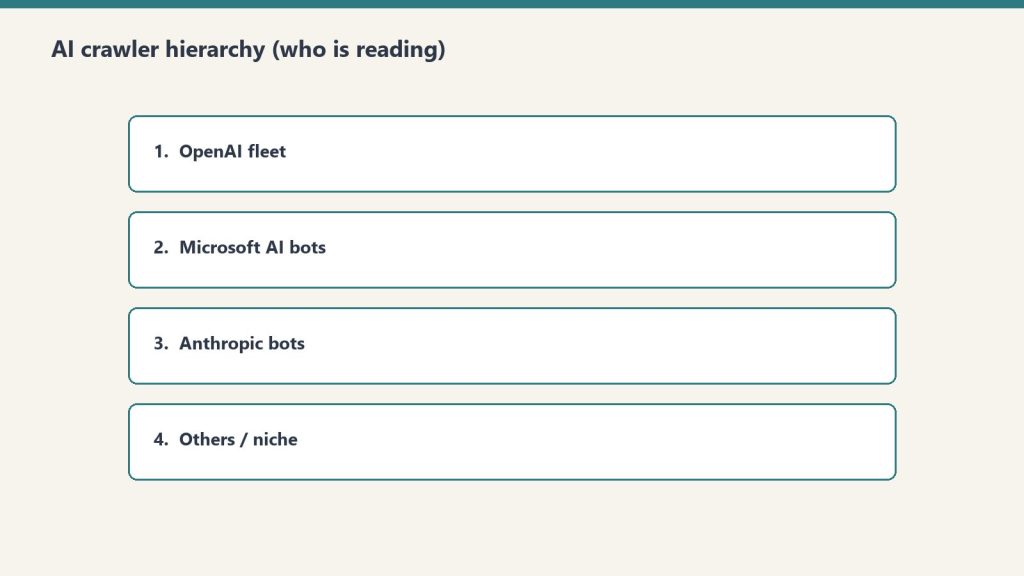
    Four ranked rows of AI crawler fleets reading publisher content
    robots.txt pairing — what controls AI bots today.

    The lever that meaningfully controls AI crawler behavior in 2026 is robots.txt with user-agent–specific rules. Anthropic publishes official documentation for three bots — ClaudeBot for training, Claude-User for user-initiated fetches, and Claude-SearchBot for search indexing — and confirms all three honor robots.txt. OpenAI runs GPTBot (training) and OAI-SearchBot (live ChatGPT search). Google’s AI training opt-out is the Google-Extended user-agent. Perplexity uses PerplexityBot.

    The two-bucket pattern most practitioner sites should ship: block training-only crawlers, allow search and user-initiated retrieval so your content can still be cited in answers.

    # Allow AI search and user-fetch traffic (citations, attribution)
    User-agent: Claude-SearchBot
    Allow: /
    
    User-agent: Claude-User
    Allow: /
    
    User-agent: OAI-SearchBot
    Allow: /
    
    User-agent: PerplexityBot
    Allow: /
    
    # Block training-only crawlers
    User-agent: ClaudeBot
    Disallow: /
    
    User-agent: GPTBot
    Disallow: /
    
    User-agent: Google-Extended
    Disallow: /
    
    # Standard search crawler — leave open
    User-agent: Googlebot
    Allow: /
    
    Sitemap: https://example.com/sitemap.xml
    

    One operational caveat: robots.txt is policy, not enforcement. Anthropic, OpenAI, and Google have all publicly committed their named bots to compliance, but unnamed scrapers and residential-IP harvesters routinely ignore it. For sites with sensitive content, pair robots.txt with WAF or Cloudflare bot-management rules at the edge.

    Structured data still does more heavy lifting than llms.txt

    If your goal is AI citation rather than IDE-agent retrieval, structured data on the page itself moves the needle more than llms.txt. The minimum stack for any article you want cited: Article schema with named author and publisher, FAQPage schema on any post that answers a discrete question, and speakable markup on the answer paragraphs. These get parsed during normal HTML fetches by every major AI crawler — no separate file required.

    How to verify your llms.txt is actually being read

    Desk with laptop, checklist notebook, and billing card ready before creating an Anthropic API key
    How to verify llms.txt is being read.

    Ship the file, then run this server-log filter weekly for 30 days. On any standard access-log format (nginx, Apache, or a Cloudflare log push), grep for requests to /llms.txt and break them down by user-agent:

    grep "GET /llms.txt" /var/log/nginx/access.log \
      | awk -F\" '{print $6}' \
      | sort | uniq -c | sort -rn
    

    What you will almost certainly see in May 2026: a steady trickle of human curl requests, the occasional IDE agent fetch tagged with a Cursor or VS Code user-agent, and effectively zero hits from GPTBot, ClaudeBot, or Google-Extended. That null result is itself the measurement — it tells you llms.txt is a developer-experience asset right now, not an AI-citation asset, and your investment should match that reality.

    The recommended 2026 rollout

    For most sites, the right sequence is: ship the robots.txt user-agent rules above first, because those are enforceable today and shape every AI crawler interaction. Add structured data to every article that competes for AI citation. Then publish llms.txt — under 30 minutes of work — for the IDE-agent and dev-tooling upside, with no expectation of immediate search lift. When OpenAI, Anthropic, or Google publicly confirm production llms.txt consumption, you are already in position.

    Related on Tygart Media: llms.txt case study · URL curation buckets · verify in logs.

  • How to Measure LLM Visibility: 2026 Tracking Stack

    How to Measure LLM Visibility: 2026 Tracking Stack

    Updated September 30, 2026.

    Direct Answer: Measure LLM visibility with five metrics—citation frequency, prompt coverage, share of voice, AI referral sessions, and conversion quality from that traffic. Pair a monthly 20-prompt audit with GA4: use Google’s May 2026 “AI Assistant” channel where it applies, plus a custom channel group (regex on session source, ordered above Referral) so Perplexity and historical sessions don’t stay buried in Referral or Direct.

    Most SEO teams know they need to care about AI search. Almost none of them have a measurement system in place for it. That’s the gap this article closes.

    Ranking in ChatGPT, Perplexity, Google AI Overviews, or Claude isn’t a vanity metric anymore — it’s a traffic channel. But unlike Google, AI systems don’t serve a results page you can screenshot. They weave citations into prose. Your brand either shows up in that prose or it doesn’t, and if you’re only watching default GA4 channel reports, you’re flying mostly blind.

    This is a practitioner’s setup guide: the exact metrics, GA4 configuration, and tool stack needed to track LLM visibility systematically — including how to define AI citation rate before you buy software.

    GEO versus SEO comparison cards

    The Five Metrics That Define LLM Visibility

    Five metrics that define LLM visibility.

    Traditional SEO tracks ranking position, impressions, and clicks. None of those exist in AI search. You need a new metric set:

    Citation frequency — How often your domain or brand is mentioned in AI-generated answers for your target query set. LLMs typically cite a handful of sources per response. Capturing one of those slots consistently is the entire game.

    Prompt coverage — Out of your tracked prompt library, what percentage of prompts return your brand at all? Calculate it as: (prompts where you appear ÷ total tracked prompts) × 100. A brand actively optimizing for AI search should be above 40% coverage on tier-1 prompts within 90 days of focused content work.

    Share of voice — For a given topic cluster, how often do AI answers cite you versus competitors? If you appear in 12 of 30 tested prompts and a competitor appears in 20, they hold 67% share of voice on that topic. That ratio is more strategically meaningful than any single citation count.

    AI referral sessions — The sessions in GA4 that arrived from an AI platform with a usable referrer header (or GA4’s native AI Assistant classification). This is the metric that ties visibility to business outcomes. Setup is covered in the next section.

    Conversion quality from AI traffic — AI-referred visitors often arrive with higher intent: they asked a specific question and your site was the answer. Track engagement rate, pages per session, and goal completions for AI referral sessions separately. If this cohort converts at 2–3× the rate of your organic traffic — which early practitioner data suggests — it changes how you think about GEO investment.

    Four-stage funnel: citation, click, engage, convert

    Setting Up GA4 to Capture AI Traffic

    GA4 regex to capture AI traffic.

    Native AI Assistant channel (May 2026)

    Since May 13, 2026, GA4’s default channel group includes an AI Assistant channel. When Google recognizes an assistant referrer, it sets medium ai-assistant. You will see it under Reports → Acquisition → Traffic acquisition. That is progress, but it is not a complete LLM visibility stack: Perplexity commonly still lands in Referral, assistant coverage in Google’s list changes, and clicks from Google AI Overviews or AI Mode still arrive as google.com — they stay in Organic Search, not AI Assistant.

    Custom channel group and regex

    For Perplexity, legacy referrers, and retroactive reporting, build your own group. In GA4: Admin → Data Display → Channel Groups → Create New Channel Group. Name it “AI Search” and add a rule:

    • Condition type: Session source
    • Match type: matches regex
    • Pattern (copy exactly):
    ^(.*\.)?(chatgpt\.com|chat\.openai\.com|perplexity\.ai|claude\.ai|anthropic\.com|gemini\.google\.com|bard\.google\.com|copilot\.microsoft\.com|deepseek\.com|grok\.com|meta\.ai|you\.com|poe\.com)$

    Critical step: Place “AI Search” above “Referral” (and treat order as first-match-wins). If Referral appears first, Perplexity and other assistant referrers never reach your AI rule. Custom channel groups can be applied retroactively in reports; the native AI Assistant channel does not backfill history the same way.

    Scope caveat: Many assistant-driven visits still arrive without a referrer — mobile apps, in-app browsers, and privacy modes send them to Direct or (not set). Your AI channel captures the visible minority. Don’t benchmark on absolute volume alone. Benchmark on growth rate, and watch Direct only when other signals line up.

    To supplement GA4, add a self-reported source question on high-intent forms: “How did you find us?” Include “ChatGPT / AI assistant” as an option. That gives ground truth session data cannot.

    The Tool Tier: Free to Enterprise

    The LLM visibility tool market matured through 2025 and 2026. Three tiers cover most teams. Start manual before you pay — the same discipline described in our AI citation monitoring guide applies whether you use a spreadsheet or a dashboard.

    Free / DIY — start here

    Run 20 representative prompts manually across ChatGPT, Perplexity, Claude, and Google AI Overviews each month. Record mentions in a spreadsheet: cited (yes/no), cited with link (yes/no), competitor named instead. That gives you baseline prompt coverage and share of voice with zero budget. Do it for at least one month before buying software — you’ll know which gaps actually hurt.

    Mid-market tools (roughly $30–$500/month)

    OtterlyAI runs scheduled prompt sets and tracks brand mentions, cited URLs, and share of voice. Published USD pricing starts at $29/month (Lite, 15 prompts); Standard is $189/month (100 prompts); Premium is $489/month (400 prompts). ChatGPT, Google AI Overviews, Perplexity, and Copilot are included; Google AI Mode, Gemini, and Claude are add-ons. Enterprise starts around $1,000/month.

    LLMrefs takes a keyword-first approach: import SEO keywords, and the platform generates prompt fan-outs and refreshes visibility on a schedule — closer to a rank tracker than a blank prompt spreadsheet. Useful when your team already thinks in keyword lists rather than conversational prompts.

    Enterprise layer ($1,000+/month)

    Profound centers on Prompt Volumes — modeled demand from real answer-engine conversations (ChatGPT, Gemini, Claude, Perplexity). It helps you prioritize which questions deserve content before you commit headcount. Valuable at scale; overkill for a single-location operator on the 20-prompt audit. Pair it with playbooks such as the GEO case studies series when you need proof the numbers moved.

    The 20-Prompt Audit: Your Monthly Baseline Protocol

    Whether you use a paid tool or not, run this protocol monthly:

    1. Build a prompt library of 20 questions your target buyer would ask an AI system. These should be questions your content is designed to answer — not keyword-stuffed phrases, but real conversational queries.
    2. Run each prompt across ChatGPT, Perplexity, and Google AI Overviews (3 platforms × 20 prompts = 60 data points per month).
    3. For each result, record: was your brand cited in text, was your domain linked, and which competitor was cited if you were not.
    4. Calculate prompt coverage per platform and total share of voice versus your top three competitors.

    Log results in a spreadsheet with a date column. Three months of data reveals directional trends — whether your GEO and AEO work is moving the needle. Longitudinal baselines also make experiments legible; structured publishing tests (for example, the 40-article Bing citation experiment) only pay off when you can compare citation rates month over month.

    Desk with laptop, checklist notebook, and billing card ready before creating an Anthropic API key

    Diagnosing a Citation Drop

    Diagnosing a citation drop.

    If your monthly audit shows prompt coverage declining, run through this checklist before blaming a black-box algorithm change:

    Did you remove or restructure a previously cited page? AI systems build representations of your content over time. Pages that disappear or get heavily rewritten lose citation weight. Check your changelog against the prompts that declined.

    Did a competitor publish stronger content on the topic? Citation slots in a single answer are finite. If a competitor shipped a more authoritative page, it may have displaced yours. Review their recent publishing calendar.

    Check LLMs.txt and robots.txt. A crawlability block in LLMs.txt or a misconfigured Disallow directive cuts AI access at the source. Verify both files allow the URLs you expect to be cited.

    Check for a platform or model update. Major chatbot and search-model releases in 2025–2026 shifted which sources each engine trusted. Read the platform’s public changelog for the period in question.

    If none of these apply, audit structured data on the pages that lost citations — schema, FAQ blocks, heading hierarchy, and factual density all affect extraction. A redesign that removed an FAQ block can remove your citation utility in the same deploy.

    The Bottom Line

    LLM visibility measurement is not solved, but the primitives exist: GA4’s AI Assistant channel plus a custom regex group for traffic, manual prompt audits for citation coverage, and mid-market tools when labor becomes the bottleneck. Operators who need a packaged starting point can map the same metrics to a vertical playbook such as the AI search visibility package for water damage — the measurement layer stays identical even when the prompts change.

    Build the 20-prompt library this week. Configure GA4 today. Everything else stacks on those two streams.

    FAQ

    What is LLM visibility? LLM visibility is how often your brand or domain appears in AI-generated answers — in the prose, in linked citations, or both — for the questions your buyers ask. It is the AI-search equivalent of showing up on page one, except there is no single rank number to screenshot.

    Does GA4 automatically track ChatGPT and Perplexity traffic? Partially. Since May 2026, GA4’s AI Assistant channel classifies some assistant referrers with medium “ai-assistant.” Perplexity often remains Referral, AI Overview clicks stay Organic, and no-referrer visits stay Direct. A custom “AI Search” channel group with a source regex — placed above Referral — is still required for complete trending.

    How often should I run a prompt audit? Monthly is the minimum useful cadence. Run the same 20 core prompts each cycle so prompt coverage and share of voice are comparable. Weekly spot checks are fine for crisis monitoring, but monthly logging is what builds a baseline.

    What is the difference between prompt coverage and share of voice? Prompt coverage is the share of your tracked prompts where you appear at all. Share of voice compares how often you appear versus named competitors across that same prompt set. High coverage with low share of voice means you show up, but rivals dominate the answers.

    Do I need a paid tool to measure AI citations? No. A spreadsheet and 60 manual checks per month (20 prompts × three platforms) are enough to start. Paid tools mainly automate scheduling, add engines, and export reports once you know which prompts and competitors matter.

    Why would AI citations drop suddenly? Common causes are URL removals or restructures, stronger competitor pages, crawl blocks via robots.txt or LLMs.txt, or model updates on the assistant platform. Rule those out before you assume your entire GEO strategy failed.

  • What Is GEO? Generative Engine Optimization Explained

    What Is GEO? Generative Engine Optimization Explained

    If you’ve optimized content for Google and still can’t get AI systems to cite you, you’re running the wrong playbook. GEO — Generative Engine Optimization — is the discipline of making your content visible, credible, and citable to AI engines like ChatGPT, Claude, Perplexity, Gemini, and Google’s AI Overviews. It is not SEO with a new name. It is a different game with different rules.

    Definition: Generative Engine Optimization (GEO) is the practice of structuring content so that large language models and AI search engines select it as a source when generating responses to user queries. Where SEO earns rankings, GEO earns citations.

    Why GEO Is Not SEO

    GEO versus SEO comparison cards
    Why GEO is not SEO.

    SEO is about ranking. You optimize a page so Google’s algorithm surfaces it when someone searches. The goal is a click. GEO is about being quoted. You structure content so an AI system trusts it enough to pull a fact, a definition, or an explanation from it when synthesizing a response. The user may never click your URL — but your content shaped what they read.

    The mechanisms are fundamentally different. Google’s ranking algorithm weighs hundreds of signals — backlinks, page speed, user behavior, authority. AI citation selection weights entity density, factual specificity, source credibility signals, and structural clarity. A page that ranks #1 on Google may get zero AI citations. A page that ranks #8 may be the one Perplexity quotes every time someone asks about that topic.

    How AI Engines Select Content to Cite

    Comparison of Claude how-to fit versus local service page fit for assistants
    How AI engines select content to cite.

    Large language models used in AI search (GPT-4, Claude, Gemini) were trained on large corpora of text, but the retrieval-augmented generation (RAG) layer that powers tools like Perplexity, ChatGPT search, and Google AI Overviews works differently. It pulls live content at query time, scores it for relevance and credibility, and synthesizes a response. The signals it uses to score your content include:

    • Entity clarity — Are the people, places, companies, and concepts in your content clearly named and linked to known entities?
    • Factual density — Does your content contain specific, verifiable claims rather than vague generalities?
    • Structural legibility — Can the AI parse your content’s structure — headings, definitions, lists — without ambiguity?
    • Source signals — Does your content cite primary sources, studies, or named experts?
    • Speakable schema — Have you marked up key paragraphs as machine-readable answer candidates?

    The Three Layers of GEO

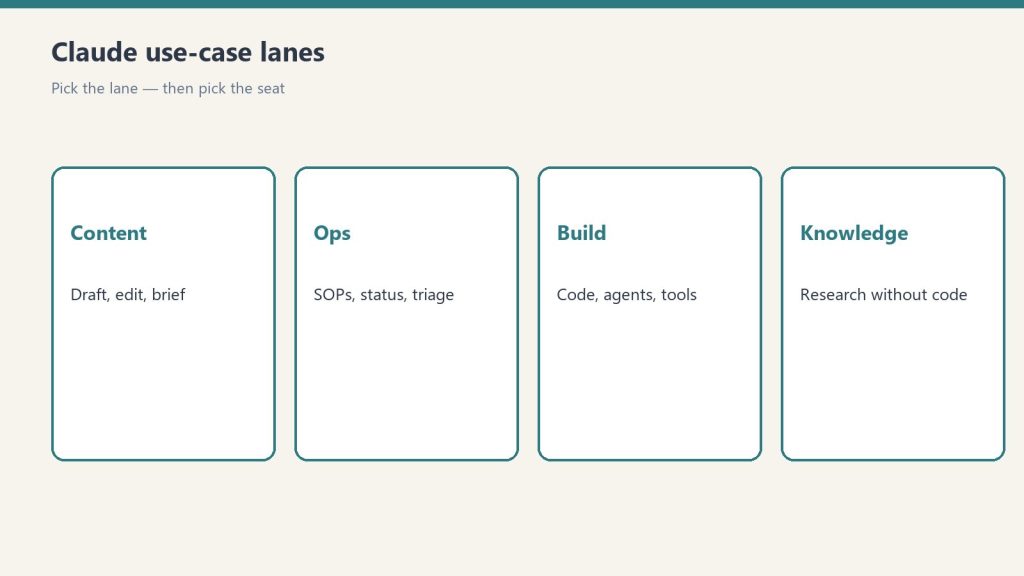
    Four cards for content, ops, build, and knowledge work with Claude
    Three layers of GEO — structure, entity, proof.

    Layer 1: Content Architecture

    GEO-optimized content is built for extraction, not just reading. That means every major claim is in a standalone sentence. Definitions appear near the top. Section headers are declarative, not clever. The structure tells an AI where the answer is before it has to read the full article.

    Layer 2: Entity Saturation

    AI systems understand content through entities — named people, organizations, places, products, and concepts that exist in their training data. A GEO-optimized article saturates relevant entities: it doesn’t say “a major AI company” when it means Anthropic. It doesn’t say “a popular search tool” when it means Perplexity. Every entity is named, spelled correctly, and used in the right context.

    Layer 3: Schema and Structured Data

    JSON-LD schema markup is a signal to both traditional search engines and AI crawlers. FAQPage schema makes your Q&A content directly extractable. Speakable schema flags the paragraphs most useful for voice and AI synthesis. Article schema establishes authorship and publication date. These are not optional extras — they are the machine-readable layer that gets your content selected.

    GEO vs AEO: What’s the Difference?

    Answer Engine Optimization (AEO) focuses on winning featured snippets, People Also Ask boxes, and zero-click search results in traditional search engines. GEO focuses on being cited by generative AI systems. The tactics overlap — both require clear structure, direct answers, and FAQ sections — but the targets are different. AEO wins position zero on Google. GEO wins the paragraph that Perplexity writes for the next million queries on your topic.

    At Tygart Media, we run both in parallel. The content pipeline produces articles that pass the AEO gate (featured snippet structure, FAQ schema) and the GEO gate (entity density, speakable markup, citation-worthy claims) before publishing.

    What GEO Looks Like in Practice

    Here is the difference between a standard paragraph and a GEO-optimized version of the same content:

    Standard: “Water damage restoration is an important service for homeowners who have experienced flooding or leaks.”

    GEO-optimized: “Water damage restoration — the professional remediation of structural damage caused by flooding, pipe failure, or storm intrusion — is performed by IICRC-certified contractors following the S500 Standard for Professional Water Damage Restoration. The process includes water extraction, structural drying, moisture monitoring, and antimicrobial treatment.”

    The second version names the certifying body (IICRC), the standard (S500), and the process steps. An AI system can extract that paragraph as a factual, citable answer. The first version has nothing to extract.

    How to Start with GEO

    If you’re running an existing content operation and want to layer in GEO, the priority order is:

    1. Audit your top 20 pages for entity gaps — everywhere you use vague references, replace with specific named entities
    2. Add speakable schema to your three strongest definitional paragraphs per page
    3. Run a factual density check — every statistic should have a source, every claim should be specific
    4. Add FAQPage schema to any page with question-format headings
    5. Submit your top pages to Google’s Rich Results Test and verify structured data is reading cleanly

    GEO Is Compounding Infrastructure

    The reason GEO matters for content operations is compounding. Once an AI system has indexed and trusted your content as a reliable source on a topic, subsequent queries on that topic draw from your content repeatedly — without you publishing anything new. A single GEO-optimized pillar article can generate thousands of AI citations over 12 months. That is a different kind of ROI than a ranked page that gets clicked and forgotten.

    We built the Tygart Media content stack around this principle. Every article that leaves our pipeline passes a GEO gate before it publishes. That gate checks entity saturation, factual specificity, schema completeness, and structural legibility. It is the same gate we build for clients.

    Frequently Asked Questions About GEO

    What does GEO stand for?

    GEO stands for Generative Engine Optimization — the practice of optimizing content to be cited by AI-powered search systems and large language models.

    Is GEO the same as SEO?

    No. SEO (Search Engine Optimization) targets traditional search rankings. GEO targets AI citation in tools like ChatGPT, Perplexity, Claude, and Google AI Overviews. The tactics overlap but the mechanisms and goals are different.

    How do I know if my content is being cited by AI?

    Run queries related to your topic in Perplexity, ChatGPT (with search enabled), and Google AI Overviews. Check whether your domain appears as a cited source. Tools like Profound and Otterly.ai can automate this monitoring.

    Does GEO replace AEO?

    No. AEO and GEO are complementary. AEO wins traditional search features like featured snippets. GEO wins AI citations. A mature content strategy runs both in parallel.

    How long does GEO take to show results?

    Unlike SEO, GEO results can appear quickly — sometimes within days of a page being indexed by AI crawlers. The compounding effect builds over 60–180 days as AI systems repeatedly select your content for related queries.

    Related on Tygart Media: GEO tactics · SEO vs GEO vs AEO · chunk-first GEO.

  • AI Referral Traffic: How to Measure Claude & ChatGPT in GA4

    AI Referral Traffic: How to Measure Claude & ChatGPT in GA4

    Short version: In the last 29 days, Claude, ChatGPT, Perplexity, Microsoft Copilot, Gemini, NotebookLM, and Kagi collectively sent at least 94 new readers to tygartmedia.com — a site whose #1 content vertical is explaining Claude. AI assistants are now our #4 traffic source, ahead of Facebook, ahead of LinkedIn, ahead of every search engine except Google and Bing. The product is citing the publication that covers the product. That’s the loop. Here is what it looks like when you can actually measure it.

    The finding that made me stop scrolling

    Four-stage funnel: citation, click, engage, convert
    The finding that made me stop scrolling.

    I built a Claude-powered browser agent to poke around our GA4 account and surface “interesting stuff” a human analyst would miss. One of the first things it flagged was our Source/Medium report. Here is the top of the list, unedited:

    RankSource / MediumNew Users (29 days)Notes
    1(direct) / (none)738Mystery bucket
    2google / organic289Standard Google SEO
    3bing / organic701m 20s average session — high intent
    4claude.ai / referral63Claude itself
    5m.facebook.com43Mostly 4-second bounces
    6duckduckgo / organic411m 02s average
    13chatgpt.com / referral9ChatGPT
    15perplexity.ai / referral5Perplexity
    21copilot.com3Microsoft Copilot
    24gemini.google.com2Google Gemini
    28notebooklm.google.com1Google NotebookLM
    35kagi.com1Kagi AI results

    Add up everything with an AI-assistant referrer and the combined count is at least 94 new users in 29 days — roughly 6.7% of all new users on the site. Claude alone, at 63 referred users, is our #4 traffic source. It is ahead of Facebook. It is ahead of LinkedIn. It is ahead of every search engine except Google and Bing. And we have been cited, at least once, by every major AI surface in the English-speaking internet: Claude, ChatGPT, Perplexity, Microsoft Copilot, Gemini, NotebookLM, and Kagi.

    Why this is different from “we show up in Google”

    Generative Engine Optimization (GEO) is the practice of structuring content so that large language models cite it as a source inside their answers. It is the younger, messier cousin of SEO. Most publishers cannot yet prove it is working. The feedback loop is long, the data is hidden inside a chat window, and the traffic that does leak through often lands in a “(direct)” bucket with no attribution at all.

    We can see ours. GA4, for reasons that are probably accidental, already records claude.ai, chatgpt.com, perplexity.ai, copilot.com, gemini.google.com, notebooklm.google.com, and kagi.com as discrete referral sources when a user clicks a citation link. That means AI-assistant traffic is measurable as a first-class channel right now, today, with the free version of Google Analytics, on any site that happens to get cited.

    The poetic layer of what we are looking at: Claude is the top AI referrer to a website whose #1 content vertical is explaining Claude. The product is sending readers to the publication that covers the product. If that is not a GEO moat, I do not know what one looks like.

    These are not bounced visitors. They are readers.

    Two cards: answer shown in overview versus optional click
    These are not bounced visitors — they are readers.

    The single biggest worry with any new traffic source is that it might be garbage — bots, previews, accidental clicks. The engagement data says the opposite. Users arriving from claude.ai spend 23 seconds on average and produce 0.56 engaged sessions per user. ChatGPT referrals average 21 seconds and 0.44 engaged sessions per user. For context, the site-wide average engagement time is dragged down hard by in-app social browsers; the Facebook mobile webview, for example, sits at about 14 seconds with 4-second bounces.

    People arriving from an AI assistant are not scrolling past. They clicked the citation because the AI told them this was the primary source, and when they got here they read. That is a qualitatively different kind of traffic than Facebook or a random Google search. These are the highest-intent non-search users we have.

    The secondary finding: Seattle is reading for three minutes

    The same GA4 pass surfaced a city-level pattern we were not expecting. Seattle readers — 61 of them in 29 days — spent an average of 3 minutes and 6 seconds on site at a 61.3% engagement rate. The site-wide average session is roughly 40 seconds. Seattle readers are spending about 4–5x longer on the page than the typical visitor, at nearly twice the engagement rate.

    CityActive UsersEngagement RateAverage Time
    Seattle6161.3%3m 06s
    The Dalles, OR310%1s
    Shelton, WA2627.6%15s
    Des Moines2437.5%10s
    Beijing316.5%0s
    Singapore2821.4%5s

    A few things jump out. The Dalles, Oregon at 31 users / 0% engagement / 1 second is almost certainly Google’s data center there returning preview requests — ignore it. Shelton, Washington is a real Mason County hyperlocal beachhead; 26 actual humans in our home county in 29 days is a legitimate foothold for the local desk. Beijing at 31 users / 0 seconds has the classic signature of cloud-hosted scrapers. And Seattle at 3 minutes is the single most valuable city in our data and it is not close.

    The browser split confirms an unusually technical audience

    BrowserUsersEngagement Rate
    Chrome850 (60%)31.3%
    Safari232 (16%)32.7%
    Edge99 (7%)62.3%
    Firefox33 (2.3%)60.5%

    Edge at 62.3% engagement and Firefox at 60.5% engagement are not normal consumer numbers. A typical general-interest site sees those two browsers hovering in the 5–15% range. Microsoft Edge is the default on corporate-managed Windows machines. Firefox is the dev-preferred privacy browser. The combination of high Edge engagement, high Firefox engagement, and a Claude-heavy referral list all point at the same audience: developers and technical professionals at real companies, reading on managed workstations.

    How to measure AI-assistant referrals in your own GA4

    Desk with laptop, checklist notebook, and billing card ready before creating an Anthropic API key
    How to measure AI-assistant referrals in your own GA4.

    If you publish anything technical and want to see your own version of this number, the fastest path is a custom GA4 exploration with one segment. Open GA4 → Explore → Free Form. Add a segment with this condition:

    Session source contains one of:
      claude.ai
      chatgpt.com
      perplexity.ai
      perplexity
      copilot.com
      gemini.google.com
      notebooklm.google.com
      kagi.com
      you.com
      phind.com

    Break it down by landing page, engagement rate, and average engagement time. That is your AI-Referral dashboard. Watch it weekly. A non-trivial number of sites will discover they already have measurable AI traffic and never bothered to look.

    Related on Tygart Media: how to use Claude · is Claude worth it · Claude rate limits.

    Frequently asked questions

    What is a GEO referral?

    A GEO referral, or AI-assistant referral, is a visit to your site from a user who clicked a citation link inside an answer generated by a large language model such as Claude, ChatGPT, Perplexity, Microsoft Copilot, Gemini, NotebookLM, or Kagi. In Google Analytics 4 these visits appear as referral traffic from the assistant’s domain — for example claude.ai / referral or chatgpt.com / referral.

    How many AI-referred users did tygartmedia.com receive in 29 days?

    At least 94 new users across seven distinct AI assistants: 63 from Claude, 14 from ChatGPT (9 attributed + 5 unassigned), 10 from Perplexity (5 attributed + 5 unassigned), 3 from Microsoft Copilot, 2 from Gemini, 1 from NotebookLM, and 1 from Kagi. That is roughly 6.7% of all new users on the site for the period.

    Are AI-assistant referrals real readers or bots?

    Real readers. Average engagement time from claude.ai is 23 seconds and from chatgpt.com is 21 seconds, with engagement rates of 0.56 and 0.44 engaged sessions per user respectively. Those numbers are qualitatively higher than in-app social browser traffic (Facebook mobile webview averages about 14 seconds) and indicate a deliberate click-through from an AI citation, not a scraper.

    Can any publisher measure AI-assistant referrals in GA4?

    Yes. GA4 records visits from claude.ai, chatgpt.com, perplexity.ai, copilot.com, gemini.google.com, notebooklm.google.com, and kagi.com as discrete referral sources by default. Build a Free Form exploration with a segment that filters Session source on those domains and you will see the channel immediately if it exists for your site.

    What is GEO in marketing?

    GEO stands for Generative Engine Optimization. It is the practice of structuring web content, schema markup, and publishing signals so that large language models cite the content as a source inside AI-generated answers. GEO is to AI assistants what SEO is to search engines — the discipline of being the answer the machine hands to the reader.

    The loop, and why it matters

    The most interesting thing about this data is not the traffic. It is the feedback structure. Tygart Media publishes explainers about Claude. Claude crawls and cites those explainers. Readers click through from Claude’s answer back to tygartmedia.com. We publish more. Claude cites more. The site becomes, in effect, training data and a recommended source for the next iteration of the product it covers. That is the recursive loop that makes AI-native publishing a different business than search-era publishing.

    I do not think every site can build this loop. It requires a narrow, technically-defensible topic — something an AI assistant would rather cite than paraphrase — and the patience to publish at a cadence LLMs reward. What I do think is that any publisher can check, today, whether the loop has quietly started forming underneath them. Most have not bothered. This post is partly a flex and partly an invitation: go look.

    What happens next at Tygart Media

    Three things. We are standing up a permanent AI-Referral channel in our GA4 so the number can be watched weekly instead of rediscovered quarterly. We are writing the playbook — the one this post hints at — for publishers who want to do the same. And we are building the browser agent that found this in the first place into a repeatable audit any publisher can run against their own GA4 in an afternoon. If that last one sounds useful, the newsletter is the place to follow along.

    Claude sent us 63 readers last month. It will send more next month. We will be counting.

  • AI Citation Playbook: Claude vs ChatGPT vs Perplexity

    AI Citation Playbook: Claude vs ChatGPT vs Perplexity

    Part 2 of 2. In the first post I showed that Claude, ChatGPT, Perplexity, Copilot, Gemini, NotebookLM, and Kagi collectively sent tygartmedia.com at least 94 new readers in 29 days — and that Claude alone is our #4 traffic source. That is the headline. What follows is the interesting part: when you filter the landing-page report one AI model at a time, the three major assistants cite completely different kinds of pages, and the pattern is actionable.

    Claude cites a small number of pages, a lot of times

    Two cards: answer shown in overview versus optional click
    Claude cites a small number of pages, a lot of times.

    Claude.ai sent 79 sessions across 63 users to 16 distinct pages. Two pages ate more than half of it:

    #PageSessions% of Claude trafficAvg Time
    1/claude-student-discount2227.9%35s
    2/anthropic-console2126.6%11s
    3(not set)1316.5%5s
    4/claude-edu45.1%6s
    5/claude-pro-vs-chatgpt-plus45.1%7s
    6/claude-code-on-vertex-ai-gcp33.8%3s
    7/claude-desktop22.5%40s
    8/how-to-install-claude-code22.5%2s
    9/claude-4-deprecation11.3%1m 07s
    10/claude-managed-agents-pricing-cost-analysis11.3%1m 38s

    The two biggest pages, /claude-student-discount and /anthropic-console, are 54.5% of all Claude-referred traffic to the site. Those are extremely specific query shapes — “how do students get Claude Pro free” and “how do I access the Anthropic Console” — and Claude has apparently decided our pages are the canonical answer for both.

    The engagement twist is worth staring at. The two biggest Claude-referred pages have the worst time-on-page: 35 seconds and 11 seconds. The two pages that got a single Claude visit each — /claude-managed-agents-pricing-cost-analysis and /claude-4-deprecation — got 1 minute 38 seconds and 1 minute 7 seconds of real read time. The pattern is clean. When Claude can extract the answer directly into its chat window, users click through briefly to verify and leave. When the answer is deeper than Claude can summarize, readers stay to actually read. Both behaviors are valuable and both are measurable.

    ChatGPT cites broadly, favors “X vs Y” content, and (oddly) sends geographic traffic

    ChatGPT’s footprint is shaped differently. 16 sessions across 14 users to 13 distinct pages — almost every page received exactly one visit, which is the signature of a model citing a wide range of sources once each rather than reaching for a favorite.

    PageSessionsAvg Time
    /claude-student-discount315s
    /claude-computer-use-tutorial12m 07s
    /grok-vs-claude115s
    /opus-4-7-vs-gpt-5-4-vs-gemini-3-1-pro10s
    /claude-pro-vs-chatgpt-plus(cross-model)—
    /claude-for-nonprofits130s
    /everett-waterfront-visitor-guide…10s
    /hood-canal-shellfish-season-2026…10s
    /rakuten-claude-managed-agents-enterprise-deployment10s

    Two patterns in that list. First, ChatGPT appears to cite us disproportionately for model comparisons — grok-vs-claude, opus-4-7-vs-gpt-5-4-vs-gemini-3-1-pro, and the cross-model claude-pro-vs-chatgpt-plus page. Second, and stranger, ChatGPT sent visits to two hyperlocal Pacific Northwest pages: an Everett waterfront guide and a Hood Canal shellfish season page. That is ChatGPT using our site as a reference source for geographic queries, which is not a pattern any other model shows.

    The hidden gem: /claude-computer-use-tutorial received one ChatGPT referral and that referral stayed for 2 minutes 7 seconds. ChatGPT appears willing to cite long-form technical tutorials in a way Claude does not.

    Perplexity treats us like a research database

    Perplexity sent 12 sessions across 10 users to 9 pages — the most evenly distributed of the three and the only model that cites people, founders, and company-history content.

    PageSessionsAvg Time
    /anthropic-founders-2217s
    /claude-code-on-vertex-ai-gcp254s
    /claude-student-discount20s
    /claude-desktop14s
    /claude-team-plan10s
    /how-to-install-claude-code10s
    /restoration-team-training-claude-cowork10s

    Perplexity is the only model that pulled visits on /anthropic-founders-2, which implies Perplexity is fielding a different query shape — something closer to “who founded Anthropic” than “how do I use Claude.” Perplexity is also the only model that surfaced the very niche B2B page /restoration-team-training-claude-cowork. That is a long-tail, vertical-specific query and Perplexity cited us as the source. That is exactly the behavior you would hope for from a research-flavored assistant.

    The three models have completely different citation personalities

    Four cards comparing ChatGPT, Gemini, Perplexity, and Copilot by job
    The three models have completely different citation personalities.

    Once you lay the three patterns side by side, the strategy falls out of the page.

    • Claude.ai favors short, factual, access-related pages. Product info, pricing, how-to-access. If you want more Claude citations, write more narrow “how do I do this one specific thing” pages.
    • ChatGPT favors comparisons and long-tail references. X vs Y, alternatives, and — unexpectedly — some geographic content. If you want more ChatGPT citations, write more “X vs Y” posts with tight comparison tables.
    • Perplexity favors people, history, and niche research. Founders, company background, domain-specific tutorials. If you want more Perplexity citations, write more research-flavored background pieces.

    This is the single most practical insight in the data set. Most people talk about “AI SEO” as if it is one thing. It is three things, at minimum, and the content shape that wins one model will not automatically win the other two.

    The crown jewel: one page, 17% of all AI-referred traffic

    The clearest cross-model winner on the site is /claude-student-discount. Claude sent 22 sessions. ChatGPT sent 3. Perplexity sent 2. Combined that is 27 sessions — roughly 17% of all AI-referred traffic we received in 29 days, from a single URL. No other page on the site is cited by all three major LLMs in meaningful volume.

    There is a playbook inside that one data point. The page works because the query “how do I get Claude for free as a student” is an extremely high-frequency question across every chat surface, and the page happens to be structured the way LLMs like to cite: a short, direct answer near the top, specific eligibility rules in a scannable block, and no wall of context before the reader gets to the fact. That structural recipe — front-load the answer, make the facts liftable, keep the page narrow — is repeatable.

    The bigger finding: 90% of our Claude content is invisible to AI

    tygartmedia.com has more than 250 Claude-related articles. Exactly 25 of them show up in the AI-referral data set at all. The 90% that do not get cited are not low-quality — several of them have strong engagement from regular search traffic:

    • /claude-managed-agents-complete-pricing-guide-2026 — 17 sessions at ~1 minute from search, zero AI citations
    • /notion-knowledge-base-for-claude — 10 sessions at 1m 23s, uncited
    • /claude-rate-limits — classic FAQ shape, 6 sessions, not cited
    • /claude-md-playbook — 1 session at 2m 33s, zero AI pickup
    • The full /claude-cowork-* family of 12+ pages, almost entirely invisible to every model

    The difference between an AI-cited page and an AI-invisible page is rarely the quality of the content. It is the shape. Pages that get cited have an early summary, short headings, bulleted facts, and a quotable direct-answer sentence. Pages that do not get cited tend to open with context, build up to the answer, and bury the quotable line in paragraph 9.

    The content-cluster scorecard

    ClusterApprox. PagesApprox. SessionsEngagementAI Citations
    Claude pricing & access~10~160MixedHigh
    Claude managed agents~12~130Strong (25s–1m)Low
    Claude Code~8~60High (18s–3m)Moderate
    Model comparisons (X vs Y)~10~45Very high (1–7 min)Moderate
    Anthropic people/company~8~30MediumModerate
    Claude how-to / tutorials~20~50MediumLow
    Claude Cowork family~15~40Very low (0–10s)Almost none

    Two clusters deserve action. The Claude Cowork family is a content swamp — 15 pages, low traffic, no AI citations, and 0–10 second engagement on the traffic that does land. That cluster should be consolidated into two or three flagship posts and the rest redirected. The model comparisons cluster is the opposite: low volume but 1–7 minutes of engagement and cross-model citations. One well-researched comparison post outperforms ten mediocre explainers on every metric that matters here.

    The playbook, in one list

    Four-stage funnel: citation, click, engage, convert
    The playbook, in one list.
    • Write more narrow single-answer pages. Candidates I would ship next: /claude-web-search, /claude-api-keys, /claude-max-plan-vs-pro, /how-to-cancel-claude, /claude-mobile-app, /claude-desktop-vs-web, /claude-subscription-refund. Each is ~600 words, answer-first, scannable. That is the shape Claude cites.
    • Add a Quick Answer block to the top of every long-form piece. Two or three sentences. Quotable. That alone moves a real share of our invisible content into AI-citation range.
    • Invest in comparison posts for ChatGPT pickup. We already know ChatGPT cites our existing X-vs-Y content. Ship more of them, with tight tables.
    • Write more founder/history/background pieces for Perplexity pickup. Research-flavored. Dates, names, primary sources.
    • Consolidate the Cowork cluster. Two or three flagship pages, everything else redirected.
    • Ship a permanent AI-Referral dashboard in GA4. Segment on all seven assistant domains. Watch it weekly. This is now a first-class channel.

    Frequently asked questions

    What kinds of pages does Claude.ai cite most often?

    Based on the tygartmedia.com data, Claude.ai disproportionately cites short, factual, access-related pages — product info, pricing, how-to-access, and eligibility details. On our site, two pages (/claude-student-discount and /anthropic-console) accounted for 54.5% of all Claude-referred traffic in a 29-day window.

    What kinds of pages does ChatGPT cite most often?

    ChatGPT’s citation pattern favors comparison and long-tail reference pages — “X vs Y” posts like Grok vs Claude, model-to-model comparisons, and, surprisingly, some geographic and local content. ChatGPT tends to cite many pages once each rather than concentrating on a small set.

    What kinds of pages does Perplexity cite most often?

    Perplexity cites research-flavored content — founders and company history, domain-specific tutorials, and niche B2B pages. It is the only major AI assistant that sent traffic to our Anthropic founders page and to a vertical-specific training page in our data set.

    Why does the same page get different citation volume from different AI models?

    Because each assistant is answering a slightly different distribution of queries. Claude is most often used for “how do I use this product” questions and favors narrow how-to pages. ChatGPT receives more comparison and alternative-seeking queries. Perplexity skews toward research and background questions. A page that is the best answer for one query type will not automatically be the best answer for another.

    How do I structure a page to get cited by AI assistants?

    Lead with a direct, quotable answer in the first paragraph. Use short scannable headings. Keep facts in bulleted or tabular form. Include an explicit FAQ block with question-shaped subheadings. Keep the page narrow — one topic, one canonical answer — rather than a sprawling multi-topic explainer.

    The bigger picture

    The meta-insight worth sitting with: we are currently being cited inside Claude’s internal answer graph for “Claude student discount” because a human sat down and wrote a clear, narrow page about it. That is almost the entire game for publishers for the next three years. Most of the web has not noticed yet. We noticed, and now we have a measurement stack to act on what we noticed.

    If you are a publisher, the thing to do this week is boring and powerful: segment your GA4 on the seven AI-assistant domains from Part 1, sort your landing pages by AI-referral volume, and look at the pages that are winning. They will have a shape. Copy it.

    — If you missed it, Part 1 is here.

  • Belfair Community AI: Boost Local Business Visibility

    Belfair Community AI: Boost Local Business Visibility

    If you run a business in Belfair or anywhere in the North Mason area, you’ve probably had the experience of a customer walking in and saying your Google hours are wrong. Or you’ve watched a potential customer drive past because they checked an app that said you were closed. Or you’ve lost a Google review battle to a chain restaurant in Silverdale that has a full-time marketing team updating its listings while you’re running the counter.

    Last refreshed: October 24, 2026 (Pacific).

    October 2026 update: The SR-3 Belfair Bypass has NOT started construction — WSDOT lists the project as pre-construction with a 2027–2029 timeline, so the spring-2026 start in early project materials (and in this page’s original version) has slipped. The bypass sections below are corrected.

    Local AI changes that dynamic — not by handing you a better Yelp listing, but by building a different kind of knowledge infrastructure that actually serves the people who live and work in Belfair.

    The Local Knowledge Problem in Belfair

    National platforms — Google, Yelp, national AI systems — optimize for scale. They work reasonably well for businesses in large markets where there’s enough review volume and enough competitive pressure to keep listings accurate. In a community the size of Belfair, with a CDP population of roughly 4,500 to 5,700 in the broader North Mason area, those systems fail constantly. Business listings go stale. New openings don’t get indexed for months. Closed businesses haunt Google results for years after the doors shut. And the national AI systems that answer “what’s open in Belfair right now” have no reliable way to know.

    The Belfair community AI layer is being built to fix the local layer of that problem. Its knowledge base is maintained by people who are actually in North Mason — who know which businesses opened, which ones changed their model, which ones are closed on Mondays despite what the listing says. That’s different in kind from what any national platform can offer.

    What It Means for Your Business to Be in the System

    When a North Mason resident — or a newcomer, or a military family arriving at PSNS — asks the Belfair community AI “where can I get [category of thing you sell],” you want to be in the answer. That requires being in the knowledge base, with accurate current information: real hours, real services, real contact details.

    Getting into the system isn’t an advertising transaction. It’s a knowledge contribution. Businesses that participate in the community knowledge layer — by making sure their information is accurate, by contributing knowledge about their own products and services that only they have — become more visible through accuracy rather than through paid placement. In a community that distrusts the paid-placement model (and most North Mason residents do, for good reason), that’s a meaningfully different kind of credibility.

    The cross-subsidy model behind the community AI is also relevant for local businesses: the same technical infrastructure that serves North Mason residents for free is used in commercial knowledge verticals — restoration, radon, asset appraisal — that pay for the operational costs. The community layer is free to access and free to be represented in, which means small business visibility isn’t gated behind an advertising budget.

    The SR-3 Bypass and What It Means for Your Customer Base

    One of the most significant changes coming to North Mason commercial life is the SR-3 Freight Corridor New Alignment — the Belfair Bypass. Construction has not started: WSDOT lists the project as pre-construction with a 2027–2029 timeline (checked October 2026), so the spring-2026 start in early project materials has slipped. Once built, the bypass will route a significant share of through-traffic around Belfair rather than through it, expected to divert 25 to 30 percent of the current 18,000-plus daily vehicles that currently pass through the Belfair commercial corridor.

    That’s a structural change in traffic patterns that will benefit some businesses and challenge others once it is built. Businesses that currently capture passing traffic will see changes. Businesses that serve the residential North Mason community rather than through-traffic will be less affected. The community AI will track and contextualize the project as it develops — giving residents and business owners the current picture rather than generic “bypass construction is underway” framing.

    For current context on what’s happening in Belfair’s civic and commercial landscape, see Sweetwater Creek Park Opening & Belfair Business News and Belfair Library Remodel & New Visitor Center Updates.

    The Workshop Opportunity

    The community AI is being developed through monthly workshops — planned at the North Mason Timberland Library and community venues once the knowledge base reaches sufficient coverage. For local business owners, these workshops are an opportunity to directly shape how your business is represented in the system, correct outdated information, and contribute knowledge about your sector that only you have.

    A restaurant owner who knows which local farms they source from. A contractor who knows which Mason County permit processes apply to which project types. A fishing guide who knows current conditions on Hood Canal in ways no agency tracks in real time. Each of these is knowledge the community AI wants — and each contributes to a system that benefits every business in North Mason by making the area more navigable for residents and newcomers alike.

    The broader vision for the project is laid out in Community AI Infrastructure: Building Belfair’s AI Layer. The short version for local business owners: community AI built from genuine local relationships serves local businesses in ways national platforms can’t replicate, because it’s optimized for this community rather than for an audience that will never set foot in Belfair.

    Frequently Asked Questions

    How does the Belfair community AI affect local business discovery?

    The Belfair community AI is built to answer the questions North Mason residents actually ask about local businesses — current hours, available services, recent changes in ownership or offerings. Unlike national platforms that update listing data through automated scraping and user reviews, the community layer is maintained by people who are actually in Belfair and know when a business has changed. For small businesses in a community of North Mason’s size, accurate representation in a community-maintained system is more valuable than any paid-placement listing on a platform optimized for larger markets.

    What does the SR-3 Belfair Bypass construction mean for Belfair businesses?

    The SR-3 Freight Corridor New Alignment has not started construction: as of October 2026 WSDOT lists it as pre-construction with a 2027–2029 timeline, so the spring-2026 start in early project materials has slipped. When built, it will route approximately 25 to 30 percent of the current 18,000-plus daily vehicles around Belfair rather than through the commercial corridor. Businesses with high dependence on passing traffic should plan for this transition. Businesses serving the residential North Mason community will be less exposed to the change. The community AI will track project status and traffic impact data as they develop, providing context for business owners making planning decisions.

    How can a Belfair business ensure it is represented accurately in the community AI knowledge base?

    The primary pathway is through the community AI workshops, planned monthly at the North Mason Timberland Library once the knowledge base reaches operational coverage. Business owners who attend can verify and update information about their business, contribute sector-specific knowledge that improves the accuracy of the whole system, and build a direct relationship with the knowledge base maintainers. There is no cost to participate and no advertising component — representation is based on accuracy and relevance to North Mason residents, not on paid placement.

    Does the Belfair community AI compete with existing business listing services?

    No. The community AI is infrastructure for the Belfair community, not a commercial directory service. It doesn’t replace Google Business Profile or Yelp listings — it provides a community-specific knowledge layer that national platforms can’t replicate. A business with accurate information in both the community AI and its Google listing is simply more discoverable through more channels. The community AI is specifically valuable for the questions that national platforms can’t answer well: current conditions, seasonal hours, recent changes, and the kind of nuanced local knowledge that only comes from being part of the community.

    What types of local businesses benefit most from the Belfair community knowledge layer?

    Businesses with high relevance to North Mason community life benefit most: local restaurants and food businesses (especially those with seasonal menus or irregular hours), outdoor recreation outfitters and fishing guides operating on Hood Canal, contractors and service businesses navigating Mason County permit processes, local professional services (healthcare, legal, financial), and any business whose customers need to know something specific before they visit — current stock, seasonal availability, appointment requirements. The community AI is most valuable for businesses whose customers are making a local decision that requires more than just a star rating and an address.

    Read more: Belfair Community AI: A Guide for North Mason Residents

    More from the Belfair Community AI Series