Tag: AI Search

  • How Restoration Companies Get Found in AI Search When Homeowners Need Help Fast

    How Restoration Companies Get Found in AI Search When Homeowners Need Help Fast


    Tygart Media — Restoration Content Strategy

    How Restoration Companies Get Found in AI Search When Homeowners Need Help Fast

    By Tygart Media Updated: April 12, 2026
    The 2am AI search reality: A homeowner discovers water in their basement at 2am. They don’t know which restoration company to call. They ask ChatGPT: “What should I do right now about water damage?” or “How fast does mold grow after water damage?” The AI synthesizes an answer from the most authoritative, structured, entity-rich restoration content it can retrieve. The restoration company cited in that answer has a significant advantage — the homeowner arrives at their phone number pre-trusting a source that just helped them.

    Why Emergency Restoration Queries Are the Highest AI Citation Opportunity

    Restoration is one of the few industries where the customer’s search happens simultaneously with the problem. A homeowner doesn’t research restoration contractors the week before their pipe bursts — they search during the crisis. This creates a specific AI search opportunity: the queries that precede a restoration call are exactly the kind of direct-answer, process-oriented questions that AI systems are built to answer.

    “What to do immediately after water damage,” “how fast does mold grow after a leak,” “is it safe to stay in a house with water damage,” “what does Category 3 water damage mean” — these are answerable questions with verifiable, standard-referenced answers. Restoration content that answers them with IICRC entity references and direct-answer formatting is exactly what AI systems retrieve and cite.

    How do restoration companies get cited by ChatGPT and Google AI Overviews for water damage queries?
    Restoration companies earn AI citations for water damage queries when their WordPress content combines: ranking in the top 20 organic results for the query, IICRC standard references (S500, S520, specific technician certifications) as named entity anchors that AI systems can verify, direct-answer speakable blocks in the first 50 words after each section heading, and FAQPage JSON-LD schema that makes question-and-answer pairs machine-parseable. Emergency query content — “what to do after water damage,” “how fast does mold grow” — has the highest AI citation potential of any restoration content type because it matches the question format AI systems are built to answer.

    The Emergency Query Content Architecture

    Lead With the Direct Answer

    For emergency restoration queries, AI systems retrieve content that answers the question immediately — not content that builds context for three paragraphs before addressing the concern. An article titled “What to Do Immediately After Water Damage” should open with: “In the first 24 hours after water damage: stop the source of water if safe, document with photos before moving anything, call your insurance company to open a claim, and contact an IICRC-certified restoration contractor for professional water extraction — mold growth can begin within 24–48 hours under warm, humid conditions per IICRC S500 guidelines.” That’s the answer. Everything after is supporting detail.

    Reference IICRC Time Standards

    The IICRC S500 standard provides specific timelines for water damage mitigation that AI systems can verify and cite: Category 1 water damage should be addressed within 24–48 hours to prevent Category 2 contamination escalation; structural drying per IICRC ASD protocols typically requires 3–5 days with commercial dehumidification equipment. These specific, standard-referenced timeframes are what separate authoritative restoration content from generic homeowner advice — and are exactly what AI systems look for when evaluating which content to cite for time-sensitive restoration queries.

    Build Speakable Blocks for the Emergency Questions

    The highest-citation emergency restoration speakable blocks target: “How fast does mold grow after water damage?” (answer: within 24–48 hours under warm, humid conditions per IICRC S500 — the standard for professional water damage restoration), “What is Category 3 water damage?” (answer: grossly contaminated water including sewage, seawater, and floodwater from rivers per IICRC S500 classification), and “Is it safe to stay in a house with water damage?” (answer: depends on Category classification and structural integrity — Category 3 contamination typically requires temporary relocation). These answers are specific, verifiable, and structured for AI extraction.

    Speakable block creation, IICRC entity injection, and FAQPage schema are the three core GEO deliverables in WordPress content optimization for restoration companies through SiteBoost — applied to your existing emergency content to maximize AI citation probability.

    Frequently Asked Questions

    Which AI systems are most important for restoration companies to optimize for?

    Google AI Overviews has the largest reach — appearing directly in Google search results for emergency restoration queries like “what to do after water damage” and “how fast does mold grow.” Perplexity is increasingly used for research-phase restoration questions because it cites sources inline, giving cited restoration companies visible brand exposure. ChatGPT’s growing search integration captures the late-night crisis searches where homeowners ask AI assistants for immediate guidance. All three use similar evaluation criteria: named IICRC entity references, direct-answer structure, and FAQPage schema.

    How is restoration AI search different from restoration Google SEO?

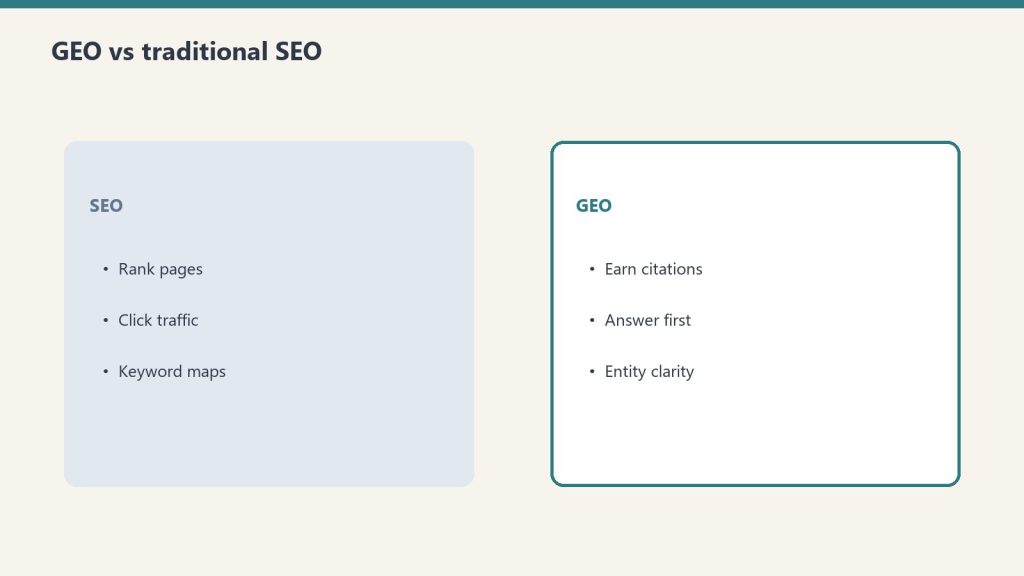
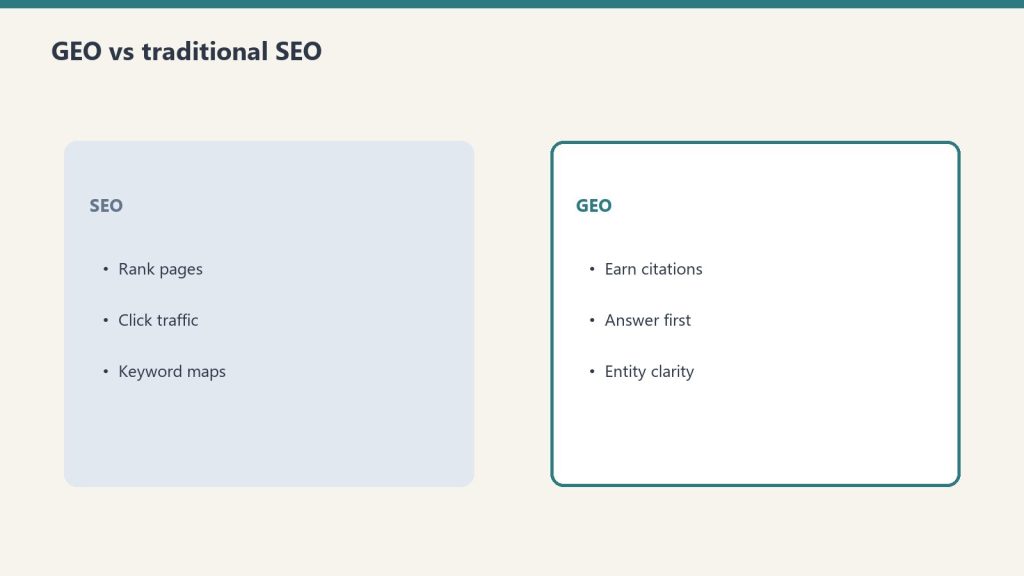
    Traditional restoration Google SEO prioritizes local signals — Google Business Profile, NAP consistency, location-specific landing pages, and review volume. AI search evaluates content differently: it looks for topical authority signals (IICRC standards, RIA membership, specific certification designations), direct-answer formatting (speakable blocks with 40–60 word direct answers), and machine-readable schema (FAQPage JSON-LD). Both matter — 97% of AI citations come from pages already ranking organically, so traditional SEO is the prerequisite. But among ranking pages, AI citation requires the additional GEO layer.

    Can a restoration company without a strong domain authority still earn AI citations?

    Yes, for specific long-tail emergency queries where competition is lower. A restoration company ranking in positions 11–20 for “what to do after a pipe bursts” with strong IICRC entity references and FAQPage schema can earn AI citations for that specific query even if it doesn’t rank in the top 3. The AI citation selection process among ranking pages rewards content quality signals — entity depth, direct-answer structure, schema — not just ranking position within the top 20.

    Sources: Blueprint Digital, “Water Damage Restoration SEO” (2026); IICRC S500 Standard for Professional Water Damage Restoration (5th ed.); Whitehat SEO, “SEO Best Practices 2025–2026”; LLMrefs, “Answer Engine Optimization: The Complete Guide for 2026”
  • How IICRC Certification Signals Rank Your Restoration Company Higher (And Get You Cited by AI)

    How IICRC Certification Signals Rank Your Restoration Company Higher (And Get You Cited by AI)


    Tygart Media — Restoration Content Strategy

    How IICRC Certification Signals Rank Your Restoration Company Higher (And Get You Cited by AI)

    By Tygart Media Updated: April 12, 2026
    IICRC as an SEO entity: The Institute of Inspection, Cleaning and Restoration Certification (IICRC) is the named credentialing body that Google’s quality evaluators and AI systems use to evaluate restoration content authority. An article that mentions “IICRC-certified technicians” once is a marketing claim. An article that references the specific IICRC S500 Standard for Professional Water Damage Restoration, the Applied Structural Drying (ASD) technician designation, and the Restoration Industry Association (RIA) as co-publisher of industry standards — that article has entity depth that signals genuine industry expertise.

    Why Certification Names in Content Matter More Than Logos

    Most restoration company websites display IICRC logos — in the footer, on the About page, on the homepage trust bar. This helps with human visitor credibility but contributes almost nothing to search or AI visibility. Logos are images. Google’s text-based quality evaluators and AI retrieval systems read the text content of pages, not the images on them.

    The SEO and AI citation value of IICRC certification comes from naming the credentials, standards, and certifying body in the text content of your articles and service pages. Specifically:

    • IICRC S500 — Standard for Professional Water Damage Restoration
    • IICRC S520 — Standard for Professional Mold Remediation
    • IICRC S770 — Standard for Professional Water Damage Restoration of Sewage Impacted Structures
    • ASD — Applied Structural Drying technician designation
    • WRT — Water Damage Restoration Technician certification
    • AMRT — Applied Microbial Remediation Technician
    • RIA — Restoration Industry Association (co-publisher of IICRC standards)
    How does IICRC certification improve restoration company SEO and AI citation?
    IICRC certification improves restoration company SEO when specific IICRC standards — S500 for water damage, S520 for mold, S770 for sewage — are named in article text content rather than just displayed as logos. These named entities signal genuine restoration industry expertise to Google’s E-E-A-T quality evaluators and AI systems like ChatGPT and Perplexity, which evaluate whether restoration content represents real industry knowledge before citing it in answers about water damage, mold, or property restoration.

    Implementing IICRC Entities in Three Content Types

    Water Damage Articles

    Every water damage article should reference the IICRC S500 standard and explain that professional water damage restoration follows its protocols — including moisture mapping, equipment placement based on psychrometric calculations, and documentation of drying progress. An article that explains Category 1 (clean water), Category 2 (grey water), and Category 3 (black water) contamination levels using IICRC S500 terminology signals expertise that generic homeowner advice does not.

    Mold Remediation Articles

    Mold content should reference the IICRC S520 standard, AMRT technician certification, and EPA mold remediation guidelines as named entities. The distinction between mold remediation (reducing mold to a normal fungal ecology per S520) and mold removal (a marketing term without a defined standard) is the kind of specific, standard-referenced distinction that earns Google quality evaluator trust for YMYL property damage content.

    Insurance Claim Content

    Insurance-related restoration content should reference IICRC standards as the basis for scope of work documentation — specifically that IICRC S500-compliant documentation (moisture readings, equipment logs, drying reports) is what adjusters require to approve claims. This entity connection between IICRC standards and insurance claim approval is highly specific and AI-citation-worthy because it answers a high-intent homeowner question with verifiable, standard-referenced information.

    IICRC entity injection is part of the GEO optimization layer in WordPress content optimization for restoration companies through SiteBoost — applied to your existing water damage, mold, and insurance content without changing any factual claims.

    Frequently Asked Questions

    What IICRC standards should restoration content reference?

    The most SEO-valuable IICRC standard references for restoration content are: S500 (Professional Water Damage Restoration — the foundational water damage standard), S520 (Professional Mold Remediation), S770 (Water Damage Restoration of Sewage Impacted Structures), and IICRC technician designations including WRT (Water Damage Restoration Technician), ASD (Applied Structural Drying), and AMRT (Applied Microbial Remediation Technician). Referencing specific standards by number and full name — not just “IICRC standards” generically — creates the named entity anchors that signal genuine expertise.

    Is RIA membership also an SEO entity signal?

    Yes. The Restoration Industry Association (RIA) co-publishes IICRC standards and is the primary trade association for the restoration industry. Referencing RIA membership, RIA industry statistics, or RIA educational programs in restoration content adds a second named industry entity alongside IICRC — which strengthens the entity cluster signaling genuine restoration industry standing. For content about insurance claims, referencing RIA’s advocacy work with insurance industry on claim documentation standards is specifically relevant and AI-citation-worthy.

    Do IICRC entity references help with both Google rankings and AI citation?

    Yes, through the same mechanism. Google’s quality evaluators assess restoration content for expertise signals — specific named standards and certifications are the clearest indicators that content reflects genuine professional knowledge. AI systems like ChatGPT and Perplexity use similar evaluation criteria when deciding which restoration content to cite in answers. Named IICRC standard references make content machine-verifiable — the AI can cross-reference the entity against known certification data — which increases citation probability for both Google AI Overviews and standalone AI assistants.

    Sources: IICRC S500 Standard for Professional Water Damage Restoration (5th ed.); IICRC S520 Standard for Professional Mold Remediation; Restoration Industry Association (RIA), restorationindustry.org; Aziel Digital, “Water Damage SEO Secrets” (2026); Peterson SEO Consulting, “Water Damage SEO for Restoration Contractors” (2025)
  • How Attorneys Get Cited by ChatGPT, Perplexity and Google AI Overviews

    How Attorneys Get Cited by ChatGPT, Perplexity and Google AI Overviews

    Tygart Media — Law Firm Content Strategy

    How Attorneys Get Cited by ChatGPT, Perplexity and Google AI Overviews

    By Tygart Media Updated: April 12, 2026
    The shift that changes everything for law firm marketing: According to ALM Corp’s 2026 legal SEO analysis, 58% of legal searches now end without a click — prospects receive their answer from Google AI Overviews without visiting any website. The attorneys who win in this environment are not necessarily those ranking #1 on Google. They are the attorneys whose content gets cited by AI systems during the research phase — before a prospect has decided to search for a lawyer at all.
    58%of legal searches end without a click
    97%of AI citations come from top-20 organic results
    $50–$500cost per click for competitive legal terms

    How AI Systems Decide Which Legal Content to Cite

    ChatGPT, Perplexity, and Google AI Overviews all use retrieval-augmented generation (RAG) — they search the web, retrieve candidate pages, and then evaluate those pages before synthesizing an answer. The evaluation is not purely about ranking. It includes an assessment of whether the content’s claims are verifiable, whether named legal entities are present, whether the content is structured for direct-answer extraction, and whether the source demonstrates domain expertise.

    Law firm content that earns AI citations has four specific properties: it ranks in the top 20 organic results (the prerequisite), it contains named legal entities (statutes, case law, bar association rules), it has direct-answer formatting (a clear 40–60 word answer near the top of each section), and it has FAQPage schema that makes those answers machine-parseable.

    What makes attorney content get cited by ChatGPT and Perplexity? Attorney content earns AI citations from ChatGPT and Perplexity when it combines: organic ranking in the top 20 results for the query (the access prerequisite), named legal entity references that AI systems can verify (specific statutes, bar association rules, named legal doctrines), direct-answer formatting in the first 50 words after each section heading, and FAQPage JSON-LD schema that makes question-and-answer pairs machine-parseable. Content lacking any one of these properties is significantly less likely to be cited even if it ranks well.

    The Named Entity Requirement: Why Generic Legal Content Gets Ignored by AI

    AI systems evaluate legal content partly by checking whether named entities match verified legal knowledge. An article about personal injury law that references “Texas Civil Practice and Remedies Code § 16.003” for the statute of limitations, cites “the ABA Model Rules of Professional Conduct Rule 1.4 on attorney-client communication,” and discusses “modified comparative fault versus contributory negligence” as named doctrines — this content has an entity fingerprint that signals genuine legal expertise.

    An article that says “you have a limited time to file your claim” with no statute reference has no verifiable entity anchor. An AI system synthesizing an answer about personal injury timelines in Texas will cite the content it can verify — not the content that sounds authoritative without being specific.

    The Speakable Block: Structuring Content for AI Direct-Answer Extraction

    Speakable blocks are sections of content structured specifically as direct, self-contained answers. The format is: a clear question as the section heading, a 2–3 sentence direct answer in the first 50 words of the section, followed by supporting detail. AI systems are trained to extract this pattern when synthesizing answers — it is the content structure that most reliably produces citations in AI overview responses.

    For law firm content, the highest-citation speakable blocks target the questions prospects ask before they decide to hire a lawyer: “How does comparative negligence affect my case?”, “What damages can I recover in a personal injury claim?”, “What is the difference between mediation and arbitration?” — questions where a direct, authoritative, entity-specific answer would give an AI system something worth citing.

    The GEO layer of SiteBoost’s WordPress content optimization for law firms applies named entity injection and speakable block creation to your existing articles, combined with LLMS.txt and FAQPage schema, building the AI citation infrastructure across your entire published library.

    Frequently Asked Questions

    Does ranking #1 on Google guarantee AI citation?

    No. Ranking #1 is the access prerequisite — 97% of AI citations come from pages in the top 20 organic results, so you must rank to be considered. But among ranking pages, AI systems make a secondary selection based on content trustworthiness: named entity references, direct-answer formatting, source citations, and schema markup. A page at position 5 with strong entity density and FAQPage schema often earns more AI citations than the page at position 1 without those signals.

    Which AI systems are most important for law firm content to target?

    Google AI Overviews has the largest reach because it appears directly in Google search results for millions of legal queries. Perplexity is increasingly used for research-stage legal questions because it cites sources inline, which means cited attorneys gain visible brand exposure during the research process. ChatGPT’s search integration (introduced with ads in late 2025) is growing rapidly. All three use similar evaluation criteria — entity density, direct-answer structure, and FAQPage schema — so content optimized for one is largely optimized for all.

    How quickly can law firm content start earning AI citations?

    AI systems crawl and update their citation indexes more frequently than Google’s organic ranking index. Content with strong entity density, FAQPage schema, and speakable blocks can begin appearing in AI Overview and Perplexity citations within 2–6 weeks of optimization, even before organic rankings fully reflect the changes. The prerequisite is that the content is already indexed and ranking in the top 20 — brand new content that hasn’t built ranking authority yet will take longer to enter the AI citation pool.

    Sources: ALM Corp, “SEO for Law Firms: Advanced Tactics for 2026”; Circles Studio, “2026 SEO Trends and What It Means for Your Business” (Gartner AI prediction data); LLMrefs, “Answer Engine Optimization: The Complete Guide for 2026”; Whitehat SEO, “SEO Best Practices 2025–2026”
  • Why Citing Sources and Keeping Content Fresh Makes Your WordPress Articles More Trustworthy — and More Likely to Be Cited by AI

    Why Citing Sources and Keeping Content Fresh Makes Your WordPress Articles More Trustworthy — and More Likely to Be Cited by AI

    Tygart Media — Content Strategy

    Why Citing Sources and Keeping Content Fresh Makes Your WordPress Articles More Trustworthy — and More Likely to Be Cited by AI

    By Will Tygart, Tygart Media Updated: April 12, 2026 7 min read
    The core argument: Citing named sources in your WordPress articles — linking to the original research, naming the organization, attributing the statistic — does three things simultaneously: it signals E-E-A-T trustworthiness to Google, it gives AI systems like ChatGPT and Perplexity a verifiable evidence chain to cite when synthesizing answers, and it makes your content demonstrably more useful to human readers. Keeping content updated with a visible “Last updated” date reinforces that the information is current — a direct trust signal in an era when AI systems are actively evaluating content freshness before deciding whether to cite it.

    The Question: Does Citing Sources Actually Help SEO?

    Short answer: yes — but not in the way most people assume. Outbound links to authoritative sources do not directly boost your PageRank. What they do is signal something more valuable in 2026: that your content is trustworthy.

    Google’s Search Quality Rater Guidelines — the document that informs how human quality evaluators assess content — emphasize Trustworthiness as the most foundational E-E-A-T dimension. According to those guidelines, trustworthy content is accurate, cites verifiable sources, and is transparent about where claims come from. Citing your sources is one of the most direct ways to demonstrate all three.

    Does citing sources in blog posts improve SEO? Citing sources in blog posts improves SEO indirectly by strengthening E-E-A-T (Experience, Expertise, Authoritativeness, Trustworthiness) signals — specifically the Trustworthiness dimension that Google’s quality evaluators assess. Named source citations also make content more citation-worthy for AI systems like ChatGPT and Perplexity, which specifically evaluate whether claims are backed by verifiable evidence before synthesizing them into AI Overview answers. The effect is indirect but meaningful: trustworthy, well-sourced content consistently outranks generic content on equivalent topics.

    How AI Systems Evaluate Citations When Deciding What to Surface

    This is where your instinct becomes especially timely. ChatGPT, Perplexity, Google AI Overviews, and Claude all use retrieval-augmented generation (RAG) — they search the web, retrieve candidate content, and then evaluate that content before synthesizing an answer. Part of that evaluation is assessing whether the content’s claims are verifiable.

    When a piece of content says “according to Gartner’s 2025 B2B Buying Report, 75% of B2B buyers prefer a rep-free sales experience” — with the source named — the AI system can cross-reference that claim. It has an evidence chain. When content says “most buyers prefer to research independently” with no source, the AI has nothing to verify against. Named citations increase the probability of AI citation because they make the content machine-verifiable, not just human-readable.

    Research finding “When you include statistics, name where they come from. ‘According to Gartner’s 2025 forecast’ carries more weight with AI systems than an unsourced claim.” — LLMrefs AEO Guide, 2026

    Three Specific Benefits of Citing Sources

    1. E-E-A-T Trustworthiness Signal

    Google’s December 2025 Core Update penalized content that lacked verifiable authority signals. Sites demonstrating genuine expertise and sourced claims saw 23% ranking gains during that period. The pattern is consistent: well-sourced content that attributes claims to named, authoritative organizations outperforms unsourced content on equivalent topics — not because Google counts the citations directly, but because sourced content tends to be more accurate, more comprehensive, and more useful, which are the underlying signals Google’s systems measure.

    2. AI Citation Probability

    97% of AI Overview citations come from pages already ranking in the top 20 organic results. Getting into those rankings requires the traditional SEO fundamentals. But among pages that are already ranking, AI systems then make a second selection: which pages are authoritative enough to cite? Named source references — SAMHSA, ASAM, Gartner, CDC, peer-reviewed studies — are the entity anchors AI systems use to verify that a page represents genuine domain expertise rather than synthesized generic content.

    3. Reader Trust and Engagement

    Cited content gives readers somewhere to go. A visitor who clicks your outbound citation to a Gartner study is not leaving your site in a negative sense — they’re confirming that you pointed them toward something real. That behavior signals to Google that your content is a useful hub, not a dead end. Time on site, scroll depth, and return visits all benefit from content that treats readers as intelligent adults who want to verify what they read.

    The Updated Date: Why It Matters More Than Most People Think

    Adding a “Last updated: [date]” timestamp to your WordPress articles is one of the simplest and most underused trust signals available. Here’s why it matters at each layer:

    • Google crawl prioritization: Google’s crawlers deprioritize stale content. A page with a recent modification date gets recrawled more frequently, which means ranking changes — up or down — register faster.
    • AI freshness evaluation: AI systems that use RAG actively evaluate content freshness before deciding whether to surface it for time-sensitive queries. A 2022 article about insurance rates is a liability in 2026. A 2026 article with a current update date signals that the information is current.
    • Reader credibility: A visible “Last updated: April 2026” tells a reader — before they’ve read a word — that this content was verified recently. In fast-moving verticals like healthcare, legal, and insurance, that signal can be the difference between a reader trusting your article or bouncing to find something newer.
    • Competitive differentiation: Most WordPress articles are published and forgotten. Adding regular update dates to your highest-traffic content is a low-effort, high-signal way to differentiate from competitors who publish and walk away.
    Does updating the date on old WordPress posts help SEO? Updating the modification date on a WordPress post only helps SEO if the content itself has been meaningfully updated — adding new data, correcting outdated claims, or refreshing statistics with current figures. Simply changing the date without updating content can be detected by Google’s systems and may be evaluated as manipulation. Genuine content refreshes — new source citations, updated statistics, expanded sections — combined with a visible “Last updated” date signal both freshness and ongoing editorial stewardship, both of which are positive trust signals.

    How to Implement This on Your WordPress Site

    The practical implementation is straightforward:

    1. Name every source — When you cite a statistic, name the organization: “According to Gartner,” “per SAMHSA,” “as reported by the National Association of Realtors.” Not just a hyperlink — the name in the text.
    2. Link to the primary source — Link to the original report, study, or page where possible. If the primary source is paywalled, link to a credible secondary source that cites it directly.
    3. Add a sources section at the bottom — A simple list of cited sources at the end of each article mirrors academic practice and explicitly signals to AI systems that the content has an evidence chain.
    4. Use a “Last updated” date prominently — Add it near the byline, visibly formatted. In WordPress, this can be displayed using the the_modified_date() function or a plugin that shows both published and updated dates.
    5. Refresh on a schedule — High-value posts (top 20% of traffic) should be reviewed and updated at minimum annually. Verticals with changing data — healthcare, legal, insurance, real estate — warrant 6-month review cycles.
    6. Use DateModified in schema — Your Article JSON-LD should include both datePublished and dateModified fields. This is the machine-readable signal AI crawlers use to evaluate freshness.
    Implementation tip For existing articles you’ve already published, a genuine content refresh — adding 2–3 new source citations, updating any statistics, and adding a current “Last updated” date — can meaningfully improve both ranking stability and AI citation probability without requiring a full rewrite.

    What This Means for Tygart Media Content Going Forward

    Every article published on tygartmedia.com from this point forward follows a source citation standard: named organizations for all statistics, primary source links where available, a sources section at the bottom of research-based articles, and a visible “Last updated” date. The SiteBoost vertical pages — law firms, healthcare, restoration, SaaS, real estate, insurance, addiction treatment — will be reviewed on a 6-month cycle and updated with current data.

    This isn’t just good practice. It’s proof of concept. The SiteBoost service we offer clients is built around the same principle: the page should demonstrate the method. If we’re asking law firms and healthcare providers to invest in trustworthy, entity-rich, sourced content — our own content needs to meet that standard first.

    Frequently Asked Questions

    Does linking to external sources hurt my SEO by sending traffic away?

    No. Outbound links to authoritative, relevant sources are a positive trust signal — not a traffic leak. Google’s systems evaluate whether a page is a useful resource, and pages that cite primary sources consistently demonstrate higher accuracy and depth than those that don’t. The behavior of readers who follow an outbound citation and return to your site (or complete an action on your site before leaving) signals quality engagement, not abandonment.

    How often should I update old WordPress articles?

    At minimum, review your top 20% of traffic-driving posts annually. For verticals with changing data — healthcare (treatment guidelines), legal (regulatory changes), insurance (coverage rules), real estate (market conditions), financial services (rate data) — a 6-month review cycle is appropriate. For evergreen how-to content, annual review is sufficient. The trigger for an update should be: a statistic is more than 12–18 months old, a regulatory reference has changed, or a new primary source is available that strengthens the article’s claims.

    Should I cite sources in every article or only data-heavy ones?

    Every article that makes a factual claim beyond common knowledge should cite its source. This includes statistics, research findings, regulatory references, and clinical or professional standards. Opinion pieces and personal experience articles don’t require citations — but they should be clearly framed as opinion. The rule of thumb: if you would want a reader to be able to verify a claim independently, cite the source that would let them do so.

    Does the “Last updated” date need to be visible to readers, or is schema enough?

    Both matter but for different audiences. The visible date builds trust with human readers who evaluate content freshness consciously — especially in fast-moving verticals. The dateModified field in Article JSON-LD schema communicates freshness to AI crawlers and Google’s indexing systems. Implement both: a visible “Last updated: [date]” near the byline, and a dateModified field in your Article schema that matches the actual modification date of the content.

    Do citations in content help with AI Overview placement specifically?

    Yes, indirectly. 97% of Google AI Overview citations come from pages already ranking in the top 20 organic results, and strong E-E-A-T signals — including source citations — are among the factors that influence those rankings. Among pages that are already ranking, AI systems then evaluate trustworthiness when selecting which to cite in synthesized answers. Named source citations provide the machine-verifiable evidence chain that AI systems use in that secondary evaluation. Well-sourced content consistently earns higher AI citation rates than equivalent content without source attribution.

    Sources Referenced in This Article

    • Google Search Quality Rater Guidelines — guidelines.raterhub.com
    • LLMrefs — “Answer Engine Optimization (AEO): The Complete Guide for 2026” — llmrefs.com
    • Crowns ville Media — “Citing Sources for SEO & AI Discovery (2025 Guide)” — crownsvillemedia.com
    • BKND Development — “E-E-A-T in 2026: The Content Quality Signals That Actually Matter” — bknddevelopment.com
    • Whitehat SEO — “SEO Best Practices 2025–2026” — whitehat-seo.co.uk
    • eesel AI — “How to cite sources in a blog: A complete guide” — eesel.ai
    • Gartner — 2025 B2B Buying Report (cited via industry sources)
  • SiteBoost for Insurance: WordPress SEO, AEO & AI Optimization for Agencies, Brokers & Independent Agents

    SiteBoost for Insurance: WordPress SEO, AEO & AI Optimization for Agencies, Brokers & Independent Agents

    SiteBoost — Vertical Series

    SiteBoost for Insurance: WordPress SEO, AEO & AI Optimization for Agencies, Brokers & Independent Agents

    By Tygart Media — This page is built using the same SEO, AEO, and GEO techniques applied through SiteBoost. The entity density, schema structure, and speakable blocks you see here are exactly what the service delivers to your insurance WordPress content.

    Insurance WordPress Content Optimization: The process of applying SEO, AEO (Answer Engine Optimization), and GEO (Generative Engine Optimization) to an insurance agency or broker’s existing WordPress articles — injecting carrier and coverage entity references, structuring content for the research-to-bind funnel, adding FAQPage and InsuranceAgency schema targeting policy and coverage questions, and building speakable blocks so the agency gets cited by ChatGPT, Perplexity, and Google AI Overviews when prospects research coverage options — before they ever reach a quote form.

    The Insurance Research Problem: Prospects Ask 20 Questions Before They Call

    Insurance buyers are among the most research-intensive consumers in any industry. Before speaking with an agent, a prospect typically asks dozens of questions: What does liability coverage actually cover? Is umbrella insurance worth it? What’s the difference between term and whole life? How do deductibles affect my premium? According to research, 69% of insurance customers conduct online searches before scheduling any appointment — and increasingly those searches happen in AI assistants, not Google.

    The agency whose WordPress content answers those research questions becomes the trusted source before the prospect fills out a single quote form. Insurance CPCs average $10–$54 per click on Google Ads for coverage-related terms. Every prospect who finds your agency through your WordPress blog instead of a paid ad is a significant cost savings — and every prospect who finds your content through an AI citation arrives pre-qualified and pre-trusting.

    The Research-to-Bind Funnel: Where AI Citation Changes Everything

    How a modern insurance prospect finds and binds in 2026:

    1
    AI Research Stage: Prospect asks ChatGPT or Perplexity “do I need umbrella insurance?” or “what does business general liability cover?” — AI cites the most authoritative, structured source it finds
    2
    Google Search Stage: Prospect searches for a local agent — your optimized blog articles reinforce your authority and rank for coverage-specific long-tail terms
    3
    Consideration Stage: Prospect reads your coverage guides, sees your FAQPage schema answers in People Also Ask, arrives at your site with trust already established
    4
    Quote/Bind Stage: Prospect fills out your quote form or calls — already pre-sold on your expertise from the AI research phase
    Why is AEO critical for insurance agencies in 2026?
    Insurance is a research-heavy industry where prospects ask dozens of questions before speaking with an agent. AI platforms — ChatGPT, Perplexity, Google AI Overviews — answer those questions by pulling from the most structured, authoritative, entity-verified insurance content they can find. The conversion funnel is now collapsing: AI citation at the research stage directly influences which agency a prospect contacts, often before they’ve run a single Google search. Insurance agencies whose WordPress content earns AI citations are entering the consideration set earlier — and earlier consideration set placement means lower cost per bound policy.

    Insurance Lines SiteBoost Optimizes Content For

    Personal Lines

    Auto, Home, Life, Umbrella

    Coverage comparison guides, deductible explainers, liability limit guides, life insurance type comparisons. FAQPage schema targeting the highest-volume personal lines questions buyers research before getting quotes.

    Commercial Lines

    BOP, GL, E&O, Cyber, Workers Comp

    Business owner policy guides, professional liability explainers, cyber coverage breakdowns, workers’ comp classification content. Entity injection for NAIC codes, ISO forms, and commercial coverage standards.

    Medicare & Health

    Medicare A/B/C/D, ACA, Supplemental

    Medicare plan comparison guides, open enrollment explainers, Medigap vs. Medicare Advantage content. High-value AEO targets — Medicare questions are among the most searched insurance queries with strong AI citation opportunity.

    Specialty Lines

    Farm, Marine, Bonds, Excess

    Specialty coverage explainers that establish niche authority. Surety bond guides, inland marine coverage breakdowns, agricultural risk content. Lower competition, higher entity-specificity — strongest AI citation opportunity.

    The Insurance Entity Set That Signals Coverage Authority

    What named entities should insurance WordPress content include for AI citation and authority?
    Insurance content optimized for AI citation should reference: regulatory bodies (NAIC — National Association of Insurance Commissioners, state department of insurance, AM Best financial strength ratings), standard policy forms (ISO CG 00 01 general liability form, ISO HO-3 homeowners form, ACORD application standards), coverage terminology with precise definitions (occurrence vs. claims-made triggers, aggregate vs. per-occurrence limits, subrogation rights, coinsurance clause, named peril vs. open peril), carrier references where compliant (admitted vs. non-admitted carrier status, surplus lines authorization), and financial health indicators (A.M. Best rating scale, Standard & Poor’s insurer financial strength). Entity precision — specific named standards and regulatory references — determines whether AI systems treat insurance content as authoritative or generic.

    Hypothetical Before & After: A Typical Insurance Agency WordPress Article

    This illustrates what SiteBoost applies to a typical insurance agency article about umbrella coverage — the kind of educational content most agencies publish but never systematically optimize:

    Before SiteBoost
    Title: “Why You Need Umbrella Insurance — A Guide for Families”

    Meta: Empty — auto-generated excerpt, 190 chars

    Word count: 560 words

    Coverage entities: “umbrella insurance” mentioned 9x — no NAIC reference, no liability limit specifics, no ISO form reference, no carrier admission status mention

    FAQ section: None

    Schema: None

    AI visibility: Zero — when prospects ask ChatGPT “is umbrella insurance worth it?”, a carrier blog or Investopedia gets cited, not your agency

    After SiteBoost
    Title: “Umbrella Insurance: What It Covers, How Much You Need & Is It Worth It?”

    Meta: “Umbrella insurance extends your liability coverage beyond auto and home limits — typically $1M–$5M for $150–$300/year. Learn who needs it and how it works.” (160 chars)

    Word count: 950 words (definition box + FAQ added)

    Coverage entities: Personal umbrella policy (PUP), ISO umbrella form references, per-occurrence limit, aggregate limit, underlying policy requirement, NAIC definition, excess vs. umbrella distinction

    FAQ section: 7 questions — “Is umbrella insurance worth it?”, “How much umbrella coverage do I need?”, “What does umbrella insurance not cover?”, “Who needs umbrella insurance?”, “How much does umbrella insurance cost?” — all PAA targets

    Schema: FAQPage + InsuranceAgency JSON-LD injected

    AI visibility: 2 speakable blocks targeting “what is umbrella insurance?” and “how much umbrella insurance do I need?”

    SiteBoost Pilot for Insurance: What You Get

    Deliverable Details
    Site Connection & Audit WordPress REST API connection, full content inventory, coverage entity gap analysis, schema coverage report, research-to-bind funnel content map, Before Baseline Report
    10 Post Optimizations Full SEO + AEO + GEO on 10 highest-opportunity articles — coverage entity injection, NAIC/ISO/AM Best references, FAQPage + InsuranceAgency schema, speakable blocks targeting AI citation
    60-Day Impact Report Before vs. after: rankings for coverage queries, PAA placements, AI citation visibility for research-stage insurance questions
    Research funnel prioritization We identify which of your posts target research-stage coverage questions and optimize those first — highest AI citation potential, most likely to enter the consideration set before a prospect quotes
    Price $597 pilot — $767 value

    Interested in the SiteBoost Pilot for Your Insurance Site?

    We onboard sites personally. Email Will with your site URL and he’ll follow up within one business day.

    Email Will — Start the Pilot

    Email only. No sales call required. No commitment to reply.

    Frequently Asked Questions: SiteBoost for Insurance

    How does SiteBoost handle insurance compliance requirements in content?

    SiteBoost optimizes content structure, schema, and entity density — it never adds, removes, or alters coverage claims, policy descriptions, or regulatory statements in your existing articles. Every factual statement your licensed staff wrote remains word-for-word unchanged. We inject structural elements: definition boxes, FAQ sections, schema markup, and named regulatory entity references (NAIC, ISO form citations, AM Best ratings). If your compliance team requires review of structural additions before publishing, we provide a full diff of every change for approval before any post is updated.

    What insurance schema markup does SiteBoost inject?

    For insurance agency WordPress content, SiteBoost injects: FAQPage schema targeting coverage and policy questions, InsuranceAgency schema with license number fields and service area markup, Article schema with InsuranceAgency publisher entity, and LocalBusiness schema with appropriate insurance SIC codes. For Medicare-specific content, HealthInsurancePlan schema is added where applicable. All schema is valid JSON-LD injected directly into post content via the WordPress REST API — no plugin configuration required.

    Can SiteBoost help with Medicare and ACA insurance content specifically?

    Yes. Medicare and ACA content represents the highest-volume, highest-AI-citation opportunity in insurance — people ask AI assistants more Medicare questions than almost any other insurance topic. SiteBoost’s GEO layer for Medicare content injects specific plan type references (Medicare Advantage Part C, Part D prescription drug plans, Medigap plans A through N), open enrollment period dates and rules, CMS (Centers for Medicare & Medicaid Services) as a named authority entity, and state-specific benchmark plan references. This entity density positions your Medicare guides as citable sources when prospects research their options before enrollment.

    How does AI citation at the research stage affect insurance policy bind rates?

    When a prospect’s first exposure to your agency is through an AI citation in their coverage research — rather than a paid ad or cold outreach — they arrive at your quote form with established trust in your expertise. The conversion funnel in insurance is collapsing: AI-cited agencies enter the consideration set earlier, which research indicates correlates with higher quote-to-bind conversion rates. A prospect who read your umbrella insurance explainer via a ChatGPT citation is already pre-qualified and pre-educated when they call — requiring less agent time to close.

    Does SiteBoost work for both independent agents and captive agents?

    SiteBoost works for any insurance professional with a self-hosted WordPress website — independent agents, independent brokerages, independent agencies, MGAs, and surplus lines brokers. Captive agents whose web presence is hosted on a carrier platform (e.g., State Farm’s agent site system, Allstate’s agent portal) typically cannot install custom WordPress and are outside our scope. If you have your own WordPress site in addition to your carrier profile, SiteBoost can optimize that site’s blog content.

    What types of insurance content generate the most AI citations?

    Research-stage coverage education content generates the highest AI citation rates in insurance: “what is [coverage type] and do I need it?” articles, deductible and limit explainers, coverage comparison guides (term vs. whole life, HO-3 vs. HO-5, occurrence vs. claims-made), and open enrollment timing guides. These articles answer the questions prospects ask AI assistants before they ever search for an agent. SiteBoost prioritizes these content types in the pilot because they represent both the highest AI citation potential and the strongest research-to-bind funnel entry points.

  • SiteBoost for Law Firms: WordPress SEO, AEO & AI Optimization for Attorneys

    SiteBoost for Law Firms: WordPress SEO, AEO & AI Optimization for Attorneys

    SiteBoost — Vertical Series

    SiteBoost for Law Firms: WordPress SEO, AEO & AI Optimization for Attorneys

    By Tygart Media — This page is built using the same SEO, AEO, and GEO techniques we apply through SiteBoost. The optimization you see here is the product.

    Law Firm WordPress Optimization: The process of applying SEO (Search Engine Optimization), AEO (Answer Engine Optimization), and GEO (Generative Engine Optimization) to a law firm’s existing WordPress content — improving title tags, meta descriptions, FAQ sections, schema markup, and entity density so the firm ranks in Google, wins People Also Ask placements, and gets cited by AI systems like ChatGPT, Perplexity, and Google AI Overviews.

    The Law Firm SEO Problem: Paying $8–$500 Per Click While Your Blog Sits Unoptimized

    Law firms pay the highest average CPC of any industry — $8.58 on core terms, with personal injury and truck accident keywords hitting $150–$500 per click. A single signed case can be worth $50,000 to several million dollars, which is why firms keep bidding. But most of those same firms have WordPress blogs full of articles with no FAQ sections, no schema markup, missing meta descriptions, and zero AI visibility — organic traffic they’re leaving entirely on the table.

    SiteBoost connects directly to your WordPress site and optimizes every existing article for the three layers that matter in 2026: traditional search rankings, People Also Ask placements, and AI citation by ChatGPT, Perplexity, and Google AI Overviews. No plugins. Changes pushed live via the WordPress REST API. Results measured at 60 days.

    What is the ROI of SEO for law firms compared to Google Ads?
    Law firms paying $8–$500 per click on Google Ads can reduce paid dependency by ranking organically for the same high-intent keywords. A single law firm blog post optimized for “personal injury lawyer FAQ” can generate consistent organic impressions at zero marginal cost per click — compared to $8–$150 per click on Google Ads for the same terms. SEO compounds over time; paid ads stop the moment the budget runs out.

    The Three Optimization Layers Applied to Every Law Firm Article

    Each post receives three passes. Here’s what happens to a typical law firm WordPress article:

    Layer What We Do What It Wins
    SEO Rewrite title tag (primary keyword front-loaded, 50–60 chars), clean slug, write meta description (140–155 chars), fix H2/H3 structure Higher rankings, better CTR from SERPs
    AEO Add 40–60 word definition box, inject 6–8 FAQ pairs targeting People Also Ask, add FAQPage JSON-LD schema Featured snippets, PAA placements, voice search
    GEO Inject named legal entities (practice areas, regulations, courts, case types), add speakable blocks, embed LLMS.txt comment Citations in ChatGPT, Perplexity, Google AI Overviews

    Real Before & After: Law Firm WordPress Article

    Here is a hypothetical demonstration of what SiteBoost applies to a typical law firm article about personal injury claims — the kind of content most firms have sitting unoptimized for years:

    Before SiteBoost
    Title: “Personal Injury Claims | a Regional Law Firm”

    Meta: (empty)

    Word count: 312 words

    FAQ section: None

    Schema: None

    AI visibility: Zero — ChatGPT and Perplexity have no reason to cite this page

    Google ranking: Page 4–6 for “personal injury lawyer FAQ”

    After SiteBoost
    Title: “Personal Injury Claims Explained: What You Need to Know | a Regional Law Firm”

    Meta: “Injured? Learn how personal injury claims work, what damages you can recover, and how our attorneys build your case. Free consultation.” (148 chars)

    Word count: 890 words (expanded)

    FAQ section: 7 questions targeting PAA: “How long do I have to file?”, “What is comparative negligence?”, “Do I pay upfront?”

    Schema: FAQPage + Article JSON-LD injected

    AI visibility: Speakable blocks + legal entity injection (ABA, negligence, statute of limitations, contingency fee)

    Google ranking: Structured for page 1 targeting across multiple long-tail terms

    Why Law Firm Content Needs GEO Optimization in 2026

    According to iLawyer Marketing, law firms should be optimizing for both Google and answer engines in 2026. When someone asks ChatGPT “what should I know before filing a personal injury claim?” or asks Perplexity “how do contingency fees work for lawyers?” — the AI pulls answers from the most entity-rich, structured, authoritative WordPress content it can find. Most law firm blogs are invisible to these systems because they lack named entities, speakable blocks, and the structural signals AI crawlers use to identify citable content.

    What legal entities should law firm WordPress content include for AI citation?
    Law firm content optimized for AI citation should reference named legal entities including: the American Bar Association (ABA), specific practice area statutes (e.g., 28 U.S.C. § 1332 for diversity jurisdiction), named legal doctrines (contributory negligence, res ipsa loquitur, respondeat superior), court systems (U.S. District Court, state circuit courts), and relevant regulatory bodies. Entity density — not keyword density — is what signals authority to AI systems like ChatGPT, Perplexity, and Google Gemini.
    How does AEO help law firms win People Also Ask placements?
    Answer Engine Optimization for law firms focuses on restructuring existing blog content so the first 40–60 words after each H2 heading directly answer the implied question. Adding a FAQPage schema block with 6–8 question-and-answer pairs targeting high-intent legal queries — “How long do I have to file a personal injury claim?”, “What does contingency fee mean?”, “Can I sue if I was partially at fault?” — positions the page for Google’s People Also Ask box, which appears above organic results for most legal searches.

    The Competitive Gap: What Servpro Has That Your Law Firm Doesn’t

    SpyFu data shows Servpro.com ranking for 178,900 organic keywords with an estimated monthly SEO value of $5.8 million — achieved through systematic content optimization at scale. Meanwhile, the typical law firm WordPress site ranks for fewer than 500 keywords with an SEO value under $50,000. The gap isn’t budget. It’s optimization depth: title tags, meta descriptions, FAQ schema, internal linking, and entity saturation — applied systematically across every post.

    SiteBoost Pilot for Law Firms: What You Get

    Deliverable Details
    Site Connection & Audit Secure WordPress REST API connection, full content inventory, schema gap report, FAQ gap report, Before Baseline Report
    10 Post Optimizations SEO + AEO + GEO + Schema on 10 of your highest-opportunity existing articles — your approval before we start
    60-Day Impact Report Before vs. after comparison: rankings, impressions, AI visibility, traffic delta
    No plugins installed All changes via WordPress REST API — nothing added to your site
    Price $597 pilot — $767 value

    Interested in the SiteBoost Pilot for Your Law Firms Site?

    We onboard sites personally. Email Will with your site URL and he’ll follow up within one business day.

    Email Will — Start the Pilot

    Email only. No sales call required. No commitment to reply.

    Frequently Asked Questions: SiteBoost for Law Firms

    How is SiteBoost different from a traditional law firm SEO agency?

    Traditional law firm SEO agencies charge $1,500–$5,000+ per month for long-term retainers, often with 6–12 month commitments. SiteBoost is a per-article, per-post service with no retainer required to start. The pilot is $597 for 10 optimized posts and a 60-day impact report. You pay for work done, not time on retainer. We also apply AEO and GEO layers that most traditional SEO agencies don’t offer — optimizing for People Also Ask and AI citation systems, not just traditional Google rankings.

    What WordPress hosting providers does SiteBoost work with for law firms?

    SiteBoost connects via the WordPress REST API using an Application Password — the same security standard used by Yoast, AIOSEO, and Rank Math plugins. We work with any self-hosted WordPress installation: WP Engine, Flywheel, SiteGround, Cloudflare-proxied sites, GCP Compute Engine, DigitalOcean, Kinsta, and bare-metal servers. The only requirement is that WordPress REST API is enabled, which it is by default on all standard installations.

    Will SiteBoost changes affect our attorney bio pages or service pages?

    No. SiteBoost optimizes blog posts and articles — not Pages, service pages, or attorney bio pages. WordPress distinguishes between Posts (post_type=post) and Pages (post_type=page). We operate exclusively on Posts unless you explicitly request a specific Page be included. Your core firm pages, practice area pages, and attorney profiles are never modified without direct written approval.

    How long does it take to see SEO results for a law firm WordPress blog?

    Traditional SEO changes typically take 60–90 days to surface in Google rankings for competitive legal keywords. However, AEO and GEO changes can appear faster — FAQPage schema can earn People Also Ask placements within 2–4 weeks, and AI systems like Perplexity crawl and update their citation index more frequently than Google’s organic index. The SiteBoost 60-Day Impact Report measures changes across all three: traditional rankings, PAA placements, and AI citation visibility.

    What makes SiteBoost suitable for E-E-A-T optimization for law firms?

    Google’s E-E-A-T framework (Experience, Expertise, Authoritativeness, Trustworthiness) is especially important for law firm content, which falls under Google’s YMYL (Your Money or Your Life) category. SiteBoost’s GEO layer injects named legal entities — specific statutes, regulatory bodies, case law concepts, and bar association references — that signal domain expertise to Google’s quality evaluators. We also add structured author references and practice area schema that reinforce attorney credentials within the content itself.

    Can SiteBoost help with local SEO for law firms?

    Yes. Local SEO for law firms — targeting searches like “personal injury attorney in [city]” or “divorce lawyer near me” — depends heavily on the content signals from your blog posts. SiteBoost injects geo-specific entities, city and county references, and locally relevant legal context into your articles. Combined with FAQPage schema and direct-answer formatting, this creates the content authority signals that reinforce your Google Business Profile and local pack rankings.

    Is SiteBoost appropriate for solo attorneys and small boutique firms?

    SiteBoost is specifically designed for small to mid-size law firms and solo attorneys who can’t justify a $3,000/month SEO agency retainer but still have WordPress blogs that need systematic optimization. The pilot bundle at $597 covers 10 posts — enough to demonstrate real results across your highest-opportunity content before committing to ongoing service. Solo attorneys often have significant organic growth potential precisely because their niche practice area content is highly specific and low-competition.

  • The Human Distillery: Turning Expert Knowledge Into AI-Ready Content

    The Human Distillery: Turning Expert Knowledge Into AI-Ready Content

    Tygart Media / Content Strategy
    The Practitioner JournalField Notes
    By Will Tygart · Practitioner-grade · From the workbench

    The Human Distillery: A content methodology that extracts tacit expert knowledge — the patterns and insights practitioners carry from experience but have never written down — and structures it into AI-ready content artifacts that cannot be produced from public sources alone.

    There is a version of content marketing where the input is a keyword and the output is an article. Feed the keyword into a system, get 1,200 words back, publish. The content is technically correct. It covers the topic. And it looks exactly like every other article on the same keyword, produced by every other operator running the same system.

    This is the commodity trap. It is where most AI-native content operations end up, and it is the ceiling for operators who never solved the knowledge sourcing problem.

    The operators who break through that ceiling have one thing the others do not: access to knowledge that cannot be retrieved from a training dataset.

    The Knowledge Sourcing Problem

    Language models are trained on what has already been published. The insight that every expert in an industry carries in their head — the pattern recognition built from thousands of real jobs, the calibrated intuition about when a situation is about to get worse, the shorthand that professionals use because long-form explanation would be inefficient — none of that makes it into training data.

    It does not make it into training data because it has never been written down. The estimator who can walk through a water-damaged building and know within minutes what the final scope will look like. The veteran adjuster who can read a claim and identify the three questions that will determine how it resolves. This knowledge is the most valuable content asset in any industry. It is also, by definition, missing from every AI-generated article that cites only what is already public.

    The Distillery Model

    The human distillery is built around a simple idea: the knowledge is in the expert. The job of the content system is to extract it, structure it, and make it accessible — to both human readers and AI systems that will index and cite it. The process has three stages.

    Stage 1: Extraction

    You sit with the expert — or review their recorded calls, their written communication, their field notes. You are not looking for quotable statements. You are looking for the patterns underneath the statements. The things they say that cannot be found in any manual because they were learned from experience rather than taught from documentation.

    Extraction is the editorial intelligence layer. It requires a human who can distinguish between “interesting” and “actionable,” between common knowledge and rare insight. The extractor is asking: what does this expert know that their industry does not know how to say yet?

    Stage 2: Structuring

    Raw expert knowledge is not content. It is material. The second stage takes the extracted insight and builds it into a form that is both readable and machine-parseable — a clear argument, a logical progression, named frameworks where the expert’s mental model deserves a name, specific examples that ground the abstraction, FAQ layers that translate the insight into the questions real people search for.

    The structuring stage is where SEO, AEO, and GEO optimization intersect with editorial work. The insight gets the right headings, the definition box, the schema markup, the entity enrichment. It becomes content that a machine can parse correctly and a reader can actually use.

    Stage 3: Distribution

    Structured expert knowledge goes into the content database — tagged, categorized, cross-linked, published. But distribution in the distillery model means something more than publishing. It means the knowledge is now an addressable artifact: a URL that can be cited, a structured data object that AI systems can parse, a piece of writing that future content can reference and build on.

    The expert’s knowledge, which existed only in their head this morning, is now part of the searchable, indexable, AI-queryable record of what their industry knows.

    Why This Produces Content That Cannot Be Commoditized

    The commodity trap that AI content falls into is a sourcing problem. If every operator is pulling from the same training data, every output approximates the same answers. The differentiation is in the writing quality and the optimization — not in the underlying knowledge.

    Distilled expert content has a different raw material. The insight itself is proprietary. It reflects what one expert learned from one specific set of experiences. Even if the structuring and optimization layers are identical to every other operator’s workflow, the output is different because the input was different.

    This is the only durable competitive advantage in content marketing: knowing something that the algorithms cannot retrieve because it was never written down. The distillery’s job is to write it down.

    The AI-Readiness Layer

    AI search systems — when synthesizing answers from web content — are looking for the most authoritative, specific, well-structured answer to a given query. Generic content that rephrases what is already in training data adds little value to the synthesis. Content that contains specific, verifiable, experience-grounded insight — with named entities, factual specificity, and clear semantic structure — is the content that gets cited.

    The human distillery, properly executed, produces exactly that kind of content. The expert’s knowledge is inherently specific. The structuring layer makes it machine-readable. The optimization layer makes it findable.

    What This Looks Like in Practice

    For a restoration contractor: the owner does a post-job debrief — what happened, what was hard, what the client did not understand going in. That debrief becomes the raw material for three articles: one technical reference, one how-to, one FAQ layer. The contractor’s real-world experience is the input. The content system structures and publishes it.

    For a specialty lender: the loan officer walks through how they evaluate a piece of collateral — the factors they weight, the signals they look for, the common errors first-time borrowers make in presenting assets. That walk-through becomes a decision framework article that no competitor has published, because no competitor has extracted it from their own experts.

    For a solo agency operator managing multiple client sites: every client conversation surfaces knowledge — about their industry, their customers, their operational context. The distillery captures that knowledge before it evaporates, structures it into content, and publishes it under the client’s authority. The client gets content that reflects actual expertise. The operator gets a differentiated product that AI cannot replicate.

    The Strategic Position

    The operators who understand the human distillery model are building content assets that will hold value regardless of how AI search evolves. AI systems are trained to identify and cite authoritative, specific, experience-grounded knowledge. Content that already meets that standard is always ahead.

    Generic content produced from generic inputs will always be at risk of being outcompeted by the next model with better training data. Distilled expert knowledge will always have a provenance advantage — it came from someone who was there.

    Build the distillery. The knowledge is already in the room.

    Frequently Asked Questions

    What is the human distillery in content marketing?

    The human distillery is a content methodology that extracts tacit expert knowledge — patterns and insights practitioners carry from experience but have never written down — and structures it into AI-ready content artifacts. The three stages are extraction, structuring, and distribution.

    Why is expert knowledge valuable for SEO and AI search?

    AI search systems are looking for authoritative, specific, experience-grounded content when synthesizing answers. Generic content adds little value to AI synthesis. Expert knowledge contains verifiable insight that both search engines and AI systems recognize as more authoritative than commodity content.

    What is tacit knowledge and why does it matter for content?

    Tacit knowledge is expertise that practitioners carry from experience but have not explicitly documented — calibrated intuitions, pattern recognition, and professional shorthand that come from doing rather than studying. It cannot be retrieved from public sources or training data, making it the only genuinely differentiated content input available.

    What makes content AI-ready?

    AI-ready content is specific, factually grounded, structurally clear, and semantically rich. It contains named entities, concrete examples, direct answers to real questions, and schema markup that helps machines parse its type and context. AI systems cite content that adds something to the synthesis.

    How does the human distillery model create a competitive advantage?

    The competitive advantage comes from the raw material. If all content operations draw from the same public sources and training data, their outputs converge. Distilled expert knowledge has a proprietary input that cannot be replicated without access to the same expert. The optimization layers can be copied; the knowledge cannot.

    Related: The system that distributes distilled knowledge at scale — The Solo Operator’s Content Stack.

  • Why SEO Impressions Beat Social Impressions Every Time

    Why SEO Impressions Beat Social Impressions Every Time

    Tygart Media / Content Strategy
    The Practitioner JournalField Notes
    By Will Tygart · Practitioner-grade · From the workbench

    Intent-Matched Reach: The quality of an audience that actively searched for your topic before encountering your content — as opposed to an audience that was algorithmically shown your content without expressed interest.

    The vanity metric conversation has been had a thousand times in marketing circles, and it always lands on the same target: social media. Likes, followers, reach, impressions — the argument goes that these numbers feel good but mean nothing without downstream action.

    That argument is correct. But it is only half the story.

    The other half is that not all impressions are created equal. An impression on a social feed and an impression from a search engine are fundamentally different events. One is a person being shown something. The other is a person asking for something. That difference is the entire ballgame.

    The Anatomy of a Social Impression

    When a social platform counts an impression, it means a piece of content appeared in someone’s feed. The person may have been scrolling at speed. They may have glanced at it for less than a second. They may have been looking at their phone while watching television. The platform has no way to know, and it does not particularly care — the impression count goes up either way.

    This is push distribution. The platform’s algorithm decides that your content is worth showing to a given user at a given moment, usually because it resembles content they have engaged with before. The user did not ask for your content. They did not express any intent. They were simply in the path of the content as it moved through the feed.

    Push distribution can build awareness. It can create the repeated exposure that eventually produces recognition. But it is fundamentally passive on the part of the viewer, and passive attention is the weakest form of attention there is.

    The Anatomy of a Search Impression

    A search impression is a different creature entirely. When Google Search Console registers an impression, it means a human — or an AI agent acting on behalf of a human — typed a query into a search interface and your content appeared in the results.

    That query represents intent. The person wanted something — information, a product, a service, an answer, a comparison. They articulated that want in the form of a search. Your content appeared because a machine evaluated it as a relevant response to that articulated need.

    This is pull distribution. The user came to the interface with a purpose. They expressed that purpose explicitly. Your content was surfaced as a potential answer. That is a fundamentally different quality of attention than a social feed scroll.

    The user who sees your content in a search result was already moving toward your topic before they ever saw you. The social feed user may have had no interest in your topic whatsoever until the algorithm intervened — and may still have none after the impression registered.

    Why Intent-Matched Reach Compounds Differently

    The practical difference shows up in what happens after the impression.

    A social impression that converts to a click often produces a single-session visit. The user saw something, clicked, consumed it, and returned to the feed. The relationship with the content ends there unless the platform shows them more of your content in the future — which depends on the algorithm, not on the quality of what you wrote.

    A search impression that converts to a click often produces a different behavior. The user was in research mode. They clicked your result. They read your content. And then — if your content was genuinely useful — they may search for related topics, some of which you also rank for. They may bookmark your site. They may return directly. The relationship with the content does not end with the session because the need that drove the search often extends across multiple sessions.

    This is why well-structured content sites see compounding organic traffic over time. Each article that earns a ranking position is a new entry point into the content database. Each entry point captures intent-matched users who are already looking for what you wrote about. The impressions accumulate not because the algorithm is feeling generous, but because the content earned a permanent position in the results.

    The AI Layer Changes the Equation Further

    Search impressions just got more valuable, not less.

    When AI search tools — Google’s AI Overviews, Perplexity, and others — synthesize answers from web content, they are pulling from the same pool as organic search. They query the content database. They find the best-structured, most authoritative sources. They cite them in the generated answer.

    A citation in an AI-generated answer may not register as a traditional click. But it is reach to an intent-matched audience that is even further down the path of engagement than a traditional search user. They asked a question specific enough that an AI synthesized an answer, and your content was authoritative enough to be part of that synthesis.

    This is the next evolution of the SEO impression. It is not just “someone searched and your result appeared.” It is “someone asked a question and your writing was the answer.”

    No social impression comes close to that.

    The Vanity Metric Reframe

    SEO impressions are also a vanity metric if you treat them that way.

    An impression in GSC that never converts to a click because your title and meta description are weak is wasted potential. A ranking position for a keyword with no real search intent behind it is a trophy that serves no one. The metric is only as good as the strategy behind it.

    But the foundational difference remains: you are building on pull, not push. The person chose to look. You earned the position. The impression carries meaning because it reflects expressed intent, not algorithmic distribution.

    What This Means for How You Write

    If you accept that SEO impressions represent intent-matched reach, then writing for search is not the sanitized, keyword-stuffed exercise it has been caricatured as. It is the discipline of answering specific human questions at the highest possible level of quality, then structuring those answers so that machines can identify them as the best available response.

    Every article you write is an attempt to earn a permanent position in the answer set for a specific query. Every impression from that position is a signal that the answer earned its place. Every click is a person who was already looking for what you know.

    That is not a vanity metric. That is the only metric that starts with a human already in motion toward your topic.

    The goal is not more impressions. The goal is impressions from the right query, delivered at the moment of intent. Everything else is noise moving through a feed.

    Frequently Asked Questions

    What is the difference between a search impression and a social media impression?

    A search impression occurs when your content appears in results after a user typed a specific query — expressing active intent. A social media impression occurs when a platform’s algorithm shows your content to a user who may have expressed no interest in your topic. Search impressions are pull; social impressions are push.

    Why are search impressions more valuable than social impressions?

    Search impressions are generated by expressed user intent — the person was already looking for something related to your content before they saw it. Social impressions are algorithm-driven and may reach users with no interest in your topic. Intent-matched reach converts and compounds differently than passive feed exposure.

    What is Google Search Console and what does it track?

    Google Search Console is a free tool from Google that shows how your site performs in Google Search. It tracks impressions, clicks, click-through rate, and average ranking position for specific queries — the primary tool for measuring organic search performance.

    How do AI search tools affect SEO impressions?

    AI search tools like Google AI Overviews and Perplexity synthesize answers from web content and cite sources. Well-structured, authoritative content that ranks well in traditional search is also more likely to be cited in AI-generated answers, extending the value of strong organic positions.

    Are SEO impressions ever a vanity metric?

    Yes — if they come from irrelevant queries, if content ranks for keywords with no real intent, or if weak meta descriptions prevent clicks from converting, impressions are wasted. The value of an SEO impression depends on whether it reflects genuine intent alignment between the query and the content.

    What does intent-matched reach mean in content marketing?

    Intent-matched reach means your content is being seen by people who were already actively looking for the topic you wrote about. Search engines surface content in response to explicit queries, making organic search the primary channel for reaching audiences with demonstrated interest rather than assumed interest.

    Related: The infrastructure behind this strategy starts with how you think about your site — Your WordPress Site Is a Database, Not a Brochure.

  • Your WordPress Site Is a Database, Not a Brochure

    Your WordPress Site Is a Database, Not a Brochure

    Tygart Media / Content Strategy
    The Practitioner JournalField Notes
    By Will Tygart · Practitioner-grade · From the workbench

    WordPress as a Database: Treating every WordPress post as a structured content record with queryable fields — taxonomy, schema, meta, internal links, and freshness signals — rather than a static page in a digital brochure.

    Most businesses treat their WordPress site like a brochure — something you print once, hand out, and update when the phone number changes. That mental model is costing them rankings, traffic, and revenue. The sites that win in search treat WordPress for what it actually is: a structured database of content records, each one a queryable, indexable, linkable data object.

    This distinction is not semantic. It changes everything about how you build, maintain, and scale a content operation.

    The Brochure Mindset (And Why It Fails)

    A brochure exists to describe. It has a homepage, an about page, a services page, and a contact form. It gets built once and left. Updates happen when someone complains that the address is wrong or the logo changed.

    Search engines do not care about brochures. They care about signals — freshness, depth, internal link structure, topical coverage, entity density, schema markup. A brochure has none of these things because a brochure was never designed to be read by a machine.

    The brochure mindset produces sites with a handful of published posts, no category structure, missing meta descriptions, zero internal linking, and content that was written once and never touched again. These sites rank for almost nothing, and the business owner wonders why.

    The Database Mindset (How Search Winners Think)

    When you treat your site as a database, every post is a record. Every record has fields: title, slug, excerpt, categories, tags, schema, internal links, author, publish date, last modified date. Every field matters. Every field is an opportunity to send a signal.

    A database mindset produces sites where:

    • Every post has a clean, keyword-rich slug
    • Every post has a meta description written for both humans and machines
    • Categories are not random buckets — they are a deliberate taxonomy that maps to how search engines understand topical authority
    • Tags are not afterthoughts — they are semantic connectors between related records
    • Internal links are not random — they form a hub-and-spoke architecture that concentrates authority where it matters
    • Schema markup tells machines exactly what type of content each record contains

    This is not a content strategy. This is content infrastructure.

    What Changes When You Adopt the Database Model

    Publishing Becomes Systematic, Not Creative

    You are not waiting for inspiration. You are filling gaps in a content map. Keyword research tools show you what topics exist in near-miss positions — those are content records waiting to be written. You write them, optimize them, and push them live. Repeat.

    Taxonomy Design Becomes the First Decision

    Before you write a single post, you map your category architecture. What are the major topical clusters? What are the sub-clusters? How do they relate? This is a database schema design exercise, not a content brainstorm.

    Every Post Connects to Every Relevant Post

    Orphan pages — posts with no internal links pointing to them — are database records that no one can find. The crawler hits a dead end. The reader hits a dead end. Internal linking is the JOIN statement that connects your records into a coherent knowledge graph.

    Freshness Becomes a Maintenance Operation

    A database record goes stale. You run an audit. You identify which records have not been updated in over a year, which records are missing fields, which records have thin content. You update them systematically, the same way a database administrator runs maintenance queries.

    The Practical System for Solo Operators

    You do not need a team of writers to run a database-model content operation. You need a system with four components:

    1. A Keyword Map

    Pull your target keywords, cluster them by topic, assign each cluster to a category, and identify which posts need to be written for full coverage. This is your content schema — the blueprint before anything gets built.

    2. A Publishing Pipeline

    Every article moves through the same stages: write, SEO-optimize, add structured data, assign taxonomy, add internal links, publish, verify. The pipeline is the same whether you are publishing one article or one hundred. Consistency is the point.

    3. An Audit Cadence

    Every quarter, run a site-wide audit. Identify gaps: missing meta descriptions, thin posts, posts with no internal links, categories with no description, tags that have drifted from your taxonomy design. Fix them systematically.

    4. A Freshness Protocol

    Every post over 12 months old gets reviewed. Some get minor updates. Some get full rewrites. Some get merged into stronger posts. The point is that the database never goes fully stale.

    Why This Matters More Now

    AI search systems — Google’s AI Overviews, Perplexity, and other generative search tools — are essentially running queries against the web’s content database. They are looking for well-structured, authoritative, entity-rich records that directly answer the question being asked.

    A brochure site does not get cited by AI. A database site does.

    When your posts have clean schema markup, speakable metadata, FAQ sections structured as direct answers, and authoritative entity references, you are making your records machine-readable in the way AI search systems prefer. You are not just optimizing for the ten blue links. You are building citations in a world where the search result is increasingly a synthesized answer pulled from the best-structured sources available.

    The Mental Shift That Precedes Everything

    Your WordPress site is not a place people visit. It is a dataset that machines query and humans consult.

    Every time you publish a post without a meta description, you are leaving a required field blank. Every time you publish a post with no internal links, you are inserting an orphan record into your database. Every time you ignore your taxonomy architecture, you are letting your schema drift.

    A well-maintained database compounds. Records reference each other. Authority accumulates. Coverage expands. Machines learn to trust the source.

    A brochure just sits there and ages.

    Build the database.

    Frequently Asked Questions

    What is the difference between a brochure website and a database website?

    A brochure website is static, rarely updated, and built for human readers only. A database website treats every page and post as a structured content record with fields that send signals to search engines and AI systems — including taxonomy, schema markup, meta descriptions, internal links, and freshness signals.

    Why does taxonomy matter for WordPress SEO?

    Taxonomy — your categories and tags — is the organizational architecture that tells search engines what topics your site covers and how they relate. A deliberately designed taxonomy creates topical clusters that concentrate authority around your key subjects, improving rankings across the entire cluster.

    How often should I update my WordPress content?

    Posts over 12 months old should be reviewed for freshness and accuracy. Thin posts should be expanded or merged. The goal is a site where every published record is complete, current, and connected to related content.

    What is schema markup and why does it matter?

    Schema markup is structured data in JSON-LD format that tells machines exactly what type of content a page contains. It improves how content appears in search results and increases the likelihood of being cited by AI search systems.

    What does internal linking do for SEO?

    Internal links connect your content records so search engines can understand your site architecture and distribute authority across posts. Posts with no internal links are orphans — they receive no authority from the rest of your site.

    How does treating WordPress as a database improve AI search visibility?

    AI search systems query the web looking for well-structured, authoritative content that directly answers questions. Sites with schema markup, FAQ sections, entity-rich prose, and clean taxonomy are more likely to be cited in AI-generated answers than sites with thin, unstructured content.

    Related: If this reframe resonates, the companion piece goes deeper on the quality of reach — Why SEO Impressions Beat Social Impressions Every Time.

  • Jared Kaplan: The Physicist Who Discovered AI Scaling Laws

    Jared Kaplan: The Physicist Who Discovered AI Scaling Laws

    Last refreshed: May 15, 2026

    Claude AI · Fitted Claude

    Jared Kaplan is the Chief Science Officer of Anthropic and one of the most consequential AI researchers alive. His 2020 paper on neural scaling laws — co-authored with Sam McCandlish and others — changed how every major AI lab thinks about model development. He is a TIME100 AI honoree, has testified before the U.S. Senate, and Forbes estimates his net worth at $3.7 billion. Yet outside of AI research circles, his name remains largely unknown to the general public.

    Academic Background

    Kaplan holds a PhD in physics, having trained as a theoretical physicist before pivoting to AI. Like several Anthropic co-founders, his physics background proved directly applicable to machine learning — particularly in developing the mathematical frameworks for understanding how AI systems scale. Physics training emphasizes finding simple underlying laws that explain complex phenomena, which is exactly what scaling law research does.

    The Discovery That Changed AI: Scaling Laws

    In January 2020, Kaplan and colleagues at OpenAI published “Scaling Laws for Neural Language Models” — a paper that demonstrated something remarkable: AI model performance improves in a smooth, predictable way as you increase model size, training data, and compute budget. The relationship follows a power law, meaning you can forecast how capable a model will be before training it, simply by knowing how much compute you’re using.

    This was not merely an academic finding. It gave AI labs a roadmap: if you want a more capable model, you know roughly how much more investment is required. It directly enabled the aggressive scaling strategies that produced GPT-4, Claude 3, and every frontier model since. The paper has been cited tens of thousands of times and is considered foundational to the modern AI race.

    Co-Founding Anthropic

    Kaplan was among the seven OpenAI researchers who left in 2021 to found Anthropic. His technical authority — particularly in understanding what training configurations produce which capabilities — made him a natural fit as Chief Science Officer, the role he holds today.

    Recognition and Public Profile

    Kaplan was named to TIME’s 100 Most Influential People in AI, one of a handful of researchers recognized for foundational contributions rather than executive roles. He has testified before the U.S. Senate on AI safety and capabilities — bringing the technical perspective of a researcher who understands, at a mathematical level, how AI systems grow in power.

    Net Worth

    Forbes estimated Kaplan’s net worth at approximately $3.7 billion as of early 2026, reflecting his co-founder equity in Anthropic at the company’s current valuation. If Anthropic proceeds with its targeted IPO in late 2026, this figure could change substantially.

    Frequently Asked Questions

    What is Jared Kaplan known for?

    Jared Kaplan is best known for co-discovering AI scaling laws — the mathematical relationships that predict how AI model performance improves with more compute, data, and parameters. His 2020 paper “Scaling Laws for Neural Language Models” is foundational to modern AI development.

    What is Jared Kaplan’s role at Anthropic?

    Kaplan is the Chief Science Officer of Anthropic, responsible for the company’s scientific research direction and the technical foundations of Claude’s development.

    What is Jared Kaplan’s net worth?

    Forbes estimated Jared Kaplan’s net worth at approximately $3.7 billion as of early 2026, based on his co-founder equity stake in Anthropic.


    Need this set up for your team?
    Talk to Will →