
Tag: AI Search

  • How to Track When ChatGPT or Perplexity Cites Your Content

    How to Track When ChatGPT or Perplexity Cites Your Content

    Tygart Media Strategy
    Volume Ⅰ · Issue 04Quarterly Position
    By Will Tygart • Long-form Position • Practitioner-grade

    ChatGPT cited a competitor’s blog post instead of yours. Perplexity summarized the wrong article. An AI answer engine described your service category without mentioning you. You’d like to know when this happens — and whether it’s improving over time.

    The problem: no one has built a clean, turnkey tool for this yet. Here’s what actually exists, what we’ve pieced together, and what a real tracking setup looks like.

    Why This Is Hard
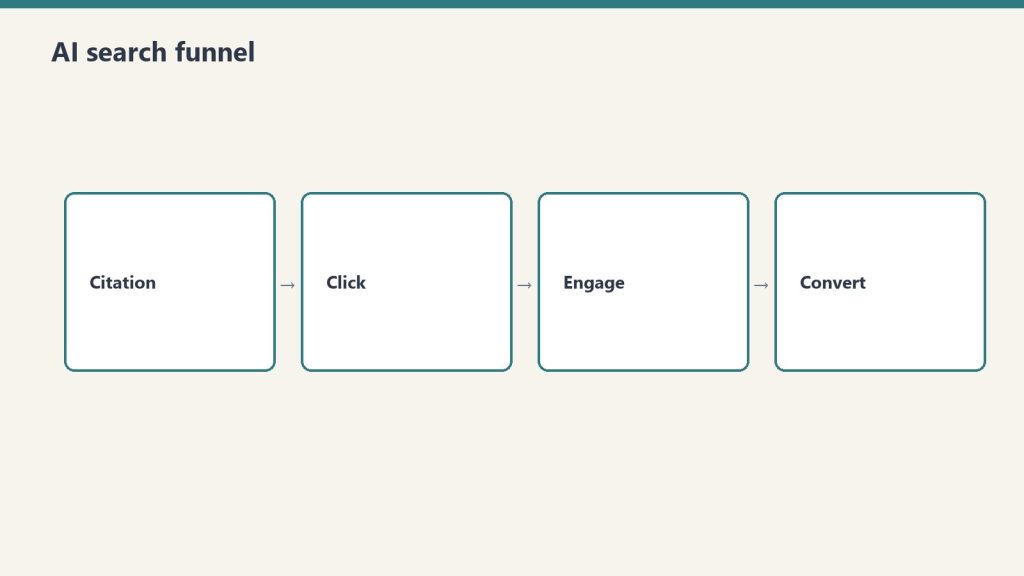
    Four-stage funnel: citation, click, engage, convert
    Why tracking ChatGPT and Perplexity citations is hard.

    Web search citation tracking is solved: rank trackers like Ahrefs and SEMrush show you who’s linking to what. AI citation tracking has no equivalent infrastructure. Here’s why:

    • Non-deterministic outputs: Ask ChatGPT the same question twice; you may get different sources cited, or no sources at all. There’s no persistent ranking to track.
    • No public citation index: Google’s index is crawlable. There’s no equivalent for “content that AI systems have cited in responses.” You can’t pull a report.
    • Variable source disclosure: Perplexity shows sources. ChatGPT’s web-enabled mode shows sources sometimes. Gemini shows sources. Claude generally doesn’t show sources in the same way. Tracking works where sources are disclosed; it breaks where they aren’t.
    • Query sensitivity: Your content might get cited for one phrasing and completely missed for a near-synonym. There’s no search volume data to tell you which phrasings matter.

    What Actually Exists Today
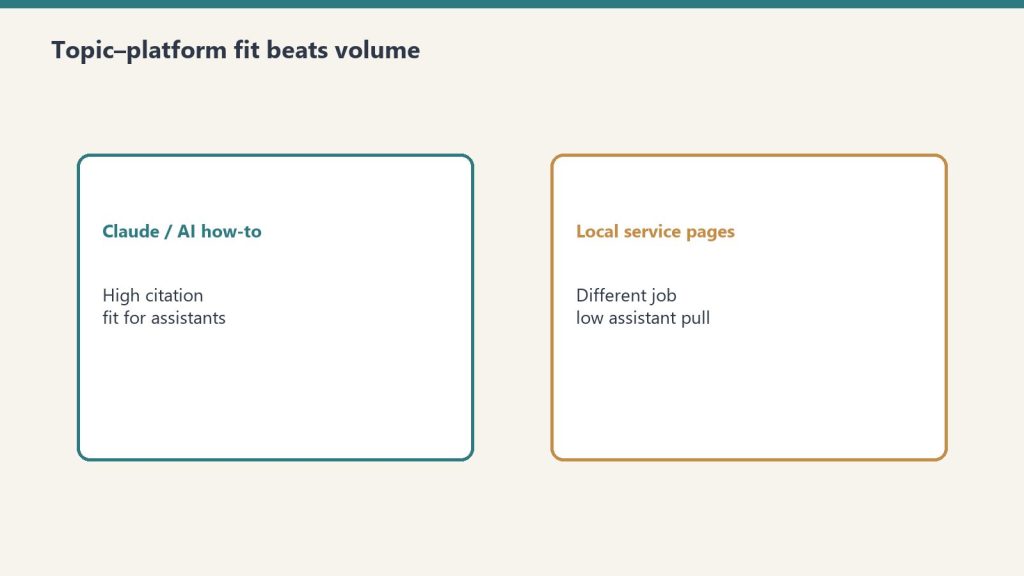
    Comparison of Claude how-to fit versus local service page fit for assistants
    What actually exists today for citation monitoring.

    Manual Query Sampling

    The only fully reliable method: run queries yourself and check the sources cited. For a content monitoring program this might look like:

    • Define 20–50 queries where you want to appear (covering your core topics)
    • Run each query in Perplexity, ChatGPT (web-enabled), and Gemini weekly or biweekly
    • Log whether your domain appears in cited sources
    • Track citation rate (appearances / total queries run) over time

    This is tedious but gives you ground truth. It’s what a real monitoring program looks like before you automate it.

    Perplexity Source Tracking

    Perplexity consistently displays its sources, making it the most tractable platform for systematic citation tracking. A simple automated approach:

    • Use Perplexity’s API to query your target questions programmatically
    • Parse the citations field in the response
    • Check whether your domain appears
    • Log and aggregate over time

    Perplexity’s API is available with a subscription. The citations field returns the URLs Perplexity used to generate its answer. You can run this as a scheduled Cloud Run job and dump results to BigQuery for trend analysis.

    ChatGPT Web Search Mode

    When ChatGPT uses web search (either via the browsing tool or search-enabled API), it returns source citations. The search-enabled ChatGPT API (available with OpenAI API access) gives you programmatic access to these citations. Same approach: define queries, run them, parse citations, track your domain.

    Limitation: not all ChatGPT responses use web search. For queries it answers from training data, no source is cited and you have no visibility into whether your content influenced the answer.

    Google AI Overviews

    Google AI Overviews (formerly SGE) shows cited sources inline in search results. You can track these through Google Search Console for your own content — if Google’s AI Overview cites your page, that page gets an impression and potentially a click recorded in GSC under that query. This is the only AI citation signal with first-party tracking infrastructure.

    Emerging Tools

    As of April 2026, several tools are building toward AI citation tracking as a category: mention monitoring services that have added AI search coverage, SEO platforms adding “AI visibility” metrics, and purpose-built tools targeting this specific problem. The category is forming but not mature. Verify current capabilities — this space has changed significantly in the past six months.

    What a Real Monitoring Setup Looks Like

    Desk with laptop, checklist notebook, and billing card ready before creating an Anthropic API key
    What a real monitoring setup looks like.

    Here’s the practical stack we’ve assembled for tracking citation presence across AI platforms:

    1. Define your query set: 30–50 queries across your core topic clusters. Weight toward queries where you have existing content and where you’re trying to establish authority.
    2. Perplexity API integration: Scheduled weekly run. Parse citations. Log domain appearances to a tracking spreadsheet or BigQuery table.
    3. ChatGPT web search sampling: Less systematic — manual sampling weekly for highest-priority queries. The API approach works but requires more engineering to handle variability in when web search activates.
    4. Google Search Console: Monitor AI Overview impressions. This is your strongest signal because it’s Google’s own data, not sampled queries.
    5. Baseline and trend: After 4–6 weeks of tracking, you have a baseline citation rate. Changes correlate (imperfectly) with content quality improvements, new publications, and competitor activity.

    What Citation Rate Actually Tells You

    Citation rate — your domain appearances divided by total queries sampled — is a proxy metric, not a direct ranking signal. What drives it:

    • Content freshness: AI systems prefer recently indexed, recently updated content for queries about current information
    • Structural clarity: Content with explicit Q&A structure, defined terms, and direct factual claims gets cited more reliably than narrative content
    • Domain authority signals: The same signals that help SEO rankings help AI citation rates — but the weighting may differ by platform
    • Entity specificity: Content that clearly establishes your brand as an entity with defined characteristics gets cited more consistently than generic content

    For the content optimization angle: AI Citation Monitoring Guide. For the broader GEO picture: What Managed Agents means for content visibility.

    Related on Tygart Media: citing sources SEO benefits · information density is the new SEO · category architecture that ranks.

    For the hosted agent infrastructure context: Claude Managed Agents Pricing Reference — how the billing works for agents that could automate citation monitoring workflows.

  • AEO, GEO, SEO Is the New Social Media

    AEO, GEO, SEO Is the New Social Media

    Related on Tygart Media: AEO content cluster · GEO tactics · SEO vs social impressions.

    Tygart Media Strategy
    Volume Ⅰ · Issue 04Quarterly Position
    By Will Tygart
    • Long-form Position
    • Practitioner-grade

    The Feed Changed. You Just Didn’t Notice.

    Comparison of Claude how-to fit versus local service page fit for assistants
    The feed changed — you just didn’t notice.

    Social media trained an entire generation of marketers to think in formats. Carousel or Reel. Thread or Story. 30 seconds or 60. Vertical or square. We built content calendars around what the algorithm wanted to see, not what the audience actually needed to know.

    That era is ending — not because social platforms are dying, but because the consumer sitting on the other side of the screen is changing. Increasingly, the first “person” to read your content isn’t a person at all. It’s an AI agent — a chatbot, an assistant, a search model — pulling information on behalf of someone who asked a question.

    And that changes everything about what “social” means.

    When the Consumer Is a Bot, the Format Doesn’t Matter

    The entire social media economy is built on format constraints. Instagram rewards visual-first. LinkedIn rewards text-heavy thought leadership with engagement bait hooks. TikTok rewards pace and pattern interrupts. Twitter rewards brevity and provocation. Every platform has its own grammar, its own algorithm, its own definition of “good content.”

    But when the consumer is an AI model — Claude, ChatGPT, Gemini, Perplexity, a Google AI Overview — format is irrelevant. What matters is the substance. The depth. The accuracy. The authority.

    An AI agent doesn’t care about your hook. It cares about whether your content actually answers the question its user asked. It doesn’t care about your carousel design. It cares about whether your claims are sourced, your entities are clear, and your expertise is demonstrable.

    This is what AEO, GEO, and SEO — the modern trifecta — actually represent. They aren’t just search optimization tactics. They are the new social media distribution layer.

    No-Click Impressions Are the New Likes

    Four-stage funnel: citation, click, engage, convert
    No-click impressions are the new likes.

    In the social media world, the metric that matters is the impression. Someone saw your post. If they liked it, they tapped a heart. If they really liked it, they commented or shared. That engagement signaled to the algorithm that your content was worth showing to more people.

    The same feedback loop now exists in AI-mediated search — it just looks different.

    When your website content appears in a Google AI Overview, that’s an impression. When Perplexity cites your page in an answer, that’s engagement. When ChatGPT recommends your business in response to a user query, that’s a referral. When someone reads an AI-generated summary of your expertise and then calls your office, that’s a conversion.

    The funnel is the same. The channel changed.

    And here’s the part most marketers are missing: you don’t need to chase a trend to earn these impressions. You don’t need to dance. You don’t need a hook. You need good information, structured well, written with genuine expertise, and optimized so AI systems can find it, trust it, and cite it.

    The Passion Advantage

    Social media has an alignment problem. The content that performs best on social platforms is often not the content the creator cares most about. It’s the content that matches the algorithm’s preferences. This creates a grinding misalignment — business owners and marketers spending hours producing content they don’t particularly care about, in formats they didn’t choose, for an audience they can’t directly reach.

    AEO/GEO/SEO flips that equation.

    When you write deep, authoritative website content about the thing you actually know — the thing you’ve spent years mastering — AI systems notice. They learn your expertise. They map your authority. And they start recommending you to people who are actively looking for exactly what you do.

    The data that learns you, learns them.

    That’s not a slogan. It’s how the technology works. Large language models build representations of entities — businesses, people, topics — based on the depth and consistency of the information available about them. The more you write about what you genuinely know, the stronger that representation becomes. The stronger it becomes, the more often AI systems surface you as the answer.

    This is the exact opposite of social media’s content treadmill. Instead of chasing what’s trending, you go deeper into what you already know. Instead of adapting to a platform’s format, you write for substance. Instead of fighting for attention, you earn citation.

    Website Content Is Now the Most Social Thing You Can Do

    Here’s the reframe that matters: your website is no longer a brochure. It’s your most important social channel.

    Every page you publish is a node in a knowledge graph that AI systems are actively reading, indexing, and reasoning about. Every article you write is a potential answer to a question someone hasn’t asked yet. Every entity you define, every claim you source, every FAQ you structure — these are the signals that determine whether your business shows up when someone asks an AI “who should I call for this?”

    Social media posts disappear in 24 hours. Website content compounds. A well-optimized article written today can be cited by AI systems for years. It doesn’t need an algorithm boost. It doesn’t need paid promotion. It needs to be right, and it needs to be findable.

    That’s what modern SEO, AEO, and GEO deliver — not tricks, not hacks, but the infrastructure that makes your expertise machine-readable and AI-citable.

    What This Means for Your Business

    Desk with laptop, checklist notebook, and billing card ready before creating an Anthropic API key
    What this means for your business.

    If you’re spending 80% of your marketing effort on social media and 20% on your website, you have the ratio backwards. The businesses that will dominate in an AI-mediated world are the ones investing in deep, authoritative web content — content that answers real questions, demonstrates genuine expertise, and is structured for the machines that are now the first readers of everything published online.

    The feed changed. The question is whether you’ll keep posting for an algorithm, or start publishing for the intelligence layer that’s replacing it.

  • Local AEO: Win AI Featured Snippets Competitors Miss

    Local AEO: Win AI Featured Snippets Competitors Miss

    Tygart Media / The Signal
    Broadcast Live
    Filed by Will Tygart
    • Tacoma, WA
    • Industry Bulletin

    Most local businesses compete on “best plumber in Austin” or “water damage restoration near me.” But answer engines reward a different kind of content. They want specific, quotable answers to questions that people actually ask. That’s where local AEO wins.

    The Local AEO Opportunity
    Perplexity and Claude don’t just rank businesses by distance and reviews. They rank by citation in answers. If you’re the source Perplexity quotes when answering “how much does water damage restoration cost?”, you get visibility that paid search can’t buy.

    And local AEO is less competitive than national. Everyone’s chasing national top 10 rankings. Almost nobody is optimizing for Perplexity citations in local verticals.

    The Quotable Answer Strategy
    AEO content needs to be quotable. That means:
    – Specific answers (not vague generalities)
    – Numbers and timeframes (“typically 3-7 days”)
    – Price ranges (“$2,000-$5,000 for standard water damage”)
    – Process steps (“Step 1: assessment, Step 2: mitigation…”)
    – Local context (“in North Texas, humidity speeds drying”)

    Generic content doesn’t get quoted. Specific, local, answerable content does.

    Content Types That Win in Local AEO
    Service Cost Guide: “Water Damage Restoration Cost in Austin: What to Expect in 2026”
    – Actual price ranges in Austin (vs. national average)
    – Breakdown of what factors affect cost
    – Comparison of premium vs. budget options
    – Timeline impact on pricing
    Result: Ranks in Perplexity for “water damage restoration cost Austin” queries

    Process Timeline: “Water Damage Restoration Timeline: Days 1-7, Week 2-3, Month 1”
    – Specific steps at specific timeframes
    – Local humidity/climate impact
    – What happens at each stage
    – When to expect mold concerns
    Result: Quoted when people ask “how long does water restoration take”

    Problem-Specific Guides: “Hardwood Floor Water Damage: Restoration vs. Replacement Decision”
    – When to restore vs. replace
    – Cost comparison
    – Timeline for each option
    – Success rates
    Result: Quoted when people research hardwood floor damage specifically

    Local Comparison Content: “Water Damage Restoration in Austin vs. Dallas: Regional Differences”
    – Climate differences (humidity, soil)r>- Cost differences
    – Timeline differences
    – Regional techniques
    Result: Ranks for “restoration Austin vs Dallas” type queries (people considering both areas)

    The Internal Linking Strategy
    Each content piece links to service pages and other authority content, creating a web:

    – Cost guide → Process timeline → Hardwood floor guide → Commercial damage guide → Service page
    – This signals to Google and Perplexity: “This is an authority cluster on water damage”

    The Review Generation Loop
    AEO content also drives reviews. When a prospect reads your detailed cost breakdown or timeline, they’re more informed. Informed customers become satisfied customers who leave better reviews. Those reviews feed back into Perplexity rankings.

    The SEO Bonus
    Content optimized for AEO also ranks well in Google. In fact, the AEO content pieces often outrank the local Google Business Profile for specific queries. You’re getting:
    – Google rankings (organic traffic)
    – Perplexity citations (AI engine traffic)
    – LinkedIn potential (if you share the content as thought leadership)
    – Social proof (highly cited content builds reputation)

    Real Results
    A local restoration client published:
    – “Water Damage Restoration Timeline” (2,500 words, specific local context)
    – “Cost Guide for Water Damage in Austin” (detailed breakdown)
    – “How We Assess Your Home for Water Damage” (process guide)

    Results (after 3 months):
    – Perplexity citations: 40+ per month
    – Google organic traffic: 2,200 monthly visitors
    – Phone calls from people who found the guide: 15-20/month
    – Average deal value: $4,500 (because informed customers are better quality)

    Why Competitors Aren’t Doing This
    – It takes 40-60 hours per content piece (slower than quick blog posts)
    – Requires local expertise (can’t outsource easily)
    – Doesn’t show results in analytics for 2-3 months
    – Requires understanding AEO principles (most agencies focus on SEO)
    – Most content agencies haven’t heard of AEO yet

    The Competitive Window
    We’re in a narrow window right now (2026) where local AEO is underdeveloped. In 12-18 months, everyone will be doing it. If you start now with detailed, quotable, local-specific content, you’ll be entrenched before competition arrives.

    How to Start
    1. Pick your top 3 search queries (“water damage cost,” “timeline,” “hardwood floors”)
    2. Write 2,500+ word guides that are specifically local and quotable
    3. Add FAQPage schema markup so Perplexity can pull Q&A pairs
    4. Internal link across your pieces
    5. Wait 3-4 weeks for Perplexity to crawl and cite
    6. Iterate based on which pieces get cited most

    The Takeaway
    Local businesses can compete on AEO with fraction of the budget that national companies spend on paid search. But you need specific, quotable, local-relevant content. Generic blog posts won’t get you there. Deep, detailed, answerable guides will.

    {
    “@context”: “https://schema.org”,
    “@type”: “Article”,
    “headline”: “AEO for Local Businesses: Featured Snippets Your Competitors Arent Chasing”,
    “description”: “Local AEO wins by publishing specific, quotable answers to local questions. Here’s how to build content that Perplexity cites instead of competing on loca”,
    “datePublished”: “2026-03-30”,
    “dateModified”: “2026-04-03”,
    “author”: {
    “@type”: “Person”,
    “name”: “Will Tygart”,
    “url”: “https://tygartmedia.com/about”
    },
    “publisher”: {
    “@type”: “Organization”,
    “name”: “Tygart Media”,
    “url”: “https://tygartmedia.com”,
    “logo”: {
    “@type”: “ImageObject”,
    “url”: “https://tygartmedia.com/wp-content/uploads/tygart-media-logo.png”
    }
    },
    “mainEntityOfPage”: {
    “@type”: “WebPage”,
    “@id”: “https://tygartmedia.com/aeo-for-local-businesses-featured-snippets-your-competitors-arent-chasing/”
    }
    }

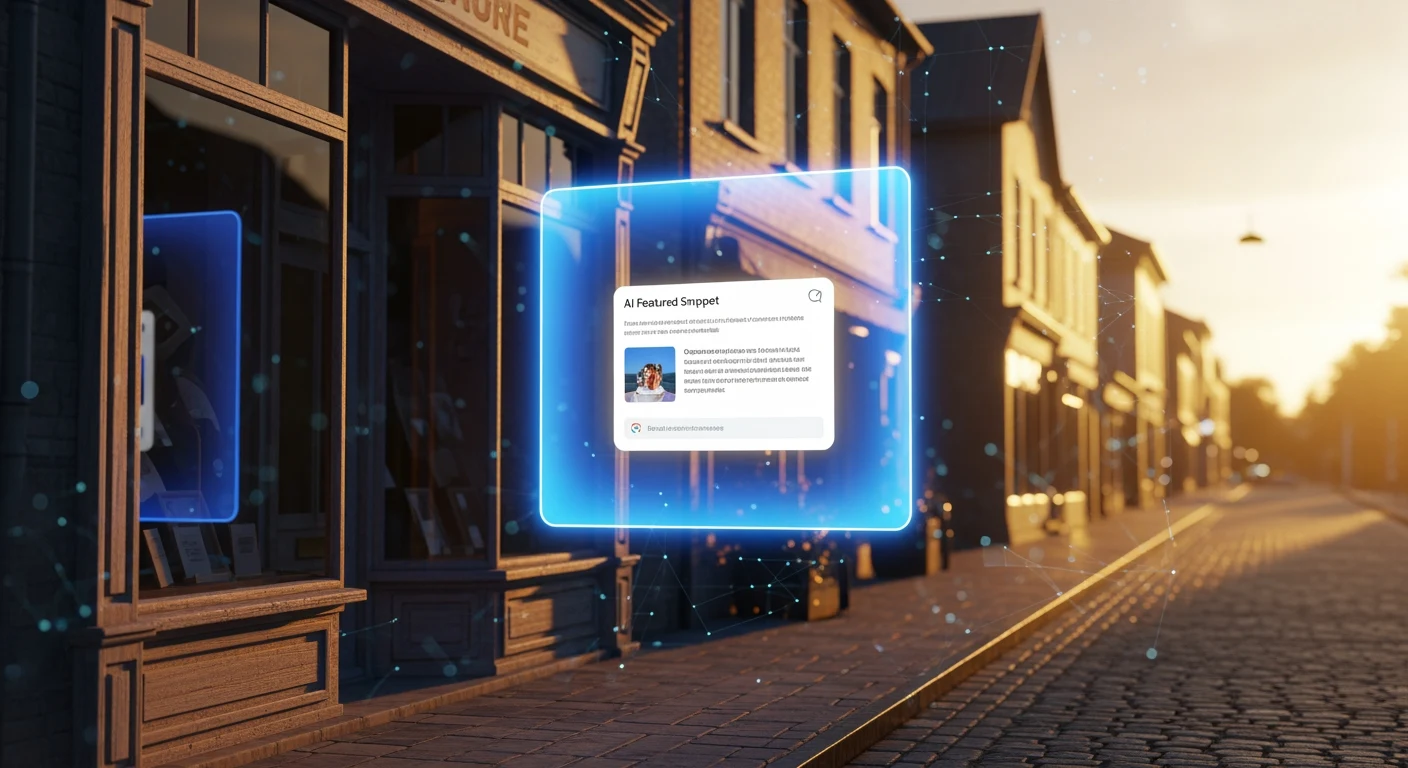
    Visual summary

    Aeo Local Businesses Snippets

    About this image. This image is part of the Article Hero Images collection in the Tygart Media visual library. Every image produced by Tygart Media is AI-generated using Google Vertex AI (Imagen), converted to WebP format, and injected with full IPTC/XMP metadata before publication.

    • Format: WEBP
    • Collection: Article Hero Images
    • Pipeline: Vertex AI Imagen → WebP → IPTC/XMP → WordPress