Tag: AI Search

  • Jared Kaplan: The Physicist Who Discovered AI Scaling Laws

    Jared Kaplan: The Physicist Who Discovered AI Scaling Laws

    Updated September 30, 2026.

    Claude AI · Fitted Claude

    Jared Kaplan is Anthropic’s co-founder and Chief Science Officer and the physicist who co-authored OpenAI’s 2020 scaling-laws paper, which showed language-model performance improves predictably with parameters, data, and compute. He also co-authored the GPT-3 paper, left OpenAI in 2021 with six colleagues to start Anthropic, and now leads science plus Responsible Scaling Policy release calls (including Claude 4). Forbes estimated his net worth at about $15.5 billion after Anthropic’s May 2026 funding round.

    Entity bios like this get compressed into AI answers; clean dates and citation-rate measurement matter as much as the headline.

    Academic background

    Physics first, then empirical laws for ML systems.

    Kaplan is a theoretical physicist with a Stanford BS and a Harvard PhD (2009, thesis on holography). He is an associate professor at Johns Hopkins University, on leave while at Anthropic. The through-line is compact laws for messy systems—quantum gravity first, language models second.

    The discovery that changed AI: scaling laws

    Compute, data, and model size tied to predictable loss improvements.

    In January 2020 Kaplan and colleagues at OpenAI published “Scaling Laws for Neural Language Models”. Cross-entropy loss improves as a power law when parameters, dataset size, and training compute grow—often across many orders of magnitude. Labs could estimate returns before a full cluster run.

    The paper underwrote the compute-heavy playbook behind GPT-4, Claude, and later frontier stacks. Later work added constraints (data quality, alignment cost), but the core bet—scale buys capability on a curve—still organizes capital in 2026.

    OpenAI years and GPT-3

    Kaplan joined OpenAI in 2019. He co-authored “Language Models are Few-Shot Learners” (2020)—the GPT-3 paper—and worked on early Codex-related research alongside Sam McCandlish, Tom Brown, Dario Amodei, and others who would co-found Anthropic.

    Co-founding Anthropic

    Seven OpenAI researchers founded Anthropic in 2021.

    Kaplan was one of seven OpenAI researchers who left in 2021 to found Anthropic. As Chief Science Officer he shapes Claude’s research direction. In October 2024 Anthropic named him responsible scaling officer for safety assessments under the Responsible Scaling Policy—work TIME cited when it put him on the TIME100 AI list for 2025 after his Claude 4 safety call.

    Washington and public policy

    CEO Dario Amodei has testified orally before Senate committees; Kaplan’s on-record policy work includes a December 2023 written statement to a Senate AI Insight Forum on risk and alignment, where he walked through scaling trends and Anthropic’s safety framing.

    Track how those sources surface in answers with an AI citation monitoring guide and LLM visibility measurement if you publish expert bios competitors scrape.

    Net worth and Forbes 400

    Forbes estimated Kaplan at roughly $3.7 billion in 2025, below that year’s Forbes 400 cutoff. After Anthropic’s $65 billion May 2026 round at about a $965 billion valuation, Forbes put each co-founder at about $15.5 billion, with Kaplan on the 2026 Forbes 400 tied near No. 75. See Forbes’s profile for the live estimate; reported IPO timing into late 2026 would move the number again.

    Why this profile matters for AI search

    Answer engines compress entity pages with primary links (OpenAI, Senate PDFs, Forbes, TIME) into one-line bios. Stale net-worth lines and vague “testified before Congress” wording drop out of GEO case studies. For citation mining on search surfaces, see the Bing citation mining experiment.

    Related on Tygart Media: Dario Amodei · Anthropic IPO · how to use Claude.

    Frequently Asked Questions

    What is Jared Kaplan known for?

    Jared Kaplan is best known for co-authoring AI scaling laws—the mathematical relationships that predict how language-model performance improves with more parameters, data, and training compute. His 2020 OpenAI paper “Scaling Laws for Neural Language Models” is widely treated as foundational for frontier model planning.

    What is Jared Kaplan’s role at Anthropic?

    Kaplan is Anthropic’s co-founder and Chief Science Officer. He also oversees Anthropic’s Responsible Scaling Policy process as the company’s responsible scaling officer, deciding safety assessments before major model releases.

    What is Jared Kaplan’s net worth?

    Forbes estimated Kaplan’s net worth at about $15.5 billion after Anthropic’s May 2026 funding round, when he joined the Forbes 400. Estimates move with private-market valuations and can change quickly.

    Did Jared Kaplan work at OpenAI?

    Yes. Kaplan joined OpenAI in 2019 and co-authored “Scaling Laws for Neural Language Models” (2020) and “Language Models are Few-Shot Learners” (2020), the paper behind GPT-3. He left with six colleagues to co-found Anthropic in 2021.

    What are AI scaling laws?

    Scaling laws are empirical power-law relationships showing that language-model loss improves smoothly as you scale model size, dataset size, and compute. Kaplan’s team showed labs could forecast capability gains before spending full training budgets—a logic that still drives frontier training in 2026.

    What is Jared Kaplan’s academic background?

    Kaplan trained as a theoretical physicist. He earned a PhD in physics from Harvard University in 2009 and is an associate professor at Johns Hopkins University (on leave while at Anthropic).



    Need this set up for your team?
    Talk to Will →

  • AI Agents vs Chatbots & Automations: Key Differences

    AI Agents vs Chatbots & Automations: Key Differences

    These terms get used interchangeably. They’re not the same thing. Here’s the actual distinction between each one, where the lines get genuinely blurry, and which category fits what you’re actually trying to build.

    Chatbots

    A chatbot is a software interface designed to simulate conversation. The defining characteristic: it’s stateless and reactive. You send a message; it responds; the exchange is complete. Each interaction is largely independent.

    Traditional chatbots (pre-LLM) operated on decision trees — “if the user says X, respond with Y.” Modern LLM-powered chatbots use language models to generate responses, which makes them dramatically more capable and flexible — but the fundamental architecture is the same: you ask, it answers, you ask again.

    What chatbots are good at: answering questions, providing information, routing conversations, handling defined service scenarios with natural language flexibility. What they’re not: action-takers. A chatbot can tell you how to cancel your subscription. An agent can cancel it.

    Automations

    Automations are rule-based workflows that execute when triggered. Zapier, Make, and similar tools are the canonical examples. When event A happens, do B, then C, then D.

    The key characteristic: the path is predefined. Every step is specified by the person who built the automation. If an unexpected situation arises that the automation wasn’t built for, it either fails or skips the step. There’s no reasoning about what to do — there’s only executing the specified path or not.

    Automations are highly reliable for well-defined, stable processes. They break when edge cases arise that weren’t anticipated. They scale perfectly for the exact task they were built for; they don’t generalize.

    APIs

    An API (Application Programming Interface) is a communication contract — a defined way for software systems to talk to each other. APIs are infrastructure, not agents or automations. They’re the mechanism through which agents and automations take action in external systems.

    When an AI agent “uses Slack,” it’s calling Slack’s API. When an automation “posts to Twitter,” it’s calling Twitter’s API. The API is the door; agents and automations are the things that open it.

    Conflating APIs with agents is a category error. An API is a tool, not a behavior pattern.

    AI Agents

    An AI agent takes a goal and figures out how to accomplish it, using tools available to it, handling unexpected situations along the way, without a human specifying each step.

    The distinguishing characteristics versus the above:

    • vs. Chatbots: Agents take action in the world; chatbots respond to messages. An agent can book the flight, not just tell you how to book it.
    • vs. Automations: Agents reason about what to do next; automations execute predefined paths. When an unexpected situation arises, an agent adapts; an automation fails or skips.
    • vs. APIs: APIs are tools an agent uses; they’re not the agent itself. The agent is the reasoning layer that decides which API to call and what to do with the result.

    Where the Lines Actually Blur

    In practice, real systems often combine these categories:

    LLM-powered chatbots with tool access: A customer service chatbot that can look up your order status, initiate a return, and send a confirmation email is starting to look like an agent — it’s taking actions, not just responding. The boundary between “advanced chatbot” and “limited agent” is genuinely fuzzy.

    Automations with AI decision steps: A Zapier workflow with an OpenAI or Claude step in the middle isn’t purely rule-based anymore — the AI step can produce variable outputs that affect what the automation does next. This is a hybrid: mostly automation, partly agentic.

    Agents with constrained scopes: An agent restricted to a single tool and a narrow task class starts to look like a sophisticated automation. The more constrained the scope, the more the distinction collapses in practice.

    The useful question isn’t “what category is this?” but “is this system reasoning about what to do, or executing a predefined path?” That’s the actual distinction that matters for how you build, monitor, and trust it.

    Why the Distinction Matters Operationally

    Reliability profile: Automations fail predictably — when an edge case hits a path that wasn’t built. Agents fail unpredictably — when their reasoning goes wrong in a way you didn’t anticipate. Different failure modes require different monitoring approaches.

    Maintenance overhead: Automations require explicit updates when processes change. Agents adapt to process changes automatically — but may adapt in unexpected ways that need to be caught and corrected.

    Auditability: Automations are fully auditable — you can read the workflow and know exactly what it does. Agents are less auditable — you can inspect their actions, but not fully predict them in advance. For compliance-sensitive contexts, this matters significantly.

    Build cost: Automations are faster to build for well-defined, stable processes. Agents are faster to deploy when the process is complex, variable, or not fully specified — because you’re specifying a goal rather than a procedure.

    For what agents can actually do in production: What AI Agents Actually Do. For a business owner’s introduction: AI Agents Explained for Business Owners. For hosted agent infrastructure: Claude Managed Agents FAQ.


    Hosted agent infrastructure pricing: Claude Managed Agents Pricing Reference.

  • What AI Agents Do: Real Production Examples Explained

    What AI Agents Do: Real Production Examples Explained

    Not the version where AI agents are going to replace all human jobs by 2030. The actual version, right now, based on what’s deployed in production.

    The Actual Definition

    What an AI agent is

    Software that takes a goal, breaks it into steps, uses tools to execute those steps, handles errors along the way, and keeps working without you directing every action. The distinguishing characteristic is autonomous multi-step execution — not just answering a question, but completing a task.

    The Key Distinction: One-Shot vs. Agentic

    Most people’s experience with AI is one-shot: you type something, the AI responds, the exchange is complete. That’s a language model doing inference. An AI agent is different in one specific way: it takes actions, checks results, and takes more actions based on what it found — often dozens of steps — without you approving each one.

    Example of one-shot AI: “Summarize this document.” You paste the document, the AI returns a summary. Done.

    Example of an AI agent doing the same task: “Research this topic and produce a summary with verified sources.” The agent searches the web, reads multiple pages, identifies conflicts between sources, runs additional searches to resolve them, synthesizes findings, and returns a summary with citations — without you specifying each search query or each page to read. You gave it a goal; it handled the steps.

    What Agents Can Actually Do

    The tools an agent can use define its capability surface. Common tool categories in production agents:

    • Web search: Query search engines and retrieve current information
    • Code execution: Write and run code in a sandboxed environment, use results to inform next steps
    • File operations: Read, write, and modify files — documents, spreadsheets, data files
    • API calls: Interact with external services — CRMs, databases, project management tools, communication platforms
    • Browser control: Navigate web pages, fill forms, extract information
    • Memory: Store and retrieve information across steps within a session, sometimes across sessions

    The combination of these tools is what makes agents capable of genuinely autonomous work. An agent that can search, write code, execute it, check the results, and write findings to a document can complete a research and analysis task that would otherwise require hours of human work — without you steering each step.

    What “Autonomous” Actually Means in Practice

    Autonomous doesn’t mean unsupervised indefinitely. Production agents are typically configured with:

    • Defined scope: The tools the agent can use, the systems it can access, the actions it’s allowed to take
    • Guardrails: Actions that require human confirmation before proceeding — making a payment, sending an email externally, modifying a production database
    • Reporting: Checkpoints where the agent surfaces what it’s done and asks whether to continue

    Autonomy is a dial, not a switch. You set how much the agent handles independently versus checks in. Most production deployments start more supervised and reduce oversight as trust in the agent’s behavior is established.

    Real Production Examples (Not Hypotheticals)

    Concrete examples from confirmed public deployments as of April 2026:

    • Rakuten: Deployed five enterprise Claude agents in one week on Anthropic’s Managed Agents platform — handling tasks across their e-commerce operations including data processing, content tasks, and operational workflows
    • Notion: Background agents that autonomously update workspace pages, synthesize database content, and process meeting notes into structured summaries without manual triggers
    • Sentry: Agents integrated into developer workflows — monitoring error streams, triaging issues, and surfacing relevant context to engineers
    • Asana: Project management agents that update task statuses, synthesize project health, and move work items based on defined triggers

    These are not pilots. These are production systems handling real operational load.

    How They’re Built

    An agent is built from three components:

    1. A language model: The reasoning layer — the part that decides what to do next, interprets tool results, and determines when the task is complete
    2. Tools: The action layer — APIs, code execution environments, file systems, or anything else the model can call to take action in the world
    3. Orchestration: The loop that connects them — manages the sequence of model calls and tool executions, maintains state between steps, handles errors

    Historically, builders had to construct the orchestration layer themselves — a significant engineering investment. Hosted platforms like Claude Managed Agents handle the orchestration layer, letting builders focus on defining the agent’s goals, tools, and guardrails rather than the mechanics of running the loop.

    What Agents Are Not Good At (Yet)

    Honest calibration on current limitations:

    • Long-horizon planning with many unknowns: Agents perform best on tasks with relatively defined scope. Open-ended exploratory work over many days with fundamentally uncertain requirements is still better handled by humans in the loop at each major decision point.
    • Tasks requiring physical world interaction: No production general-purpose physical agent exists. Software agents operating through APIs and interfaces are the current state.
    • Tasks where errors are catastrophic: Agents make mistakes. For any irreversible, high-stakes action — financial transactions, production data modifications, external communications to important relationships — human confirmation steps should remain in the loop.

    For how hosted agent infrastructure works: Claude Managed Agents FAQ. For the difference between agents and chatbots: AI Agents vs. Chatbots, Automations, and APIs. For an SMB-focused explanation: AI Agents Explained for Business Owners.


    For pricing specifics on hosted agent infrastructure: Claude Managed Agents Complete Pricing Reference.

  • AI Citation Optimization: How to Get Cited by AI Systems

    AI Citation Optimization: How to Get Cited by AI Systems

    Tygart Media / Content Strategy
    The Practitioner JournalField Notes
    By Will Tygart
    · Practitioner-grade
    · From the workbench

    Being cited by AI systems is not luck and it’s not purely a domain authority game. There are structural characteristics of content that make AI systems more or less likely to pull from it. Here’s what those characteristics are and how to build them in deliberately.

    Why Content Structure Determines Citation Likelihood

    AI systems — whether Perplexity, ChatGPT with web search, or Google AI Overviews — are trying to answer a question. When they search the web and retrieve candidate content, they’re looking for the passage or page that most directly and reliably answers the query. The content that wins is the content that makes the answer easiest to extract.

    This has direct structural implications. A 3,000-word narrative essay that eventually answers a question on page 2 loses to a 600-word page that answers the question in the first paragraph, provides supporting evidence, and includes a definition. Not because shorter is better, but because clarity of answer placement is better.

    The Structural Characteristics That Drive Citation

    1. Direct Answer in the First 100 Words

    Every piece of content you want AI systems to cite should answer the primary question it’s targeting before the first scroll. AI retrieval systems don’t read like humans — they identify the most relevant passage, and that passage needs to contain the answer, not just lead toward it.

    Test: take your target query and your first 100 words. Does the answer exist in those 100 words? If not, restructure until it does. The rest of the piece can develop nuance, context, and supporting evidence — but the answer must be front-loaded.

    2. Explicit Q&A Formatting

    Question-and-answer structure signals to AI systems that the content is explicitly organized around answering queries. H3 headers phrased as questions, followed by direct answers, are one of the most reliable patterns for citation capture.

    This is why FAQ sections work — not because of FAQPage schema specifically, but because the underlying structure gives AI systems a clean extraction target. Schema reinforces it; the structure is the foundation.

    3. Defined Terms and Named Concepts

    Content that defines terms clearly — “X is Y” statements — becomes citable for queries looking for definitions. AI systems frequently answer “what is X” queries by pulling the clearest definition they can find. If your content doesn’t include a crisp definitional sentence, it’s not competing for definition queries even if you’ve written a thorough treatment of the topic.

    Add definition boxes. State “AI citation rate is the percentage of sampled AI queries where your domain appears as a cited source.” Don’t bury the definition in the third paragraph of an explanation.

    4. Specific, Verifiable Facts

    AI systems weight specificity. “$0.08 per session-hour” gets cited. “A relatively modest fee” does not. “60 requests per minute for create endpoints” gets cited. “Limited rate limits apply” does not.

    Replace hedged language with concrete numbers and specific claims wherever your content supports it. Don’t fabricate specificity — wrong specific numbers are worse than honest hedging. But wherever you have real, verifiable data, make it explicit and prominent.

    5. Entity Clarity

    Content that makes clear who is speaking, what organization they represent, and what their basis for authority is gets cited more reliably. This is the E-E-A-T signal applied to AI citation: the system needs to assess whether this source is credible enough to cite.

    Name the author. State the organization. Link to primary sources. Include dates on time-sensitive claims (“as of April 2026”). These signals tell the AI system this content has an accountable source, not anonymous text.

    6. Freshness on Time-Sensitive Topics

    For any topic where recency matters — product pricing, regulatory status, current events — AI systems heavily weight recently indexed, recently updated content. A page published April 2026 beats a page published January 2025 for queries about current status, even if the older page has higher domain authority.

    Update time-sensitive content. Add “last updated” dates. Re-publish with fresh timestamps when the underlying facts change. Freshness signals are real citation drivers for volatile topic areas.

    7. Speakable and Structured Data Markup

    Speakable schema explicitly marks the passages in your content best suited for AI extraction. It’s a direct signal to AI retrieval systems: “this paragraph is the answer.” Combined with FAQPage schema, Article schema, and HowTo schema where relevant, structured markup makes your content more parseable.

    Schema doesn’t replace the underlying structure — it reinforces it. A well-structured page with schema beats a poorly structured page with schema. But a well-structured page with schema beats a well-structured page without it.

    8. Internal Link Architecture

    AI systems that crawl the web assess topical depth partly through link structure. A page that sits within a tight cluster of related pages — all cross-linking around a topic — signals topical authority more strongly than an isolated page, even if the isolated page’s content is comparable.

    Build the cluster. The hub-and-spoke architecture is as relevant for AI citation as it is for traditional SEO. Every spoke article should link to the hub; the hub should link to every spoke.

    What Doesn’t Work

    A few patterns that are intuitively appealing but don’t translate to citation lift:

    • More content for its own sake: 5,000 words of padded content is not more citable than 900 words of dense, accurate content. AI retrieval is looking for passage quality, not page length.
    • Keyword density: Traditional keyword repetition strategies don’t make content more citable. The query match is handled at retrieval; the citation decision is about answer quality, not keyword frequency.
    • Generic authority claims: “We’re the leading experts in X” is not citable. A specific data point that demonstrates expertise is.

    The Compound Effect

    These characteristics compound. A page with a direct front-loaded answer, Q&A structure, defined terms, specific facts, clear entity signals, fresh timestamps, and schema markup sitting within a well-linked cluster is materially more citable than a page with only two or three of these characteristics. The full stack produces disproportionate results.

    For the monitoring layer: How to Track When AI Systems Cite You. For the metrics: What Is AI Citation Rate?. For the full citation monitoring guide: AI Citation Monitoring Guide.


    For the infrastructure layer: Claude Managed Agents Pricing Reference | Complete FAQ Hub.

  • AI Citation Monitoring Tools — What Exists, What Doesn’t, What We Built

    AI Citation Monitoring Tools — What Exists, What Doesn’t, What We Built

    The Lab · Tygart Media
    Experiment Nº 570 · Methodology Notes
    METHODS · OBSERVATIONS · RESULTS

    You want to monitor whether AI systems are citing your content. What tools actually exist for this, what they do, what they don’t do, and what we’ve built ourselves when nothing on the market fit.

    The Market as of April 2026

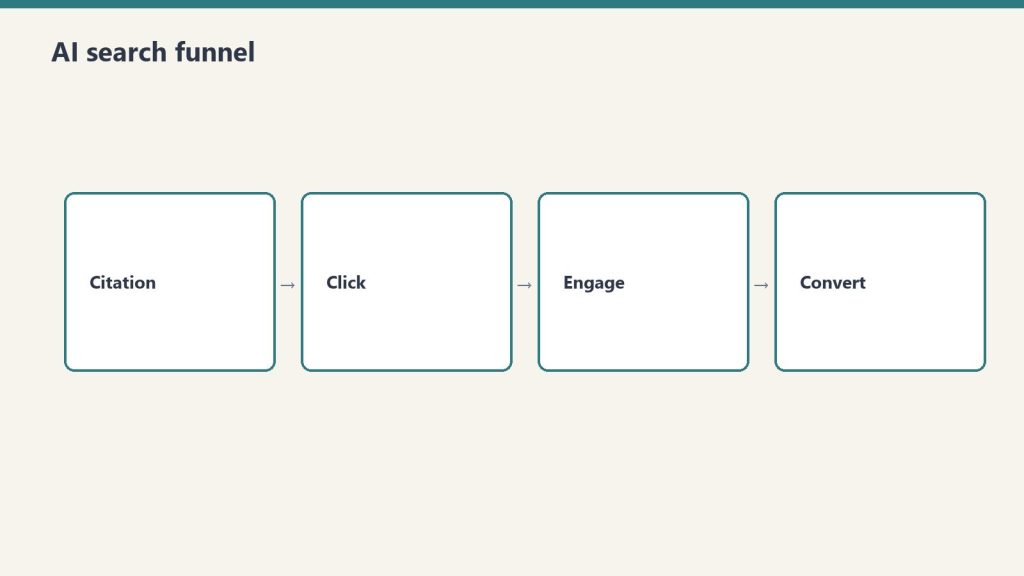
    Four-stage funnel: citation, click, engage, convert
    The market as of April 2026.

    The AI citation monitoring category is real but nascent. Here’s an honest inventory:

    Established SEO Platforms Adding AI Visibility Metrics

    Several major SEO platforms have added “AI visibility” or “AI search” modules in the past 6–12 months. These generally track:

    • Whether your domain appears in AI Overviews for tracked keywords (via SERP scraping)
    • Brand mentions in AI-generated snippets
    • Comparative visibility versus competitors in AI search results

    Ahrefs, Semrush, and Moz have all moved in this direction to varying degrees. Verify current feature availability — this has been an active development area and capabilities have changed rapidly.

    Mention Monitoring Tools Expanding to AI

    Brand mention tools like Brand24 and Mention have begun tracking AI-generated content that includes brand references. The challenge: they’re tracking brand name occurrences in crawled content, not necessarily AI citation events. Useful for brand visibility in AI-generated content that gets published, less useful for tracking in-session citations.

    Purpose-Built AI Citation Tools (Emerging)

    Several purpose-built tools targeting AI citation tracking specifically have launched or raised funding in early 2026. This category is moving fast. As of our last check:

    • Tools focused on tracking specific brand or entity mentions across AI platforms
    • API-first tools targeting developers who want to build citation monitoring into their own workflows
    • Dashboard tools with pre-built query sets for common industry categories

    Treat any specific product recommendation here as a starting point for your own research — the category will look different in 6 months.

    Google Search Console

    The strongest existing tool, and it’s free. AI Overviews that cite your pages register as impressions and clicks in GSC under the relevant queries. This is first-party data from Google itself. Limitation: covers only Google AI Overviews, not Perplexity, ChatGPT, or other platforms.

    What We Built

    Desk with laptop, checklist notebook, and billing card ready before creating an Anthropic API key
    What we built.

    When no existing tool covered the specific workflows we needed, we built our own. The stack:

    Perplexity API Query Runner

    A Cloud Run service that runs a predefined query set against Perplexity’s API on a weekly schedule. It parses the citations field from each response, checks for domain appearances, and writes results to a BigQuery table. Total engineering time: roughly one day. Ongoing cost: minimal (Cloud Run idle cost + Perplexity API usage).

    The output: a weekly BigQuery record per query showing which domains Perplexity cited, with timestamps. Trend queries show citation rate over time by query cluster.

    GSC AI Overview Monitor

    Not a custom build — just systematic review of GSC data. We check weekly which queries are generating AI Overview impressions for our tracked sites. The signal: if a page is generating AI Overview impressions on new queries, that’s a citation event.

    Manual ChatGPT Sampling

    For highest-priority queries, manual weekly sampling of ChatGPT with web search enabled. We log results to a shared spreadsheet. Less scalable than the API approach, but ChatGPT’s web search activation is inconsistent enough that API automation adds complexity without proportional reliability gain.

    What Doesn’t Exist (That Would Be Useful)

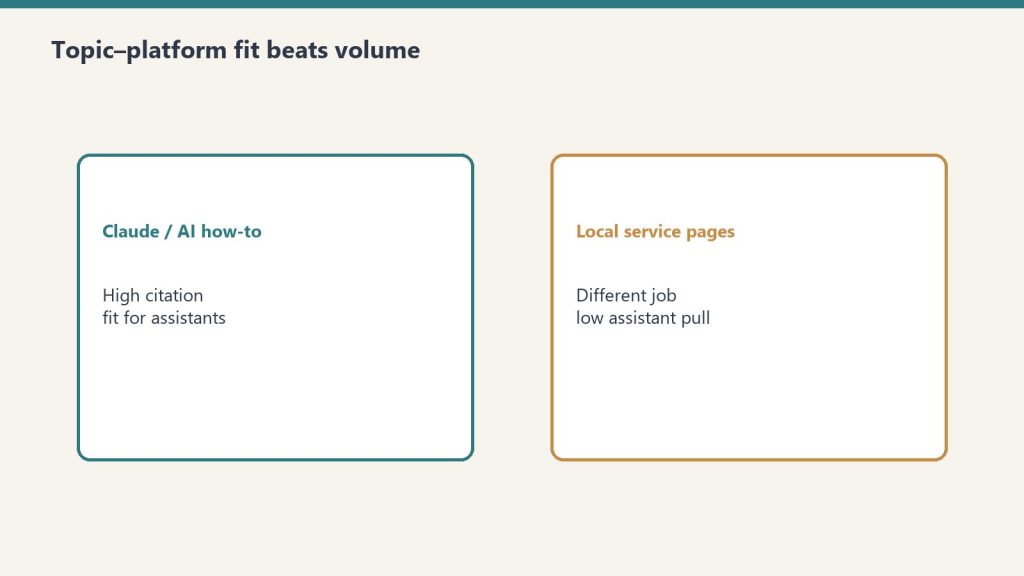
    Comparison of Claude how-to fit versus local service page fit for assistants
    What doesn’t exist that would be useful.

    The tool gaps that we still feel:

    • Cross-platform citation dashboard: A single view showing citation rate across Perplexity, ChatGPT, Gemini, and AI Overviews for the same query set. Nobody has built this cleanly yet.
    • Historical citation rate database: Knowing your citation rate is useful. Knowing whether it improved after you published a new piece of content is more useful. The temporal correlation is hard to establish with spot-check sampling.
    • Competitor citation tracking at scale: Easy to check manually for specific queries; hard to monitor systematically across a large competitor set and query space.

    These gaps exist because the category is new, not because the problems are technically hard. Expect the tool landscape to fill in significantly over the next 12 months.

    How to calculate citation rate: What Is AI Citation Rate?. How to set up tracking: How to Track When ChatGPT or Perplexity Cites Your Content. How to optimize for citations: How to Write Content That AI Systems Cite.

    Related on Tygart Media: AI citation monitoring guide · track citations · citing sources.


    The Perplexity API monitoring stack we built runs on Claude. For the hosted infrastructure context: Claude Managed Agents Pricing Reference | Complete FAQ.

  • What Is AI Citation Rate? (And How to Calculate Yours)

    What Is AI Citation Rate? (And How to Calculate Yours)

    Updated September 30, 2026.

    Updated October 30, 2026: Added The Citation Rate Workbook — a $7 workbook that works this page’s method end-to-end, with the worksheet to measure your own brand’s citation rate.

    Citation rate for AI-generated responses: (queries in your sample where the model cited your domain or URL) ÷ (total queries you sampled) × 100. That is a rate you own. Bing Webmaster Tools AI Performance reports total citations, page-level counts, and—since the June 2026 preview—Citation Share, Intents, Topics, and Compare for grounding queries. None of those Bing numbers is your sampled rate until you pick a denominator.

    Direct Answer: AI citation rate is cited queries divided by sampled queries, times 100, measured per platform. Bing’s total citations measure volume; Citation Share is your site’s percentage of all citations shown for one grounding query—not the same fraction. Define 20–100 target queries, log cited yes/no, then track the line after you refresh content on the URL that already earns citations.

    Definition

    AI citation rate

    The percentage of sampled AI queries where a specific domain or URL appears as a cited source.

    Formula: (queries where your domain or URL appeared as a source) ÷ (total queries sampled) × 100

    This is observational math on a sample you control. It is not a ranking, a traffic metric, or Bing’s Citation Share.

    Citations vs citation rate (the Bing trap)

    Microsoft clarified the AI Performance vocabulary in 2026. Treat each metric as a different question.

    • Total citations — how often your URLs were shown as sources in AI answers across Copilot, Bing AI summaries, and supported partner surfaces in the date range you select.
    • Citation Share — your citations for a specific grounding query divided by all citations shown for that same query, times 100. High volume can still mean low share when many domains split the citation space.
    • Grounding query — the phrase Bing associates with retrieval that led to citations. Use it to cluster your manual sample, not as a substitute for running the sample.
    • Citation rate (yours) — cited queries in your log ÷ queries you actually ran (or a defined export window you label) × 100.

    For how to read the dashboard without treating citations as clicks, see how to read Bing Webmaster Tools AI citations. For ongoing logging across ChatGPT, Claude, Perplexity, and AI Overviews, use the AI citation monitoring guide.

    How to calculate it

    1. Define the sample

    Pick 20–100 queries that match how you win work—not vanity prompts. Sample separately on Perplexity, ChatGPT with browsing/search enabled, Google AI Overviews, and Bing/Copilot. Do not blend platforms into one headline rate.

    2. Log every run

    Record query text, platform, date, cited yes/no, exact URL cited vs domain-only mention, and which competitor URL appeared if you were absent. A spreadsheet is enough; the discipline is what matters.

    3. Compute and segment

    Rate = cited ÷ sampled × 100, by platform and by query cluster (service + geo, software comparison, pricing, etc.). Pair the rate with LLM visibility measurement so you see mentions that never become footnotes.

    4. Baseline, then patch in place

    Run a 4–6 week baseline, then measure the delta after you update the slug that already has citation history. Do not mint a twin URL for the same intent—RE-BITE pages keep their addresses for a reason. When citations stall after a quiet period, check whether crawlers are seeing the refresh; our IndexNow speed test compares how fast Bing, Google, and GPT-oriented crawlers pick up a changed URL.

    Worked example (Tygart Media, Bing export)

    In a trailing ~30-day Bing AI Performance export pulled 9 September 2026, this domain showed 913 grounding queries and about 126,700 total citations. On the grounding family around “citation rate calculation AI-generated responses,” one line read 11,123 citations at 34.06% Citation Share. Share describes Bing’s slice for that query; it is not the cited ÷ sampled rate from a manual audit. Re-pull your own window in Bing—counts move with demand, model updates, and partner refresh cycles.

    Reading the method is step one. Running it on your own brand is the job.

    The Citation Rate Workbook works the formula end-to-end with real numbers, keeps citations and citation rate separated on one page, walks the Bing AI Performance exports step by step, and gives you the log sheet to measure your own brand’s rate with the same method — plus what a good rate honestly looks like, from observed data, not promises.

    Get the Workbook — $7

    Delivered right after checkout — your download opens automatically.

    Vertical example: a $1–10M restoration shop

    Do not use Tygart Media’s software-pricing Citation Share as the shop’s KPI. Sample the ~20 queries that mirror dispatch: “water damage restoration [city],” Xactimate supplement disputes, emergency dry-out vs rebuild scope. Count whether the contractor domain, Google Business Profile, or a managed spoke was cited. One citation on a generic AI tooling query is not a booked job. Patterns from GEO case studies show lifts when answer boxes match how estimators and adjusters actually ask questions—not when marketing copies SaaS keywords.

    When a citation does convert, model value with calculating the value of an AI citation and tie outcomes to restoration job profitability dashboards instead of citation counts alone.

    FAQ

    How do you calculate citation rate for AI-generated responses?
    Cited queries ÷ sampled queries × 100. Run the math separately for each platform and query cluster.

    Is a Bing AI Performance citation count a citation rate?
    No. Total citations are a volume count. Citation Share is your site’s share of citations for one grounding query. Your rate still needs a denominator you choose.

    What is the difference between citation share and citation rate?
    Citation Share is Bing’s fraction of all citations shown for a single grounding query that went to your domain. Citation rate is your cited-query count divided by a sample you ran (or defined), times 100.

    What is a good AI citation rate?
    There is no published benchmark. Track your own line after content and structure changes.

    Should I combine ChatGPT, Perplexity, and Google AI Overviews into one rate?
    No. Each system picks sources differently. A blended rate hides where you are actually winning or losing.

    How often should I recalculate citation rate?
    Baseline for 4–6 weeks, then recalculate after you patch a ranking slug or publish a material update—not daily.

  • How to Track When ChatGPT or Perplexity Cites Your Content

    How to Track When ChatGPT or Perplexity Cites Your Content

    Tygart Media Strategy
    Volume Ⅰ · Issue 04Quarterly Position
    By Will Tygart • Long-form Position • Practitioner-grade

    ChatGPT cited a competitor’s blog post instead of yours. Perplexity summarized the wrong article. An AI answer engine described your service category without mentioning you. You’d like to know when this happens — and whether it’s improving over time.

    The problem: no one has built a clean, turnkey tool for this yet. Here’s what actually exists, what we’ve pieced together, and what a real tracking setup looks like.

    Why This Is Hard

    Four-stage funnel: citation, click, engage, convert
    Why tracking ChatGPT and Perplexity citations is hard.

    Web search citation tracking is solved: rank trackers like Ahrefs and SEMrush show you who’s linking to what. AI citation tracking has no equivalent infrastructure. Here’s why:

    • Non-deterministic outputs: Ask ChatGPT the same question twice; you may get different sources cited, or no sources at all. There’s no persistent ranking to track.
    • No public citation index: Google’s index is crawlable. There’s no equivalent for “content that AI systems have cited in responses.” You can’t pull a report.
    • Variable source disclosure: Perplexity shows sources. ChatGPT’s web-enabled mode shows sources sometimes. Gemini shows sources. Claude generally doesn’t show sources in the same way. Tracking works where sources are disclosed; it breaks where they aren’t.
    • Query sensitivity: Your content might get cited for one phrasing and completely missed for a near-synonym. There’s no search volume data to tell you which phrasings matter.

    What Actually Exists Today

    Comparison of Claude how-to fit versus local service page fit for assistants
    What actually exists today for citation monitoring.

    Manual Query Sampling

    The only fully reliable method: run queries yourself and check the sources cited. For a content monitoring program this might look like:

    • Define 20–50 queries where you want to appear (covering your core topics)
    • Run each query in Perplexity, ChatGPT (web-enabled), and Gemini weekly or biweekly
    • Log whether your domain appears in cited sources
    • Track citation rate (appearances / total queries run) over time

    This is tedious but gives you ground truth. It’s what a real monitoring program looks like before you automate it.

    Perplexity Source Tracking

    Perplexity consistently displays its sources, making it the most tractable platform for systematic citation tracking. A simple automated approach:

    • Use Perplexity’s API to query your target questions programmatically
    • Parse the citations field in the response
    • Check whether your domain appears
    • Log and aggregate over time

    Perplexity’s API is available with a subscription. The citations field returns the URLs Perplexity used to generate its answer. You can run this as a scheduled Cloud Run job and dump results to BigQuery for trend analysis.

    ChatGPT Web Search Mode

    When ChatGPT uses web search (either via the browsing tool or search-enabled API), it returns source citations. The search-enabled ChatGPT API (available with OpenAI API access) gives you programmatic access to these citations. Same approach: define queries, run them, parse citations, track your domain.

    Limitation: not all ChatGPT responses use web search. For queries it answers from training data, no source is cited and you have no visibility into whether your content influenced the answer.

    Google AI Overviews

    Google AI Overviews (formerly SGE) shows cited sources inline in search results. You can track these through Google Search Console for your own content — if Google’s AI Overview cites your page, that page gets an impression and potentially a click recorded in GSC under that query. This is the only AI citation signal with first-party tracking infrastructure.

    Emerging Tools

    As of April 2026, several tools are building toward AI citation tracking as a category: mention monitoring services that have added AI search coverage, SEO platforms adding “AI visibility” metrics, and purpose-built tools targeting this specific problem. The category is forming but not mature. Verify current capabilities — this space has changed significantly in the past six months.

    What a Real Monitoring Setup Looks Like

    Desk with laptop, checklist notebook, and billing card ready before creating an Anthropic API key
    What a real monitoring setup looks like.

    Here’s the practical stack we’ve assembled for tracking citation presence across AI platforms:

    1. Define your query set: 30–50 queries across your core topic clusters. Weight toward queries where you have existing content and where you’re trying to establish authority.
    2. Perplexity API integration: Scheduled weekly run. Parse citations. Log domain appearances to a tracking spreadsheet or BigQuery table.
    3. ChatGPT web search sampling: Less systematic — manual sampling weekly for highest-priority queries. The API approach works but requires more engineering to handle variability in when web search activates.
    4. Google Search Console: Monitor AI Overview impressions. This is your strongest signal because it’s Google’s own data, not sampled queries.
    5. Baseline and trend: After 4–6 weeks of tracking, you have a baseline citation rate. Changes correlate (imperfectly) with content quality improvements, new publications, and competitor activity.

    What Citation Rate Actually Tells You

    Citation rate — your domain appearances divided by total queries sampled — is a proxy metric, not a direct ranking signal. What drives it:

    • Content freshness: AI systems prefer recently indexed, recently updated content for queries about current information
    • Structural clarity: Content with explicit Q&A structure, defined terms, and direct factual claims gets cited more reliably than narrative content
    • Domain authority signals: The same signals that help SEO rankings help AI citation rates — but the weighting may differ by platform
    • Entity specificity: Content that clearly establishes your brand as an entity with defined characteristics gets cited more consistently than generic content

    For the content optimization angle: AI Citation Monitoring Guide. For the broader GEO picture: What Managed Agents means for content visibility.

    Related on Tygart Media: citing sources SEO benefits · information density is the new SEO · category architecture that ranks.

    For the hosted agent infrastructure context: Claude Managed Agents Pricing Reference — how the billing works for agents that could automate citation monitoring workflows.

  • AEO, GEO, SEO Is the New Social Media

    AEO, GEO, SEO Is the New Social Media

    Related on Tygart Media: AEO content cluster · GEO tactics · SEO vs social impressions.

    Tygart Media Strategy
    Volume Ⅰ · Issue 04Quarterly Position
    By Will Tygart
    • Long-form Position
    • Practitioner-grade

    The Feed Changed. You Just Didn’t Notice.

    Comparison of Claude how-to fit versus local service page fit for assistants
    The feed changed — you just didn’t notice.

    Social media trained an entire generation of marketers to think in formats. Carousel or Reel. Thread or Story. 30 seconds or 60. Vertical or square. We built content calendars around what the algorithm wanted to see, not what the audience actually needed to know.

    That era is ending — not because social platforms are dying, but because the consumer sitting on the other side of the screen is changing. Increasingly, the first “person” to read your content isn’t a person at all. It’s an AI agent — a chatbot, an assistant, a search model — pulling information on behalf of someone who asked a question.

    And that changes everything about what “social” means.

    When the Consumer Is a Bot, the Format Doesn’t Matter

    The entire social media economy is built on format constraints. Instagram rewards visual-first. LinkedIn rewards text-heavy thought leadership with engagement bait hooks. TikTok rewards pace and pattern interrupts. Twitter rewards brevity and provocation. Every platform has its own grammar, its own algorithm, its own definition of “good content.”

    But when the consumer is an AI model — Claude, ChatGPT, Gemini, Perplexity, a Google AI Overview — format is irrelevant. What matters is the substance. The depth. The accuracy. The authority.

    An AI agent doesn’t care about your hook. It cares about whether your content actually answers the question its user asked. It doesn’t care about your carousel design. It cares about whether your claims are sourced, your entities are clear, and your expertise is demonstrable.

    This is what AEO, GEO, and SEO — the modern trifecta — actually represent. They aren’t just search optimization tactics. They are the new social media distribution layer.

    No-Click Impressions Are the New Likes

    Four-stage funnel: citation, click, engage, convert
    No-click impressions are the new likes.

    In the social media world, the metric that matters is the impression. Someone saw your post. If they liked it, they tapped a heart. If they really liked it, they commented or shared. That engagement signaled to the algorithm that your content was worth showing to more people.

    The same feedback loop now exists in AI-mediated search — it just looks different.

    When your website content appears in a Google AI Overview, that’s an impression. When Perplexity cites your page in an answer, that’s engagement. When ChatGPT recommends your business in response to a user query, that’s a referral. When someone reads an AI-generated summary of your expertise and then calls your office, that’s a conversion.

    The funnel is the same. The channel changed.

    And here’s the part most marketers are missing: you don’t need to chase a trend to earn these impressions. You don’t need to dance. You don’t need a hook. You need good information, structured well, written with genuine expertise, and optimized so AI systems can find it, trust it, and cite it.

    The Passion Advantage

    Social media has an alignment problem. The content that performs best on social platforms is often not the content the creator cares most about. It’s the content that matches the algorithm’s preferences. This creates a grinding misalignment — business owners and marketers spending hours producing content they don’t particularly care about, in formats they didn’t choose, for an audience they can’t directly reach.

    AEO/GEO/SEO flips that equation.

    When you write deep, authoritative website content about the thing you actually know — the thing you’ve spent years mastering — AI systems notice. They learn your expertise. They map your authority. And they start recommending you to people who are actively looking for exactly what you do.

    The data that learns you, learns them.

    That’s not a slogan. It’s how the technology works. Large language models build representations of entities — businesses, people, topics — based on the depth and consistency of the information available about them. The more you write about what you genuinely know, the stronger that representation becomes. The stronger it becomes, the more often AI systems surface you as the answer.

    This is the exact opposite of social media’s content treadmill. Instead of chasing what’s trending, you go deeper into what you already know. Instead of adapting to a platform’s format, you write for substance. Instead of fighting for attention, you earn citation.

    Website Content Is Now the Most Social Thing You Can Do

    Here’s the reframe that matters: your website is no longer a brochure. It’s your most important social channel.

    Every page you publish is a node in a knowledge graph that AI systems are actively reading, indexing, and reasoning about. Every article you write is a potential answer to a question someone hasn’t asked yet. Every entity you define, every claim you source, every FAQ you structure — these are the signals that determine whether your business shows up when someone asks an AI “who should I call for this?”

    Social media posts disappear in 24 hours. Website content compounds. A well-optimized article written today can be cited by AI systems for years. It doesn’t need an algorithm boost. It doesn’t need paid promotion. It needs to be right, and it needs to be findable.

    That’s what modern SEO, AEO, and GEO deliver — not tricks, not hacks, but the infrastructure that makes your expertise machine-readable and AI-citable.

    What This Means for Your Business

    Desk with laptop, checklist notebook, and billing card ready before creating an Anthropic API key
    What this means for your business.

    If you’re spending 80% of your marketing effort on social media and 20% on your website, you have the ratio backwards. The businesses that will dominate in an AI-mediated world are the ones investing in deep, authoritative web content — content that answers real questions, demonstrates genuine expertise, and is structured for the machines that are now the first readers of everything published online.

    The feed changed. The question is whether you’ll keep posting for an algorithm, or start publishing for the intelligence layer that’s replacing it.

  • Local AEO: Win AI Featured Snippets Competitors Miss

    Local AEO: Win AI Featured Snippets Competitors Miss

    Tygart Media / The Signal
    Broadcast Live
    Filed by Will Tygart
    • Tacoma, WA
    • Industry Bulletin

    Most local businesses compete on “best plumber in Austin” or “water damage restoration near me.” But answer engines reward a different kind of content. They want specific, quotable answers to questions that people actually ask. That’s where local AEO wins.

    The Local AEO Opportunity
    Perplexity and Claude don’t just rank businesses by distance and reviews. They rank by citation in answers. If you’re the source Perplexity quotes when answering “how much does water damage restoration cost?”, you get visibility that paid search can’t buy.

    And local AEO is less competitive than national. Everyone’s chasing national top 10 rankings. Almost nobody is optimizing for Perplexity citations in local verticals.

    The Quotable Answer Strategy
    AEO content needs to be quotable. That means:
    – Specific answers (not vague generalities)
    – Numbers and timeframes (“typically 3-7 days”)
    – Price ranges (“$2,000-$5,000 for standard water damage”)
    – Process steps (“Step 1: assessment, Step 2: mitigation…”)
    – Local context (“in North Texas, humidity speeds drying”)

    Generic content doesn’t get quoted. Specific, local, answerable content does.

    Content Types That Win in Local AEO
    Service Cost Guide: “Water Damage Restoration Cost in Austin: What to Expect in 2026”
    – Actual price ranges in Austin (vs. national average)
    – Breakdown of what factors affect cost
    – Comparison of premium vs. budget options
    – Timeline impact on pricing
    Result: Ranks in Perplexity for “water damage restoration cost Austin” queries

    Process Timeline: “Water Damage Restoration Timeline: Days 1-7, Week 2-3, Month 1”
    – Specific steps at specific timeframes
    – Local humidity/climate impact
    – What happens at each stage
    – When to expect mold concerns
    Result: Quoted when people ask “how long does water restoration take”

    Problem-Specific Guides: “Hardwood Floor Water Damage: Restoration vs. Replacement Decision”
    – When to restore vs. replace
    – Cost comparison
    – Timeline for each option
    – Success rates
    Result: Quoted when people research hardwood floor damage specifically

    Local Comparison Content: “Water Damage Restoration in Austin vs. Dallas: Regional Differences”
    – Climate differences (humidity, soil)r>- Cost differences
    – Timeline differences
    – Regional techniques
    Result: Ranks for “restoration Austin vs Dallas” type queries (people considering both areas)

    The Internal Linking Strategy
    Each content piece links to service pages and other authority content, creating a web:

    – Cost guide → Process timeline → Hardwood floor guide → Commercial damage guide → Service page
    – This signals to Google and Perplexity: “This is an authority cluster on water damage”

    The Review Generation Loop
    AEO content also drives reviews. When a prospect reads your detailed cost breakdown or timeline, they’re more informed. Informed customers become satisfied customers who leave better reviews. Those reviews feed back into Perplexity rankings.

    The SEO Bonus
    Content optimized for AEO also ranks well in Google. In fact, the AEO content pieces often outrank the local Google Business Profile for specific queries. You’re getting:
    – Google rankings (organic traffic)
    – Perplexity citations (AI engine traffic)
    – LinkedIn potential (if you share the content as thought leadership)
    – Social proof (highly cited content builds reputation)

    Real Results
    A local restoration client published:
    – “Water Damage Restoration Timeline” (2,500 words, specific local context)
    – “Cost Guide for Water Damage in Austin” (detailed breakdown)
    – “How We Assess Your Home for Water Damage” (process guide)

    Results (after 3 months):
    – Perplexity citations: 40+ per month
    – Google organic traffic: 2,200 monthly visitors
    – Phone calls from people who found the guide: 15-20/month
    – Average deal value: $4,500 (because informed customers are better quality)

    Why Competitors Aren’t Doing This
    – It takes 40-60 hours per content piece (slower than quick blog posts)
    – Requires local expertise (can’t outsource easily)
    – Doesn’t show results in analytics for 2-3 months
    – Requires understanding AEO principles (most agencies focus on SEO)
    – Most content agencies haven’t heard of AEO yet

    The Competitive Window
    We’re in a narrow window right now (2026) where local AEO is underdeveloped. In 12-18 months, everyone will be doing it. If you start now with detailed, quotable, local-specific content, you’ll be entrenched before competition arrives.

    How to Start
    1. Pick your top 3 search queries (“water damage cost,” “timeline,” “hardwood floors”)
    2. Write 2,500+ word guides that are specifically local and quotable
    3. Add FAQPage schema markup so Perplexity can pull Q&A pairs
    4. Internal link across your pieces
    5. Wait 3-4 weeks for Perplexity to crawl and cite
    6. Iterate based on which pieces get cited most

    The Takeaway
    Local businesses can compete on AEO with fraction of the budget that national companies spend on paid search. But you need specific, quotable, local-relevant content. Generic blog posts won’t get you there. Deep, detailed, answerable guides will.

    {
    “@context”: “https://schema.org”,
    “@type”: “Article”,
    “headline”: “AEO for Local Businesses: Featured Snippets Your Competitors Arent Chasing”,
    “description”: “Local AEO wins by publishing specific, quotable answers to local questions. Here’s how to build content that Perplexity cites instead of competing on loca”,
    “datePublished”: “2026-03-30”,
    “dateModified”: “2026-04-03”,
    “author”: {
    “@type”: “Person”,
    “name”: “Will Tygart”,
    “url”: “https://tygartmedia.com/about”
    },
    “publisher”: {
    “@type”: “Organization”,
    “name”: “Tygart Media”,
    “url”: “https://tygartmedia.com”,
    “logo”: {
    “@type”: “ImageObject”,
    “url”: “https://tygartmedia.com/wp-content/uploads/tygart-media-logo.png”
    }
    },
    “mainEntityOfPage”: {
    “@type”: “WebPage”,
    “@id”: “https://tygartmedia.com/aeo-for-local-businesses-featured-snippets-your-competitors-arent-chasing/”
    }
    }

    Visual summary

    Aeo Local Businesses Snippets

    About this image. This image is part of the Article Hero Images collection in the Tygart Media visual library. Every image produced by Tygart Media is AI-generated using Google Vertex AI (Imagen), converted to WebP format, and injected with full IPTC/XMP metadata before publication.

    • Format: WEBP
    • Collection: Article Hero Images
    • Pipeline: Vertex AI Imagen → WebP → IPTC/XMP → WordPress