
Updated September 30, 2026.
Direct Answer: Measure LLM visibility with five metrics—citation frequency, prompt coverage, share of voice, AI referral sessions, and conversion quality from that traffic. Pair a monthly 20-prompt audit with GA4: use Google’s May 2026 “AI Assistant” channel where it applies, plus a custom channel group (regex on session source, ordered above Referral) so Perplexity and historical sessions don’t stay buried in Referral or Direct.
Most SEO teams know they need to care about AI search. Almost none of them have a measurement system in place for it. That’s the gap this article closes.
Ranking in ChatGPT, Perplexity, Google AI Overviews, or Claude isn’t a vanity metric anymore — it’s a traffic channel. But unlike Google, AI systems don’t serve a results page you can screenshot. They weave citations into prose. Your brand either shows up in that prose or it doesn’t, and if you’re only watching default GA4 channel reports, you’re flying mostly blind.
This is a practitioner’s setup guide: the exact metrics, GA4 configuration, and tool stack needed to track LLM visibility systematically — including how to define AI citation rate before you buy software.
Get The Signal
What we actually ran, what it measured, and what it means for a restoration shop — every week, including the flops.
The Five Metrics That Define LLM Visibility
Traditional SEO tracks ranking position, impressions, and clicks. None of those exist in AI search. You need a new metric set:
Citation frequency — How often your domain or brand is mentioned in AI-generated answers for your target query set. LLMs typically cite a handful of sources per response. Capturing one of those slots consistently is the entire game.
Prompt coverage — Out of your tracked prompt library, what percentage of prompts return your brand at all? Calculate it as: (prompts where you appear ÷ total tracked prompts) × 100. A brand actively optimizing for AI search should be above 40% coverage on tier-1 prompts within 90 days of focused content work.
Share of voice — For a given topic cluster, how often do AI answers cite you versus competitors? If you appear in 12 of 30 tested prompts and a competitor appears in 20, they hold 67% share of voice on that topic. That ratio is more strategically meaningful than any single citation count.
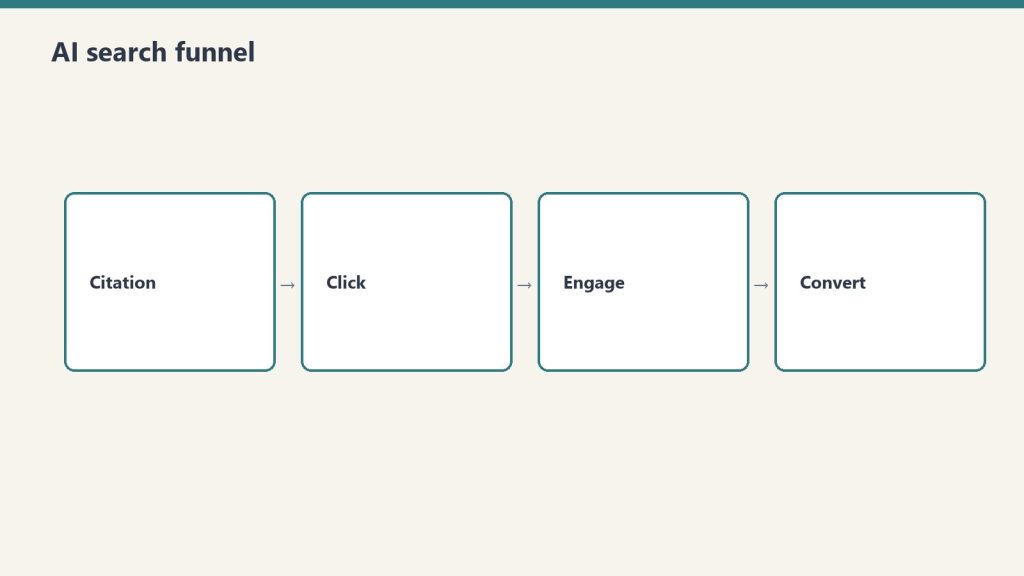
AI referral sessions — The sessions in GA4 that arrived from an AI platform with a usable referrer header (or GA4’s native AI Assistant classification). This is the metric that ties visibility to business outcomes. Setup is covered in the next section.
Conversion quality from AI traffic — AI-referred visitors often arrive with higher intent: they asked a specific question and your site was the answer. Track engagement rate, pages per session, and goal completions for AI referral sessions separately. If this cohort converts at 2–3× the rate of your organic traffic — which early practitioner data suggests — it changes how you think about GEO investment.
Setting Up GA4 to Capture AI Traffic
Native AI Assistant channel (May 2026)
Since May 13, 2026, GA4’s default channel group includes an AI Assistant channel. When Google recognizes an assistant referrer, it sets medium ai-assistant. You will see it under Reports → Acquisition → Traffic acquisition. That is progress, but it is not a complete LLM visibility stack: Perplexity commonly still lands in Referral, assistant coverage in Google’s list changes, and clicks from Google AI Overviews or AI Mode still arrive as google.com — they stay in Organic Search, not AI Assistant.
Custom channel group and regex
For Perplexity, legacy referrers, and retroactive reporting, build your own group. In GA4: Admin → Data Display → Channel Groups → Create New Channel Group. Name it “AI Search” and add a rule:
- Condition type: Session source
- Match type: matches regex
- Pattern (copy exactly):
^(.*\.)?(chatgpt\.com|chat\.openai\.com|perplexity\.ai|claude\.ai|anthropic\.com|gemini\.google\.com|bard\.google\.com|copilot\.microsoft\.com|deepseek\.com|grok\.com|meta\.ai|you\.com|poe\.com)$Critical step: Place “AI Search” above “Referral” (and treat order as first-match-wins). If Referral appears first, Perplexity and other assistant referrers never reach your AI rule. Custom channel groups can be applied retroactively in reports; the native AI Assistant channel does not backfill history the same way.
Scope caveat: Many assistant-driven visits still arrive without a referrer — mobile apps, in-app browsers, and privacy modes send them to Direct or (not set). Your AI channel captures the visible minority. Don’t benchmark on absolute volume alone. Benchmark on growth rate, and watch Direct only when other signals line up.
To supplement GA4, add a self-reported source question on high-intent forms: “How did you find us?” Include “ChatGPT / AI assistant” as an option. That gives ground truth session data cannot.
The Tool Tier: Free to Enterprise
The LLM visibility tool market matured through 2025 and 2026. Three tiers cover most teams. Start manual before you pay — the same discipline described in our AI citation monitoring guide applies whether you use a spreadsheet or a dashboard.
Free / DIY — start here
Run 20 representative prompts manually across ChatGPT, Perplexity, Claude, and Google AI Overviews each month. Record mentions in a spreadsheet: cited (yes/no), cited with link (yes/no), competitor named instead. That gives you baseline prompt coverage and share of voice with zero budget. Do it for at least one month before buying software — you’ll know which gaps actually hurt.
Mid-market tools (roughly $30–$500/month)
OtterlyAI runs scheduled prompt sets and tracks brand mentions, cited URLs, and share of voice. Published USD pricing starts at $29/month (Lite, 15 prompts); Standard is $189/month (100 prompts); Premium is $489/month (400 prompts). ChatGPT, Google AI Overviews, Perplexity, and Copilot are included; Google AI Mode, Gemini, and Claude are add-ons. Enterprise starts around $1,000/month.
LLMrefs takes a keyword-first approach: import SEO keywords, and the platform generates prompt fan-outs and refreshes visibility on a schedule — closer to a rank tracker than a blank prompt spreadsheet. Useful when your team already thinks in keyword lists rather than conversational prompts.
Enterprise layer ($1,000+/month)
Profound centers on Prompt Volumes — modeled demand from real answer-engine conversations (ChatGPT, Gemini, Claude, Perplexity). It helps you prioritize which questions deserve content before you commit headcount. Valuable at scale; overkill for a single-location operator on the 20-prompt audit. Pair it with playbooks such as the GEO case studies series when you need proof the numbers moved.
The 20-Prompt Audit: Your Monthly Baseline Protocol
Whether you use a paid tool or not, run this protocol monthly:
- Build a prompt library of 20 questions your target buyer would ask an AI system. These should be questions your content is designed to answer — not keyword-stuffed phrases, but real conversational queries.
- Run each prompt across ChatGPT, Perplexity, and Google AI Overviews (3 platforms × 20 prompts = 60 data points per month).
- For each result, record: was your brand cited in text, was your domain linked, and which competitor was cited if you were not.
- Calculate prompt coverage per platform and total share of voice versus your top three competitors.
Log results in a spreadsheet with a date column. Three months of data reveals directional trends — whether your GEO and AEO work is moving the needle. Longitudinal baselines also make experiments legible; structured publishing tests (for example, the 40-article Bing citation experiment) only pay off when you can compare citation rates month over month.

Diagnosing a Citation Drop
If your monthly audit shows prompt coverage declining, run through this checklist before blaming a black-box algorithm change:
Did you remove or restructure a previously cited page? AI systems build representations of your content over time. Pages that disappear or get heavily rewritten lose citation weight. Check your changelog against the prompts that declined.
Did a competitor publish stronger content on the topic? Citation slots in a single answer are finite. If a competitor shipped a more authoritative page, it may have displaced yours. Review their recent publishing calendar.
Check LLMs.txt and robots.txt. A crawlability block in LLMs.txt or a misconfigured Disallow directive cuts AI access at the source. Verify both files allow the URLs you expect to be cited.
Check for a platform or model update. Major chatbot and search-model releases in 2025–2026 shifted which sources each engine trusted. Read the platform’s public changelog for the period in question.
If none of these apply, audit structured data on the pages that lost citations — schema, FAQ blocks, heading hierarchy, and factual density all affect extraction. A redesign that removed an FAQ block can remove your citation utility in the same deploy.
The Bottom Line
LLM visibility measurement is not solved, but the primitives exist: GA4’s AI Assistant channel plus a custom regex group for traffic, manual prompt audits for citation coverage, and mid-market tools when labor becomes the bottleneck. Operators who need a packaged starting point can map the same metrics to a vertical playbook such as the AI search visibility package for water damage — the measurement layer stays identical even when the prompts change.
Build the 20-prompt library this week. Configure GA4 today. Everything else stacks on those two streams.
FAQ
What is LLM visibility? LLM visibility is how often your brand or domain appears in AI-generated answers — in the prose, in linked citations, or both — for the questions your buyers ask. It is the AI-search equivalent of showing up on page one, except there is no single rank number to screenshot.
Does GA4 automatically track ChatGPT and Perplexity traffic? Partially. Since May 2026, GA4’s AI Assistant channel classifies some assistant referrers with medium “ai-assistant.” Perplexity often remains Referral, AI Overview clicks stay Organic, and no-referrer visits stay Direct. A custom “AI Search” channel group with a source regex — placed above Referral — is still required for complete trending.
How often should I run a prompt audit? Monthly is the minimum useful cadence. Run the same 20 core prompts each cycle so prompt coverage and share of voice are comparable. Weekly spot checks are fine for crisis monitoring, but monthly logging is what builds a baseline.
What is the difference between prompt coverage and share of voice? Prompt coverage is the share of your tracked prompts where you appear at all. Share of voice compares how often you appear versus named competitors across that same prompt set. High coverage with low share of voice means you show up, but rivals dominate the answers.
Do I need a paid tool to measure AI citations? No. A spreadsheet and 60 manual checks per month (20 prompts × three platforms) are enough to start. Paid tools mainly automate scheduling, add engines, and export reports once you know which prompts and competitors matter.
Why would AI citations drop suddenly? Common causes are URL removals or restructures, stronger competitor pages, crawl blocks via robots.txt or LLMs.txt, or model updates on the assistant platform. Rule those out before you assume your entire GEO strategy failed.
Get The Signal
What we actually ran, what it measured, and what it means for a restoration shop — every week, including the flops.
Leave a Reply