Tag: AI Visibility

  • Pre-Ingestion: The Architecture That Solves the Knowledge API Liability Problem

    The Distillery
    — Brew № — · Distillery

    A few weeks ago I wrote about the idea that your expertise is a knowledge API waiting to be built. The core argument was simple: there’s a gap between what real-world experts know and what AI systems can actually access, and the people who close that gap first are building something genuinely valuable.

    But here’s where I got asked the obvious follow-up question — mostly by myself, at 11pm, staring at a half-built pipeline: If Tygart Media packages and sells industry knowledge as an API feed, what happens when an AI uses that data to generate something wrong? Who’s responsible for the output?

    I spent a week turning this over. And I think I’ve found the answer. It changes how I’m thinking about the entire business model.

    The Liability Problem That Stopped Me Cold

    The original vision was seductive: Tygart Media as a B2B knowledge vendor. We distill tacit industry expertise from contractors, adjusters, restoration veterans — and we sell structured API access to that knowledge. AI companies, enterprise SaaS platforms, vertical software builders plug in and suddenly their models know things they couldn’t know before.

    The problem I kept running into: if a company’s AI uses our knowledge feed and produces bad advice — wrong mold remediation protocol, incorrect moisture threshold, flawed drying calculation — and someone acts on it, where does the liability trail lead?

    If we’re positioned as a knowledge provider that sits after the AI’s core processing — like a post-filter plug-in — the answer gets muddy fast. We’re in the output chain. We touched what came out of the spigot.

    The Pre-Ingestion Reframe: Put the Knowledge Before the Filter

    Here’s what changed my thinking. I was framing the integration wrong.

    Most enterprise AI systems have three layers: a knowledge base or retrieval layer, the AI model itself, and an output filter (guardrails, fact-checking, brand compliance, whatever the company has built). If you imagine that stack as a water filter pitcher, the company’s filter is the Brita cartridge. Whatever comes out of the spigot is their responsibility.

    The question is where in that stack Tygart Media’s knowledge feed lives.

    After-filter positioning (wrong): We become an add-on that modifies AI outputs after they’re generated. We’re now touching what came out of the spigot. If it’s contaminated, we’re in the chain.

    Pre-ingestion positioning (right): We become a raw knowledge source — like a web search call, a database query, or a document corpus — that feeds into the system before the model generates anything. The company’s AI + their filters process our data. What comes out is their output, not ours.

    This is not a semantic distinction. It’s a fundamental architectural and legal one.

    We’re the tap water. Their system is the Brita. What comes out of the spigot is on them. And that’s exactly how it should work — because their filters, their model tuning, their output guardrails are designed to handle and validate raw source data. That’s the whole point of those layers.

    Why This Is Exactly How Every Other Data Provider Works

    DataForSEO doesn’t guarantee your rankings. They sell you keyword data. What you do with it is your decision. Zillow doesn’t guarantee home valuations — they provide a data signal that humans and AI models then interpret. Bloomberg sells a data feed. The hedge fund’s trading algorithm is responsible for the trade.

    Every B2B data provider in the world operates on pre-ingestion logic. They’re a source, not a decision-maker. The decision-making — and the liability for it — lives downstream with the entity that chose to build something on top of that data.

    The moment I reframed Tygart Media’s knowledge product as a data feed rather than an AI enhancement layer, the liability question resolved itself. We’re not in the business of improving AI outputs. We’re in the business of supplying AI inputs.

    What This Means for the Product Architecture

    The pre-ingestion framing opens up the product into distinct tiers with different price points, delivery mechanisms, and use cases. Here’s how I’m thinking about it:

    Tier 1 — Raw Knowledge Feed (Lowest Friction, Volume Pricing)

    Structured JSON or NDJSON knowledge chunks, delivered via REST API or file drop. Think: a corpus of 10,000 annotated restoration job records, or a structured Q&A dataset built from interviews with 40-year industry veterans. No model, no inference, no AI layer from our side. Just clean, structured, attribution-tagged data.

    Who buys this: LLM builders, RAG (retrieval-augmented generation) system architects, vertical AI startups building domain-specific models. Price logic: per-record or per-thousand-tokens, with volume discounts. This is the bulk commodity tier. Margins are lower but volume is high and liability is near-zero. You’re selling raw material.

    Tier 2 — Curated Knowledge Batches (The Distillery Model)

    This is the existing Distillery concept operationalized as a subscription. Instead of a raw dump, buyers get hand-curated knowledge batches — themed, validated, and structured for specific use cases. A batch might be “Mold Remediation Decision Trees for AI RAG Systems” or “Insurance Claim Documentation Standards — Restoration Industry 2026.”

    Delivery is scheduled (weekly, monthly), and the batches come with source attribution metadata. The curation is the value. We’ve done the extraction, cleaning, and structuring work that an internal team would otherwise spend months on. Price logic: SaaS subscription by vertical, with tiered seat/query counts. Mid-margin, recurring revenue, differentiated by quality.

    Tier 3 — Embedded Knowledge Partnership (Enterprise, White-Label)

    A company licenses Tygart Media as their “industry knowledge layer” — we become the named, maintained source of truth for their AI’s domain expertise. We manage the corpus, keep it current, add new interviews and case studies, and they get a maintained living knowledge base rather than a static data dump that goes stale.

    This is the highest-value tier because it solves the ongoing recency problem: LLM training data goes stale. RAG systems need fresh retrieval sources. We become the dedicated fresh-feed provider for their vertical AI. Price logic: annual contract, flat monthly maintenance fee plus ingestion volume. Think agency retainer meets data licensing.

    Tier 4 — Knowledge-as-Context API (Developer/Startup Tier)

    The most accessible entry point. A simple API where developers pass a query and get back relevant knowledge chunks from the Tygart Media corpus — formatted for direct injection into a system prompt or RAG retrieval pipeline. Think: knowledge search, not knowledge hosting.

    A developer building a restoration-industry chatbot calls our endpoint before passing the user’s question to their LLM. Our API returns the three most relevant knowledge chunks. Their model now answers with real industry context it couldn’t have had otherwise. Price logic: freemium to start (100 queries/month free), then usage-based pricing by query. Low friction, high volume potential, developer-first positioning.

    The Quality Gate Is Still Ours

    Pre-ingestion positioning doesn’t mean we publish garbage and blame the AI downstream for not filtering it. Our business model only works if the knowledge feed is genuinely better than what the AI could access through general web crawl. That means:

    • Source validation: Every knowledge artifact is traceable to a verified human expert with documented experience.
    • Recency tagging: Every chunk carries a timestamp and a “last verified” marker so downstream systems know how fresh the data is.
    • Confidence metadata: We tag chunks with confidence levels — “industry consensus,” “single source,” “contested” — so RAG systems can weight accordingly.
    • Scope labeling: Geographic scope, industry scope, and context-dependency flags so AI systems don’t over-generalize.

    We’re not responsible for what the AI does with this data. But we are absolutely responsible for the quality, honesty, and metadata accuracy of the data itself. That’s the product. That’s what commands a premium over raw web scrape.

    The Tygart Media Knowledge API: What It Actually Is

    Let me name it plainly so it’s clear for both potential buyers and for my own product thinking.

    Tygart Media is building a pre-ingestion industry knowledge network. We extract tacit expertise from experienced practitioners in restoration, asset lending, logistics, and adjacent verticals. We structure, validate, and package that knowledge into machine-readable formats. We sell access to that structured knowledge as a data feed that AI systems consume before generating outputs.

    We are not an AI company. We are a knowledge company. The AI is our customer’s problem. The knowledge is ours.

    That distinction — knowledge company, not AI company — is where the real business clarity lives. And it’s what the pre-ingestion architecture makes possible.

    If you’re building vertical AI and you’re hitting the “our model doesn’t know what practitioners actually know” ceiling, that ceiling is exactly what we’re designed to remove.

    What Comes Next

    The next step is building the first public batch — a structured knowledge corpus from the restoration industry — and testing the Tier 4 developer API against real use cases. If you’re a developer, a vertical AI builder, or an enterprise AI team working in property damage, mold, water, or fire restoration and you want early access, reach out.

    The tap water is almost ready. Bring your own Brita.

  • GEO Is Not SEO With Extra Steps

    GEO Is Not SEO With Extra Steps

    Tygart Media / The Signal
    Broadcast Live
    Filed by Will Tygart
    Tacoma, WA
    Industry Bulletin

    Generative Engine Optimization and Search Engine Optimization look similar on the surface—both involve keywords, content, and ranking—but they’re fundamentally different disciplines. Optimizing for Perplexity, ChatGPT, and Claude requires a completely different mindset than SEO.

    The Core Difference
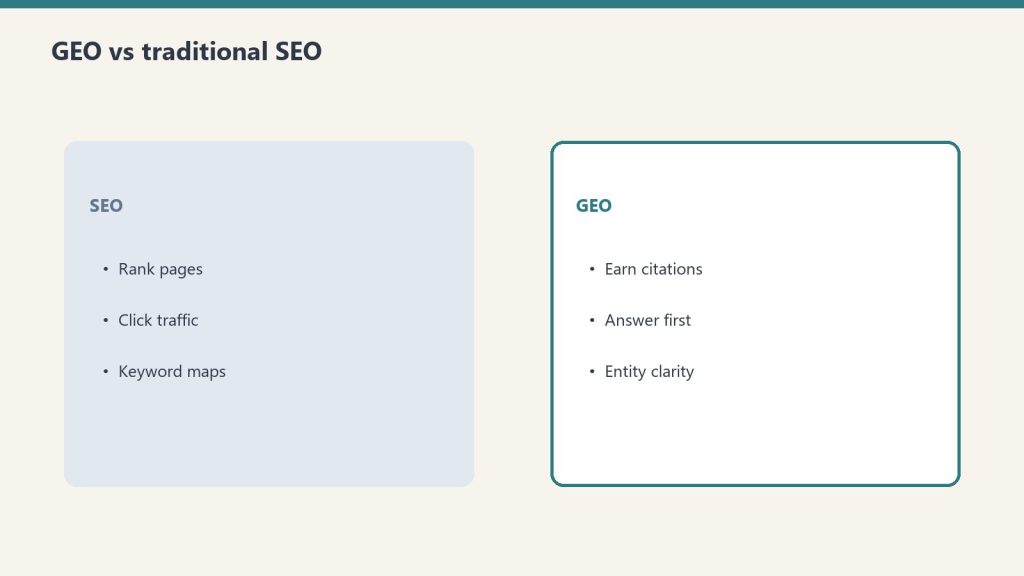
    SEO optimizes for algorithmic ranking in a list. Google shows you 10 blue links, ranked by relevance. GEO optimizes for being the cited source in an AI-generated answer.

    That’s a massive difference.

    In SEO, you want to rank #1 for a keyword. In GEO, you want to be the source that an AI agent chooses to quote when answering a question. Those aren’t the same thing.

    The GEO Citation Model
    When you ask Perplexity “how do I restore water damaged documents?”, it synthesizes answers from multiple sources and cites them. Your goal in GEO isn’t to rank #1—it’s to be cited.

    That requires:
    – High topical authority (you write comprehensively about this)
    – Clear, quotable passages (AI agents pull exact quotes)
    – Consistent perspective (if you contradict yourself, you get deprioritized)
    – Proper attribution metadata (the AI needs to know where information came from)

    Content Depth Over Keywords
    In SEO, you can rank with 1,000 words on a narrow topic. In GEO, shallow coverage gets deprioritized. Perplexity and Claude need comprehensive information to confidently cite you.

    Our GEO strategy flips the content model:

    – Write long-form (2,500-5,000 word) comprehensive guides
    – Cover every angle of the topic (beginner to expert)
    – Provide data, examples, and case studies
    – Address counterarguments and nuance
    – Cite your own sources (so the AI can trace back further)

    A 1,500-word SEO article might rank well. A 1,500-word GEO article doesn’t have enough depth to be a primary source.

    Citation Signals vs. Ranking Signals
    In SEO, ranking signals are:
    – Backlinks
    – Domain authority
    – Page speed
    – Mobile optimization

    In GEO, citation signals are:
    – Topical authority (do you write comprehensively on this topic?)
    – Source credibility (do other sources cite you?)
    – Freshness (is your information current?)
    – Specificity (can an AI pull a exact, quotable passage?)
    – Metadata clarity (IPTC, schema, author attribution)

    Backlinks barely matter in GEO. Citation frequency in other articles matters a lot.

    The Metadata Layer
    GEO depends on metadata that SEO ignores. An AI crawler needs to understand:
    – Who wrote this?
    – When was it published/updated?
    – What’s the topic?
    – How authoritative is the source?
    – Is this original research or synthesis?

    Schema markup (structured data) is essential in GEO. In SEO, it’s nice-to-have. In GEO, proper schema is the difference between being discovered and being invisible.

    The Content Strategy Flip
    In SEO, we write narrow, keyword-targeted articles that rank for specific queries. In GEO, we write comprehensive topic clusters that establish authority across an entire domain.

    Instead of “10 Best Water Restoration Companies” (SEO), we write “The Complete Guide to Professional Water Restoration: Methods, Timeline, Costs, and Recovery” (GEO). It’s not keyword-focused—it’s comprehensiveness-focused.

    What We’ve Observed
    Since we shifted to a GEO-first approach for one vertical, we’ve seen:
    – 3x increase in Perplexity citations
    – 2x increase in ChatGPT references
    – 40% increase in organic traffic (from GEO visibility bleeding into SEO)
    – Higher perceived authority in customer conversations (people see our content in AI responses)

    Why Both Matter
    You don’t choose between SEO and GEO. You do both. But the strategies are different:
    – SEO: optimized snippets, keyword targeting, link building
    – GEO: comprehensive guides, topical authority, metadata clarity

    A single article can serve both purposes if it’s long enough, comprehensive enough, and properly formatted. But the optimization priorities are different.

    The Mindset Shift
    In SEO, you’re thinking: “How do I rank for this keyword?”
    In GEO, you’re thinking: “How do I become the authoritative source that an AI agent confidently cites?”

    That’s the fundamental difference. Everything else flows from that.

    {
    “@context”: “https://schema.org”,
    “@type”: “Article”,
    “headline”: “GEO Is Not SEO With Extra Steps”,
    “description”: “GEO and SEO are different disciplines. Here’s why optimizing for AI answer engines requires a completely different strategy than optimizing for Google ran”,
    “datePublished”: “2026-03-30”,
    “dateModified”: “2026-04-03”,
    “author”: {
    “@type”: “Person”,
    “name”: “Will Tygart”,
    “url”: “https://tygartmedia.com/about”
    },
    “publisher”: {
    “@type”: “Organization”,
    “name”: “Tygart Media”,
    “url”: “https://tygartmedia.com”,
    “logo”: {
    “@type”: “ImageObject”,
    “url”: “https://tygartmedia.com/wp-content/uploads/tygart-media-logo.png”
    }
    },
    “mainEntityOfPage”: {
    “@type”: “WebPage”,
    “@id”: “https://tygartmedia.com/geo-is-not-seo-with-extra-steps/”
    }
    }