
If you have run a GEO campaign for any length of time, you already know the measurement problem: there is no Search Console for ChatGPT, no Performance report for Perplexity, and the analytics you do have leak roughly a third of the traffic into Direct. LLM visibility is real, the buyers are real, but the dashboards that prove it exist have to be assembled from at least three different layers. This is the stack we use for client work in 2026 — what each layer measures, what it costs, and the regex you need to make it work.
What “LLM visibility” actually means
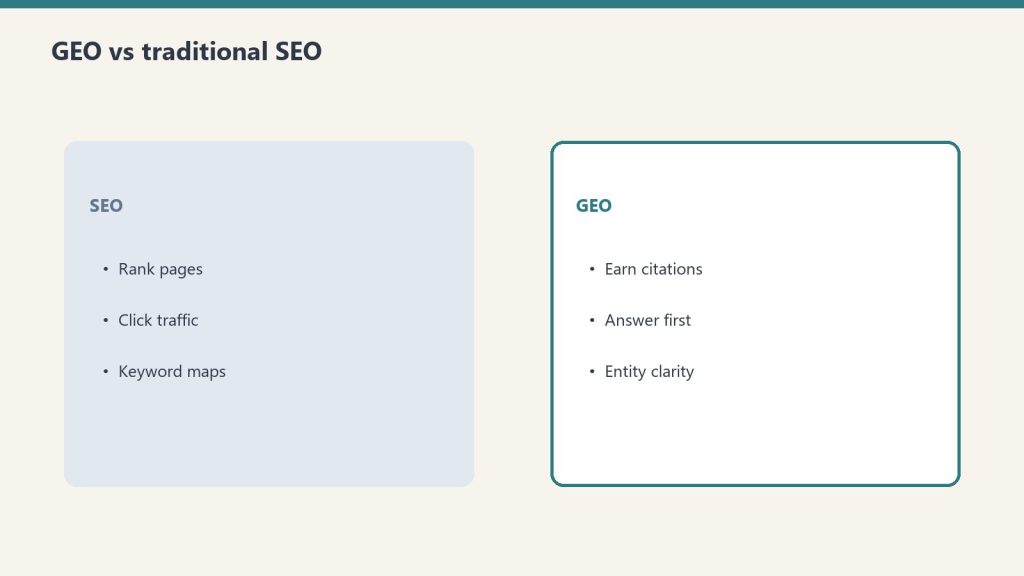
LLM visibility is the percentage of relevant AI-generated answers in which your brand, content, or experts appear. It is not the same as ranking, because answers do not have ranks — they have presence or absence. A useful operational definition borrowed from the practitioner community: track a fixed list of prompts that represent buyer intent for your category, run them across a fixed list of models on a recurring cadence, and count two things. First, mention rate — what percent of responses name you at all. Second, citation rate — what percent of responses include a clickable link back to your domain. Those two numbers are the foundation of every dashboard worth building.
The three measurement layers
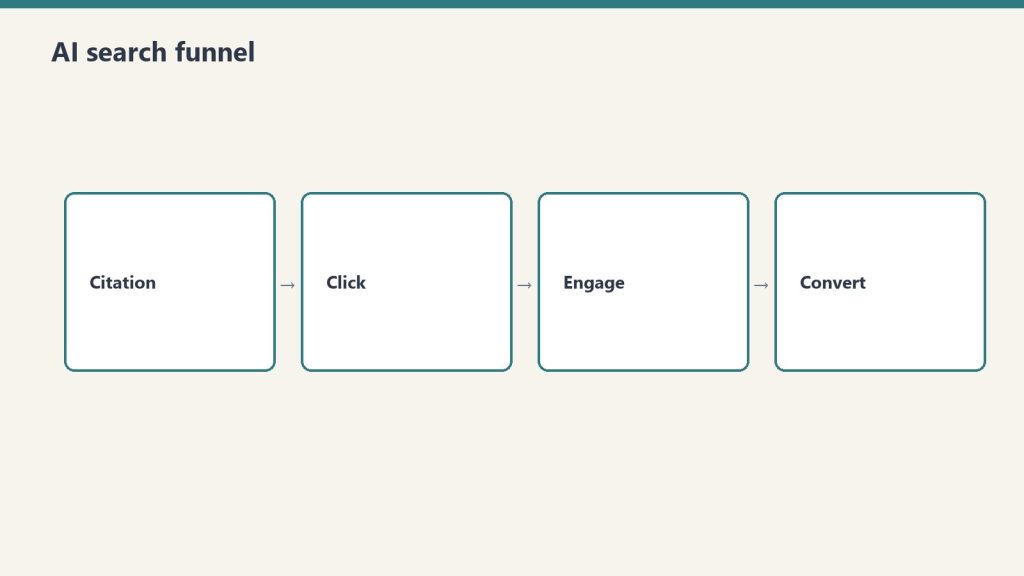
No single tool gives you the full picture, so build the stack in three layers and treat them as complementary.
Layer one — Visibility tracking. Are you in the answer? This is the prompt-monitoring layer. You pick 50 to 200 prompts that a real buyer would type into ChatGPT, Perplexity, Gemini, Copilot, or Claude, then a tool re-runs them on a schedule and parses the responses for your brand and your competitors. This is the only layer that can prove a GEO campaign is working before any clicks happen.
Layer two — Referral analytics. When an AI answer does include a link and a user clicks it, does it show up in GA4? In May 2026 Google added a native “AI Assistant” channel to the GA4 Default Channel Group, which assigns the medium value ai-assistant to recognized referrers and groups those sessions automatically. That is a major improvement, but the underlying problem has not gone away: mobile apps and in-app browsers for ChatGPT, Claude, and Perplexity strip referrer headers, so a meaningful portion of AI-originated visits still arrive as Direct. Practitioner estimates put clean-referrer coverage somewhere in the 60 to 80 percent range depending on the model and the platform mix.
Layer three — Proxy signals. Branded search volume, direct traffic on long-tail URLs that have no other discovery path, self-reported attribution in lead forms, and CRM “how did you hear about us” data. None of these are clean, but together they sanity-check the first two layers and catch the AI traffic that the referrer pipeline lost.
The GA4 channel-group regex
Even with the native AI Assistant channel in place, you still want a custom channel group for granular per-platform reporting and for any property where the new default has not propagated yet. Create one under Admin → Data Display → Channel Groups and put it above Referral in the rule order — GA4 applies rules top-down and Referral will swallow the visit if it gets there first.
Match against the source dimension with this pattern:
chatgpt\.com|chat\.openai\.com|openai\.com|perplexity\.ai|claude\.ai|gemini\.google\.com|copilot\.microsoft\.com|bing\.com/chat|deepseek\.com|grok\.com|meta\.ai|you\.comThat is the full set of recognized referrers as of the May 2026 Google update. For agency reporting we split this into one channel per platform rather than a single “AI” bucket, because the engagement profile is genuinely different — Perplexity sessions tend to behave like high-intent research traffic, while ChatGPT sessions skew more exploratory.
What the tools actually do — and what they cost
The visibility-tracking market in 2026 has consolidated into a recognizable shape. Here is the practitioner read on the four tools most likely to come up in a procurement conversation.
Profound. Tracks coverage across ChatGPT, Gemini, Google AI Overviews, Google AI Mode, Perplexity, Claude, Copilot, Grok, and DeepSeek. The Lite tier starts at $499/month per Profound’s published pricing. This is the enterprise-default option — broadest model coverage, mature competitive view, the price tag to match.
Semrush AI Toolkit. Tracks Google AI Overviews, Google AI Mode, Perplexity, ChatGPT, and Gemini. Available standalone at $99/month per domain or bundled inside Semrush One starting at $199/month. Strong choice if you already run Semrush — the prompt monitoring lives next to your traditional keyword reports.
Otterly. Tracks share of voice across ChatGPT, Google AI Overviews, Perplexity, and Copilot, with AI Mode and Gemini as add-ons. Starts at $29/month on the Lite plan, which makes it the cheapest serious on-ramp in the category. Best for solo operators and small in-house teams that need a real share-of-voice number without a five-figure annual commitment.
SE Ranking AI Visibility Tracker. Bundled inside SE Ranking’s existing SEO platform. Good fit for SE Ranking users; not a category leader for AI alone.
For a single client account we typically run Otterly for the day-to-day share-of-voice number and add Profound when the scope justifies the spend — usually when the client has more than three competitors they care about benchmarking against.
A minimal measurement framework you can ship this week

Build it in this order. None of the steps require a tool purchase to begin.
- Write your prompt list. Fifty prompts that a buyer in your category would actually type. Mix top-of-funnel (“what is X”), comparison (“X vs Y”), and bottom-of-funnel (“best X for Y”) in roughly equal thirds.
- Establish a baseline manually. Run every prompt in ChatGPT, Perplexity, and Gemini once. Record: did the response mention you, did it cite you, who was cited instead. This becomes the zero-point for the campaign.
- Configure GA4. Create the AI custom channel group with the regex above and place it above Referral. Verify the native AI Assistant channel is populated on the property.
- Set the cadence. Monthly for the manual re-run if you are unfunded. Weekly automated tracking the moment Otterly or equivalent is in the stack.
- Report two numbers. Mention rate and citation rate, broken down by model. Everything else is secondary.
The honest limitation
Every tool in this category is sampling. They re-run your prompts on their own infrastructure, not on the model instance a real user hits. The same prompt run twice in ChatGPT in the same hour can return different brand mentions because of retrieval variance and the freshness of the model’s web index. Treat any single-day number as noise and any 30-day trend as signal. The teams that get this right report on rolling four-week windows, not daily deltas.
Where to spend next
Once the measurement stack is live, the next dollar belongs in two places: the content updates that show up in your low-mention-rate prompts, and an LLMs.txt file if you don’t have one yet. Measurement without an action loop is a dashboard, not a campaign. The point of knowing your citation rate is to move it.
Related on Tygart Media: measure LLM visibility in GA4 · AI citation monitoring · ChatGPT search citations.
Frequently asked questions
What is LLM visibility?
LLM visibility is the percentage of relevant AI-generated answers — across ChatGPT, Perplexity, Gemini, Copilot, and Claude — in which your brand, content, or experts are mentioned or cited. It is measured by running a fixed prompt list on a recurring cadence and counting mention rate and citation rate.
How do I track AI traffic in Google Analytics 4?
GA4 added a native “AI Assistant” channel to the Default Channel Group in May 2026 that automatically groups sessions from recognized AI referrers. For per-platform reporting, also create a custom channel group under Admin → Data Display → Channel Groups, place it above Referral, and match the source dimension against the regex of known AI domains.
What is the cheapest LLM visibility tool?
Otterly is the lowest-priced serious option at $29/month on its Lite plan, with coverage of ChatGPT, Google AI Overviews, Perplexity, and Copilot. It is the recommended starting point for solo operators and small in-house teams.
Why does AI referral traffic show up as Direct in GA4?
Mobile apps and in-app browsers for ChatGPT, Claude, and Perplexity often strip the referrer header when a user clicks an outbound link. Without a referrer, GA4 cannot identify the source and classifies the session as Direct. Industry estimates put clean-referrer coverage at 60 to 80 percent of true AI-originated traffic.
How often should I measure GEO performance?
Report on rolling four-week windows, not daily deltas. The same prompt run twice in the same hour can return different brand mentions because of retrieval variance, so single-day numbers are noise. Weekly automated tracking with monthly reporting is the practitioner standard.
Leave a Reply