
Last verified: August 26, 2026 (Pacific Time)
Official links: Live status page · API docs · Upgrade plans · Help center
June 2026 note: Anthropic’s compute expansion in May 2026 roughly doubled rate limits across paid tiers (covered in our May 2026 updates), and the lineup grew again with Claude Fable 5 in June. The API tier tables below reflect current published limits.
Direct Answer (August 2026): Claude rate limits scale by plan: Free users get dynamic session limits (~5-10 messages); Pro ($20/mo) provides roughly 5x capacity (~45 messages per 5-hour rolling window); Max ($100–$200/mo) offers extended quotas for Claude Code. API rate limits operate on rolling token buckets from Tier 1 (50 RPM) to Tier 4 (4,000 RPM), with cached tokens exempt from input rate caps.
Claude rate limits are the single most complained-about aspect of the product. A viral Reddit post on the topic received over 1,060 upvotes. This guide explains what the limits are at every plan tier, why they exist, and every community-tested strategy for getting more out of your plan before hitting the wall.
1. Anthropic API Usage Tier Qualifications & Thresholds
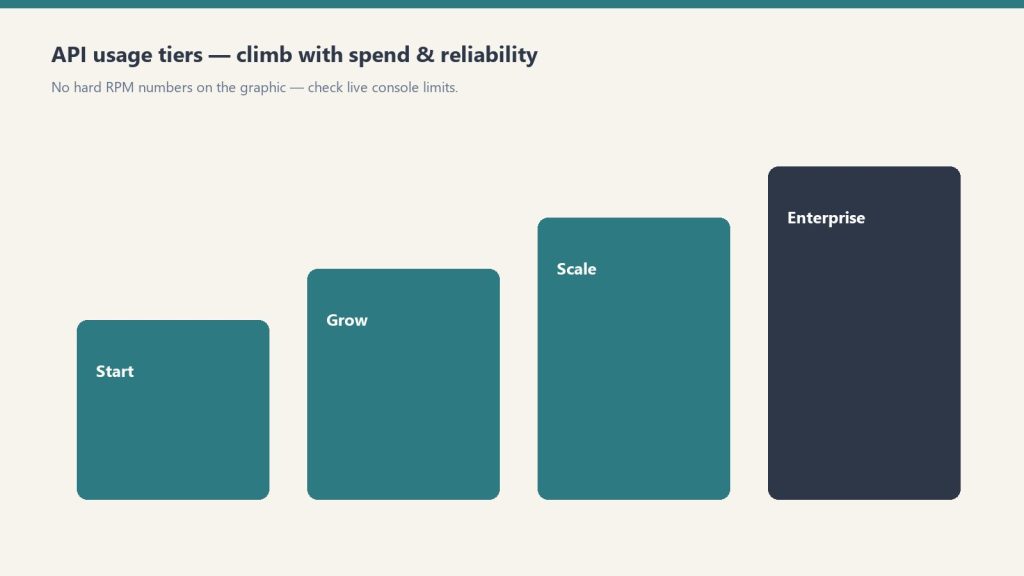
Your API account’s rate limits are determined automatically based on your cumulative payment deposit and account standing in the Anthropic Console:
| Usage Tier | Deposit Requirement | Credit Expiration / Waiting Period | Primary Purpose |
|---|---|---|---|
| Tier 1 | $5 initial deposit | Instant activation upon card verification | Prototyping, local CLI tools, script development |
| Tier 2 | $40 cumulative spend + 7 days standing | Automatic upgrade upon threshold | Small internal team tools, staging environments |
| Tier 3 | $200 cumulative spend + 7 days standing | Automatic upgrade upon threshold | Production web applications, customer-facing agents |
| Tier 4 | $1,000 cumulative spend + 14 days standing | Automatic upgrade upon threshold | High-concurrency SaaS, multi-tenant agent fleets |
| Custom Tier | Enterprise contract agreement | Sales-assisted provisioning | High-throughput batch indexing, real-time telephony/voice |
2. Requests Per Minute (RPM) and Tokens Per Minute (TPM) by Model
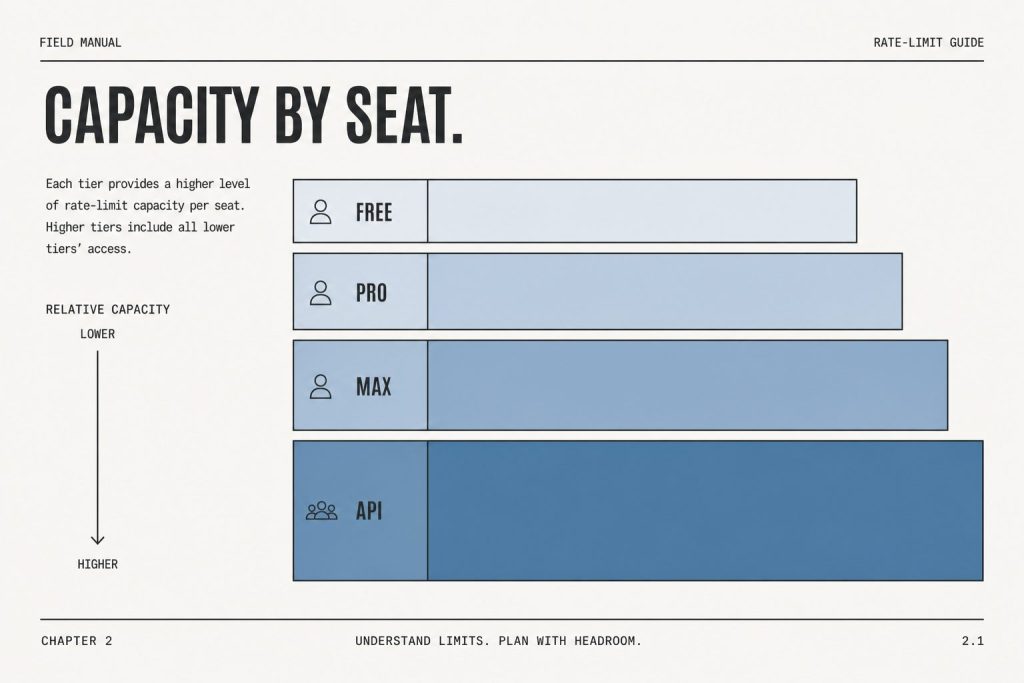
Rate limits apply independently across model families. High-intelligence models (Opus) have tighter token concurrency caps than lightweight models (Haiku):
Lineup currency (Sept 2026): Current API list (Sept 2026, verified): Sonnet 5 $2/$10, Opus 5.5 $4/$20, Haiku 4.5 $1/$5, Fable 5.1 $10/$50. Legacy (still listed on Anthropic’s card): Opus 4.8 $5/$25, Sonnet 4.6 $3/$15. Rows below that still name Opus 4.8 / Sonnet 4.6 / Fable 5 are legacy-or-prior availability figures — confirm live Anthropic limits before quoting TPM/RPM/context.
| Model Name | Tier 1 (RPM / TPM) | Tier 2 (RPM / TPM) | Tier 3 (RPM / TPM) | Tier 4 (RPM / TPM) |
|---|---|---|---|---|
| Claude Haiku 4.5 | 50 RPM / 50,000 TPM | 1,000 RPM / 100,000 TPM | 2,000 RPM / 200,000 TPM | 4,000 RPM / 400,000 TPM |
| Claude Sonnet 4.6 | 50 RPM / 40,000 TPM | 1,000 RPM / 80,000 TPM | 2,000 RPM / 160,000 TPM | 4,000 RPM / 400,000 TPM |
| Claude Opus 4.8 | 50 RPM / 20,000 TPM | 1,000 RPM / 40,000 TPM | 2,000 RPM / 80,000 TPM | 4,000 RPM / 200,000 TPM |
3. Diagnosing and Handling HTTP 429 Rate Limit Errors

When your application exceeds either its Requests-Per-Minute or Tokens-Per-Minute cap, the Anthropic API responds with an HTTP 429 Too Many Requests error containing response headers detailing when capacity will reset:
retry-after: Number of seconds to wait before retrying.anthropic-ratelimit-requests-remaining: Remaining requests available in the current 60-second window.anthropic-ratelimit-tokens-remaining: Remaining token budget available in the current window.anthropic-ratelimit-tokens-reset: ISO timestamp indicating when the token pool will fully refresh.
Production Rate Limit Mitigation Playbook
- Exponential Backoff with Full Jitter: Never retry immediately in a tight loop. Implement an exponential backoff formula with randomized jitter to prevent thundering herd spikes on your backend.
- Utilize Prompt Caching: Cached prefix tokens read from memory bypass standard token generation latency and dramatically streamline token processing windows. Read our full Claude AI Pricing and Token Rates Guide for complete caching cost structures.
- Route Heavy Jobs to the Batch API: For bulk processing, offline report generation, and data extraction, use the Anthropic Messages Batch endpoint. Batch jobs run against separate capacity pools, avoiding live interactive rate caps while cutting token costs by 50%.
Why Rate Limits Exist
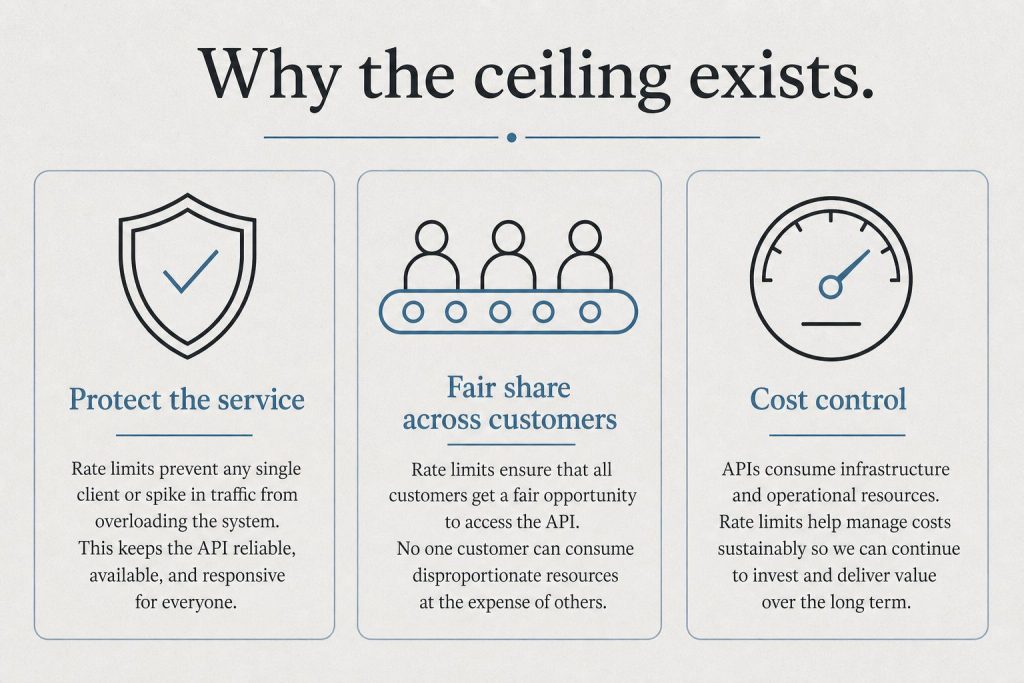
Claude’s rate limits are primarily about compute capacity, not money. Running Claude Opus 4.8 on complex tasks requires enormous GPU resources. Anthropic limits usage to ensure consistent performance for all users. The limits are enforced per rolling time window, not per calendar day.
Rate Limits by Plan
Free Plan
Access to Claude Sonnet 5 with limited daily usage. Heavy users hit limits after 5-10 substantive prompts. Anthropic adjusts dynamically based on system load.
Claude Pro ($20/month)
Roughly 5x the usage of free. Community consensus: approximately 12 heavy prompts per session before throttling. Light prompts run much longer before hitting limits.
Claude Max 5x ($100/month)
Approximately 5x Pro limit. Claude Code users get roughly 44,000-220,000 tokens per 5-hour window depending on model and task.
Claude Max 20x ($200/month)
20x the Pro limit. Introduced for developers running Claude Code for extended sessions and professionals processing large document volumes daily.
API Rate Limits (Tier 1–4)
API limits are measured in requests per minute (RPM), input tokens per minute (ITPM), and output tokens per minute (OTPM), enforced per model class at the organization level. Your usage tier advances automatically as your cumulative API credit purchases cross each threshold:
| Usage tier | Credit purchase to advance | Monthly spend limit |
|---|---|---|
| Tier 1 | $5 | $500 |
| Tier 2 | $40 | $500 |
| Tier 3 | $200 | $1,000 |
| Tier 4 | $400 | $200,000 |
| Monthly Invoicing | — | No limit |
Rate limits apply separately per model, so you can run different models up to their respective limits simultaneously. The Opus limit is a single combined pool across all Opus 4.x versions; the Sonnet limit is combined across all Sonnet 4.x versions.
Tier 1
| Model | RPM | ITPM | OTPM |
|---|---|---|---|
| Claude Fable 5 | 50 | 100,000 | 20,000 |
| Claude Opus 4.x | 50 | 500,000 | 80,000 |
| Claude Sonnet 4.x | 50 | 30,000 | 8,000 |
| Claude Haiku 4.5 | 50 | 50,000 | 10,000 |
Tier 2
| Model | RPM | ITPM | OTPM |
|---|---|---|---|
| Claude Fable 5 | 1,000 | 500,000 | 100,000 |
| Claude Opus 4.x | 1,000 | 2,000,000 | 200,000 |
| Claude Sonnet 4.x | 1,000 | 450,000 | 90,000 |
| Claude Haiku 4.5 | 1,000 | 450,000 | 90,000 |
Tier 3
| Model | RPM | ITPM | OTPM |
|---|---|---|---|
| Claude Fable 5 | 2,000 | 1,500,000 | 300,000 |
| Claude Opus 4.x | 2,000 | 5,000,000 | 400,000 |
| Claude Sonnet 4.x | 2,000 | 800,000 | 160,000 |
| Claude Haiku 4.5 | 2,000 | 1,000,000 | 200,000 |
Tier 4
| Model | RPM | ITPM | OTPM |
|---|---|---|---|
| Claude Fable 5 | 4,000 | 4,000,000 | 800,000 |
| Claude Opus 4.x | 4,000 | 10,000,000 | 800,000 |
| Claude Sonnet 4.x | 4,000 | 2,000,000 | 400,000 |
| Claude Haiku 4.5 | 4,000 | 4,000,000 | 800,000 |
Cache-aware ITPM: for current models, only uncached input tokens count toward your ITPM limit — cache_read_input_tokens do not. With an 80% cache-hit rate against a 2,000,000 ITPM limit you can effectively process ~10,000,000 total input tokens per minute, so prompt caching is the single best lever for raising effective throughput.
When you hit a limit, the API returns a 429 with a retry-after header (seconds to wait), plus anthropic-ratelimit-* headers showing remaining requests/tokens and reset times. Limits use a token-bucket algorithm — capacity replenishes continuously rather than resetting at a fixed clock time. The Message Batches API and Managed Agents endpoints have their own separate limits.
Community-Tested Workarounds
- Use Projects with persistent system prompts — reduces token overhead per conversation
- Use Sonnet for routine tasks, Opus 4.8 for complex ones, and Fable 5 for the most demanding work — don’t burn your limit budget on tasks Sonnet handles equally well
- Batch related work into single long sessions — starting five conversations uses more overhead than one long one
- Compress your inputs — extract only relevant sections from long documents before pasting
- Use the API for high-volume predictable workflows — more limit-efficient than the consumer interface for automated tasks
Frequently Asked Questions
How many messages can I send on Claude Pro?
No published exact number — depends on message complexity. Community estimates suggest roughly 12 heavy messages per session before throttling begins on Pro.
Do Claude rate limits reset daily?
Rate limits use a rolling time window, not a fixed midnight reset.
>Part of the complete guide: Claude Pricing, Plans & Limits
Leave a Reply