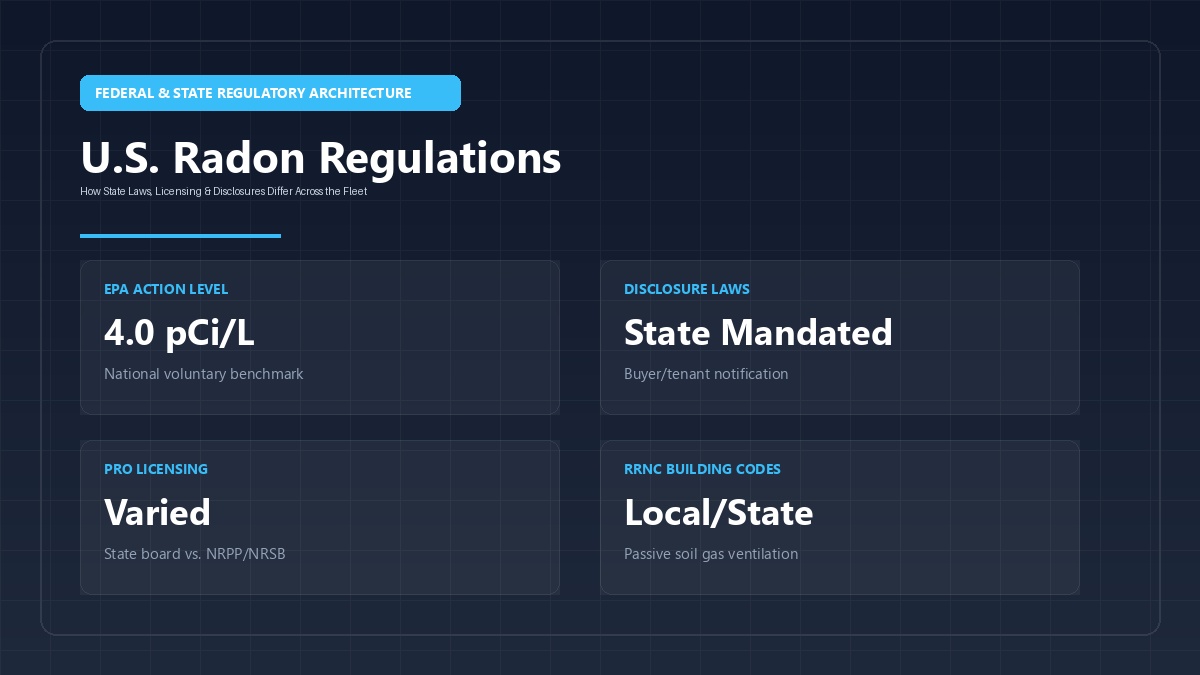
In the United States, radon regulation is defined by a striking contrast: while federal public health agencies establish scientific risk baselines and national testing benchmarks, legal authority to mandate testing, mitigation, or building standards rests entirely with state and local jurisdictions. Because the federal government imposes no universal radon mandate on private residential property, homeowners, home buyers, and real estate professionals must navigate a fragmented patchwork of state statutes, health department administrative rules, and municipal building codes.
The Federal EPA Framework
The foundation of U.S. radon policy was codified under the Indoor Radon Abatement Act of 1988 (15 U.S.C. §§ 2661–2671), which established the long-term national goal that indoor air across the United States should be as free of radon as ambient outdoor air (approximately 0.4 picocuries per liter of air, or pCi/L). To provide actionable guidance for property owners and policymakers, the U.S. Environmental Protection Agency (EPA) established a national recommended action level of 4.0 pCi/L. If indoor radon levels meet or exceed 4.0 pCi/L, the EPA strongly advises installing an active soil depressurization or mitigation system; for levels between 2.0 and 4.0 pCi/L, the agency suggests considering mitigation to further reduce lung cancer risk.
To assist national, state, and local governments in targeting resources and adopting building codes, the EPA developed the Map of Radon Zones, categorizing every county in the nation into three risk categories:
- Zone 1 (High Potential): Predicted average indoor screening levels greater than 4.0 pCi/L.
- Zone 2 (Moderate Potential): Predicted average indoor screening levels between 2.0 and 4.0 pCi/L.
- Zone 3 (Low Potential): Predicted average indoor screening levels less than 2.0 pCi/L.
Crucially, federal law establishes guidelines, technical protocols, and state indoor radon grant funding, but creates no federal requirement for individual homeowners to test or mitigate existing dwellings. For detailed geographical analysis of county risk tiers across the nation, consult our EPA Radon Zone Map guide.
Four Dimensions Where State Laws Differ
Because federal oversight ends with advisory guidelines, states have legislated radon risk across four distinct regulatory dimensions:
1. Real Estate Disclosure Laws
Real estate transactions represent the most common commercial pressure point for radon testing. State disclosure laws fall into three general categories:
Get The Signal
What we actually ran, what it measured, and what it means for a restoration shop — every week, including the flops.
- Statutory Awareness Acts: States like Minnesota (Minn. Stat. § 144.496) and Colorado (SB 23-206) require sellers (and in Colorado, residential landlords) to provide formal written disclosure forms, distribute official state health department educational publications, disclose all historical test records, and incorporate statutory health warning statements into contracts before execution.
- Standard Property Condition Disclosures: States such as Nebraska (Neb. Rev. Stat. § 76-2,120), New Jersey, and Washington (RCW 64.06.020) include specific radon questions on mandatory property condition statements, obligating sellers to disclose known test data or installed mitigation systems.
- Caveat Emptor / Common Law States: States like Massachusetts and Georgia lack radon-specific disclosure statutes, relying instead on common-law prohibitions against active fraud or concealment of known material latent defects, leaving testing to purchase contract inspection contingencies.
2. Mitigator and Tester Credentialing
Consumer protection standards for commercial radon professionals vary widely across state lines:
- Independent State Licensing Boards: States including Minnesota (MDH), New Jersey (NJDEP), Colorado (DORA), Florida (FDOH), and Nebraska (DHHS) mandate comprehensive state licenses or certifications. In these states, performing measurement, mitigation, or laboratory analysis for compensation without an active state credential is a statutory violation. Minnesota further mandates that every installed system carry a serialized state tracking tag.
- Statutory National Board Adoption: Virginia (Va. Code § 32.1-229.01) makes commercial testing or mitigation unlawful without active proficiency certification from national boards—specifically the National Radon Proficiency Program (NRPP) or the National Radon Safety Board (NRSB)—without maintaining an independent state credentialing bureaucracy.
- Voluntary / Unregulated States: Jurisdictions such as Massachusetts, Washington, and Georgia operate no state credentialing programs, directly pointing consumers and building officials to the NRPP and NRSB national rosters.
3. Institutional and School Testing Mandates
While testing in existing single-family homes is universally voluntary for private owners, several states mandate routine monitoring in sensitive institutional facilities:
- Mandatory School and Childcare Testing: Florida (F.S. § 404.056) mandates testing across all public/private K-12 schools, state-licensed daycares, and 24-hour care facilities in designated counties. New Jersey (N.J.S.A. 18A:20-40) mandates testing in public school buildings and licensed child care centers every five years. Virginia (Va. Code § 22.1-138) mandated historical baseline testing of all public schools with ongoing reporting to the health department.
- Voluntary School Frameworks: In Minnesota, Nebraska, Colorado, Massachusetts, Washington, and Georgia, testing in existing school buildings is conducted voluntarily by local school boards, often utilizing state health department grants or national ANSI/AARST testing protocols.
4. Radon-Resistant New Construction (RRNC) Building Codes
Radon-resistant new construction techniques—such as passive soil-gas collection layers, vapor retarders, vertical PVC vent pipes, and sealed foundation perimeters—are enforced through building code adoptions:
- Statewide Mandatory RRNC: Minnesota mandates passive radon control statewide across all new residential construction via Minnesota Statutes § 326B.106 and International Residential Code (IRC) Appendix F. Nebraska mandates passive RRNC in new residential and educational buildings built after September 1, 2019 (Neb. Rev. Stat. § 76-3501).
- County-Specific / High-Risk Mandates: Massachusetts (780 CMR Appendix F) enforces mandatory passive RRNC strictly within EPA Zone 1 counties (Essex, Middlesex, and Worcester). Washington (WSRC Appendix F) mandates passive RRNC across seven designated Zone 1 counties. New Jersey (N.J.A.C. 5:23-10) enforces the Radon Hazard Subcode in designated Tier 1 municipalities.
- Locally Adopted or Voluntary Codes: In Virginia and Georgia, RRNC enforcement depends on local municipal code adoptions or voluntary builder adherence to EPA architectural standards.
State Radon Laws: Wave 2A Comparison Table
The table below summarizes the core statutory mechanisms, credentialing standards, and disclosure rules across the top nine state jurisdictions evaluated in Wave 2A. Click any state guide for complete statutory citations, administrative rules, and state program contacts.
| State | Primary Statutory / Regulatory Authority | Professional Credential Requirement | Real Estate Disclosure Rule | State Guide |
|---|---|---|---|---|
| Minnesota | Minn. Stat. §§ 144.496, 144.4961; Minn. Rules Ch. 4620 | Mandatory MDH state license + system tagging | Mandatory written disclosure, warning statement & MDH guide | Radon Laws in Minnesota: Testing, Disclosure & Mitigation Rules |
| Massachusetts | 780 CMR (State Building Code); MDPH Public Health Law | Voluntary (MDPH refers to NRPP / NRSB) | Common law defect disclosure; contractual inspection | Radon Laws in Massachusetts: Testing, Disclosure & Mitigation Rules |
| Nebraska | Neb. Rev. Stat. §§ 71-3501, 76-2,120, 76-3501; Title 180 NAC 11 | Mandatory DHHS state license + monthly reports | Mandatory Seller Property Condition Disclosure Statement | Radon Laws in Nebraska: Testing, Disclosure & Mitigation Rules |
| New Jersey | N.J.S.A. 26:2D-70 et seq.; N.J.A.C. 7:28-27; N.J.A.C. 5:23-10 | Mandatory NJDEP state certification | Mandatory property disclosure + statutory confidentiality (§ 26:2D-73) | Radon Laws in New Jersey: Testing, Disclosure & Mitigation Rules |
| Colorado | SB 23-206; HB 21-1195; C.R.S. §§ 12-165-101, 38-35.7-112, 38-12-803 | Mandatory DORA state license | Mandatory sales & lease disclosure + statutory tenant remedies | Radon Laws in Colorado: Testing, Disclosure & Mitigation Rules |
| Florida | Fla. Stat. § 404.056; F.A.C. Chapter 64E-5 Part XII | Mandatory FDOH state certification | Mandatory verbatim statutory notification on all sales and leases | Radon Laws in Florida: Testing, Disclosure & Mitigation Rules |
| Washington | RCW 64.06.020; Washington State Residential Code App. F | Voluntary (WA DOH refers to NRPP / NRSB) | Mandatory Seller Disclosure Statement for improved residential | Radon Laws in Washington: Testing, Disclosure & Mitigation Rules |
| Virginia | Va. Code §§ 32.1-229.01, 22.1-138, 55.1-703; USBC App. AF | Mandatory national certification (NRPP or NRSB) by statute | Residential Property Disclosure Statement advises buyer testing | Radon Laws in Virginia: Testing, Disclosure & Mitigation Rules |
| Georgia | Georgia Public Health Authority; UGA Extension Educational Program | Voluntary (GA DPH refers to NRPP / NRSB) | Common law latent defect disclosure; contractual due diligence | Radon Laws in Georgia: Testing, Disclosure & Mitigation Rules |
| North Dakota | N.D.C.C. § 47-10-02.7; NDDEQ Radiation Control Rules | Voluntary (NDDEQ refers to NRPP / NRSB) | Mandatory written disclosure of known radon tests & mitigation systems (§ 47-10-02.7) | Radon Laws in North Dakota: Testing, Disclosure & Mitigation Rules |
| Ohio | ORC Chapter 3723; OAC Chapter 3701-69; RCO App. F; ORC § 5302.30 | Mandatory ODH state license (Tester, Mitigator, Lab) | Mandatory Residential Property Disclosure Form + dual-role notice (§ 3723.06) | Radon Laws in Ohio: Testing, Disclosure & Mitigation Rules |
| Kentucky | KRS §§ 211.9101–211.9135; 902 KAR 95:040; KRS § 324.360 | Mandatory KDPH registration + NRPP or NRSB certification | Mandatory Seller’s Disclosure of Property Condition (KREC) | Radon Laws in Kentucky: Testing, Disclosure & Mitigation Rules |
| Vermont | 18 V.S.A. § 104b; Act 72 (School Testing); VDH Health Regulations | Voluntary (VDH refers to NRPP / NRSB) | Common law defect disclosure; contractual inspection contingencies | Radon Laws in Vermont: Testing, Disclosure & Mitigation Rules |
| Michigan | MCL §§ 565.951–565.966; Michigan Residential Code App. F | Voluntary (EGLE refers to NRPP / NRSB) | Mandatory Seller’s Disclosure Statement (MCL § 565.957) | Radon Laws in Michigan: Testing, Disclosure & Mitigation Rules |
| Connecticut | CGS §§ 20-420, 10-220(d), 20-327b; DPH Public Health Code | Mandatory DCP registration as Home Improvement Contractor + NRPP/NRSB | Mandatory Residential Property Condition Disclosure Report (§ 20-327b) | Radon Laws in Connecticut: Testing, Disclosure & Mitigation Rules |
| Wisconsin | Wis. Stat. Chapter 709; SPS Chapter 321 (Uniform Dwelling Code) | Voluntary (DHS refers to NRPP / NRSB) | Mandatory Real Estate Condition Report (Wis. Stat. § 709.02) | Radon Laws in Wisconsin: Testing, Disclosure & Mitigation Rules |
| Montana | Montana Radon Control Act, MCA §§ 75-3-601–75-3-607 | Voluntary (DEQ refers to NRPP / NRSB) | Mandatory signed statutory radon warning disclosure & test records (MCA § 75-3-606) | Radon Laws in Montana: Testing, Disclosure & Mitigation Rules |
| North Carolina | NCGS §§ 47E-1–47E-10; NCREC Real Estate Commission Rules; NCDHHS | Voluntary (NCDHHS refers to NRPP / NRSB) | Mandatory Residential Property Disclosure Statement (RPOADS) + broker duty to disclose ≥ 4.0 pCi/L | Radon Laws in North Carolina: Testing, Disclosure & Mitigation Rules |
| Utah | Utah Code Title 58 (DOPL Rule R156-55a); Utah Code § 57-1-1 et seq. | Mandatory DOPL S354 Specialty License + NRPP/NRSB credential | Standard Seller’s Property Condition Disclosure (buyer due diligence) | Radon Laws in Utah: Testing, Disclosure & Mitigation Rules |
| West Virginia | W. Va. Code §§ 16-34-1–16-34-14; 64 CSR 78; W. Va. Code § 36E-1-1 | Mandatory OEHS state license (Radon Mitigator, Tester, Lab) | Mandatory Property Condition Disclosure + statutory test confidentiality (§ 16-34-9) | Radon Laws in West Virginia: Testing, Disclosure & Mitigation Rules |
| Tennessee | TCA §§ 66-5-201–66-5-210; TDEC Sustainable Practices Radon Program | Voluntary (TDEC refers to NRPP / NRSB) | Mandatory Tennessee Residential Property Condition Disclosure (TCA § 66-5-212) | Radon Laws in Tennessee: Testing, Disclosure & Mitigation Rules |
| Idaho | Idaho Code §§ 55-2501–55-2518; IDHW Indoor Radon Program | Voluntary (IDHW refers to NRPP / NRSB) | Mandatory Seller’s Property Condition Disclosure Form (§ 55-2504) | Radon Laws in Idaho: Testing, Disclosure & Mitigation Rules |
Accessing Official State Programs and Test Kits
Every state health department maintains a designated radon program or radiation control coordinator supported by federal State Indoor Radon Grants (SIRG). Residents seeking to test their dwellings can obtain subsidized, low-cost short-term and long-term test kits directly through state health agency links or authorized university extension services. Property owners seeking professional mitigation should independently verify contractor credentials through either their state licensing division (in mandatory licensing states) or via the official registries maintained by the National Radon Proficiency Program (NRPP) and the National Radon Safety Board (NRSB).
For additional architectural and geological context on how soil gas potential impacts local property values and building performance, consult our national EPA Radon Zone Map.
Sources & Limits
This regulatory hub is provided for informational purposes only and does not constitute formal legal, real estate, or engineering advice. Statutory disclosure requirements, professional licensing standards, and building codes vary by state and local municipality and are subject to legislative amendment. Property buyers, sellers, landlords, and contractors should verify current rules directly with their respective state health department radon programs or qualified legal counsel.
Primary Official Sources: U.S. Environmental Protection Agency (Indoor Radon Abatement Act, 15 U.S.C. §§ 2661–2671; EPA Map of Radon Zones), Centers for Disease Control and Prevention (CDC), and official state health department radon programs across all fifty states.
Get The Signal
What we actually ran, what it measured, and what it means for a restoration shop — every week, including the flops.
Leave a Reply