The Short Answer
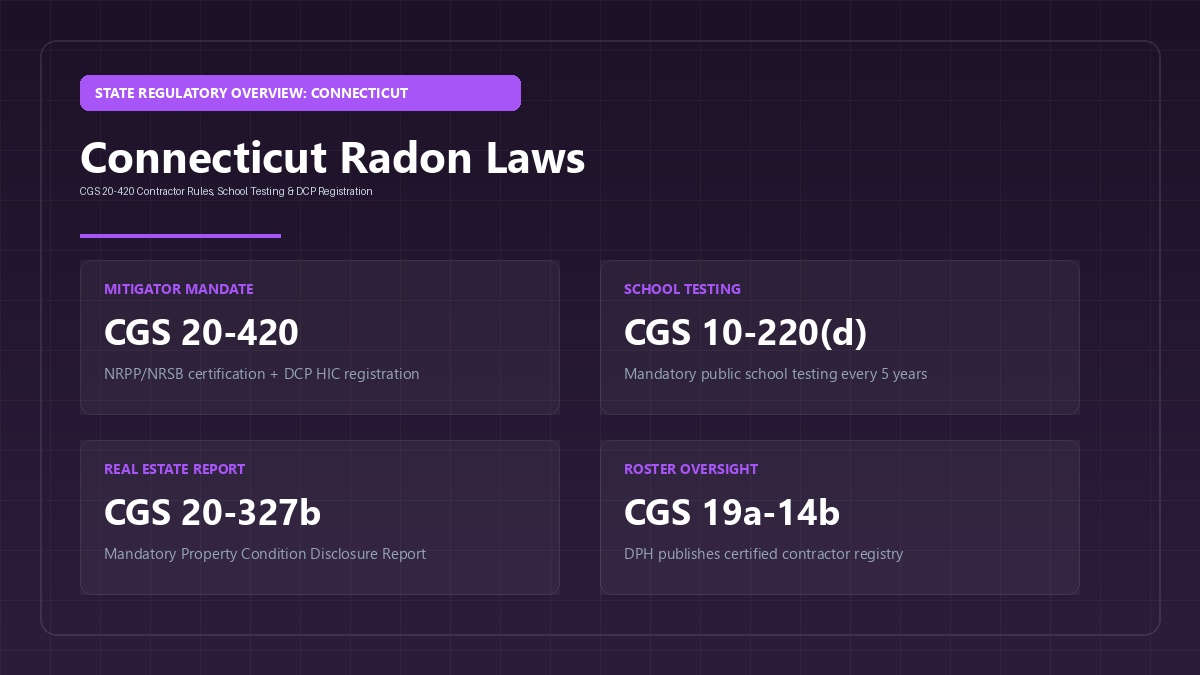
Connecticut enforces a comprehensive radon regulatory regime that combines statutory credentialing mandates, periodic public school testing, and mandatory real estate disclosures. Under Connecticut General Statutes (CGS) § 20-420, it is unlawful for any contractor to perform radon mitigation without holding active national certification (NRPP or NRSB) and registration as a Home Improvement Contractor with the Department of Consumer Protection. Public schools are mandated under CGS § 10-220(d) to undergo radon testing every five years. Residential sellers must disclose known radon test records under CGS § 20-327b, and the state building code requires radon-resistant construction in designated high-risk jurisdictions.
Testing Requirements
Connecticut mandates indoor radon testing in sensitive educational facilities. Under CGS § 10-220(d), local and regional boards of education are statutorily required to conduct periodic indoor air quality assessments, including radon testing, in all public school buildings (grades K-12) constructed before or without radon controls, repeating tests at least once every five years following Connecticut Department of Public Health (DPH) and EPA protocols. Child day care centers licensed by the Office of Early Childhood must also undergo testing prior to initial licensure and periodic renewal. For private single-family homes and general residential rental properties, radon testing remains voluntary under state law.
Real-Estate Disclosure
Residential property transactions are governed by Connecticut General Statutes § 20-327b. Before a purchase contract is finalized, sellers of residential real estate (1 to 4 units) must provide prospective buyers with a written Residential Property Condition Disclosure Report prescribed by the Department of Consumer Protection. The statutory report includes explicit questions concerning whether the seller has knowledge of any radon testing, the most recent test scores, and whether an active or passive radon mitigation system is installed on the property. Sellers must disclose known historical data, though they are not statutorily compelled to commission new tests.
Mitigator & Tester Certification
Contractor credentialing is strictly enforced under CGS § 20-420 and CGS § 19a-14b. No person or business may advertise or perform radon mitigation services in Connecticut without providing proof of active national certification through either the National Radon Proficiency Program (NRPP) or the National Radon Safety Board (NRSB), and maintaining an active Home Improvement Contractor (HIC) registration with the Department of Consumer Protection (DCP). Under CGS § 19a-14b, the Connecticut Department of Public Health maintains and publishes the official registry of qualified mitigation and measurement professionals operating in the state.
New Construction
Radon-resistant construction is integrated into the Connecticut State Building Code, which incorporates the International Residential Code (IRC) Appendix F. Builders constructing new one- and two-family dwellings in designated high-potential municipalities (primarily within EPA Zone 1 regions such as Middlesex and Fairfield counties) must install passive radon-resistant features during initial construction. Required techniques include sub-slab aggregate or soil-gas collectors, 6-mil polyethylene membranes, sealed perimeter expansion joints, and a routed vertical vent pipe terminating above the roofline.
Radon Zones & the Action Level
The EPA Map of Radon Zones designates Fairfield and Middlesex counties in Connecticut as EPA Zone 1 (High Potential), where predicted average indoor screening levels exceed 4.0 pCi/L. The remaining counties—including Hartford, New Haven, New London, Litchfield, Tolland, and Windham—fall within Zone 2 (Moderate Potential, 2.0 to 4.0 pCi/L). Connecticut DPH establishes the state action level at the federal standard of 4.0 pCi/L, while advising that mitigation be considered for levels between 2.0 and 4.0 pCi/L to reduce lifetime radiation exposure. For comprehensive regional classifications, review our EPA Radon Zone Map guide.
The State’s Radon Program
The official regulatory and public health authority is the Connecticut Department of Public Health Radon Program, housed within the Environmental Health and Drinking Water Branch. The DPH Radon Program publishes the statewide contractor roster, provides protocol oversight for school testing under CGS § 10-220(d), and distributes public education and subsidized test kits through local health departments. Homeowners, school administrators, and contractors can access official lists and ordering information via the Connecticut DPH Radon Program portal or by calling 860-509-7367.
Sources & Limits
This regulatory guide is provided for educational and informational purposes only and does not constitute formal legal, building code, or engineering counsel. Statutory credentialing requirements and school testing rules are subject to legislative amendment. Real estate buyers, sellers, landlords, and contractors should verify current rules directly with the Connecticut Department of Public Health or a qualified real estate attorney.
Official Sources: Connecticut General Statutes §§ 20-420, 19a-14b, 10-220(d), 20-327b; Connecticut State Building Code Appendix F; Connecticut Department of Public Health; U.S. Environmental Protection Agency.
To compare Connecticut’s statutory standards with neighboring states, consult our complete guide to radon regulations across the United States or inspect the EPA Radon Zone Map.
Get The Signal
What we actually ran, what it measured, and what it means for a restoration shop — every week, including the flops.
Leave a Reply