The Short Answer
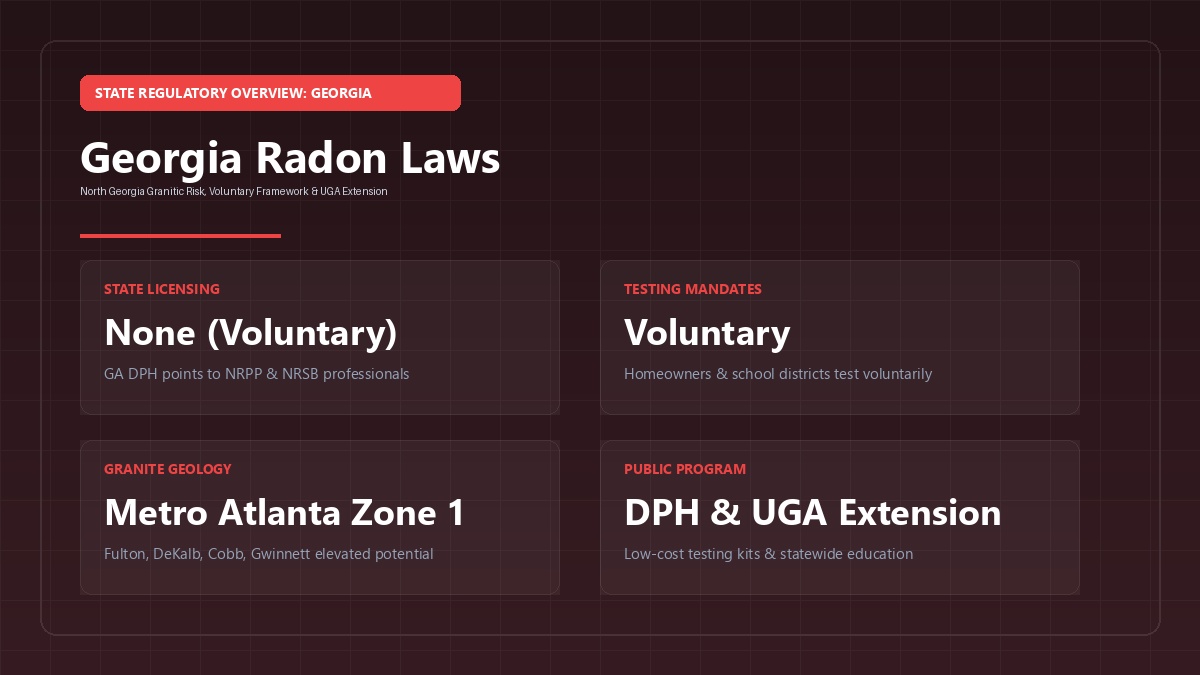
Georgia operates within a largely voluntary radon regulatory framework, with no state-administered contractor licensing board and no standalone statutory radon disclosure act. However, substantial radon hazards exist in the granitic geology of North Georgia and the metro Atlanta area, which are classified as EPA Zone 1. In real estate transactions, Georgia adheres to common-law principles modified by mandatory disclosure of known latent material defects. The Georgia Department of Public Health (GA DPH) and the University of Georgia (UGA) Radon Program coordinate statewide public education, directing consumers to hire nationally certified NRPP and NRSB professionals.
Testing Requirements
Radon testing is completely voluntary for private single-family homeowners, residential landlords, and commercial building owners in Georgia; no state statute mandates indoor air testing. In addition, Georgia has no statutory mandate compelling routine radon testing in public or private K-12 schools, childcare centers, or state-owned buildings. The GA DPH and UGA Extension Radon Program encourage school districts across North Georgia’s Zone 1 counties to conduct voluntary screening during the winter heating months.
Real-Estate Disclosure
Georgia does not have a dedicated Radon Awareness Act. Real estate disclosures operate under Georgia common law: property sellers and licensed brokers have a legal obligation to disclose known material latent defects that could not be discovered by a prospective buyer exercising ordinary due diligence. Standard Georgia Association of Realtors (GAR) Seller’s Property Disclosure Statements include specific questions asking whether the seller is aware of any radon tests, elevated concentrations, or installed mitigation systems on the property.
Mitigator & Tester Certification
Georgia does not license or certify radon measurement or mitigation contractors at the state level; the state does not issue radon licenses. General contractors must be licensed by the Georgia State Licensing Board for Residential and General Contractors. For radon services, the GA DPH and UGA Extension officially recommend that property owners hire only contractors credentialed by the National Radon Proficiency Program (NRPP) or the National Radon Safety Board (NRSB).
New Construction
New construction standards are governed by the Georgia State Minimum Standard One and Two Family Dwelling Code, which adopts the International Residential Code (IRC). In Georgia, Appendix F (Radon Control Methods) is an optional, adoptive appendix rather than a mandatory statewide requirement enforced by the Georgia Department of Community Affairs (DCA). However, individual municipal and county building departments in high-radon North Georgia jurisdictions are authorized to adopt Appendix F locally for new residential construction.
Radon Zones & the Action Level
Georgia exhibits a sharp geological dividing line along the Fall Line:
- Zone 1 (High Potential, predicted average indoor levels > 4.0 pCi/L): Granitic Piedmont and Appalachian counties in North Georgia and metro Atlanta, including Cherokee, Cobb, DeKalb, Forsyth, Fulton, Gwinnett, and Jackson.
- Zone 2 (Moderate Potential, predicted average 2.0 to 4.0 pCi/L): Upper-central Georgia counties, including Barrow, Clarke, Hall, and Walton.
- Zone 3 (Low Potential, predicted average < 2.0 pCi/L): Coastal Plain counties across central and south Georgia, including Bibb (Macon), Muscogee (Columbus), Richmond (Augusta), and Chatham (Savannah).
GA DPH and UGA adhere to the EPA action level of 4.0 pCi/L, strongly advising mitigation for living areas testing at or above 4.0 pCi/L. Explore the full national map on our EPA Radon Zone Map guide.
The State’s Radon Program
The state’s educational and testing program is coordinated by the Georgia Department of Public Health (GA DPH) in partnership with the University of Georgia (UGA) Extension Radon Program (radon.uga.edu). Georgia residents can order subsidized test kits through UGA Extension county offices, view county-by-county radon test maps, and access national NRPP/NRSB contractor registries.
Sources & Limits
This regulatory guide is provided for informational and educational purposes only and does not constitute formal legal, building code, or engineering counsel. State building codes and disclosure interpretations are subject to administrative and judicial review. Always consult GA DPH, UGA Extension, or a qualified attorney for site-specific guidance.
Primary Official Sources: Georgia Department of Public Health (GA DPH); University of Georgia (UGA) Extension Radon Program; Georgia Department of Community Affairs (DCA); U.S. Environmental Protection Agency (Map of Radon Zones for Georgia).
Return to our national guide on Radon Regulations in the United States or inspect national county risk rankings on the EPA Radon Zone Map.
Get The Signal
What we actually ran, what it measured, and what it means for a restoration shop — every week, including the flops.
Leave a Reply