Tag: Local Guide

  • Pierce Transit’s Stream Community Line Reaches Downtown Tacoma: The Bus Bet Replacing the BRT That Got Away

    Pierce Transit’s Stream Community Line Reaches Downtown Tacoma: The Bus Bet Replacing the BRT That Got Away

    Pierce Transit’s Stream Community Line Reaches Downtown Tacoma: The Bus Bet Replacing the BRT That Got Away

    For most of the last decade, the big transit story in Pierce County was supposed to be steel: light rail creeping south, a Bus Rapid Transit corridor with its own dedicated lanes muscling up Pacific Avenue. The reality landing in Tacoma in 2026 is quieter, cheaper, and arguably more useful to the people who actually ride. Pierce Transit’s Stream Community Line now runs all the way into downtown Tacoma — and it tells you almost everything about how transit in this county is going to grow for the rest of the decade.

    If you commute the Pacific Avenue spine between Spanaway and downtown, drop a kid at a school served by a free youth ORCA pass, or just want to understand where your transit tax dollars are going, here’s the operator’s-eye view of what changed, what’s coming June 7, and why the bus — not the train — is doing the heavy lifting.

    What the Stream Community Line Actually Is

    The Stream Community Line is enhanced bus service running the Tacoma–Spanaway corridor, and as of the March 29, 2026 service change it was extended into downtown Tacoma with new stops at Pacific Avenue & 14th Street, Pacific Avenue & 19th Street, and Commerce Street Station. It’s a partnership with MultiCare, and it runs weekdays during the morning and evening rush.

    The selling point is time. By skipping lower-demand stops and using transit-signal priority — technology that holds a green light or shortens a red when a bus approaches — Stream cuts at least 14 minutes off the trip compared to the existing local Route 1, according to Pierce Transit’s own service materials. For a corridor where the alternative is sitting in single-occupancy traffic on Pacific, 14 minutes each way is real money in time and fuel.

    Route 1 itself didn’t get left behind. The same March service change added eight new northbound and ten new southbound weekday trips on Route 1 (6th Ave–Pacific Ave), per Pierce Transit, so riders who need every stop still get more frequent local service while Stream handles the express layer on top.

    Why It’s “Stream” and Not Bus Rapid Transit

    Here’s the part longtime Pierce County residents will remember differently. Stream is what’s left of a much larger ambition. Pierce Transit spent years planning a true Bus Rapid Transit line on the Route 1 corridor — dedicated bus lanes, station platforms, the works — to deliver fast, reliable service up and down Pacific Avenue at all hours, not just at rush.

    That plan came apart in 2023. As The Urbanist reported, updated cost estimates pushed the dedicated-lane BRT project out of reach, with the latest figure pegged at roughly $311 million. Rather than abandon the corridor, the agency pivoted to “enhanced” service: signal priority and stop consolidation instead of poured concrete and condemned lanes. It’s a pragmatic downgrade — you get most of the speed benefit without the capital cost or the years of construction fights over who gives up a travel lane.

    Whether that’s a smart compromise or a missed opportunity depends on who you ask. Transit advocates wanted the permanent infrastructure; budget hawks wanted the restraint. What’s not in dispute is that the bus reached downtown in 2026 and the BRT didn’t.

    The June 7 Service Change: What Riders Should Know

    Pierce Transit adjusts service a few times a year, and the next round lands June 7, 2026. The changes are modest but worth a glance if you ride these routes:

    Route 3 (Lakewood–Tacoma): Southbound trips will no longer travel on S. 19th St between Market St. and Jefferson Ave., continuing on Jefferson Ave. instead. No stops or schedules are affected — it’s a routing cleanup.

    Route 101 (Gig Harbor Waterfront Connector): The seasonal Connector returns for the summer, running Fridays, Saturdays, and Sundays around Gig Harbor. As with all Pierce Transit service, riders 18 and younger ride free.

    Route 206 (Pac Hwy/Tillicum/Madigan): Northbound trips toward Lakewood Transit Center are getting daily schedule adjustments — relevant for the JBLM-adjacent communities of Tillicum and the Madigan corridor.

    Fan Zone Express: Starting June 12, Pierce Transit’s Fan Zone Express will offer free rides connecting fans to international soccer match watch parties tied to the summer’s marquee events. It’s a short-run promotional service, but it signals how the agency uses buses to move crowds around big regional moments.

    Spanaway: A New Hub, and a Temporary Hole

    The corridor’s anchor at the south end got a major upgrade in 2025. The Spanaway Transit Center opened in August 2025 — Pierce Transit’s first new public transit facility since the Tacoma Dome Station opened in 1998, according to coverage of the agency’s 2025 milestones. Phase One came in around $13.2 million and added 38 park-and-ride stalls, with a planned Phase Two expected to bring roughly 250 more.

    That facility matters because park-and-ride capacity is the unglamorous bottleneck on suburban transit. A fast bus down Pacific is only useful if you can leave your car somewhere when you board. Spanaway’s expansion — and the broader park-and-ride priorities in the agency’s long-range plan — is the supply side of the ridership equation.

    There’s a near-term complication, though. Because of Pierce County’s 208th Street East Sewer Extension project, the Spanaway Transit Center was temporarily closed effective April 27 for an expected 13 weeks, and during that window Route 1 and the Stream Community Line are not serving the Spanaway Transit Center. If you board at the south end of the corridor, check Pierce Transit’s alerts before you head out — temporary stops are in place, but the hub itself is offline through roughly late July.

    Ridership: The Numbers Behind the Investment

    Service changes only make sense if people are riding, and Pierce Transit’s recovery from the pandemic trough has been steady. The agency logged 7,039,888 boardings in 2025, running an 84% on-time performance rate against an 85% target, per its annual reporting. By the first quarter of 2026 the system was carrying roughly 26,700 riders on a typical weekday. Its 2025 annual report frames the bus side of the operation at just under 7 million rides, alongside hundreds of thousands of Rideshare and SHUTTLE paratransit trips.

    Those aren’t boom-era numbers, but they’re a recovery — and they’re concentrated on exactly the kind of all-day, working-rider corridors that Stream and the beefed-up Route 1 are built to serve. The strategy traces back to the agency’s Bus System Recovery Plan, launched in summer 2023, which rebuilt service around evening and weekend demand and higher frequency on core routes rather than simply restoring the old 2019 timetable.

    Fares: Who Rides Free in Pierce County

    One reason ridership holds up is that a meaningful share of riders pay nothing. Thanks to Washington’s 2022 Move Ahead Washington package, all youth ages 18 and under ride Pierce Transit for free. State employees who work in Pierce, King, and Snohomish counties can also commute free by bus or train. For everyone else, ORCA LIFT offers a 50% discount on adult fares for qualifying households based on federal poverty guidelines. Pierce Transit also ran a system-wide fare-free day on June 1 to kick off Ride Transit Month.

    The takeaway for households doing the math: between free youth passes and ORCA LIFT, a Spanaway-to-downtown family commute can cost far less than the fuel and parking it replaces — which is the case Pierce Transit is implicitly making with every Stream trip that beats Route 1 by a quarter hour.

    The Seattle Question and the JBLM Reality

    Pierce County transit doesn’t end at the county line. Sound Transit operates the regional connections — the T Line streetcar in downtown Tacoma, Sounder commuter rail and ST Express buses north toward Seattle — while Pierce Transit runs the local network that feeds those regional spines. The handoff between the two systems is where the daily Tacoma-to-Seattle commute actually happens, and where Joint Base Lewis-McChord’s enormous workforce shapes peak-hour demand on the I-5 corridor through Lakewood and Tillicum.

    That’s the larger backdrop to the Stream decision. Pierce County’s transit dollars are finite, the dedicated-lane BRT proved unaffordable, and the agency is now placing its bets on faster buses, better hubs, and frequency where the riders already are. Its Destination 2045 long-range plan sketches further growth — park-and-ride expansion, zero-emission buses, higher-frequency trunk service — if and only if operating funding grows. Pierce Transit has also opened public comment on its growth plan, so residents who want a say in what comes after Stream have a window to weigh in.

    From where I sit, the Stream Community Line is the honest version of Pierce County transit: not the train everyone pictured, but a bus that’s now 14 minutes faster down the corridor where the most people live and work. That’s not a consolation prize. For a county that needs to move workers more than it needs ribbon-cuttings, it might be the better deal.

    Frequently Asked Questions

    What is the Pierce Transit Stream Community Line?

    The Stream Community Line is enhanced weekday bus service running between Tacoma and Spanaway along the Pacific Avenue corridor. As of the March 29, 2026 service change, it extends into downtown Tacoma with stops at Pacific Avenue & 14th Street, Pacific Avenue & 19th Street, and Commerce Street Station. It uses transit-signal priority and skips lower-demand stops to save at least 14 minutes compared to local Route 1 service.

    Why didn’t Pierce Transit build a Bus Rapid Transit line on Pacific Avenue?

    Pierce Transit originally planned a true BRT line with dedicated bus lanes on the Route 1 corridor, but the project’s cost estimate rose to roughly $311 million and the dedicated-lane plan fell apart in 2023. The agency pivoted to the Stream Community Line — “enhanced” service using signal priority and stop consolidation rather than dedicated infrastructure — to capture most of the time savings at a fraction of the capital cost.

    Is the Spanaway Transit Center open right now?

    The Spanaway Transit Center, which opened in August 2025, was temporarily closed effective April 27, 2026 for an expected 13 weeks due to Pierce County’s 208th Street East Sewer Extension project. During the closure, Route 1 and the Stream Community Line do not serve the transit center, though temporary stops are in place. Riders should check Pierce Transit alerts before traveling.

    Who rides Pierce Transit for free?

    All youth ages 18 and under ride free, funded by Washington’s 2022 Move Ahead Washington package. State employees working in Pierce, King, and Snohomish counties also ride free. Income-qualifying riders can use ORCA LIFT for a 50% discount on adult fares. Pierce Transit also held a fare-free day on June 1, 2026 to launch Ride Transit Month.

    What is changing in the June 7, 2026 service change?

    Route 3 (Lakewood–Tacoma) southbound trips reroute from S. 19th St to Jefferson Ave. with no stop or schedule changes; the seasonal Route 101 Gig Harbor Waterfront Connector returns Fridays through Sundays; Route 206 northbound trips toward Lakewood Transit Center get daily schedule adjustments; and the free Fan Zone Express begins June 12 to connect fans to summer soccer events.

  • PCSing to JBLM in 2026: A Tacoma-Area Family Guide to Housing, Childcare, Spouse Jobs, and the Transition Off-Ramp

    PCSing to JBLM in 2026: A Tacoma-Area Family Guide to Housing, Childcare, Spouse Jobs, and the Transition Off-Ramp

    If you just got orders to Joint Base Lewis-McChord, you are joining one of the largest military communities in the country — roughly 40,000 active-duty service members spread across more than 90,000 acres straddling Pierce and Thurston counties. That scale is good news and bad news. The good news is that JBLM and the surrounding Pierce County area have built a deep bench of services for military families. The bad news is that the most valuable of those services — on-base housing and licensed childcare — run on waitlists, and the families who win those waitlists are the ones who get their paperwork moving early. This is a practical field guide for families PCSing into the Tacoma area in 2026: where to live, how to solve childcare, what the working spouse should know, and where the transitioning service member can find a runway into civilian work.

    On-Base Housing: 5,159 Homes, a Waitlist, and 212 New Ones Coming

    JBLM’s family housing is privatized — it’s run by Lewis-McChord Communities, powered by Liberty Military Housing, not the Army directly. There are 5,159 privatized homes on base, and the inventory is actively growing. Liberty broke ground on 212 new homes in JBLM North’s Meriwether Landing community, with the first units moving in starting in early 2026. By the math the developer has shared publicly, roughly 126 of those homes should be finished by the end of 2026 and the remaining 20 by the end of 2027 — part of why Rep. Marilyn Strickland’s office framed the project as a direct answer to the base’s housing shortage. Older stock is being addressed too, through a six-year, roughly $100 million renovation effort modernizing close to a thousand homes.

    Here is the operator’s reality check: a new house under construction does not help you if your report date is next month. On-base homes are assigned by a waitlist managed through the JBLM Housing Division, and the smart move is to get on that list the day your orders are in hand — not the day you arrive. The Liberty leasing center can give you a current read on wait times by bedroom count and village; reach them at (253) 912-2112. Treat the on-base option as a maybe, not a plan, and have an off-post backup ready.

    Off-Post: Where Families Actually Land

    Most JBLM families end up off post, and the geography matters because I-5 traffic is the silent tax on your day. The four communities that come up again and again, per MilitaryByOwner’s relocation guidance, are DuPont, Lakewood, Spanaway, and Puyallup. DuPont is the perennial favorite — it sits right by the gate, it’s walkable, and it’s packed with parks, which is why young families gravitate there. Lakewood, on the north end of the base, gives you the most shopping and a wider rental range. Tacoma proper is the urban option: restaurants, museums, and a downtown that keeps adding to itself, at the cost of a longer commute. One money-saving lever worth knowing before you sign anything is the Rental Partnership Program (RPP), which negotiates reduced fees and lower deposits with participating off-base landlords — ask the Housing Services Office to point you to the current RPP property list.

    Childcare: The Waitlist That Punishes Procrastination

    If there is one sentence to tattoo on your PCS folder, it’s this: register for childcare before you arrive. JBLM’s Child Development Centers, Family Child Care homes, and School-Age Care programs all run through a single front door — MilitaryChildCare.com — and demand routinely outstrips supply. Families request care online, then call Parent Central Services at (253) 966-2977 to complete registration. Parent Central is located at 2295 S. 12th St. at Bitar Avenue on Lewis Main.

    Two details trip up newcomers. First, you have to keep your waitlist request active — log in and confirm it every 30 days, or the system can drop you. Second, fees are not a flat rate; CDC tuition runs on a sliding scale tied to total family income, with the government subsidizing a meaningful share of the cost. The current School Year 2025–26 fee schedule took effect January 1, 2026.

    When the on-base centers are full — and they often are — the fallback is the DoD’s off-base subsidy, now administered as MCCFAO (formerly MCCYN). You find a licensed civilian provider in the Tacoma area, and DoD pays the difference between your income-based CDC rate and the provider’s actual rate, up to a local market ceiling. You qualify by being on a CDC or FCC waitlist with no on-base slot available, you apply through the same MilitaryChildCare.com portal, and approval typically takes two to four weeks. One PCS-specific perk: ask for a Child Care for PCS certificate, which provides transitional childcare support while you’re still settling in.

    Military Spouse Employment: JBLM Has a One-Stop for This

    Pierce County is unusually well-equipped for the working military spouse, largely because of the Hawk Career Center on Lewis North, which co-locates JBLM’s Employment Readiness Program with a WorkSource JBLM office — a partnership of state and local agencies that grew out of the Camo2Commerce workforce initiative between JBLM Command, the Pacific Mountain Workforce Development Council, and WorkForce Central. In plain terms, a spouse can walk into one building and get résumé help, job leads, and connections to local employers. WorkSource JBLM is reachable at worksourcejblm@esd.wa.gov or (253) 593-7320, Monday through Friday, 9 a.m. to 4 p.m., at 11577 41st Division Dr., Room 206.

    Beyond the local office, two DoD programs do the heavy lifting. SECO (Spouse Education and Career Opportunities) offers free career counseling, and My Career Advancement Account (MyCAA) provides up to financial assistance toward licenses, certifications, and associate degrees in portable career fields. If your career requires a state license — nursing, teaching, cosmetology, real estate — start the Washington license-transfer process early; the Employment Readiness Program staff can walk you through reciprocity, and Washington has provisions specifically meant to speed credential transfers for military spouses. The off-base civilian side is covered too: WorkSource Pierce runs dedicated veteran and military-family services countywide.

    PCS Logistics: The Boring Stuff That Saves You Money

    The families who PCS into JBLM cleanly tend to do the same unglamorous things, according to local relocation guides. The moment orders land, read them closely and map your timeline backward from the report date: household goods shipment, school and medical record transfers, travel. Pull your BAH rate for the JBLM ZIP codes early so your housing budget is built on real numbers rather than hope. And if your home — on base or off — isn’t ready when you arrive, the Temporary Lodging Expense (TLE) program can reimburse up to 10 days of lodging, which is the difference between a stressful arrival and a financially painful one.

    For families buying rather than renting, the VA loan remains the headline benefit, and Pierce County’s inventory near the base — DuPont, Lakewood, Spanaway, Puyallup — is deep enough to give you choices. Just weight your search by commute: a house that looks like a bargain in Puyallup can quietly cost you 45 minutes each way on I-5.

    Transition and Veteran Resources: Building the Off-Ramp

    For the service member nearing the end of a contract, JBLM’s Transition Assistance Program (TAP) is the joint-service hub for getting out cleanly — and it serves spouses too. Reach it at (253) 967-3258 or through the Hawk Career Center. The single most valuable transition tool for many is DoD SkillBridge, which lets eligible service members spend their final up-to-180 days in an industry internship or apprenticeship — full military pay, civilian work experience. You’re eligible after at least 180 continuous days of active duty, with command approval, and there are SkillBridge host organizations in the Puget Sound region.

    On the state side, the Washington State Department of Veterans Affairs (WDVA) maintains a Pierce County resource directory, and its Transitioning Warrior Program connects separating members to benefits navigation. Families with school-age kids should make early contact with JBLM’s School Liaison Officers, who smooth enrollment, records transfers, and the credit and graduation snags that hit military kids changing districts mid-year.

    The Operator’s Bottom Line

    JBLM and Pierce County have genuinely built the infrastructure military families need — privatized housing with new inventory coming online, a subsidized childcare system, a one-stop employment center, and a transition pipeline that runs all the way to a paid civilian internship. The catch is that almost every one of those systems rewards the family that starts early and punishes the one that waits. Get on the housing list and the MilitaryChildCare.com list the week your orders arrive, pull your BAH, and book a Parent Central appointment before the truck is even loaded. Do that, and the Tacoma chapter of your military life starts on solid ground.

    Frequently Asked Questions

    How long is the JBLM on-base housing waitlist in 2026?

    Wait times vary by bedroom count and village and change constantly, so there is no single number. On-base homes are managed by Liberty Military Housing through the JBLM Housing Division, and JBLM has 5,159 privatized homes with 212 new units phasing in through 2027. Call the Liberty leasing center at (253) 912-2112 for a current read, and get on the list the day your orders are in hand.

    When should I sign up for childcare at JBLM?

    Before you arrive. Register at MilitaryChildCare.com and call Parent Central Services at (253) 966-2977 to complete registration. Demand exceeds supply, you must reconfirm your waitlist request every 30 days, and PCSing families can request a Child Care for PCS certificate for transitional support.

    What if on-base childcare is full when I get to Tacoma?

    Use the DoD’s off-base subsidy, MCCFAO (formerly MCCYN). You find a licensed civilian provider in the Tacoma/Pierce County area and DoD covers the difference between your income-based CDC rate and the provider’s rate, up to a local ceiling. You apply through MilitaryChildCare.com once you’re on a waitlist with no on-base slot; approval takes two to four weeks.

    Where do most military families live off post near JBLM?

    The most common choices are DuPont (closest to the gate, walkable, family-oriented), Lakewood (most shopping, on the north end), Spanaway, and Puyallup. Tacoma proper offers a more urban lifestyle with a longer commute. Ask the Housing Services Office about the Rental Partnership Program for reduced deposits and fees on participating off-base rentals.

    What employment help is available for military spouses at JBLM?

    The Hawk Career Center on Lewis North houses both JBLM’s Employment Readiness Program and a WorkSource JBLM office, reachable at (253) 593-7320 or worksourcejblm@esd.wa.gov. DoD’s SECO program offers free career counseling, and MyCAA funds licenses and certifications. Washington also has provisions to speed professional license transfers for military spouses.


  • Tacoma’s Neighborhood Pulse: A New Burger Joint in Stadium, Farmers Markets in Full Swing, and a Packed June Calendar

    Tacoma’s Neighborhood Pulse: A New Burger Joint in Stadium, Farmers Markets in Full Swing, and a Packed June Calendar

    Tacoma’s Neighborhood Pulse: A New Burger Joint in Stadium, Farmers Markets in Full Swing, and a Packed June Calendar

    If you want to know how a city is actually doing, skip the macro headlines for a minute and walk its business districts. Tacoma’s neighborhoods are where the real economy lives — the storefront that just got a fresh coat of paint, the market stall that draws a line by 10 a.m., the festival that fills a park on a Saturday. Heading into summer 2026, those signals are pointing up. A well-known regional burger brand is moving into the Stadium District, both of the city’s flagship farmers markets are back in full rhythm, and the early-June events calendar is dense enough to fill several weekends. Here’s what’s moving on the ground.

    Stadium District Lands Lil Woody’s Burgers & Shakes

    The most concrete neighborhood retail news of the season is the arrival of Lil Woody’s Burgers & Shakes in the Stadium District. The Seattle-born burger brand is taking over the former Harvester Restaurant space at 29 N. Tacoma Ave., bringing its menu of quarter-pound, grass-fed beef burgers — with the trademark cheeky names like The Fig and The Pig and The New Mexican — to one of Tacoma’s most walkable corridors, according to industry outlet What Now Seattle.

    The location matters as much as the name. The Stadium District is exactly the kind of dense, pedestrian-first business district that rewards a casual, fast-casual concept — foot traffic from Stadium High School, the surrounding apartments, and the Wright Park crowd all feed the same few blocks. Filling a previously occupied restaurant space, rather than leaving it dark, is a healthy sign for a corridor. Empty restaurant boxes have a way of dragging down the blocks around them; a new tenant with a regional following does the opposite.

    Why Neighborhood Business Districts Are the Real Tell

    Tacoma formally recognizes a network of neighborhood business districts — Stadium, Sixth Avenue, Proctor, Hilltop, the Dome District, and more — each with its own character and its own merchant base. These districts are where small operators take their shot, and watching which storefronts turn over tells you more about local confidence than almost any single statistic. A burger shop choosing Stadium over a suburban strip is a vote for the walkable-neighborhood model that Tacoma has been leaning into for years.

    Both Flagship Farmers Markets Are Back in Full Swing

    Few things signal neighborhood vitality like a busy farmers market, and Tacoma’s two anchors are both well into their 2026 seasons.

    The Broadway Farmers Market runs Thursdays from 10 a.m. to 2 p.m., April 2 through September 24, 2026, at 925 Broadway between 9th and 11th in downtown Tacoma. This is a milestone year — the market is celebrating its 36th season, making it one of the longest-running community institutions downtown. For office workers, residents of the growing number of downtown apartments, and anyone who works nearby, it’s a midweek ritual.

    Up in the North End, the Proctor Farmers’ Market — billed as Tacoma’s only year-round farmers market — sits at North 27th and North Proctor and runs its regular season Saturdays from 9 a.m. to 2 p.m., April 4 through December 19, 2026, before shifting to a reduced winter schedule into 2027. The Proctor market is woven tightly into the Proctor District’s merchant identity; it’s as much a neighborhood gathering point as a grocery run.

    Both markets accept EBT/SNAP and WIC, which matters in a year when household food budgets remain stretched. A market that takes federal nutrition benefits isn’t just a lifestyle amenity — it’s part of the neighborhood’s food access infrastructure.

    An Unusually Dense Early-June Events Calendar

    The community calendar this June is stacked, and the lineup leans hard into the free, family-friendly, park-based events that define a Tacoma summer.

    Point Defiance Flower & Garden Festival (June 6–7)

    The headline weekend event is the Point Defiance Flower & Garden Festival, returning to Point Defiance Park at 5400 N. Pearl St. on June 6 and 7 with free admission. Parks Tacoma is programming the festival as a full showcase of Pacific Northwest gardening: guided tours of the Japanese Garden, hands-on lectures, food trucks, plant and garden-goods shopping, live music, and ticketed add-ons like a beer-and-wine tasting and a paint-and-sip. For a free gate, it’s a remarkably full day — and it pulls visitors from across the South Sound into one of Tacoma’s signature green spaces.

    Juneteenth Celebration (June 19)

    On June 19, Stewart Heights Park hosts a Juneteenth Celebration featuring live music, entertainment, and more than 100 vendors, per regional event guides including Seattle Refined. A 100-plus-vendor footprint is a meaningful platform for local makers, food entrepreneurs, and community organizations — the kind of event where a side-hustle table can turn into a storefront conversation.

    Looking Ahead to Mid-Summer

    The neighborhood event drumbeat continues past June. MOSAIC: Tacoma’s Arts & Culture Festival lands at Wright Park July 25–26 as a free celebration of traditional dance, music, art, and food. And the North End’s signature street party, the Proctor Arts Fest, returns Saturday, August 1, 2026 — an event that the Proctor District Association says draws roughly 10,000 visitors and around 160 art and craft vendors, with three stages of live music, a kids’ area, a farmers market, and a merchant sidewalk sale. For Proctor’s small businesses, Arts Fest is one of the biggest single-day traffic drivers of the year.

    Reading the Signals: What This Season Says About Tacoma

    Put the pieces together and a picture forms. New retail tenants are choosing dense, walkable districts over the periphery. The two flagship farmers markets are not just surviving but marking anniversaries and holding year-round footprints. The events calendar is leaning into free, vendor-heavy gatherings that double as launchpads for small operators. None of these is a blockbuster on its own. Together, they describe a neighborhood economy that is active, pedestrian-oriented, and still betting on its own main streets.

    Community signal: Local discussion forums such as r/Tacoma and neighborhood Facebook groups remain the fastest place to catch storefront turnover — soft openings, closures, and “what’s going in there?” threads — often weeks before they hit formal channels. We treat those as leads to verify, not confirmed reporting, and we’ll continue to geo-verify each before it lands here.

    Frequently Asked Questions

    What new restaurant is opening in Tacoma’s Stadium District?

    Lil Woody’s Burgers & Shakes, a Seattle-founded burger brand, is opening in the Stadium District at 29 N. Tacoma Ave. in the former Harvester Restaurant space, per What Now Seattle. The menu features quarter-pound, grass-fed beef burgers.

    When does the Broadway Farmers Market run in 2026?

    The Broadway Farmers Market runs Thursdays from 10 a.m. to 2 p.m., April 2 through September 24, 2026, at 925 Broadway between 9th and 11th in downtown Tacoma. 2026 marks its 36th season, according to the Tacoma Farmers Market.

    Is the Proctor Farmers’ Market open year-round?

    Yes. The Proctor Farmers’ Market at North 27th and North Proctor is Tacoma’s only year-round farmers market. Its regular season runs Saturdays 9 a.m. to 2 p.m., April 4 through December 19, 2026, followed by a reduced winter schedule.

    What free community events are happening in Tacoma in June 2026?

    The Point Defiance Flower & Garden Festival (June 6–7 at Point Defiance Park) offers free admission, and a Juneteenth Celebration with 100-plus vendors takes place June 19 at Stewart Heights Park. Details are available through Parks Tacoma.

    When is the 2026 Proctor Arts Fest?

    The Proctor Arts Fest returns Saturday, August 1, 2026, in Tacoma’s Proctor District. The Proctor District Association reports the event typically draws about 10,000 visitors and roughly 160 art and craft vendors.

  • From Railway Palace to Tacoma Icon: The Unlikely Story of Stadium High School

    From Railway Palace to Tacoma Icon: The Unlikely Story of Stadium High School


    On July 14, 1873, a crowd gathered at Yesler’s Mill in Seattle expecting to hear that their city had won the transcontinental railroad. Instead, they got a telegram that read: “We have located the terminus on Commencement Bay.” Tacoma — scarcely a village at the time — had been chosen over Seattle as the western end of the Northern Pacific Railway, and nothing in Pierce County would ever be the same.

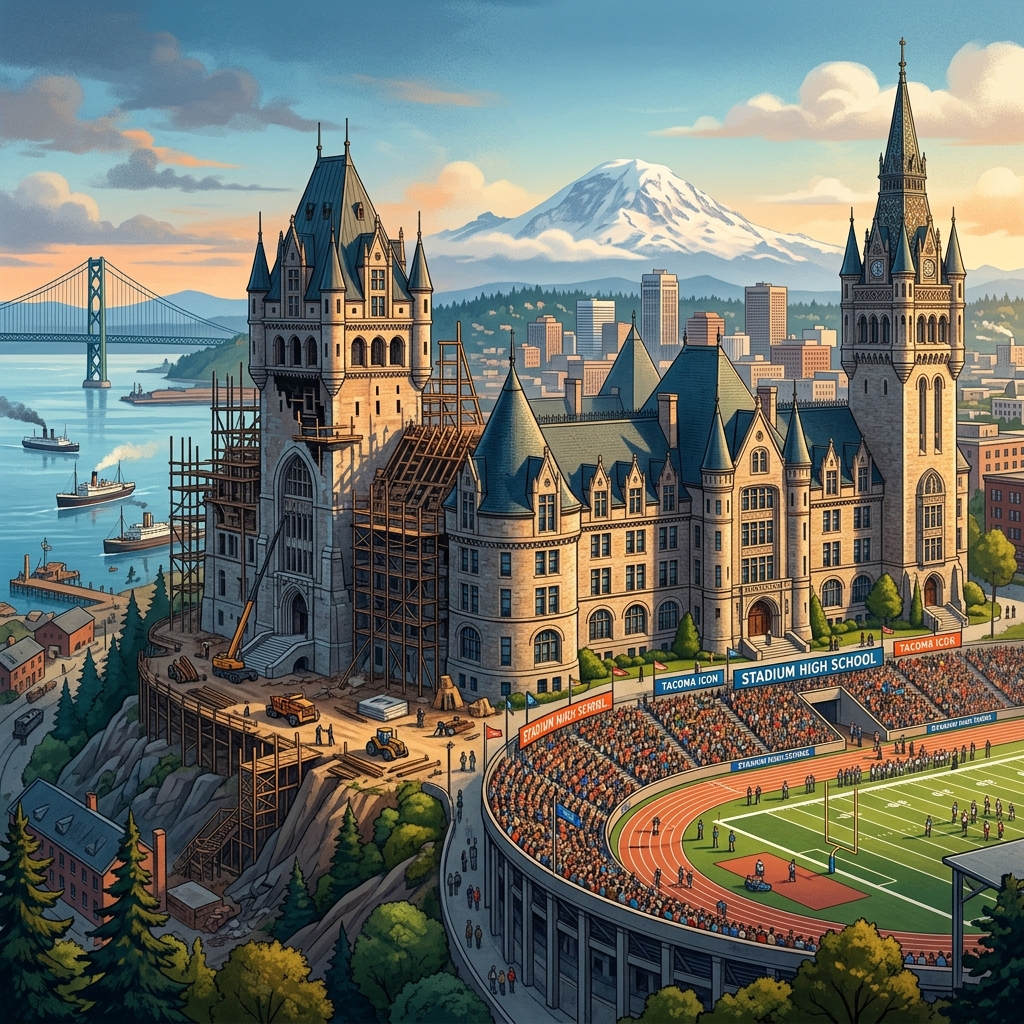
    That single decision set off a chain of events that would eventually produce one of the most architecturally striking high schools in America: the chateau-crowned building at 111 North E Street that Tacoma residents call Stadium High School, and that the rest of the world knows as the backdrop to a certain 1999 Shakespeare adaptation filmed right on the bluff above Commencement Bay.

    But the story between the 1873 telegram and the 1999 film crew is one of ambition, financial ruin, fire, citizen activism, and the kind of resilient improvisation that defines Tacoma at its best.

    The Railroad Bets on Tacoma

    The Northern Pacific’s engineers chose Commencement Bay for practical, not sentimental reasons. The Prairie Line — the flat, treeless corridor connecting Tacoma to the interior — offered the path of least resistance to tidewater. Seattle had lobbied hard, reportedly offering the railroad 7,500 town lots, 3,000 acres, $50,000 in cash, and $200,000 in bonds. The Northern Pacific took Tacoma’s waterfront instead.

    The choice was transformative. Tacoma’s population stood at roughly 1,100 in 1880. By 1889 — the year Washington achieved statehood — it had exploded to 36,000, according to HistoryLink.org. The city platted streets, attracted sawmills and smelters, and began to fancy itself the commercial capital of the Pacific Northwest. The Tacoma Land Company, the railroad’s real estate arm, controlled vast swaths of the city and moved aggressively to shape its identity.

    Part of that identity was supposed to be a world-class hotel.

    The Hotel That Never Opened

    In 1891, the Tacoma Land Company commissioned Philadelphia architects Hewitt and Hewitt to design a palatial tourist hotel on a bluff north of downtown. The site commanded sweeping views of Commencement Bay and the Olympic Mountains beyond. The architects responded with a design drawn directly from the châteaux of France’s Loire Valley: steep mansard rooflines, copper-topped turrets rising from every corner, ornate dormers, and facades built from Roman brick — a distinctive elongated brick style that gave the building its warm, reddish-gold character.

    Construction began with the momentum of a city convinced of its own destiny. Then the Panic of 1893 hit.

    The financial crisis that swept the country in 1893 devastated the Northern Pacific. The company went into receivership. The half-finished hotel on the bluff was quietly abandoned, its turrets and rooflines standing without windows or interior floors, a monument to interrupted ambition. For a time it served as a lumber and shingle warehouse. Then, on October 11, 1898, fire tore through the building, gutting it completely and leaving only the exterior walls standing.

    The Northern Pacific began dismantling the shell, reportedly removing some 40,000 of the distinctive Roman bricks before two Tacoma citizens intervened to halt the demolition. Their argument: the walls were salvageable, the bones were sound, and the city desperately needed a high school.

    Citizens Save the Building

    The Tacoma School District purchased the fire-gutted structure on February 19, 1904, and hired local architect Frederick Heath to complete the reconstruction. Heath’s task was unusual — he was not designing a new building so much as finishing and converting one that had been started by someone else’s vision, interrupted by economic disaster, and partially destroyed by fire.

    Heath preserved the Châteauesque exterior that the Hewitt brothers had designed while reworking the interior entirely for educational use. The building that opened on September 10, 1906, as Tacoma High School was recognizably the same chateau the railroad had started — multiple turrets, mansard lines, the copper detailing — but now filled with classrooms, corridors, and students rather than hotel suites and dining rooms.

    In 1913, when Lincoln High School opened as the district’s second secondary school, Tacoma High School was renamed. The name everyone now knows — Stadium High School — came from the natural feature directly to the south: a ravine called Old Woman’s Gulch that Frederick Heath had also been commissioned to transform into an outdoor athletic venue.

    The Stadium Bowl: Engineering a Natural Amphitheater

    Old Woman’s Gulch cut deep into the Stadium District, its floor originally below sea level and subject to tidal flooding. Between 1909 and 1910, construction crews using steam shovels and hydraulic sluicing moved more than 180,000 cubic yards of earth to level the ravine floor and shape its walls into terraced seating. Wooden molds were poured to cast 31 rows of concrete seating for 11,000 spectators, with the open north end framing an unobstructed view of Commencement Bay and Puget Sound.

    The resulting Stadium Bowl — dedicated on July 10, 1910, at a cost of $135,000 — was one of the largest outdoor athletic venues in the Pacific Northwest. The school and the stadium became inseparable in the public mind, each reinforcing the other’s architectural drama. The chateau on the bluff looked down at the bowl carved from the earth below; together they defined a neighborhood.

    The Stadium District Takes Shape

    The Stadium-Seminary Historic District that grew around the school between 1888 and 1930 is itself a remarkable piece of Tacoma history. The neighborhood — roughly 400 buildings across 50 blocks on the bluff northwest of downtown — developed as the Tacoma Land Company released residential parcels and middle-class families built substantial two- and three-story homes in Queen Anne, Colonial Revival, and Craftsman styles.

    The neighborhood’s layout reflected, however loosely, the ideas of the City Beautiful movement. Frederick Law Olmsted had been commissioned in 1873 to prepare a master plan for New Tacoma; though his specific proposals were never implemented, the design sensibility he represented — broad streets, topographic sensitivity, attention to views — influenced how the Stadium District ultimately developed.

    Today the district is listed on both the Washington State and National Registers of Historic Places. The City of Tacoma’s Historic Preservation Office maintains design review authority over development within it. The near-continuous architectural character — Victorian-era homes beside Craftsman bungalows, largely untouched by mid-century demolition — is rare for a city of Tacoma’s size.

    From Preservation to Pop Culture

    In 2005 and 2006, Stadium High School underwent a major seismic upgrade, historical restoration, and expansion designed to preserve the building for the next century of students. The renovation carefully maintained the exterior’s historic character — the turrets, the rooflines, the Roman brick — while modernizing the interior for contemporary educational use.

    By then, the school had already achieved a different kind of fame. When location scouts for the 1999 film 10 Things I Hate About You — a modern retelling of Shakespeare’s The Taming of the Shrew — saw photographs of Stadium High School, they scrapped plans to film in Los Angeles and moved the entire production to Tacoma. The film’s opening sequence, with Heath Ledger and Julia Stiles navigating the chateau’s corridors and exterior courtyard, introduced the building to a global audience who had no idea they were looking at a failed railway hotel from 1891.

    According to The Seattle Times, alums of Stadium High describe the film as having “put the school on the map” nationally — which is saying something for a building already on three historic registers.

    What the Building Means for Tacoma

    There’s a temptation to read Stadium High School purely as a happy accident — abandoned railroad ambition recycled into public good. But the building’s survival required active choices at several points: the citizens who halted demolition in 1898, the school board that voted to purchase the shell, the architect who honored the original design in his reconstruction, and the community that successfully argued for its historic designation decades later.

    The Washington State Historical Society documents Tacoma’s railroad era extensively, and the Northern Pacific’s choice of Commencement Bay as its terminus runs as a through-line in nearly every major story about the city’s early growth — from the original platting of downtown to the industrial development of the tideflats to the residential neighborhoods that climbed the surrounding bluffs.

    Stadium High School is the most visible physical artifact of that era. It is the building that the Northern Pacific built, that the Panic of 1893 stopped, that fire gutted, that citizens saved, and that Tacoma finished. It has been a school for 120 years. It will likely be one for a good while longer.

    For anyone who wants to understand how Tacoma became Tacoma, the view from the Stadium District bluff — chateau to the left, the bowl below, the bay beyond — is about as clear an explanation as the city offers.

    Frequently Asked Questions About Stadium High School

    Why was Stadium High School originally built as a hotel?

    The Northern Pacific Railway’s Tacoma Land Company began construction of a luxury chateau-style hotel in 1891 to anchor its investment in Tacoma, the railroad’s chosen western terminus since 1873. The hotel was designed to attract wealthy travelers and signal Tacoma’s status as the premier city on Puget Sound. The Panic of 1893 halted construction before the building ever opened.

    What architectural style is Stadium High School?

    Stadium High School is built in the Châteauesque style, drawing from French Renaissance châteaux of the Loire Valley. Designed by Philadelphia architects Hewitt and Hewitt, the building features multiple copper-topped turrets, steep mansard rooflines, decorative dormers, and facades built from Roman brick. It is listed on the Tacoma, Washington State, and National Registers of Historic Places.

    When did Stadium High School open and why did the name change?

    The school opened September 10, 1906, as Tacoma High School after the district purchased the fire-gutted hotel shell in 1904 and commissioned architect Frederick Heath to complete the reconstruction. The name changed to Stadium High School in 1913 when Lincoln High School opened as the district’s second high school, requiring a more specific name tied to the adjacent Stadium Bowl.

    What movie was filmed at Stadium High School?

    The 1999 film 10 Things I Hate About You, a modern adaptation of Shakespeare’s The Taming of the Shrew, was filmed extensively at Stadium High School. Location scouts originally planned to film in Los Angeles but moved the entire production to Tacoma after seeing photographs of the school’s dramatic exterior overlooking Commencement Bay.

    Is Stadium High School a historic landmark?

    Yes. Stadium High School is listed on the Tacoma Register of Historic Places, the Washington State Register of Historic Places, and the National Register of Historic Places. The surrounding Stadium-Seminary Historic District — nearly 400 buildings across 50 blocks — is also listed on both registers. A major seismic upgrade and historical restoration was completed in 2005–2006.


    Related Reading

  • Belfair & Hood Canal Lodging: Where to Stay Guide

    Belfair & Hood Canal Lodging: Where to Stay Guide

    Belfair sits right at the head of Hood Canal, where the long fishhook of saltwater finally runs out of room and turns into the shallow, muddy, eagle-haunted flats of Lynch Cove. This is the top of the canal, not the Great Bend – that elbow is down at Union, a different stretch with a different crowd. Up here the water goes warm and skinny on a summer afternoon, the tide pulls way back over the oyster ground, and the towns stay small: Belfair on the highway, Allyn over on Case Inlet, Tahuya out the north shore, Grapeview tucked off on its own. It is working-forest, shellfish, and shipyard-commute country more than resort country, and the lodging follows suit.

    So set your expectations the right way. You will not find a row of brand-name hotels here. What you get instead is a handful of honest options: one practical in-town motel for a work trip or a quick overnight, a cluster of Washington State Parks and DNR campgrounds for tents, RVs, and a few cabins, a couple of small seasonal waterfront resorts and marinas, and a growing list of whole-house vacation rentals strung along the saltwater. This guide walks all of them, grouped so you can find your kind of stay fast, tells you who each place is really for and the best season to go, and then points you at the live booking pages and search tools so you are always looking at current rooms and rates – not a stale screenshot.

    One housekeeping note that locals care about: if you are coming for a Puget Sound Naval Shipyard interview or an early Bremerton ferry, Belfair is your friend. You sleep at small-town North Mason prices and you are a short, easy run north to the shipyard gates in the morning. More on that below.

    In-town motel: the practical overnight

    When you do not need a view – you need a clean bed, free parking at the door, and a short drive in the morning – this is the category. It is the room a local books for a cousin who is in town to work, not to vacation.

    Belfair Motel

    The Belfair Motel is the straightforward, in-town option: a locally run, single-story motel sitting right on SR-3 (Highway 3) as you roll through the middle of town. No water view, no resort frills – just clean, updated rooms with comfortable beds, refrigerators, and Keurig coffee makers, plus a well-lit lot and free parking. Think of it as the practical pick rather than the destination.

    It is built for people who need a reliable bed more than an experience – someone driving in for a shipyard interview, a one-night stopover, or a budget-minded base camp. It is pet friendly, which matters if the dog is along. From here you are minutes from the Theler Wetlands trails, the shops and food along Highway 3, and the head of Hood Canal at Lynch Cove, with Belfair State Park a short drive south. Best window is late spring through early fall, when the canal, the wetlands, and the parks are at their peak, but for a work stay this room does the job any month. Book direct for current rooms and rates: belfairmotel.com.

    State parks and public campgrounds

    The public land is the real anchor at this end of the canal. Two Washington State Parks sit on warm saltwater beaches, and the Tahuya State Forest behind town is laced with trails and DNR camps. These are campgrounds and day-use parks, not resorts – expect picnic shelters, busy summer weekends, and rules to follow – but they put you right on the water or right on the trail for very little money. Day-use at the state parks needs a Discover Pass; campsites and cabins book ahead, and summer weekends go fast, so reserve early.

    Belfair State Park (cabins and campground)

    This is the public anchor at the very head of Hood Canal, sitting on the Lynch Cove tide flats a few miles southwest of Belfair. It is a Washington State Park, which means a real campground – primitive, standard, and full-hookup sites – plus a handful of simple rentable cabins if you want a roof and a locking door instead of a tent. The draw is the saltwater: a long, shallow swimming and wading beach that warms up on a sunny afternoon, a spit and tide flats for beach walking, and seasonal clamming and oyster picking when the canal is open.

    It is built for families and weekend campers more than for anyone chasing quiet luxury – expect kids, picnic shelters, and a busy summer. The heated cabins lock up tight and stay open year-round, which also makes this an easy, cheap off-season base when the storms roll in. Best window is late spring through early fall for the beach, but always check the current shellfish season before you count on digging dinner. Reserve sites and cabins through the official Washington State Parks system.

    Twanoh State Park (campground)

    Twanoh is a Washington State Park, not a resort, so set expectations accordingly: this is a Civilian Conservation Corps-era day-use and camping park on the south shore of Hood Canal, about eight miles west of Belfair on Highway 106. It sits on one of the warmest saltwater beaches in the state, which is the whole point. Come for wading, swimming, and shellfishing; the tide flats here are a reliable spot to dig clams and gather oysters in season, license required and shuck-on-the-beach rules in force.

    The campground is modest and old-school, a mix of standard tent sites and full-hookup spots tucked under big timber, plus a couple of kitchen shelters for groups. Best window is mid-summer, when the water actually warms up and reservations open; spring and fall are quieter but cooler, and winter is first-come with limited water. A note worth checking before you load the car: this park has restoration work scheduled, so confirm current closures and dates through the official Washington State Parks system first.

    Tahuya River Horse Camp (DNR)

    This is a state-run horse camp, not a resort, tucked into the Tahuya State Forest west of Belfair off the Belfair-Tahuya Road. The Department of Natural Resources runs it for one job: getting riders and their stock onto the trails. Sites come with corrals, fire rings, picnic tables, and potable water, and they are sized to take a decent trailer, so it is built for people hauling horses rather than tent campers looking for a view.

    From here you can reach the Tahuya River Trail and tie into the wider network that threads this forest, which is the real draw. Note that the campground itself is non-motorized, so it suits horse folks and quiet trail users more than the ORV crowd. Sites are first-come, first-served and you will need a Discover Pass on the dash. Best window is late spring through early fall, when DNR opens drive-in access on weekends from Memorial Day to Labor Day. Check the official DNR Green Mountain-Tahuya page before you load up, since access and conditions shift by season.

    Waterfront resorts, marinas, and glamping

    These are the small, mostly seasonal places that put you on the water without renting a whole house. Think simple cottages and park models, RV rows, a boat launch and moorage, kayaks downstairs, or a stocked glamping tent at a trailhead. None of them are polished hotels, and that is exactly the appeal – they are unfussy basecamps for boaters, anglers, paddlers, and riders.

    Summertide Resort and Marina

    Drive the North Shore Road out of Belfair, hug the waterline for a while, and you land at Summertide Resort and Marina in Tahuya. This is a small, seasonal place right on Hood Canal, not a polished hotel, and that is the appeal. The lineup is straightforward: a handful of cottages and park models with full kitchens and water views, an RV row, tent sites, plus the working stuff that makes a canal trip easy – a boat launch, moorage, and a general store for the bag of ice you forgot.

    It suits families and small groups who want an unfussy base on the water, and it earns its keep with boaters and anglers who need a ramp, a slip, and a beach to set crab pots from. Come in summer, when the canal warms up for swimming and the shrimp and crab seasons draw people to this end of the water. Check current cottage and RV availability and book direct on their official site.

    Tahuya Adventure Resort

    This is a campground built for people who came to ride. Tucked into the heart of the Tahuya State Forest, a short hop up the north shore from Belfair, it sits right at the doorstep of the Tahuya off-road vehicle park and its big web of trails. You can pick your comfort level: stocked glamping tents with real beds and a stove if you want a roof and a soft landing, full-hookup pull-through sites for the RV, or plain tent sites if you are happy with a fire ring and the trees. A covered camp kitchen ties the place together for groups.

    The crowd skews ORV, dirt bike, mountain bike, and horse, and the trailhead access is the whole point – though Twanoh State Park and the canal shoreline are close enough for a swim or a fishing afternoon. Summer is prime for riding and water; spring and fall trade heat for quieter trails. Check current rates and dates on their booking page before you load the trailer: tahuyaresort.com.

    Allyn House Inn (and North Bay Kayaks)

    This is waterfront lodging in the small town of Allyn, set right on the North Bay of Case Inlet near the head of Hood Canal. It is not a resort and it is not a chain motel; it is a handful of self-contained, apartment-style units a short walk from the Allyn waterfront, the dock, and a cluster of local eateries. The draw is the same family running North Bay Kayaks downstairs, so you can roll out of bed, grab a rental or book a guided paddle, and be on the water in minutes.

    It suits couples and small families who want a quiet base on the saltwater without fussing with a big property, and paddlers who want lodging and boats in one stop. Nearby you have Allyn’s waterfront park, easy launches into the protected bay, and the back roads toward Grapeview and Tahuya. Late spring through early fall is the sweet spot, when the inlet calms down, shorebirds work the tide flats, and the paddling is at its best. Check current units and rates on their official site.

    Waterfront vacation homes (whole-house rentals)

    This is the category that has grown the most around Belfair: rent the whole place, get your own stretch of beach, spread out, and cook for the group. These are owner-run houses, not resorts with a front desk, so they range from a tidy three-bedroom cottage to a five-bedroom reunion house. The common thread is private shoreline at the quiet head of the canal – bring kayaks, watch for eagles, and plan your days around the tide. Listings change hands and rates shift, so always confirm on the live booking page.

    Sunrise Canal (waterfront cottage)

    Sunrise Canal is a single owner-run vacation cottage on Belfair’s north shore, sitting right on the saltwater up at the quiet head of Hood Canal. This is a whole-house rental, not a room or a resort – a remodeled three-bedroom place with its own beach access, a stocked kitchen, water views from the living space, and a fire pit out back for the evening. It suits families or a couple of households who want their own waterfront base rather than a hotel hallway, with enough room to spread out and a stretch of shoreline to call your own for the stay.

    You are close to the good stuff without being on top of it. Belfair State Park is about ten minutes off, the Theler Wetlands trails and the Lynch Cove boat launch are right around the corner, and groceries and a meal out are a short drive. Bring kayaks and watch for eagles off the patio. Late spring through early fall is the sweet spot – warmest water, calmest paddling, longest evenings. Check current rates and open dates on the owner’s site.

    Once Upon a Tide

    This is a single owner-run waterfront vacation home on Hood Canal’s North Shore, a few minutes west of Belfair near the head of the canal. It is a two-story Cape Cod-style house sitting on roughly 100 feet of low-bank pebble beach, with a wide deck built for watching the water and the far ridgeline. It rents as a whole house, not a room, so it suits a family or two couples who want the place to themselves rather than a resort with a front desk.

    The draw here is the beach itself: an oyster bed surfaces on a good low tide, you can pull a kayak or small boat right up on the gravel, and there is a public launch about a mile down the road for anything bigger. Summer is the obvious season, since this stretch of Hood Canal warms up enough to actually swim and the minus tides are best for oystering, though the quiet shoulder months reward anyone who just wants the deck and the view. Book direct through the owner via their listing page.

    Shoofly Creek Retreat

    Shoofly Creek Retreat is one of the larger waterfront houses on the Belfair end of Hood Canal, and it is built for a crowd. This is a single big vacation home, not a resort with a front desk, sleeping somewhere around fifteen across five bedrooms with its own stretch of beach and the namesake creek running down to the water. That makes it a reunion-and-wedding-party kind of place rather than a quiet couples getaway. You get the whole house, room to spread out, and kayaks to put in right off the lawn.

    You are at the very head of the canal here, close to Belfair State Park and the local beaches, with Tahuya and the north shore an easy drive for hiking and tide-pooling. Summer is the obvious draw for swimming, crabbing, and warm-water shellfish season. But come fall and you can watch salmon push up Shoofly Creek from the backyard, which is the quieter, more local reason to book. Check current rates and dates on the official listing.

    Plan your stay by season

    The head of Hood Canal reads completely differently depending on when you come. Here is how locals match the trip to the calendar, with a sample weekend for each.

    Summer: shellfish and a saltwater swim weekend

    This one is for the family that wants to fill a bucket at low tide and still get a real swim in before dinner. Belfair sits at the head of Hood Canal, where the water goes shallow and warm and the tide pulls way back over the flats. Mid-July through August is the sweet spot: longest daylight, warmest water, and the recreational shellfish season usually open. Come for two nights and plan around the tide chart. Base yourself on the water at Summertide Resort in Tahuya, or grab a waterfront campsite or cabin at Belfair State Park with the warm swimming lagoon right there.

    • Time the tide first. Dig and swim on a good low. Check the Lynch Cove tide predictions before you commit a day.
    • Clear the shellfish, every trip. Confirm the beach is open on the Washington Department of Health biotoxin map and check season and limits with WDFW. Closures change fast – bring boots and a license.
    • Fill the in-between hours. Walk the boardwalks at Theler Wetlands, drive out to Tahuya State Forest, or run up to Allyn for a burger and a look at Case Inlet.

    Spring through early fall: Tahuya dirt-and-trail weekend

    This is a get-dirty weekend, not a spa weekend. Tahuya State Forest sits just west of Belfair and is the engine room for ORV riders, mountain bikers, and horse folks across North Mason – roughly 84 miles of trail through working DNR forest. It is a working forest, so logging and washouts move the closure map around week to week. Best window is late spring through early fall, after the gates open (roughly mid-April through October 31) and before the mud sets in. Start at the Elfendahl Pass Staging Area, the main trailhead hub off Belfair-Tahuya Road.

    • Where to stay: the Tahuya River Horse Camp for equestrians with rigs, or Tahuya Adventure Resort for ATV-friendly basecamp lodging close to the trails.
    • Permits: you need both – a Discover Pass to park on DNR land, and an ORV tab and permit for motorized rigs. Confirm current rules at the DNR page.
    • Bring: a paper trail map, spare straps and a tow strap, first aid, bug spray, and water – cell service is patchy out there.
    • Cool down: Belfair State Park and the Theler Wetlands boardwalks on Lynch Cove, or a quiet evening up at Allyn on Case Inlet.

    Spring: birding and a paddle at the head of the canal

    Spring is the right time to point yourself at the head of Hood Canal. The Union River estuary at Belfair wakes up fast as the days lengthen, and Case Inlet lies down enough to put a boat in. Make it a slow weekend: birds in the morning, a paddle on a friendly tide, oysters and a porch by evening. Start at the Theler Wetlands at first light – the boardwalk runs out through restored salt marsh, and April through May is peak for herons, eagles, osprey, swallows, and warblers. For a base, the Allyn House Inn sits on the Case Inlet waterfront with the kayak shop run by the same folks.

    • Paddle: launch onto Case Inlet from Allyn on a rising or high tide; the south end goes to mud fast, so check the tide tables first. North Bay Kayaks rents and guides if you are not hauling your own.
    • Shellfish: beaches open and close on biotoxins – confirm before you dig on the Washington Shellfish Safety Map.
    • Day two: Tahuya State Forest is ten minutes out for trails and quiet lakes, and Belfair State Park has a tidal beach.

    Fall and winter: storm-watching and better rates

    The locals’ secret about the head of Hood Canal is that it gets better after the summer crowds leave. From roughly November through February, Lynch Cove turns moody and gorgeous: low gray light, southerlies pushing whitecaps up the canal, and lodging rates that finally make sense. This is a trip for people who like weather, not sunbathing. The heated cabins at Belfair State Park lock up tight and stay open year-round, which makes them an easy, cheap off-season base right on the saltwater. Ask for a site near the shore for the best storm seats.

    • Theler Wetlands: flat boardwalk through the estuary, great in a light rain when the birds move in.
    • Tahuya State Forest: gravel-road exploring and quiet trails just west when the canal turns rough.
    • Allyn: a short drive north for a hot meal and a look at the water from the other side.

    Year-round: the PSNS-interview one-night practical stay

    This is the no-fuss play for a work trip to the head of Hood Canal. You are interviewing at the shipyard, catching an early ferry out of Bremerton, or just need a clean room and a short drive in the morning. You are not chasing a waterfront view tonight; you want to sleep, get up, and go. Belfair sits right at the top of Lynch Cove, so you are close to Bremerton and PSNS while paying small-town Belfair prices instead of in-town Bremerton rates. Book the in-town Belfair Motel straight off their site – microwave, fridge, parking at the door, easy checkout.

    • Morning, if you have an hour: coffee and a short walk at the Theler Wetlands boardwalk or down at Belfair State Park on the tideflats. Check the Lynch Cove tide first – low tide is mud, not beach.
    • Heading out: Bremerton and the PSNS gates are a quick run north; confirm the live Washington State Ferries schedule before you commit to a sailing.
    • Want water instead: if the trip turns into an overnight worth a view, the waterfront rentals on Lynch Cove and toward Allyn are the upgrade. Save those for when you are not racing a 6 a.m. boat.

    More waterfront vacation rentals

    The houses above are the ones we know and can vouch for, but the short-term-rental inventory at the head of the canal churns constantly – places come on and off the market every season. Rather than mirror listings that go stale, here are live searches that always show what is actually open right now. Set your dates and party size and book direct with the host or platform.

    Frequently asked questions

    Is Belfair on the Great Bend of Hood Canal?

    No. Belfair sits at the head of Hood Canal, at the very top of the fishhook, where the saltwater shallows out into Lynch Cove. The Great Bend – the sharp elbow where the canal turns east – is down at Union, several miles to the southwest. People mix these up all the time. If you are reading about Belfair, Allyn, Tahuya, or Lynch Cove, you are at the head of the canal; the Great Bend and Union are their own stretch with their own lodging.

    Where should I stay near Belfair for a Puget Sound Naval Shipyard trip?

    For a work stay – a PSNS interview, a contractor rotation, or an early Bremerton ferry – the in-town Belfair Motel is the practical pick. It is a clean, pet-friendly roadside motel on Highway 3 with parking at the door, and from Belfair you are a short run north to the Bremerton and shipyard area while paying small-town prices. If your trip turns into an overnight worth a view, step up to one of the waterfront rentals on Lynch Cove or over toward Allyn.

    Can I camp right on the water near Belfair?

    Yes. Belfair State Park sits on the Lynch Cove tide flats with waterfront campsites and a few heated cabins, and Twanoh State Park, about eight miles west on Highway 106, sits on one of the warmest saltwater beaches in the state. Both are Washington State Parks – reserve ahead for summer weekends, bring a Discover Pass for day use, and check current closures before you go. For RVs and cottages on the canal, Summertide Resort and Marina out the north shore in Tahuya is the waterfront option.

    When is the best time to visit Belfair and the head of Hood Canal?

    Late spring through early fall is the all-around sweet spot: warmest water for swimming, calmest paddling, and the recreational shellfish season usually open (always confirm the beach is open before you dig). Mid-summer is peak for the warm-water beaches at Belfair and Twanoh. If you would rather have lower rates and dramatic weather, late fall and winter bring storm-watching on Lynch Cove and open, heated cabins at Belfair State Park.

  • The Everett WA Waterfront: A Visitor’s Guide to Boxcar Park, the Marina & Port Gardner Bay

    The Everett WA Waterfront: A Visitor’s Guide to Boxcar Park, the Marina & Port Gardner Bay

    The Everett WA waterfront is the city’s saltwater front door: a working marina, a public park-lined esplanade, and an open sweep of Port Gardner Bay looking out toward Whidbey Island and the Olympics. It has grown from a quiet boat-and-rail district into one of the most walkable destinations in Snohomish County, anchored by Boxcar Park, the Port of Everett’s marina, and seasonal ferry access to Jetty Island. This guide covers what’s down there, how to get around, and how to spend an afternoon by the water.

    Quick answer: The Everett WA waterfront sits along Port Gardner Bay on the west side of the city, centered on the Port of Everett marina and the Waterfront Place district. The main things to do are walking the public esplanade, hanging out at Boxcar Park, watching boats and sunsets over the bay, and (in summer) riding the free passenger ferry to Jetty Island. It’s free to visit and open year-round, with public parking near the marina.

    Where Is the Everett WA Waterfront?

    The Everett WA waterfront runs along the eastern shore of Port Gardner Bay, the body of water where the Snohomish River meets Possession Sound and the larger Puget Sound. It’s on the west side of downtown Everett, a short drive from Interstate 5, and is managed largely by the Port of Everett, a public agency that operates the marina, the surrounding parks, and the mixed-use Waterfront Place development of apartments, shops, and restaurants.

    The setting is the draw. Looking west across the bay, you see Jetty Island in the foreground, Whidbey Island beyond it, and on a clear day the Olympic Mountains on the horizon. To the north, the river delta opens into a maze of channels and wildlife habitat. Because the marina faces west, it is one of the better sunset spots in the region.

    Boxcar Park: The Waterfront’s Front Lawn

    Boxcar Park is a centerpiece public green space of the Everett waterfront and one of the easiest places to start a visit. Named in a nod to the area’s rail heritage, it’s a grassy point at the north end of the marina district built for people to gather, picnic, and take in the view across Port Gardner Bay.

    What makes Boxcar Park worth the stop:

    • Open lawn and seating with direct, unobstructed views of the bay and, on a clear day, the Olympics
    • A relaxed, dog-friendly atmosphere — it’s a popular gathering spot and serves as the staging area for the Jetty Island ferry in summer
    • A shelter for shade and weather, handy on a breezy or drizzly day
    • Proximity to the marina boardwalk, so you can combine a park visit with a waterfront walk
    • Sunsets and kite-flying — the open exposure and steady bay breeze make it a local favorite for both

    It’s a low-key spot rather than a playground-and-amenities mega-park, which is exactly its appeal: bring a blanket, a coffee, or takeout and watch the water. For current hours and any event closures, check the City of Everett or Port of Everett parks listings.

    The Port of Everett Marina and the Esplanade Walk

    The Port of Everett marina is the heart of the waterfront and one of the largest public marinas on the West Coast, home to a large fleet of recreational and commercial vessels. You don’t need a boat to enjoy it — the public esplanade and boardwalk let anyone walk right along the water’s edge past the slips.

    Walking the waterfront

    The marina-side promenade is flat, paved, and stroller- and wheelchair-friendly, making it the best way to experience the Everett waterfront on foot. A typical loop links Boxcar Park, the marina boardwalk, and the Waterfront Place plaza, with benches and public art along the way. Expect to see:

    • Rows of moored sailboats and motor yachts, plus the occasional fishing or charter vessel heading out
    • Public viewpoints and pocket plazas built into the development
    • Restaurants and a bakery opening onto the water (see below)
    • Boat launches and guest moorage for visiting boaters

    On-water recreation

    Beyond walking, the marina is a launch point for getting onto the water. Kayak and small-craft rentals, fishing charters, whale-watching trips, and sailing are all part of the Port Gardner scene in season. Operators and schedules change year to year, so confirm what’s currently running with the Port of Everett before planning an on-water outing.

    Jetty Island: A Free Summer Ferry Ride

    Jetty Island is the long, low, largely man-made island just offshore from the marina, and reaching it is one of the signature Everett waterfront experiences. It offers a long stretch of sandy beach, shallow sun-warmed tide flats that are unusually swimmable for Puget Sound, dunes, and excellent birdwatching — there are no permanent buildings, just open natural shoreline.

    The key thing to know: during the summer season, the City of Everett runs a free passenger ferry from the waterfront over to Jetty Island. Important planning notes:

    • The ferry is seasonal (summer only) and typically requires a reservation for the short crossing — walk-up availability can be limited
    • There are no stores and limited or no drinking water and restrooms on the island, so bring water, sun protection, and anything else you’ll need
    • It’s a day-use destination with no overnight access
    • Outside the ferry season, the island is reachable only by private boat or kayak

    Because dates, reservation rules, and any fees are set each year, always confirm the current season and booking process through the City of Everett’s Jetty Island ferry information before you go.

    Port Gardner Bay Views and What Else to Do

    Port Gardner Bay is the scenic payoff of the entire Everett waterfront, and simply taking in the view is a legitimate reason to visit. Beyond the park and the ferry, here’s how people round out a waterfront day:

    • Sunset watching — the west-facing marina and Boxcar Park glow at golden hour over the water and, on clear evenings, the Olympics
    • Wildlife and birding — seals, herons, eagles, and shorebirds are common along the delta and the jetty
    • Festivals and events — the waterfront hosts seasonal markets, music, and community events; check the Port of Everett events calendar for current listings
    • Photography — the boats, the bay, and the mountain backdrop make this one of Snohomish County’s most photogenic spots
    • A meal by the water — the district has grown into a genuine dining destination (see below)

    Where to eat on the Everett waterfront

    This guide focuses on the waterfront as a place to go, but the food down there deserves its own visit. The Waterfront Place district has added sit-down restaurants and a bakery that open onto the water, well suited to a coffee-and-pastry stop before a walk or a meal after one. Because the lineup of businesses changes as the district grows, check the Port of Everett or Waterfront Place directory for what’s currently open, and watch this site for our dedicated waterfront restaurant write-ups.

    Visiting Tips: Parking, Access, and Best Time to Go

    • Getting there: The waterfront is a short drive from I-5 via the Marine View Drive corridor on the west side of the city; signage points to the marina and Waterfront Place.
    • Parking: There is public parking near the marina and Waterfront Place. Lots can fill on summer weekends and event days, so arrive early and check the Port of Everett site for current locations and any rates.
    • Accessibility: The esplanade and main boardwalk are paved and level, suitable for strollers and wheelchairs.
    • Best time to go: Summer for the Jetty Island ferry and warm tide flats; late afternoon year-round for sunsets over the bay. Dress in layers — the bay breeze runs cool even on warm days.
    • Dogs: Leashed dogs are generally welcome along the waterfront and at Boxcar Park; the Jetty Island ferry and island have their own pet rules, so check ahead.

    Frequently Asked Questions About the Everett WA Waterfront

    What is there to do at the Everett WA waterfront?

    At the Everett waterfront you can walk the public esplanade along the marina, relax at Boxcar Park, take in Port Gardner Bay and Olympic Mountain views, ride the seasonal free ferry to Jetty Island, and eat at waterfront restaurants. On-water options like kayaking, fishing charters, and whale watching are available in season through Port of Everett operators.

    Is Jetty Island free, and how do you get there?

    Jetty Island itself is free to enjoy, and in summer the City of Everett runs a free passenger ferry to it from the waterfront. The ferry is seasonal and typically requires a reservation for the short crossing. Outside the summer ferry season, the island is only reachable by private boat or kayak. Confirm current dates and booking details with the City of Everett.

    Is there parking at the Everett marina and waterfront?

    Yes. There is public parking near the Port of Everett marina and the Waterfront Place district. Spaces can fill quickly on summer weekends and during festivals or events, so arriving early is recommended. Check the Port of Everett website for current parking locations and any rates.

    What is Boxcar Park in Everett?

    Boxcar Park is a public waterfront green space at the north end of the Port of Everett marina, named for the area’s rail history. It offers open lawn, seating, bay and mountain views, and serves as the summer staging area for the Jetty Island ferry. It’s a popular, low-key spot for picnics, sunsets, and kite-flying.

    When is the best time to visit the Everett waterfront?

    Summer is best for the Jetty Island ferry and the island’s warm, swimmable tide flats, while late afternoon and golden hour are ideal year-round for sunsets over Port Gardner Bay. Weekday visits avoid the busiest parking. Bring layers, since the bay breeze stays cool even on warm days.

  • Things to Do in Everett, WA: A Local’s Complete Guide

    Things to Do in Everett, WA: A Local’s Complete Guide

    Looking for things to do in Everett, WA? This is the master guide a lot of locals wish they’d had when they moved here. Everett is the largest city in Snohomish County, sitting on Port Gardner Bay about 25 miles north of Seattle, and it packs a saltwater waterfront, a genuine arts district, family museums, and high-level junior hockey into a compact city with a walkable downtown core. Whether you have a free afternoon, a rainy Saturday, or out-of-town guests to impress, there’s more here than the I-5 view lets on.

    Quick answer: The top things to do in Everett, WA include riding the seasonal foot ferry to Jetty Island, walking the Port of Everett waterfront and marina, catching an Everett Silvertips hockey game at Angel of the Winds Arena, exploring the Schack Art Center and Imagine Children’s Museum downtown, and hiking or picnicking at parks like Forest Park and Howarth Park. Many of the best options are free or low-cost, and most sit within a short drive of one another.

    Things to Do in Everett, WA on the Waterfront

    Everett’s defining feature is its working waterfront on Port Gardner Bay. The Port of Everett operates one of the largest public marinas on the West Coast, and the surrounding district, often called Waterfront Place, blends boat slips with restaurants, public plazas, and walking paths. It’s the kind of place where you can watch sailboats come and go, grab a meal with a water view, and let kids burn off energy near the water, all in one stop.

    Jetty Island

    Jetty Island is Everett’s signature summer experience. It’s a roughly two-mile-long, human-made island with a sandy beach and shallow, sun-warmed tidal flats that get surprisingly swimmable for Puget Sound. A passenger ferry runs across the channel during the summer season (generally mid-summer through early fall). Because the island has no concessions and limited facilities, locals treat it like a true beach day: pack water, sunscreen, snacks, and shade. Ferry sailings fill up on hot weekends, so check the City of Everett Parks website for the current season dates, fees, and reservation details before you go.

    Marina walks and boat watching

    Even outside ferry season, the marina is worth a visit. You can stroll the docks, watch the fishing and pleasure fleet, and take in views across the bay toward the Olympics on a clear day. The waterfront is also a launch point for whale-watching and fishing charters that depart Everett seasonally; the operators handle their own scheduling, so book directly with the charter company.

    Parks and Outdoor Things to Do

    Everett’s park system is one of its quiet strengths, ranging from forested trails to bluff-top beach access. These are durable, year-round options and most are free.

    • Forest Park — A large, central park with forested trails, picnic shelters, sports facilities, and a seasonal animal farm and spray park that are family favorites. A reliable pick when you want to be outside but close to town.
    • Howarth Park — Known for its pedestrian bridge over the railroad tracks down to a Puget Sound beach, plus a hillside playground. One of the better spots in the city for a real saltwater beach walk.
    • Legion Memorial Park and Langus Riverfront Park — Northside parks with golf nearby, water views, and flat trails. Langus connects to a riverside loop that’s popular with runners, cyclists, and rowers along the Snohomish River.
    • Grand Avenue Park — A bluff-top park with a pedestrian bridge over to the waterfront and some of the best sunset views in the city.

    For trail conditions, seasonal hours, and the Forest Park animal farm schedule, the City of Everett Parks and Recreation website is the source to check.

    Arts, Culture, and Family Museums

    Downtown Everett has a compact, genuinely good arts and culture cluster, which makes it a strong rainy-day destination.

    Schack Art Center

    The Schack Art Center is a downtown gallery and studio space best known for its hot-glass studio, where you can watch artists blow glass and, in some seasons, sign up for hands-on classes. It rotates exhibitions throughout the year and anchors Everett’s visual-arts scene. Check the Schack’s website for current exhibits and class registration.

    Imagine Children’s Museum

    The Imagine Children’s Museum is the go-to indoor destination for families with young kids, with hands-on, play-based exhibits across multiple floors and a popular rooftop play area. It’s purpose-built for the under-10 crowd and one of the most reliable Saturday options when the weather turns. Verify hours and any timed-ticket requirements on the museum’s site before visiting.

    Live performance and historic theaters

    Downtown Everett also hosts live theater and music. The Historic Everett Theatre stages performances and screenings, and the broader downtown core fills with events, markets, and gallery walks throughout the year. For what’s on while you’re in town, check the venues’ own calendars alongside our Everett events coverage.

    Angel of the Winds Arena and Everett Silvertips Hockey

    Angel of the Winds Arena is downtown Everett’s largest event venue and the home of the Everett Silvertips, the city’s major-junior ice hockey team in the Western Hockey League (WHL). Silvertips games are one of the best-value live-sports nights in the region: fast-paced hockey, an energetic crowd, and a downtown location with restaurants in easy walking distance.

    The arena also books concerts, family shows, and other events throughout the year. The hockey season generally runs from fall into spring, with playoffs extending later for teams that advance. For the current Silvertips schedule, ticket prices, and the arena’s full event calendar, go straight to the Angel of the Winds Arena and Everett Silvertips official websites.

    Free and Cheap Things to Do in Everett, WA

    You don’t need to spend much to have a good day here. Budget-friendly and free options include:

    • Walk the waterfront and marina — Free, scenic, and open year-round.
    • Beach time at Howarth or Jetty Island — The beaches themselves cost nothing; the Jetty ferry charges only a modest fare in season (confirm current rates with City of Everett Parks).
    • Explore the parks — Forest Park, Grand Avenue Park, and Langus Riverfront Park are all free to enter.
    • Browse downtown galleries — The Schack Art Center’s gallery and glass-studio viewing are low-pressure, and downtown art walks are free to wander.
    • Catch a community event or farmers market — Seasonal markets and festivals run through the warmer months; check our Everett events coverage for current dates.

    Weekend and Rainy-Day Itinerary Ideas

    Everett rewards a little planning. Here are two simple frameworks locals lean on.

    1. Sunny summer Saturday: Start with a morning Jetty Island ferry and beach session, head back to the marina for lunch with a water view, then close the day with sunset from Grand Avenue Park or Howarth Park.
    2. Rainy-day plan: Open at the Imagine Children’s Museum or the Schack Art Center, grab lunch downtown, then catch an evening Silvertips game or a show at Angel of the Winds Arena. Everything stays within the walkable downtown core.

    For where to eat between stops, lean on our Everett restaurant coverage rather than guessing, hours and menus change, and locals have strong opinions worth borrowing.

    Frequently Asked Questions

    What is Everett, WA known for?

    Everett is known as the largest city in Snohomish County, for its working waterfront and large public marina on Port Gardner Bay, for Boeing’s major aerospace manufacturing presence in the area, and as home to the Everett Silvertips junior hockey team at Angel of the Winds Arena.

    Is Jetty Island free?

    The beach on Jetty Island is free, and the passenger ferry run through the City of Everett is typically free or charges only a modest fare during its summer operating season. Sailings can fill on hot weekends and may require a reservation, so check the City of Everett Parks website for the current schedule and any fees before you go.

    What is there to do in Everett when it rains?

    Good rainy-day options include the Imagine Children’s Museum, the Schack Art Center and its glass studio, a performance at the Historic Everett Theatre, and an Everett Silvertips game or other event at Angel of the Winds Arena, all in the walkable downtown core.

    How far is Everett from Seattle?

    Everett sits roughly 25 to 30 miles north of downtown Seattle along Interstate 5. Driving time varies widely with traffic; regional transit options also connect the two cities. Check current transit schedules with the relevant agency before relying on them.

    Is Everett, WA worth visiting?

    Yes. Everett offers a saltwater waterfront, a unique summer beach experience at Jetty Island, a real downtown arts cluster, family museums, and affordable major-junior hockey, often at lower cost and with smaller crowds than comparable Seattle attractions, making it an easy and rewarding day trip or weekend stop.

  • Salish Cliffs Golf Club: A Guide to Mason County’s Championship Course

    Salish Cliffs Golf Club: A Guide to Mason County’s Championship Course

    Salish Cliffs Golf Club is an 18-hole championship golf course near Shelton in Mason County, Washington, owned and operated by the Squaxin Island Tribe as part of Little Creek Casino Resort. Carved into the forested foothills of the South Sound, it pairs a well-regarded, environmentally stewarded layout with a full resort that offers lodging, dining, gaming, and a spa. For golfers, it is one of the signature destinations in the region; for visitors, it anchors a full overnight getaway just off U.S. Highway 101. For current tee times, green fees, and hours, always check the official Salish Cliffs and Little Creek Casino Resort website.

    What is Salish Cliffs Golf Club?

    Salish Cliffs Golf Club is the championship golf course at Little Creek Casino Resort, located in the Kamilche area between Shelton and Olympia, just off Highway 101 in southern Mason County. The course is owned by the Squaxin Island Tribe and operates alongside the resort’s hotel, casino, restaurants, and event spaces. Since opening, it has earned a strong reputation among Pacific Northwest golfers for its design quality, scenic setting, and well-maintained playing conditions.

    The “cliffs” in the name reflect the terrain: the layout moves through rolling, wooded foothills with notable elevation changes, exposed rock, wetlands, and dramatic forest backdrops typical of the South Sound. The course was designed to flow with the natural landscape rather than flatten it, which gives each hole its own character and keeps the round visually engaging from start to finish.

    Who owns and operates it

    The Squaxin Island Tribe owns and operates both Salish Cliffs Golf Club and Little Creek Casino Resort. The Squaxin Island people are known as the “People of the Water,” with deep ancestral ties to the inlets and shorelines of southern Puget Sound. The resort and golf club are part of the tribe’s broader enterprise presence in Mason County, and the course’s design and stewardship reflect a strong emphasis on environmental care and the surrounding natural setting.

    The course: setting, design, and reputation

    Salish Cliffs is widely described as a destination-quality course rather than a casual municipal track. It is built to challenge serious golfers while remaining playable for a range of skill levels through multiple sets of tees. Expect a parkland-meets-forest experience: tree-lined corridors, water features, elevation changes, and views that open up across the wooded hills of Mason County.

    A few things set the course apart:

    • Environmental stewardship. Salish Cliffs is known for its environmental program, including recognition through Audubon International certification, reflecting an emphasis on wildlife habitat, water quality, and responsible land management. This stewardship is a point of pride and is woven into how the course is maintained.
    • Natural routing. The holes are routed to follow the land’s contours, so the course uses the foothills’ natural ridges, drops, and forest edges rather than fighting them.
    • Conditioning. The course has a reputation for strong conditioning, helped by the relatively mild South Sound climate, though play and conditions naturally vary with Pacific Northwest seasons.
    • Scenery. Mature evergreen forest, rock outcrops, and wetlands give the round a distinctly Northwest sense of place.

    Because yardages, slope and rating, par, and tee configurations are the kind of details that get updated over time, confirm the current scorecard and course specifics on the official Salish Cliffs website before you play.

    The resort context: lodging, dining, and gaming around your round

    One of the biggest advantages of Salish Cliffs is that it sits inside a full resort. A round here can be a quick stop or the centerpiece of a stay-and-play weekend without ever needing to get back in the car.

    Lodging

    Little Creek Casino Resort offers on-site hotel accommodations, which makes early tee times and multi-day golf trips convenient. Staying on property means you can roll from your room to the first tee and back to dinner without leaving the resort grounds. Stay-and-play packages that bundle lodging with golf are a common offering at resort courses like this, so it is worth asking about current packages when you book.

    Dining

    The resort includes multiple dining options, ranging from casual to more upscale, plus the food-and-beverage service you would expect around a championship course. Whether you want a quick bite at the turn or a sit-down meal after your round, the resort is set up to handle it. Specific restaurants, menus, and hours change over time, so check the resort’s dining page for what is currently open.

    Gaming, spa, and events

    Beyond golf, Little Creek Casino Resort features a casino floor, a spa, and event and meeting space. That mix makes it a popular choice for group trips where not everyone in the party plays golf, as well as for corporate outings, tournaments, and special events. The combination of course, hotel, casino, and spa under one roof is a large part of what makes Salish Cliffs a true destination rather than just a place to play 18 holes.

    How to plan a visit to Salish Cliffs

    Planning a round at Salish Cliffs is straightforward, but a little preparation goes a long way—especially if you are traveling in or trying to land a weekend tee time.

    1. Book tee times in advance. As a sought-after resort course, prime weekend and holiday times can fill up. Reserve through the official Salish Cliffs website or pro shop, and check for current rates and any seasonal or twilight pricing.
    2. Ask about stay-and-play. If you are coming from out of town, bundling a hotel night with your round through Little Creek Casino Resort is often the most convenient (and sometimes the best-value) way to go.
    3. Plan for the weather. This is the Pacific Northwest. Summers are typically dry and pleasant; shoulder seasons and winter can bring rain. Pack layers and rain gear outside the peak summer stretch, and confirm seasonal hours before you drive out.
    4. Check facilities and policies. Practice areas, club rentals, cart policies, dress code, and lesson availability are all best confirmed directly with the pro shop, since these can change.
    5. Build in resort time. Give yourself room before or after the round to enjoy the dining, casino, or spa—many visitors treat Salish Cliffs as part of a broader getaway rather than a standalone outing.

    Getting there

    Salish Cliffs and Little Creek Casino Resort are located off U.S. Highway 101 in the Kamilche area, between Shelton and Olympia in southern Mason County. The location is convenient from the South Sound and the broader Olympia–Tacoma corridor, making it an easy day trip or weekend escape for golfers across the region. For exact driving directions, use the address listed on the official resort website.

    Why Salish Cliffs matters to Mason County

    For a largely rural county better known for its shoreline, forests, and small-town character, Salish Cliffs Golf Club is a standout regional draw. It brings destination golfers into Mason County, supports the local visitor economy, and showcases the area’s natural beauty to people who might otherwise pass through on Highway 101 without stopping. As a tribal enterprise of the Squaxin Island Tribe, it also reflects the central role the tribe plays in the county’s economy and hospitality landscape. For residents, it is a high-quality course close to home; for visitors, it is often the reason they discover this corner of the South Sound in the first place.

    Frequently asked questions

    Where is Salish Cliffs Golf Club located?

    Salish Cliffs Golf Club is in the Kamilche area near Shelton, in southern Mason County, Washington, just off U.S. Highway 101. It is part of Little Creek Casino Resort, between Shelton and Olympia in the South Sound region.

    Who owns Salish Cliffs Golf Club?

    Salish Cliffs Golf Club is owned and operated by the Squaxin Island Tribe as part of Little Creek Casino Resort. The course and resort are tribal enterprises located near Squaxin Island Tribe lands in Mason County.

    Is Salish Cliffs open to the public?

    Yes. Salish Cliffs operates as a public, daily-fee championship course where anyone can book a tee time, and it is also paired with on-site lodging for stay-and-play visits. Reserve through the official Salish Cliffs or Little Creek Casino Resort website, and confirm current hours and rates there.

    Is there a hotel at Salish Cliffs?

    Yes. Salish Cliffs is part of Little Creek Casino Resort, which includes an on-site hotel along with dining, a casino, a spa, and event space. This makes it convenient for golf getaways and group trips where not everyone plays.

    How do I get current tee times and green fees?

    Tee times, green fees, seasonal pricing, and hours change over time, so the most reliable source is the official Salish Cliffs Golf Club and Little Creek Casino Resort website or the pro shop. Booking ahead is recommended for weekends and holidays.

  • Parks in Tacoma: A Complete Guide to Metro Parks, Waterfront & More

    Parks in Tacoma: A Complete Guide to Metro Parks, Waterfront & More

    Parks in Tacoma are managed primarily by the Metropolitan Park District of Tacoma, better known as Metro Parks Tacoma, an independent special-purpose government separate from the City of Tacoma. The system spans hundreds of acres across the city, from the forested peninsula of Point Defiance Park to neighborhood green spaces, waterfront promenades, off-leash dog areas, spray parks, and skate parks. This guide explains how the system is organized, walks through the marquee parks worth knowing, and breaks parks down by the type of visit you have in mind.

    The short version: most public parks in Tacoma are run by Metro Parks Tacoma, an independent voter-funded park district rather than a city department. The system is anchored by Point Defiance Park, one of the largest urban parks in the United States, and includes everything from formal gardens and Puget Sound shoreline to dog parks, spray parks, skate parks, and natural-area trails. For anything time-sensitive, the official Metro Parks Tacoma website is the authoritative source.

    Whether you are new to the South Sound or a longtime resident looking to use the system more fully, the takeaway is the same: Tacoma punches well above its weight on parkland, anchored by a major urban park and a Puget Sound waterfront most cities would envy.

    How Parks in Tacoma Are Organized: Metro Parks Tacoma

    Most of the public parks in Tacoma fall under Metro Parks Tacoma, a metropolitan park district governed by an elected board of commissioners and funded largely through property taxes. Because it is a separate taxing district rather than a city department, Metro Parks operates with its own budget, planning process, and staff dedicated to parks, recreation, and conservation.

    The system is broad. In addition to traditional parks and trails, Metro Parks Tacoma operates several signature attractions and facilities, including:

    • Point Defiance Zoo & Aquarium, located inside Point Defiance Park
    • Northwest Trek Wildlife Park, a wildlife park in nearby Eatonville known for its tram tour and walking paths
    • Community and recreation centers offering classes, sports leagues, and rentals
    • Sports complexes, golf, and aquatic facilities spread across the district

    A handful of green spaces and trails in and around the city are managed by other entities, including Washington State Parks and the City of Tacoma, but for the typical visitor, Metro Parks is the front door. For current hours, fees, reservations, and program registration, the official Metro Parks Tacoma website is the authoritative source to check, since those details change seasonally.

    The Marquee Parks in Tacoma

    If you only have time for a handful of parks, start with these. They represent the range of the system, from a forested peninsula to formal Victorian gardens to working waterfront.

    Point Defiance Park

    Point Defiance Park is the crown jewel of the Tacoma park system and one of the largest urban parks in the country, occupying a forested peninsula of several hundred acres at the city’s northern tip, where Commencement Bay meets the Tacoma Narrows. Within its boundaries you’ll find old-growth forest, miles of hiking and walking trails, formal gardens, saltwater beach access, a marina, the Point Defiance Zoo & Aquarium, and the historic Fort Nisqually living-history museum. Five Mile Drive, the loop road through the park, is a favorite for scenic driving, cycling, and running, and portions are set aside as car-free for walkers and cyclists at certain times; check the official site for the current schedule. Because there is so much to do here, Point Defiance rewards repeat visits, and it deserves its own deep dives rather than a single paragraph.

    Wright Park

    Wright Park is Tacoma’s classic Victorian-era urban park, set in the heart of the city with mature, labeled trees, walking paths, a pond, and open lawns. Its centerpiece is the W.W. Seymour Botanical Conservatory, a historic glass-and-steel greenhouse filled with tropical and seasonal plant displays. Wright Park functions as an arboretum as much as a park, making it a quiet, walkable destination close to downtown.

    Titlow Park

    Titlow Park sits on the western shore along the Tacoma Narrows and pairs an open park with saltwater beach access, tidepools, a lagoon, and views of the Tacoma Narrows Bridge. It is popular with families, beachcombers, and scuba divers, who use the shoreline as a well-known dive spot. The mix of lawn, wetland, and beach makes Titlow one of the most varied waterfront parks in the city.

    Wapato Park

    Wapato Park, on Tacoma’s south side, is built around Wapato Lake, with a paved loop trail circling the water that is a neighborhood favorite for walking and jogging. It offers a more relaxed, residential park experience, with picnic areas, playgrounds, and gardens, and the lake itself is a focal point for casual recreation.

    Swan Creek Park

    Swan Creek Park is one of the larger natural-area parks in the system, known for its forested canyon, restored creek, and an extensive network of trails used by hikers, trail runners, and mountain bikers. It also hosts a community garden. Swan Creek is the park to visit when you want a sense of wildness without leaving the city.

    Waterfront Parks and Green Space

    Tacoma’s relationship with the water is central to its park system. Sitting on Commencement Bay and the Tacoma Narrows, the city offers an unusual amount of accessible saltwater shoreline for an urban area.

    Along the downtown and Foss Waterway corridor, a connected promenade and a string of public spaces give pedestrians and cyclists access to the water, linking museums, marinas, and gathering spots. On the Narrows side, Titlow Park and the beaches near Point Defiance provide rocky shoreline, tidepools, and sweeping views. Across these waterfront parks you’ll generally find walking paths, viewpoints, and boat or kayak access, though specific amenities vary by location. For exact public-access points, parking, and any tide or safety considerations, check the managing agency’s site for the specific park before you go.

    Parks in Tacoma by Type

    Beyond the marquee destinations, the value of the Tacoma park system is in matching the right park to the right visit. Here is how the network breaks down by use. Specific locations, hours, and rules can change, so confirm details on the Metro Parks Tacoma website.

    Dog Parks and Off-Leash Areas

    Metro Parks Tacoma maintains designated off-leash dog areas where dogs can run and socialize without a leash; outside those areas, dogs are generally required to be leashed in city parks. Point Defiance Park has long been associated with one of the city’s popular off-leash areas. Off-leash sites typically include fenced or signed boundaries and waste stations, and standard etiquette rules, such as cleaning up after your dog and keeping aggressive dogs leashed, apply throughout. Because the roster of off-leash locations can change, confirm current sites on the Metro Parks website.

    Spray Parks and Water Play

    For families with young children, Tacoma’s spray parks (also called splash pads or water-play areas) are a summer staple, offering free water play that parents supervise, without the depth or lifeguard requirements of a pool. These typically operate on a seasonal schedule, running during the warmer months and closing in the off-season. Because opening dates, hours, and which sites are active each year are set seasonally, the Metro Parks Tacoma website is the place to confirm before you load the car.

    Skate Parks

    Tacoma supports skateboarding, BMX, and scooter riding through public skate parks distributed across the city, ranging from larger destination facilities to neighborhood spots. Designs vary, with features such as bowls, ramps, rails, and street-style sections. As with other specialized facilities, hours and any helmet or use rules are posted by Metro Parks.

    Trails and Natural Areas

    For hiking, trail running, and mountain biking, the standouts are the natural-area parks: Swan Creek Park and the trail network inside Point Defiance Park lead the list, supplemented by smaller greenbelts and connector trails. These offer forest cover, elevation changes, and a true away-from-traffic feel within city limits.

    Tips for Visiting Parks in Tacoma

    • Check the official source first. Hours, seasonal closures, spray-park schedules, and event dates change. Treat the Metro Parks Tacoma website as the authority for anything time-sensitive.
    • Plan for weather. The Pacific Northwest climate means many months are cool and wet, so waterproof layers extend your park season considerably.
    • Mind the tides at waterfront parks. Tidepooling and beach access at places like Titlow are best around low tide, so check a tide table before you go.
    • Know the leash rules. Dogs must be leashed except in designated off-leash areas.
    • Give big parks more than one trip. Point Defiance in particular is too large to absorb in a single visit.

    Frequently Asked Questions About Parks in Tacoma

    What is the biggest park in Tacoma?

    Point Defiance Park is the largest park in Tacoma and one of the largest urban parks in the United States, covering a forested peninsula of several hundred acres at the city’s northern tip. It contains trails, gardens, beaches, a marina, a zoo and aquarium, and a historic fort.

    Who manages the parks in Tacoma?

    Most public parks in Tacoma are managed by Metro Parks Tacoma (the Metropolitan Park District of Tacoma), an independent, voter-funded park district separate from city government. A few green spaces and trails are managed by Washington State Parks or the City of Tacoma.

    Are there free things to do in Tacoma’s parks?

    Yes. Walking the trails and waterfront, using playgrounds and open lawns, visiting Wright Park and its grounds, and playing at seasonal spray parks are all free. Certain attractions inside the system, such as the Point Defiance Zoo & Aquarium and some rentals or programs, charge admission or fees.

    Does Tacoma have dog parks?

    Yes. Metro Parks Tacoma maintains designated off-leash dog areas, including one long associated with Point Defiance Park. Outside off-leash areas, dogs must be kept on a leash in city parks. Check the Metro Parks website for current off-leash locations and rules.

    What is the best park in Tacoma for families?

    It depends on the visit. Point Defiance Park offers the most variety, including the zoo and aquarium; Wapato Park and Titlow Park are family-friendly with playgrounds and water access; and seasonal spray parks are ideal for young kids on warm days.