The Short Answer
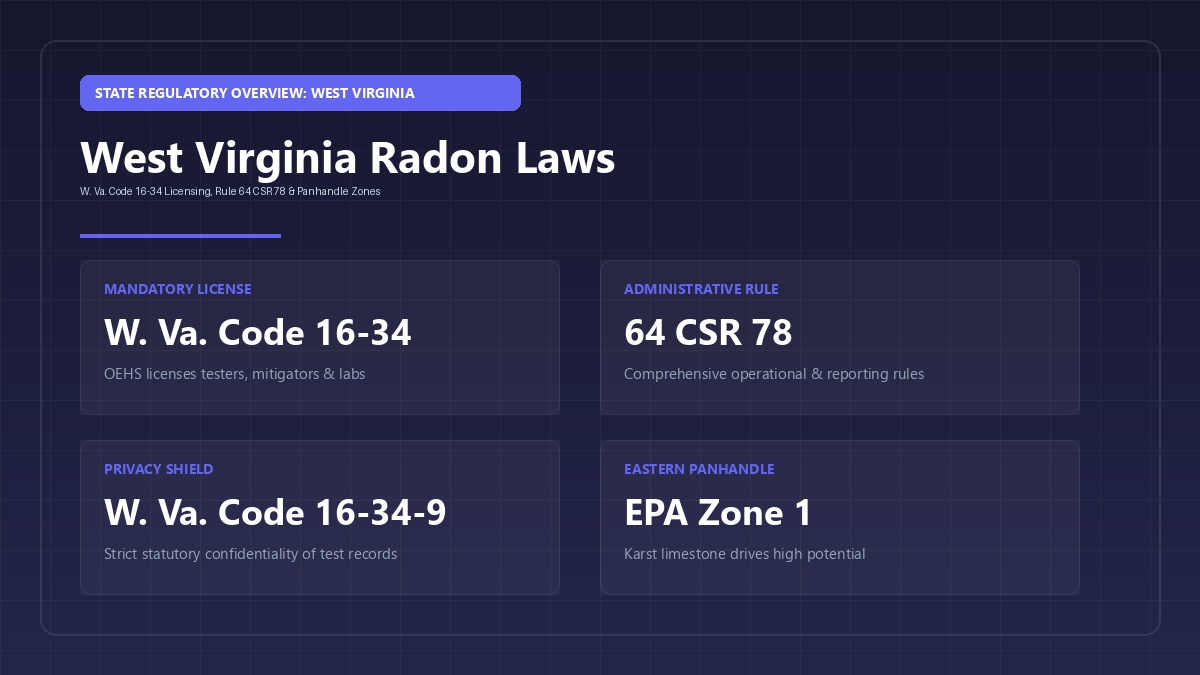
West Virginia enforces a comprehensive statutory licensing framework for radon professionals, paired with statutory confidentiality safeguards and common-law real estate disclosure rules. Under West Virginia Code §§ 16-34-1 through 16-34-14, it is unlawful for any individual or business to perform radon testing, mitigation, or laboratory analysis for compensation without holding an active state license issued by the West Virginia Department of Health. The state maintains strict statutory confidentiality over residential radon test records under W. Va. Code § 16-34-9. Geologically, West Virginia experiences elevated radon concentrations, particularly in the karst limestone formations of the Eastern Panhandle.
Testing Requirements
Indoor radon testing is voluntary for private single-family homeowners and residential landlords under West Virginia law; the state does not compel property owners to test existing dwellings prior to occupancy or sale. In addition, West Virginia statutes do not mandate routine radon testing in public or private K-12 school buildings or commercial child care facilities, though the Office of Environmental Health Services (OEHS) strongly encourages school administrators to test voluntarily using licensed measurement specialists adhering to EPA and ANSI/AARST protocols.
Real-Estate Disclosure
West Virginia does not have a standalone statutory real estate radon disclosure act, per the West Virginia Department of Health, verified November 2026. Real estate transactions in West Virginia operate under traditional principles of caveat emptor (“buyer beware”), modified by common-law rules governing the disclosure of known material latent defects. Licensed real estate brokers in West Virginia are legally obligated under Real Estate Commission regulations to act honestly and disclose known material defects affecting property habitability or health. Furthermore, under W. Va. Code § 16-34-9, the state and licensed contractors are prohibited from releasing residential radon test records to third parties without the owner’s written consent, protecting homeowner privacy while leaving transaction testing to contractual inspection contingencies.
Mitigator & Tester Certification
Commercial licensing is strictly mandatory in West Virginia under W. Va. Code Chapter 16, Article 34 and legislative rule 64 CSR 78. Anyone performing radon testing, mitigation, or laboratory analysis for compensation must hold an active license from the West Virginia Department of Health, Office of Environmental Health Services (OEHS). OEHS administers four specific license types: Radon Tester, Radon Mitigation Specialist, Radon Mitigation Contractor, and Radon Laboratory. To obtain a state license, applicants must complete state-approved training, maintain active national certification through the National Radon Proficiency Program (NRPP) or the National Radon Safety Board (NRSB), pass background reviews, and submit mandatory semi-annual activity reports. Operating without a license is a statutory misdemeanor under W. Va. Code § 16-34-12.
New Construction
West Virginia has not enacted a mandatory statewide building code requiring passive or active Radon-Resistant New Construction (RRNC) in all new single-family residential dwellings. Building code adoption and enforcement operate under local county and municipal jurisdiction. While the State Fire Commission adopts model building codes, Appendix F of the International Residential Code is not universally enforced across all residential construction statewide, though voluntary implementation is common in high-risk Panhandle communities.
Radon Zones & the Action Level
According to the EPA Map of Radon Zones, West Virginia exhibits substantial radon potential. The Eastern Panhandle counties—including Jefferson, Berkeley, and Morgan—along with several central limestone counties (such as Greenbrier, Mercer, and Monroe), are designated as EPA Zone 1 (High Potential), where predicted average indoor screening levels exceed 4.0 pCi/L. Remaining counties fall within Zone 2 (Moderate Potential, 2.0 to 4.0 pCi/L). OEHS adopts the federal action level benchmark of 4.0 pCi/L, strongly advising active mitigation for indoor levels at or above 4.0 pCi/L. For complete county classifications, visit our EPA Radon Zone Map guide.
The State’s Radon Program
The state regulatory and educational authority is the West Virginia Department of Health Radon Program, housed within the Office of Environmental Health Services (OEHS), Radiation, Toxics and Indoor Air Division. The program manages professional licensing, conducts regulatory compliance audits, tracks statewide testing data, and provides subsidized, low-cost short-term test kits to West Virginia residents. Homeowners and contractors can verify licensed professionals and order test kits through the official West Virginia OEHS Radon Program portal or by calling the program division at 304-558-2981.
Sources & Limits
This regulatory guide is provided for educational and informational purposes only and does not constitute formal legal, building code, or engineering counsel. State statutory licensing requirements and legislative rules are subject to amendment. Property buyers, sellers, landlords, and contractors should verify current rules directly with the West Virginia Department of Health or a licensed attorney.
Official Sources: West Virginia Code §§ 16-34-1–16-34-14; West Virginia Legislative Rule 64 CSR 78; West Virginia Department of Health (Office of Environmental Health Services); U.S. Environmental Protection Agency.
To compare West Virginia’s licensing standards with neighboring Appalachian states, consult our complete guide to radon regulations across the United States or inspect the EPA Radon Zone Map.
Get The Signal
What we actually ran, what it measured, and what it means for a restoration shop — every week, including the flops.
Leave a Reply