The Short Answer
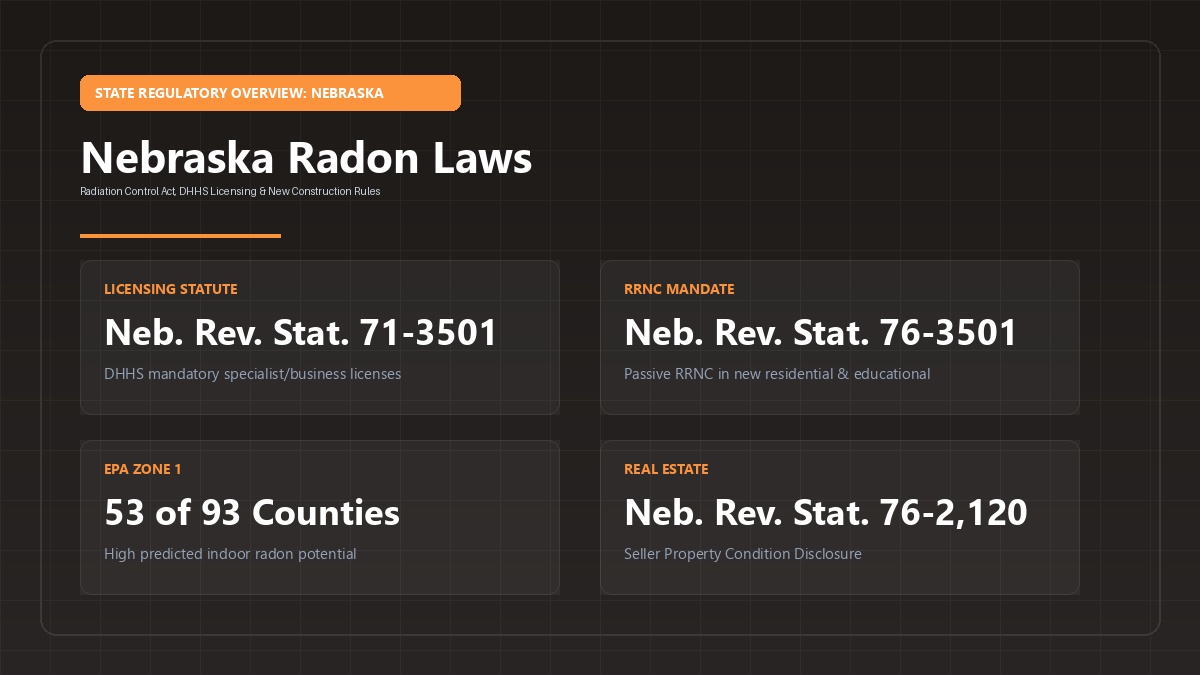
Nebraska enforces stringent statutory controls over radon through comprehensive commercial licensing, mandatory real estate disclosures, and statewide building codes. Under the Nebraska Radiation Control Act, all radon measurement and mitigation professionals must be licensed by the Nebraska Department of Health and Human Services (DHHS). Under the Nebraska Radon-Resistant New Construction Act, all new single-family homes, townhouses, and school buildings built since September 2019 must incorporate passive radon-resistant features. In residential real estate transactions, sellers are statutorily required to complete a detailed property condition disclosure disclosing known radon levels and mitigation history.
Testing Requirements
Radon testing in existing residential dwellings is voluntary for private homeowners and landlords in Nebraska. The state does not impose a mandatory testing schedule on private rental units. For public and private schools, the Nebraska DHHS Radon Program offers technical testing protocols and grant assistance; however, routine periodic testing in existing school facilities remains voluntary under local school district authority. Commercial facilities are not subject to mandatory testing under Nebraska state statute.
Real-Estate Disclosure
Real estate disclosures in Nebraska are governed by Nebraska Revised Statutes § 76-2,120. Sellers of residential real property are statutorily required to complete and deliver a written Seller Property Condition Disclosure Statement to prospective buyers before entering into a purchase contract. The disclosure form contains explicit questions regarding radon gas: sellers must disclose whether the dwelling has been tested for radon, the most recent test concentrations, whether copies of test reports are attached, and whether a radon mitigation system is installed and operational. Failure to provide the required disclosure gives buyers legal rights to void the transaction or seek statutory damages.
Mitigator & Tester Certification
Under Neb. Rev. Stat. §§ 71-3501 to 71-3520 (Radiation Control Act) and Title 180 Nebraska Administrative Code (NAC) Chapter 11, it is illegal to test for or mitigate radon for compensation in Nebraska without an active license issued by DHHS. Nebraska licenses Radon Measurement Specialists, Radon Measurement Technicians, Radon Mitigation Specialists, and Radon Mitigation Businesses. To qualify, applicants must pass national NRPP/NRSB credentialing exams, submit an approved Quality Assurance Plan to DHHS, and fulfill annual continuing education. Licensed businesses must also submit monthly reporting logs to DHHS documenting all testing and mitigation jobs performed in Nebraska.
New Construction
Nebraska enforces statewide building standards under the Nebraska Radon-Resistant New Construction Act (Neb. Rev. Stat. §§ 76-3501 to 76-3507). All new one- and two-family residential dwellings, townhouses, and new educational buildings constructed after September 1, 2019, must be built using radon-resistant new construction techniques in compliance with IRC Appendix F or ANSI/AARST standard CCAH. Builders must install a gas-permeable layer beneath the slab, a 6-mil polyethylene soil gas retarder, sealed foundation joints, and a continuous vertical PVC vent pipe routed through the roof to allow conversion to an active system if testing reveals elevated radon levels.
Radon Zones & the Action Level
Nebraska features widespread, severe radon potential across its geology: 53 of Nebraska’s 93 counties are classified as EPA Zone 1 (High Potential), where average indoor levels are predicted to exceed 4.0 pCi/L. An additional 24 counties are classified as Zone 2 (Moderate Potential, 2.0 to 4.0 pCi/L), and 16 counties are Zone 3 (Low Potential, < 2.0 pCi/L). Historical testing records published by DHHS show that more than 50% of all homes tested across Nebraska exceed the EPA action level of 4.0 pCi/L. Nebraska adheres strictly to the EPA action level of 4.0 pCi/L. Learn more about county rankings on our EPA Radon Zone Map guide.
The State’s Radon Program
The state regulatory and educational authority is the Nebraska Department of Health and Human Services (DHHS) — Radon Program (dhhs.ne.gov/Pages/Radon.aspx). Nebraska residents can order subsidized test kits directly through the DHHS website, review county-level test statistics, and verify active state licenses for measurement and mitigation contractors before contracting for services.
Sources & Limits
This regulatory overview is prepared for informational purposes only and does not constitute formal legal, building inspection, or engineering advice. State statutes and administrative codes may be amended by the Nebraska Legislature and DHHS. Always consult Nebraska DHHS or a qualified attorney to address specific property questions.
Primary Official Sources: Nebraska Department of Health and Human Services (DHHS); Nebraska Revised Statutes §§ 71-3501 et seq., 76-2,120, 76-3501 to 76-3507; Title 180 NAC 11; U.S. Environmental Protection Agency (Map of Radon Zones for Nebraska).
Return to our national guide on Radon Regulations in the United States or inspect national county risk rankings on the EPA Radon Zone Map.
Get The Signal
What we actually ran, what it measured, and what it means for a restoration shop — every week, including the flops.
Leave a Reply