The Short Answer
Florida regulates radon through mandatory institutional facility testing, commercial contractor certification, and statutory contract disclosures under Florida Statutes § 404.056. While testing in private homes is voluntary, Florida law mandates routine radon testing across all public and private K-12 schools, licensed day care centers, and 24-hour residential care facilities. Furthermore, Florida requires a specific verbatim radon notification on every residential real estate sales contract and lease agreement, and mandates that all commercial radon testers, mitigators, and laboratories be certified by the Florida Department of Health (FDOH).
Testing Requirements
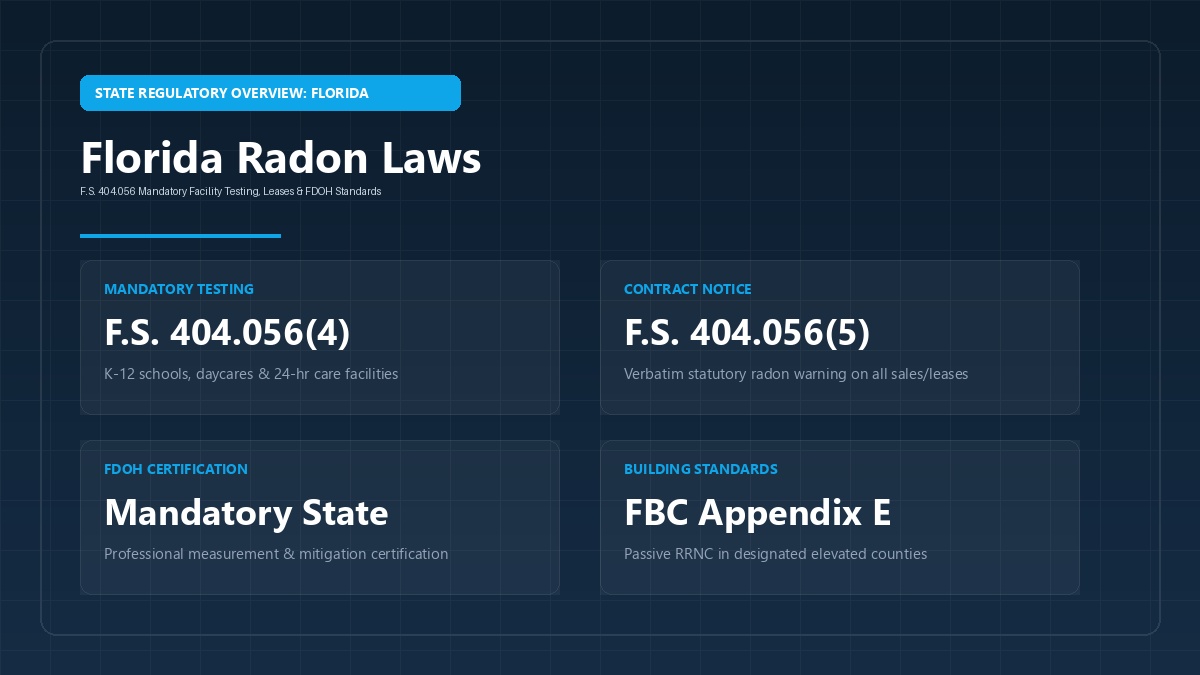
Florida enforces mandatory testing in designated institutional facilities under Fla. Stat. § 404.056(4). All public and private kindergarten through grade 12 schools, state-licensed child care facilities, day care centers, nursing homes, and 24-hour residential care facilities in designated counties must undergo radon testing within one year of opening and repeat testing every five years. Facility administrators must report test results to FDOH. For private single-family homeowners and standard commercial properties, radon testing is voluntary under state law.
Real-Estate Disclosure
Florida law mandates statutory radon disclosure under Fla. Stat. § 404.056(5). Every contract for the sale of residential real property and every residential lease agreement must contain a specific, verbatim notification in conspicuous print explaining the nature of radon gas, noting that levels exceeding federal guidelines have been found in buildings in Florida, and directing parties to the county health department. In addition, under Florida Supreme Court precedent (Johnson v. Davis), sellers have a legal duty to disclose known material latent defects not readily observable by the buyer.
Mitigator & Tester Certification
Under Fla. Stat. § 404.056(1) and Florida Administrative Code (F.A.C.) Chapter 64E-5 Part XII, anyone performing radon measurement, mitigation, or laboratory analysis for compensation must be certified by the Florida Department of Health. The department certifies Radon Measurement Specialists, Radon Measurement Technicians, Radon Mitigation Specialists, Radon Mitigation Businesses, and Radon Laboratories. Certified professionals must pass state-approved examinations, complete approved continuing education, follow FDOH measurement protocols, and submit monthly activity reports documenting all Florida projects.
New Construction
Radon-resistant construction is addressed through the Florida Building Code (FBC) — Residential, Appendix E (Radon Control Methods). Appendix E provides technical construction standards for passive soil depressurization systems in new residential construction. While Appendix E is not applied as a mandatory statewide requirement across all Florida jurisdictions, local building departments in designated counties with elevated radon potential (such as areas near phosphate mining operations) are authorized to enforce Appendix E standards for new construction.
Radon Zones & the Action Level
Florida has an entirely distinct radon profile compared to northern states: there are zero EPA Zone 1 counties in Florida. The state is predominantly classified as EPA Zone 3 (Low Potential, predicted average indoor levels < 2.0 pCi/L). However, a cluster of counties in north-central and central Florida—associated with natural phosphate geological deposits—are classified as Zone 2 (Moderate Potential, 2.0 to 4.0 pCi/L), including Alachua, Citrus, Gilchrist, Hillsborough, Levy, Marion, Polk, and Union counties. FDOH adheres to the EPA action level of 4.0 pCi/L. See county-level details on our EPA Radon Zone Map guide.
The State’s Radon Program
The state regulatory program is the Florida Department of Health (FDOH) — Radon and Indoor Air Program (floridahealth.gov/environmental-health/radon/index.html). Property owners can access the certified radon contractor registry, order educational materials, review institutional facility compliance guidelines, or call the FDOH Radon Hotline at (800) 543-8279.
Sources & Limits
This regulatory guide is provided for educational and informational purposes only and does not constitute formal legal, building code, or medical advice. Statutory mandates and administrative rules are subject to legislative update. Always confirm specific requirements with the Florida Department of Health or qualified legal counsel.
Primary Official Sources: Florida Department of Health (FDOH) Radon and Indoor Air Program; Florida Statutes § 404.056; Florida Administrative Code Chapter 64E-5 Part XII; Florida Building Code; U.S. Environmental Protection Agency (Map of Radon Zones for Florida).
Return to our national guide on Radon Regulations in the United States or inspect national county risk rankings on the EPA Radon Zone Map.
Get The Signal
What we actually ran, what it measured, and what it means for a restoration shop — every week, including the flops.
Leave a Reply