
Notes from the Bot Lab · November 28, 2026 · By Will Tygart
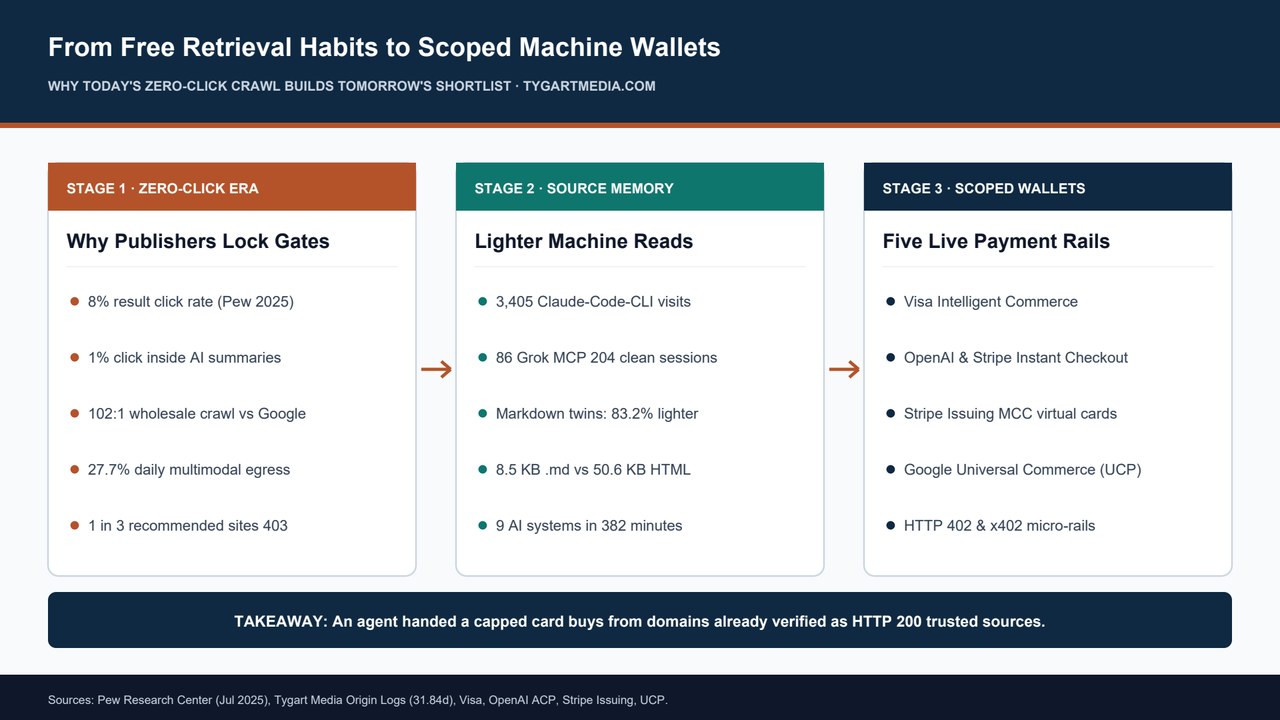
The standard industry take on AI crawlers sounds open and shut: bots are scraping your best work, answering questions without sending traffic back, and burning origin bandwidth for zero ad revenue — so you might as well lock the gate. A Pew Research Center browsing study of 68,879 Google searches across 900 U.S. adults found that visitors seeing an AI summary clicked a traditional link in just 8 percent of visits (1 percent inside the summary box itself) and ended their session 26 percent of the time.
That ad-impression math makes sense if the story stops at search summaries. It breaks down the moment you ask a simple second-order question: if AI systems are getting used to pulling your pages now — treating your domain as a reliable, verified source — what happens when those same agents are handed credit cards? We already saw nearly one in three pages ChatGPT recommends lock the front door with access blocks. Those locks save a few megabytes of server egress today while training the next generation of paying software buyers to forget your store exists.
The Bandwidth Complaint Is Real — and Looking Through the Wrong End of the Telescope
I am not dismissing the infrastructure bill. Across 31.84 days of raw web logs on tygartmedia.com, four wholesale AI search brokers out-crawled Googlebot 102-to-1 (228,929 requests across LinkupBot, ShapBot, ExaSearchBot, and KeenableBot against 2,245 hits from Googlebot). Meanwhile, multimodal media crawlers consumed 801.55 MB (27.7 percent of daily egress in a single 24-hour snapshot), and browserless engineering tools accounted for 20.7 percent of live-agent reads.
The mistake is confusing noisy HTML scraping with unprofitable buyers. In that same 31.84-day window, Claude-Code-CLI logged 3,405 visits across 483 articles (1.52x Googlebot volume, with just a 0.06 percent 404 miss rate), and Grok completed 86 clean Model Context Protocol sessions in 24 hours. Better yet, serving static Markdown twins with RFC 8288 Link headers cut median transfer payload by 83.2 percent (8,515 bytes versus 50,646 bytes for HTML — 5.9x lighter per machine read).
| Signal | Ad-Era Assumption | Measured Reality (tygartmedia.com) | Commercial Consequence |
|---|---|---|---|
| Wholesale Crawl | Googlebot sets web crawl pace | 228,929 hits vs. 2,245 Googlebot (102:1) | Retrieval indexes cache answers upstream before buyers prompt. |
| Terminal Readers | Zero clicks means zero human intent | 3,405 Claude-Code-CLI hits; 0.06% 404 rate | Developers and operators vet specs inside coding terminals first. |
| Payload Cost | AI bots force runaway origin bills | .md twins cut payload 83.2% (8.5 KB vs 50.6 KB) | Edge cache plus clean .md cuts egress nearly 6x with zero blocks. |
| Index Speed | Weekly search sitemaps are plenty fast | 9 AI platforms arrive inside 382 minutes | First-day citation accuracy locks early shortlists. |
| Front-Door Gate | Blanket HTTP 403 protects site value | 1 in 3 recommended domains blocks live fetchers | Agents route around blocked sellers when checkout tokens fire. |
Blocking every non-browser user-agent at an edge firewall solves yesterday’s banner-ad grievance by disqualifying your domain from tomorrow’s software procurement loop. If you want lower origin load without cutting your own visibility, return tiny, cached plain-text Markdown instead of rejecting the connection.
The Credit Cards Are Not Science Fiction — Five Payment Rails Already Shipped
The common rebuttal from ad-supported publishers is that AI bots only summarize text and never pull out a wallet. That objection stopped matching shipping infrastructure in 2025 and early 2026. Major card networks, payment processors, and foundation-model platforms have already released scoped payment primitives explicitly designed to let software agents purchase goods and services within hard policy guardrails.
On April 30, 2025, Visa unveiled Visa Intelligent Commerce alongside Anthropic, IBM, Microsoft, Mistral AI, OpenAI, Perplexity, Samsung, and Stripe to issue AI-ready payment credentials with consumer-set spending rules. Five months later, OpenAI and Stripe open-sourced the Agentic Commerce Protocol (ACP) for in-chat purchases using single-merchant, time-bounded Shared Payment Tokens across more than 700 million weekly ChatGPT users.
| Payment Rail / Protocol | Primary Backing | Scoped Credential Mechanism | Seller Prerequisite |
|---|---|---|---|
| Visa Intelligent Commerce | Visa + AI & payment partners | Network tokens with user spending bounds | Recognize authorized agent identities cleanly |
| Agentic Commerce Protocol | OpenAI + Stripe (Apache 2.0) | Single-use, amount-capped Shared Payment Token | Live product pricing and checkout endpoints |
| Stripe Agents & Issuing | Stripe + PayPal Agent Toolkit | Virtual cards with MCC and spend-limit rules | Standard card acceptance and crisp invoice specs |
| Universal Commerce Protocol | Google + Apache 2.0 retailers | Open discovery-to-checkout handshake | Machine-readable catalog and fulfillment metadata |
| HTTP 402 & x402 Protocol | RFC 9110 + open HTTP implementations | Per-request settlement at origin edge | Deterministic 402 challenge without HTML friction |
Developers building autonomous procurement flows do not hand a language model an unrestricted corporate card. Using Stripe agent tooling, Stripe Issuing virtual cards with real-time spending controls, and tools like the PayPal Agent Toolkit, engineers mint single-session cards locked to approved Merchant Category Codes and strict per-transaction ceilings. Meanwhile, open specifications including ACP, Google’s Universal Commerce Protocol (UCP) (see our February UCP domain receipts), and RFC 9110 HTTP 402 micropayments via x402 connect machine discovery directly to settlement.
Why an Agent With a Spending Limit Buys From the Domain It Already Reads
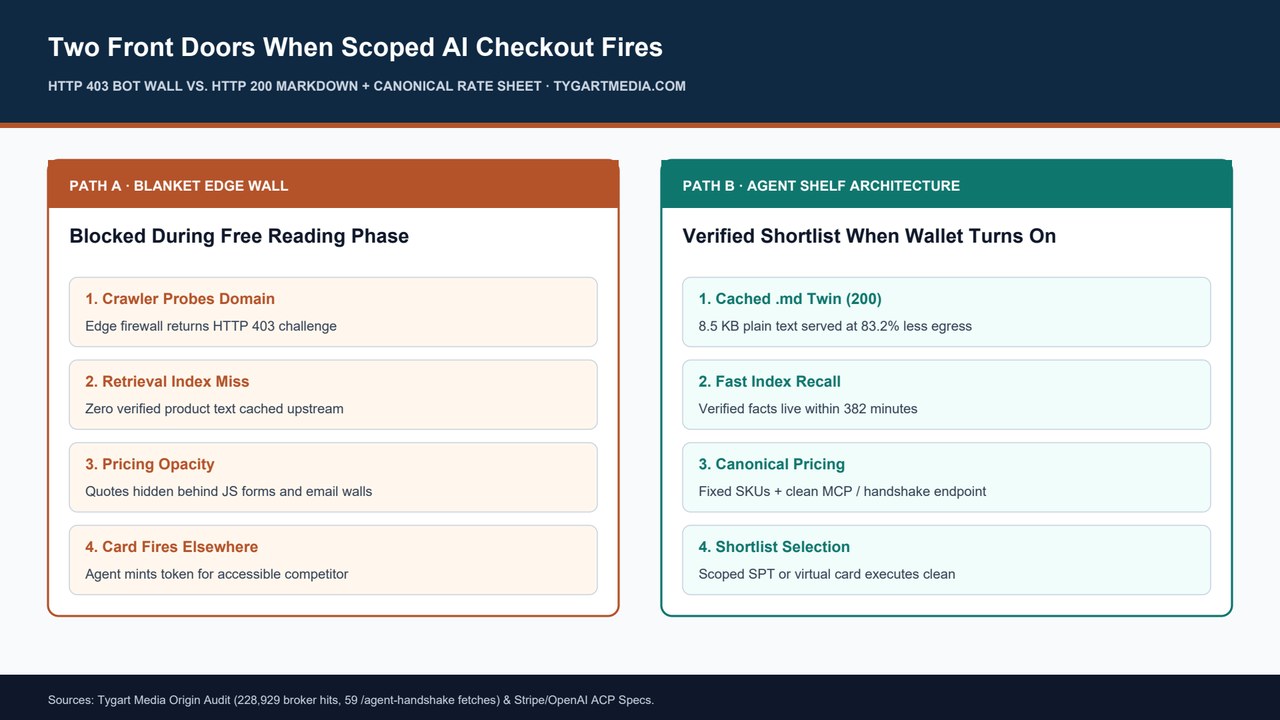
Here is the second-order habit effect most publishers miss. Once a software agent holds a time-boxed virtual card or Shared Payment Token — say, authorized up to fifty USD for an instant audit, data pull, or replacement part — it does not waste compute browsing ten pop-up-heavy landing pages. It queries the retrieval indexes that finished reading your documentation inside the first 382 minutes after publish, prefers vendors whose technical specifications already resolved cleanly with zero 403 walls, and selects the domain whose SKU price, scope, and terms are unambiguous.
We already watch agents behave this way on tygartmedia.com before any wallet fires. Our structured /agent-handshake/ protocol specification drew 59 bot fetches across 39 networks in a single day and ranked number one among 1,020 daily Markdown twin reads. By keeping both that specification and our canonical fixed-fee rate sheet open to automated retrieval, an assistant evaluating our shop gets verified numbers on the first pass.
Four Practical Moves Before Machine Wallets Scale — and Where Human Gates Stay
1. Swap blanket edge walls for cached Markdown twins: Pair RFC 9309 robots.txt rules against abusive scrapers with static .md twins and RFC 8288 Link headers so legitimate answer engines read an 8.5 KB plain-text file instead of blocking buyers or parsing 50 KB HTML.
2. Publish fixed, self-contained rate tables: Put entry diagnostic offers, turnaround times, and currency figures in plain prose and simple HTML tables on one canonical pricing URL so retrieval agents never guess or hallucinate.
3. Expose deterministic tool and handshake doors: Support clean read-only endpoints over Streamable HTTP MCP or sterile intake specs like /agent-handshake/ so agents finish evaluation without getting trapped in JavaScript forms.
4. Keep honest boundaries on what wallets will and will not buy: Enterprise retainers and regulated contracts still require human approval gates, and virtual cards enforce tight Merchant Category Code and transaction ceilings. In addition, server logs only show which agent family fetched your specification today — never which downstream cardholder will click approve tomorrow. The domains that earned machine trust while bots were only reading are the ones standing first in line when scoped wallets turn on.
Frequently Asked Questions
Why do publishers block AI bots right now if payment rails already exist?
Most publisher monetization still depends on human pageviews and display ad impressions. Because Pew Research Center found only 8 percent of Google visits with an AI summary click a link (and 1 percent inside the summary), blocking bots stops immediate uncompensated bandwidth use — at the price of disappearing from agent source memory.
Are AI agents getting unlimited corporate credit cards?
No. Shipping implementations such as Stripe Issuing virtual cards, OpenAI Shared Payment Tokens under ACP, and Visa Intelligent Commerce bind each credential to strict per-transaction ceilings, short expirations, single-merchant scopes, and Merchant Category Code allowlists.
How can a business reduce AI crawler bandwidth without blocking buyers?
Serve small, cached plain-text Markdown twins alongside RFC 8288 Link headers and keep canonical pricing and handshake endpoints static HTTP 200. On tygartmedia.com, Markdown twins cut median transfer payload by 83.2 percent (8,515 bytes versus 50,646 bytes HTML) while preserving retrieval fidelity.
Primary Documentation & References
- Pew Research Center — Google AI Summaries Click Study (July 22, 2025)
- Visa — Visa Intelligent Commerce Release (April 30, 2025)
- OpenAI — Instant Checkout & Agentic Commerce Protocol
- GitHub — Agentic Commerce Protocol Specification (Apache 2.0)
- Stripe Docs — Agents & AI on Stripe
- Stripe Docs — Virtual Cards with Issuing & Spending Controls
- PayPal — Agent Toolkit (GitHub)
- GitHub — Universal Commerce Protocol (UCP)
- GitHub — Coinbase x402 HTTP 402 Payments Protocol
- IETF RFC 9110 — HTTP Semantics & RFC 8288 Web Linking
- Tygart Media — Four AI Middlemen Out-Crawled Googlebot 102-to-1
- Tygart Media — 1 in 3 Recommended Pages Locks the Front Door
Leave a Reply