
From the Workbench · November 28, 2026 · By Will Tygart
When an operator speaks an idea into a voice assistant on a walk or pulls context out of Notion, the bottleneck is almost never model intelligence — it is handoff friction. As we described in Two Plushies and a Work Order and The Shared Brain: A Company Brain Any Model Can Read, keeping all active state inside a cloud SaaS workspace forces every model to burn API calls just to read yesterday’s decision.
Wait until you run three or four agents concurrently. Notion’s documented API request rate limit averages three requests per second with HTTP 429 backoff headers and nested block pagination. Move your active bus to plain UTF-8 Markdown on local NVMe storage, and every terminal model — Antigravity, Claude Code, Cursor, or Grok — reads the exact same source files in milliseconds.
Local Markdown Bus vs. Live Cloud Task Databases
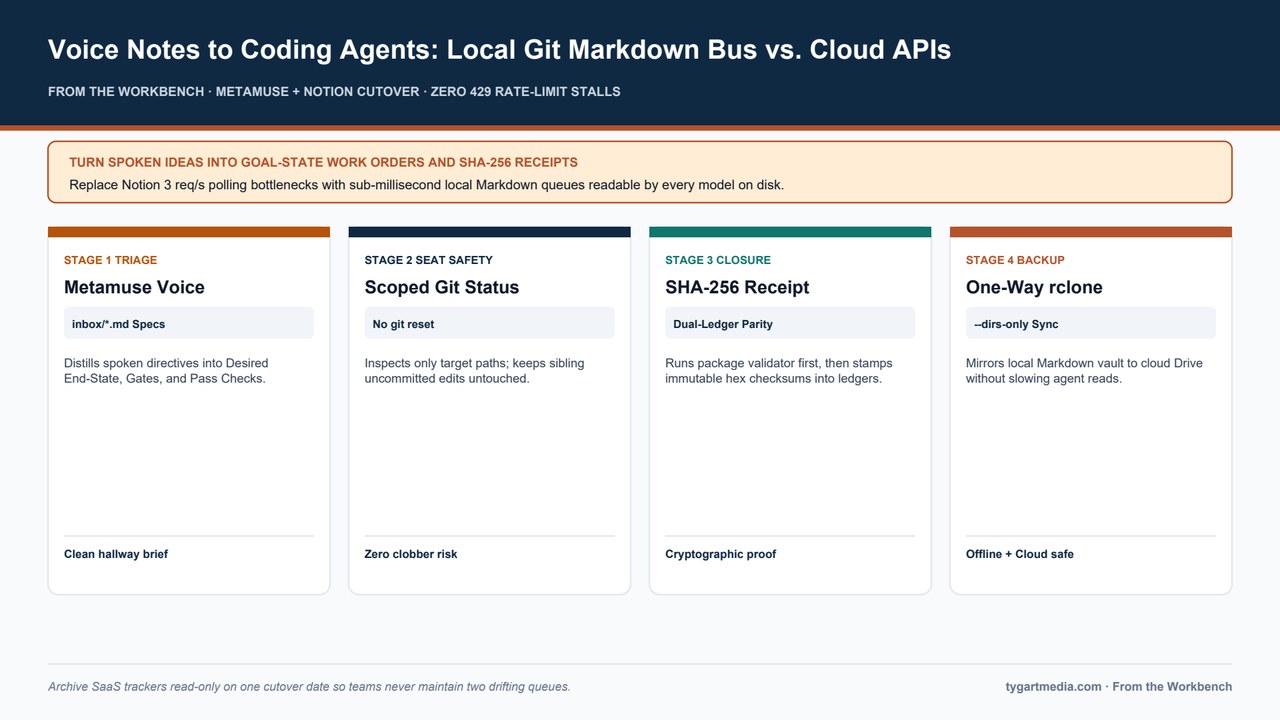
You do not have to throw away Notion archives or Metamuse voice tools — you simply turn SaaS portals into read-only cold archives or spoken triage fronts, while all active engineering work runs through local files:
| Operating Dimension | Cloud SaaS API Queue (Notion) | Local Git + Markdown Bus | Multi-Seat Impact |
|---|---|---|---|
| Read Latency & Quotas | 3 req/s average; HTTP 429 Retry-After delays | Sub-millisecond NVMe disk reads; infinite local throughput | Coding terminals never stall scanning active plans |
| Schema & Vendor Lock-In | Proprietary nested block JSON requiring pagination | Plain UTF-8 Markdown readable by every CLI and IDE | Zero SDK churn when switching model vendors |
| Audit & Tamper Evidence | UI edit history without local file hashes | SHA-256 digest receipts verified by independent auditor | Eliminates false completion claims across agents |
| Cloud Disaster Backup | Lives solely in vendor tenant | Daily one-way rclone sync to encrypted cloud Drive | Full offline autonomy plus cloud disaster recovery |
When Metamuse transcribes a spoken directive, have it emit one self-contained goal-state Markdown file into inbox/ rather than dumping raw paragraphs into chat. Never freeze legacy Notion databases in two active places at once: pick one canonical cutover date, archive Notion read-only, and route all net-new queues strictly through local Markdown.
Goal-State Work Orders and Receipt Templates
Keep every spoken-to-Markdown handoff concise using a “hallway” spec: state the desired end-state, list your non-negotiable approval gates (no silent spend, no unapproved external emails, no production deletes), and finish with exact deterministic checks:
# Work Order: WO-2026-11-EXAMPLE
- Desired End-State: Publish guide with 2-page PDF and LF Markdown twin on example.com.
- Approval Gates:
  1. Cash spend must remain zero.
  2. Never touch sibling client domains or delete existing subscriber tables.
  3. Draft outbound notifications only; never auto-send external email.
- Verification Checks:
  - Bare and cache-busted HTTP 200 on HTML, PDF, and .md twin URLs.
  - Exact SHA-256 parity on local vs. served PDF and Markdown files.

---
# Canonical Receipt (receipts/2026-11/wo-2026-11-example.md)
- Status: DONE (Books zero until auditor verifies SHAs)
- Report SHA-256: <64-hex-sha256-after-validation>
- Markdown Twin SHA-256: <64-hex-sha256>
Concurrency Guardrails and Cryptographic Verification
Running multiple AI seats against one local folder creates two real hazards: dirty worktree clobbering and premature task closure. Combine scoped Git status checks, SHA-256 file receipts, and careful rclone directory sync to prevent four classic failures:
| Multi-Seat Hazard | Why Agents Trigger It | Blast Radius | Safe Workspace Rule |
|---|---|---|---|
| Broad git reset or checkout | Agent tries to clean unrelated modified files before editing | Silently wipes a sibling agent's uncommitted report or ledger edit | Check git status –short — <target> only; never run reset/stash/clean |
| Recursive cloud Drive listings | Running rclone lsf remote: –recursive at root | Spends minutes walking thousands of nested media folders | Pass –dirs-only at root first and copy targeted subfolder IDs |
| Premature SHA-256 Ledger Stamping | Agent hashes report before running validator dollar/link fixes | Post-fix edits invalidate ledger checksums immediately | Run package validator first, then compute SHA-256 and stamp ledgers |
| Concurrent Ledger Regex Prepend | Wrong table regex matches unrelated summary tables lower in file | Corrupts Markdown formatting 1,700 lines down the ledger | Re-read lines 1-20 right before writing and match exact header anchor |
import hashlib, pathlib, subprocess

def sha256_hex(path: pathlib.Path) -> str:
    h = hashlib.sha256()
    with path.open("rb") as f:
        for chunk in iter(lambda: f.read(65536), b""):
            h.update(chunk)
    return h.hexdigest()

def precheck_shared_ledger(repo_dir: pathlib.Path, target_rel: str) -> str:
    # Inspect strictly the file you are about to prepend; never touch sibling files
    st = subprocess.run(
        ["git", "-C", str(repo_dir), "status", "--short", "--", target_rel],
        capture_output=True, text=True, check=True,
    )
    return st.stdout.strip()

def verify_receipt_parity(receipt_path: pathlib.Path, artifacts: dict[str, pathlib.Path]) -> bool:
    txt = receipt_path.read_text(encoding="utf-8")
    return all(sha256_hex(p) in txt for p in artifacts.values())
Remember too: email airlocks and CRM lists deserve the exact same non-destructive boundary. Stage outbound replies strictly as review-gated drafts rather than auto-sending, and keep analytical snapshots read-only behind pre-run checksum assertions.
Turn Spoken Ideas Into Replayable Infrastructure
Every tool mentioned in Readers Without a Web Browser works better when your desk stops trapping state inside browser tabs. When spoken notes become structured Markdown specifications backed by immutable receipts, an AI voice companion and a terminal coder cooperate on the exact same sheet of paper.
Frequently Asked Questions
Why move active work orders out of Notion into local Markdown files?
Notion API calls average 3 requests per second with pagination delays. Local Markdown in a Git-tracked folder lets terminal coding agents read specs in milliseconds with zero vendor lock-in or network throttling.
How do multiple coding agents avoid clobbering one shared directory?
Agents avoid global git reset, stash, or clean commands, run git status –short on specific target files only, re-read the top 20 lines of shared ledgers immediately before prepending, and record SHA-256 receipts after final edits.
How should spoken voice instructions from tools like Metamuse enter the workflow?
Route voice transcripts into clean goal-state Markdown work orders inside a dedicated inbox folder stating desired end-state, explicit approval gates, and objective pass/fail verification checks.
Primary Documentation & References
- Notion API Request & Rate Limits Reference
- Git Official Status Documentation
- rclone Copy Documentation
- RFC 6234 US Secure Hash Algorithms (SHA-256)
- Claude Code Official Documentation
Leave a Reply