Last verified: October 8, 2026 (Pacific) against claude.com/pricing, platform.claude.com pricing, and Haiku 5.5.
Direct Answer: Claude costs $0 on Free; Pro is $20/month ($17 annual); Max starts at $100/month with a choice of 5x or 20x Pro usage per five-hour session (the Help Center lists the 20x tier at $200/month on the web); Team Standard is $20–$25/seat; Team Premium is $100–$125/seat; Enterprise is $20/seat plus usage. API list rates: Haiku 5.5 $0.10/$0.50 under 100k prompt tokens ($0.50/$2.50 over), Haiku 4.5 $1/$5, Sonnet 5.5 and Sonnet 5 $2/$10, Opus 5.5 $4/$20, Opus 5 $5/$25 per million tokens. Sonnet 5.5 cache reads are $0.10.
If you searched “how much is Claude AI” or “Claude AI cost,” here is the straight list — seat plans first, then API token rates. Numbers below are verified October 8, 2026. Seat prices did not move on October 7.
The Free Tier: $0
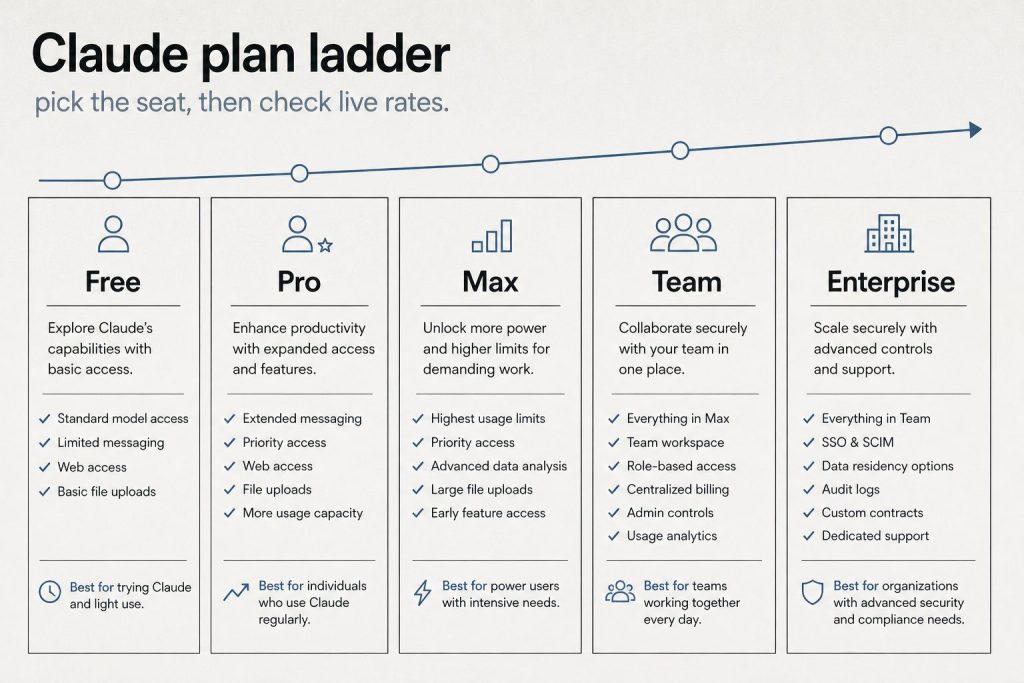
Claude’s free tier is $0 — no credit card required. Chat on web, mobile, and desktop, web search, memory, file creation, and code execution are included. Claude Code is not. Usage limits are tighter than paid seats.
Claude Pro: $20/Month
Pro costs $20/month billed monthly or $17/month if you pay annually ($200 upfront). Official claude.com copy includes Claude Code, Design/Slides/Docs, projects, more models, and Claude for Microsoft 365.
Claude Max: From $100/Month
Max starts at $100/month with a choice of 5x or 20x more usage than Pro per five-hour session. The pricing card prints “from $100” and does not list a separate 20x dollar amount. Anthropic’s Help Center lists Max 5x at $100/month and Max 20x at $200/month for web checkout. Mobile store prices may differ. Max is monthly billing only.
Claude Team: From $20/Seat/Month
Official claude.com Team seats (USD): Standard $20/seat annual or $25 monthly; Premium $100/seat annual or $125 monthly. Premium is 5× Standard usage. Enterprise on the same page is $20/seat plus usage at API rates, billed annually. Anthropic said on October 7 it will roll out monthly Platform credits this week: Max 5x $100, Max 20x $200, Team up to $500 pooled. That is an announced credit, not a lower seat price.
Claude API: Pay Per Token
API access is separate from seats. You pay per million tokens (MTok) for input and output. Current first-party list (October 8, 2026):
| Model | Input / MTok | Output / MTok | Notes |
|---|---|---|---|
| Haiku 5.5 | $0.10 / $0.50 | $0.50 / $2.50 | Under / over 100k prompt tokens. Launched Oct 7, 2026 |
| Haiku 4.5 | $1 | $5 | Still listed |
| Sonnet 5.5 | $2 | $10 | Cache reads now $0.10 (was $0.20) |
| Sonnet 5 | $2 | $10 | Cache reads still $0.20 |
| Sonnet 4.6 | $3 | $15 | Legacy SKU still listed |
| Opus 5.5 | $4 | $20 | Cache reads $0.20 |
| Opus 5 / 4.8 | $5 | $25 | Cache reads $0.50 |
| Fable 5.1 | $10 | $50 | Cache reads $0.25 |
Batch API is 50% off input and output. Prompt caching: 5-minute write 1.25× input, 1-hour write 2×. Cache reads are 0.05× on Sonnet 5.5 and Opus 5.5, 0.1× on Sonnet 5 and Haiku 4.5, and $0.01 / $0.05 on Haiku 5.5. Full schedule: Claude API pricing & token rates.
Quick Cost Comparison Table
| Product | Price | Best for |
|---|---|---|
| Free | $0 | Light chat, no Claude Code |
| Pro | $20/mo ($17 annual) | Daily chat + Claude Code |
| Max 5x | $100/mo | Heavy interactive use |
| Max 20x | Help Center $200/mo (web) | Very heavy interactive use |
| Team Standard | $20–$25/seat | Shared workspace, light seats |
| Team Premium | $100–$125/seat | Power seats (5× Standard) |
| Enterprise | $20/seat + usage | Admin, SSO, usage billing |
| API (Haiku 5.5 → Fable) | $0.10–$10 input / MTok | Apps, automation, CI |
Seat vs API: which bill are you on?
| If you… | You pay… | Read next |
|---|---|---|
| Chat in Claude.ai / use interactive Claude Code | Seat plan usage limits | Claude Code billing & credit pools |
Run claude -p, Agent SDK, or GitHub Actions on a subscription |
Separate Agent SDK monthly credit | Dual-bucket billing |
| Build on an API key | Pay-per-token API rates | API token rates |
How Claude usage limits actually work
The seat price buys a usage window, not a fixed number of messages. Limits reset on a rolling five-hour session, and paid plans add a weekly cap on top.
On claude.com/pricing, checked October 8, 2026, Free covers everyday questions. Pro includes at least 5x more usage per five-hour session than Free. Max includes 5x or 20x more usage per five-hour session than Pro. Chat on the web, the desktop app, mobile, and Claude Code draw from one pool. The Max plan Help Center article says the weekly limit resets on a fixed day and time for the account. Settings, then Usage, shows the session meter and the weekly reset.
When the meter runs out, wait for the reset, move to a higher plan, or turn on usage credits and the extra work bills at standard API rates.
Claude API pricing, by model
The API is a separate bill from the seat. You pay per million tokens, and on every current model the output line costs more than the input line.
| Current model | Input / MTok | Output / MTok |
|---|---|---|
| Haiku 5.5 (≤100k / >100k) | $0.10 / $0.50 | $0.50 / $2.50 |
| Sonnet 5.5 | $2 | $10 |
| Opus 5.5 | $4 | $20 |
| Fable 5.1 | $10 | $50 |
Haiku 4.5 remains $1 and $5. Sonnet 5 remains $2 and $10. Sonnet 4.6 remains $3 and $15. Opus 5 remains $5 and $25. The Batch API takes 50% off: Haiku 5.5 batch is $0.05 and $0.25 under 100k, Sonnet 5.5 is $1 and $5, Opus 5.5 is $2 and $10, Fable 5.1 is $5 and $25. US-only inference on Claude 4.6 and later is 1.1x. Fast mode prices Opus 5.5 at $8 and $40. Haiku 5.5 is the model that raises the rate above 100,000 prompt tokens. Other Claude 4.6 and later models keep one rate through the 1M window.
When prompt caching saves money
A 5-minute cache write is 1.25 times base input and a 1-hour write is 2 times. A cache hit on Sonnet 5.5 is $0.10 per million tokens, down from $0.20 on October 7. Opus 5.5 hits stay $0.20. Fable 5.1 hits stay $0.25. Haiku 5.5 hits are $0.01 under 100k and $0.05 over. A 5-minute write is $0.125 for Haiku 5.5 under 100k, $2.50 for Sonnet 5.5, $5 for Opus 5.5, and $12.50 for Fable 5.1.
Frequently Asked Questions
How much does Claude AI cost per month?
Free is $0. Pro is $20 monthly or $17 annual. Max starts at $100/month, with a choice of 5x or 20x Pro usage per five-hour session. The Help Center lists the 20x tier at $200/month on the web. Team starts at $20/seat annual. Enterprise is $20/seat plus API-rate usage. API bills separately per token.
Related on Tygart Media: API rates · Haiku 5.5 list.
Part of the complete guide: Claude Pricing, Plans & Limits
Get The Signal
What we actually ran, what it measured, and what it means for a restoration shop — every week, including the flops.
Leave a Reply