
From the Workbench · November 28, 2026 · By Will Tygart
When an engineer runs a prompt inside a terminal or IDE, their agent rarely wants fifty kilobytes of theme CSS, navigation menus, and inline scripts. Across our 31.8-day telemetry audit in Four AI Middlemen Out-Crawled Googlebot, a typical WordPress article page weighed 50,646 bytes uncompressed while its clean Markdown twin weighed just 8,515 bytes — a 5.9x payload reduction.
Wait until you check how different agents discover those files. In 3,405 Visits From Readers Without a Browser, CLI agents explicitly sent Accept: text/markdown headers and pulled 55 direct .md files cleanly. Meanwhile, bulk scrapers routinely ignored <head> tags unless visible links appeared in the HTML body or HTTP headers. Wiring all four rails onto the same canonical URL serves every client without splitting your SEO equity.
The Four Machine Discovery Rails on One Canonical URL
Never spin up separate per-bot directories or return cloaked HTML by User-Agent. Keep one canonical URL and expose the static .md twin uniformly across all four RFC 8288 and HTML pointers:
| Discovery Rail | Protocol / Layer | Best Consumer Clients | Verification Requirement |
|---|---|---|---|
| 1. HTTP Link Header | RFC 8288 Link header via PHP send_headers | CLI terminals and headless fetchers checking HEAD/GET | Header present on single posts; zero duplicate Link headers on homepage |
| 2. HTML Head Alternate | link rel='alternate' type='text/markdown' | Standards-compliant crawlers and Markdown-aware browsers | Exact single tag count == 1 matching live HTTP 200 .md path |
| 3. Schema.org encoding | Article JSON-LD MediaObject encodingFormat text/markdown | Structured knowledge graphs and schema extractors | Valid JSON-LD citing canonical contentUrl |
| 4. Visible Body Button | Inline HTML anchor pointing directly to slug.md | Search APIs and scrapers that ignore head metadata | Verified 200 status and byte-exact SHA-256 against local source |
For broader catalog indexing alongside per-post twins, also maintain an llms.txt index at your domain root — remembering never to overwrite a dynamic SEO plugin route with a static file if your stack already generates one dynamically.
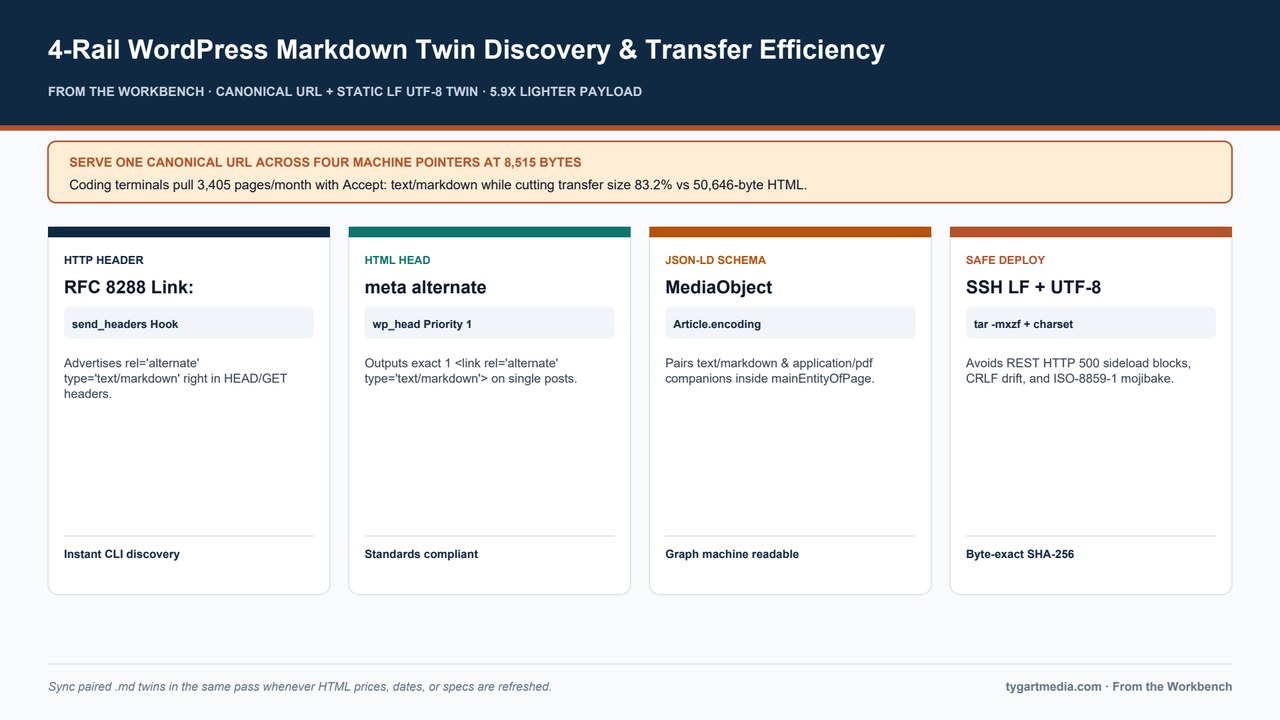
WordPress MU-Plugin to Emit Both Link Headers and Head Tags
Block themes omit Markdown alternate links by default, and WordPress core REST media uploads reject .md files with HTTP 500 rest_upload_sideload_error. Deploy .md files directly to your webroot over SSH/SFTP, then drop a compact Must-Use plugin inside wp-content/mu-plugins/ that checks disk existence before advertising the alternate URL:
<?php
/* Plugin Name: Markdown Twin Discovery Rail */
if (!defined('ABSPATH')) { exit; }

function tm_resolve_md_twin_url(): string {
    if (!is_singular('post') || is_front_page()) { return ''; }
    if (!get_post_field('post_name', get_queried_object_id())) { return ''; }
    if (!file_exists(ABSPATH . get_post_field('post_name', get_queried_object_id()) . '.md')) { return ''; }
    return home_url('/' . get_post_field('post_name', get_queried_object_id()) . '.md');
}

add_action('wp_head', function (): void {
    if (tm_resolve_md_twin_url() !== '') {
        echo '<link rel="alternate" type="text/markdown" href="' . esc_url(tm_resolve_md_twin_url()) . '">' . "\n";
    }
}, 1);

add_action('send_headers', function (): void {
    if (tm_resolve_md_twin_url() !== '') {
        header('Link: <' . esc_url_raw(tm_resolve_md_twin_url()) . '>; rel="alternate"; type="text/markdown"', false);
    }
}, 20);
Nginx MIME Configuration, UTF-8 Decoding, and Common Traps
Serving a Markdown twin as application/octet-stream forces terminals and browsers into download prompts instead of inline reading. Configure Nginx MIME types cleanly and guard against four silent deployment defects:
| Markdown Twin Trap | Root Technical Cause | Concrete Symptom | Operational Fix |
|---|---|---|---|
| WP REST Media upload rejects .md | WordPress core blocks Markdown uploads via rest_upload_sideload_error | Deterministic HTTP 500 on POST /wp-json/wp/v2/media | Stage LF .md tarballs over SSH and install with web-user ownership |
| ISO-8859-1 smart-punctuation mojibake | Python requests defaults charset-less text/* types to ISO-8859-1 | Em-dashes corrupt when reading resp.text instead of UTF-8 bytes | Set Content-Type charset=utf-8 in Nginx and decode resp.content UTF-8 |
| CRLF vs LF SHA-256 drift | Windows editors write CRLF unless newline='\n' is forced | Disk file fails exact SHA-256 verification against Linux origin | Force newline='\n' on Python write_text and extract via tar -mxzf |
| Short italic byline before Direct Answer | Chunkers score p[0] under H1 as opening passage density | Sub-30-word byline tanks RAG readiness scores into low 50s | Place 45-55w Direct Answer paragraph immediately after H1 heading |
# 1. Nginx server block (text/markdown; charset=utf-8)
# location ~* \.md {
#     types { text/markdown md; }
#     default_type text/markdown;
#     charset utf-8;
#     charset_types text/markdown text/plain;
#     try_files /wp-content/uploads/md-cache =404;
# }
# (Simply point location at your static webroot file path with try_files uri =404)

# 2. Write explicit LF UTF-8 locally & decode strictly as UTF-8 on verify
import hashlib, pathlib, urllib.request

def publish_prepare_and_verify(md_text: str, out_path: pathlib.Path, live_url: str) -> None:
    clean = md_text.replace("\r\n", "\n")
    out_path.write_text(clean, encoding="utf-8", newline="\n")
    expected_sha = hashlib.sha256(out_path.read_bytes()).hexdigest()
    req = urllib.request.Request(live_url, headers={"User-Agent": "Mozilla/5.0"})
    with urllib.request.urlopen(req, timeout=15) as r:
        assert "markdown" in r.headers.get("Content-Type", "").lower()
        live_bytes = r.read()
        assert hashlib.sha256(live_bytes).hexdigest() == expected_sha
Keep one more habit mandatory across refreshes: whenever you update dates, prices, or benchmarks inside WordPress, regenerate its paired .md twin in the exact same release pass. Nothing burns terminal-agent trust faster than an HTML page updated in November paired with a stale September Markdown file, a gap we detailed in Do AI Crawlers Follow llms.txt and Markdown Twins.
Make Every How-To Pullable From a Terminal
Remember RFC 9110 content and caching rules: clear any page cache or reverse-proxy cache layer right after updating .md files and warm key URLs with GET requests rather than HEAD probes. When an engineer asks their coding agent for help mid-debug, a clean 8.5 KB Markdown spec arrives inside their editor before a bloated HTML page finishes rendering.
Frequently Asked Questions
Why not upload .md files through the standard WordPress Media Library REST endpoint?
WordPress core rejects Markdown file extensions on /wp-json/wp/v2/media with HTTP 500 rest_upload_sideload_error. Deploying static LF UTF-8 .md files directly to your webroot over SSH avoids core upload blocks and serves at full web-server speed.
Why advertise both HTTP Link headers and HTML alternate tags?
Different tools inspect different layers: CLI tools and API crawlers parse RFC 8288 Link headers or send Accept: text/markdown, while page-level parsers look for HTML <head> <link rel='alternate'> tags, JSON-LD encoding arrays, or visible anchors.
What causes smart dashes or quotes in Markdown files to garble in Python HTTP scripts?
HTTP clients like Python requests default charset-less text/plain responses to ISO-8859-1. Explicitly configuring charset utf-8; in Nginx and decoding raw bytes as UTF-8 keeps checksums and punctuation exact.
Primary Documentation & References
- RFC 8288 Web Linking Specification
- RFC 9110 HTTP Semantics
- WordPress Must-Use Plugins Documentation
- Nginx Core HTTP Module Documentation
- llms.txt Domains Specification
Leave a Reply