
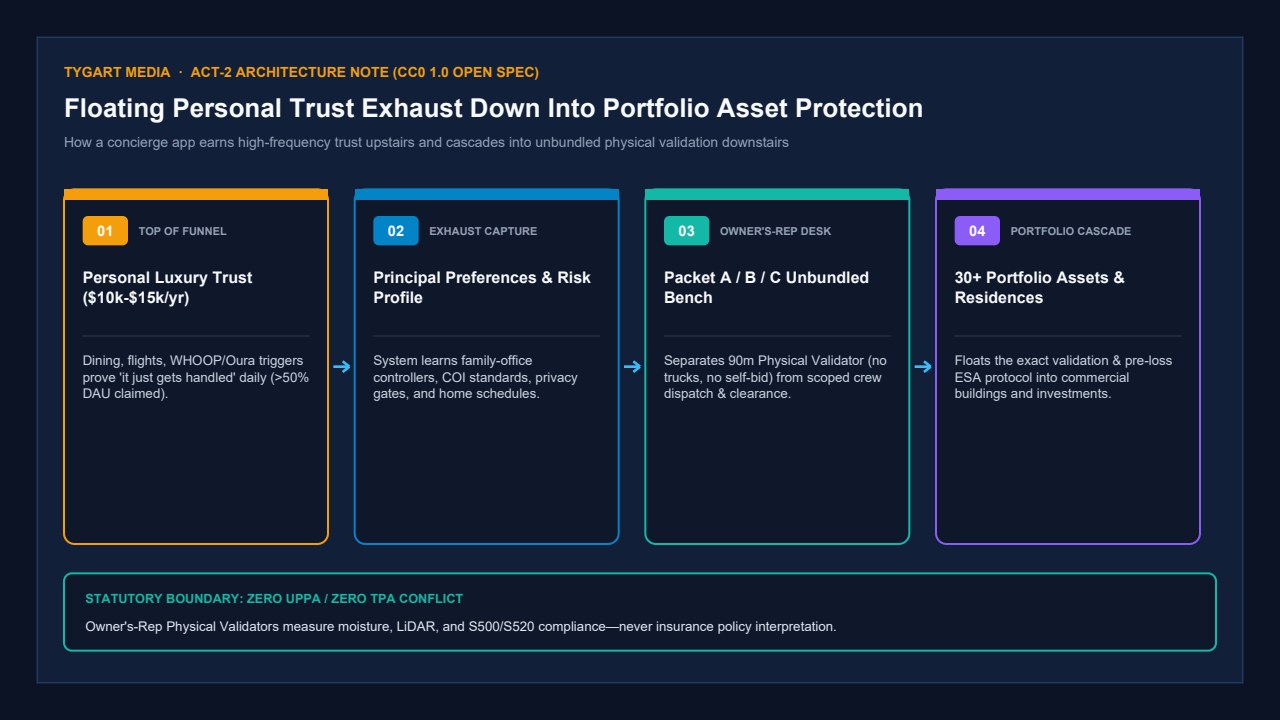
Luxury AI concierges like Aurora (joinaurora.co, $14M raised, $5,000 initiation plus $10,000/yr) look like dining-and-aviation clubs at first glance, yet their deepest Act-2 moat is floating personal trust exhaust down into members’ residences, commercial properties, and portfolio companies through an unbundled Owner’s-Rep and Physical Validator model.
By Will Tygart · Architecture Field Note · November 26, 2026
The Portfolio Clue Hiding on joinaurora.co: Floating Exhaust Down
Look closely at the bottom of joinaurora.co right past the Tribeca private dining rooms and track days. Alongside NBA champion Kevin Love’s endorsement sits a six-clause roster of his actual operating surface: “More than 82 games a year. 20+ family members. 30+ portfolio projects. 20 countries. A growing staff.” In our earlier Aurora company spotlight and crawl audit, we noted how Aurora ($14M raised, $5,000 initiation plus $10,000/yr, profiled in Fortune) wins personal frequency through proactive dining, travel, and wearable integrations.
That personal luxury layer is actually customer acquisition that pays for itself. If you cold-pitch a principal or family office on commercial facility protection or crisis project management, procurement routes you into a dead-end vendor portal. When you handle their personal life seamlessly every week, however, the system accumulates invaluable operational exhaust—who signs checks, which family-office controller handles certificates of insurance, what risk tolerance governs primary residences, and which commercial buildings sit inside those 30+ portfolio projects.
Once an AI-native lifestyle desk holds that verified trust graph, the natural Act-2 expansion is floating that exhaust straight down into physical asset protection. Not by buying a single box truck or becoming a contractor, and certainly not by stepping into insurance adjusting—but by operating as an Agentic Owner’s Representative backed by an unbundled bench of independent physical validators.
| Role | Who They Serve | Fee / Incentive Model | Licensing / Statutory Boundary | Fit for Concierge Cascade |
|---|---|---|---|---|
| Public Adjuster (PA) | Policyholder (adversarial claim) | 10%-15% contingency of claim payout | Strict state PA licensing (e.g., RCW 48.17.010 UPPA boundary) | Poor fit: triggers carrier hostility and licensing gates |
| Carrier / IA Adjuster | Insurance carrier | Carrier salary or fee schedule | Adjuster license; interprets policy exclusions | Wrong side of table for principal asset protection |
| Third-Party Administrator (TPA) | Insurance carrier | 3%-8%+ clip taken from contractor | Carrier SLA enforcement and cost containment | Incentivized for carrier budgets, not custom estates |
| Appraisal Umpire | Disputed appraisal panel | Hourly or split flat fee | Enters months later once claim deadlocks | Too late for Hour-Zero physical triage |
| Agentic Owner’s Rep + Physical Validator | The Principal / Family Office | Membership + flat validation gig + PM fee | Zero policy interpretation; pure physical telemetry & S500/S520 PM | Ideal Act-2 layer: fast, neutral, truck-free |
Separating the Radiologist From the Surgeon: The 3-Packet Split
Why don’t luxury concierges manage 2 a.m. pipe bursts, hurricane prep, or facility remediation today? Because traditional restoration bundles physical diagnosis with demolition and equipment rental inside one truck-bound contractor—or forces owners into carrier-owned Third-Party Administrators (TPAs). As we documented in Cameras Count Pixels, Scales Settle Claims and Mold Spores Don’t Pick Locks, physical-world operations break whenever the party capturing telemetry also profits from tearing out extra drywall.
Get The Signal
What we actually ran, what it measured, and what it means for a restoration shop — every week, including the flops.
An AI-native concierge solves that cleanly by splitting incident response into three unbundled work packets—separating the radiologist from the surgeon:
- Packet A — The 90-Minute Physical Validator Gig ($500–$1,500 Flat): An independent veteran certified under ANSI/IICRC S500 and S520 arrives with LiDAR, FLIR thermal imaging, and moisture meters—zero demolition saws, zero box trucks. Under a strict conflict firewall (mirroring EPA commercial remediation separation guidance), the Packet A validator cannot bid the tear-out work.
- Packet B — Headless Project Management + Pre-Scoped Crew Dispatch: Aurora’s AI PM layer (described on joinaurora.co/careers as headless, intelligent agents orchestrating multi-party execution) dispatches vetted local water, fine-art contents, and millwork specialists strictly against Packet A’s objective Hour-Zero scope while tracking daily psychrometric drying telemetry.
- Packet C — Independent Dry-Standard Clearance ($350–$750 Flat): Before custom millwork rebuilds or final vendor payouts release via structured protocols like HANDSHAKE v0.1, a Physical Validator signs off that moisture targets and containment closures match baseline.
Open Reference Packet: HOUR-ZERO-VALIDATOR v0.1
Because a concierge desk only needs machine-verifiable telemetry—not proprietary contractor spreadsheets—every Packet A dispatch can emit a lightweight, deterministic JSON receipt feeding straight into the Owner’s-Rep timeline before Packet B dispatches:
{
  "spec": "HOUR-ZERO-VALIDATOR-v0.1",
  "license": "CC0-1.0",
  "packet": "A_PHYSICAL_VALIDATION",
  "standards": [
    "ANSI/IICRC S500",
    "ANSI/IICRC S520"
  ],
  "self_bid_firewall": true,
  "uppa_policy_advice": false,
  "telemetry": {
    "lidar_scan_sha256": "<sha256-3d-mesh>",
    "moisture_points_pct": [
      28.4,
      19.2,
      11.8
    ],
    "ambient_rh_pct": 64.5,
    "thermal_anomalies_flagged": 3
  },
  "next_gate": "PACKET_B_PRE_SCOPED_DISPATCH"
}
Notice how little infrastructure is required to stand this up across major metros (New York, Miami, Los Angeles, Aspen, London). Validators running Packet A and Packet C carry lightweight professional liability (E&O) rather than heavy demolition fleet overhead, while Packet B trades absorb CGL, Workers’ Comp, and pollution risk cleanly under their own operations.
| Asset Required | Core Function | Insurance & Firewall Spec | Build vs. Partner Path |
|---|---|---|---|
| 1. Vetted Validator Bench (Packet A/C) | 2-3 senior MWR or IEP specialists per metro (NYC, LA, London, Miami, Aspen) | Lightweight E&O; strictly barred from bidding Packet B tear-out | Contract idle senior estimators at $500-$1,500 flat per walk |
| 2. Non-UPPA Owner’s-Rep Contract | Scopes PM coordination and physical documentation outside claim adjusting | Explicitly excludes policy coverage advice or carrier negotiation | Standardize once with property-management counsel |
| 3. Hour-Zero Telemetry Schema | Converts LiDAR mesh, thermal deltas, and moisture logs into structured JSON | Tamper-evident SHA-256 receipts checked by AI PM engine | Adopt open HOUR-ZERO-VALIDATOR v0.1 JSON spec |
| 4. Pre-Scoped Trade Roster (Packet B) | Vetted water, fine-art contents, and millwork crews on transparent rate sheets | Carries heavy CGL, Workers’ Comp, and pollution coverage | Replace 5%-8% TPA clips with clean scopes and 48h milestone pay |
Frequently Asked Questions
How is an Agentic Owner's Rep and Physical Validator different from a Public Adjuster or TPA?
A Public Adjuster negotiates insurance policy coverage and claim payouts on contingency, which triggers strict state licensing and unauthorized-practice statutes like RCW 48.17.010, while a TPA serves carrier cost containment. An Owner's Rep and Physical Validator works directly for the property principal on flat or project-management fees, measuring physical moisture, LiDAR geometry, and IICRC standards with zero policy interpretation.
Why must Packet A Physical Validators be barred from bidding Packet B restoration work?
Separating diagnosis from demolition eliminates the core incentive conflict in emergency property losses. When the specialist capturing Hour-Zero LiDAR, thermal, and moisture readings collects a flat validation fee and cannot bid tear-out or equipment rental days on the same incident, owners get an objective scope rather than an inflated demo invoice.
What does 'floating personal trust exhaust down' mean for platforms like Aurora?
High-performing members already pay Aurora $10,000+ annually to handle travel, dining, and wearable-triggered wellness, generating rich operational exhaust around approval thresholds, family-office contacts, and asset locations. Extending that same trusted orchestration layer into residences and 30+ portfolio companies avoids cold B2B procurement gates entirely.
Can any concierge desk, family office, or restoration operator adopt the HOUR-ZERO-VALIDATOR v0.1 schema?
Yes. The conceptual workflow and HOUR-ZERO-VALIDATOR v0.1 JSON packet published in this note are released into the public domain under CC0 1.0 alongside open statutory boundaries (17 U.S.C. 102(b) and 35 U.S.C. 102), allowing unrestricted commercial implementation without royalties or permission.
Primary Verification & Statutory References
- Aurora Official Platform & Portfolio Quotes (https://joinaurora.co/)
- Aurora Headless Agent Architecture (/careers) (https://joinaurora.co/careers)
- Fortune: Meet Aurora, the $10,000/yr Proactive AI Concierge (https://fortune.com/2026/10/11/meet-aurora-invite-only-ai-concierge-ultrawealthy-pay-10000-a-year-to-anticipate-their-every-need/)
- ANSI/IICRC S500 Water Damage Restoration Standard (https://iicrc.org/s500/)
- ANSI/IICRC S520 Mold Remediation Standard (https://iicrc.org/s520/)
- EPA Commercial Mold Remediation Guidance (Ch. 1) (https://www.epa.gov/mold/mold-remediation-schools-and-commercial-buildings-guide-chapter-1)
- Washington RCW 48.17.010 (Adjuster & Public Adjuster Definitions) (https://app.leg.wa.gov/RCW/default.aspx?cite=48.17.010)
- Creative Commons CC0 1.0 Public Domain Dedication (https://creativecommons.org/publicdomain/zero/1.0/)
- 17 U.S.C. § 102 (Subject Matter of Copyright: Ideas/Methods Excluded) (https://www.law.cornell.edu/uscode/text/17/102)
- 35 U.S.C. § 102 (Public Prior Art Conditions) (https://www.law.cornell.edu/uscode/text/35/102)
Get The Signal
What we actually ran, what it measured, and what it means for a restoration shop — every week, including the flops.
Leave a Reply