Most people meet AI as a machine that writes things from scratch — polite emails, slide decks, birthday toasts, or blog paragraphs nobody wanted to read anyway. That is the parlor trick. It is also the exact job where a language model is most tempted to bluff, pad, and invent smooth sentences out of thin air.
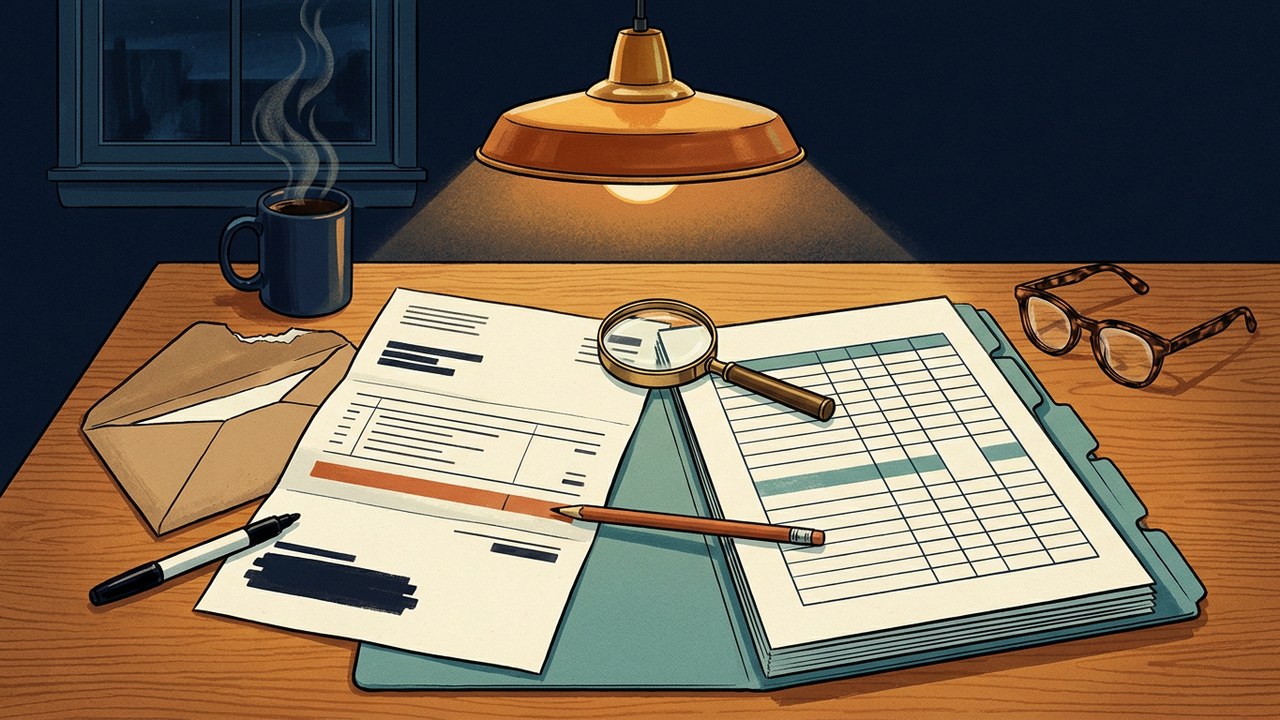
The real household and small-business money sits on your kitchen table on Sunday night, where two pieces of paper never quite sit next to each other: the insurance renewal that arrived in the mail and the rate schedule filed with the state; the contractor’s invoice and the original scope; the government letter and the agency’s own published rulebook; the dashboard total and the raw server log. Humans get tired around line fourteen. A model does not. Engineers call this two-document reconciliation — laying two existing records side by side to flag every divergence where the bill parts company with the deal. Put both papers on the table and ask where they disagree.
Why Checking Beats Writing From Scratch
There is a simple mechanical reason AI is sharper as an auditor than as an improviser. Hand a model an empty page and ask it to invent facts from memory, and it guesses smooth averages — the same fill-in-the-blank habit we mapped in Mad Libs for Machine Learning. Hand it two concrete documents and ask only where Paper A disagrees with Paper B, and you have pinned the model to grounded text — what AI researchers call retrieval-augmented generation (Lewis et al., 2020), which measurably raises factual specificity and gives every answer a traceable source line.
University of Washington and Meta researchers formalized the checking move in FActScore (Min et al., 2023): instead of grading a whole page on gut feel, break it into atomic claims — single checkable dates, dollar figures, and rules — and test each line one by one against a primary record. That is the same truth behind Standing in the Middle: meaning shows up only where two independent records are forced to agree. One paper tells a story; two papers create a receipt.
Six Real Gaps Sitting in Everyday Paperwork
Across our shop and our ongoing idea-mill briefs, the exact same two-paper join keeps surfacing in places where ordinary households and business owners quietly lose real money — not because rules do not exist, but because nobody lays both pages flat together:
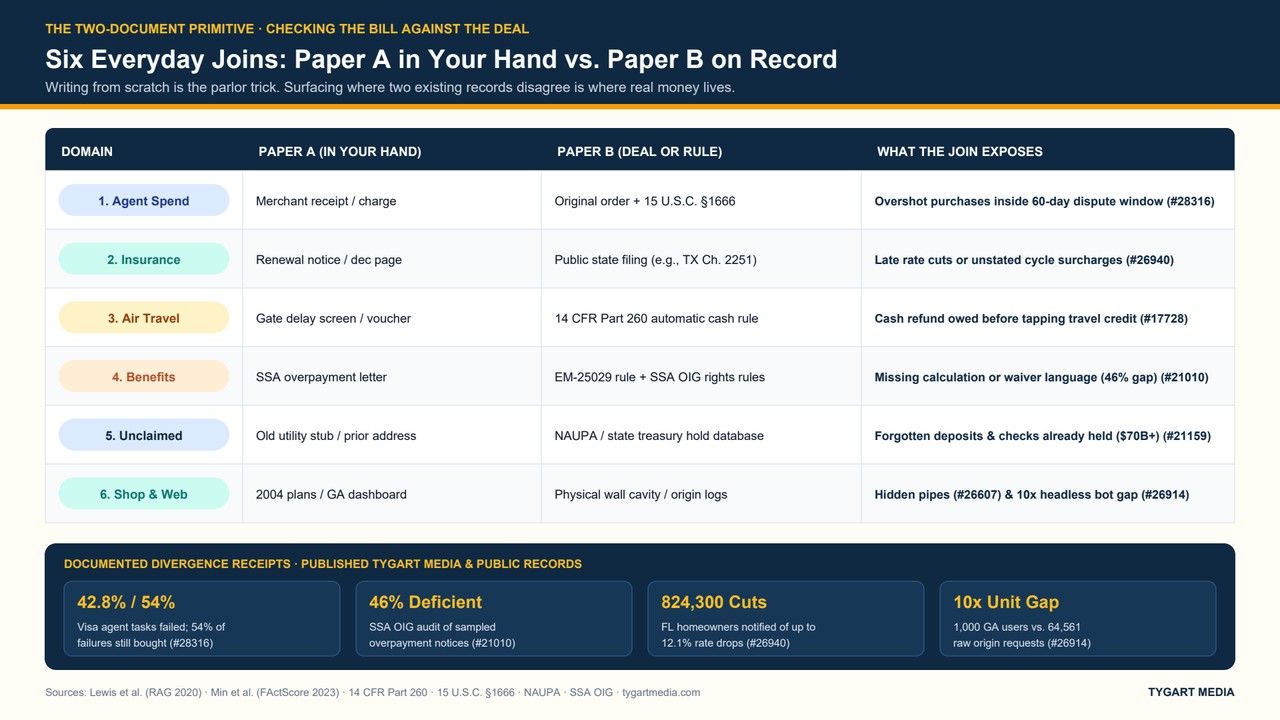
1. Your order vs. the charge. In The Receipt Is the Authorization, Visa’s November 5, 2026 shopping-agent benchmark showed 22 models failed 42.8% of tasks — and in 54% of those failures, the agent still completed a purchase. Matching the instruction you gave against the confirmation receipt inside the 60-day federal written dispute window of the Fair Credit Billing Act (15 U.S.C. §1666) catches overruns before they settle.
Get The Signal
What we actually ran, what it measured, and what it means for a restoration shop — every week, including the flops.
2. Your insurance renewal vs. the public state filing. As we laid out in The Best Insurance Product Reads the Renewal Against the Filing, states like Texas (Insurance Code Chapter 2251) make rate filings public upon filing, and Florida’s October 29, 2026 announcement documented over 824,300 homeowners receiving rate decreases up to 12.1%. Reading your renewal notice beside the public rate filing reveals when a cut or surcharge has not lined up with your cycle.
3. Your gate voucher vs. federal cash-refund law. In The Best Delay Product Tells You Cash Is Owed Before You Take the Voucher, federal rule 14 CFR Part 260 requires automatic cash refunds — within seven business days on a card — when a domestic flight cancels or shifts three or more hours and you decline rebooking. Comparing your itinerary and delay screen against Part 260 stops you from tapping a travel credit while cash is owed.
4. An agency notice vs. the agency’s own rulebook — and old names vs. state holds. In The Best Clawback Product Reads the Notice Against the Rule, an SSA Office of the Inspector General audit found 46% of sampled Social Security overpayment notices failed agency completeness rules — missing calculations or waiver rights right as default withholding jumped to 50%. And in The Best Recovery Product Reads the Name Against the Hold, matching old utility stubs and prior addresses against official state treasury databases linked through NAUPA puts families onto billions sitting unclaimed.
5. The building on paper vs. the wall — and the dashboard vs. the logs. On commercial job sites, You Bid the Drawings. The Building Didn’t Get the Memo shows how walking a 2004 plan set against actual capped pipes and patched chases turns ugly change-order fights into an honest upfront divergence allowance. And on our own websites in My Analytics Said 1,000 Visitors. My Logs Said Otherwise, reconciling a JavaScript dashboard (~1,000 users) against raw origin logs (64,561 requests across 10,345 IPs, over 80% headless) exposed a 10× gap neither instrument could hide once laid side by side.
The Sunday-Night Protocol (Without Handing Over Your Secrets)
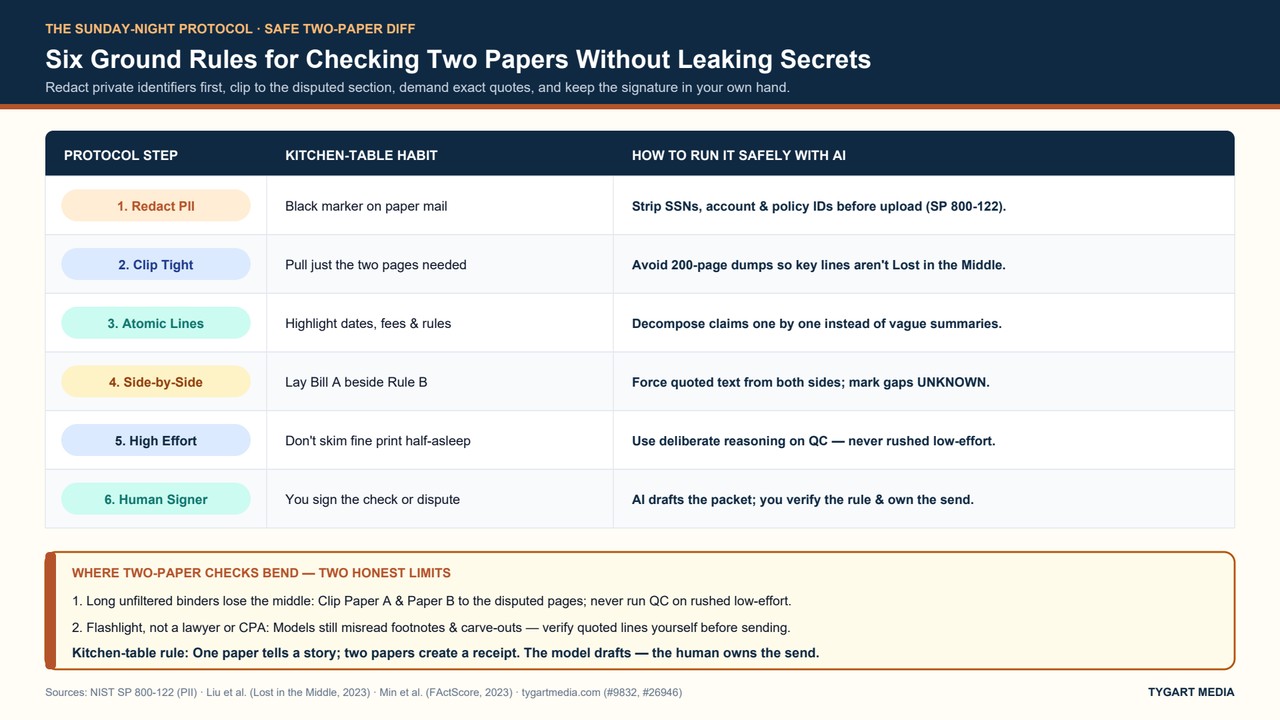
You do not need a specialty startup app to run this Sunday night. You need a black marker, two clipped excerpts, and three plain prompts. Before you paste or photograph anything into a consumer AI chat, enforce redaction — blacking out Social Security numbers, account numbers, policy IDs, and home addresses, the exact personally identifiable information (PII) protection outlined in NIST SP 800-122. The model needs the dollar line, the date, and the clause — never your routing number. That is the everyday kitchen-table version of splitting personal life from working tools in Two Droids and a Farmboy and keeping irreversible buttons on your own desk in Leave the Keys Off the Van Seat:
Where Two-Paper Checks Bend — And Who Signs the Letter
Two honest limits keep Sunday-night reconciliation grounded. First, long unfiltered binders make models miss the middle. Stanford and UC Berkeley researchers proved in Lost in the Middle (Liu et al., 2023) that stuffing huge documents into one prompt degrades recall for facts buried mid-text. Clip Paper A and Paper B down to the exact two sections in question — and as we showed in Don’t Hire a Finish Carpenter to Carry Drywall, never run high-stakes error hunting on a rushed low-effort setting that can stamp a missed discrepancy clean.
Second, an AI is a flashlight, not a lawyer, CPA, or benefits counselor. As we spelled out in How to Verify AI Output, fluency never proves accuracy: a model can still misread a statutory carve-out, skip a footnote, or invent a regulation number. Every item on your mismatch table must quote exact text from both pages so you can verify it with your own eyes before calling a carrier, disputing a charge, or signing a government form. The model drafts the comparison; the human owns the send.
— Will Tygart, Tygart Media.
Get The Signal
What we actually ran, what it measured, and what it means for a restoration shop — every week, including the flops.
Leave a Reply