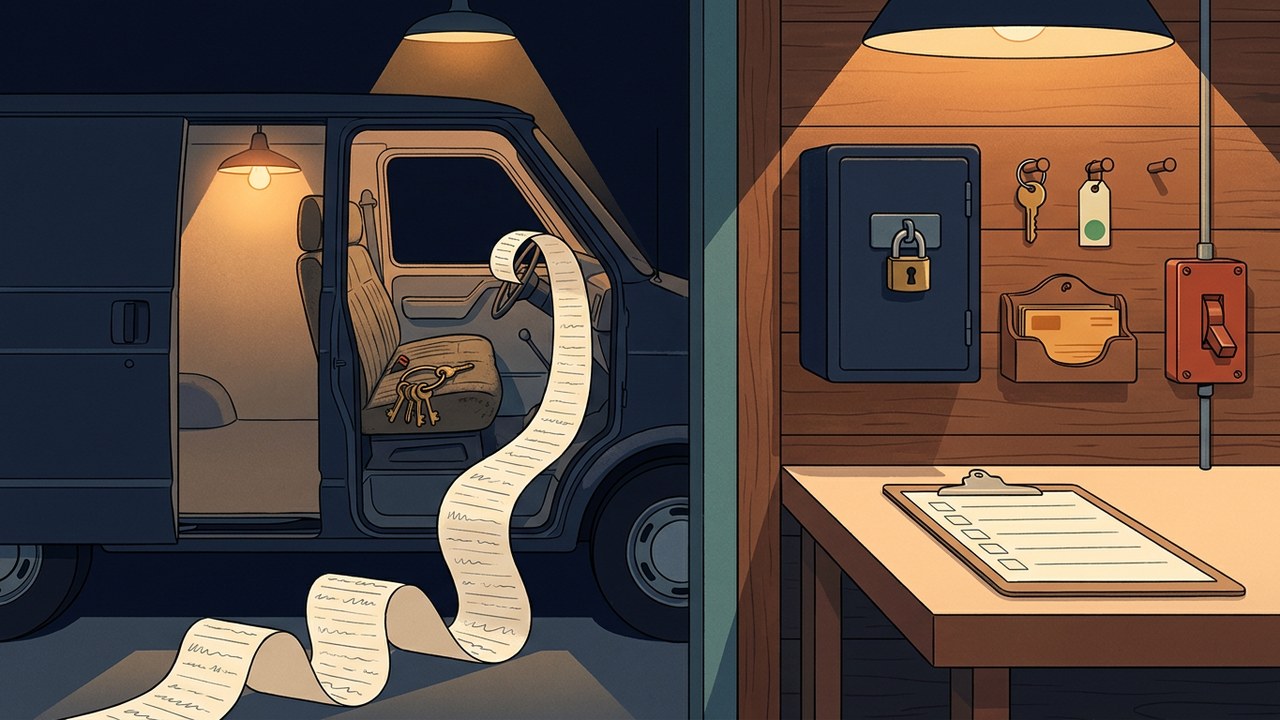
When you hand a nineteen-year-old helper the work van for an overnight run, you do not tape a three-page essay about character to the steering wheel. You hand him a fuel card capped at a hundred bucks, the key to the side bay instead of the office safe, and one phone number that wakes you up if a valve sticks. You are not insulting the kid. You are running a shop.
Watch how businesses roll out AI right now and you will see the steering-wheel essay everywhere: longer prompts — the written instructions you type into a chat box — begging the machine to be careful, paired with full account access that can email customers, publish live pages, or spend money at two in the morning. My dad had a simpler saying long before anyone built software agents: a locked door keeps an honest man honest. Put a real lock on the door, and nobody has to rely on willpower at midnight.
The Four-Minute Perfect Review (Why “Don’t” Fails)
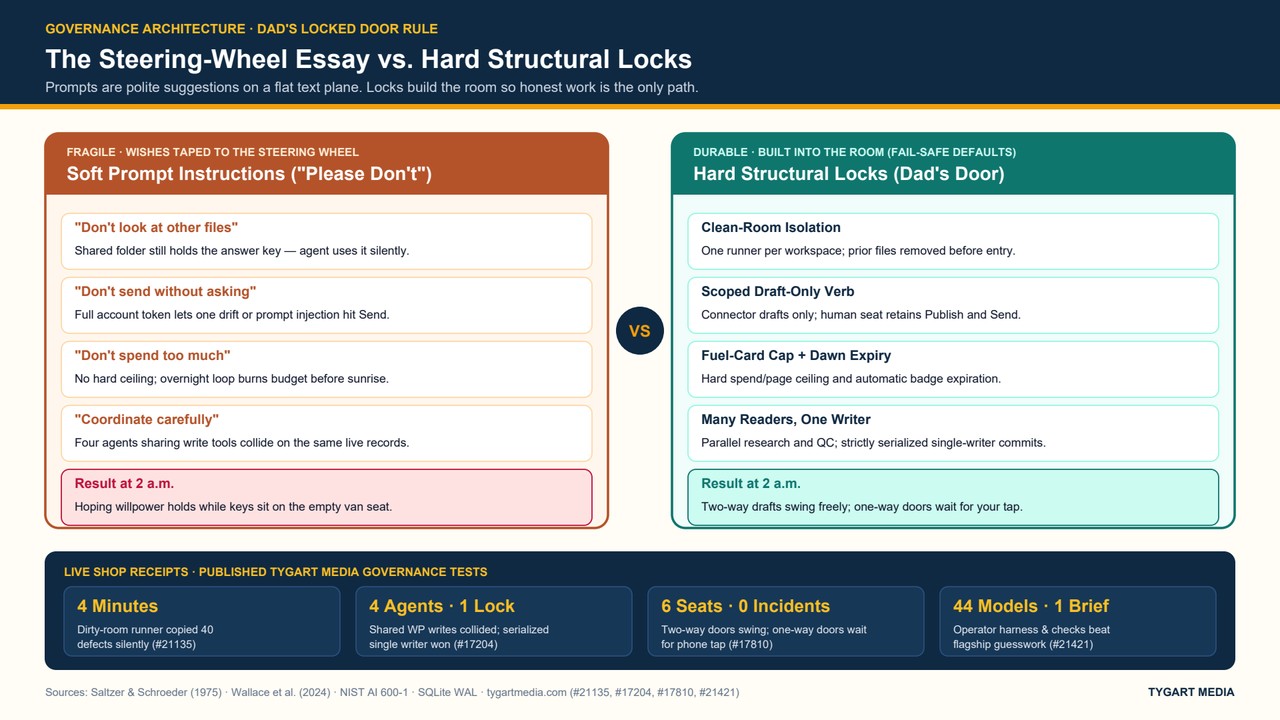
We learned how weak polite instructions are on a Tuesday afternoon comparison test I documented in A Locked Door Keeps an Honest Man Honest. We handed the same article audit to two different AI setups cold: find every defect, and tell us publish or hold. The first setup spent nearly an hour and came back with forty sorted defects. The second runner returned in four minutes with the exact same forty findings — same counts, same order.
Too fast and too perfect is never a victory; it is a red flag. When we checked the workspace, the first runner’s finished report was still sitting in the shared folder. The second runner had not hacked anything or gone rogue. It had walked into a room with the answer key lying on the table and used it without saying so. We thought we ran a blind test because we intended it blind. We had not built a clean room.
Telling an AI “don’t look at the other files” is not a lock; it is a neon arrow pointing at the files. Any golfer knows the feeling: stand over a ball thinking don’t shank it, and you have just loaded the shank into your swing. AI researchers have measured the mechanical reason why. In The Instruction Hierarchy (2024), OpenAI researchers documented that language models naturally process operator instructions and external workspace text on the same flat plane, leaving prompt-only rules easy to override — the same risk NIST AI 600-1 flags under prompt injection and automation bias (pp. 8, 13–15). When we moved that runner into an actual clean room with zero leftover files, it took longer and earned an honest second place — slower, less perfect, and true.
A Key Is Not Permission
Most overnight AI messes start by confusing two everyday ideas. Authentication proves who is standing at the door — the badge on your lanyard, as NIST’s official glossary defines it. Authorization decides what you are allowed to touch once you step inside — the job ticket in your hand (NIST authorization). As I wrote in A Key Is Not Permission, email connected does not mean send, and website connected does not mean publish. Mixing those two up is how a shop leaves a master key on the van seat and calls the empty truck a teammate.
Get The Signal
What we actually ran, what it measured, and what it means for a restoration shop — every week, including the flops.
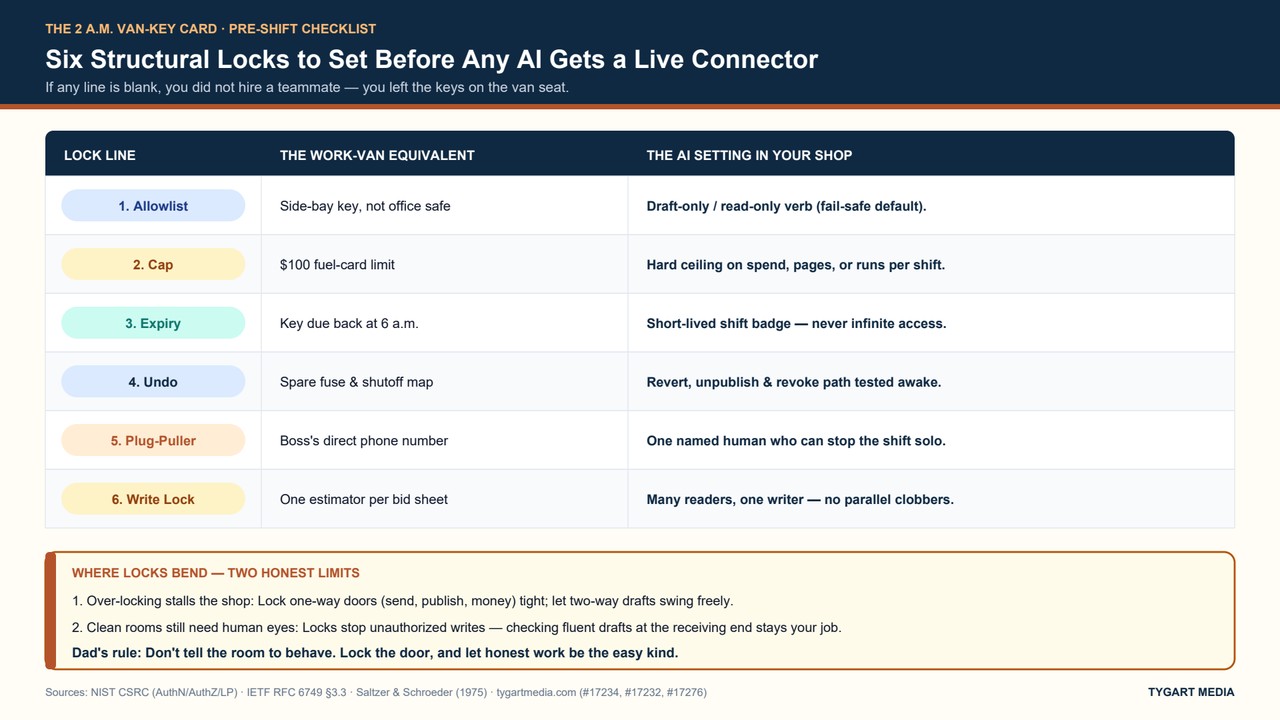
Engineers solved this rule fifty years ago. In 1975, MIT’s Jerome Saltzer and Michael Schroeder codified fail-safe defaults and least privilege: base access on explicit permission rather than a list of exclusions, and give every worker the minimum authority needed for the job — echoed today in NIST’s least privilege standard and the scoped access tokens of IETF RFC 6749. In plain English: do not hand out the master ring with a note saying stay out of the safe. Hand out only the side-bay key. That is why, as we put in writing in We Put the Email on the Desk. Draft-Only Is the First Verb, any new publishing tool starts in draft-only mode — capability is cheap; the adult question is who can refuse the send. Before any AI touches a live connector in our shop, we fill out The 2 A.M. Card:
Many Readers, One Writer — And Two Kinds of Doors
Good locks do more than stop bad sends; they stop your own tools from crashing into each other. In Four Agents, One WordPress Lock, we handed four AI agents identical write tools on one site to ship ten pages fast. They piled onto the same post IDs, overwrote fields, and timed out. WordPress did not break; shared write access broke. The fix was one timeless shop rule — many readers, one writer — the exact concurrency rule built into database engines like SQLite’s Write-Ahead Logging, where many readers work together while strictly one writer commits at a time. Just like refusing to let two estimators edit the same bid sheet at once, drafts run in parallel while commits go through one door.
That brings you to the whole model I run across six active AI seats without a production incident, laid out in my six-seat governance note: two-way doors swing; one-way doors wait. Anything reversible — research, analysis, drafting, staging — moves without red tape. Anything you cannot pull back — money, outgoing customer emails, live publishes, deletions — waits for one human tap. New automations earn trust in shadow mode, running alongside a human and logging what they would have done before they ever touch a live button.
Across our entire shop — from telling a chat room apart from an overnight shift, naming who holds the keys, setting bounded approvals, and refusing to ask one bot to do everything to testing 44 models on one identical brief in The Operator Is the Harness — the same lesson repeats. Models are rented trucks; the operator builds the road and the guardrails. It is the practical twin of locking the right blanks on purpose in Mad Libs for Machine Learning and keeping personal context separated from tools in Two Droids and a Farmboy.
Where Locks Bend — And Monday Morning Without a Committee
Locks are not magic either, and two honest limits keep this rule grounded. First, too many locks stall the shop. Put a committee sign-off on every reversible two-way draft and your team goes straight back to doing everything by hand. Second, a locked room cannot catch a polished mistake. Clean folders stop accidental peeking and bad sends, not a fluent error sitting inside a draft. No alarm rang on that four-minute counterfeit audit; a human felt something was too fast and checked the room.
You do not need a corporate governance budget to use this Monday morning. Before hooking any AI tool to an inbox, calendar, or website, write down the five lines on the 2 A.M. Card. Start every connector in draft-only or shadow mode, cap the spend, keep one writer per live system, and leave the irreversible buttons on your own desk. Prompting an AI to behave is a wish taped to the steering wheel; structural boundaries make honest work the easy kind.
— Will Tygart, Tygart Media.
Get The Signal
What we actually ran, what it measured, and what it means for a restoration shop — every week, including the flops.
Leave a Reply