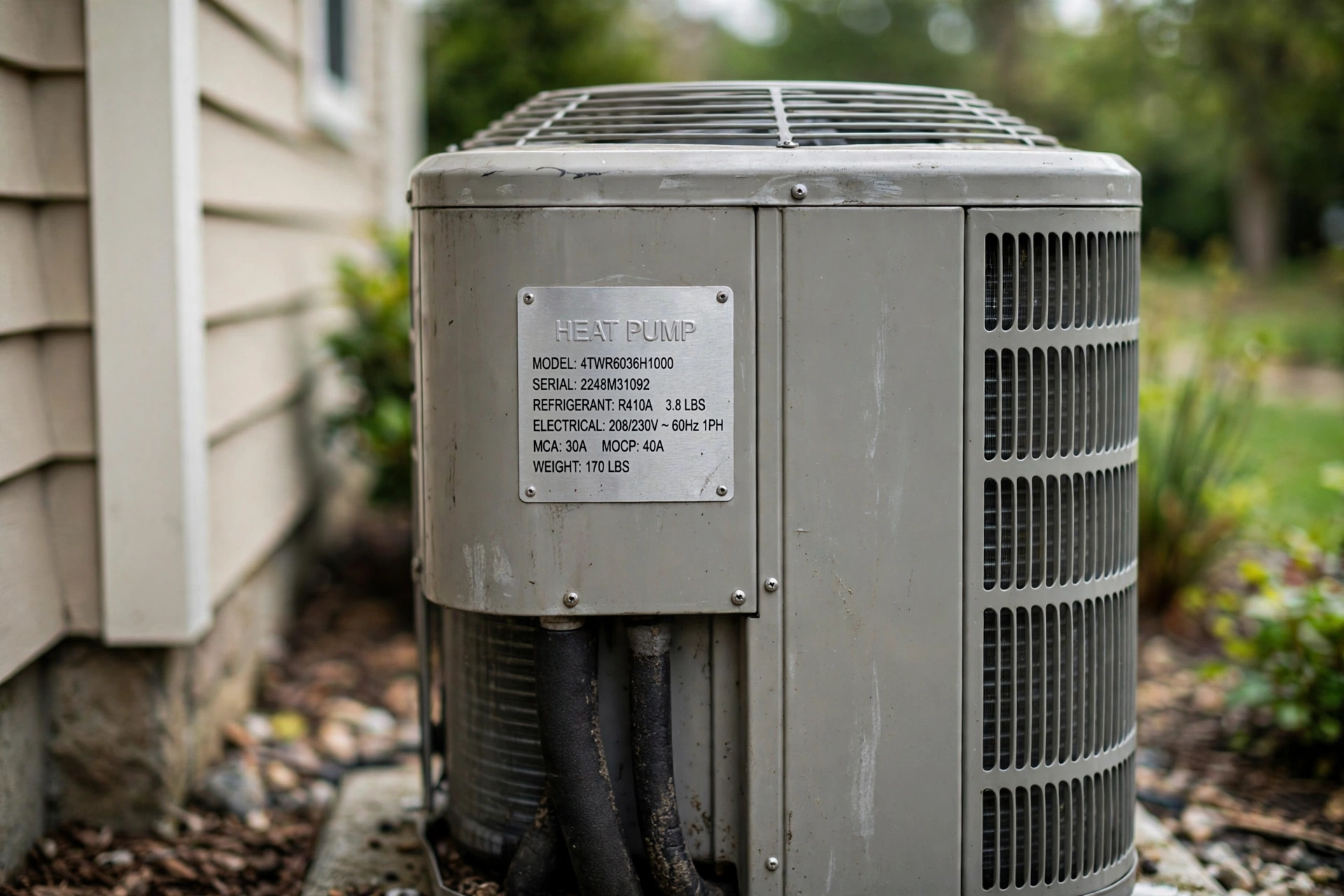
The best energy product this year is not another savings calculator. It is the thing that reads the nameplate on the unit already sitting on the pad and tells you, this week, whether your ZIP still has an open rebate file.
Listen to this essay. Audio version (MP3)
That is not a slogan. It is how a dead federal tax credit, a late state rebate launch, and cheap vision models rhyme.
Two clocks that no longer match
The residential energy-efficiency credit under section 25C stopped for property placed in service after December 31, 2025. Home Energy Basics and the rest of the contractor press have been repeating that date all year. The credit was the simple path. A household bought a qualifying heat pump, kept the invoice, and filed. That path is closed.
The messy path is still open. The Inflation Reduction Act put $8.8 billion into state Home Efficiency Rebates (HOMES) and High-Efficiency Electric Home Rebates (HEEHR / HEAR). The Building Performance Association’s June 2026 fact sheet is the clean public cut: 55 states and territories applied by January 2025. As of June 2026, twelve states and the District of Columbia had actually launched. DOE released updated program guidance on June 1, 2026. Active programs had until August 31 to conform. The same guidance limited replacement of non-electric appliances under HEEHR. Several state pages now say electric-to-electric only for reservations made on or after September 1, 2026.
Georgia is the early proof that money can move when a state office is live. GEFA, cited in that June fact sheet, had paid more than 2,600 households through a network of more than 150 contractors, with estimated annual household energy savings around $1,482. Georgia also paused new HEAR applications on August 14, 2026, according to Home Energy Basics’ September state roundup. Open last month is not open this week. That is the product surface.
A homeowner does not read DOE Notice 26-2. A contractor does not want to eat a denied reservation. The notice dies in a feed. The unit stays on the pad. The rebate window closes on a rule the household never saw.
Stop treating these as four micro-SaaS names
The X idea mill keeps splitting this into vertical slogans. One bot that watches DOE guidance. One that ranks heat-pump rebates by state. One that reads a utility bill. One that fills a contractor packet. Cute. Wrong cut.
Greg Isenberg keeps posting the same two primitives under different names: proprietary datasets, and a domain harness that does one industry’s work. The daily micro-SaaS accounts keep minting *.ai words for each document type. The household does not wake up wanting a “HEAR product.” They wake up because the furnace is loud, the bill jumped, or a neighbor said there was still free money.
The object is the same. A piece of equipment with a model number. A ZIP. A program that is open, reserved, paused, or banned for that fuel path. If you build four checkers you will raise four small rounds and lose to the shop that treats the nameplate as one object.
The wedge is a free photo checker. Not a platform.
Do not start with a contractor CRM. Start with a moment the homeowner already has in their hand.
Photograph the outdoor nameplate. Photograph the water-heater sticker. Paste the first page of last month’s utility bill. Add the ZIP. Thirty seconds later: open, reserved, closed, or fuel-switch blocked. If it is closed, you still captured a labeled unit. If it is open, you draft the state packet — and a person hits submit.
That is the only honest first offer. No seat fee to see the first answer. You get paid later, on a cut of funded rebates, on a contractor lead that already knows the reservation is live, or on the B2B scoreboard that names which model numbers and which ZIPs keep dying at the portal.
The application is not a toy. Income verification, AMI bands, measured-versus-modeled paths, and the September fuel-switch limit are a profession. The agent reads. A homeowner or a licensed contractor signs. Same pattern we already use on every irreversible step in this shop: the model drafts, a person owns the send.
Why this is buildable now
Two years ago the input was the problem. Nameplates are stamped metal in bad light. Utility PDFs are slop. State portals change the eligible SKU list without a press release. That slop is now the default training diet. Multimodal models can pull a model number off a photo of a condenser. They can match it against ENERGY STAR and against the state’s current measure list. They still lie. They do not need to be trusted with the reservation. They need to be trusted with the first pass.
The other half of “why now” is the mismatch. The simple federal credit is gone. The $8.8 billion is not. Most of the country is still in the 43-state lag the June fact sheet named. DOE’s June guidance was supposed to unstick those plans. Launch dates will keep slipping. Pauses will keep happening, the way Georgia paused HEAR in August. You do not need a new behavior. You need to sit on the photo people already take when they call an HVAC shop.
How the company actually compounds
The first dollar is the funded rebate or the avoided dead lead. That is not the business. The business is the labeled corpus.
After a few thousand photos you know which outdoor model numbers fail the current HEEHR list. You know which ZIPs went from open to reserved in a week. You know which utilities already stack a point-of-sale discount that the state portal does not mention. That is a B2B product every state energy office, distributor, and mid-size contractor will pay for — not because they love software, because the report names the miss before the crew is on the driveway.
Consumer volume trains the model. Contractor and state contracts pay for the map. Do not sell the map before you have closed real reservations for real houses. A dashboard of “possible savings” is how this idea dies in a sales deck.
What not to build
Do not build another national rebate marketplace that asks a homeowner to create an account and pick a contractor in week one. You will lose to the state portal on the households that already care, and you will never reach the person who only has a phone photo of the sticker.
Do not build a product that pretends a language model is a state energy office. AMI documentation and income attestation still need a human. The portal does not care about your demo.
Do not brand this as “AI for electrification in the agentic era.” That sentence is how you attract the wrong first ten customers. Brand the outcome. A unit that already exists, checked against a program that is still open.
A build order that will survive contact
- Week 1–2: one checker. Nameplate photo plus ZIP in, verdict out. No account required to see the first answer.
- Week 3–4: a draft packet for one live state program, with a human signer. Contingency fee only, or a contractor bounty on a funded reservation.
- Month 2: add the second object in the same house. If you started on the outdoor unit, add the water-heater sticker or the first page of the bill.
- Month 3: publish the first ugly internal scoreboard. Which model families, which ZIPs, which weeks the portal flipped. That scoreboard is the seed of the B2B SKU.
If you cannot get a stranger to photograph one nameplate this week, you do not have a company. You have a thesis.
Why this is worth writing, and building
Most idea-mill posts describe a feature. This one describes a shift in who does the tedious work of matching. The matching used to require a person who already reads state energy-office PDFs for fun. It now requires a model that can read the sticker and a person who will send the application.
Rebate businesses endure when the first action is free and the downside of a miss is visible. That is rare. Most software asks for a seat fee before it has proven a reservation. This one pays for itself on the first funded match or it does not deserve a second conversation.
Someone will own the system of record for equipment that already sits on pads and still sits in live state files. The threads will keep proposing a new .ai name for each appliance. Ignore the names. Match first. Keep the map.
Will Tygart — Tygart Media.
This is the idea-mill series.
Leave a Reply