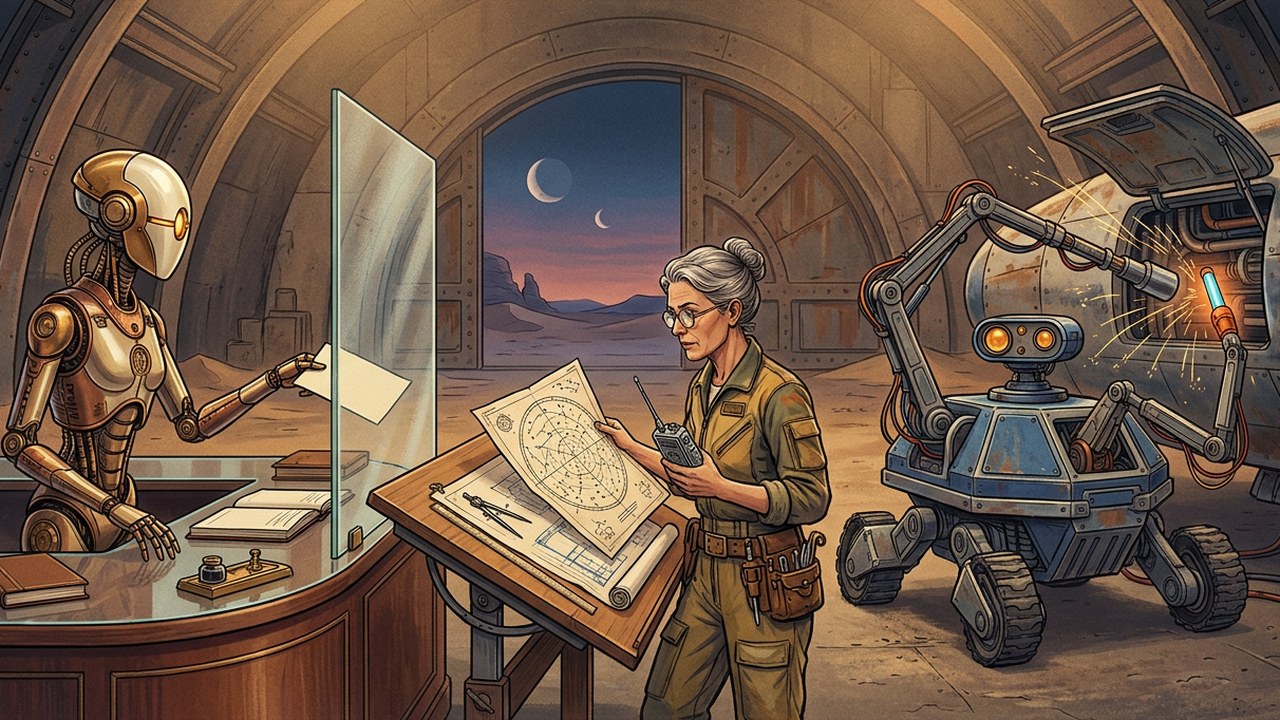
On May 25, 1977, if you were old enough to buy your own popcorn, you sat in a dark theater and watched George Lucas quietly solve the hardest problem in modern AI — nearly half a century before anyone started selling “autonomous agents” from a keynote stage. The movie sits in the Library of Congress National Film Registry's inaugural 1989 class for a reason. Picture one scene you still remember without closing your eyes: the Death Star trash compactor.
The walls are closing in on Luke, Leia, Han, and Chewbacca. Luke grabs his comlink and yells for C-3PO — the golden protocol droid built for etiquette and translation, famously fluent in over six million forms of communication (later upgraded past seven million in the sequel era). Notice what 3PO does not do: he does not grab a wrench. He understands human panic, turns Luke’s shouting into a clean instruction, and relays it to R2-D2. R2 makes no speech. The stout astromech — who smuggled Princess Leia’s stolen Death Star plans and later patched Luke’s X-wing mid-battle — rolls straight to the wall socket, plugs in, and shuts down the mashers.
Now look at how most people are told to use AI today: hire one droid to do both jobs. Dump your life, your clients, your bills, and your business keys into one all-knowing chat window, hand that same window tools to touch live work, and hope for the best. On this site, the opposite design has quietly run underneath half a dozen essays — yet before tonight, the names C-3PO and R2-D2 had appeared zero times on tygartmedia.com. Tonight we are naming the crew out loud, because this isn’t a trend piece. It is how I actually run my work, every day.
Casting Call: Three Roles, One Shop
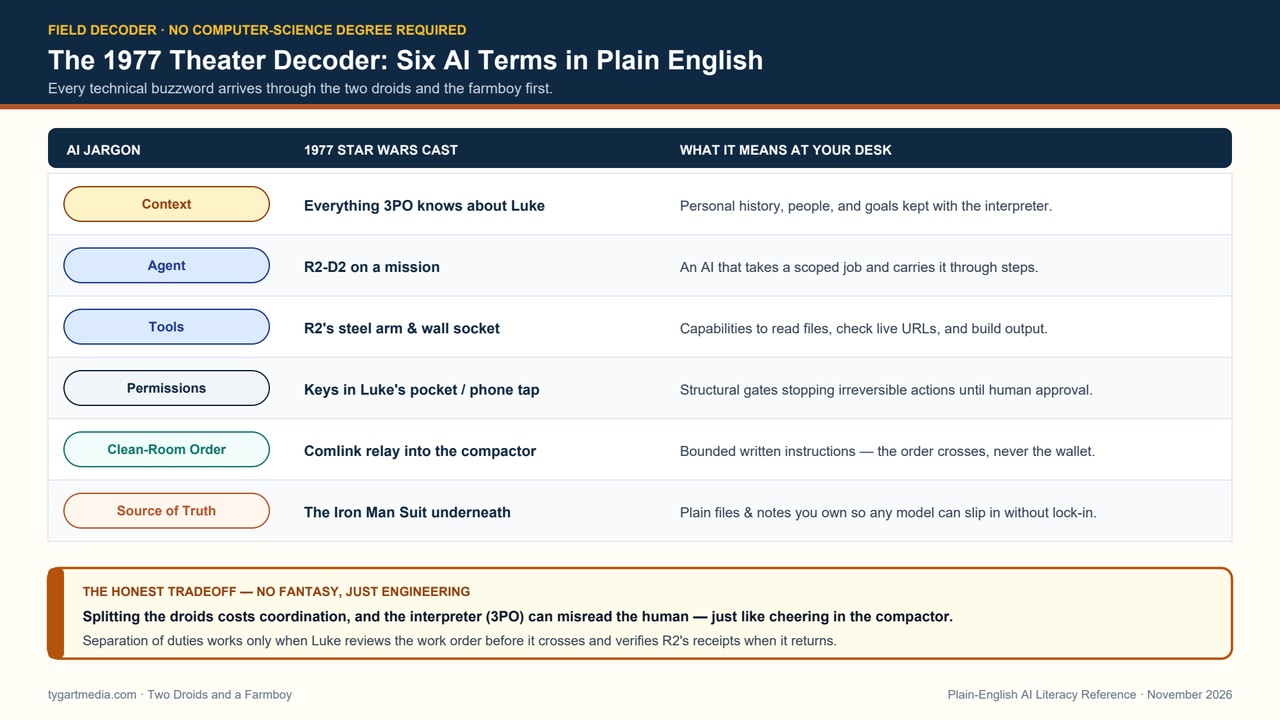
AI jargon makes a plain shop arrangement sound like wizardry. Four words — context, agent, tools, and permissions — do nearly all the work. Put the 1977 cast back on screen and every term snaps into plain English.
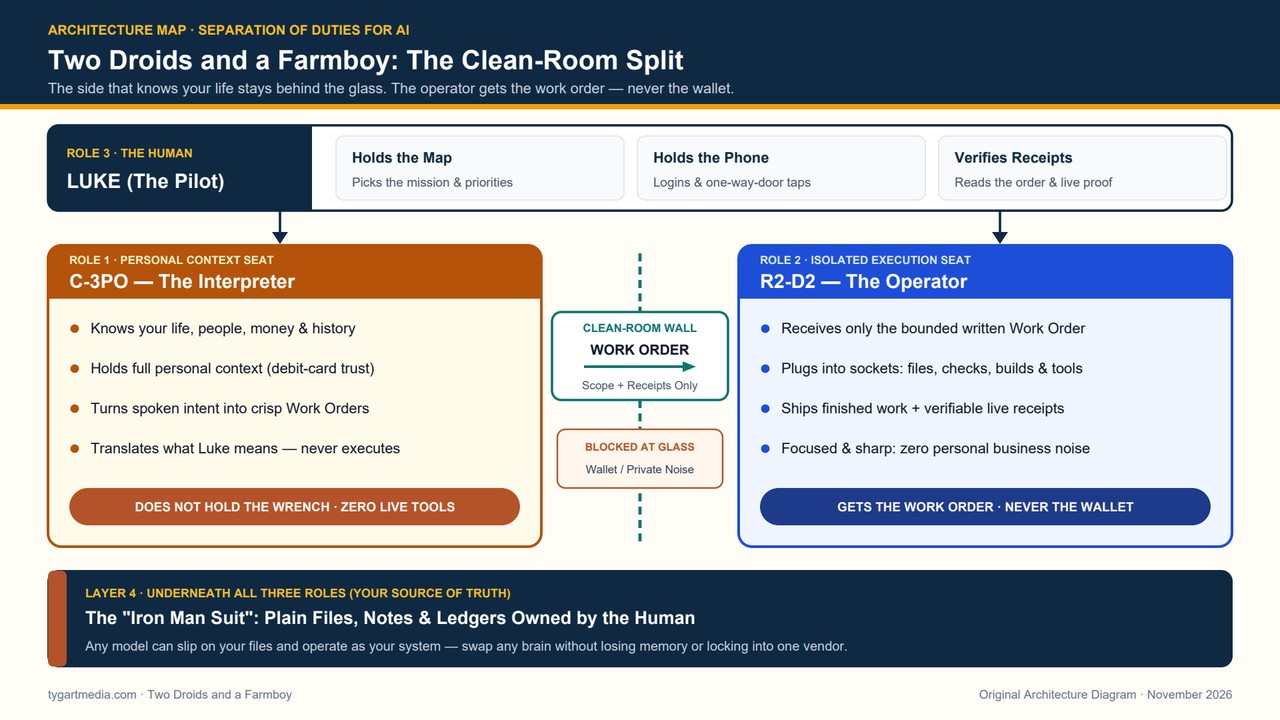
C-3PO is the personal side — the interpreter. This is the AI seat that knows me: my history, my people, my money, and what I decided on a clear-headed Tuesday. In plain terms, it is the side you would trust with your debit card. Engineers call that personal background context. Its only job is understanding and translation — turning what I talk through into a crisp, bounded written work order, the paperwork discipline we mapped in Agentic AI, From Inside the Shop. C-3PO does not execute. The side that knows your life does not hold the wrench.
R2-D2 is the operator side — the mechanic. Across a hard wall sits a separate AI that receives the work order and does the build: beeps, wrenches, results, and verifiable receipts. In AI research — formalized in Princeton and Google’s ReAct paper — an agent is simply a model paired with tools: instead of only offering advice, it reads files, checks live pages, and ships real work. What R2 does not get is my personal business noise or my wallet. As we drew that line in Bring Your Own Fleet, the personal identity seat never crosses the clean-room wall; the work seat only sees what the job needs.
Get The Signal
What we actually ran, what it measured, and what it means for a restoration shop — every week, including the flops.
Keeping personal noise out of R2’s room makes the mechanic sharper, not just safer. Stanford and UC Berkeley researchers showed in Lost in the Middle that stuffing extraneous background into long inputs measurably degrades how well a model uses the facts that matter. It mirrors the lesson in our sibling piece, Mad Libs for Machine Learning: lock only the right blanks into the pad, and everything downstream sharpens. Splitting framing from bounded execution also protects your cognitive budget, the same foreman-and-crew split we run across models.
Luke is the human — holding the map and the phone. Neither droid picks the mission. The Tatooine farmboy connects both droids, decides what ships, and takes them out to do work. In my real setup, logins and irreversible approvals live on my phone — a structural gate where reversible drafting flows while one-way doors wait for my tap, as I laid out in how I run six AI seats on my business. Engineers call those gates permissions. To anyone who has run a shop, they are the keys in your pocket. The droids don’t replace the farmboy; as we measured in Just a Guy: What Is One Person Worth Now?, one director running clean work orders extends what one person can finish while staying more in charge, not less.
Underneath the Droids: The Iron Man Suit
Underneath the three characters sits a fourth layer that makes the whole thing last: a source-of-truth layer made of plain files, notes, and ledgers that belong to me, not to whichever AI company tops this quarter’s benchmarks. I call it my iron man suit.
Because the real memory lives in my own files rather than locked inside one vendor’s chat history, any capable model can slip the suit on and still be my system. No single model is a single point of failure. We hit the same structural truth in Is Your Voice Assistant a Brain, or Just a Router?: the microphone, the router, and the brain were never meant to be welded shut. And as we documented in Wonder Full Stays in the Seat. The API Key Is a Different Promise, different seats carry completely different promises about your data. Own your files, separate personal context from execution, and swapping a model becomes a quick tool change instead of starting over.
The Honest Turn: Two Keys — And What the Split Costs
Long before AI, engineers and bookkeepers knew why one all-knowing assistant is a bad shape. In 1975 — two years before Star Wars opened — MIT’s Jerome Saltzer and Michael Schroeder documented least privilege and separation of privilege: give every role the minimum access needed to finish its job, and split critical authority like the two keys on a bank safe-deposit box. Today, the NIST glossary on separation of duty puts it in one line every business owner knows from accounting: the person authorizing a paycheck should not also be the one who can prepare them — echoed in least privilege and the clear role accountability of NIST's AI Risk Management Framework.
Here is the real insight worth keeping: the safest and most useful way to live with AI isn’t one all-knowing assistant — it is a separation of duties, with a human holding the map.
Now for the honest tradeoff, because nobody should sell this as magic. Splitting the droids costs coordination. Putting a wall between the side that knows you and the side that builds means writing clean work orders instead of firing off a half-formed wish at midnight. Worse, the interpreter can misread the human. At the end of the trash compactor scene, the instant R2 stops the walls and Luke’s crew starts cheering over the comlink, C-3PO mistakes their relief for dying screams until Luke yells back that they are fine. A personal AI seat fails the exact same way: it can over-read a casual remark, carry yesterday’s assumption into today’s order, or hand the mechanic a slightly crooked brief. The split protects your wallet and sharpens the wrench only when Luke reads the order before it crosses and checks the receipts when R2 rolls back.
Monday Morning Without Buying a Starship
You do not need six AI seats or a server rack to use this Monday morning. Stop putting your personal notebook and your working tools in the same room. Keep one space for thinking out loud with real context — untangling what you mean and what stays private. Carry only the finished brief, stripped of account noise, to the working seat that drafts, checks, or builds. Keep your real decisions in plain files you own, and leave the irreversible buttons in your own hand.
A moisture farmboy in 1977 knew better than to hand C-3PO a welding torch — or ask R2-D2 to make dinner conversation. Nearly fifty years later, the blueprint still holds. Let the interpreter know your life. Let the mechanic hold the wrench. Keep the map yourself.
— Will Tygart, Tygart Media.
Get The Signal
What we actually ran, what it measured, and what it means for a restoration shop — every week, including the flops.
Leave a Reply