In 1953, television writer Leonard Stern sat at his New York typewriter stuck on a Honeymooners script, hunting for an adjective to describe the nose of Ralph Kramden’s new boss. His friend Roger Price walked in and offered to help. Stern began, “I need an adjective that—” and before he could share a word of context, Price blurted out “clumsy” and “naked.” Suddenly Ralph Kramden worked for a man with a clumsy nose — or a naked nose.
As Stern tells it in the official Mad Libs history, both men laughed and realized they had a game. Five years later, over eggs Benedict at Sardi’s in the summer of 1958, they overheard an actor and his agent arguing whether it was “mad” to “ad-lib” an interview. Publishers called it a game; game makers called it a book. So they printed 14,000 copies themselves, stacked them in Price’s dining room for three months and seventeen days, got Steve Allen to play a round live on Sunday night TV to introduce Bob Hope, and sold out bookstores by Wednesday.
If you are in your fifties, you probably shouted nouns from the back seat of a station wagon while someone hid that yellow pad behind a clipboard. What nobody tells you is that Price and Stern accidentally invented the clearest mental model we have for modern machine learning. You do not need a computer science degree to understand today’s AI. You played the manual on I-90.
Rule 1: The Machine Plays Mad Libs in Reverse
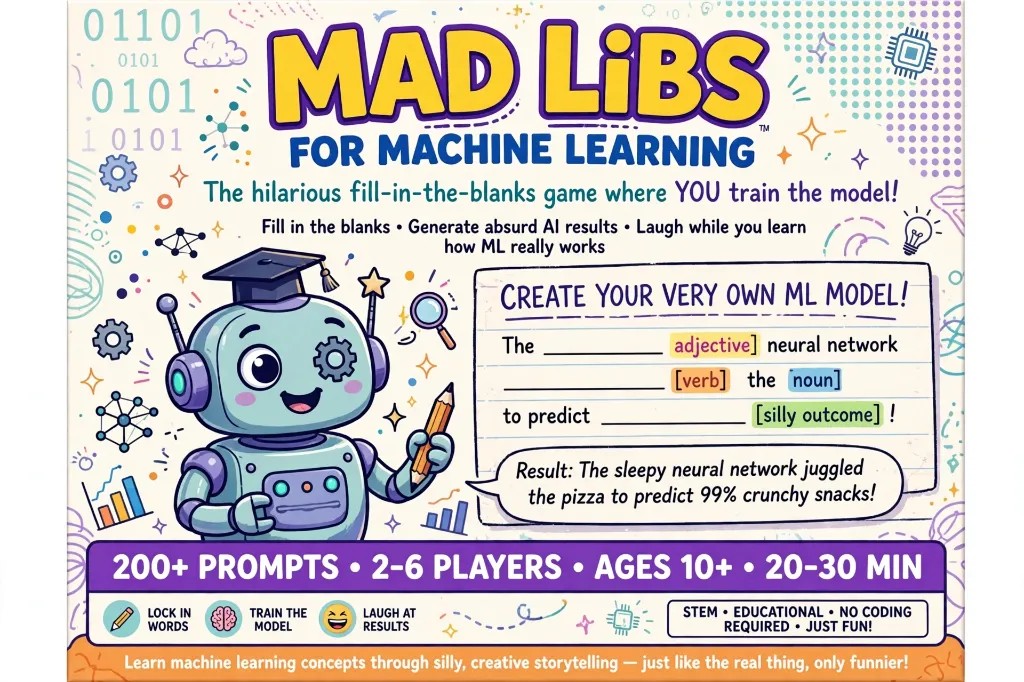
Look at the game box at the top of this page: “The [adjective] neural network [verb] the [noun] to predict [silly outcome]!” Fill those blanks station-wagon style and you get: “The sleepy neural network juggled the pizza to predict 99% crunchy snacks!” The grammar snaps shut. The cadence sounds strangely official. The meaning walked off a pier — because the player supplying the words could not see the rest of the sentence.
A large language model plays that fill-in-the-blank game in reverse. During training, it reads billions of pages with words masked out — like Google’s teaching line, “The ___ of the sleepy town weren’t prepared for ___ came next” — and grades itself on every guess. Earlier encoders like Google’s 2018 BERT read both sides of hidden blanks; modern chat models play a rolling left-to-right version (Google ML Crash Course). When you type a prompt, the system puts an imaginary blank after your last word, scores every plausible continuation, picks one, and locks it onto the page in permanent ink — adding one piece of a word at a time (Stephen Wolfram).
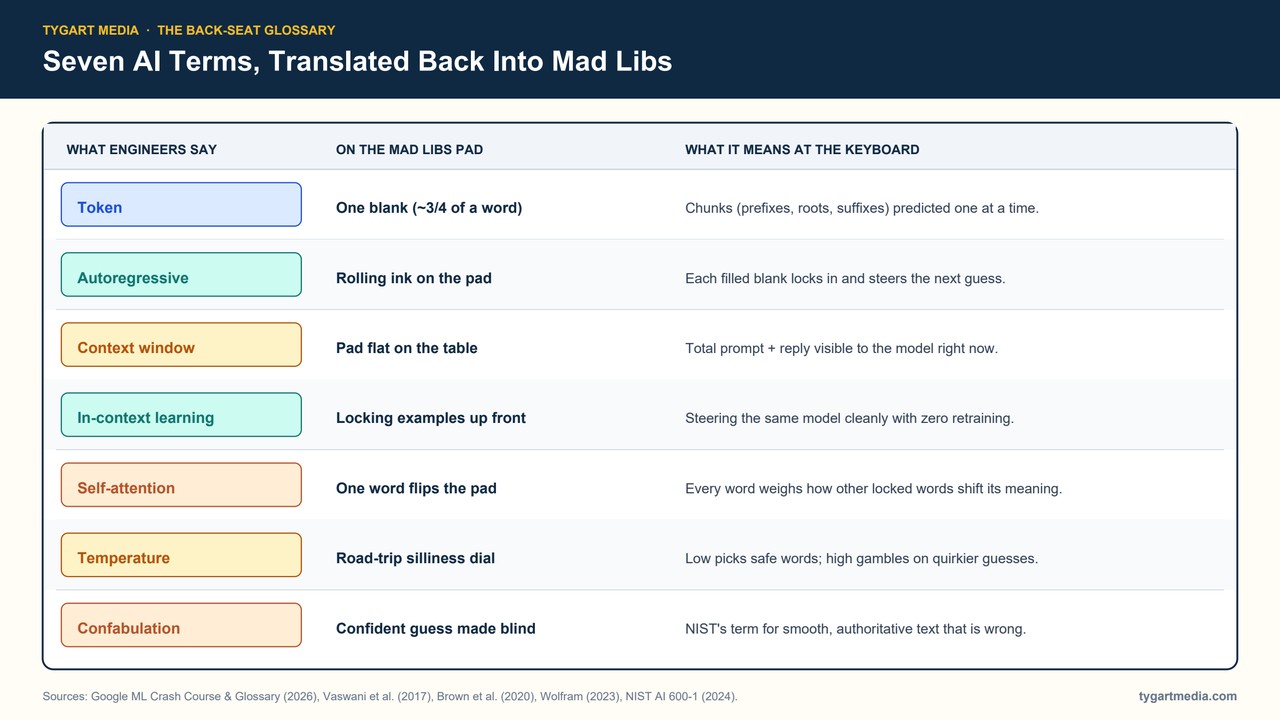
Three AI terms live right on that paper pad. A token is one blank — a short word or piece of a longer word (un + watch + ed), averaging roughly four characters or three-quarters of an English word (Google ML Crash Course). Autoregressive means rolling ink: each blank the model fills becomes part of the clue for the next blank (Google ML Glossary). And the context window is how much of the pad fits flat on the kitchen table at once — your prompt plus the reply so far. Most long-chat frustration isn’t mysterious; as we noted in our guide on why token limits are really a habits problem, it is letting clutter crowd the table.
Get The Signal
What we actually ran, what it measured, and what it means for a restoration shop — every week, including the flops.
Rule 2: Play Both Rounds — Same Skeleton, Two Worlds
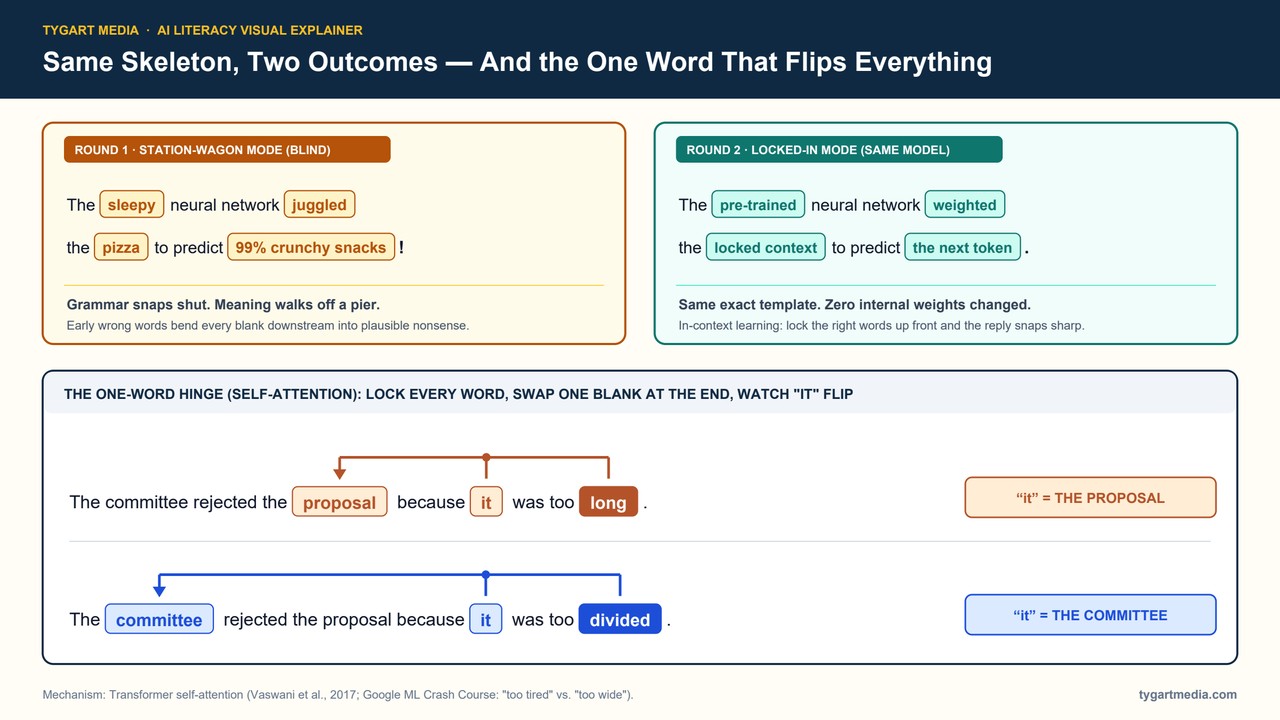
Why can the exact same AI sound like a sharp chief of staff at nine o’clock and an improv troupe at nine-fifteen? Watch one eight-blank office memo run twice — first context-blind, then locked down.
Round 1 almost reads like real office prose — funny and weird, yet weirdly right in cadence. Paste just that first silly sentence about the haunted casserole and the dentist into an AI and hit Enter: rolling ink accepts “haunted casserole” as fact and smoothly writes a deadpan follow-up on break-room exorcism rules. Turn up temperature — the randomness dial controlling how often the model picks quirkier, lower-ranked words (Wolfram; Google ML Glossary) — and the detour gets even wilder.
Now compare Round 2. Not one word of the skeleton changed — and inside an AI, not one internal weight changed either. OpenAI’s 2020 GPT-3 paper (Language Models are Few-Shot Learners) showed that a 175-billion-parameter model adapts to brand-new tasks purely from instructions and examples locked into the prompt, with zero retraining. Engineers call that in-context learning. On a Mad Libs pad, it is simpler: lock the right words in up front, and every blank downstream snaps into line.
Rule 3: Lock the Pad, Change One Word, Watch Meaning Swing
Once the right words are locked in, you can move to another spot in the sentence, swap one word, and flip the entire meaning. Modern models run on the Transformer architecture (Attention Is All You Need, 2017), powered by self-attention: every word on the pad weighs how strongly every other word shifts its meaning (Google ML Crash Course: Transformers). Google proves it with one classic pair: “The animal didn’t cross the street because it was too tired” versus “…because it was too wide.” Swap one end word and it swings from the animal to the street. The same hinge appears every week outside the lab:
When one tweaked adjective changes an AI’s entire draft, the machine isn’t moody. Self-attention is recalculating the pull across every locked word on the pad.
Rule 4: Why a Confident Guesser Invents Plausible Nonsense
That same fill-in-the-blank drive explains why AI occasionally invents a court case, clinic phone number, or price you never quoted — in the calm voice of a senior partner. People call it a hallucination. In NIST AI 600-1, the National Institute of Standards and Technology calls it confabulation — “the production of confidently stated but erroneous or false content” — and notes it is a natural result of how generative models work.
Roger Price didn’t pause in 1953 to check whether Ralph Kramden’s boss truly had a clumsy nose; the blank demanded an adjective. Ask an AI for a specific fact neither locked into your prompt nor pinned in its training patterns, and grammar still demands a next token — so the predictor supplies the smooth shape of an answer. Our guide to seven specific ways AI chatbots get things wrong maps each pattern so you can catch it fast.
Rule 5: Who Holds the Pencil?
Here is where the road-trip game turns serious — and hands you the one rule worth carrying into Monday morning: prompting is not coding. Prompting is choosing which blanks get locked in, and by whom.
Hand an AI an almost-empty pad — “Write a proposal for this client” — and you put the machine in Roger Price’s 1953 chair, asking for an adjective without showing the nose. Every open blank gets filled with the internet’s blandest average. As we wrote in The Operator Is the Harness, the model is the truck; the driver steers the load. Lock down the reader, the real numbers, the constraints, and the hinge word before the model writes a syllable, and the same tool writes like someone who sat in the room.
There is one catch most business owners miss until it costs them work: you are not always the person typing the prompt. Every hour, buyers and researchers ask an AI a question with a blank right in the middle — “Who is the most dependable [your specialty] in [your city], and what do they charge?” As we documented in Six in Seven AI Answers Never Look Anything Up, models lean heavily on what is already clear and verifiable. If your website hides behind vague slogans instead of locking in plain facts, the machine still finishes the sentence — with a competitor’s name, or a polite guess that misses who you are. The game runs whether you pick up the pencil or not. Lock your blanks on purpose.
— Will Tygart, Tygart Media.
Get The Signal
What we actually ran, what it measured, and what it means for a restoration shop — every week, including the flops.
Leave a Reply