Middle Manager Evaluation Scorecard
$59
Delivered by email after checkout.
Secure checkout via Square — all major cards accepted
You can copy this method and do it yourself. Name the person and the seat. Score nine traits 1-5 from recent examples. Total them. Read the band. Buy Now is the packaged Notion table you duplicate, so you are not rebuilding the scorecard from a blank spreadsheet.
Tool #6 of the Restoration Leadership Toolkit. Help owners assess whether someone is ready to manage people, not just perform tasks. Your best tech is not automatically your best lead. The skills that make a great doer (speed, craft, hustle) are different from the skills that make a great manager (getting work done through others). Use this before you promote the wrong person.
How to run it
- Name the person and the seat. Lead, crew chief, PM, estimator, office manager. The bar shifts with the seat. A crew chief lives or dies on conflict and training. A PM lives or dies on judgment and communication.
- Walk the nine traits in order. For each, ask for a recent, specific example: “Tell me about the last time they hit a problem on a job. What did they do?” Then give a 1-5 and confirm it. Anchor every score in observed behavior, not gut feel or potential.
- Flag the unknowns. If you have never seen a trait (they have never had to handle real conflict or train anyone), record it as a known gap. Do not guess a high score. Untested is itself a finding.
- Total the nine (max 45). Read the shape of the scores, not just the total.
- Name the lowest 2-3 traits as the gaps to close. One concrete development action each. A re-evaluation date, typically 60-90 days.
One person = one row. Duplicate a row or a page for the next person. Do not overwrite last quarter’s scores.
The nine traits
- Ownership. 1-5. Takes responsibility for outcomes, no blame-shifting.
- Communication. 1-5. Clear, timely, two-way communication. Closes the loop.
- Judgment. 1-5. Makes sound decisions without being told every step.
- Emotional maturity. 1-5. Stays steady under pressure, regulates reactions.
- Coachability. 1-5. Seeks and applies feedback, not defensive.
- Follow-through. 1-5. Closes the loop, does what they said by when they said.
- Trains others. 1-5. Can teach a task and bring others up to standard.
- Handles conflict. 1-5. Addresses tension directly and fairly, does not avoid it or blow it up.
- Values alignment. 1-5. Models company values when no one is watching.
Also write: Name, Role (current title), Notes (evidence, specific gaps to close, target re-eval date), Total (auto-sum of the nine, max 45), Recommendation (Promote / Develop first / Not yet).
The 1-5 anchors
- 1. Not yet / recurring problem.
- 2. Inconsistent, needs heavy supervision.
- 3. Developing. Does it when reminded.
- 4. Solid. Does it on their own most of the time.
- 5. Consistently strong. Others learn from how they do it.
The recommendation bands
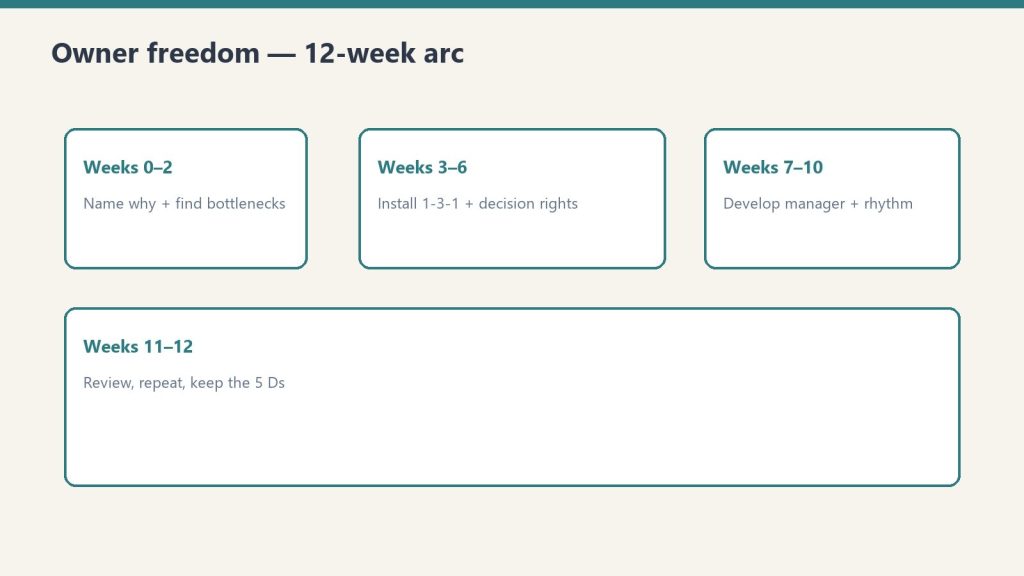
- Promote. About 37-45. Ready to lead now. Strong and even across traits.
- Develop first. About 27-36. Real potential with named gaps. Give a development plan and a date. Do not promote yet.
- Not yet. 26 or below. Performs tasks but is not ready to lead people. Revisit later, or keep growing them as an individual contributor.
Override rule. Any single trait scored 1-2 on Ownership, Emotional maturity, or Values alignment caps the recommendation at Develop first, regardless of total. Those are the floors for putting someone over people. Call it out when it triggers.
The bands are guides, not hard cutoffs. The owner decides. The score is an input, not a verdict. Never treat the number as a must-promote or must-pass.
How to fill it without lying to yourself
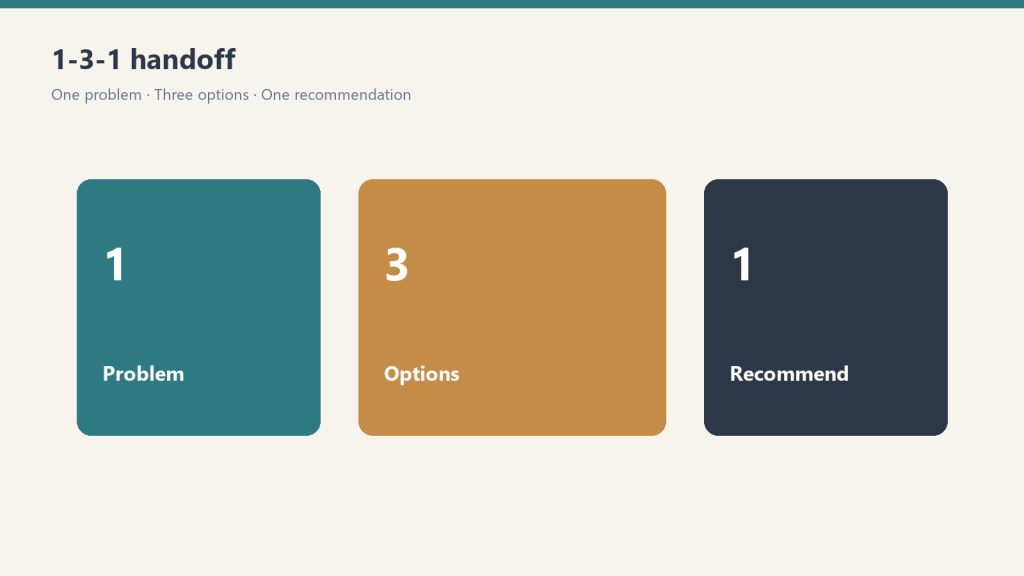
Score behavior, not the person. Tie every number to something you actually saw. Never score personality, background, age, accent, health, family situation, or “culture fit” as a stand-in for a protected characteristic. If that is the reason in your head, redirect to what they actually did.
Watch three biases. Halo: great tech, so you assume great leader. Recency: one good or bad week coloring everything. Similarity: rating people like you higher. Name it if you see it.
If several traits are untested, say so out loud. Lower your confidence. Put a trial of responsibility in front of the decision: run a job, train a hire, own a file end-to-end. Then re-score.
After a Develop-first result, the next move is usually an accountability conversation: here is what is between you and the seat, here is the 30-day or 90-day target. After a Promote, hand them one area end-to-end and put them on the 90-day doer-to-leader spine (Weeks 7-8: develop one manager). Put every scored name on a bench list so you are not keeping five people “on your radar” and developing none.
If you want the packaged scorecard
You can run the nine traits on a legal pad. Buy Now is the Notion table delivered by email after checkout. Duplicate it so the master stays clean. The nine scores, the Total, the Recommendation, and the Notes field are already laid out. Same Square button at the top of this page.
Pairs with the Leadership Readiness Checklist (lighter yes/no read on the same person), the Restoration Leadership Bench Builder (develop the Develop-first group), the Accountability Conversation Planner (the “here is what is between you and the promotion” talk), and the 90-Day Doer-to-Leader Transition Plan. Matching Claude skill: middle-manager-scorecard. Decision support only. Not legal or HR advice. Not a hiring, firing, promotion, compensation, or disciplinary determination.
Related on Tygart Media: leadership readiness · leadership toolkit.
Leave a Reply