
Leadership Readiness Kit
$197
Delivered by email after checkout.
Secure checkout via Square — all major cards accepted
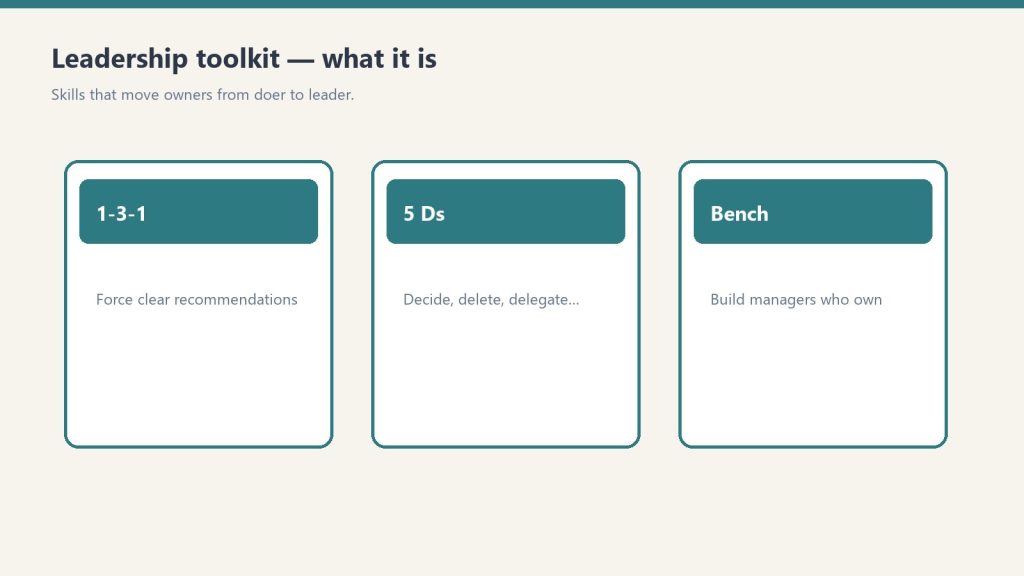
You can copy this method and do it yourself. Walk the bench. Score the person you want to promote. Plan the hard talk. Install 1-3-1 so the next problem comes back as a recommendation. Buy Now is the packaged bundle: four Notion tools plus the matching Claude skills, so you are not assembling the readiness read from blank pages.
This is the flagship of the Restoration Leadership Toolkit. Everything an owner needs to see whether their team can actually lead, and who to develop next. For growth-stage restoration owners who sense they are the ceiling on their own business.
What’s in the kit
- Leadership Readiness Checklist
- Middle Manager Evaluation Scorecard
- Accountability Conversation Planner
- 1-3-1 Delegation Worksheet
The matching skills from the Leadership AI plugin: leadership-readiness-checklist, middle-manager-scorecard, accountability-planner, delegation-1-3-1.
Run them in this order. The checklist is the scan. The scorecard is the person. The planner is the talk. 1-3-1 is the habit that keeps the next problem from landing back on you.
1. Leadership Readiness Checklist
Can your team actually lead, or does everything still run through you? Work six sections. Check only what is truly true today. A box you wish were true is a box left unchecked. Rate each section red / yellow / green. Duplicate the page each quarter so you can watch the bench get stronger.
1. Current leadership bench. Who leads field production, estimating, project files, sales, office / AR, marketing, finance, hiring. If a function has no owner besides you, that is a finding. Check: every core function has a named owner who is not you; each owner knows they own it; someone besides you can speak for the company to a customer or adjuster; you have at least one true second-in-command, not just a senior doer. Red = it is all me. Yellow = one or two real leaders. Green = a functioning leadership team.
2. Decision-making. The test of a leader is whether they can make the call when you are not reachable. Clear dollar threshold. Someone can authorize a job, a crew move, or an equipment purchase if you are out a day. When a lead brings a problem, they bring options and a recommendation. You have not reversed a reasonable decision in front of their team in the last 30 days. Red = everything routes to you. Yellow = small stuff yes, real calls no. Green = they own their lane.
3. Accountability habits. A leader who will not hold the line is a doer with a title. Do leads address underperformance, or do they route it to you? Written standards. Feedback that is not just a task list. Consequences when standards are missed. You are not the only person who delivers hard feedback. Red = you are the only enforcer. Yellow = leads avoid the hard ones. Green = leads own their team’s standards.
4. Communication rhythm. Leadership runs on cadence, not heroics. Weekly or biweekly leadership / ops meeting that actually happens. Daily or start-of-job huddle. Recurring 1:1s. A known way job status is communicated (not you texting everyone). Meetings produce decisions and owners. Bad news reaches you early. Red = ad hoc / by text. Yellow = some of it, inconsistently. Green = reliable cadence.
5. Single points of failure. You. The one estimator. The one person who holds carrier relationships. The one person who knows payroll. The one dispatcher. Passwords in one head. No SOP for the things “only so-and-so knows.” For each checked box, name the person, what breaks, and whether a backup exists. Red = several critical SPOFs. Yellow = one or two. Green = cross-covered.
6. Next leader candidates. Name real people. Rate ready now / 1-2 areas to grow / raw potential. Write the one thing each most needs. Have you actually told your top candidate you see leadership in them?
Tally last. Mostly green: deepen the bench and formalize succession. Mostly yellow: push decision authority and accountability down a level. Mostly red: you are still the company. The priority is not more hiring. It is building one true second-in-command and removing the biggest single point of failure (usually you). Write three lines: biggest SPOF right now; the one leader to develop next; the first move in the next 30 days.
2. Middle Manager Evaluation Scorecard

Great doers do not automatically become great leaders. Score the person you named in section 6 before you promote them. One person, one row. Nine traits, 1-5 each. Total is /45.
- Ownership. Takes responsibility for outcomes, no blame-shifting.
- Communication. Clear, timely, two-way.
- Judgment. Makes sound decisions without being told every step.
- Emotional maturity. Stays steady under pressure.
- Coachability. Seeks and applies feedback, not defensive.
- Follow-through. Closes the loop, does what they said by when they said.
- Trains others. Can teach a task and bring others up to standard.
- Handles conflict. Addresses tension directly and fairly, does not avoid.
- Values alignment. Models company values when no one is watching.
Anchor every score in a recent, specific example. Untested is itself a finding. Do not guess a high score on a trait you have never seen. Bands: Promote about 37-45. Develop first about 27-36. Not yet 26 or below. Override: a 1 or 2 on Ownership, Emotional maturity, or Values alignment caps the recommendation at Develop first, regardless of total. Those are the floors for putting someone over people.
Name the lowest 2-3 traits. One concrete development action each. A re-eval date, typically 60-90 days. The owner decides. The score is an input, not a verdict.
3. Accountability Conversation Planner
Use this when someone keeps missing the mark and you have been avoiding the talk. Ten minutes of prep. Six prompts, then a five-beat script.
- What is the actual issue? The pattern, not a single bad day. Business impact.
- What specific behavior needs to change? Observable. “Calls in after the crew is already on site,” not “doesn’t care.”
- What have I already allowed or tolerated? Where you let it slide or finished their file yourself.
- What expectation needs to be clarified? State the standard the way you would want it repeated back.
- What consequence or support is needed? Both sides.
- What does success look like in 30 days? Concrete. “Zero late starts for four weeks.”
Script beats: open and set the tone; name the issue and the behavior; own your part; state the expectation and the support; confirm the 30-day target and listen. Private, not on the job site, not by text. This is a planning doc, not a personnel record.
4. 1-3-1 Delegation Worksheet
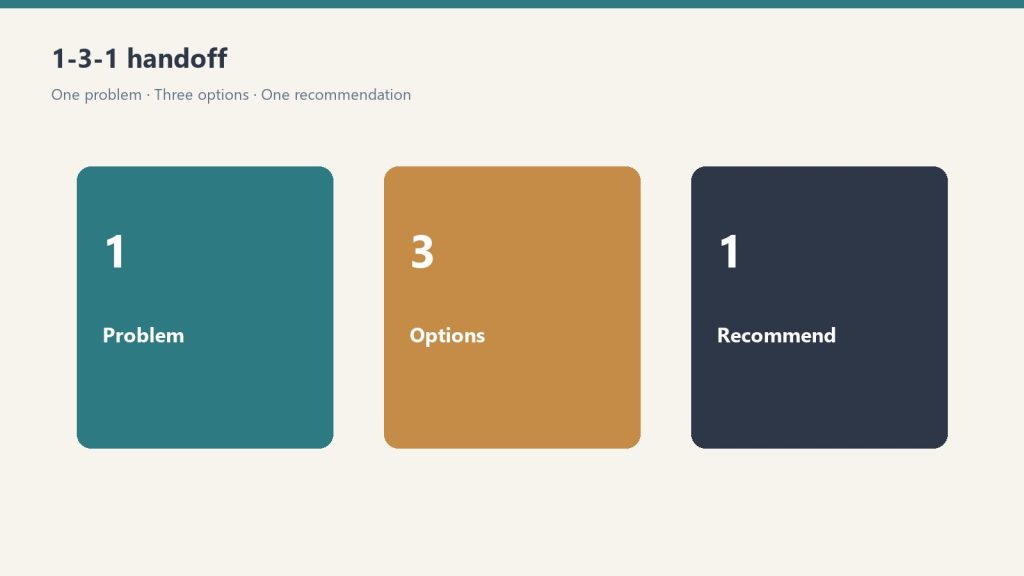
The old way: “The dehu on Maple St died. What do you want me to do?” You just took back the problem, the thinking, and the decision.
The 1-3-1 way: one issue (the fork in the road, one or two sentences); three real options with pros, cons, and rough cost (“do nothing” can be one when it is honest); one recommendation and why in one line; a default if they do not hear back by a deadline. Explain it once. Pin it where decisions get made. When someone brings a raw problem, ask: “What are your three options, and which do you recommend?” Then wait. Run at least five real conversations. Approve the recommendation whenever it is reasonable. Phase done when at least one person brings 1-3-1s without being reminded.
If the Readiness Checklist “options and a recommendation” box is empty, install 1-3-1 before you hire another lead.
If you want the packaged kit
You can run the four tools from the outline above. Buy Now is the bundle delivered by email after checkout: the four Notion pages (duplicate each so the master stays clean), plus the matching skills if you want the interviews walked. Same Square button at the top of this page.
Coaching and operational tools only. Not legal or HR advice. The planner is a planning doc, not a personnel record. The scorecard is decision support, not a hiring, firing, or promotion determination.
Related on Tygart Media: leadership toolkit · manager scorecard · owner dependency audit.
Leave a Reply