Updated November 13, 2026 — facts, pricing tiers, models, and field-sheet PDF verified against live Anthropic documentation.
Direct Answer · Verified November 13, 2026
Businesses deploy Claude across engineering (Claude Code), legal/compliance (1M-context contract review), GTM, and unified Claude Desktop with integrated Cowork workflows on Team Standard ($20/seat/mo annual or $25 monthly; 2–150 seats), Team Premium ($100/$125, 5× Standard), or Enterprise ($20/seat/mo annual + metered API usage, 20-seat minimum). Measure real ROI by timing baseline vs assisted cycle time and tool consolidation against verified seat and API costs across Fable 5.2, Opus 5.5, Sonnet 5.5, and Haiku 5.5 rather than vendor averages (claude.com/solutions/enterprise). Full pricing math on tygartmedia.com/claude-ai-pricing/.
Claude for Business & ROI — Tygart Media Field Sheet (PDF)
Claude AI has moved from experimental tool to operational infrastructure for businesses of all sizes. But the question most decision-makers ask isn’t “what can it do?” — it’s “what’s the return?” This guide covers the concrete use cases where businesses are deploying Claude in 2026, a framework for calculating ROI, and real data from published case studies.
Engineering and Development
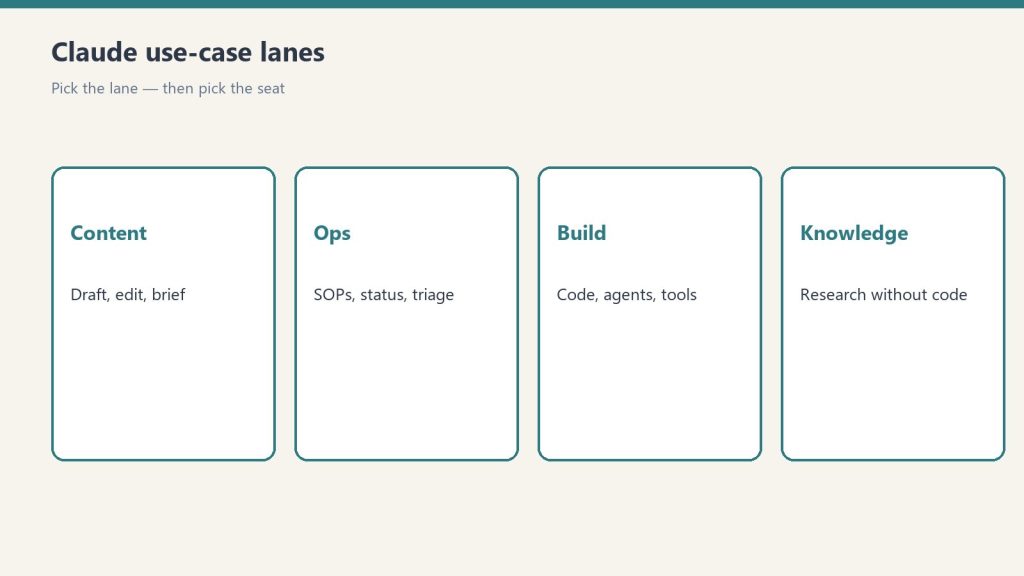
Claude Code is the primary engineering lever inside Pro, Team, and Enterprise deployments, covering code review, test generation, debugging, documentation, and multi-file refactoring across 1M-context codebases. Teams that standardize structured workflows (plan mode, hooks, managed settings) establish measurable cycle-time baselines before rollout rather than guessing from ad hoc usage.
Content and Marketing
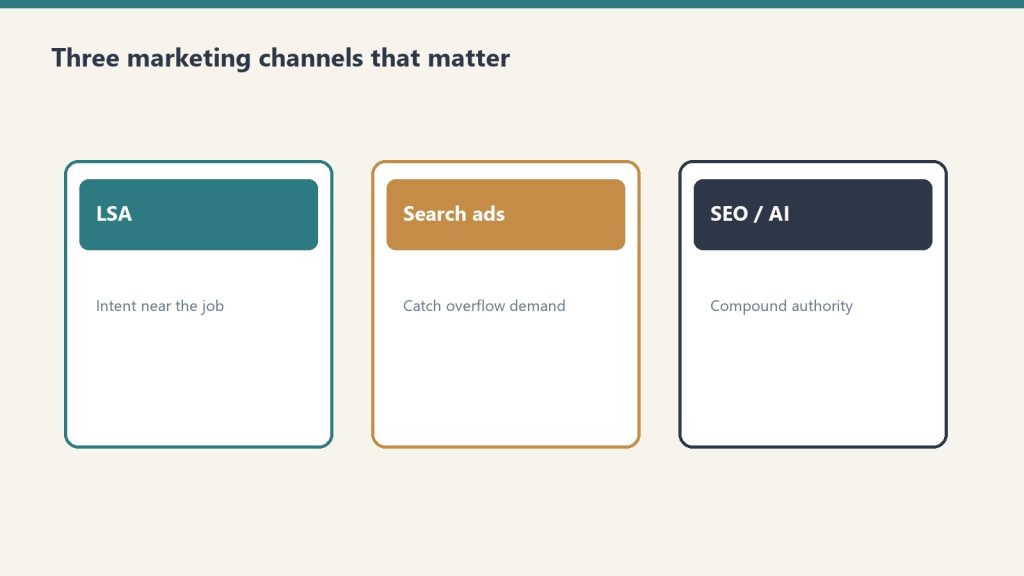
Marketing teams deploy Claude across long-form drafting, product catalogs, email campaigns, and SEO workflows using shared Projects and 1M-context models (content workflow guide). Instead of benchmarking against assumed daily article counts, measure first-draft plus human-editing hours per published deliverable before and after standardization.
Sales and Customer Support
Sales teams use Claude for prospect research, call preparation, proposal drafting, and competitive analysis. Customer support teams deploy Claude through the API to handle first-line inquiries, draft responses for human review, and summarize long ticket histories. The combination of Claude’s natural language understanding and tool use (via MCP) means it can pull CRM data, check order status, and draft personalized responses in a single flow.
Legal and Compliance
Legal teams use Claude for contract review, regulatory research, and compliance documentation across a 1M-token context window (Fable 5.2, Opus 5.5, Sonnet 5.5, Haiku 5.5). Enterprise features like audit logs, HIPAA readiness, and custom data retention make it viable for regulated industries. Law firms and legal departments report significant time savings on document review and research tasks.
Operations and Internal Productivity

Beyond specialized functions, Claude serves as a general productivity multiplier. Teams use it for meeting preparation, report drafting, data analysis, process documentation, and internal communication. Claude Desktop now integrates Cowork directly inside the unified Claude desktop experience (claude.com/product/cowork), supporting file organization, cross-step workflow execution, and structured report synthesis without bouncing between separate apps.
ROI Calculation Framework
Calculate Claude’s ROI for your organization with this framework. Time savings: estimate hours saved per employee per week. Multiply by the employee’s fully-loaded hourly cost. Quality improvements: reduced error rates in code, content, or customer communications. Speed to market: faster project completion times. Tool consolidation: Claude may replace or reduce spending on multiple SaaS tools (writing assistants, code review tools, research platforms). Total cost: verified seat spend — Team Standard ($20/seat/mo annual or $25 monthly; up to $500/mo pooled API credits), Team Premium ($100/$125, 5× Standard), or Enterprise ($20/seat/mo annual + metered API usage, 20-seat min) — plus production API tokens (full rate table). Track net ROI directly as (Measured Hours Reclaimed × Loaded Rate + Tool Consolidation Savings) − (Seat + API Spend).
Choosing the Right Plan for Business
Team Standard ($20/seat/mo annual; $25 monthly) and Team Premium ($100/$125, 5× Standard) cover 2–150 seats with mix-and-match seats and zero default model training. Organizations with 20+ seats requiring SCIM provisioning, audit logs, custom data retention, IP allowlisting, or a HIPAA BAA adopt Enterprise ($20/seat/mo annual + metered API usage) (claude.com/solutions/enterprise).
Related on Tygart Media: Claude for content · how to use Claude · is Claude worth it.
Frequently Asked Questions
How much does Claude cost for a business?
Team spans 2–150 seats: Standard is $20/seat/month annual ($25 monthly) (so 20 Standard seats annual = $400/mo or $4,800/yr) and Premium is $100/seat/month annual ($125 monthly, 5× Standard). Enterprise starts at $20/seat/month annual plus metered API usage (20-seat minimum) (pricing hub; claude.com/solutions/enterprise).
What is the ROI of Claude AI for businesses?
ROI depends on workflow repeatability, baseline cycle time, and seat-tier matching rather than a fixed benchmark. Measure hours reclaimed on high-frequency workflows plus consolidated point-tool spend against actual seat and API costs in a 30-day pilot.
Is Claude AI secure enough for enterprise use?
Yes. Enterprise includes SSO, SCIM, audit logs, compliance API, HIPAA readiness, custom data retention, and IP allowlisting. Content is not used for model training.
Can Claude replace our existing AI tools?
Claude can consolidate multiple point solutions — writing assistants, code review tools, research platforms, and customer support drafting tools — into a single platform, potentially reducing overall tool costs.
Get The Signal
What we actually ran, what it measured, and what it means for a restoration shop — every week, including the flops.
Leave a Reply