The Anthropic API gives developers programmatic access to Claude — the same models that power claude.ai, but accessible through HTTP requests or official SDKs. Whether you’re building a chatbot, automating document processing, or integrating AI into an existing application, this guide gets you from zero to your first API call in under 10 minutes.
Step 1: Create an Anthropic Account

Go to platform.claude.com and sign up. This is the developer console — separate from claude.ai. You’ll need a valid email address. After email verification, you’ll land on the console dashboard where you can generate API keys and manage billing.
Step 2: Add Billing and Get Your API Key
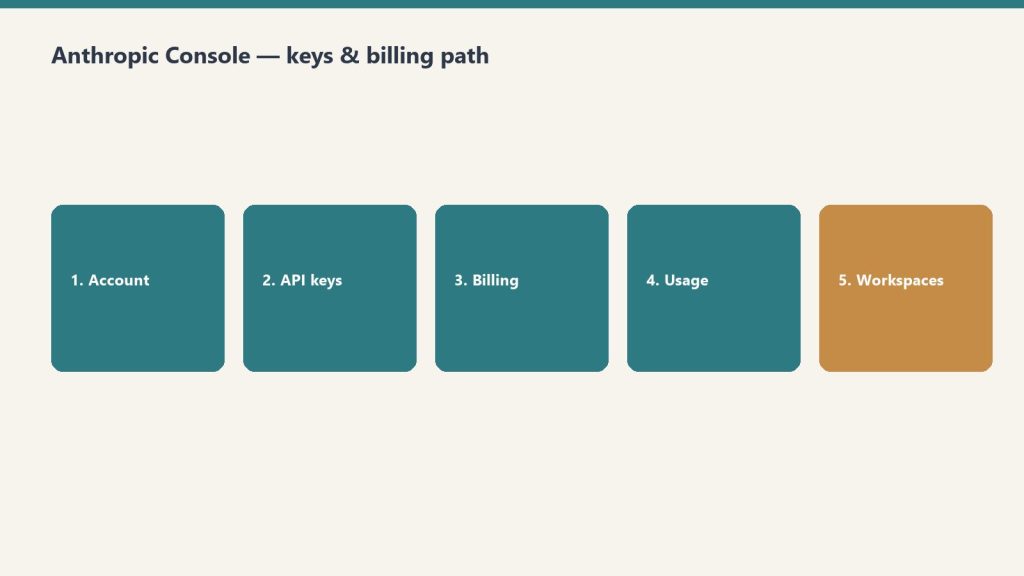
Navigate to the billing section and add a payment method. Anthropic uses a prepaid credit system — load funds and API calls draw from your balance. Once billing is set up, go to the API Keys section and click “Create Key.” Name the key descriptively (e.g., “my-first-project-dev”) and copy the key immediately — it starts with “sk-ant-” and won’t be shown again. Store it securely: in an environment variable, a secrets manager, or a .env file that’s in your .gitignore.
Step 3: Install an SDK
Anthropic provides official SDKs for Python and TypeScript. For Python: pip install anthropic. For TypeScript/JavaScript: npm install @anthropic-ai/sdk. Both SDKs handle authentication, request formatting, streaming, error handling, and retries. You can also use the raw HTTP API directly with any language that supports HTTP requests.
Step 4: Make Your First API Call
In Python, set your API key as an environment variable: export ANTHROPIC_API_KEY="sk-ant-your-key-here". Then write a simple script. Import the Anthropic client, create a message with the model name (e.g., “claude-sonnet-4-6”), specify the max tokens for the response, and pass your prompt. The response includes the generated text, token usage counts, and metadata about the request.
The API endpoint is Messages — you send a list of messages (with roles “user” and “assistant”) and Claude responds. System prompts are set separately to establish Claude’s behavior for the conversation. Each request is stateless — you manage conversation history by including previous messages in each request.
Available Models
The current production models and their API identifiers: claude-opus-4-6 (Opus 4.8 is the latest, but check the docs for exact model strings), claude-sonnet-4-6, and claude-haiku-4-5-20251001. Each model has different strengths. Opus is the most capable for complex reasoning and coding. Sonnet balances capability and cost. Haiku is the fastest and cheapest for high-volume, simpler tasks.
Key API Features
Streaming: Get responses token-by-token as they’re generated, reducing perceived latency. Tool use (function calling): Define functions that Claude can invoke to interact with external systems — databases, APIs, calculators. Vision: Send images along with text for multimodal analysis. Extended thinking: Enable Claude’s step-by-step reasoning for complex problems. Prompt caching: Cache system prompts and frequently-used context to reduce costs by up to 90%. Batch API: Submit multiple requests for asynchronous processing at 50% off.
Alternative Access Points
Beyond the direct Anthropic API, you can access Claude through Amazon Bedrock (AWS), Google Cloud Vertex AI, Microsoft Azure through Foundry, and third-party routers like OpenRouter. Each platform has its own authentication, pricing adjustments, and additional features. The direct API gives you the most control and typically the lowest latency.
Related on Tygart Media: Anthropic Console · Message Batches API · how to use Claude.
Frequently Asked Questions
How do I get an Anthropic API key?
Sign up at platform.claude.com, add billing, then go to API Keys and click Create Key. The key starts with “sk-ant-” and should be stored securely.
Is the Anthropic API free?
There is no permanent free tier. You pay per token used. Pricing starts at $1/MTok input for Haiku 4.5.
Which SDK should I use?
Python (pip install anthropic) or TypeScript (npm install @anthropic-ai/sdk). Both are officially maintained by Anthropic with the same feature set.
Can I use Claude API with other programming languages?
Yes. The API is standard HTTP with JSON payloads. Any language that can make HTTP requests can call the Anthropic API directly without an SDK.
Get The Signal
What we actually ran, what it measured, and what it means for a restoration shop — every week, including the flops.
Leave a Reply