Tygart Media Editorial - Tygart Media

Category: Tygart Media Editorial

Tygart Media’s core editorial publication — AI implementation, content strategy, SEO, agency operations, and case studies.

  • Claude Enterprise Pricing & Procurement Guide (2026)

    Claude Enterprise Pricing & Procurement Guide (2026)

    Updated November 2, 2026 — added direct answers on Claude Enterprise pricing and contract structure, sourced from Anthropic’s published pricing.

    Updated October 28, 2026: Made infographic diagrams clickable to open full-size images.

    Claude Enterprise pricing works differently from the individual and Team plans. Instead of a fixed per-seat fee that includes unlimited usage, Enterprise charges a base seat cost of $20/seat with additional usage billed at API rates. This model gives large organizations more flexibility but requires understanding how usage translates to cost. Here’s the complete breakdown for decision-makers evaluating Claude Enterprise in 2026.

    Last refreshed: November 2, 2026 (Pacific)

    Direct Answer (October 2026): Claude Enterprise pricing starts at ~$20/user/month for identity access (SSO/SCIM/Audit Logs) with token consumption billed at standard API rates — now spanning Sonnet 5.5 and Opus 5.5 as the current models, alongside legacy Opus 4.8 and Sonnet 4.6. Total monthly spend averages $60–$250/active user based on model selection and prompt caching adoption.

    How Enterprise Pricing Works
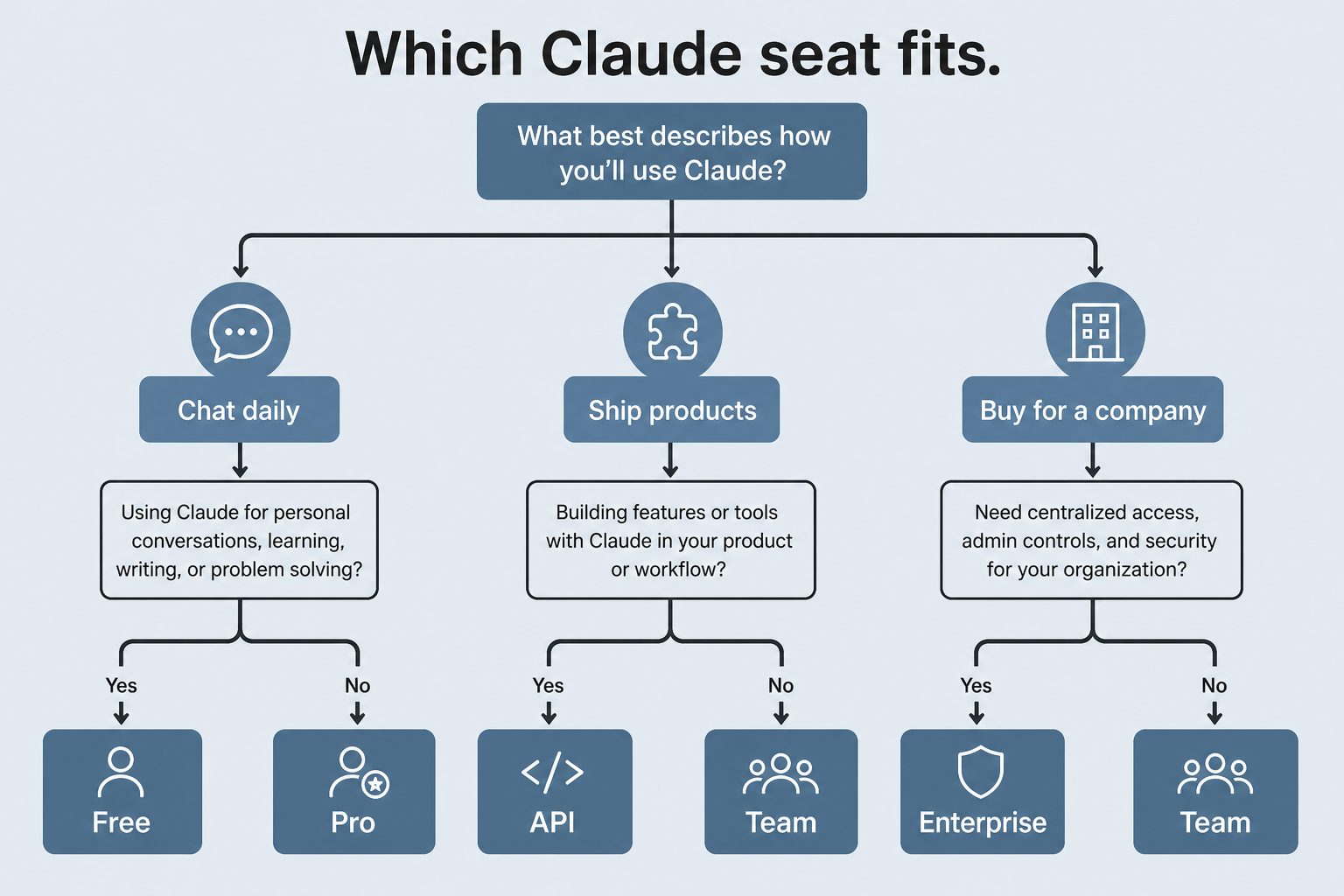
    Decision map from daily chat, shipping products, or buying for a company to Free/Pro, API, or Team/Enterprise
    How Claude Enterprise pricing works — recheck this breakdown whenever Anthropic changes seat fees or API rates (last verified October 2026).

    The pricing structure has two components. First, a per-seat fee of $20/month per user. This covers access to the Claude interface and all Enterprise features. Second, usage-based charges at API rates that scale with which model each user interacts with and how much they use it. When an Enterprise user chats with Claude, token costs follow current API rates. Sonnet 5.5 (Anthropic’s current mid-tier model) is priced at $2/MTok input and $10/MTok output, and Opus 5.5 (the current flagship) at $4/$20. Legacy models remain available at their existing rates: Opus 4.8 at $5/$25 and Sonnet 4.6 at $3/$15. Haiku 4.5 stays at $1/$5.

    This means actual costs per user vary significantly. A light user who sends a few messages per day might cost $20-30/month total. A power user running Claude Code and extended research sessions could cost $150-500+/month. Administrators can set per-user and organizational spending limits to maintain budget predictability.

    Two Paths to Enterprise
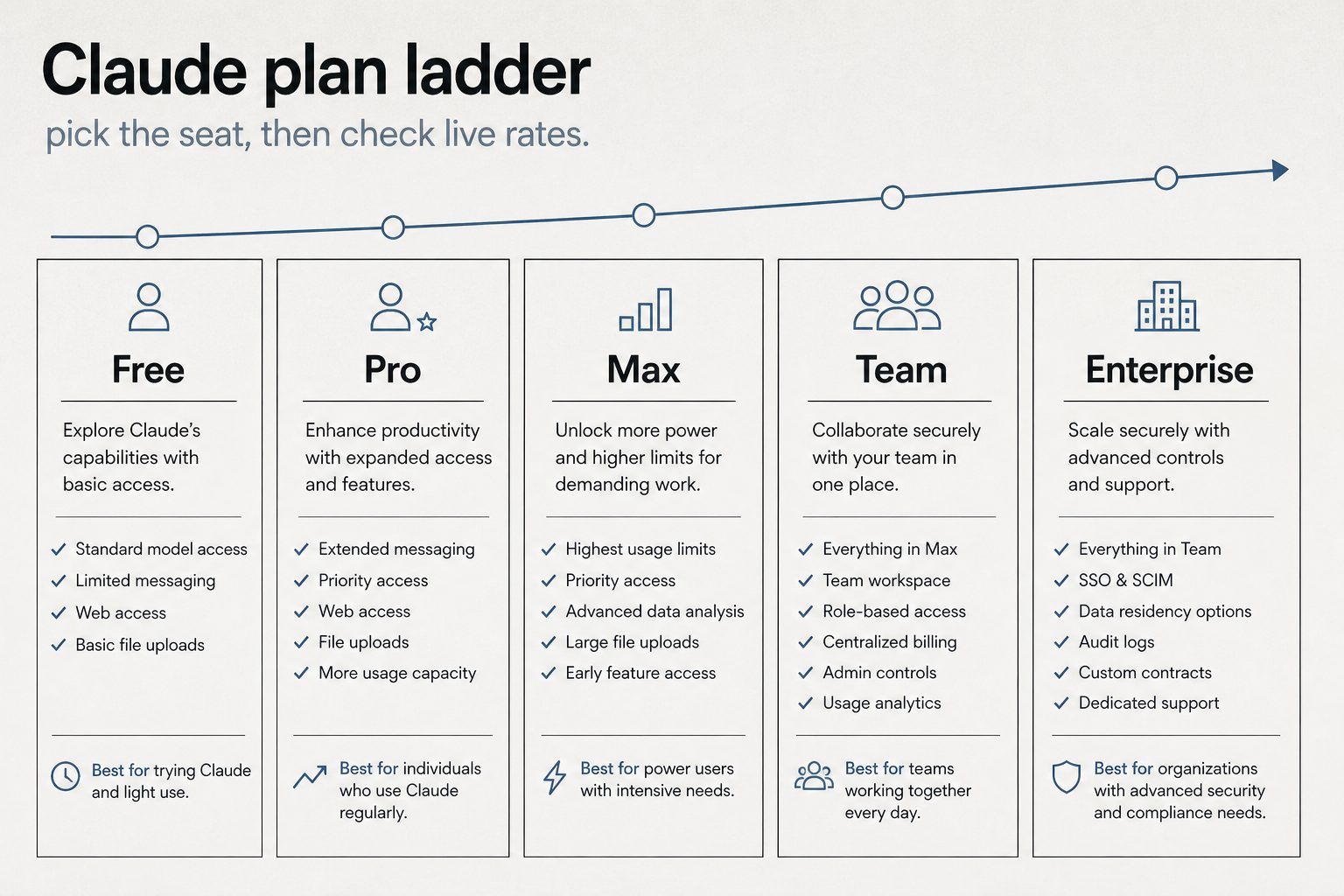
    Infographic ladder of Claude plans: Free, Pro, Max, Team, and Enterprise
    Two paths to Enterprise.

    Anthropic now offers two ways to get on the Enterprise plan. The self-serve path lets organizations sign up directly at claude.ai/create/enterprise without contacting sales. This is designed for teams that want enterprise security features but want to move fast. You get SSO, domain verification, central billing, admin controls, usage analytics, and the ability to add seats on demand. The sales-assisted path is for organizations that need custom contracts, MSAs, purchase orders, usage commitments, tiered incentives on committed spend, non-standard terms, trials, or consultation. Contact sales through claude.com/contact-sales.

    Enterprise-Only Features

    Enterprise includes everything in the Team plan plus several capabilities only available at this tier. Admin-set spend limits let administrators control costs at both user and organization levels. Role-based access with fine-grained permissioning controls who can access what. SCIM (System for Cross-domain Identity Management) automates user provisioning and deprovisioning. Audit logs provide detailed records of user activity. Compliance API enables observability and monitoring. Custom data retention controls let you set how long data is stored. Network-level access control and IP allowlisting restrict where Claude can be accessed from. HIPAA-ready offering is available for healthcare and regulated industries. Claude Security (currently in beta) provides AI-powered vulnerability scanning.

    Enterprise vs Team: When to Upgrade
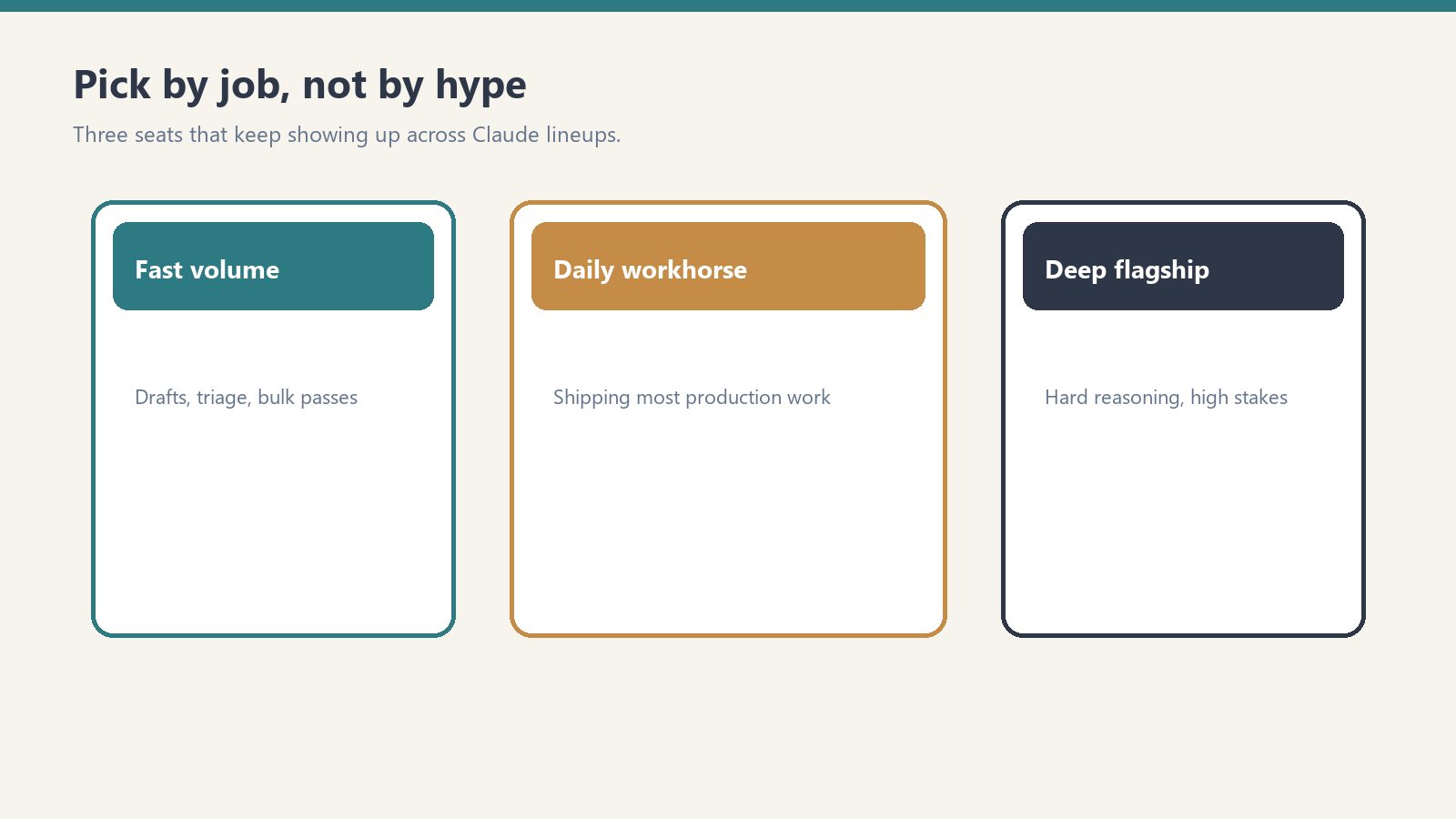
    Three cards for fast volume, daily workhorse, and deep flagship Claude seats
    Enterprise vs Team — when to upgrade.

    The Team plan caps at 150 users and uses fixed per-seat pricing ($20-125/seat depending on seat type). Enterprise has no user cap and uses the seat-plus-usage model. Upgrade to Enterprise when you need more than 150 seats, when you require SCIM for automated provisioning, when compliance requirements demand audit logs and a compliance API, when you need custom data retention or HIPAA readiness, or when the usage-based model would actually cost less than Team Premium seats for your usage patterns.

    Current Enterprise Promotion

    As of June 2026, Anthropic ran a promotion offering $1,000 in Claude Code and Claude Cowork credits for every Enterprise seat activated by July 2, 2026 — that window has since closed.

    Evaluating Enterprise ROI

    To evaluate whether Claude Enterprise justifies the cost, consider time savings per employee (if each user saves 5 hours/week at $50/hour effective cost, that’s $1,000/month in productivity per person), reduction in tool sprawl (replacing multiple SaaS subscriptions), code velocity improvements (engineering teams using Claude Code report 20-40% productivity gains in published case studies), and compliance cost avoidance (audit logs, SCIM, and HIPAA readiness may replace other compliance tools).

    What does Claude Enterprise cost?

    There is no single published flat rate for Claude Enterprise; total pricing is structured around a base platform seat fee plus variable usage charges and negotiated contract terms. On Anthropic’s official published self-serve terms, the Enterprise plan starts at $20 per seat per month (billed annually, with a 20-seat minimum), while all token and model usage is billed separately at standard API rates based on consumption.

    For sales-assisted agreements covering larger deployments, seat minimums and volume discounts are established during the enterprise sales conversation rather than fixed by a public rate card. Total enterprise cost is governed by several core commercial factors: total seat count, annual billing commitments, token consumption across models (such as Sonnet and Opus), and organizational requirements for enterprise governance capabilities. These include Single Sign-On (SSO), automated user provisioning via SCIM, comprehensive audit logs, Compliance API observability, custom data retention policies, IP allowlisting, and HIPAA-ready configurations.

    Frequently Asked Questions

    How much does Claude Enterprise cost per user?

    $20/seat/month base plus usage at API rates. Actual per-user costs depend on usage — light users might total $25-30/month, while heavy users could reach $200+/month.

    Can I start Claude Enterprise without talking to sales?

    Yes. Anthropic offers a self-serve Enterprise option at claude.ai/create/enterprise. You can sign up, add seats, and start using Enterprise features immediately.

    Is Claude Enterprise HIPAA compliant?

    Anthropic offers a HIPAA-ready Enterprise option. Organizations in healthcare and regulated industries should contact sales to discuss specific compliance requirements and BAA arrangements.

    What is the minimum number of seats for Enterprise?

    There is no publicly stated minimum seat count for the self-serve Enterprise option. The sales-assisted path may have minimum commitments depending on the contract terms.


    Related: Claude AI Pricing (2026) — every plan, API rate, and the cost calculator

    💼 Deploying Claude or AI Infrastructure in Your Business?

    At Tygart Media, we engineer custom Model Context Protocol (MCP) servers, multi-model content pipelines, and AI operational systems. Explore our Claude AI Team Implementation Services or check out our complete Restoration Operations & AI Kit.
  • Who Owns Claude AI? Anthropic’s Founders, Funding, Structure, and Mission Explained

    Who Owns Claude AI? Anthropic’s Founders, Funding, Structure, and Mission Explained

    Claude AI is owned and developed by Anthropic, an artificial intelligence safety company headquartered in San Francisco. Anthropic was founded in 2021 by Dario Amodei (CEO) and Daniela Amodei (President), along with several other former members of OpenAI. The company is structured as a public benefit corporation — a legal structure that allows it to balance profit with its stated mission of AI safety.

    Direct Answer (September 2026): Claude is developed and owned by Anthropic PBC, a public benefit corporation founded in 2021 by former OpenAI executives Dario Amodei (CEO) and Daniela Amodei (President). Anthropic is privately held, was valued at $965 billion in its May 2026 Series H ($65 billion raised), and is reportedly targeting a November 2026 IPO at around a $2 trillion valuation. Major strategic investors include Amazon and Google.

    The Founders: Dario and Daniela Amodei

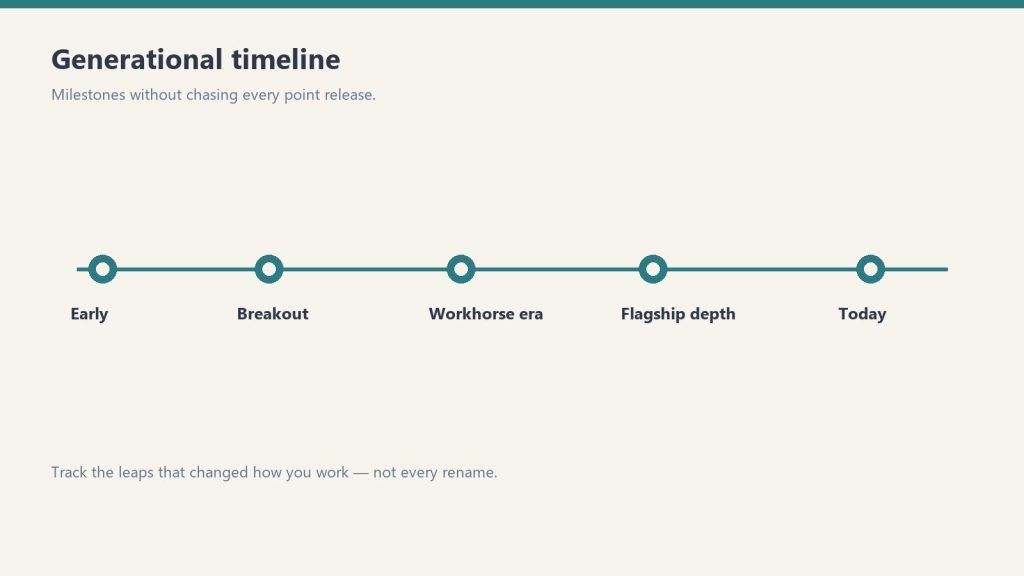
    Abstract milestone timeline from early Claude eras through today without version numbers
    Founders and the Anthropic origin story.

    Dario Amodei served as VP of Research at OpenAI before co-founding Anthropic. His sister Daniela Amodei was VP of Operations at OpenAI. They left in 2021 along with a group of researchers who shared concerns about the direction of AI development and the importance of safety-first research. Several founding team members had published influential work on AI alignment, interpretability, and the scaling properties of large language models.

    Funding and Investors

    Anthropic has raised more private capital than any AI lab in history. In February 2026 it closed a $30 billion Series G at a $380 billion post-money valuation; three months later it raised $65 billion in Series H funding at a $965 billion post-money valuation — surpassing OpenAI’s $852 billion mark and making Anthropic the most valuable private AI company in the world. Amazon remains the largest strategic investor: beyond its earlier commitments, Amazon invested a further $5 billion ahead of the Series H with the door open to another $20 billion tied to commercial milestones, while Anthropic pledged more than $100 billion of AWS spend over ten years. Alphabet’s filings imply its Anthropic stake is now carried at roughly $124 billion. Earlier investors include Google, Spark Capital, and Salesforce Ventures. The company’s annualized revenue run rate topped $100 billion by mid-September 2026, per New York Times reporting — up from $65 billion at the end of July and $9 billion at the end of 2025 — driven largely by enterprise adoption of Claude Code and the Cowork workplace product.

    The IPO: what we know

    Anthropic filed a confidential S-1 on June 1, 2026 and selected Nasdaq for its listing. The company is reportedly targeting a November 2026 IPO at a valuation around $2 trillion, seeking to raise up to $100 billion — which would rank among the largest public offerings on record. Reuters reported on September 11 that Nvidia is in talks to invest up to $10 billion as an anchor investor. The November timing, per Wall Street Journal reporting, lets Anthropic show public investors a completed third quarter before pricing. Treat the figures in this section as reported, not confirmed: they come from press coverage citing investor materials and people familiar with the company’s finances, not from Anthropic itself.

    Corporate Structure: Public Benefit Corporation

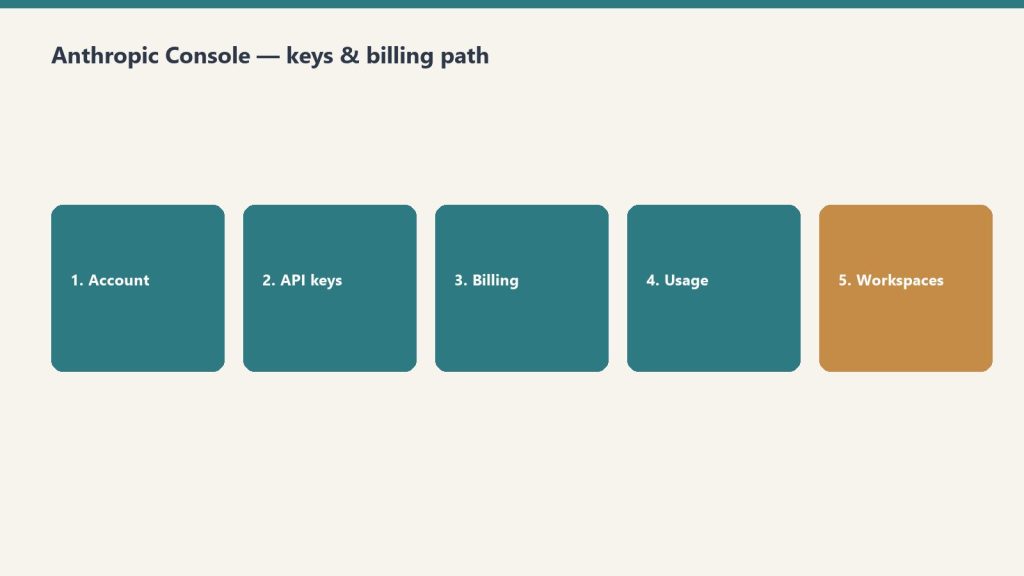
    Five-step path: account, API keys, billing, usage, workspaces
    Corporate structure: public benefit corporation.

    Anthropic is incorporated as a public benefit corporation (PBC) in Delaware. This corporate structure legally requires the company to consider the impact of its decisions on all stakeholders — not just shareholders. The PBC structure is central to Anthropic’s identity: it creates a legal framework that supports the company’s commitment to AI safety even when that commitment might conflict with short-term profit maximization.

    Anthropic also has a Long-Term Benefit Trust (LTBT) — a governance mechanism designed to ensure that the company’s safety commitments are maintained over time, even as leadership changes. The LTBT has the authority to intervene if the company’s actions deviate from its stated safety mission.

    The Safety Mission

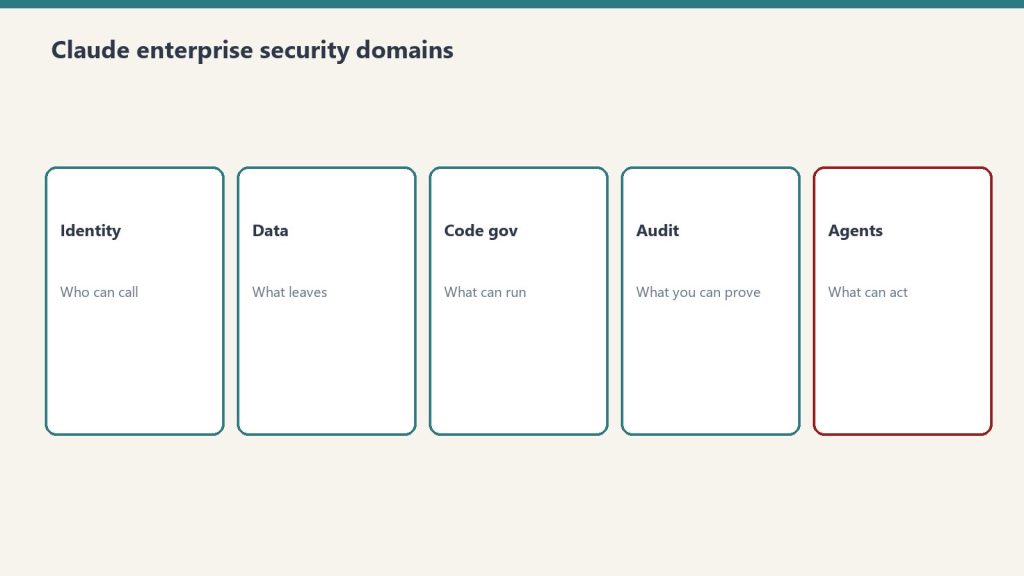
    Five security domains: identity, data, code governance, audit, agents
    The safety mission shapes product decisions.

    Anthropic’s stated mission is “the responsible development and maintenance of advanced AI for the long-term benefit of humanity.” This mission is embedded in the company’s corporate structure, not just its marketing. Key safety initiatives include the Responsible Scaling Policy (RSP), which sets thresholds for when more rigorous safety evaluations are required as models become more capable. Constitutional AI, the training methodology that gives Claude a set of principles to follow. Extensive red-teaming and safety testing before model releases. Published research on AI interpretability — understanding what happens inside neural networks. Transparency reports on model capabilities and limitations.

    Anthropic’s Global Presence

    While headquartered in San Francisco, Anthropic has expanded globally. The company has offices in multiple countries and has established a significant presence in the Asia-Pacific region, including offices in Tokyo, Bengaluru (India), Sydney, and Seoul. India has become Anthropic’s second-largest market globally, with partnerships including a major deal with Infosys for regulated AI deployment.

    Key Partnerships

    Anthropic’s major partnerships include Amazon Web Services (compute infrastructure and investment), Google Cloud (Vertex AI distribution and investment), Snowflake ($200M partnership for enterprise data integration), and Microsoft (Claude available through Azure and Microsoft Foundry). Claude is also available through third-party platforms like OpenRouter and various enterprise integrations.

    Frequently Asked Questions

    Who owns Claude AI?

    Claude AI is owned by Anthropic, a public benefit corporation founded by Dario and Daniela Amodei. Anthropic’s major investors include Amazon and Google.

    Is Anthropic owned by Amazon or Google?

    No. Amazon and Google are major investors in Anthropic, but Anthropic operates independently. It is a public benefit corporation with its own leadership, board, and decision-making authority.

    Who is the CEO of Anthropic?

    Dario Amodei is the CEO of Anthropic. He co-founded the company in 2021 after serving as VP of Research at OpenAI.

    Is Anthropic a nonprofit?

    No. Anthropic is a for-profit public benefit corporation (PBC). The PBC structure means it legally balances profit with its stated mission of AI safety, but it is not a nonprofit organization.

    Did the founders of Anthropic come from OpenAI?

    Yes. Dario Amodei (VP of Research) and Daniela Amodei (VP of Operations) both left OpenAI in 2021 to found Anthropic, along with several other former OpenAI researchers.

    Is Anthropic publicly traded?

    Not yet. Anthropic is still a private company, but it filed a confidential S-1 on June 1, 2026 and is reportedly targeting a November 2026 IPO on Nasdaq at a valuation around $2 trillion. Until shares list publicly, there is no ticker to buy — exposure comes through private-market funds or ETFs that hold private AI company stakes.

    What is Anthropic worth?

    Anthropic’s last priced round — the $65 billion Series H in May 2026 — set a $965 billion post-money valuation, ahead of OpenAI’s $852 billion. Press reports discussing the planned IPO float valuations as high as $2 trillion, but that figure is not finalized and none of these numbers are audited.


    💼 Deploying Claude or AI Infrastructure in Your Business?

    At Tygart Media, we engineer custom Model Context Protocol (MCP) servers, multi-model content pipelines, and AI operational systems. Explore our Claude AI Team Implementation Services or check out our complete Restoration Operations & AI Kit.
  • Is Claude AI Free? Everything You Get Without Paying and When Upgrading Makes Sense

    Is Claude AI Free? Everything You Get Without Paying and When Upgrading Makes Sense

    Updated October 28, 2026: Made infographic diagrams clickable to open full-size images.

    Yes, Claude AI is free. Not “free trial” free or “free for 7 days” free — genuinely, permanently free with no credit card required. But “free” comes with boundaries. This guide covers exactly what you get on Claude’s free tier, where the limits hit, and at what point upgrading to a paid plan actually saves you time or money.

    What the Free Tier Includes

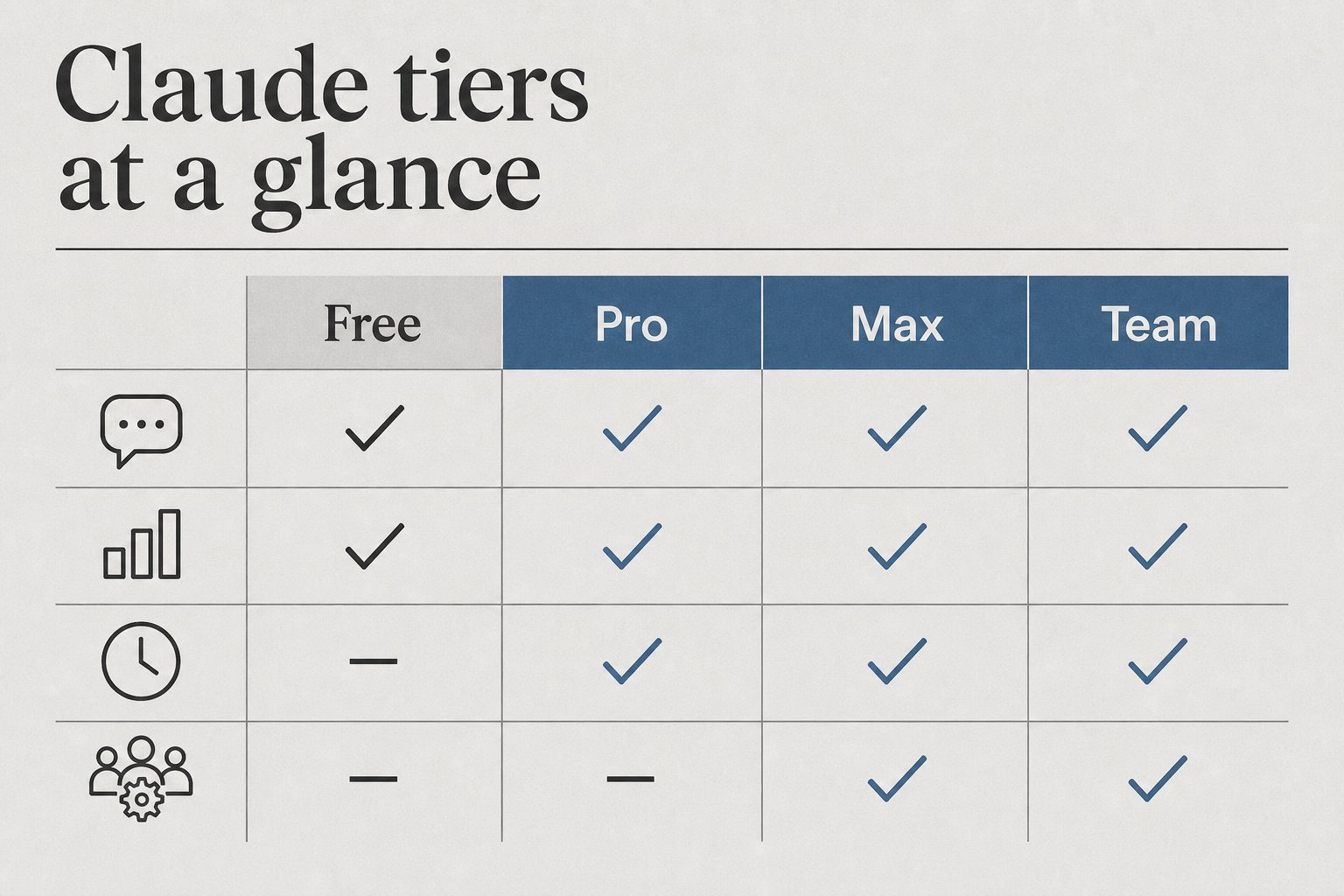
    At-a-glance board comparing Free, Pro, Max, and Team Claude tiers by chat, limits, priority, and admin controls
    What the Free tier includes.

    Claude’s free tier is more capable than most people realize. You get full access to chat on web (claude.ai), iOS, Android, and the desktop app. You can search the web directly within conversations — Claude will find current information and cite sources. Memory works across conversations, so Claude remembers context you’ve shared previously. You can create files and execute code — Claude will write Python, JavaScript, or other code and run it in a sandbox. Desktop extensions let you connect Claude to your local environment. You can connect Slack and Google Workspace services through connectors. Remote MCP (Model Context Protocol) integrations let Claude access external tools and data sources. Extended thinking allows Claude to reason through complex multi-step problems.

    That’s a substantial feature set for $0. The free tier in June 2026 includes features that were Pro-only just a year ago.

    Where the Free Tier Limits Hit

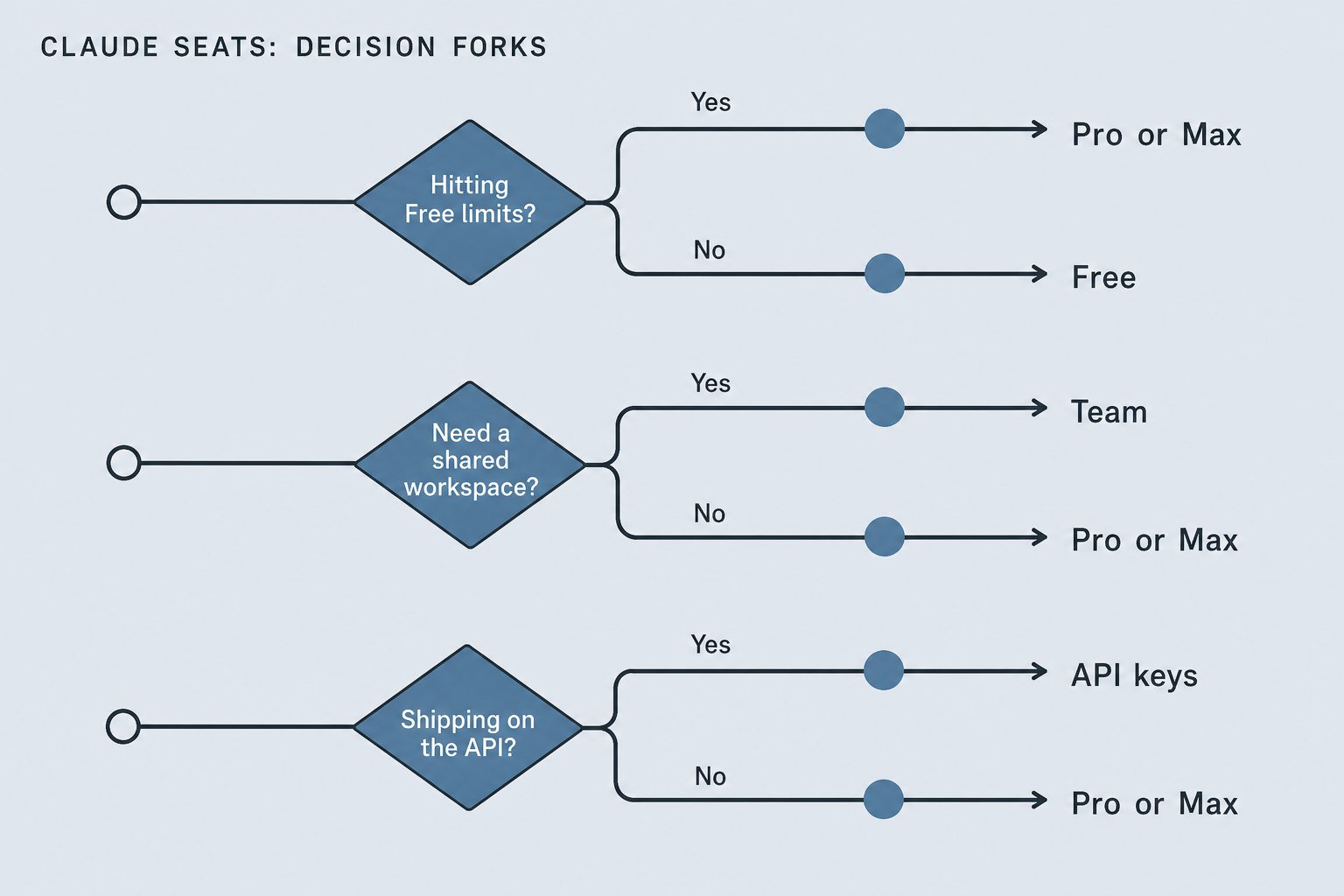
    Decision diagram: hitting Free limits, needing a shared workspace, or shipping on the API
    Where Free-tier limits hit — and when to stay.

    The primary limitation is usage volume. Free users get a limited number of messages per time period — when you hit the limit, you’ll see a message telling you to wait or upgrade. During high-traffic periods, free users may experience slower response times or temporary unavailability while paid users get priority access. You also don’t get access to Claude Code (the terminal-based coding agent), Claude Cowork (the desktop automation tool), Research mode, unlimited Projects, or Claude for Microsoft 365/Outlook. You can’t access all model variants — some premium models are reserved for paid subscribers.

    When to Stay on Free

    The free tier works well if you use Claude a few times per day for quick questions, writing assistance, or light coding. If you’re a student, casual user, or someone evaluating Claude before committing, the free tier gives you a genuine experience of what Claude can do. You won’t hit limits if your usage is moderate and spread throughout the day rather than concentrated in heavy sessions.

    When to Upgrade to Pro ($20/month)

    Upgrade when you hit rate limits regularly — when you find yourself waiting to continue conversations during your workday. Upgrade when you need Claude Code for programming projects. Upgrade when you want Research mode for deep investigation tasks. Upgrade when you use Claude for professional work and the interruptions from usage limits cost you more than $20/month in lost productivity.

    When to Upgrade to Max ($100-200/month)

    Max is for users who spend multiple hours per day working with Claude — running extended Claude Code sessions, producing large volumes of content, or conducting marathon research sessions. If you consistently hit Pro limits, Max removes that friction. The $100/month tier gives 5x Pro usage, and the $200/month tier gives 20x. Max also provides early access to new features and priority during peak demand.

    Claude Free vs ChatGPT Free vs Gemini Free

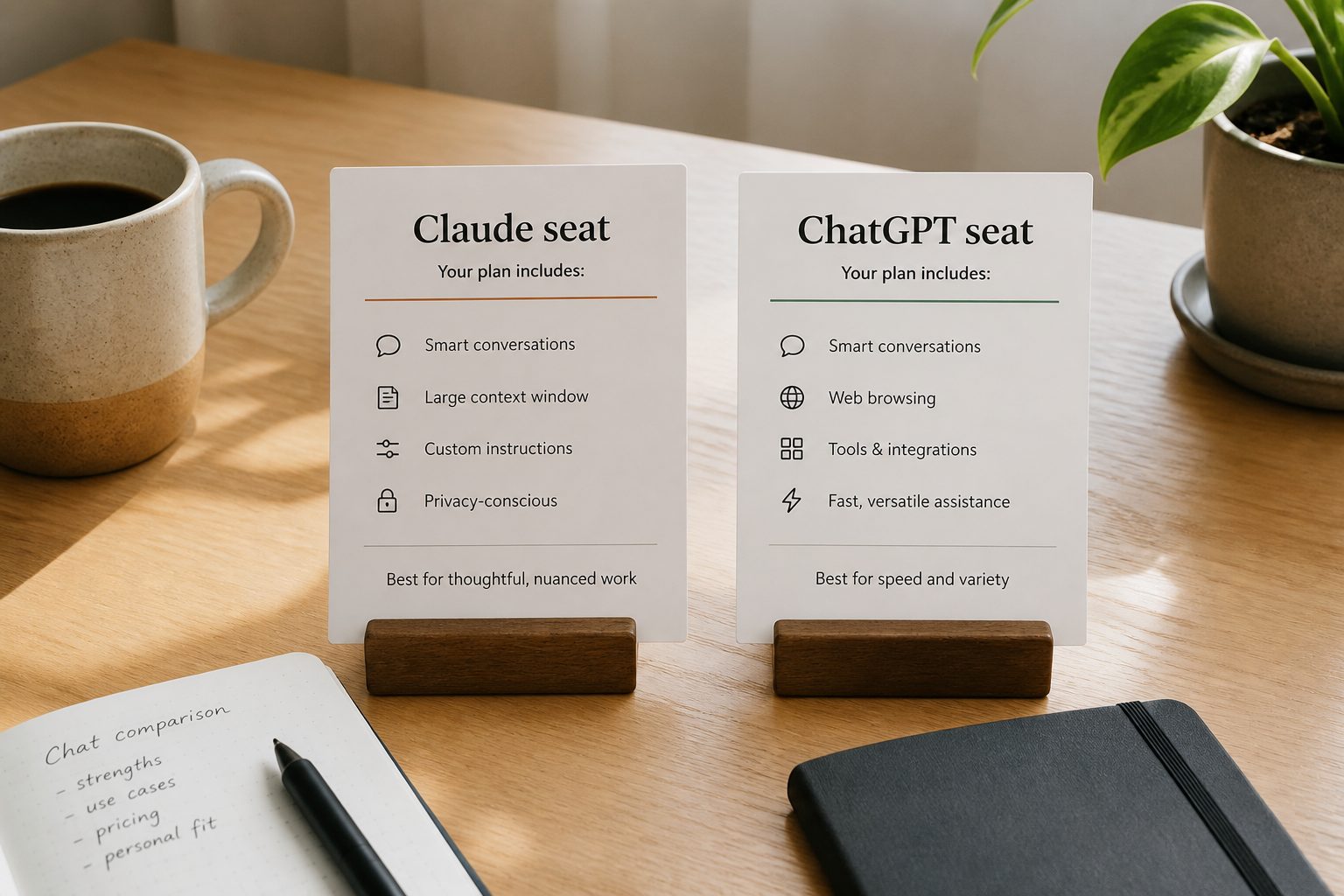
    Two subscription cards on a desk labeled Claude seat and ChatGPT seat for side-by-side comparison
    Claude Free vs ChatGPT Free vs Gemini Free.

    All three major AI platforms offer free tiers, but the feature sets differ. Claude’s free tier includes web search, code execution, memory, desktop extensions, and extended thinking. ChatGPT’s free tier offers GPT-4o access with usage limits and web browsing. Gemini’s free tier provides access to Gemini models with Google Workspace integration. Claude’s free tier is arguably the most feature-complete of the three, particularly with its inclusion of desktop extensions and remote MCP integrations at the free level.

    Related on Tygart Media: Claude pricing · Pro vs Max · how to use Claude.

    Frequently Asked Questions

    Is Claude AI completely free?

    Claude has a permanently free tier with no credit card required and no trial expiration. You get chat, web search, code execution, memory, and more — with usage limits. Paid plans ($20-200/month) remove usage limits and add features like Claude Code.

    Do I need a credit card to use Claude for free?

    No. You can sign up and use Claude’s free tier without providing any payment information.

    What happens when I hit the free tier limit?

    You’ll see a message indicating you’ve reached your usage limit. You can wait for the limit to reset (typically within hours) or upgrade to a paid plan for immediate access and higher limits.

    Can I use Claude Code on the free plan?

    No. Claude Code requires at least a Pro subscription ($20/month). The free tier includes the chat interface with code execution but not the terminal-based Claude Code agent.

  • Claude API Pricing & Token Rates Schedule (2026)

    Claude API Pricing & Token Rates Schedule (2026)

    Updated October 28, 2026: Made infographic diagrams clickable to open full-size images.

    Updated November 2, 2026 — added direct answers on token pricing schedules and input versus output calculations, sourced from Anthropic’s published pricing.

    Claude’s API pricing is token-based: you pay for the tokens you send (input) and the tokens Claude generates (output). Rate limits, service tiers, prompt caching, batch processing, and feature-specific charges all affect your actual bill. Last refreshed: November 2, 2026 (Pacific) against platform.claude.com pricing and Haiku 5.5. Seat prices did not move. The list-price change is Haiku 5.5 and a Sonnet 5.5 cache-read cut.

    Direct Answer (October 8, 2026): Official first-party list: Haiku 5.5 $0.10 / $0.50 per MTok for prompts up to 100,000 tokens, and $0.50 / $2.50 over 100,000 tokens (Haiku 4.5 remains $1 / $5); Sonnet 5.5 $2 / $10 with cache reads now $0.10 (was $0.20); Sonnet 5 $2 / $10 with cache reads still $0.20; Sonnet 4.6 and Sonnet 4.5 $3 / $15; Opus 5.5 $4 / $20 with cache reads at $0.20; Opus 5 / Opus 4.8 $5 / $25; Fable 5 and Mythos 5 $10 / $50 with cache reads at $1; Fable 5.1 and Mythos 5.1 $10 / $50 with cache reads at $0.25. Batch API is 50% off. Do not average Haiku 5.5’s two prompt-length bands.

    Per-Token Pricing by Model

    Workshop fuel gauge and metal tokens pouring into an API hopper, metaphor for pay-per-token pricing
    Per-token pricing by model — no sticky dollars.

    All prices are per million tokens (MTok), verified October 8, 2026. Claude Haiku 5.5, launched October 7, lists $0.10 input / $0.50 output up to 100,000 prompt tokens and $0.50 / $2.50 above that. Haiku 4.5 remains $1 / $5. Claude Sonnet 5.5 remains $2 input / $10 output. Cache reads on Sonnet 5.5 are now $0.10, down from $0.20. Claude Opus 5.5 remains $4 / $20 with cache reads at $0.20. Fast mode for Opus 5.5 is $8 / $40. Sonnet 4.6 remains $3 / $15. Fable 5.1 keeps $10 / $50 with cache reads at $0.25.

    How much does the Claude API cost per million tokens?

    ModelStandard Input (per MTok)Standard Output (per MTok)Cache Read (per MTok)Batch Input (per MTok)Batch Output (per MTok)
    Claude Haiku 5.5 (prompts ≤ 100K tokens)$0.10$0.50$0.01$0.05$0.25
    Claude Haiku 5.5 (prompts > 100K tokens)$0.50$2.50$0.05$0.25$1.25
    Claude Haiku 4.5$1.00$5.00$0.10$0.50$2.50
    Claude Sonnet 5.5$2.00$10.00$0.10$1.00$5.00
    Claude Sonnet 4.6$3.00$15.00$0.30$1.50$7.50
    Claude Opus 5.5$4.00$20.00$0.20$2.00$10.00
    Claude Fable 5.1$10.00$50.00$0.25$5.00$25.00
    Current Claude API token pricing per million tokens across standard, cached, and batch tiers (sourced from Anthropic published pricing).

    What’s the difference between input and output token pricing on Claude?

    Input tokens represent the prompt text, system instructions, tool declarations, and context history transmitted to Claude, while output tokens represent the new text Claude generates in response. Across all flagship tiers, Anthropic prices output tokens at exactly 5x the cost of input tokens (for example, Sonnet 5.5 is $2.00 input vs. $10.00 output; Haiku 5.5 is $0.10 input vs. $0.50 output; Opus 5.5 is $4.00 input vs. $20.00 output). Output tokens carry a 5x multiplier because text generation requires sequential autoregressive inference—each token must be predicted and computed one step at a time—which is substantially more compute-intensive than parallelized input processing.

    Worked Calculation: Why Output-Heavy Workloads Dominate Spend
    Consider 10,000 API calls per day on Claude Sonnet 5.5 ($2.00/MTok input, $10.00/MTok output):

    • Workload A (Input-heavy analysis / summarization): 4,000 input tokens + 200 output tokens per call.
    – Daily Input: 40 MTok × $2.00 = $80.00
    – Daily Output: 2 MTok × $10.00 = $20.00
    – Total Spend: $100.00/day (Output accounts for only 20% of cost).

    • Workload B (Output-heavy generation / scaffolding): 500 input tokens + 3,500 output tokens per call.
    – Daily Input: 5 MTok × $2.00 = $10.00
    – Daily Output: 35 MTok × $10.00 = $350.00
    – Total Spend: $360.00/day (Output accounts for 97.2% of cost).

    Even though Workload B processes fewer total tokens per request than Workload A (4,000 vs. 4,200), it costs 3.6x more because 87.5% of its tokens fall into the 5x output pricing tier.

    Prompt Caching Pricing

    5-minute cache write is 1.25x input. 1-hour cache write is 2x input. Cache read is 0.05x on Sonnet 5.5 and Opus 5.5, 0.1x on Sonnet 5 and Haiku 4.5. Fable 5.1 and Mythos 5.1 use 0.025x ($0.25/MTok). Haiku 5.5 cache reads are $0.01 / $0.05 (under / over 100k). Haiku 5.5 cache writes are $0.125 / $0.625. Opus 5.5 cache writes $5 / 1-hour $8 / reads $0.20. Opus 5 cache writes $6.25 / reads $0.50. Sonnet 5.5 cache writes $2.50 / reads $0.10. Sonnet 5 cache writes $2.50 / reads $0.20. Sonnet 4.6 cache writes $3.75 / reads $0.30. Haiku 4.5 cache writes $1.25 / reads $0.10.

    Batch Processing: 50% Off

    The Batch API processes requests asynchronously at half the standard rate. Haiku 5.5 batch is $0.05 / $0.25 under 100k tokens and $0.25 / $1.25 over. Sonnet 5.5 and Sonnet 5 batch list is $1 / $5. Sonnet 4.6 batch list is $1.50 / $7.50. Opus 5.5 batch is $2 / $10. Opus 5 batch is $2.50 / $12.50. Fable 5.1 batch is $5 / $25.

    How to Calculate Your Monthly Bill

    To estimate your monthly Claude API bill, calculate your expected daily token volume—multiplying daily requests by average input tokens (at the model’s input rate per million) plus daily requests by average output tokens (at the model’s output rate per million)—multiply that daily sum by 30 days, and deduct applicable discounts for prompt caching (up to 90% off cached inputs) or batch processing (50% off total spend). Here is how that calculation works in practice:

    Example at Sonnet 5.5 list ($2 / $10): 2,000 input tokens and 500 output tokens × 10,000 requests/day = 20 MTok input ($40) + 5 MTok output ($50) = $90/day, about $2,700/month before cache or batch. Same volume on Opus 5.5 at $4 / $20 is $180/day before cache. Same volume on Haiku 5.5 at the under-100k band ($0.10 / $0.50) is $4.50/day before cache.

    Same volume with caching on Sonnet 5.5: at a 90% cache-hit rate, 18 of those 20 MTok re-read from cache at $0.10/MTok ($1.80) instead of $2/MTok ($36) — input drops from $40 to $5.80/day. The cache line, not the input line, is usually what separates the sticker price from the real bill. That example used $0.20 before October 7.

    Service Tiers and Rate Limits

    Priority, Standard, and Batch tiers still apply. US-only inference (inference_geo: "us") on Claude 4.6 and later is 1.1x. Fast mode on Opus 5.5 is $8 / $40. Fast mode on Opus 5 / Opus 4.8 is $10 / $50. Haiku 5.5 is the exception on long-context pricing: prompts over 100,000 tokens use the higher band. Other Claude 4.6 and later models keep one per-token rate through the 1M window. Check live limits in the Claude Console; published RPM/ITPM figures move by spend tier. Confirm five-hour windows in Settings > Usage, not from a screenshot.

    Anthropic said on October 7 it will roll out monthly Claude Platform credits this week: Max 5x $100, Max 20x $200, Team up to $500 pooled. That is an announced credit, not a seat-price change. Confirm in the Help Center article before you book it as included usage.

    Frequently Asked Questions

    How much does Claude API cost for a small project?

    A small project making 100–500 API calls per day with Haiku 5.5 on the under-100k band is cheaper than the same volume on Haiku 4.5 ($1 / $5). Sonnet 5.5 at the same volume is cheaper than Sonnet 4.6 because the list is $2 / $10, not $3 / $15.

    Is there a free tier for the Claude API?

    Anthropic does not offer a permanent free API tier. You need to add a payment method and load credits. The October 7 Max and Team credit is a subscriber allowance, not a public free tier.

    What’s the cheapest way to use the Claude API?

    Use Haiku 5.5 on prompts under 100,000 tokens ($0.10/MTok input), enable prompt caching, and batch non-real-time work (50% off). Haiku 4.5 remains $1 / $5 if a workload is pinned to that SKU. For mid-tier quality, prefer Sonnet 5.5 at $2 / $10 over Sonnet 4.6 at $3 / $15 unless you need the 4.6 SKU specifically. For Opus-class work, prefer Opus 5.5 at $4 / $20 over Opus 5 at $5 / $25 unless you are pinned to the older SKU.

    How do Claude API costs compare to OpenAI?

    This page’s prior OpenAI pair was gpt-6.1-sol at $2 / $10 short-context and GPT-5 at $1.25 / $10. Those OpenAI rows were not re-verified on this pass. Sonnet 5.5 at $2 / $10 is unchanged. Haiku 5.5 at $0.10 / $0.50 under 100k is the new cheap Claude band. Compare the exact SKU pair, not the family name.

    What happens when I hit a Claude API rate limit?

    The API returns HTTP 429. Back off and retry with exponential backoff; if you hit limits regularly, request a higher spend tier in the Claude Console. Our Claude rate limits guide covers the RPM/TPM tiers and the full 429 playbook.

    Do cached tokens cost the same as fresh input?

    No. Cache reads run 0.025×–0.10× the input price depending on model — $0.10/MTok on Sonnet 5.5, $0.20 on Sonnet 5 and Opus 5.5, $0.25 on Fable 5.1, $0.01 on Haiku 5.5 under 100k, $0.10 on Haiku 4.5. On cache-heavy workloads the read line sets your bill, not the input line.

    Related: Claude AI pricing guide · Fable 5 pricing, cache rates & plan access · Claude rate limits & tiers · How to get an Anthropic API key · How much does Claude AI cost

  • Claude in Chrome: Setup, Use Cases & Limits (2026)

    Claude in Chrome: Setup, Use Cases & Limits (2026)

    Last refreshed: October 20, 2026 — primary: Get started with Claude in Chrome (Claude Help Center). Plan matrix re-checked against claude.com/pricing.

    Direct Answer (6 October 2026): The Claude in Chrome extension lets Claude read the page you have open and work in a side panel — it reads the live DOM, clicks, fills forms, and downloads files, all inside the browser. It is not Cowork and it is not Claude Code. On the claude.com/pricing comparison read 6 October 2026, Claude in Chrome is No on Free and Yes on Pro, Max 5x, Max 20x, Team, and Enterprise. Permission claims (passwords, history, autofill) were not re-checked against the Chrome Web Store on this date.

    Claude in Chrome is a browser extension that brings Claude into the tab you already have open. Rather than copying the page into a chat, the extension lets Claude see the page and answer next to it. This guide is built from documented operational use across eight previously separate guides — setup, use cases, profiles, web-app automation, the API decision, the Cowork comparison, LinkedIn workflows, and a production video pipeline — merged into one canonical reference.

    What Claude in Chrome actually is

    Claude in Chrome is a browser extension — separate from claude.ai, separate from Cowork — that connects Claude to your active Chrome tab. Once installed and connected, Claude gains browser-native tools it doesn’t have in a standard chat session:

    • Reading page content — text, links, form fields, and interactive elements on the current tab
    • Clicking — buttons, links, checkboxes, and UI controls (with your permission per action)
    • Filling forms — with explicit approval per action
    • Scrolling and navigating between your open tabs
    • Downloading files through the browser

    The key technical distinction: Claude in Chrome works through DOM access, not screenshots. That makes it faster and more precise for web tasks than screenshot-based computer use — it reads the page structure directly rather than looking at pixels. It has no awareness of your desktop, no filesystem access, and cannot open applications outside the browser. If you close Chrome, Claude in Chrome stops.

    How to install Claude in Chrome

    1. Search the Chrome Web Store for the official Anthropic Claude extension.
    2. Click Add to Chrome, then sign in.
    3. Click the toolbar icon to open the side panel.
    4. Click Connect to link the extension to your chat session.

    Plan availability verified 6 October 2026 against claude.com/pricing: No on Free; Yes on Pro, Max 5x, Max 20x, Team, and Enterprise. Usage draws from the same seat pool as claude.ai — a rolling five-hour window, plus weekly limits on paid plans. The install steps and permission claims above were not re-checked against the Chrome Web Store on this date.

    What it can do — and what it can’t

    It can: summarize articles and long docs, extract HTML tables, draft replies against a visible thread, walk a pricing or docs page, research a LinkedIn profile (read-only), fill forms with your approval, and operate web apps that have no API.

    It cannot: see a page you aren’t authenticated to. Heavy iframe / SPA pages can fail. It does not get your history, passwords, or autofill data. It does not submit purchases without you confirming. It is not a bulk scraper — it works one page at a time, in your session. And it cannot run on a schedule or while you’re away: every session needs you present and a manual click to connect.

    Claude in Chrome vs Cowork vs Chat vs API

    Four tools, four jobs. The decision rule that holds up in practice:

    • Use Chat when the work is text in a conversation.
    • Use Chrome when the source is a live web page and you’re present.
    • Use Cowork when the work is files on the desktop or needs to run on a schedule while you’re asleep.
    • Use the API first whenever one exists for what you need — Chrome is the fallback, not the default.

    The API-first rule. An API call is deterministic — same endpoint, same payload, same result. A Chrome UI interaction depends on the current state of a live webpage, and web pages change. Chrome automation runs at human browsing speed, needs a running logged-in browser, and typically needs maintenance when sites redesign. Expect roughly 80-90% reliability per run versus 99%+ for a good API integration. So: API first; Claude in Chrome when the API doesn’t exist, doesn’t expose what you need, or the task is genuinely one-off. The cleanest architectures use both — API for everything it can reach, Chrome for the UI-only edges.

    One question resolves most cases: do you need it to run while you’re asleep? If yes, that’s Cowork territory. If no, Chrome with you present.

    Practical use cases

    Research and summarization

    Long docs, papers, vendor pages, competitive pricing pages — open the URL and ask for a comparison against your offer, or a summary with the numbers pulled out. Tables come out clean because Claude reads the DOM, not a screenshot.

    Email in the browser

    Draft against the thread you can still see. Claude reads the email context in Gmail and drafts the reply next to it.

    LinkedIn: assist, don’t automate

    The genuinely useful LinkedIn jobs are read-and-prepare: summarizing a prospect’s profile before a call, researching a company page, scanning a feed for the day’s relevant threads, drafting a DM or comment for your approval. The standout use case is paste-assist for long-form Articles — schedulers can only push short feed posts through the official API, so native Articles stay a manual copy-paste, and a guided in-browser assist turns that tedium into minutes.

    What to never do: automated feed posting, bulk connection requests, or bulk messaging. Networks detect automation, it violates terms of service, and accounts get throttled or suspended. The browser is an assistant, not a posting robot. Keep a human on the trigger for anything that publishes or sends.

    Automating web apps without an API

    The pattern that works: Claude Chat writes the work order; Claude in Chrome executes it. You describe the task to Chat; Chat writes precise step-by-step instructions (what page, what to click, what to fill, what to confirm); you paste that into the Chrome session; it executes. Documented uses include cloud console navigation, DNS updates through a registrar UI, posting through scheduling tools whose API tier lacked the endpoint, and operating browser-based AI tools that have no API at all.

    A good work order is sequential, specific about UI elements, anticipates surprises (login screens, MFA prompts, CAPTCHAs — which Chrome cannot solve), and ends with a confirmation step. Pre-login matters: Claude can only touch services you’re already logged into in that profile. And never leave it running on high-stakes actions — payments, publishing, deletions — without reviewing first. There is no undo button.

    Multiple Chrome profiles

    Each Chrome profile is its own island — separate logins, extensions, sessions. Claude in Chrome connects to one profile at a time via your manual click. The extension must be installed separately on each profile. When Claude needs a different profile mid-session it calls switch_browser; you click Connect in the right window. Practical ceiling: two to three profiles per session before the manual clicks get tedious. Keep personal tabs in a profile you never connect.

    The production pattern: scheduled pipelines

    One documented production pipeline shows how far the pattern goes: two staggered Cowork scheduled tasks use Claude in Chrome to operate a browser-based notebook tool with no API — creating notebooks from article URLs, triggering video generation, harvesting finished videos, and drafting WordPress watch pages. The architecture (trigger, wait, harvest, log) generalizes to any browser-only tool. The real failure modes, documented from production: generation timeouts (most common), Chrome tab closures killing a run, and daily per-account generation limits handled by rotating accounts across profiles. Posts go up as drafts — a human spot-check before publishing is intentional.

    Privacy

    The extension only sends page content when you invoke it. It sees visible page content you share — not passwords, history, or autofill. Team and Enterprise default to no training on that content. Review permissions at install, and use judgment with regulated or confidential data: page content is processed by Anthropic’s systems under your plan’s privacy settings.

    Frequently asked questions

    Is Claude in Chrome free?

    No. Not on the Free plan per the 6 October 2026 pricing table. Pro, Max, Team, and Enterprise are Yes.

    Does it work on Edge or Brave?

    Official support is Chrome. Chromium forks sometimes work; don’t count on it for production.

    Can it see my passwords?

    No. Visible page content you share only.

    Can Claude in Chrome run overnight or on a schedule?

    No. It needs an active session and a manual connection per session. Scheduled, unattended runs are Cowork’s job.

    Can it switch Chrome profiles by itself?

    No. Every profile switch needs your click on Connect. Deliberate design, not a limitation to work around.

    Is it safe to use while logged in to sensitive accounts?

    Use a dedicated work profile for Claude sessions and keep personal or sensitive tabs in a profile that’s never connected. Claude can see and interact with any tab open in the connected profile.

    What happens when a site redesigns and breaks my workflow?

    Claude reports it couldn’t find the expected element and stops — it won’t guess or click something random. Update the work order to match the new UI. Writing instructions in terms of intent (“find the button that saves the record”) is more resilient than describing exact pixels, but no wording survives every redesign.

    How is this different from Claude for Microsoft 365?

    Chrome is any website in the browser. Microsoft 365 is Word, Outlook, and Teams.

    Sources: Claude Help Center, Get started with Claude in Chrome; claude.com/pricing (plan availability verified 6 October 2026); documented operational use across eight Tygart Media guides (May–September 2026). Install-step and permission claims were not re-checked against the Chrome Web Store on the verification date. Desktop-behavior claims about Cowork were not re-tested against Anthropic on that date.

  • How Much Does Claude AI Cost? The Plain-English Pricing Breakdown for 2026

    How Much Does Claude AI Cost? The Plain-English Pricing Breakdown for 2026

    Updated October 28, 2026: Made infographic diagrams clickable to open full-size images.

    Last verified: October 8, 2026 (Pacific) against claude.com/pricing, platform.claude.com pricing, and Haiku 5.5.

    Direct Answer: Claude costs $0 on Free; Pro is $20/month ($17 annual); Max starts at $100/month with a choice of 5x or 20x Pro usage per five-hour session (the Help Center lists the 20x tier at $200/month on the web); Team Standard is $20–$25/seat; Team Premium is $100–$125/seat; Enterprise is $20/seat plus usage. API list rates: Haiku 5.5 $0.10/$0.50 under 100k prompt tokens ($0.50/$2.50 over), Haiku 4.5 $1/$5, Sonnet 5.5 and Sonnet 5 $2/$10, Opus 5.5 $4/$20, Opus 5 $5/$25 per million tokens. Sonnet 5.5 cache reads are $0.10.

    If you searched “how much is Claude AI” or “Claude AI cost,” here is the straight list — seat plans first, then API token rates. Numbers below are verified October 8, 2026. Seat prices did not move on October 7.

    The Free Tier: $0

    Infographic ladder of Claude plans: Free, Pro, Max, Team, and Enterprise
    Plan ladder — Free through Enterprise (no sticky dollars on graphic).

    Claude’s free tier is $0 — no credit card required. Chat on web, mobile, and desktop, web search, memory, file creation, and code execution are included. Claude Code is not. Usage limits are tighter than paid seats.

    Claude Pro: $20/Month

    Pro costs $20/month billed monthly or $17/month if you pay annually ($200 upfront). Official claude.com copy includes Claude Code, Design/Slides/Docs, projects, more models, and Claude for Microsoft 365.

    Claude Max: From $100/Month

    Max starts at $100/month with a choice of 5x or 20x more usage than Pro per five-hour session. The pricing card prints “from $100” and does not list a separate 20x dollar amount. Anthropic’s Help Center lists Max 5x at $100/month and Max 20x at $200/month for web checkout. Mobile store prices may differ. Max is monthly billing only.

    Claude Team: From $20/Seat/Month

    Official claude.com Team seats (USD): Standard $20/seat annual or $25 monthly; Premium $100/seat annual or $125 monthly. Premium is 5× Standard usage. Enterprise on the same page is $20/seat plus usage at API rates, billed annually. Anthropic said on October 7 it will roll out monthly Platform credits this week: Max 5x $100, Max 20x $200, Team up to $500 pooled. That is an announced credit, not a lower seat price.

    Claude API: Pay Per Token

    API access is separate from seats. You pay per million tokens (MTok) for input and output. Current first-party list (October 8, 2026):

    Model Input / MTok Output / MTok Notes
    Haiku 5.5 $0.10 / $0.50 $0.50 / $2.50 Under / over 100k prompt tokens. Launched Oct 7, 2026
    Haiku 4.5 $1 $5 Still listed
    Sonnet 5.5 $2 $10 Cache reads now $0.10 (was $0.20)
    Sonnet 5 $2 $10 Cache reads still $0.20
    Sonnet 4.6 $3 $15 Legacy SKU still listed
    Opus 5.5 $4 $20 Cache reads $0.20
    Opus 5 / 4.8 $5 $25 Cache reads $0.50
    Fable 5.1 $10 $50 Cache reads $0.25

    Batch API is 50% off input and output. Prompt caching: 5-minute write 1.25× input, 1-hour write 2×. Cache reads are 0.05× on Sonnet 5.5 and Opus 5.5, 0.1× on Sonnet 5 and Haiku 4.5, and $0.01 / $0.05 on Haiku 5.5. Full schedule: Claude API pricing & token rates.

    Quick Cost Comparison Table

    Product Price Best for
    Free $0 Light chat, no Claude Code
    Pro $20/mo ($17 annual) Daily chat + Claude Code
    Max 5x $100/mo Heavy interactive use
    Max 20x Help Center $200/mo (web) Very heavy interactive use
    Team Standard $20–$25/seat Shared workspace, light seats
    Team Premium $100–$125/seat Power seats (5× Standard)
    Enterprise $20/seat + usage Admin, SSO, usage billing
    API (Haiku 5.5 → Fable) $0.10–$10 input / MTok Apps, automation, CI

    Seat vs API: which bill are you on?

    If you… You pay… Read next
    Chat in Claude.ai / use interactive Claude Code Seat plan usage limits Claude Code billing & credit pools
    Run claude -p, Agent SDK, or GitHub Actions on a subscription Separate Agent SDK monthly credit Dual-bucket billing
    Build on an API key Pay-per-token API rates API token rates

    How Claude usage limits actually work

    The seat price buys a usage window, not a fixed number of messages. Limits reset on a rolling five-hour session, and paid plans add a weekly cap on top.

    On claude.com/pricing, checked October 8, 2026, Free covers everyday questions. Pro includes at least 5x more usage per five-hour session than Free. Max includes 5x or 20x more usage per five-hour session than Pro. Chat on the web, the desktop app, mobile, and Claude Code draw from one pool. The Max plan Help Center article says the weekly limit resets on a fixed day and time for the account. Settings, then Usage, shows the session meter and the weekly reset.

    When the meter runs out, wait for the reset, move to a higher plan, or turn on usage credits and the extra work bills at standard API rates.

    Claude API pricing, by model

    The API is a separate bill from the seat. You pay per million tokens, and on every current model the output line costs more than the input line.

    Current model Input / MTok Output / MTok
    Haiku 5.5 (≤100k / >100k) $0.10 / $0.50 $0.50 / $2.50
    Sonnet 5.5 $2 $10
    Opus 5.5 $4 $20
    Fable 5.1 $10 $50

    Haiku 4.5 remains $1 and $5. Sonnet 5 remains $2 and $10. Sonnet 4.6 remains $3 and $15. Opus 5 remains $5 and $25. The Batch API takes 50% off: Haiku 5.5 batch is $0.05 and $0.25 under 100k, Sonnet 5.5 is $1 and $5, Opus 5.5 is $2 and $10, Fable 5.1 is $5 and $25. US-only inference on Claude 4.6 and later is 1.1x. Fast mode prices Opus 5.5 at $8 and $40. Haiku 5.5 is the model that raises the rate above 100,000 prompt tokens. Other Claude 4.6 and later models keep one rate through the 1M window.

    When prompt caching saves money

    A 5-minute cache write is 1.25 times base input and a 1-hour write is 2 times. A cache hit on Sonnet 5.5 is $0.10 per million tokens, down from $0.20 on October 7. Opus 5.5 hits stay $0.20. Fable 5.1 hits stay $0.25. Haiku 5.5 hits are $0.01 under 100k and $0.05 over. A 5-minute write is $0.125 for Haiku 5.5 under 100k, $2.50 for Sonnet 5.5, $5 for Opus 5.5, and $12.50 for Fable 5.1.

    Frequently Asked Questions

    How much does Claude AI cost per month?

    Free is $0. Pro is $20 monthly or $17 annual. Max starts at $100/month, with a choice of 5x or 20x Pro usage per five-hour session. The Help Center lists the 20x tier at $200/month on the web. Team starts at $20/seat annual. Enterprise is $20/seat plus API-rate usage. API bills separately per token.

    Related on Tygart Media: API rates · Haiku 5.5 list.

    Part of the complete guide: Claude Pricing, Plans & Limits

  • Claude Team Pricing: Standard vs Premium Seats (2026)

    Claude Team Pricing: Standard vs Premium Seats (2026)

    Updated October 28, 2026: Made infographic diagrams clickable to open full-size images.
    Updated November 5, 2026: Added the monthly API credits Team seats now include (verified against Anthropic’s documentation) and sharpened the seat usage multipliers.

    Claude’s Team plan is built for groups of 2 to 150 people who need collaborative AI access with centralized administration. As of November 2026, Anthropic offers two seat types within the Team plan — Standard and Premium — with meaningfully different usage allowances and price points. This guide breaks down exactly what each seat type includes, what the real costs look like, and how to decide which mix works for your organization.

    Direct Answer (November 2026): Claude Team pricing offers two options (2-seat minimum): Standard Team ($25/seat/mo or $20 annual) with bundled usage and shared workspaces, and Premium Team ($125/seat/mo or $100 annual) with 5x the usage of a Standard seat (6.25x Pro per session). Every seat also adds monthly Claude API credits to the team’s shared pool — $20 per Standard seat, $100 per Premium, pooled and capped at $500/month.

    Team Plan Pricing Overview

    Infographic ladder of Claude plans: Free, Pro, Max, Team, and Enterprise
    Team plan seat overview.

    The Team plan uses per-seat pricing with two tiers. Standard seats cost $25 per seat per month on monthly billing, or $20 per seat per month on annual billing. Premium seats cost $125 per seat per month on monthly billing, or $100 per seat per month on annual billing. You can mix and match seat types within the same organization — not everyone needs the same usage level.

    For a 10-person team on annual billing with 7 Standard and 3 Premium seats, the monthly cost would be (7 × $20) + (3 × $100) = $440/month, or $5,280/year. That same mix also pools $440/month in API credits (7 × $20 + 3 × $100), under the $500 pool cap. Compare that to putting all 10 on Standard ($200/month) or all 10 on Premium ($1,000/month) to see why the mix-and-match model matters.

    What Standard Seats Include

    Three cards for fast volume, daily workhorse, and deep flagship Claude seats
    What Standard seats include.

    Standard seats include all Claude features — chat across web, iOS, Android, and desktop — plus 1.25x the per-session usage of an individual Pro subscription. Standard seat holders can access Claude Code and Claude Cowork, connect Microsoft 365, Slack, and other integrations, and use Enterprise search across the organization. They get SSO, admin controls, and the enterprise desktop app deployment. The key differentiator from Pro is the organizational layer: centralized billing, admin controls, and content that isn’t used for model training by default.

    What Premium Seats Add

    Premium seats provide 5x the usage of Standard seats — 6.25x an individual Pro subscription per session, against a Standard seat’s 1.25x. This is designed for power users — engineers running Claude Code all day, researchers doing deep analysis sessions, content teams producing high volumes of output. On usage alone a Premium seat sits above an individual Max plan (5x Pro) — and it keeps all the organizational infrastructure (SSO, admin controls, no training on content) that individual plans lack.

    Team Plan vs Individual Pro/Max Plans

    The question many organizations face: should each person just buy their own Pro or Max subscription? The Team plan adds several capabilities that individual plans lack. Central billing means one invoice instead of individual expense reports. SSO and domain capture ensure that everyone in your organization uses the managed account. Admin controls let you manage connectors and desktop app deployment centrally. Content is not used for model training by default — individual free and Pro accounts have an opt-out option, but Team accounts are opted out by default. Enterprise search lets team members search across organizational knowledge.

    Team Plan vs Enterprise Plan

    The Team plan caps at 150 users. If you need more, or if you need features like SCIM provisioning, audit logs, compliance API, custom data retention, HIPAA readiness, IP allowlisting, or role-based access with fine-grained permissions, you need Enterprise. Enterprise is published at $20/seat/month plus API usage, billed annually — contact Anthropic sales for volume terms.

    How to Choose Between Standard and Premium Seats

    Decision map from daily chat, shipping products, or buying for a company to Free/Pro, API, or Team/Enterprise
    How to choose between Standard and Premium seats.

    Start with Standard seats for everyone and monitor usage. If specific team members consistently hit rate limits — especially developers using Claude Code heavily or analysts running extended research sessions — upgrade those individuals to Premium seats. The mix-and-match model means you don’t need to over-provision. A typical pattern for a 20-person team might be 4-5 Premium seats for heavy users and 15-16 Standard seats for everyone else.

    Frequently Asked Questions

    What is the minimum team size for Claude Team?

    The Claude Team plan requires a minimum of 2 seats. You can mix Standard and Premium seats within that minimum.

    Can I switch between Standard and Premium seats?

    Yes. Administrators can upgrade individual seats from Standard to Premium or downgrade from Premium to Standard. Changes take effect on the next billing cycle.

    Does Claude Team include Claude Code?

    Yes. Both Standard and Premium Team seats include access to Claude Code and Claude Cowork.

    Is my team’s data used for training on the Team plan?

    No. Content is not used for model training by default on the Claude Team plan.


    Related: Claude AI Pricing (2026) — every plan, API rate, and the cost calculator

    💼 Deploying Claude or AI Infrastructure in Your Business?

    At Tygart Media, we engineer custom Model Context Protocol (MCP) servers, multi-model content pipelines, and AI operational systems. Explore our Claude AI Team Implementation Services or check out our complete Restoration Operations & AI Kit.
    Part of the complete guide: Claude Pricing, Plans & Limits

  • Anthropic Console: Developer Quickstart Guide (2026)

    Anthropic Console: Developer Quickstart Guide (2026)

    The Anthropic Console at platform.claude.com is where developers manage everything related to the Claude API. Whether you’re generating your first API key, tracking token usage, setting spend limits, or managing team workspaces, the console is your control center. This guide walks through every section of the console as it exists in June 2026.

    What Is the Anthropic Console?

    The Anthropic Console — also called the Anthropic Developer Console — is the web-based dashboard at platform.claude.com where you manage your Claude API access. It is separate from claude.ai, which is the consumer chat interface. The console handles API key generation, billing and payment, usage monitoring, workspace and team management, rate limit visibility, and access to developer documentation. Think of claude.ai as where you use Claude, and platform.claude.com as where you build with Claude.

    Getting Started: Creating an Account

    Five-step path: account, API keys, billing, usage, workspaces
    Console path: account → keys → billing → usage → workspaces.

    Navigate to platform.claude.com and sign up with your email or Google account. You’ll need to add a payment method before you can make API calls. Anthropic uses a prepaid credit system — you load credits onto your account and API calls draw from that balance. New accounts start with a default spending limit that increases as you build usage history.

    API Keys: Creating and Managing

    Desk with laptop, checklist notebook, and billing card ready before creating an Anthropic API key
    API keys: create, name, store once — never paste into chat logs.

    API keys are generated in the console under the API Keys section. Each key begins with “sk-ant-” and should be treated as a secret credential. Best practices include creating separate keys for different applications or environments (development, staging, production), naming keys descriptively so you can identify which application uses which key, rotating keys periodically, and never committing keys to source control. If a key is compromised, you can revoke it immediately from the console without affecting your other keys.

    Billing and Usage Monitoring

    The billing section shows your current credit balance, spending history, and usage breakdown by model. You can view costs broken down by Opus, Sonnet, and Haiku usage, see daily and monthly spending trends, set up automatic credit top-ups, and configure spending alerts. Usage is reported in tokens — both input tokens (what you send to Claude) and output tokens (what Claude generates). The console shows real-time and historical usage data with charts that break down costs by model, feature, and time period.

    Workspaces and Team Management

    For organizations, the console supports workspace-level management. You can invite team members with specific roles, set per-user or per-workspace spending limits, view aggregated usage across your organization, and manage API keys at the workspace level rather than individually. This is particularly useful for agencies or development teams where multiple people need API access but you want centralized billing and usage controls.

    Rate Limits and Service Tiers

    Infographic with three panels: protect the service, fair share, and cost control explaining rate limits
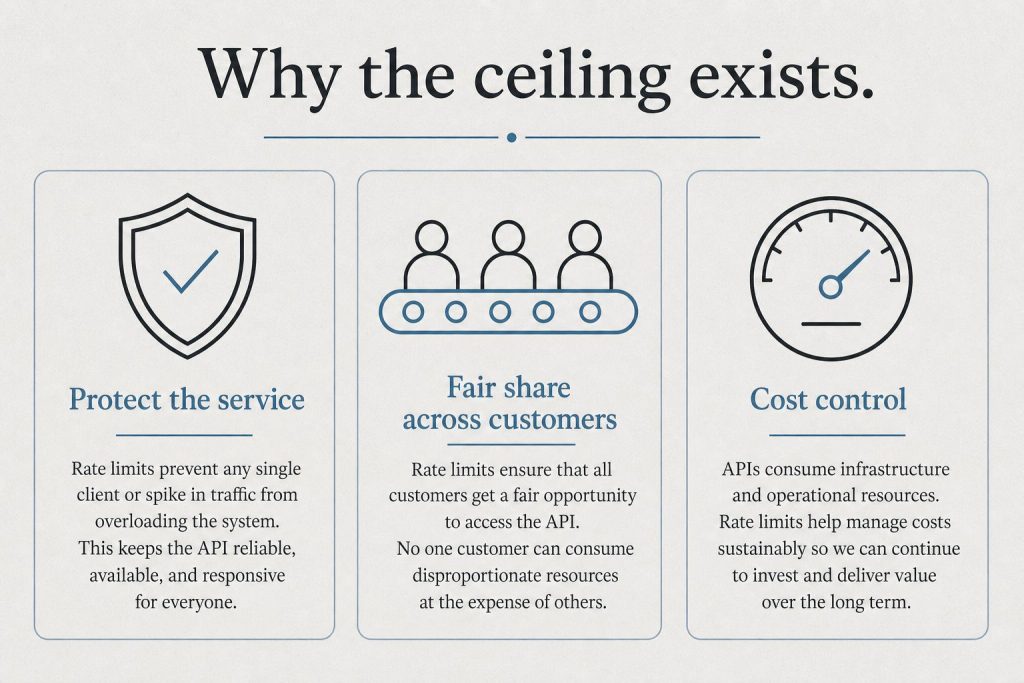
    Rate limits and tiers live next to billing — watch both.

    The console displays your current rate limits, which depend on your service tier. Anthropic offers three service tiers: Priority for when time, availability, and predictable pricing matter most; Standard as the default tier for both piloting and scaling everyday use cases; and Batch for asynchronous workloads processed together at 50% off. Rate limits increase as your account matures and your spending history grows. The console shows your current limits for requests per minute and tokens per minute across each model.

    Developer Documentation Access

    The console links directly to Anthropic’s developer documentation at platform.claude.com/docs, which includes API reference with endpoint specifications, SDK guides for Python and TypeScript, prompt engineering best practices, tool use and function calling documentation, vision and multimodal capabilities, and integration guides for AWS Bedrock, Google Cloud Vertex AI, and Microsoft Foundry.

    Console vs Claude.ai: Key Differences

    A common point of confusion: the Anthropic Console (platform.claude.com) is not the same as Claude.ai. Claude.ai is the consumer-facing chat interface where individuals and teams interact with Claude through conversation. The console is the developer-facing dashboard for API management, billing, and infrastructure. You can have accounts on both — your Claude.ai subscription (Free, Pro, Max, Team, Enterprise) is separate from your API credits on the console.

    Related on Tygart Media: API quickstart · Message Batches · how to use Claude.

    Frequently Asked Questions

    How do I access the Anthropic Console?

    Go to platform.claude.com and sign in with your Anthropic account. If you don’t have one, you can create a free account and add billing information to start making API calls.

    Is the Anthropic Console free to use?

    The console itself is free. You only pay for API usage based on the tokens consumed. There is no monthly fee for console access — you pay per token as you use the API.

    What is the difference between the Anthropic Console and the Anthropic Developer Console?

    They are the same thing. “Anthropic Console” and “Anthropic Developer Console” both refer to the dashboard at platform.claude.com where developers manage API keys, billing, and usage.

    Can I set spending limits on the Anthropic Console?

    Yes. The console allows you to set both per-workspace and per-user spending limits. You can also configure automatic credit top-ups and spending alerts to stay within budget.


    >Part of the complete guide: Working with the Anthropic API

  • llms-full.txt vs llms.txt: Why AI Agents Crawl It More (2026)

    llms-full.txt vs llms.txt: Why AI Agents Crawl It More (2026)

    Last verified: October 11, 2026. AI crawler user-agents and llms.txt conventions shift quickly — always confirm bot names and file conventions against the current provider docs and your own server logs before relying on them.

    Most conversations about AI crawlability focus on one file: llms.txt. But if you look at what Anthropic, Vercel, and LangGraph actually ship – and what GEO crawler research found AI agents fetching most – the file that matters more is its companion: llms-full.txt.

    Here’s the practical reality: llms.txt is the map. llms-full.txt is the territory. And in 2026, the agents that matter for citation traffic are fetching the territory.

    The Full File Family You Probably Don’t Know About

    The original llms.txt proposal – published by Jeremy Howard in September 2024 – defined one file. Implementers built the rest. The complete family as of mid-2026 is four files, but most sites only need two:

    FileWhat’s in itWhen to use
    /llms.txtCurated index – H1, summary, link sectionsAlways. The orientation layer.
    /llms-full.txtFull content of every linked page, concatenated as MarkdownWhen you want a model to deep-ingest your docs in a single fetch
    /llms-ctx.txtPre-expanded context without URLsFastHTML-style implementations
    /llms-ctx-full.txtPre-expanded context with URLs preservedSame, but URL-aware

    The pattern that works – and the one Anthropic, Vercel, and LangGraph all run – is the index + export pair: llms.txt for orientation, llms-full.txt for deep ingestion.

    Why llms-full.txt Gets Crawled More

    Four ranked rows of AI crawler fleets reading publisher content
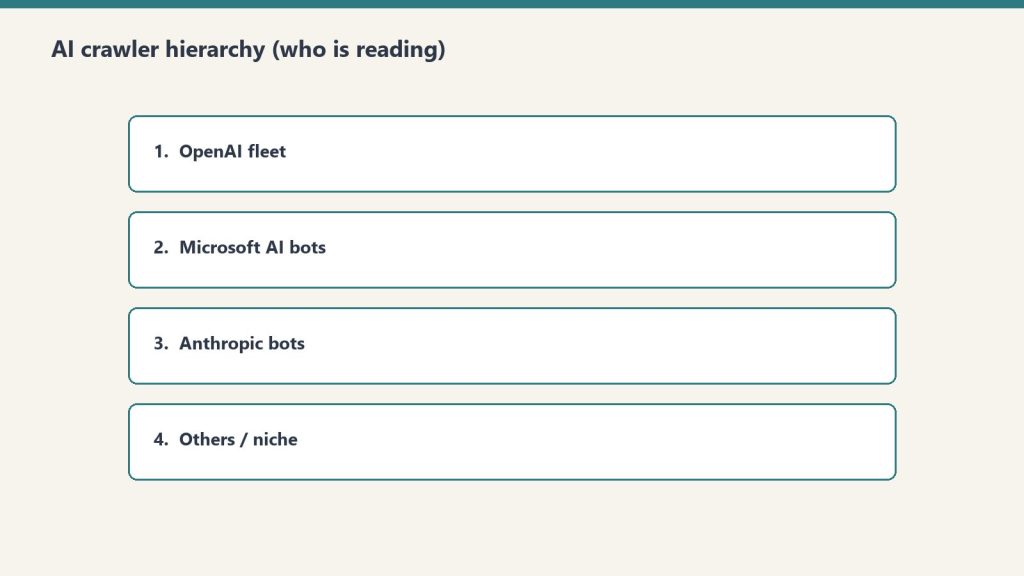
    Why llms-full.txt gets crawled more.

    GEO researchers analyzing AI crawler behavior – including work cited by Profound – have noted that agents from Microsoft, OpenAI, and others tend to fetch llms-full.txt more frequently than llms.txt when both are present. The working explanation is structural: when a file contains the full content, it removes one retrieval step. An agent that fetches llms-full.txt gets everything it needs in a single HTTP request instead of fetching the index, parsing the links, then fetching each linked page individually. This is consistent with how developer documentation platforms like Mintlify describe the behavior of IDE agents operating under tight latency budgets.

    For IDE agents (Cursor, Continue, Cline) and MCP integrations, this is even more pronounced. These tools are operating under tight context windows and latency budgets. A single fetch that returns a clean Markdown blob of your entire docs is structurally preferable to a multi-step crawl.

    The implication: if you’ve shipped llms.txt but not llms-full.txt, you’ve done half the job.

    How to Build llms-full.txt

    Desk with laptop, checklist notebook, and billing card ready before creating an Anthropic API key
    How to build llms-full.txt.

    The construction logic is simple: take every URL in your llms.txt, fetch each page, strip HTML to Markdown, and concatenate. In practice, most sites do this in their build pipeline.

    Here’s the minimal Node.js pattern:

    const fs = require('fs');
    const fetch = require('node-fetch');
    const TurndownService = require('turndown');
    const turndown = new TurndownService();
    
    async function buildLlmsFullTxt(llmsIndexPath, outputPath) {
      const index = fs.readFileSync(llmsIndexPath, 'utf8');
      const urlRegex = /\[.*?\]\((https?:\/\/[^\)]+)\)/g;
      const urls = [...index.matchAll(urlRegex)].map(m => m[1]);
    
      let output = '';
      for (const url of urls) {
        const res = await fetch(url);
        const html = await res.text();
        const markdown = turndown.turndown(html);
        output += \n\n---\n# Source: \n\n;
      }
    
      fs.writeFileSync(outputPath, output);
      console.log(Built llms-full.txt:  pages,  chars);
    }
    
    buildLlmsFullTxt('./public/llms.txt', './public/llms-full.txt');

    One constraint to manage: keep llms-full.txt under roughly 200,000 tokens (about 150K words, around 700KB). That’s the threshold where most models can ingest the file in a single context window. If your docs are larger, segment by product or language the way Supabase does – llms-full-api.txt, llms-full-guides.txt – and list the segmented files in your main llms.txt.

    The 2026 robots.txt Stack That Completes the Picture

    Three cards for Google cautious, Bing speed, OpenAI aggressive crawl styles
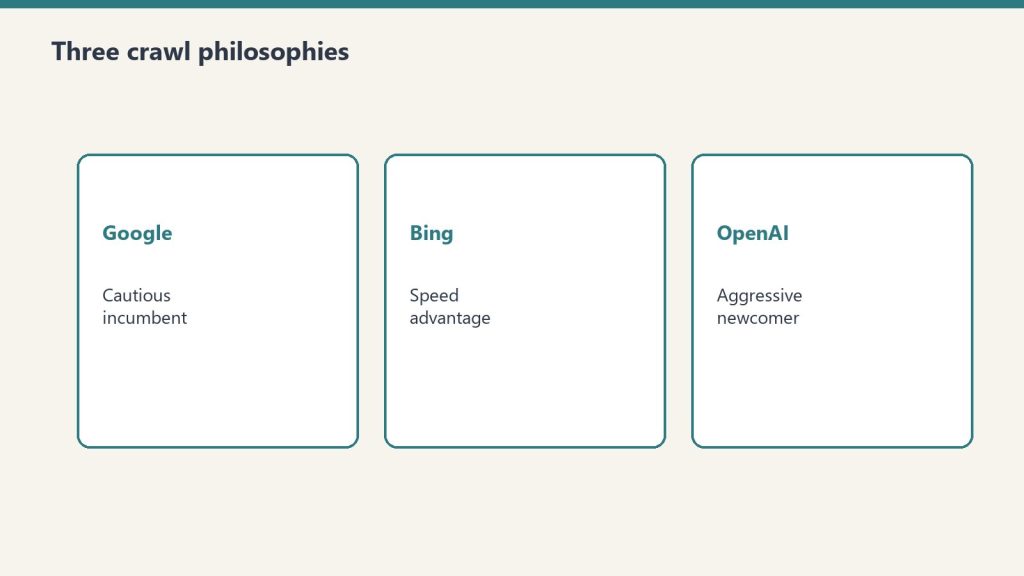
    The 2026 robots.txt stack that completes the picture.

    Shipping llms.txt and llms-full.txt is the visibility layer. The access-control layer is robots.txt – and it changed significantly in Q2 2026.

    The key development: Anthropic split its crawler into two separate user-agents. ClaudeBot is the training scraper (high bandwidth, no citation value – block it). Claude-Web is the live-retrieval agent that fetches pages to answer Claude.ai user queries in real time (allow it, because it drives citation traffic). Brands that blanket-block “all Anthropic crawlers” lose Claude citations entirely.

    Meta also shipped two active training scrapers in March 2026 – FacebookBot and Meta-ExternalAgent – at GPTBot-level crawl volume. Most sites have no rules for them yet.

    Here’s the 2026 template:

    # BLOCK: Training scrapers - high bandwidth, zero referral value
    User-agent: GPTBot
    Disallow: /
    
    User-agent: CCBot
    Disallow: /
    
    User-agent: ClaudeBot
    Disallow: /
    
    User-agent: FacebookBot
    Disallow: /
    
    User-agent: Meta-ExternalAgent
    Disallow: /
    
    # OPT OUT: Google Gemini training (keeps Search indexing intact)
    User-agent: Google-Extended
    Disallow: /
    
    # ALLOW: Live-retrieval agents - drive citation traffic
    User-agent: OAI-SearchBot
    Allow: /
    
    User-agent: ChatGPT-User
    Allow: /
    
    User-agent: Claude-Web
    Allow: /
    
    User-agent: anthropic-ai
    Allow: /
    
    User-agent: PerplexityBot
    Allow: /

    One important caveat on robots.txt enforcement: aggressive training scrapers often ignore the file or spoof their user-agents. The robots.txt rules signal intent and work for compliant bots; a WAF rule at the edge is the only deterministic block for non-compliant crawlers.

    The Honest State of the Technology

    The SERanking study of 300,000 domains (November 2025) found no measurable correlation between having llms.txt and being cited by ChatGPT, Claude, Gemini, or Perplexity. Google’s John Mueller compared the file to the deprecated keywords meta tag – something site owners declare but that search systems derive from the content itself.

    None of that means you shouldn’t ship both files. The cost is low, the optionality is real, and the IDE-agent ecosystem (Cursor, Continue, Cline) does actively use llms.txt. But the robots.txt work is the lever that moves outcomes today. The llms.txt + llms-full.txt pair is infrastructure investment – you want to be correct when major LLM providers start honoring it, and building the build pipeline now costs far less than retrofitting it later.

    The practical sequence for a site that hasn’t done this yet:

    1. Update robots.txt first. Add the Q2 2026 user-agent rules above. This takes twenty minutes and immediately affects how training scrapers treat your content.
    2. Ship llms.txt. Curated index, 20-50 priority pages, one-sentence description per link, sections in priority order.
    3. Build llms-full.txt. Concatenated Markdown of every linked page, under 200K tokens. Run it in your build pipeline so it stays current.
    4. Verify both files are served correctly. curl -I https://yoursite.com/llms.txt should return 200 with Content-Type: text/plain. A 404 on either file is the most common implementation error.
    5. Add an access-log check. Once per month, grep your logs for requests to /llms.txt and /llms-full.txt by user-agent. You want to see live-retrieval agents (Claude-Web, OAI-SearchBot, PerplexityBot) in the results – not just training scrapers.

    The goal isn’t to optimize for a standard that isn’t fully adopted yet. It’s to build the infrastructure correctly now, while the field is still forming, so that adoption changes work in your favor rather than requiring catch-up.

    Related Reading

    Frequently Asked Questions

    What is the difference between llms.txt and llms-full.txt?

    llms.txt is a curated index — an H1, a summary, and link sections that orient an AI agent to your site. llms-full.txt is the full content of every linked page concatenated as Markdown, so an agent can deep-ingest your documentation in a single fetch. The index is the map; the full file is the territory.

    Why do AI agents crawl llms-full.txt more often than llms.txt?

    Fetching llms-full.txt removes a retrieval step: the agent gets everything in one HTTP request instead of fetching the index, parsing links, and fetching each page individually. For IDE agents like Cursor, Continue, and Cline operating under tight latency and context budgets, a single clean Markdown blob is structurally preferable to a multi-step crawl.

    How big should llms-full.txt be?

    Keep it under roughly 200,000 tokens (about 150K words, around 700KB) so most models can ingest it in a single context window. If your docs are larger, segment by product or language — for example llms-full-api.txt and llms-full-guides.txt — and list the segmented files in your main llms.txt.

    Does having llms.txt actually improve AI citations?

    Not measurably on its own. A November 2025 SERanking study of 300,000 domains found no correlation between having llms.txt and being cited by ChatGPT, Claude, Gemini, or Perplexity, and Google’s John Mueller compared it to the deprecated keywords meta tag. The lever that moves outcomes today is robots.txt configuration; llms.txt and llms-full.txt are low-cost infrastructure for when adoption grows.

    Which AI crawlers should I allow in robots.txt in 2026?

    Allow live-retrieval agents that drive citation traffic — Claude-Web, OAI-SearchBot, ChatGPT-User, anthropic-ai, and PerplexityBot. Block high-bandwidth training scrapers with no referral value such as GPTBot, CCBot, ClaudeBot, FacebookBot, and Meta-ExternalAgent, and opt out of Google-Extended to skip Gemini training while keeping Search indexing intact.

  • How AI Engines Actually Cite Your Content: Grounding and GEO Guide

    How AI Engines Actually Cite Your Content: Grounding and GEO Guide

    Last verified: June 2026.

    Most “GEO” advice is recycled SEO with the word “AI” pasted on top. This guide is different. It describes what actually happens when Microsoft Copilot, Bing’s AI answers, and Google’s AI Overviews build a response and decide whose page to cite — based on running content sites that get cited tens of thousands of times a month. The short version: AI engines do not cite the page that ranks #1 for a head term. They cite the page that most directly answers the specific sub-question the model is grounding on. That distinction changes everything about what you should write.

    How grounding actually works (the part nobody explains)

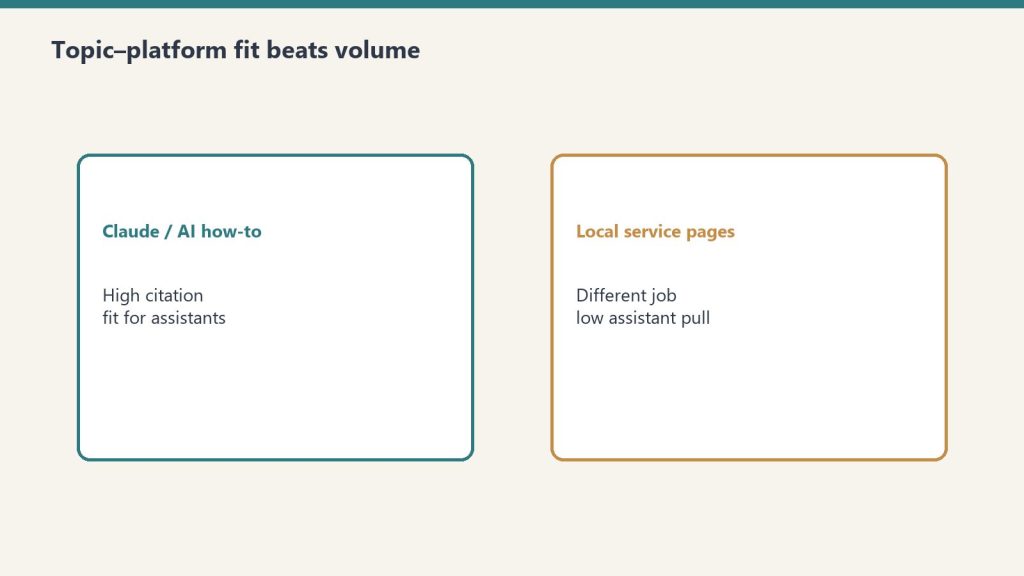
    Topic platform fit visual for first-party AI citation measurement
    How grounding actually works.

    When you ask Copilot or Bing’s AI a question, the model does not answer from memory. It runs a retrieval step called grounding: it rewrites your question into one or more search queries, fetches a handful of live web results, reads them, and composes an answer with inline citations pointing back at the pages it used. Google’s AI Overviews work the same way with a technique it calls “query fan-out” — one user question becomes many narrower synthetic queries.

    Two things follow directly from this mechanism:

    • The model is not searching for your keyword. It is searching for the answer to a decomposed sub-question. A user who asks “what’s the best way to instantly index a new page” triggers grounding queries like “IndexNow API endpoint”, “submit URL to Bing programmatically”, and “IndexNow key file location”. The page that wins is the one that answers those narrow strings, not the one optimized for “indexing tips”.
    • Citations are extracted at the passage level, not the page level. The model lifts the specific sentence or table that answers the sub-question. If your answer is buried under 600 words of preamble, it loses to a page that states the fact in the first line under a matching heading.

    This is why a niche, specific page routinely out-cites a high-authority generalist. The generalist ranks; the specialist gets quoted.

    Why operational and comparison pages win over head terms

    Across real citation data, the pages that get pulled into AI answers cluster into three shapes. None of them are “ultimate guide to X”.

    1. Operational pages with real commands, configs, and error messages

    When someone asks an AI assistant “how do I fix [specific error]” or “what’s the exact command to do X”, the model needs a page that contains the literal command, the literal config, or the literal error string. Generic advice cannot be cited because there is nothing concrete to quote. A page that says:

    curl "https://www.bing.com/indexnow?url=https://example.com/new-page/&key=YOUR_KEY"
    # 200 = received (not "indexed"), 422 = URL/key mismatch, 429 = too many submits

    …is citation gold, because the model can extract that block verbatim and the user can act on it. The error-code annotations matter: questions about failures (“IndexNow 422”, “why am I getting 429”) are high-intent and low-competition, and a page that names the exact codes owns them.

    2. Comparison pages (“X vs Y”)

    “Which is better, X or Y” is one of the most common shapes of AI query, and comparison content is structurally easy to cite because it maps cleanly to a decision. If you maintain honest, current head-to-head pages, you become the default source the model reaches for when a user is choosing between tools. This is exactly why we keep dedicated comparison pages like Claude Code vs Cursor and Claude Code vs Codex — they answer a decision the model is constantly being asked to make, and a table of differences is trivially quotable.

    3. Fresh, dated pages on fast-moving topics

    For anything that changes — pricing, model versions, API limits, feature availability — grounding strongly favors recency. The model would rather cite a page dated this month than an “authoritative” page from two years ago that might be wrong. A visible “Last verified” date and a real publish/update timestamp are not decoration; they are a relevance signal the retrieval layer reads.

    The losing move is chasing broad head terms. “Best AI coding assistant” is saturated, generic, and rarely the literal grounding query. The winning move is to own the long, specific, operational and comparison strings that the fan-out actually generates.

    IndexNow: how to get cited the same day you publish

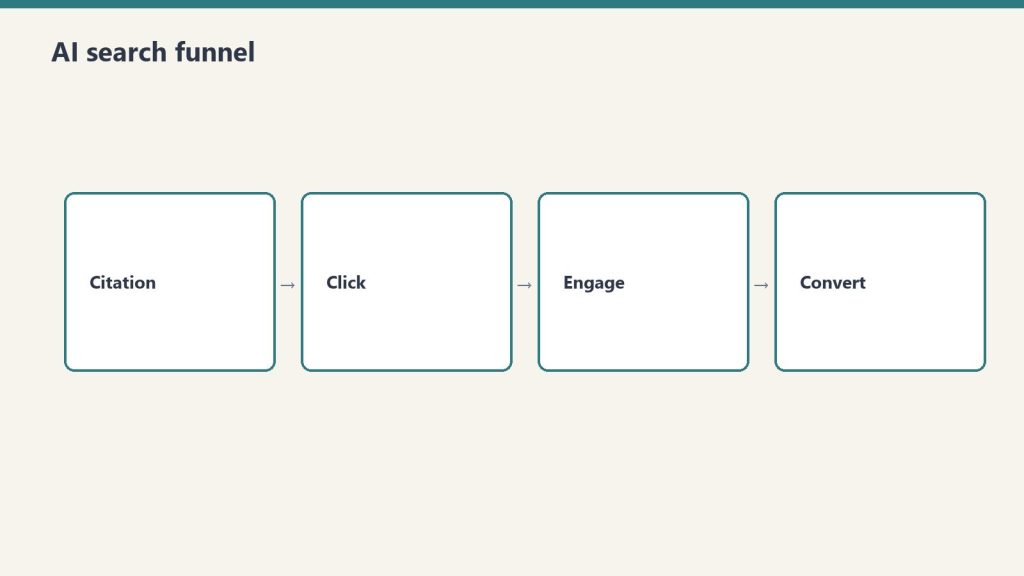
    Four-stage funnel: citation, click, engage, convert
    IndexNow — cited the same day you publish.

    Grounding can only cite pages the engine knows about. The bottleneck for new content is crawl latency — and IndexNow collapses it. IndexNow is an open protocol (backed by Microsoft Bing and Yandex) that lets you push a URL to the index the instant you publish, instead of waiting for a crawler to wander by.

    Setup is two steps:

    1. Host a key file. Generate a key of 8-128 hex characters and place it at your site root as a UTF-8 text file named {key}.txt containing exactly that key. Example: https://example.com/daa44a2c....txt. This proves you own the host.
    2. Ping on publish. Single URL via GET:
      curl "https://api.indexnow.org/indexnow?url=https://example.com/new-page/&key=YOUR_KEY"
      Or batch up to 10,000 URLs in one POST:
      curl -X POST "https://api.indexnow.org/indexnow" \
        -H "Content-Type: application/json" \
        -d '{"host":"example.com","key":"YOUR_KEY","urlList":["https://example.com/a/","https://example.com/b/"]}'

    A 200 means the endpoint received your URL (not that it is indexed yet). Submitting to api.indexnow.org shares the ping with all participating engines, so you do not need to hit Bing and Yandex separately. Most WordPress SEO plugins (Rank Math, Yoast, SEOPress) have IndexNow built in — turn it on and it fires automatically on every publish and update. The practical payoff: pages can enter Bing’s crawl queue within hours, which means they are eligible to be grounded and cited the same day, not next week.

    One caveat worth stating plainly: IndexNow accelerates indexing, which is a precondition for citation. It does not force a citation. You still need the page to be the best answer to the sub-question. But for fresh, time-sensitive content, same-day indexing is often the difference between getting cited while the topic is hot and showing up after the conversation has moved on.

    How to actually measure your AI citations

    For a long time AI citations were invisible — you could see referral clicks in analytics but not the citations themselves (most AI answers are zero-click). That changed. As of February 2026, Bing Webmaster Tools ships an AI Performance report (public preview) that shows when your pages are cited across Microsoft Copilot, Bing’s AI answers, and partner surfaces. It is the first direct, free window into AI citation behavior, and you should be reading it weekly.

    The four metrics that matter:

    • Total citations — how many times your site was cited as a source in AI answers over the period.
    • Average cited pages — the daily average count of unique URLs from your site that got referenced. This tells you whether citations are concentrated on one page or spread across the site.
    • Grounding queries — sample query phrases the AI used to retrieve and cite you. This is the single most actionable field in the report. It is a literal list of the sub-questions you are winning, which tells you exactly which operational/comparison angles to expand next.
    • Page-level citation activity — citations by URL, so you can see which pages are doing the work.

    Two limitations to keep in mind so you read the data honestly: the report does not show click data (you see citations, not visits from them), and it aggregates Copilot with Bing summaries, so you cannot isolate one surface from the other. For Google’s AI Overviews there is still no equivalent citation dashboard — the closest proxy is watching impressions and referral patterns in GA4 and Search Console, plus spot-checking your target queries by hand.

    The workflow that works: pull the grounding-queries list, find the patterns, and feed them straight back into your content plan. If you are getting cited for “claude mcp setup” variants, that is a signal to deepen pages like the Claude MCP setup guide and adjacent operational walkthroughs, not to chase a new head term.

    A repeatable checklist for citation-optimized pages

    Desk with laptop, checklist notebook, and billing card ready before creating an Anthropic API key
    Checklist for citation-optimized pages.

    Everything above reduces to a build pattern. For any page you want AI engines to cite:

    • Lead with the answer. Put a short, factual, quotable answer in the first 1-2 sentences under each heading. Assume the model reads only that passage.
    • Use question-shaped headings. H2s and H3s that mirror real queries (“How does IndexNow work?”, “How do I measure AI citations?”) match the grounding query and give the extractor a clean anchor.
    • Be specific and operational. Real commands, real config, real numbers, real error codes and fixes. Concrete text is extractable; vague advice is not.
    • Add a visible FAQ near the end. Plain question/answer pairs are the single most citation-friendly format, because each pair is a self-contained answer to a discrete sub-question. You do not need JSON-LD schema for this to work — visible Q&A text is what the model reads.
    • Date it and keep it current. A “Last verified” line plus genuine updates on fast-moving topics buys you the recency edge in grounding.
    • Push it with IndexNow so it is indexable the same day, then watch the AI Performance report to see which sub-questions it wins.

    If you want the larger system this fits into — the full toolchain for operating as an AI-first publisher, from MCP servers to publishing pipelines — start with the AI operator’s stack.

    FAQ

    Do AI engines cite the page that ranks #1 on Google?

    Not reliably. AI engines run their own grounding retrieval and cite the page that most directly answers the specific decomposed sub-question, which is often a niche, operational page rather than the head-term winner. Ranking helps your page be discoverable, but the citation goes to whichever passage best answers the exact grounding query.

    What is grounding in AI search?

    Grounding is the retrieval step where an AI assistant rewrites your question into search queries, fetches live web pages, reads them, and builds an answer with inline citations to those pages. It is why current, specific pages can get cited even by a model whose training data predates them.

    Does IndexNow guarantee my page will be cited by AI?

    No. IndexNow guarantees fast indexing, which is a precondition for being cited. The page still has to be the best, most specific answer to the sub-question the model is grounding on. Think of IndexNow as removing the crawl-latency excuse, not as buying a citation.

    How do I measure how often AI cites my site?

    Use the AI Performance report in Bing Webmaster Tools (public preview since February 2026). It shows total citations, average cited pages per day, sample grounding queries, and citation counts by URL across Microsoft Copilot and Bing AI answers. It does not yet show click-through from those citations, and there is no equivalent dashboard for Google AI Overviews.

    Do I need JSON-LD or schema markup to get cited?

    No. Citation extraction works on visible, well-structured text — question-shaped headings, short factual answers, and a plain visible FAQ. Schema can help search features generally, but it is not required for AI grounding to read and quote your page.

    What kind of pages get cited most?

    Three shapes dominate: operational pages with real commands, configs, and error fixes; comparison pages that resolve a “X vs Y” decision; and fresh, dated pages on fast-moving topics like pricing and model versions. Broad head-term content tends to get skipped because it rarely matches the literal grounding query and offers nothing concrete to quote.

    Related on Tygart Media: citation economy · AI search funnel · citation monitoring.