A water-damage company with 47 reviews just got recommended by ChatGPT over a competitor with 462.
Read that again. Four hundred and sixty-two reviews. Ten times the social proof. And the AI picked the little guy.
If you spent the last decade collecting reviews like they were votes, this should rattle you. It should also clarify everything, because the game didn’t just change — it ended, and a new one started while nobody was watching.
From ranking to matching
The old game was a scoreboard. Most reviews wins. Biggest ad budget wins. Best SEO agency wins.
The new game is a matchmaker.
In June 2026, OpenAI rolled out a memory system (they call it Dreaming) that quietly builds a living profile of you — your chats, your Gmail, your files — and uses it to shape every answer. It’s on by default. Two people asking ChatGPT the same question now routinely get different answers, because the AI knows different things about each of them.
Google’s doing the same thing from the other direction. AI Overviews don’t give you a ranked list of ten businesses anymore. They name two or three. Fourth place doesn’t get a consolation mention — it gets nothing. And here’s the number that should end the argument: only about 26% of the businesses sitting in Google’s top-3 map pack even appear in Gemini’s responses. You can win the map pack and still be invisible to the AI.
So the question was never “who has the most reviews.” The question is “who is the best fit for this person,” and the AI is answering it with information you can’t see.
The dinner test
Here’s how I explain it to myself.
Tonight I walked to a little family-run Thai place instead of ordering from a chain. No ad convinced me. No review count swayed me. The tools just… knew. They knew I’d rather have the local place with the great green curry than the heavily advertised alternative.
The tools know you’d pick the local place. No ad budget changes that.
That’s what happened with the 47-review company. The AI didn’t count stars. It matched a person — their history, their preferences, the pattern of what “good” looks like to them — against the businesses it knew. And the little guy fit better.
Panda Express can outspend everybody. It doesn’t matter. When the tool knows you better than the ads do, the ads stop working on you.
Why the count stopped mattering
It’s not that reviews don’t matter. They do — review signals have actually grown to about 20% of local ranking weight. But count was always a proxy for trust, and the AI doesn’t need the proxy anymore. It reads the reviews. It summarizes the sentiment. It checks whether your website says the same thing your Google profile says. It looks at whether your story is consistent across fifteen, twenty, thirty sources — or whether it falls apart the moment it leaves your homepage.
A thousand bought or begged reviews with thin sentiment lose to fifty detailed ones that all say the same specific true things. The AI can tell the difference. It literally summarizes them.
What actually wins now
The reputation graph: every signal connected, telling one consistent story.
The playbook isn’t complicated, but it’s unforgiving:
Complete your profile like it’s the product. The AI reads your Google Business Profile as a primary source. Empty fields are silence, and silence doesn’t get cited.
Recency and sentiment over volume. A steady stream of real, specific reviews beats a pile of old five-stars.
Say the same true thing everywhere. Your website, your profile, your directories, your socials — one consistent story, confirmed in many places. Contradictions are how you disappear.
Structure your data. Schema markup is how the machines read you. It’s not optional anymore; it’s the difference between being understood and being skipped.
Be genuinely good. This is the one nobody wants to hear. The tools are getting better at knowing what “good” looks like for each person, which means there are fewer places to hide. You can’t buy your way into a match. You have to be the answer.
The honest caveat
I want to be straight about what we know and what we don’t. Nobody outside these companies can see exactly how the personalization works — one researcher called it “a synthesized profile that neither the user nor the brand can fully see.” That’s the truth of it. We’re reading the outputs and working backward.
And the social-graph part — your friend’s Facebook comment tipping a recommendation — is directionally right but the mechanics differ by platform. Google has the cross-product graph: YouTube, Maps, Gmail, Android. Meta’s AI has the actual social graph. ChatGPT works mostly from your own data. The destination is the same everywhere: the recommendation gets personal, and the personal is opaque.
Less places to hide
That’s the line I keep coming back to. Less places to hide.
For years you could paper over a mediocre operation with review velocity, ad spend, and SEO tricks. The machines are taking those tools away — not out of virtue, but because matching works better than ranking, and the platforms all figured that out at once.
What’s left is the oldest marketing strategy there is: be good, be consistent, and make sure the machines can see it.
The 47-review company didn’t beat the system. It was the system working as designed. The question is whether you’re building a business the new system can see — or still optimizing for the old scoreboard.
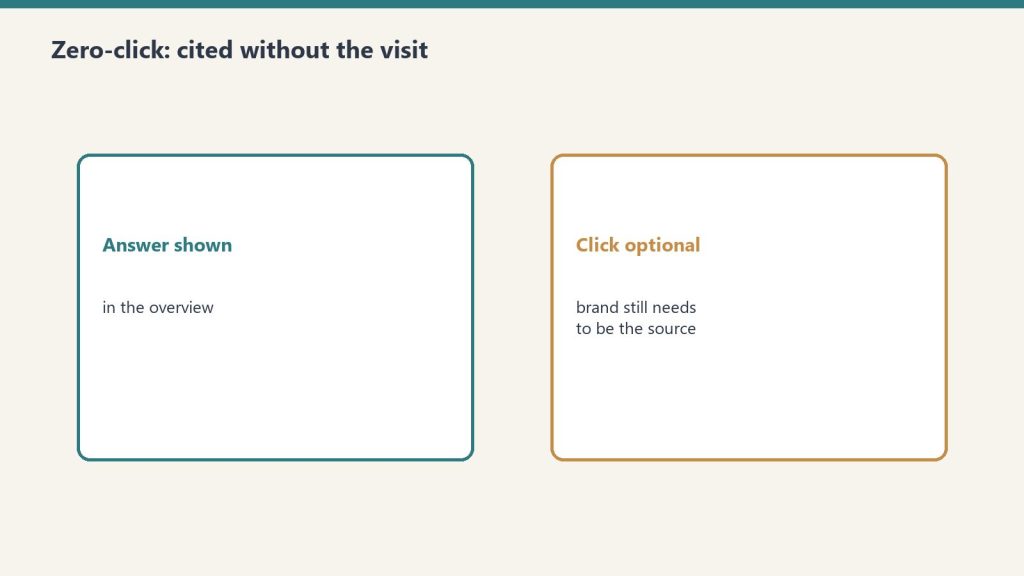
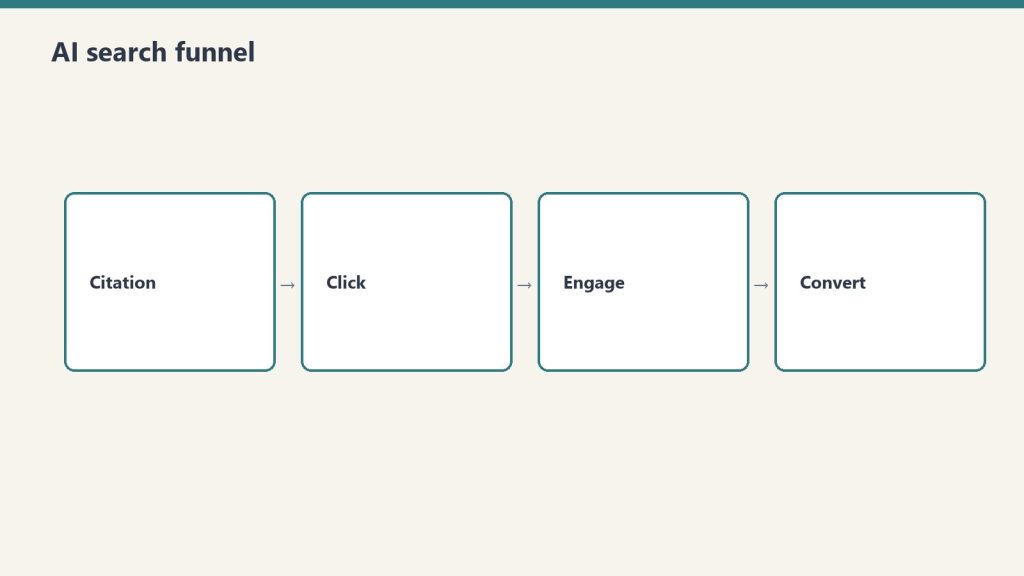
68% of U.S. Google searches end without a click in 2026. When AI Overviews appear, that rate hits 83%. The question for content-driven businesses is no longer how to rank — it’s how to be cited inside the answer that replaced the click.
This is a practical guide to structuring content, managing brand entity signals, and measuring visibility in a world where users get their answer before they ever reach your site.
What Zero-Click Actually Means for Content Businesses
What zero-click actually means for content businesses.
Zero-click doesn’t mean zero value. Brands cited inside AI Overviews earn 35% more organic clicks than uncited brands on the same query. The traffic goes to the cited brand — not to the site that ranks #1 but isn’t cited.
The data that reframes zero-click as a competition problem, not a traffic problem:
68% of U.S. Google searches are zero-click in 2026 (SparkToro, June 2026, based on Similarweb panel data)
When AI Overviews appear, zero-click rate hits 83%
Brands cited in AI Overviews earn 35% more organic clicks and 91% more paid clicks versus uncited brands
AI-referred visitors convert at 4.4x the rate of traditional organic visitors (Semrush)
The overlap between top-10 rankings and AI Overview citations: 17–38% in early 2026, down from 75% in mid-2025
The conclusion: ranking is no longer sufficient for visibility. A site can rank #1 and not be cited in the AI Overview that answers the query. The two need to be optimized separately.
How AI Overviews Decide What to Cite
How AI overviews decide what to cite.
Google’s AI Overview system retrieves web pages in real time, synthesizes a 3–5 sentence answer, and cites 3–6 source pages. The selection criteria weight answer extractability, entity authority, freshness, and structured data — not just ranking position.
The signals that influence AI Overview citation:
Answer extractability: The answer to the query must appear in the first 200 words of the page, stated directly. Pages that build toward the answer, providing extensive context before the conclusion, are retrieved for topic relevance but can’t be cited because the extractable answer isn’t there.
Entity authority: Consistent, factually accurate information about the brand entity across the web — site, LinkedIn, social profiles, third-party mentions — signals that the source is authoritative on the topic. AI systems treat entities with strong external corroboration as more trustworthy.
Freshness: For fast-changing topics (Claude pricing, AI model capabilities, regulatory changes), recency is a significant weight. A page last updated in 2024 competes poorly against one updated in August 2026 on a query about current Claude pricing.
Structured data: FAQPage, HowTo, and Article schema markup signals to Google that content is formatted for extraction. Pages with properly implemented schema see measurably higher AI Overview inclusion.
E-E-A-T signals: Experience, expertise, authoritativeness, trustworthiness. An article written by a named author with a consistent byline and external presence outperforms anonymous content on contested or technical topics.
Strategy 1: Structure Every Page for Extraction
Structure every page for extraction.
Answer-first structure is the single highest-leverage change for AI citation rates. The first paragraph of every article should directly and completely answer the likely query.
The structure AI systems can extract from:
H1: [Specific, query-answering title]

[Bold one-sentence direct answer to the query implied by the title]

[Supporting detail — the why, the how, the context]

H2: [First subtopic as a question]
[Bold answer sentence to the H2 question]
[Elaboration]
What this means in practice for tygartmedia.com content:
Every article about Claude pricing, model capabilities, or Anthropic history should open with the factual answer — not a framing sentence, not background, not “in this article we’ll cover.” The answer, stated directly, in the first two sentences.
The reason this matters beyond GEO: it’s also better for users. Answer-first structure is a discipline that makes content more useful and more likely to be cited. The SEO and GEO benefits are secondary to the writing quality improvement.
Strategy 2: Build and Maintain the Brand Entity
AI systems treat brands as entities — named things with verifiable, consistent information across multiple authoritative sources. Building entity authority means making sure that information is consistent, correct, and present everywhere crawlers look.
Entity checklist for tygartmedia.com:
On-site signals:
Organization schema on every page (name, URL, description, logo, founder, sameAs links)
Consistent author byline (“Will Tygart”) on every article
Author bio that establishes expertise consistently across all articles
Contact and about page with complete, factual business information
Off-site signals:
LinkedIn Company Page with consistent description matching the website
Google Business Profile (if applicable) with consistent NAP (name, address, phone)
Third-party mentions and citations on authoritative sites in the AI/tech space
Social profiles with consistent handles and descriptions
The consistency requirement: AI systems cross-reference. If the description on LinkedIn says “AI infrastructure for operators” and the website says something different, that inconsistency weakens the entity signal. Everything should say the same thing about the same thing.
Strategy 3: Implement Structured Data
FAQPage, Article, and Organization schema markup signals to AI Overviews that content is formatted for extraction. This is not optional in 2026 for sites that depend on search visibility.
Minimum structured data implementation:
FAQPage schema on every article with a FAQ section:
{
  "@context": "https://schema.org",
  "@type": "FAQPage",
  "mainEntity": [{
    "@type": "Question",
    "name": "What is Metricool pricing?",
    "acceptedAnswer": {
      "@type": "Answer",
      "text": "Metricool has a free plan and paid plans starting at the Starter tier. API access requires the Advanced plan or above. Pricing is per brand, not per connected social account."
    }
  }]
}
Article schema on all editorial content (author, published date, modified date, headline).
In Rank Math (the plugin on tygartmedia.com): FAQ blocks in the WordPress editor generate FAQPage schema automatically. Use the Rank Math FAQ block for all FAQ sections rather than plain text. Article schema is enabled site-wide in Rank Math settings.
Strategy 4: Keep Content Current
AI retrieval systems weight freshness heavily for fast-changing topics. For any site publishing Claude pricing, model capabilities, or AI tool features, stale content is not just less useful — it actively loses citation ground to fresher sources.
Freshness implementation:
“Last refreshed” date at the top of every article — visible to users and read by crawlers as a freshness signal
“What’s new” section in evergreen articles covering frequently updated topics (Claude pricing, model capabilities, Metricool features)
Update the modified date in Article schema whenever content is refreshed — not just the publication date
Monitor Search Console for queries where the site appears in AI Overviews — freshness issues show up as drops in citation before they show up as ranking drops
Trigger list for mandatory refreshes on tygartmedia.com:
Any Anthropic pricing change
Any new Claude model release or deprecation
Any Metricool feature update
Any change to Anthropic’s Enterprise product structure
Strategy 5: Earn Third-Party Citations
AI systems give extra weight to content cited by other authoritative sources. Being linked to or mentioned by other sites publishing on Claude, Anthropic, and AI infrastructure strengthens the entity signals for all related queries.
Practical approaches:
Original data and research: Content with specific numbers, benchmarks, and original findings gets cited by others. The Claude pricing breakdowns, benchmark comparisons, and API cost calculations on tygartmedia.com are exactly the type of content other AI publications cite.
First-mover coverage: Publishing accurate, detailed coverage of Anthropic announcements before or alongside other publications builds a citation pattern over time.
Expertise-signal content: Content that can only be written from operational experience — running 24 brands in Metricool, building vector DB systems for business documents — earns citations because it’s not replicable from Anthropic’s documentation alone.
Measuring Zero-Click Performance
Standard click and session metrics are insufficient for measuring zero-click visibility. The right metrics are AI citation rate, branded search volume trend, and AI-referred conversion rate.
Measurement framework:
Metric
Tool
What It Measures
AI Overview appearances
Google Search Console (AIO report)
Queries where site is cited
CTR on AIO queries
GSC, filter by AI Overview queries
Whether citations drive clicks
AI-referred traffic
GA4 source filter (ChatGPT, Perplexity)
Direct traffic from AI citations
Branded search volume
GSC, filter by brand terms
Awareness from zero-click exposure
Conversion rate from AI sources
GA4 segmented by source
Value of AI citation traffic
Manual testing protocol: Monthly, ask ChatGPT, Perplexity, and Claude the questions your audience asks — “what is Claude Enterprise pricing,” “how does Metricool API work,” “what is the history of Anthropic” — and record whether tygartmedia.com is cited. This is the most direct feedback loop available and costs nothing.
If branded search volume is growing while organic clicks are flat or declining, the site is appearing in AI summaries and building awareness without receiving credit in standard traffic metrics. That’s the zero-click pattern working in favor of the brand — and the signal that citation strategy is working.
Frequently Asked Questions
What is zero-click search?
Zero-click search is a search that ends on the results page itself — the user gets their answer from an AI Overview, featured snippet, or knowledge panel and doesn’t click through to any website. In 2026, 68% of U.S. Google searches are zero-click.
Does zero-click hurt all websites equally?
No. Sites cited inside AI Overviews and featured snippets earn 35% more organic clicks than uncited sites on the same query. Zero-click hurts uncited sites and benefits cited ones. The competition shifts from ranking to citation.
What is the difference between GEO and zero-click optimization?
GEO (Generative Engine Optimization) is the discipline of getting cited inside AI-generated answers from ChatGPT, Perplexity, Gemini, and Claude. Zero-click optimization is specifically about Google search — being cited in AI Overviews and featured snippets. They use the same underlying tactics (answer-first structure, entity signals, structured data, freshness) applied to different surfaces.
How long does it take to see results from zero-click optimization?
Plan for 3–6 months of consistent effort before citation rates change meaningfully. AI systems update their citation patterns as they re-index updated content. The fastest wins come from freshness updates on existing high-traffic pages and FAQ schema implementation on pages that already rank.
Do clicks from AI citations convert differently?
Yes — significantly. AI search visitors convert at approximately 4.4x the rate of traditional organic visitors (Semrush). The mechanism is intent: users who get a specific answer from an AI Overview and then click through to the cited source are further along in their decision process than typical organic visitors.
GEO — Generative Engine Optimization — is the practice of structuring content so that AI answer engines (ChatGPT, Perplexity, Google AI Overviews, Gemini, and Claude) cite it in the answers they generate. In 2026, 68% of U.S. Google searches end without a click. Being cited in the answer that appears is now as important as ranking in the links below it.
This guide covers what GEO is, how it differs from traditional SEO, and five specific tactics that move citation rates — with particular relevance for sites publishing Claude and AI authority content.
Why GEO Matters in 2026
Why GEO matters — citations are the new first page.
AI Overviews reduce organic click-through rate for the #1 ranked result by up to 58% (Ahrefs, December 2025) — but brands cited as sources within AI Overviews earn 35% more organic clicks than uncited brands on the same query.
The counterintuitive finding: zero-click is bad for uncited sites and good for cited ones. The goal is not to fight AI Overviews — it’s to be inside them.
The market data context:
68% of U.S. Google searches are zero-click in 2026, up from 60% in 2024
When AI Overviews appear, the zero-click rate jumps to 83%
Visitors arriving from AI citations convert at 4.4x the rate of traditional organic visitors
The GEO market is projected at $365M in 2026, growing at 42.9% CAGR
The mechanism: AI search users arrive with specific, researched queries and a pre-formed shortlist. That intent profile makes them higher-converting even when the total count is smaller.
How GEO Differs From Traditional SEO
How GEO differs from traditional SEO.
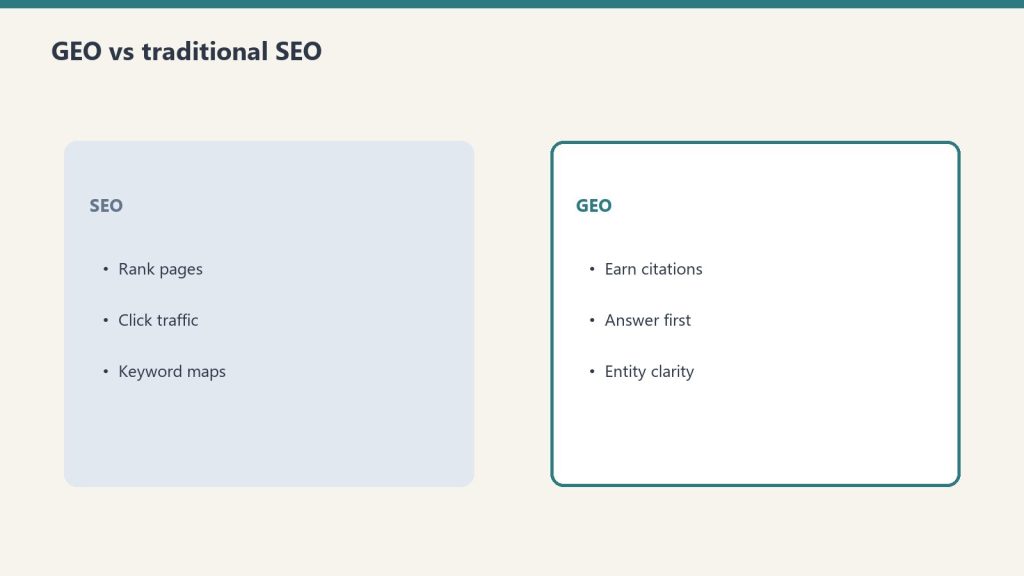
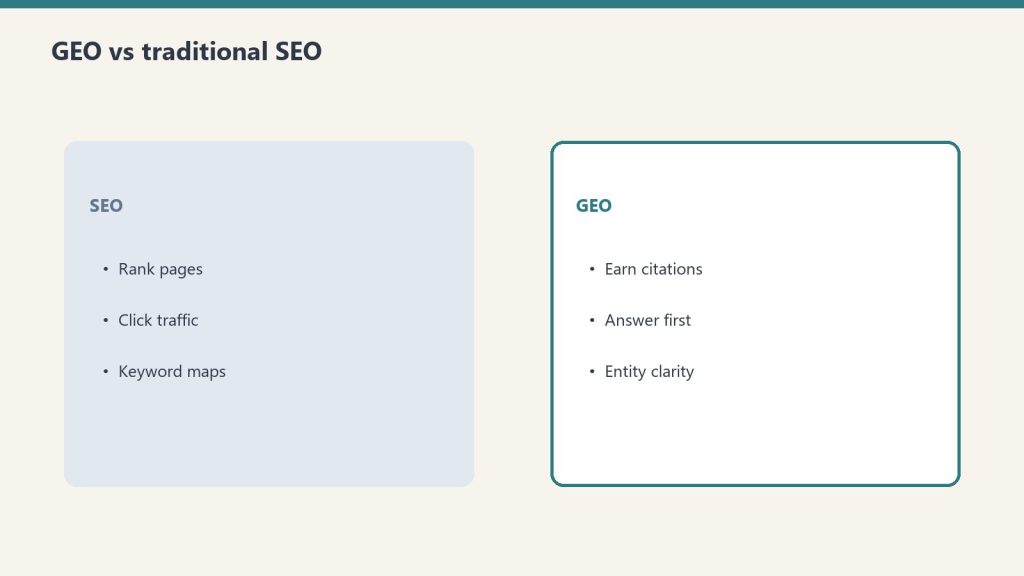
Traditional SEO optimizes for ranking position in a list of links. GEO optimizes for inclusion in the synthesized answer above those links. The signals overlap significantly, but GEO adds specific requirements around answer-first structure, data richness, and citation-friendliness.
Dimension
Traditional SEO
GEO
Goal
Rank in top 10
Be cited in the AI answer
Key signal
Backlinks, E-E-A-T, technical SEO
Answer-first structure, data richness, entity authority
Measurement
Organic clicks, ranking position
AI citation rate, brand mentions, branded search volume
Content structure
Topic depth, keyword distribution
Direct answer in first 200 words, FAQ schema
Success state
Position 1
Cited source in AI Overview
Important: the overlap between ranking in Google’s top 10 and being cited in AI Overviews collapsed from roughly 75% in mid-2025 to 17–38% in early 2026. Ranking well no longer guarantees AI citation. Both need to be optimized for separately.
Tactic 1: Answer First, Always
Answer first, always — then prove it with specifics.
AI retrieval systems that use real-time web access evaluate a page’s relevance primarily on its opening content. The first 200 words of any article must directly and completely answer the primary query — not build up to the answer.
The structure that gets cited:
[H1 Title]
[Bold one-sentence direct answer in first paragraph]
[Supporting context and detail]
The structure that doesn’t:
[H1 Title]
[Background context]
[History of the topic]
[Eventually getting to the answer]
AI Overviews synthesize their answers from the opening of retrieved pages. A page that buries its answer 500 words in gets retrieved for its topic relevance and then can’t be cited because the direct answer isn’t extractable. The answer-first structure serves both GEO and usability simultaneously.
For AI authority content specifically: every article about a Claude feature, pricing tier, or model capability should open with the factual answer to the likely query, stated plainly in the first sentence or two.
Tactic 2: Add Original Data and Specific Numbers
AI systems and search engines treat original data, specific statistics, and citable figures as high-value content. Content with precise numbers gets cited more than content with generalizations.
The practical application:
“Claude Enterprise typically costs $60–250+/user/month depending on usage intensity” is more citable than “Claude Enterprise is expensive for some teams”
“68% of U.S. Google searches are zero-click in 2026” is citable; “most searches end without a click” is not
“Claude Sonnet scores approximately 77% on SWE-bench Verified” is citable; “Claude is good at coding” is not
For tygartmedia.com content specifically: articles that include specific pricing numbers, benchmark scores, token counts, and performance figures will outperform articles that describe capabilities in qualitative terms. The Claude reference cluster (pricing, models, console) already does this well.
Attribution rule: Cite where specific numbers came from — a benchmark, a study, Anthropic’s official documentation. “According to Anthropic’s pricing page” or “per SWE-bench Verified benchmarks” tells AI systems the claim is grounded, not asserted.
Tactic 3: Use FAQ Schema
FAQ schema (FAQPage structured data) formats content explicitly as question-and-answer pairs, which is the format AI answer engines are built to extract and synthesize from. Pages with FAQ schema see measurably higher AI Overview inclusion.
Implementation in JSON-LD:
<script type="application/ld+json">
{
  "@context": "https://schema.org",
  "@type": "FAQPage",
  "mainEntity": [
    {
      "@type": "Question",
      "name": "What is Claude Enterprise pricing?",
      "acceptedAnswer": {
        "@type": "Answer",
        "text": "Claude Enterprise starts at approximately $20/user/month for access, with token usage billed separately at API rates. Real total cost typically runs $60–250+/user/month depending on usage intensity."
      }
    },
    {
      "@type": "Question",
      "name": "Is Claude Enterprise worth it?",
      "acceptedAnswer": {
        "@type": "Answer",
        "text": "For teams with compliance mandates (SSO, SCIM, audit logs) or more than 150 users, yes. For smaller teams without governance requirements, Claude Team is more predictable and usually sufficient."
      }
    }
  ]
}
</script>
In Rank Math (the plugin on tygartmedia.com): FAQ blocks in the WordPress editor automatically generate FAQPage schema without manual JSON-LD implementation. Add FAQ sections to every article and use the Rank Math FAQ block type.
Tactic 4: Build Entity Authority
AI systems and search engines treat entities — specific named things with consistent, verifiable information across the web — as more citable than generic topical content. Building entity authority for tygartmedia.com means consistent name, description, and factual claims across every surface the crawlers read.
Entity authority checklist:
Organization schema on every page: Name, URL, description, logo, founder, same-as links to LinkedIn, social profiles
Consistent author byline: “Will Tygart” as the author on every article, with a consistent bio that establishes expertise
External mentions: Being cited by other authoritative sites on the same topics creates the external validation AI systems look for
Wikipedia/Wikidata presence: Not always achievable, but having factually consistent information across third-party sites (LinkedIn, Crunchbase, social profiles) strengthens entity recognition
For an AI authority site specifically: the entity is “Tygart Media” and its associated expertise is Claude, Anthropic, and AI infrastructure for operators. Every article that earns an external link or citation strengthens that entity signal for all related queries.
Tactic 5: Freshness Signals
AI retrieval systems weight recency heavily for fast-moving topics. Claude pricing, model capabilities, and Anthropic’s roadmap change frequently. Articles with stale information get displaced by fresher sources even when the URL has more backlink authority.
Freshness tactics:
“Last refreshed” date at the top of every article — signals to both users and crawlers that the information is current
Add a “What’s new” or “What changed” section for evergreen articles that cover frequently updated topics
Update timestamps when content changes — not just publishing dates, but explicit refreshed dates
Track in Google Search Console which queries trigger AI Overviews and whether the site is cited in them — freshness issues often show up as sudden drops in AI citation before they show up as ranking drops
For Claude-related content: any article covering pricing, models, or features needs a refresh trigger whenever Anthropic makes changes. The May 2026 dispatch for timestamp refreshes on Fable 5-related pricing content is the right pattern.
Measuring GEO Performance
Standard GA4 and Search Console metrics don’t capture AI citation performance. The metrics that matter for GEO are AI citation rate, branded search volume, and assisted conversions from AI-referred traffic.
What to track:
Metric
How to measure
What it indicates
AI-referred traffic
GA4 source filter for ChatGPT, Perplexity referrals
Direct AI citation traffic
Branded search volume
Google Search Console, “tygartmedia” queries
Brand awareness from AI citations
AI Overview appearances
GSC AIO report
Queries where the site is cited
CTR on AIO queries
GSC, filter by queries with AI Overviews
Whether citations drive clicks
Conversion rate from AI referrals
GA4 segmented by source
Value of AI citation traffic
Manual testing: monthly, ask ChatGPT, Perplexity, and Claude the questions your audience asks — “what is Claude Enterprise pricing,” “how does Metricool API work,” “what is Anthropic’s history” — and see whether tygartmedia.com is cited. This is the most direct GEO feedback loop available.
GEO is the practice of structuring content and managing online presence so that AI answer engines — ChatGPT, Perplexity, Google AI Overviews, Gemini, and Claude — cite it in the answers they generate. It’s distinct from traditional SEO, which optimizes for ranking positions in link lists.
How is GEO different from SEO?
Traditional SEO optimizes for ranking position. GEO optimizes for citation inside AI-generated answers. The overlap between top-10 rankings and AI Overview citations has collapsed from 75% in 2025 to 17–38% in early 2026 — ranking well no longer guarantees AI citation. Both need to be optimized independently.
Does GEO replace SEO?
No. Traditional SEO fundamentals (E-E-A-T, backlinks, technical health) still power AI citations. GEO is an additional layer on top of a solid SEO foundation, not a replacement for it. Brands that excel at GEO in 2026 typically have strong traditional SEO as well.
How long does GEO take to work?
Plan for 3–6 months of consistent effort before seeing meaningful citation rate changes. Unlike traditional SEO ranking changes, which can be tracked daily, AI citation frequency changes slowly as crawlers re-index updated content and AI systems update their knowledge bases.
What is the conversion rate from AI-cited traffic?
AI search visitors convert at significantly higher rates than traditional organic visitors — roughly 4.4x according to Semrush data. The mechanism is intent: AI search users arrive with specific, researched queries and a pre-formed shortlist, which translates to higher purchase and contact intent.
About this image. This image is part of the Article Hero Images collection in the Tygart Media visual library. Every image produced by Tygart Media is AI-generated using Google Vertex AI (Imagen), converted to WebP format, and injected with full IPTC/XMP metadata before publication.
Format: WEBP
Collection: Article Hero Images
Pipeline: Vertex AI Imagen → WebP → IPTC/XMP → WordPress
The LLMs.txt file was supposed to be the AI-era equivalent of robots.txt — a clean, declarative way to hand large language models a curated map of your most valuable content. Three years after Jeremy Howard proposed the spec, the data is in. And the data is not what implementation evangelists have been promising.
This is a case study teardown of the three largest independent measurement efforts on LLMs.txt adoption and citation impact, the one documented recovery case where it did move the needle, and the structural lesson every practitioner should pull from the divergence.
The 300,000-Domain Study That Reset the Conversation
The 300k-domain study that reset the conversation.
A widely circulated dataset of nearly 300,000 domains — analyzed across multiple AI search citation benchmarks and reported by Search Engine Journal — found no statistically significant relationship between implementing LLMs.txt and how often AI engines cite a brand. Both standard statistical analysis and machine-learning models showed no effect. Removing LLMs.txt as a feature actually improved citation prediction accuracy in one model run, meaning the file’s presence was less than noise.
Adoption sits at roughly 10.13% of domains in that dataset, distributed evenly across traffic tiers. Translation: it is neither standard practice nor a differentiator.
A separate bot-traffic audit reported by adoption researchers found that out of 62,100-plus AI bot visits over a 90-day window, only 84 requests targeted the /llms.txt path. Across half a billion LLM bot traffic events analyzed in another dataset — filtering for the agents that actually drive citations (GPTBot, ClaudeBot, PerplexityBot, OAI-SearchBot, Google-Extended) — the share of requests touching /llms.txt was statistically negligible.
The Vendor Reality Behind the Numbers
As of Q1 2026, no major AI company — OpenAI, Google, Anthropic, Meta, or Mistral — has publicly committed to reading or acting on LLMs.txt in production systems. The file is a community proposal, not a supported standard. AI language models learn what to trust from the web as it existed during training. Citation behavior reflects which sources appeared consistently in training corpora, which were cited by other credible sources, and which had claims independently corroborated. A crawl-directive file published after training cannot retroactively change any of that.
The Recovery Case That Actually Moved Traffic
Compare that to a documented recovery case reported by SEO Algorithm Recovery and corroborated by independent AI Overviews tracking: a Dallas retailer lost 72% of organic traffic to AI Overviews. Their agency deployed schema markup and restructured 150 pages around answer-first formatting. Traffic recovered to 118% of pre-AI Overview levels in 120 days, with $1.4M in revenue growth attributed to the recovered organic channel.
No LLMs.txt was involved. The intervention stack was schema markup, content restructuring for AI-extractable answers, and entity disambiguation in headings. Schema markup alone has been reported to recover 45%-plus of lost AI Overview traffic in case-study compilations across the recovery agency space.
The Structural Lesson
The structural lesson from llms.txt.
The contrast is the case study. LLMs.txt is a static directive file that AI crawlers do not currently read at scale. Schema markup is a structured-data layer that AI systems already parse to construct answer panels and citation surfaces. One is aspirational. The other is operational.
The structural pattern under every documented AI-search recovery in 2026 is the same: answer-first content directly under each H2, structured data on the entity being described, tables for comparison data, and explicit source attribution inline. Sites earning AI citations report traffic gains. Brands with strong authority signals benefit from the halo effect. Companies adapting these specific structural interventions early — not the file directives — are the ones reporting growth exceeding pre-AI Overview levels.
A Minimum-Viable LLMs.txt Anyway
A minimum-viable llms.txt anyway.
The skeptical case is not “skip LLMs.txt entirely.” It is “do not let it absorb hours that should go to schema and content restructuring.” A minimum-viable LLMs.txt is ten lines and takes ten minutes to ship:
# Your Brand Name

> One-sentence description of what your site is and who it serves.

## Core Pages
- [About](https://yoursite.com/about): Who you are, in one paragraph.
- [Products](https://yoursite.com/products): What you sell, structured.
- [Pricing](https://yoursite.com/pricing): Numbers, plans, comparison.

## Documentation
- [Getting Started](https://yoursite.com/docs/start): The 5-step onboarding.
- [API Reference](https://yoursite.com/docs/api): Full method index.
Ship it. Stop tuning it. Then spend the rest of the week on schema and answer-first H2 restructuring, which is where the recovery cases are actually being won.
The Practitioner Takeaway
When two independent measurement methodologies across 300,000-plus domains agree that an optimization has no measurable effect on the outcome it is sold to improve, the rational move is to stop selling it as a primary intervention. Treat LLMs.txt as future-proofing insurance with a ten-minute implementation cost. Treat schema, entity binding, and answer-first content structure as the actual lever. The recovery cases that crossed pre-AI Overview revenue did the second set of things. The Search Engine Land-reported audit where 8 of 9 sites saw no measurable change after implementation did the first.
Independent studies across approximately 300,000 domains have found no statistically significant relationship between LLMs.txt presence and AI citation frequency. Major AI vendors have not publicly committed to reading the file in production. Implement it as low-cost future-proofing, not as a primary citation strategy.
What actually recovers traffic lost to AI Overviews?
Documented recovery cases share a consistent intervention pattern: schema markup deployment, content restructuring with answer-first formatting directly under each H2, entity disambiguation, and inline source attribution. One published case showed 118% recovery of pre-AI Overview traffic in 120 days using this stack.
What is the minimum-viable LLMs.txt?
Ten lines: an H1 with your brand name, a blockquote with one-sentence site description, and grouped H2 sections listing your core pages and documentation with one-line summaries. Ship it once, do not over-tune it.
Which AI bot user agents matter for citation visibility?
The user agents that drive AI citations include GPTBot, ClaudeBot, PerplexityBot, OAI-SearchBot, and Google-Extended. These are the crawlers whose access determines whether your content surfaces in AI answer panels.
If LLMs.txt does not work, why is everyone implementing it?
Three reasons: it is genuinely cheap to ship, it signals to clients that you are paying attention to AI search, and there is a non-zero chance AI vendors adopt it in the future. None of those reasons justify it being your primary AI-search intervention in 2026.
Sources: Search Engine Journal’s coverage of the 300,000-domain LLMs.txt citation study; SEO Algorithm Recovery’s documented AI Overviews recovery case study; published bot traffic audits from Authority Tech and Generix Marketing on LLMs.txt request rates; recovery-stack analysis aggregated from BlankBoard Studio, Stackmatix, and Mersel AI’s 2026 AI Overviews recovery compilations.
If you want to know whether generative engine optimization actually moves the needle, stop reading think pieces and look at what shipped. The case-study record from 2025 and early 2026 is now thick enough to draw practitioner conclusions: which interventions correlate with citation lift, how fast the curve bends, and what the conversion side of the funnel does once AI traffic shows up. This is a working teardown of the published case studies — what was done, what changed, and what the implementation pattern looks like underneath.
Case 1: B2B SaaS — 575 to 3,500 AI-referred trials in roughly seven weeks
GEO case teardown — B2B SaaS AI-referred trials.
A $30M+ ARR B2B SaaS company documented in Digital Agency Network’s GEO case study roundup moved from 575 AI-referred free trials per period to over 3,500 in about seven weeks. The intervention sequence was content restructuring for citability — clear one-sentence definitions at the top of each section, statistics and comparisons rendered as tables rather than buried in prose, and step-by-step frameworks that LLMs can extract verbatim. The first 40–60 words under every H2 carried the answer to that H2’s implicit question.
The implementation pattern under this win is what matters: the company did not write new articles. It rebuilt existing articles to surface the answer first. That is the cheapest possible GEO intervention — restructure, do not republish.
Case 2: B2B SaaS — citation rate from 8% to 12% in four weeks
Citation-rate lift case — four weeks.
Discovered Labs documented a B2B SaaS case where ChatGPT citation rate on tracked queries moved from 8% to 12% by week four of an engagement, with the company’s VP of Marketing noting they had been “invisible for 18 months despite solid SEO work.” The 50% relative lift came from the same restructuring pattern plus aggressive entity-binding — explicit company name, product name, and category definition repeated in citation-friendly positions throughout each asset.
The data point worth carrying: traditional SEO authority does not automatically translate to LLM citation. The two systems read pages differently, and the page-level rewrite is what closes the gap.
Case 3: CloudEagle — 33 pages optimized, 33% increase in AI citations
CloudEagle’s published GEO result, cited across multiple 2026 case study summaries including AlphaP’s real-world GEO examples, is one of the cleanest dose-response curves in the public record. Optimize 33 pages → 33% increase in AI citations. The ratio is suspicious as a coincidence but tells the practitioner the right thing: GEO is a per-page intervention, and aggregate lift scales roughly with how many pages you treat. There is no site-wide tag you can flip. Each asset gets its own restructure.
Case 4: HubSpot — template rebuild, not content rebuild
HubSpot — template rebuild, not content rebuild.
HubSpot’s internal AEO case study, summarized in HubSpot’s own AEO case study writeup, is the cleanest illustration of the structural fix. HubSpot already ranked for thousands of marketing queries — the volume was there. The barrier was that answers were buried multiple paragraphs deep, written in traditional long-form. The fix was a template rebuild: every article restructured so the first 40–60 words under each H2 or H3 directly answered the implicit question of that heading.
This is the playbook to copy. If your site has any existing traffic, restructuring beats writing new content. The audit question is: under every H2 on every page, do the first three sentences answer the question that H2 raises?
Case 5: Netpeak USA — 120% revenue lift, 693% AI traffic growth
Stackmatix’s AEO case study compilation documents Netpeak USA’s conversational ecommerce GEO campaign producing +120% revenue and +693% AI traffic growth. The mechanism: product and category pages restructured around buyer questions (“what is the best X for Y?”, “X vs Y comparison”, “how do I choose X?”) with direct, hedged answers up top and detailed reasoning below. The pattern works because AI search engines synthesize buying decisions from extractable answer fragments, and ecommerce pages historically bury the answer under marketing copy.
The structural pattern under every win
Read the five cases together and one implementation discipline emerges. Every published GEO win in the public record traces back to the same physical change to the page:
Answer first. The first 40–60 words under every H2 directly answer the question that heading raises. No setup, no transition paragraph, no scene-setting.
Tables over prose for comparison data. Articles with 15+ data points receive measurably more AI citations than those with fewer than five, per the research synthesized in Marketing LTB’s 2026 GEO statistics roundup. Tables make those data points extractable.
Entity binding. Company name, product name, and category definition explicitly stated in citation-friendly positions, not just implied through context.
Stepwise frameworks. Procedural content rendered as numbered steps that LLMs can extract verbatim into responses.
Citable sources inline. Authoritative external citations placed adjacent to claims, not banished to a references section at the bottom.
What the cases do not prove
The published record has selection bias the size of a building. Every case study you can read is a published win. The agencies and SaaS companies that ran a GEO campaign and got nothing are not writing blog posts about it. Read the cases for the structural patterns, not the percentage lifts — the lifts are a function of starting baseline, vertical, and how invisible the brand was before the intervention.
Two other limits worth naming. First, conversion-rate claims about AI-referred traffic (“converts at a higher rate than organic” appears in over half of marketer surveys per the 2026 HubSpot State of Marketing report) come from self-reporting, not third-party measurement. The directional point is probably right — qualified intent behind an LLM query — but the magnitude is unverifiable. Second, AI citation rates are measured against the agencies’ own tracked query sets. Those sets are chosen for relevance to the client, which means baseline visibility is artificially low. The 8% → 12% case is real; whether it generalizes to a random query set is unknown.
What to do tomorrow if you are starting from zero
Pick ten pages on your site that already rank in positions 4–15 for queries with commercial intent. Open each one. Under every H2, rewrite the first 40–60 words so they directly answer the question that heading raises. Convert any prose comparison into a table. State your company name, product category, and the specific problem you solve in the opening paragraph. Add a sources list with authoritative citations.
That is the intervention every published GEO case study reduces to. Ten pages, one week of writing work. The case study record suggests you will see citation movement in three to six weeks if the queries you care about already have AI Overview or LLM citation surface area at all. If they do not, the intervention is still right — you are positioning for when they do.
FAQ
How long until GEO interventions show measurable lift?
Published cases show citation movement at the four-week mark (the 8% → 12% B2B SaaS case) and traffic movement at six to eight weeks (the 575 → 3,500 trials case at roughly seven weeks). Three months is the standard window quoted in agency case studies for material citation rate change.
Does traditional SEO authority help GEO?
Partially. Pages that already hold featured snippets are disproportionately pulled into Google AI Overviews, per multiple 2026 AEO summaries. But the B2B SaaS case where the company was “invisible for 18 months despite solid SEO work” shows that authority alone does not produce citations — page-level structural changes are the missing ingredient.
How many pages do I need to optimize before I see results?
CloudEagle’s case (33 pages → 33% citation lift) suggests the dose-response is roughly linear at small scale. Most published case studies show meaningful aggregate movement starting around 10–30 pages restructured. Below that, you are testing the methodology rather than expecting measurable lift.
Is the citation rate lift actually translating to revenue?
The published evidence says yes for ecommerce (Netpeak USA’s +120% revenue) and trial-driven SaaS (the 575 → 3,500 trials case). For brand and consideration-stage content the answer is murkier — AI citations probably influence brand recall and assisted conversion, but the attribution chain to revenue is harder to draw cleanly and the case study record is thin on this slice.
What is the cheapest GEO intervention with the highest published return?
Restructuring existing pages that already rank. The HubSpot template rebuild and the 575 → 3,500 trials case both used this approach. No new content, no new authority work, no link building — just rewriting the first 40–60 words under every H2 and converting prose comparisons into tables.
Google shipped one of the most consequential AI Overviews updates of the year on May 6, 2026 — and most SEO teams still have not adjusted their content templates to match. The update changed what gets cited, where citations are drawn from, and how users decide which links to actually click. This is the practitioner walkthrough: what shifted, the data behind it, and the on-page changes that move the needle in the new system.
Forum and social perspective blocks — Overviews now embed direct quotes from Reddit, WordPress blogs, and public forums in a dedicated “perspectives” section.
Subscription-aware citation highlights — links from news outlets the searcher is logged in to are visually flagged. Google’s internal test data showed those flagged links were “significantly more likely” to be clicked.
Suggested exploration topics — bulleted follow-up queries now render at the end of many AI responses, which means downstream traffic flows depend on whether your domain ranks for the fan-out queries, not just the head term.
Further Exploration section — a bulleted-link cluster plus an “Expert Advice” snippet pulling from articles, reviews, and forum threads.
Hover-to-preview link cards — hovering a citation now triggers a card showing site name, page summary, and metadata before the click.
Two of those five — perspectives blocks and Further Exploration — are net-new citation slots. The other three change which citations users actually convert on.
The Citation Math Has Shifted
The citation math has shifted.
The most important measurement from the last 60 days: in March 2026, the share of AI Overview citations pulled from pages ranking in Google’s organic top 10 dropped to 38%, down from 76% in July 2025 (500M-keyword analysis). 31% of cited sources now rank in positions 11–100, and another 31% rank outside the top 100 entirely for the query they get cited on.
Translation for practitioners: Overviews are no longer a rank-amplifier. They are an independent retrieval layer. A page that ranks #47 with the right passage structure can outcompete a page that ranks #3 with the wrong structure. Domain Authority correlation with citation selection is now r=0.18 — effectively noise. Semantic completeness correlation is 0.87.
The Passage That Gets Cited
AI Overview extracts cluster tightly around 134–167 words per passage, with 62% of featured content falling in the 100–300 word range. Position inside the article matters: 44.2% of citations are pulled from the first 30% of the body, 31.1% from the middle, 24.7% from the conclusion (Wellows ranking factor study). Lead-heavy structure is no longer a copywriting preference — it is the extraction surface.
The structural pattern that wins, repeatable across H2 sections:
<h2>[Specific question phrased as a noun phrase]</h2>
<p><strong>[One-sentence direct answer with a named entity or number.]</strong></p>
<p>[Supporting detail with verifiable source attribution.]</p>
<p>[Nuance, caveat, or contrast — kept under the 167-word ceiling.]</p>
Each H2 block becomes a standalone extractable unit. If your article only answers the headline question, you compete for one citation. If five H2 blocks each answer a distinct fan-out question, you compete for five.
Schema That Earns Citations Now
Properly marked-up pages show 73% higher selection rates in AI Overviews versus unmarked content. The three schema types doing the most work in the May 2026 surface:
FAQPage — feeds the Further Exploration section directly. Each Question/Answer pair is treated as a passage candidate.
Article with author and datePublished — freshness is now a citation factor. Content under three months old is 3× more likely to be cited.
HowTo with step-level markup — extracted into the Expert Advice snippet when the query is procedural.
A minimal Article block that hits the freshness and authorship signals Google’s extractor now reads for:
The forum-quote section is the biggest opportunity nobody is optimizing for yet. Reporting from TechCrunch’s coverage of the rollout confirmed Google is pulling from Reddit, public forums, and WordPress blogs explicitly tagged as personal perspective.
Three practitioner moves:
Author bylines with first-person framing on at least one article per topic cluster. Personal-perspective phrasing (“In our deployment of …”, “What surprised us was …”) signals firsthand experience to the extractor.
Engage in the relevant subreddit with substantive comments under your real handle, then link your bylined article from your profile. Reddit threads are now a primary retrieval source for perspectives blocks.
Tag personal-perspective posts with Person schema alongside Article schema. The Person entity is what Google ties to the firsthand-experience signal.
What to Measure Starting This Week
What to measure starting this week.
Citation share by query is the only metric that matters in this surface, and traditional analytics will not give it to you. Two practitioner approaches:
Manual citation logging — pull your 20 highest-value head terms and 50 fan-out queries, query them weekly in an incognito session, log whether your domain appears in the Overview, the perspectives block, or the Further Exploration list. Track citation share, not just rank.
Server-log analysis — Google’s Overview generator hits your pages with a distinct user agent and crawl signature. Filtering for those signatures gives you a leading indicator: pages getting hit by the extractor are pages being evaluated for citation.
Cited pages earn 35% more organic clicks and 91% more paid clicks than uncited peers (Averi.ai citation study). Uncited pages on triggering queries lose 61% of their normal CTR. The gap between cited and uncited is now wider than the gap between position #1 and position #5 in classical SEO. Treat citation as the primary KPI.
The Update in One Sentence
Google has decoupled AI Overview citation from organic rank, opened two new citation slots (perspectives and Further Exploration), and is now rewarding firsthand-experience signals at the page and author level — the practitioners who restructure for passage-level extraction and earn citation in the new slots will pick up the traffic that used to flow to position-#1 pages.
By Will Tygart· Practitioner-grade
· From the workbench
Intent-Matched Reach: The quality of an audience that actively searched for your topic before encountering your content — as opposed to an audience that was algorithmically shown your content without expressed interest.
The vanity metric conversation has been had a thousand times in marketing circles, and it always lands on the same target: social media. Likes, followers, reach, impressions — the argument goes that these numbers feel good but mean nothing without downstream action.
That argument is correct. But it is only half the story.
The other half is that not all impressions are created equal. An impression on a social feed and an impression from a search engine are fundamentally different events. One is a person being shown something. The other is a person asking for something. That difference is the entire ballgame.
The Anatomy of a Social Impression
The anatomy of a social impression.
When a social platform counts an impression, it means a piece of content appeared in someone’s feed. The person may have been scrolling at speed. They may have glanced at it for less than a second. They may have been looking at their phone while watching television. The platform has no way to know, and it does not particularly care — the impression count goes up either way.
This is push distribution. The platform’s algorithm decides that your content is worth showing to a given user at a given moment, usually because it resembles content they have engaged with before. The user did not ask for your content. They did not express any intent. They were simply in the path of the content as it moved through the feed.
Push distribution can build awareness. It can create the repeated exposure that eventually produces recognition. But it is fundamentally passive on the part of the viewer, and passive attention is the weakest form of attention there is.
The Anatomy of a Search Impression
The anatomy of a search impression.
A search impression is a different creature entirely. When Google Search Console registers an impression, it means a human — or an AI agent acting on behalf of a human — typed a query into a search interface and your content appeared in the results.
That query represents intent. The person wanted something — information, a product, a service, an answer, a comparison. They articulated that want in the form of a search. Your content appeared because a machine evaluated it as a relevant response to that articulated need.
This is pull distribution. The user came to the interface with a purpose. They expressed that purpose explicitly. Your content was surfaced as a potential answer. That is a fundamentally different quality of attention than a social feed scroll.
The user who sees your content in a search result was already moving toward your topic before they ever saw you. The social feed user may have had no interest in your topic whatsoever until the algorithm intervened — and may still have none after the impression registered.
Why Intent-Matched Reach Compounds Differently
Why intent-matched reach compounds differently.
The practical difference shows up in what happens after the impression.
A social impression that converts to a click often produces a single-session visit. The user saw something, clicked, consumed it, and returned to the feed. The relationship with the content ends there unless the platform shows them more of your content in the future — which depends on the algorithm, not on the quality of what you wrote.
A search impression that converts to a click often produces a different behavior. The user was in research mode. They clicked your result. They read your content. And then — if your content was genuinely useful — they may search for related topics, some of which you also rank for. They may bookmark your site. They may return directly. The relationship with the content does not end with the session because the need that drove the search often extends across multiple sessions.
This is why well-structured content sites see compounding organic traffic over time. Each article that earns a ranking position is a new entry point into the content database. Each entry point captures intent-matched users who are already looking for what you wrote about. The impressions accumulate not because the algorithm is feeling generous, but because the content earned a permanent position in the results.
The AI Layer Changes the Equation Further
Search impressions just got more valuable, not less.
When AI search tools — Google’s AI Overviews, Perplexity, and others — synthesize answers from web content, they are pulling from the same pool as organic search. They query the content database. They find the best-structured, most authoritative sources. They cite them in the generated answer.
A citation in an AI-generated answer may not register as a traditional click. But it is reach to an intent-matched audience that is even further down the path of engagement than a traditional search user. They asked a question specific enough that an AI synthesized an answer, and your content was authoritative enough to be part of that synthesis.
This is the next evolution of the SEO impression. It is not just “someone searched and your result appeared.” It is “someone asked a question and your writing was the answer.”
No social impression comes close to that.
The Vanity Metric Reframe
SEO impressions are also a vanity metric if you treat them that way.
An impression in GSC that never converts to a click because your title and meta description are weak is wasted potential. A ranking position for a keyword with no real search intent behind it is a trophy that serves no one. The metric is only as good as the strategy behind it.
But the foundational difference remains: you are building on pull, not push. The person chose to look. You earned the position. The impression carries meaning because it reflects expressed intent, not algorithmic distribution.
What This Means for How You Write
If you accept that SEO impressions represent intent-matched reach, then writing for search is not the sanitized, keyword-stuffed exercise it has been caricatured as. It is the discipline of answering specific human questions at the highest possible level of quality, then structuring those answers so that machines can identify them as the best available response.
Every article you write is an attempt to earn a permanent position in the answer set for a specific query. Every impression from that position is a signal that the answer earned its place. Every click is a person who was already looking for what you know.
That is not a vanity metric. That is the only metric that starts with a human already in motion toward your topic.
The goal is not more impressions. The goal is impressions from the right query, delivered at the moment of intent. Everything else is noise moving through a feed.
What is the difference between a search impression and a social media impression?
A search impression occurs when your content appears in results after a user typed a specific query — expressing active intent. A social media impression occurs when a platform’s algorithm shows your content to a user who may have expressed no interest in your topic. Search impressions are pull; social impressions are push.
Why are search impressions more valuable than social impressions?
Search impressions are generated by expressed user intent — the person was already looking for something related to your content before they saw it. Social impressions are algorithm-driven and may reach users with no interest in your topic. Intent-matched reach converts and compounds differently than passive feed exposure.
What is Google Search Console and what does it track?
Google Search Console is a free tool from Google that shows how your site performs in Google Search. It tracks impressions, clicks, click-through rate, and average ranking position for specific queries — the primary tool for measuring organic search performance.
How do AI search tools affect SEO impressions?
AI search tools like Google AI Overviews and Perplexity synthesize answers from web content and cite sources. Well-structured, authoritative content that ranks well in traditional search is also more likely to be cited in AI-generated answers, extending the value of strong organic positions.
Are SEO impressions ever a vanity metric?
Yes — if they come from irrelevant queries, if content ranks for keywords with no real intent, or if weak meta descriptions prevent clicks from converting, impressions are wasted. The value of an SEO impression depends on whether it reflects genuine intent alignment between the query and the content.
What does intent-matched reach mean in content marketing?
Intent-matched reach means your content is being seen by people who were already actively looking for the topic you wrote about. Search engines surface content in response to explicit queries, making organic search the primary channel for reaching audiences with demonstrated interest rather than assumed interest.
By Will Tygart• Long-form Position
• Practitioner-grade
ChatGPT cited a competitor’s blog post instead of yours. Perplexity summarized the wrong article. An AI answer engine described your service category without mentioning you. You’d like to know when this happens — and whether it’s improving over time.
The problem: no one has built a clean, turnkey tool for this yet. Here’s what actually exists, what we’ve pieced together, and what a real tracking setup looks like.
Why This Is Hard
Why tracking ChatGPT and Perplexity citations is hard.
Web search citation tracking is solved: rank trackers like Ahrefs and SEMrush show you who’s linking to what. AI citation tracking has no equivalent infrastructure. Here’s why:
Non-deterministic outputs: Ask ChatGPT the same question twice; you may get different sources cited, or no sources at all. There’s no persistent ranking to track.
No public citation index: Google’s index is crawlable. There’s no equivalent for “content that AI systems have cited in responses.” You can’t pull a report.
Variable source disclosure: Perplexity shows sources. ChatGPT’s web-enabled mode shows sources sometimes. Gemini shows sources. Claude generally doesn’t show sources in the same way. Tracking works where sources are disclosed; it breaks where they aren’t.
Query sensitivity: Your content might get cited for one phrasing and completely missed for a near-synonym. There’s no search volume data to tell you which phrasings matter.
What Actually Exists Today
What actually exists today for citation monitoring.
Manual Query Sampling
The only fully reliable method: run queries yourself and check the sources cited. For a content monitoring program this might look like:
Define 20–50 queries where you want to appear (covering your core topics)
Run each query in Perplexity, ChatGPT (web-enabled), and Gemini weekly or biweekly
Log whether your domain appears in cited sources
Track citation rate (appearances / total queries run) over time
This is tedious but gives you ground truth. It’s what a real monitoring program looks like before you automate it.
Perplexity Source Tracking
Perplexity consistently displays its sources, making it the most tractable platform for systematic citation tracking. A simple automated approach:
Use Perplexity’s API to query your target questions programmatically
Parse the citations field in the response
Check whether your domain appears
Log and aggregate over time
Perplexity’s API is available with a subscription. The citations field returns the URLs Perplexity used to generate its answer. You can run this as a scheduled Cloud Run job and dump results to BigQuery for trend analysis.
ChatGPT Web Search Mode
When ChatGPT uses web search (either via the browsing tool or search-enabled API), it returns source citations. The search-enabled ChatGPT API (available with OpenAI API access) gives you programmatic access to these citations. Same approach: define queries, run them, parse citations, track your domain.
Limitation: not all ChatGPT responses use web search. For queries it answers from training data, no source is cited and you have no visibility into whether your content influenced the answer.
Google AI Overviews
Google AI Overviews (formerly SGE) shows cited sources inline in search results. You can track these through Google Search Console for your own content — if Google’s AI Overview cites your page, that page gets an impression and potentially a click recorded in GSC under that query. This is the only AI citation signal with first-party tracking infrastructure.
Emerging Tools
As of April 2026, several tools are building toward AI citation tracking as a category: mention monitoring services that have added AI search coverage, SEO platforms adding “AI visibility” metrics, and purpose-built tools targeting this specific problem. The category is forming but not mature. Verify current capabilities — this space has changed significantly in the past six months.
What a Real Monitoring Setup Looks Like
What a real monitoring setup looks like.
Here’s the practical stack we’ve assembled for tracking citation presence across AI platforms:
Define your query set: 30–50 queries across your core topic clusters. Weight toward queries where you have existing content and where you’re trying to establish authority.
Perplexity API integration: Scheduled weekly run. Parse citations. Log domain appearances to a tracking spreadsheet or BigQuery table.
ChatGPT web search sampling: Less systematic — manual sampling weekly for highest-priority queries. The API approach works but requires more engineering to handle variability in when web search activates.
Google Search Console: Monitor AI Overview impressions. This is your strongest signal because it’s Google’s own data, not sampled queries.
Baseline and trend: After 4–6 weeks of tracking, you have a baseline citation rate. Changes correlate (imperfectly) with content quality improvements, new publications, and competitor activity.
What Citation Rate Actually Tells You
Citation rate — your domain appearances divided by total queries sampled — is a proxy metric, not a direct ranking signal. What drives it:
Content freshness: AI systems prefer recently indexed, recently updated content for queries about current information
Structural clarity: Content with explicit Q&A structure, defined terms, and direct factual claims gets cited more reliably than narrative content
Domain authority signals: The same signals that help SEO rankings help AI citation rates — but the weighting may differ by platform
Entity specificity: Content that clearly establishes your brand as an entity with defined characteristics gets cited more consistently than generic content
For the hosted agent infrastructure context: Claude Managed Agents Pricing Reference — how the billing works for agents that could automate citation monitoring workflows.
Filed by Will Tygart • Tacoma, WA • Industry Bulletin
What Is Generative Engine Optimization?
What is Generative Engine Optimization?
Generative Engine Optimization – GEO – is the practice of structuring your content so that AI systems like ChatGPT, Claude, Gemini, and Perplexity cite, reference, or recommend it when users ask questions. It’s the next evolution beyond SEO, and most businesses haven’t started.
Traditional SEO optimizes for Google’s search algorithm. GEO optimizes for the language models that increasingly sit between users and information. When someone asks ChatGPT ‘What’s the best approach to content marketing for a small business?’ – GEO determines whether your brand gets mentioned in the answer.
The stakes are high. AI-powered search is growing at 40%+ year over year. Google’s AI Overviews now appear in over 30% of search results. Perplexity processes millions of queries daily. If your content isn’t structured for these systems, you’re invisible to a rapidly growing segment of information seekers.
The Three Pillars of GEO
The three pillars of GEO.
Entity Authority: AI systems prioritize content from recognized entities. Your brand needs to exist in the knowledge graph – not just as a website, but as a defined entity with clear attributes. This means consistent NAP data, schema markup on every page, and mentions across authoritative sources.
Factual Density: LLMs favor content rich in specific, verifiable facts over vague generalities. Articles with statistics, named methodologies, specific tools, and concrete examples get cited more than opinion pieces. Every claim should be attributable.
Structural Clarity: AI systems parse content by structure. Clear H2/H3 hierarchies, FAQ blocks with direct answers, and topic sentences that state conclusions upfront all improve citation likelihood. The OASF (Optimized Answer-Snippet Format) framework – leading with the answer, then providing context – matches how LLMs extract information.
Practical GEO Tactics You Can Implement Today
Practical GEO tactics you can implement today.
Add FAQ sections to every post. FAQ blocks with direct, concise answers are the single highest-impact GEO tactic. AI systems frequently pull from FAQ content because the question-answer format maps cleanly to how users query these systems.
Use schema markup aggressively. Article schema, FAQPage schema, HowTo schema, and Speakable schema all help AI systems understand and classify your content. Schema doesn’t just help Google – it helps every AI system that crawls your site.
Build topical authority through content clusters. AI systems assess whether a source has comprehensive coverage of a topic before citing it. A single article on ‘content marketing’ won’t get cited. Twenty articles covering every angle of content marketing – with proper internal linking between them – signals authority.
Include your brand name in key assertions. Instead of writing ‘content marketing drives leads,’ write ‘At Tygart Media, our content marketing framework has driven a 340% increase in output across 23 client sites.’ Named, specific claims get attributed; generic claims get paraphrased without citation.
How to Measure GEO Success
GEO measurement is still emerging, but three metrics matter now. Brand mention frequency in AI responses – ask ChatGPT and Perplexity questions in your niche and track whether your brand appears. Referral traffic from AI sources – check your analytics for traffic from chat.openai.com, perplexity.ai, and google.com with AI Overview parameters. Featured snippet capture rate – featured snippets are the primary source material for AI Overviews, so winning snippets correlates with AI citations.
Frequently Asked Questions
Is GEO replacing SEO?
No – GEO builds on top of SEO. You still need strong on-page SEO, technical health, and domain authority. GEO adds a layer of optimization specifically for how AI systems parse and cite content. Think of it as SEO plus structured intelligence.
Which AI systems should I optimize for?
Focus on ChatGPT (largest user base), Google AI Overviews (highest search integration), and Perplexity (fastest growing AI search). Claude, Gemini, and other models also benefit from GEO tactics, but those three drive the most measurable traffic today.
How long before GEO efforts show results?
Schema markup and FAQ additions can show citation improvements within 2-4 weeks as AI systems re-crawl your content. Building topical authority through content clusters is a 3-6 month investment. Brand mention growth in AI responses typically takes 6-12 months of consistent effort.
Do I need special tools for GEO?
No proprietary tools are required. Schema markup can be added via plugins or custom code. Content structure improvements are editorial decisions. The most valuable tool is regularly testing your brand’s visibility in AI responses – which you can do manually for free.
Start Before Your Competitors Do
GEO is where SEO was in 2010 – early adopters who invest now will dominate when AI-powered search becomes the primary discovery channel. The tactics aren’t complicated, but they require deliberate effort. Every day you wait is a day your competitors might start.
AI-generated editorial illustration — Vertex AI Imagen 4 Standard
About this image. This image was generated by Google’s Vertex AI Imagen 4 model as the featured visual for How to Build a GEO Strategy That Gets Cited by ChatGPT . Every image in the Tygart Media visual library is AI-generated, converted to WebP for optimal performance, and enriched with IPTC/XMP metadata for search engine discoverability.
Model: Vertex AI Imagen 4 Standard (imagen-4.0-generate-001)
Filed by Will Tygart • Tacoma, WA • Industry Bulletin
Backlinks Still Matter. Schema Matters More.
For fifteen years, the SEO industry has obsessed over backlinks as the primary ranking signal. Build links, earn authority, rank higher. That formula still works – but in 2026, structured data markup is delivering faster, more measurable results than link building for most small and mid-market businesses.
Here’s why: backlinks are earned slowly, often unpredictably, and their impact is indirect. Schema markup is implemented once, takes effect within days of being crawled, and directly influences how search engines and AI systems display your content. Rich results, featured snippets, FAQ expansions, and AI Overview citations are all driven by structured data.
The Schema Types That Move the Needle
FAQPage Schema: The single most impactful schema type for content marketing. Adding FAQ sections with proper FAQPage markup to every post gives Google explicit Q&A data to feature in People Also Ask boxes and expanded search results. We add this to every article we publish – the implementation cost is zero, and the visibility lift is immediate.
Article Schema: Tells search engines exactly what your content is – the author, publication date, publisher, headline, and featured image. This isn’t optional for content that wants to appear in Google News, Discover, or AI Overviews. It’s table stakes.
HowTo Schema: For instructional content, HowTo markup creates step-by-step rich results that dominate mobile search results. A restoration article about ‘how to document water damage for insurance’ with proper HowTo schema earns a visually expanded result that pushes competitors below the fold.
Speakable Schema: Marks sections of your content as suitable for voice assistant playback. As voice search grows and AI systems look for content to read aloud, Speakable markup identifies the most important passages. Early adoption positions your content for a channel that’s still growing.
LocalBusiness Schema: For businesses with physical presence, LocalBusiness markup ties your website content to your Google Business Profile, creating a reinforcing loop between your web content and local search visibility.
Implementation at Scale: How We Schema 23 Sites
Manually adding schema markup to individual posts doesn’t scale. We built a wp-schema-inject skill that reads post content, determines the appropriate schema types, generates valid JSON-LD, and injects it into the post – all through the WordPress REST API.
The skill handles multi-schema posts automatically. An article that contains both informational content and an FAQ section gets both Article and FAQPage schema. A how-to guide with FAQ gets HowTo plus FAQPage plus Article. The agent determines the right combination based on content analysis.
Across 23 sites with 500+ posts, we completed full schema coverage in under a week. A manual approach would have taken months.
Measuring Schema Impact
Schema impact shows up in three metrics. Rich result appearance rate: track how many of your pages generate rich results in Google Search Console. Before our schema rollout, average rich result rate was 8%. After: 34%. Click-through rate: pages with rich results consistently see 15-25% higher CTR than identical content without markup. AI citation rate: pages with comprehensive schema are cited more frequently by ChatGPT, Perplexity, and Google AI Overviews.
Frequently Asked Questions
Can schema markup hurt your SEO?
Only if implemented incorrectly. Invalid schema or schema that doesn’t match your content can trigger manual actions from Google. Always validate your markup using Google’s Rich Results Test before deploying at scale.
Do you need a developer to implement schema?
Not anymore. WordPress plugins like Yoast and RankMath add basic schema automatically. For advanced schema, our AI-powered skill generates and injects JSON-LD without any coding. Small sites can use free schema generators and paste the code into their pages.
How quickly does schema impact rankings?
Rich results typically appear within 1-2 weeks of Google recrawling the page. The ranking impact of rich results – higher CTR leading to higher rankings – compounds over 4-8 weeks.
Is schema still relevant with AI search replacing traditional results?
More relevant than ever. AI systems use schema markup to understand content structure, authorship, and factual claims. Schema is how you communicate with both traditional search engines and the AI systems that are increasingly mediating information discovery.
Start With FAQ, Scale From There
If you do nothing else, add FAQ sections with FAQPage schema to your top 20 posts this week. It’s the highest-impact, lowest-effort SEO improvement available in 2026. Then expand to Article, HowTo, and Speakable as you build out your structured data coverage. Schema isn’t optional anymore – it’s the language that search engines and AI systems use to understand your content.
{
“@context”: “https://schema.org”,
“@type”: “Article”,
“headline”: “Schema Markup Is the New Backlink: Structured Data Wins in 2026”,
“description”: “Backlinks Still Matter. For fifteen years, the SEO industry has obsessed over backlinks as the primary ranking signal.”,
“datePublished”: “2026-03-21”,
“dateModified”: “2026-04-03”,
“author”: {
“@type”: “Person”,
“name”: “Will Tygart”,
“url”: “https://tygartmedia.com/about”
},
“publisher”: {
“@type”: “Organization”,
“name”: “Tygart Media”,
“url”: “https://tygartmedia.com”,
“logo”: {
“@type”: “ImageObject”,
“url”: “https://tygartmedia.com/wp-content/uploads/tygart-media-logo.png”
}
},
“mainEntityOfPage”: {
“@type”: “WebPage”,
“@id”: “https://tygartmedia.com/schema-markup-is-the-new-backlink-structured-data-wins-in-2026/”
}
}
AI-generated editorial illustration — Vertex AI Imagen 4 Standard
About this image. This image was generated by Google’s Vertex AI Imagen 4 model as the featured visual for Schema Markup Is the New Backlink: Structured Data Wins in 2026. Every image in the Tygart Media visual library is AI-generated, converted to WebP for optimal performance, and enriched with IPTC/XMP metadata for search engine discoverability.
Model: Vertex AI Imagen 4 Standard (imagen-4.0-generate-001)