Spring playoff season is arriving in Belfair. North Mason’s Lady Bulldogs delivered the signature moment of the week on Friday, May 8 — a walk-off 6-5 win over Bainbridge Island to close out their home slate and punch their ticket to the postseason.
Softball: Walk-Off Win Sends Lady Bulldogs to Districts
The Lady Bulldogs ended their regular season on the best possible note, walking off at home with a 6-5 victory over Bainbridge Island on Friday afternoon in Belfair. The win capped a strong late-season push for North Mason, who entered the week at 10-7 (5-5 Olympic League) after sweeping Sequim and topping Bremerton in late April.
North Mason will now compete in the 2A District 2/3 tournament at the Regional Athletic Complex in Lacey. Tournament brackets and game times will be posted on the WIAA website as seeding is finalized. The Lady Bulldogs are in the mix and playing their best ball of the season heading into the postseason.
Baseball: Regular Season in the Books
The Bulldogs baseball squad wrapped up their regular season schedule this week with three final contests. North Mason traveled to Bremerton to face Olympic on Tuesday, May 5, hosted Olympic again at home on Wednesday, May 6, and welcomed Klahowya for a non-conference game Thursday, May 7. The Bulldogs entered the week at 7-7 (4-6 Olympic League). District tournament seeding and bracket details will follow through the WIAA 2A District 2/3 portal.
Track & Field: Riding League Momentum Into Districts
Coming off a banner showing at the 2A Olympic League Championships — where Adrianna Tupolo won the discus, Adrianne Tupolo took the long jump, and Samantha Neil claimed the pole vault — the Bulldogs track program turns its attention toward district-level competition. The squad also placed 8th out of 30 girls teams at the 66th Shelton Invitational. Watch the North Mason athletics schedule for upcoming district qualifying dates.
Across the Bridge
A couple of Highclimbers programs wrapped up this week. The Shelton baseball team honored their seniors in style with an 8-0 shutout of Black Hills on May 5 at Highclimber Field, but saw their season end with a 2-1 loss to Mark Morris in the 2A District IV tournament on May 8. The Shelton boys soccer team closed their home schedule on senior night with a 1-0 win over Black Hills on May 6 before their season came to a close as well. Congratulations to all the Highclimbers seniors on strong careers.
Looking Ahead
The biggest date on the calendar: the Lady Bulldogs head to districts next week at the Regional Athletic Complex in Lacey. Baseball district brackets are also imminent. Over at Ridge Motorsports Park in Shelton, Track Night in America returns on May 19 — and the marquee MotoAmerica Superbikes event is set for June 26-28.
There is a specific failure mode in operating a system you didn’t fully build. The operator looks at the dashboard. The operator recognizes the numbers. The operator does not internalize what the numbers mean.
Most operators using AI systems at scale are doing this. The dashboard is full. The metrics are present. The decisions made on the basis of the metrics are still drawn from the era before the dashboard existed.
The reading vs. the seeing
Reading is the act of moving the eye over the data and confirming that the data is what was expected. Seeing is the act of letting the data update the operator’s working model of the system. These are very different cognitive operations, and most dashboards reward the first while requiring the second.
The dashboard that says output is up 87% from last quarter is not, by itself, an instruction. It is a question. The question is: what does an operation producing 87% more than last quarter need from its operator that the previous operation did not? That question is rarely on the dashboard. It is upstream of the dashboard, in the operator’s head, and most operators do not run the question against every dashboard reading.
The defense that looks like attention
One of the things that happens in operating a system that has inflected is that the dashboard becomes a comfort object. The operator checks it more frequently. The numbers continue to be good. The frequent checking feels like attention to the system. It is not. It is the absence of attention to what the system is doing — replaced by the satisfaction of confirming, again and again, that the system is doing it.
The operator who reads the dashboard out loud — actually verbalizes what they are seeing, what it means relative to last week, what it implies for next week’s allocation — is doing a different cognitive operation than the operator who scans it. The verbalization forces the model to update. The scan does not.
Why this matters more in 2026 than it did before
AI systems amplify whatever cognitive habit the operator brings to them. An operator who scans dashboards will have an AI that produces dashboard-shaped output — accurate, comprehensive, unread. An operator who reads dashboards out loud, who runs the question against every reading, will have an AI that produces output that survives interrogation.
The infrastructure of attention is built upstream of the system. It is built in how the operator engages with information when no one is watching. Whatever that habit is, the AI will compound it. The dashboard that reads itself is not coming. The operator who reads the dashboard is the one whose system pays back.
The most interesting organizational failures share a structure. Nobody was wrong. Every decision that contributed to the outcome was locally correct — defensible, even good. The damage was done in the space between decisions, in the gaps between the partial contexts each party was operating from.
That is a different problem from the one most accountability systems are built to address.
The standard model of organizational accountability follows a decision tree. Something went wrong. Trace backward: who made the call? What did they know? Was the call reasonable given what they knew? The model assumes most failures have a responsible party — someone who had sufficient context to have known better, or who made a call that violated the information they held.
This model handles a lot of real failures correctly. It is not wrong. It just misses an entire category.
The category where every party had incomplete context. Every party made the reasonable call given what they held. And the aggregate was wrong in a way that was not visible from any single vantage point.
Call it the distributed blindspot. It is not a gap in any individual’s knowledge — it is the gap between their partial views. Nobody owned it because nobody could see it. It was not a failure of judgment. It was a failure of structure.
The Pattern
This happens constantly. Three teams each make rational decisions about a shared situation, each unaware of what the other two are doing. A project stalls because four people are each waiting on the others under different assumptions about who holds the blocking predicate. A strategy runs for two years on an implicit assumption everyone believes someone else confirmed.
The damage does not show up on anyone’s record. Nobody made a wrong call. The wrong outcome happened because the right calls never aggregated into a coherent view.
Article 37 argued that the context relevant to organizational AI deployment is not documented anywhere — it lives between people as standing assumptions, enacted through decisions, readable only in the pattern of what moves and what stalls. Documentation of this layer produces a curated version that is already wrong before it is finished.
What follows from that, and what Article 37 declined to take the second step on: when decisions are made between instances of partial context — not just held by individuals but acted on simultaneously across distributed nodes — the resulting blindspot isn’t in any individual’s view. It’s in the aggregate. And the aggregate, in most organizations, belongs to nobody.
Why AI Makes This Worse Before It Makes It Better
The standard AI deployment is a single system with a context window, serving one operator. That is already a partial-context problem. The system knows what it has been shown, reasons correctly within that, and the gaps between what it was shown and what is actually true constitute the risk surface.
But increasingly, the real deployment picture is multiple instances, multiple agents, multiple systems — each operating from partial and non-overlapping context. Each correct on its own terms. The aggregate, unowned.
This is not a retrieval problem. Giving every instance access to every document does not solve it. The context that matters most was never documented — it is enacted, not stored. Put ten well-configured agents into an organization that has not solved its distributed-blindspot problem and you have ten faster generators of locally correct, collectively incoherent output.
The system cannot tell you that the context it was given is one of several partial views of the same situation, all of them incomplete, none of them flagged as such. It can only reason from what it holds.
Most of the people building multi-agent systems are deeply focused on what each agent can see and do. Almost none of them are asking who owns the aggregate, or whether the aggregate can be owned at all.
The Accountability Gap
Here is the structural failure the distributed blindspot produces: standard accountability doesn’t attach to it.
You can hold someone accountable for a bad decision. You cannot hold anyone accountable for a structural gap — because no single person created it, no single person could have fixed it alone, and the harm doesn’t trace back to a decision. It traces back to the absence of a process that would have forced aggregation.
The absence of a process is not a decision. It is, in most organizations, a default. And that default is increasingly expensive as the speed of locally correct decisions accelerates.
The failure doesn’t announce itself. It looks, from the inside, like a series of reasonable moves. Everyone involved can account for their own actions. The gap between those accounts is where the problem lives — and gaps don’t go in anyone’s ledger.
What Aggregate Ownership Actually Requires
The fix is not more documentation. Not faster communication. Not better individual accountability. Those address individual-context failures. They do not address structural gaps.
What addresses structural gaps is explicit aggregate ownership — someone or something whose function is not to make the local decisions but to ask whether the local decisions cohere. Not an auditor checking individual calls against individual information, but an auditor checking whether the individually correct calls added up to the intended outcome.
This is a different function. In human organizations, the closest approximation is usually whoever has spoken to enough parties to notice when three locally correct decisions are in quiet contradiction. Their value is not knowing more in any individual domain. It is holding more simultaneous partial contexts and noticing the collision — before the collision produces an outcome nobody will be able to explain.
That function is hard to hire for, hard to retain, and almost impossible to delegate. It cannot be systematized easily because the collisions it is looking for are not predictable from any single context window. The skill is peripheral, not focal: staying attuned to the edges of what each party is assuming the others know.
Most multi-agent AI systems have no equivalent of this function at all.
The Uncomfortable Version
Aggregate ownership may be impossible above a certain scale.
Every context-aggregation mechanism I have observed has a bandwidth problem. The person — or system — holding the aggregate can only hold so much of it. The more distributed the operation, the more partial contexts that need to be synthesized, the faster the aggregate degrades. Not through failure but through the genuine impossibility of the job at sufficient scale.
If that is true, it changes the design question fundamentally. It is no longer: how do we achieve aggregate coherence? It is: how do we build systems that tolerate distributed incoherence gracefully — detecting it faster, recovering from it more cheaply, making it visible before it becomes load-bearing?
Those are different engineering problems. They require accepting that some degree of distributed blindspot is structural and permanent rather than a defect to be engineered away. Most of the systems being built right now — organizational and technical — are not designed from that premise. They are designed from the premise that the right process will eventually close the gap.
The gap does not close. It moves.
And in a system where every instance is reasoning faster than ever, with more confidence than ever, on context that remains as partial as it ever was — the gap moves faster too.
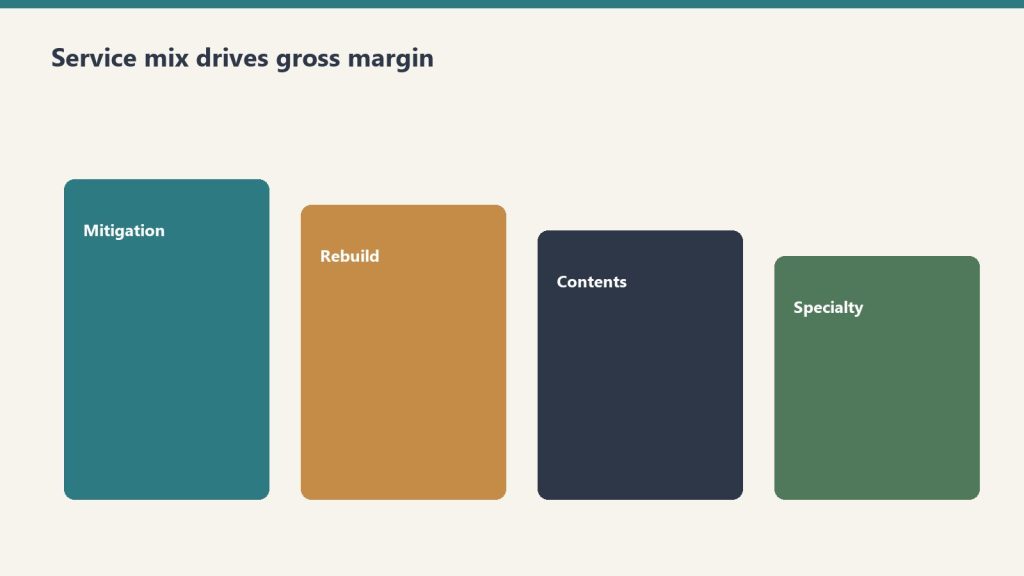
Direct answer: A restoration company’s profitability is determined more by service mix than by total revenue. Industry references consistently show water mitigation gross margins of 70-80%, mold remediation 40-50%, fire damage 25-30% with some references showing 20-25%, and reconstruction commonly cited around 10% with high-capacity volume shops achieving up to 50%. Two shops with the same $5 million revenue and the same operational competence can produce radically different profit dollars depending on whether the mix is mitigation-heavy or reconstruction-heavy. The well-run shop measures gross margin by line, prices each line to absorb appropriate overhead, and chooses mix deliberately rather than letting it drift based on whatever walks through the door.
The previous article in this cluster framed the AR cycle as the foundation discipline. This article frames service mix as the most important strategic decision an operator makes. The decisions are linked — the cycle problem is harder to solve in a reconstruction-heavy mix than in a mitigation-heavy mix, because reconstruction billing cycles are inherently longer and reconstruction margin is inherently thinner. An operator working on both at once will find that fixing service mix actually compounds the AR cycle improvements from the previous article.
The case for thinking carefully about mix starts with arithmetic. Consider two restoration companies, both running $5 million in annual revenue with identical overhead structures, identical labor costs, and identical operational discipline. Company A runs 60 percent water mitigation at 75 percent gross margin and 40 percent reconstruction at 15 percent gross margin. Company B runs 30 percent water mitigation at 75 percent gross margin and 70 percent reconstruction at 15 percent gross margin. Same revenue, same competence — different financial outcomes. Company A produces roughly $2.55 million in gross profit; Company B produces roughly $1.65 million. The mix decision alone costs Company B about $900,000 in gross profit, which after fixed overhead becomes a far larger gap in net profit. The two companies look similar from the street and from the customer-facing pitch. They are not similar businesses.
This is the conversation most restoration owner-operators do not have with themselves. They think of revenue as the goal and mix as whatever happens. They take the work that comes in. The discipline this article describes is to invert that — to treat mix as the deliberate choice and revenue as the consequence of mix multiplied by efficient execution.
What each service line actually pays
Mix shifts margin more than slogans do.
Industry references including Restoration Profits, Kiwi Cashflow’s restoration CFO commentary, the Cost of Doing Business Survey covered by Restoration & Remediation Magazine, and restoration franchise public materials produce a consistent directional picture of gross margin by service line. The numbers vary by region, geography, and company-specific factors, but the relative ordering is robust.
Water mitigation. Gross margin 70-80 percent. The highest-margin line in restoration. The economic engine: equipment does most of the work. Air movers, dehumidifiers, and air scrubbers run on 24-hour cycles with limited human attendance. Xactimate’s mitigation pricing rewards the equipment-heavy model. A typical mitigation job has labor cost around 15-20 percent of revenue, equipment rental or amortization around 5-10 percent, materials and consumables around 2-5 percent, leaving roughly 70-80 percent for overhead absorption and profit. The math works because equipment, once owned, has marginal cost approaching zero per additional job day. Industry coverage from Claims Delegates and others has explicitly described high-margin mitigation strategies as “$1,000 per hour” lines when Xactimate is used correctly.
Mold remediation. Gross margin 40-50 percent. Lower than water mitigation because the labor content is heavier and the protective cost (PPE, containment, disposal) is real. Mold work is also more documentation-intensive, more regulated, and often more disputed by carriers, all of which add cost without proportional revenue. Mitigation-style equipment (HEPA filtration, negative-air, dehumidification) supplements but does not replace skilled hand labor for source removal and structural cleaning. Mold is a real margin line for shops with the capability, but it is not the equipment-leveraged windfall that water mitigation can be.
Fire damage restoration. Gross margin 25-30 percent commonly cited; 20-25 percent in some references. The work is labor-intensive, slow, contents-heavy, and odor-and-soot-management-heavy. Fire jobs are larger and more complex than water jobs, requiring skilled project management and coordination layered on the technical work. The pricing in Xactimate supports the work but does not provide the equipment-leverage that water enjoys. Fire-damage restoration is good revenue at honest margin, but it does not produce the windfall margin that an underloaded mitigation crew can produce on the right water job.
Reconstruction. Gross margin 10-20 percent in typical operator references; up to 50 percent for high-volume operators per Cleanfax-published commentary on the most efficient operators. The wide range reflects two different business models. The standard model treats reconstruction as a service line layered onto the restoration relationship — the restoration company handles the rebuild because the customer is already in their hands, but margins are construction-industry margins (10-15 percent) plus general overhead absorption. The high-volume model treats reconstruction as a primary business with restoration relationships as the customer acquisition channel — these shops have invested in subcontractor management, project management depth, scheduling systems, and supplier relationships that allow them to run reconstruction at 30-50 percent gross margin through volume efficiency and subcontractor leverage. Most owner-operator restoration shops run reconstruction in the 10-20 percent range. A few have built the operational discipline to run it higher.
Contents cleanup. Gross margin around 50-65 percent for shops with capability. Per the same Cleanfax operator commentary, high-capacity contents shops achieve 65 percent gross margin on cleaning and around 50 percent on packouts when subcontractor pricing is doubled into invoiced cost. Contents work is real margin for shops that specialize, more variable for shops that treat it as ancillary to structure work. This line has the largest gap between specialist operators and generalist operators.
Specialty services. Gross margin variable but often strong on coordination revenue. As covered in the specialty restoration cluster, specialty work performed through a vetted subcontractor bench produces coordination revenue at high effective margin (the coordination fee is high-margin because the direct work cost is the specialist’s, not the restoration company’s). Specialty work performed in-house by the restoration company is rare and is its own business model.
Biohazard, trauma, and crime scene cleanup. Gross margin commonly cited 40-60 percent for trained operators with appropriate licenses. This is a smaller volume, higher-emotional-stakes line that pays at a premium because few operators are equipped or willing to do it. Operators who specialize here can run profitable practices at relatively low total revenue.
The overhead absorption problem
Pure gross margin numbers do not tell the full story because each service line absorbs a different proportional share of fixed overhead. A shop that runs at $5 million revenue with $1.5 million in fixed overhead (rent, salaried staff, fleet, equipment depreciation, insurance, software, marketing) has to allocate that overhead across the work it produces.
The well-run shop allocates overhead to service lines based on the share of resources each line consumes, not based on revenue share. A reconstruction job uses substantially more project-management time, more office support, more procurement effort, and more accounting time per revenue dollar than a water mitigation job. If overhead is allocated by revenue share, reconstruction looks more profitable than it actually is and mitigation looks less profitable than it actually is.
The accounting fix is service-line P&L with deliberately allocated overhead. The shop sets up its accounting to track direct cost (labor, materials, equipment, subs) by service line, then allocates fixed overhead using a cost-driver methodology — project-management time, billing time, office support time, fleet usage — that reflects actual consumption. The result is service-line contribution margin that shows what each line is actually earning after overhead absorption, not just what it earns before overhead.
Most restoration shops do not run this analysis. Most operators are surprised by the answer when they do. Reconstruction often emerges as a marginal contributor or actual loser after appropriate overhead allocation, even when its gross margin looks acceptable. Water mitigation often emerges as a much larger contributor than its revenue share suggests. The strategic implications follow from the analysis — and they are usually different from what the gut-feel running of the business produced.
How mix actually shifts in the day-to-day operation
Day-to-day mix shifts are decisions — not accidents.
Mix is not chosen in a strategy session. It shifts based on a series of small decisions made across the operation, often without anyone realizing they are shifting mix.
Marketing channels favor specific lines. Google Ads bids on emergency water keywords drive water mitigation calls. Roofer partnerships drive storm-damage reconstruction. Insurance preferred-vendor program leads come in line-mix patterns specific to each program. The marketing decisions made in the prior cluster (Marketing Stack on Tygart Media) directly shape mix.
Sales scripts favor specific lines. The way the call-taker scopes the conversation, the way the on-site rep frames the work, and the way the project manager presents options to the customer all subtly steer the work mix. A shop whose sales conversation centers on “let us handle everything” tends to capture more reconstruction. A shop whose sales conversation centers on “we are the mitigation specialist” tends to keep more focused mix.
Staffing tilts the mix. A shop that has hired heavily on reconstruction project managers will sell more reconstruction because that is what the team is configured to deliver. A shop with deep mitigation lead techs and a thin reconstruction PM bench will lean toward mitigation. The org structure and the work mix shape each other.
Carrier program enrollments drive specific line mixes. Some carrier programs are mitigation-heavy, others are reconstruction-heavy, others are biohazard-and-emergency-response-heavy. The shop’s program portfolio shapes its inbound mix more than most operators recognize.
Customer relationship behaviors drive mix. A shop that subcontracts reconstruction to trade partners on relationship terms (offering them the rebuild work in exchange for emergency referral flow) keeps mitigation margin while passing through reconstruction. A shop that holds reconstruction in-house captures both lines but absorbs both margin profiles.
Recognizing that mix is the cumulative result of these small decisions is the first step. Choosing to make those decisions deliberately is the second.
Strategic mix archetypes
Most well-run shops fall into one of four mix archetypes, each with its own logic and its own trade-offs.
Mitigation specialist. Mix heavily weighted toward water mitigation and mold remediation, with reconstruction passed through to trade partners or refused entirely. Highest gross margin profile of the four archetypes; smallest revenue per claim; highest claim volume requirement to hit a given revenue target. This model works well in metro markets with high water-loss frequency and a reliable network of reconstruction partners. The trade-off is that the specialist sees a smaller share of total restoration spend per claim — the rebuild work and the contents work go to others — and the customer relationship is shorter.
Full-service generalist. Mix balanced across mitigation, reconstruction, and contents. Most common archetype in mid-size independent shops. Captures the full claim economically but at blended margin that includes the lower reconstruction line. Works in most geographies. Trade-offs: requires operational depth across multiple service lines, requires management depth to run reconstruction at acceptable margin, and tends to produce lower overall gross margin than the specialist model.
Specialty commercial wedge. Mix weighted toward commercial accounts with specialty recovery components (documents, electronics, art, medical equipment) plus the general mitigation and reconstruction those accounts produce. The model described in the previous specialty restoration cluster. Higher revenue per relationship, higher complexity, higher operational bar. Trade-offs: longer sales cycles, regulatory and compliance overhead, and dependency on a smaller number of larger accounts.
High-volume reconstruction operator. Mix weighted toward reconstruction at scale, with mitigation as a feeder. Less common as a deliberate strategy but possible — these are the operators who have built reconstruction operational discipline equivalent to a homebuilder or commercial GC and who run reconstruction at 30-50 percent gross margin. The Cleanfax-cited high-capacity volume shops fall in this archetype. Trade-offs: requires substantial management investment in reconstruction operations, exposes the business to construction-cycle dynamics, and runs into the long-cycle AR problem from the prior article harder than the mitigation-led models.
The choice of archetype is not permanent. Many shops evolve from one to another as they grow, change ownership, or respond to market shifts. The point is to choose deliberately, build the operations to support the chosen archetype, and resist drift back to whatever-walks-through-the-door because that drift is what produces undisciplined service mix and the lower margins that follow.
Pricing each line to absorb appropriate overhead
The 10-and-10 myth — that restoration contractors should bill 10 percent overhead and 10 percent profit on top of direct costs as the standard markup — is one of the most damaging conventions in the industry. Industry coverage from Restoration & Remediation Magazine has covered this extensively under the “10 and 10 myth” framing. The math simply does not work. A shop with $5 million in revenue and $1.5 million in fixed overhead is running at 30 percent overhead, not 10 percent. Pricing at 10-and-10 means the shop is losing money on every job and making it up only when extreme volume covers the gap.
The disciplined alternative is to know the shop’s actual overhead rate as a percentage of direct cost and to price each service line with a markup that absorbs an appropriate share. For a shop with 30 percent overhead, the minimum markup over direct cost is roughly 50 percent (which produces gross margin around 33 percent — exactly the breakeven before profit). For acceptable profit, markup of 75-100 percent over direct cost is more common. The Xactimate price list, when used correctly, supports this markup level on most service lines. The shop’s price list and Xactimate practice should reflect the true overhead structure and the target profit margin, not industry conventions that are decades out of date.
The pricing decision differs by service line. Water mitigation can support high markup because the equipment-heavy model produces low direct cost, leaving room. Reconstruction is harder to mark up because direct cost is dominated by subcontractor and material cost, both of which are visible to customers and adjusters. The well-run shop applies different markup logic to different lines and matches its pricing to its actual cost structure rather than to a uniform convention.
For shops that are uncertain whether their pricing is right, the diagnostic is simple. Pull twelve months of P&L. Compute gross margin by line. Compute fixed overhead as a percentage of revenue. Compute net margin. If net margin is below 8-10 percent, pricing or mix is wrong. If gross margin on water mitigation is below 70 percent, Xactimate practice is the likely culprit. If gross margin on reconstruction is positive at any level, the shop is doing better than many; the question is whether the reconstruction is absorbing its appropriate share of overhead. The numbers reveal the problem; the operator’s job is to diagnose specifically and intervene at the right point.
What to refuse
What to refuse is a margin decision wearing a values jacket.
The hardest discipline in service mix is refusing work that does not fit. Most restoration owner-operators struggle with this because every job feels like revenue and revenue feels like progress. But work that runs below contribution margin (revenue minus direct cost minus appropriate overhead allocation) actually subtracts from the business — every dollar of bad-fit revenue requires the next dollar of good-fit revenue to make up the loss.
Specific patterns of work that the disciplined shop is willing to refuse:
Reconstruction at price points that require the shop to break its actual cost structure. Customers and adjusters who insist on 10-and-10 markup on reconstruction are asking the shop to lose money on the rebuild. The discipline is to either decline or to pass the rebuild to a trade partner who can do it at the contemplated price.
Out-of-area work that requires excessive mobilization. The labor and equipment cost of crews working far from base eats margin in ways the customer does not see. A shop with capacity issues during a CAT event can sometimes justify out-of-area work at higher pricing, but routine out-of-area work at standard pricing is usually a margin loser.
Carrier programs whose pricing structure does not fit the shop’s cost structure. Some preferred-vendor programs price meaningfully below market with the expectation of volume making up for unit margin. Whether this trade is worth taking is operator-specific, but the shop that signs into every program offered without doing the math is signing into structural losses.
Customer relationships that consume management time at scale. Some customers and adjusters require an hour of phone time and three documentation revisions for every invoice. The shop’s project management cost on these accounts often exceeds the gross profit. The discipline is to identify these accounts and either reset the relationship or end it.
Work the shop does not have the operational depth to deliver well. Taking a fire job when the shop has no fire-experienced lead tech, or a commercial loss when the shop has no commercial PM, is taking work the shop will execute poorly and damage its reputation on. The work feels like revenue; the reputation cost compounds against future revenue.
The operator who can decline bad-fit work calmly and confidently is operating from financial clarity. The operator who cannot is operating from fear that the next call may not come. The financial clarity is what comes from running this analysis and knowing the numbers cold.
How this article fits the cluster
Mix is the second foundation decision after AR cycle. With both in place, the rest of the cluster has solid ground to stand on. The next article — equipment economics — depends on understanding mix because equipment ROI is line-specific (water mitigation equipment has different utilization economics than reconstruction equipment). The crew structure and KPI dashboard articles that follow build on both foundation decisions.
If the prior article (AR cycle) is the highest-leverage operational improvement most restoration shops can make, this article (service-line mix) is the highest-leverage strategic improvement. They are different kinds of work — AR is a tactical, weekly operating discipline; mix is a quarterly and annual strategic discipline — but both produce outsized returns relative to the effort required.
Should I be running service-line P&L if my accounting system doesn’t support it natively?
Yes, with manual allocation if necessary. The first version can be a quarterly spreadsheet exercise — pull total revenue, total direct cost, and total overhead from the financial statements, then estimate the mix and the line-specific direct cost ratios. The numbers are imprecise but directionally accurate, and they will surface the strategic question even before the accounting system is reconfigured. Once you have decided that mix matters, invest in setting up the accounting to produce the analysis automatically.
Why is reconstruction so much harder to make money on?
Three structural reasons. First, the work is dominated by labor and materials, both of which are heavily benchmarked by competitors and carriers. Second, the cycle is long, so working capital cost is higher. Third, the customer can see the cost of the materials and the visible labor in ways they cannot for mitigation, which makes pricing pressure harder to absorb. The operators who run reconstruction at high margin have invested in subcontractor management, supplier relationships, and project-management efficiency that takes years to build.
Should an owner-operator pursue the high-volume reconstruction archetype?
Probably not as a starting strategy. The high-volume reconstruction model requires substantial management infrastructure that is expensive to build and difficult to maintain. Most owner-operators who try to evolve into this model end up with reconstruction-heavy mix at standard 10-15 percent margin rather than the 30-50 percent the well-built operators achieve. The honest assessment is that this archetype works for a small number of operators who have the construction-management capability, and most owner-operators are better served by mitigation specialist or full-service generalist archetypes.
What is a realistic mix to target if I want to maximize gross profit?
A mix-of-business analysis specific to your geography, capability, and capacity is needed for an actual answer. As a directional reference, mitigation specialists often run 60-75 percent mitigation and mold (combined), 15-25 percent contents and specialty, and 0-15 percent reconstruction (often passed through). Full-service generalists run 35-50 percent mitigation and mold, 15-20 percent contents and specialty, and 30-50 percent reconstruction. The right mix for a specific shop is a function of the local market, the shop’s operational depth, and the owner’s risk tolerance.
Does the specialty restoration wedge from the prior cluster fit into mix strategy?
Yes, directly. Specialty work is a high-coordination-margin add to the mix. The specialty cluster’s commercial-account focus produces relationships that generate mitigation, reconstruction, and specialty revenue together, and the specialty coordination component is high-margin in a way that lifts the blended profile. Operators who have built specialty capability typically see their mix shift toward more mitigation and specialty, less commodity reconstruction.
How often should I revisit the mix question?
At minimum, annually as part of business planning. More frequently if the shop is growing fast, going through ownership changes, expanding geography, or seeing significant changes in carrier program enrollments. A quarterly directional review is good discipline. Monthly is overkill. Weekly is panic.
What if I’m carrying lines I’m bad at because I haven’t done this analysis before?
The disciplined response is to either invest in becoming good at the line (hire, train, partner) or exit the line. Carrying lines you are bad at is carrying work that produces below-average margin and below-average customer experience. It is the worst of both worlds. The annual review process should produce these decisions explicitly.
Are biohazard, trauma scene, and unattended death cleanup really good margin work?
For shops with proper licensing and trained crews, yes. The pricing supports the work and the competitive density is low because most operators do not want the work. The trade-offs are emotional weight on the crew, careful customer-facing communication, and licensing and disposal compliance overhead. For shops with the right operational fit, this is a legitimate niche.
What’s the relationship between mix and consolidator interest in acquiring my shop?
Consolidators value mix-driven margin profile. A shop with disciplined mitigation-heavy mix at clean margin is a more attractive acquisition target than a shop with the same revenue but lower margin from undifferentiated reconstruction-heavy mix. The mix work this article describes is also exit-positioning work, and operators who run it well over a few years are positioning for a stronger acquisition outcome whether or not they intend to sell.
What is the single move I should make this week from this article?
Pull last quarter’s P&L, estimate revenue and direct cost by service line, compute the implied gross margin per line, and compare to the industry directional ranges in this article. If your mitigation gross margin is below 70 percent, your reconstruction gross margin is below 10 percent, or your overall mix is reconstruction-heavy without operational depth supporting it, the analysis has identified the largest profitability lever in your business. Treat the answer as the agenda for the next quarter.
Direct answer: A restoration company’s profit and loss statement and its bank account tell two different stories, and the gap between them is the AR cycle. Industry data references show construction-sector DSO averaging around 83 days — the highest of any major industry — and restoration claim cycles stretching well beyond 60-90 days are common. The well-run shop measures days sales outstanding by carrier, by service line, and by job size, builds working capital reserves sized to the actual aging profile rather than the optimistic version, and runs documentation discipline that removes the most common reasons adjusters delay payment. Compressing days-to-cash from 90+ down to a defensible 45-60 is worth more to most restoration companies than a 5-point margin improvement, because it directly funds growth without external capital.
The single most common silent killer of growing restoration companies is not bad work, bad marketing, or bad people. It is the gap between when the cash goes out and when the cash comes in. A restoration company growing at 30 percent per year is, by definition, funding 30 percent more labor, more equipment, more materials, and more subcontractor invoices than the previous year — out of working capital that has not yet been replenished by the carrier checks for last quarter’s work. The math compounds. Every additional dollar of revenue requires roughly the same proportional dollar of working capital. A growth rate that exceeds the working-capital cycle eventually exhausts the bank account, even while the P&L looks healthy and the owner cannot understand why payroll is suddenly hard to make.
The first move toward fixing this is recognizing that the AR cycle is not a back-office annoyance. It is the central operational metric of the restoration business model. Operators who understand and manage it correctly run growing companies without external capital. Operators who do not understand it either grow slower than their market opportunity allows or take on debt they do not need to take on. The well-run shop treats AR cycle as a strategic discipline.
This article is the first cluster piece in the finance and operations stack and is the one most operators should attack first. The rest of the cluster builds on the assumption that the AR cycle is under control. Without it, the other improvements in service mix, equipment economics, crew structure, and KPI hygiene cannot compound.
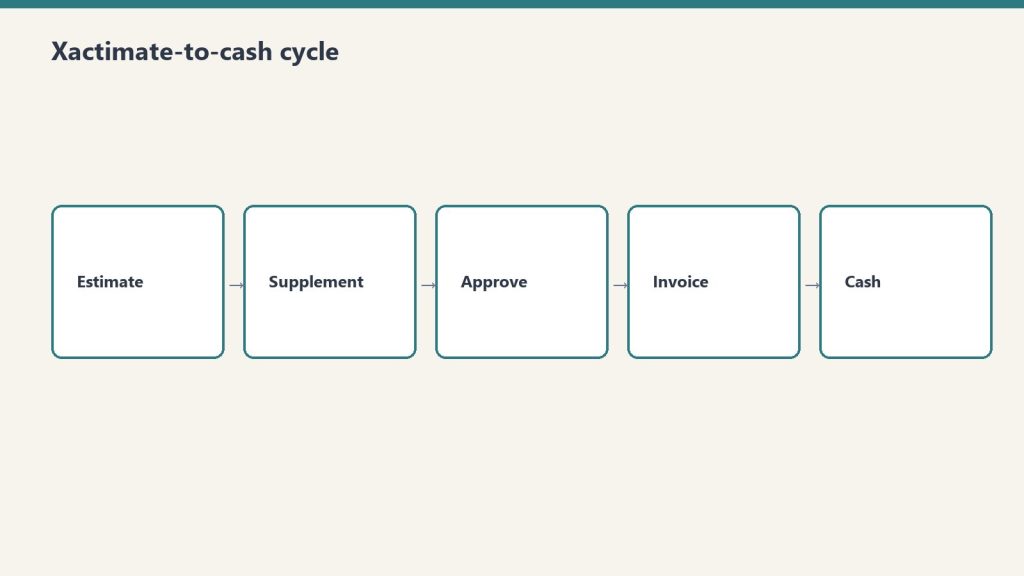
What the Xactimate-to-cash cycle actually looks like
What the Xactimate-to-cash cycle actually looks like.
The Xactimate-to-cash cycle has more steps than most operators map out. Each step is a place where days accumulate. The full sequence on a typical commercial or residential insurance claim:
Loss event and dispatch. Day zero. Restoration company arrives, performs emergency mitigation, begins documentation.
Mitigation completion. Days three to seven on a typical water loss. Drying complete, dry standards verified, mitigation invoice ready to assemble.
Mitigation invoice submission. Days seven to fourteen. Restoration company assembles the mitigation invoice — Xactimate estimate, photos, moisture logs, daily reports, work authorization, certificate of completion — and submits to the adjuster.
Adjuster review and approval. Days fourteen to thirty-five. Adjuster reviews the submission, may request additional documentation, may negotiate scope or pricing, eventually approves the invoice in whole or in part. Independent industry references from restoration billing services note that documentation gaps are the most common reason adjusters extend this window — missing photos, incomplete moisture logs, inconsistent line items, or scope items that cannot be supported by the documentation.
Carrier payment processing. Days thirty-five to sixty. Carrier processes the approved invoice and issues payment. For claims involving a mortgaged residential property, the check is typically made out jointly to the policyholder and the contractor, which means the homeowner has to endorse and forward, and lender involvement is required for claims above a threshold (commonly $10,000-$15,000) where mortgage companies release funds in stages.
Reconstruction or repair phase. Begins after mitigation phase. The reconstruction scope is developed, approved, and executed. The cycle for reconstruction billing repeats — invoice assembly, adjuster review, carrier processing — but on a longer cycle because reconstruction work itself takes longer.
Final invoice and closing. Days ninety to one-hundred-eighty for a fully reconstructed loss. Final scope reconciliation, depreciation holdback recovery on RCV claims, retainage release if applicable.
The aggregated cycle on a typical mid-size residential or commercial loss runs sixty to one-hundred-twenty days from loss to full payment. On larger commercial losses with multiple phases, scope disputes, or coverage issues, it stretches to one-hundred-eighty days or more. On problematic claims with denied items, public adjuster involvement, or litigation, it can stretch into multi-year territory.
For working-capital math, the simple version is that every dollar of revenue requires roughly the proportional dollars of cash held in AR for the average cycle length. A shop with $10 million in annual revenue and a 90-day cash cycle is carrying roughly $2.5 million in average AR — and that AR is funding the labor, equipment, materials, and subcontractor cost the shop is incurring on the next set of jobs. Compress the cycle to 60 days and the shop’s working-capital requirement drops to roughly $1.65 million, freeing $850,000 in cash for growth, debt reduction, equipment investment, or distribution. Compress further to 45 days and the freed cash hits $1.25 million. These are real, recoverable numbers, and they show up in the bank account, not just on the spreadsheet.
Why DSO is the wrong single metric and the right multi-metric
Most restoration companies that measure AR at all measure a single overall DSO number, calculated as accounts receivable divided by total revenue, multiplied by the number of days in the period. This is the standard cross-industry calculation and it produces a useful directional read — but on its own it is not actionable, because the underlying AR is not homogenous. The well-run shop measures DSO three ways simultaneously.
DSO by carrier. The DSO with State Farm is different from the DSO with USAA, which is different from the DSO with Allstate, which is different from the DSO with the local independent commercial carriers. Some carriers pay reliably in 30-45 days; some stretch to 60-90; some stretch beyond 90 routinely. The shop that knows its DSO by carrier can make rational decisions — which programs to lean into, which to pull back from, which to limit exposure on. The shop that knows only its blended DSO is making aggregate decisions on heterogeneous data.
DSO by service line. Mitigation invoices typically pay faster than reconstruction invoices because they are smaller, simpler, and structured to industry-standard mitigation Xactimate line items. Reconstruction invoices pay slower because they involve more scope negotiation and more adjuster review. Specialty work — documents, electronics, art, medical — pays in patterns that depend on the carrier’s familiarity with the specialty pricing and on whether the specialist bills direct or through the prime restoration company. A shop that knows DSO by service line can spot whether the cycle problem lives in mitigation, reconstruction, or specialty.
DSO by job size. Small jobs (under a few thousand dollars) often pay quickly because adjusters approve them with minimal review. Mid-size jobs ($10,000-$50,000) often hit the worst of both worlds — large enough to require full documentation review, small enough to lack the executive attention that moves large losses through the system. Large jobs (over $100,000) often have dedicated adjuster attention, large-loss specialists involved, and faster decision-making once scope is settled, although the cycle from loss to first payment can still be long. A shop that knows DSO by job size can identify the band where the cycle is most painful and target documentation and follow-up effort there.
The combined picture — DSO by carrier, by service line, by job size — is what produces actionable management information. Most restoration companies do not produce this view because their accounting systems are not configured to slice AR this way and their internal reporting effort has been on top-line metrics. Configuring the accounting system to support this slicing is a one-time investment that pays back almost immediately.
What is causing the long cycle, and which causes are operator-controllable
Operator-controllable causes of a long cycle.
The long restoration cycle has multiple causes, and the operator’s intervention point is different for each.
Documentation gaps. Operator-controllable, high impact. Industry references from restoration billing services consistently identify documentation as the single largest cause of payment delays. An invoice missing photos, moisture logs, daily reports, signed work authorizations, or scope justification gives the adjuster a defensible reason to delay payment with a request for more information. Each round trip costs five to fourteen days. A shop that submits complete, clean, defensible documentation on the first submission collects faster than a shop that submits incomplete documentation and chases revisions.
Xactimate scope quality. Operator-controllable, high impact. An Xactimate estimate that uses incorrect line items, that prices outside the standard price list without justification, or that includes scope items not supported by the documentation will be reduced or returned. Real Xactimate proficiency — Level 1 certification at minimum, Level 2 ideal, in-house or contracted — pays for itself on the first half-dozen invoices. Operators who use Xactimate as a glorified word processor without understanding the underlying line-item logic submit estimates that produce avoidable disputes.
Carrier program structure. Partially operator-controllable. Different carrier preferred-vendor programs have different documentation requirements, different review cycles, and different payment-processing timelines. Some require submission through specific portals (Verisk’s claims platforms, Symbility, carrier-specific systems) that produce faster cycles than email-based submission. Some require pre-approval at scope thresholds. The operator’s intervention point is to learn the program’s specifications cold and submit to specification, and to selectively de-prioritize programs whose cycle structure does not work for the shop’s working-capital tolerance.
Mortgage company involvement. Limited operator-controllability. On residential losses where the property is mortgaged, the lender’s check-handling protocol adds a cycle layer the contractor cannot eliminate. The intervention is to communicate the lender process to the homeowner early, provide the documentation the lender will require (final invoices, work completion certificates, lien waivers) ahead of need, and follow up actively rather than passively waiting.
Public adjuster involvement. Mixed operator-controllability. When a PA is on the file, scope is scrutinized harder and disputes take longer. The contractor’s intervention is to maintain documentation discipline strict enough to survive PA scrutiny, communicate professionally with the PA on scope questions, and avoid behaviors that escalate the file unnecessarily.
Coverage disputes. Limited operator-controllability. When the carrier disputes coverage on items the contractor has performed, the cycle stretches indefinitely. The intervention is upfront — confirming coverage on questionable items before performing the work, getting written authorization on scope expansions, and avoiding work the policy clearly does not cover.
Litigation. Not operator-controllable except by avoidance. Once a claim is in litigation, the cycle is governed by the legal process rather than the claims process. The contractor’s defense is to not get into litigation in the first place, which means honest scope, complete documentation, professional communication, and a willingness to walk away from disputes that are not worth litigating.
The pattern in this list: the highest-impact causes are operator-controllable. Documentation discipline and Xactimate scope quality are the two largest levers, and they are entirely within the shop’s control. Operators who blame the long cycle on the carriers without first auditing their own documentation and Xactimate practice are diagnosing the wrong problem.
The operational moves that compress the cycle
Operational moves that compress the AR cycle.
The well-run shop runs a specific set of operational practices that compress the AR cycle. These are not novel and they are not glamorous. They are the practices that produce the difference between a 90-day cycle and a 45-60 day cycle.
Document at the job level, in real time. Not at invoice time. Photos taken on day one, moisture logs updated daily, daily reports completed by the lead tech before leaving site, scope-of-loss documented progressively as the work develops. Documentation assembled at invoice time is documentation that has gaps. Documentation assembled in real time is documentation that is complete on day seven when the mitigation invoice is ready to go out.
Use a documentation platform. Several industry-standard platforms — including CompanyCam for photos, MICA and ENCIRCLE for full documentation packages, and proprietary platforms from larger carriers’ preferred-vendor programs — automate documentation capture. Operators using these platforms submit cleaner invoices and submit them faster than operators relying on phone photos and paper logs.
Build the Xactimate estimate as the work progresses, not after. The mitigation Xactimate estimate should be largely written by the time the drying is finished. The reconstruction Xactimate estimate should be developed during the mitigation phase, not after the customer authorizes the rebuild. Operators who treat Xactimate as a billing-time activity add days to the cycle that the operators who treat it as a project-execution activity do not.
Submit the invoice on a schedule. The shop’s standard should be invoice within seven days of mitigation completion, with no exceptions for shop-side delays. Customers and adjusters pay invoices that arrive promptly faster than they pay invoices that arrive late, partly because the file is fresh and partly because prompt invoicing signals professional operations.
Follow up on a schedule. Adjuster contact at day fourteen post-submission if not approved, day twenty-one with escalation request, day thirty with escalation to the carrier’s claims service line. Adjusters have hundreds of files. The files that get attention are the ones the contractor stays present on. The files that drift are the ones where the contractor submits and waits silently.
Reconcile cash to invoices weekly, not monthly. The accounting team should know which invoices are open, by carrier and by adjuster, every week. Stale aging that is not reviewed is aging that gets older. Weekly review with explicit follow-up assignments produces faster collections than monthly review.
Use a billing service when in-house capacity does not exist. Restoration-industry-specific billing services — companies like Restoration Insurance Billing, Blackwater Billing Services, NetClaimsNow, and others — exist specifically to handle Xactimate invoice assembly, submission, and follow-up. For shops that do not have in-house Xactimate competence or in-house collections discipline, outsourcing this function to a specialist often produces a faster cycle than handling it in-house at the shop’s current capability level. The fee is paid out of the cash-cycle compression.
Working capital strategy
Compressing the AR cycle reduces but does not eliminate working capital intensity. Even at a defensible 45-60 day cycle, a growing restoration company carries substantial cash in receivables. The well-run shop has a deliberate working capital strategy that funds this intensity without surprises.
Cash reserve sized to the actual aging profile. A shop with a 60-day cycle should carry cash reserves sufficient to operate for at least 60 days at current burn rate, plus a buffer for delayed collections on specific files. Many operators size reserves to 30 days of operating cost, which is too thin for restoration’s cycle. Sizing reserves to 75-90 days of operating cost, with a clear policy on when reserves can be drawn down for growth investment versus when they must be held, gives the shop room to absorb a slow collection month without payroll stress.
Line of credit as a flex tool, not a permanent funding source. Most growing restoration shops should have a working-capital line of credit with a commercial bank, sized to cover one to two months of operating cost. The line is a tool for absorbing month-to-month variation in collections, not a tool for funding ongoing operations. Shops that operate continuously on the line of credit are shops with a structural cash problem they have papered over with debt.
Customer financing as a deliberate tool. On residential reconstruction work where insurance does not cover the full scope, customer financing can be offered through restoration-industry-specific finance partners or general home-improvement finance platforms. This converts a payment-cycle question into a marketing question and shifts the cycle off the shop’s balance sheet.
Avoid AOB-driven cash flow models. Some restoration companies build their cash flow on aggressive use of assignments of benefits, where the carrier pays the contractor directly. AOBs solve the homeowner-endorsement step but do not address the underlying claim cycle, and several states have passed AOB reform that complicates or restricts the practice. Building working capital strategy around AOBs is fragile both legally and operationally.
Factoring as last resort, not first option. Specialty receivables-factoring firms exist that will advance against restoration AR, but the cost is meaningful (often 2-4 percent per month effective rate) and using factoring routinely indicates that the underlying cycle problem has not been fixed. Use factoring only as a bridge while implementing the operational improvements that compress the cycle, not as a permanent solution.
What the AR cycle reveals about the rest of the business
The AR cycle is a diagnostic tool as much as it is an operational metric. Specific patterns in the AR aging report point to specific underlying issues elsewhere in the operation.
Long cycle on a specific carrier. The carrier’s program structure may not fit the shop’s working-capital tolerance, or the shop’s documentation may not fit the carrier’s submission requirements. Either way, this is a focused intervention point.
Long cycle on a specific service line. The Xactimate competence in that service line may be weaker, or the documentation discipline may be looser. Investigate the lead tech and project manager on that service line and compare practice to the better-performing service lines.
Long cycle on a specific job size. Process gaps in the size band — possibly insufficient project-management attention on mid-size jobs or insufficient documentation rigor on small jobs that get treated casually. Address process at the size band rather than the job level.
Long cycle on jobs led by a specific project manager. The PM’s documentation, communication, or follow-up practice may be substandard. Coachable, often quickly.
Spike in cycle in a specific month. Look for upstream issues — was a billing person out, did a software change disrupt invoice generation, did a regulatory change affect a common scope item, did a carrier change its program. The cycle is the downstream symptom of upstream operations.
The shop that uses AR aging as a diagnostic produces continuous improvement. The shop that uses AR aging only as a financial-statement input misses most of the management information the metric carries.
How this article fits the cluster
The AR cycle is the foundation. The next article in the cluster — gross margin by service line — depends on the AR cycle being defensible, because service-line economics that look good on margin but fail on cash conversion are not actually good economics. The articles that follow on equipment economics, crew structure, KPI dashboards, and the rest all assume the operator has working capital under control. An operator who works through the rest of the cluster without first fixing the AR cycle is building on sand.
If you take only one operational improvement from this entire cluster, take this one. The investment is modest — documentation discipline, Xactimate competence, scheduled follow-up, weekly cash review. The return is direct, measurable, and recurring. Compressing days-to-cash from 90 to 60 frees roughly two months of revenue in working capital. For a $5 million shop, that is roughly $830,000 in cash. For a $20 million shop, it is roughly $3.3 million. Those are not theoretical numbers. They are sitting in your AR right now.
What is a realistic DSO target for a restoration company?
For mitigation-heavy work with disciplined operations, 45-60 days is achievable. For mixed mitigation and reconstruction work, 60-75 days is realistic. For reconstruction-heavy work, 75-90 days is realistic. Operators running 90+ days have specific operational issues that should be diagnosable from the by-carrier, by-service-line, by-job-size view. Targeting under 30 days is unrealistic in this industry; targeting under 45 is achievable on the mitigation side but not the reconstruction side.
Should I use a restoration-specific billing service or build in-house?
Depends on shop size and current capability. Shops under $3 million with no in-house Xactimate-certified estimator typically benefit from a billing service — the cost is roughly offset by the cycle compression. Shops over $5 million should generally have in-house capability because the service fees become a real expense at scale and because in-house ownership of the cycle produces better discipline. Shops in between can go either way; the deciding factor is whether in-house capacity is genuinely competent or whether it is the owner-operator’s spouse doing it on weekends.
How do I get my AR aging by carrier, service line, and job size if my accounting system doesn’t slice it that way?
This is a one-time configuration project. Most accounting systems used by restoration companies (QuickBooks Online, QuickBooks Enterprise, Sage Intacct, NetSuite, restoration-specific platforms like Albi, KnowHow, and others) support custom fields or class tracking that can produce this slicing. The configuration takes a few days of accountant time and pays back permanently. If your current system genuinely cannot support this, the system is the bottleneck.
What about retainage on commercial work?
Commercial reconstruction often involves retainage (commonly 5-10 percent held until project completion) which extends the cycle on the retained portion well beyond the standard cycle. Build retainage into the AR aging view as a separate category so the operating cycle on the non-retained portion is visible cleanly. Retainage release is its own follow-up activity that should be treated as a managed process, not as something that happens automatically.
What if a specific carrier program is producing a long cycle but represents a meaningful portion of revenue?
This is a strategic decision, not just an operational one. The cycle math is real — if a carrier program produces revenue at acceptable margin but stretches AR by an extra 30 days, that’s a working-capital cost that the program revenue should justify. Quantify the cost (roughly the additional AR carried at the cost of capital), compare to the program’s contribution to gross profit, and decide whether the program is net positive on cash-adjusted economics. Many operators discover that programs they thought were valuable are actually drag once the cycle cost is accounted for.
How do I handle homeowners who do not endorse the joint check from the mortgage company?
This is a customer-service issue layered on a cash-cycle issue. Communicate the joint-check process to the homeowner before the loss is even mitigated, get them comfortable with the workflow, and follow up actively when the check is issued. Most customers cooperate; the few who do not usually have a deeper issue (dispute over scope, dispute over quality, financial distress) that needs to be addressed directly. Avoid letting these accounts age silently.
Is a line of credit absolutely necessary, or can a shop run without one?
Smaller shops under $1-2 million can sometimes run without one if reserves are healthy and growth is moderate. Shops over $3 million typically benefit from having one even if it sits unused most months — the optionality is worth the modest commitment fee. The decision is risk tolerance: a line of credit is insurance against a slow collection month, and like all insurance, it is most valuable when not needed.
How do I know if my Xactimate practice is the bottleneck?
Pull your most recent ten mitigation invoices and ten reconstruction invoices. For each, document the date submitted, the date approved, and any back-and-forth requests from the adjuster. If more than 30 percent of submissions trigger requests for revisions, your Xactimate practice has gaps. The specific gaps will be visible in the revision requests — line items used incorrectly, pricing outside standard with insufficient justification, scope items unsupported by documentation. Address those gaps directly, and the cycle compresses.
Can compressing the AR cycle actually replace the need for outside capital on a growing shop?
For most shops in the $1-30 million range, yes. The math works because each dollar of cycle compression frees a proportional dollar of working capital, and that capital recurs every cycle. Compressing cycle from 90 to 60 days on a $10 million shop frees roughly $830,000 in cash; on a $20 million shop, roughly $1.7 million. Those numbers fund meaningful growth without any external capital. Operators with cleaner AR cycles typically do not borrow for working capital because they do not need to.
What is the single most important practice I can install this week?
Daily documentation by the lead tech on every job, completed before the tech leaves site. Photos of pre-mitigation and post-mitigation conditions, moisture readings logged with timestamps, daily report covering work performed and conditions encountered, signed work authorization on file from day one. This single practice will compress your invoice submission time and reduce documentation-driven adjuster delays by more than any other change. Everything else in this article matters; this is where to start.
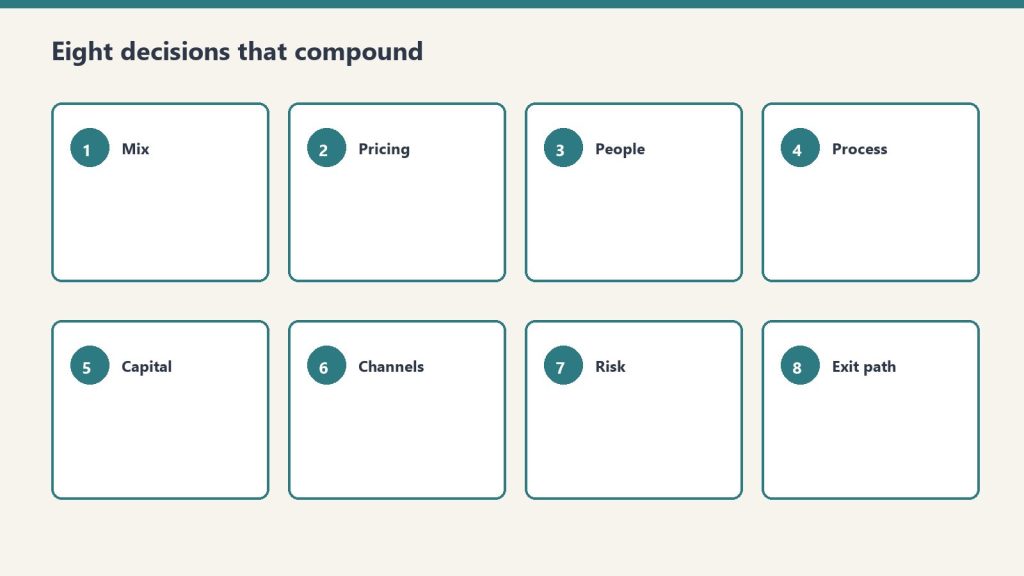
Direct answer: A restoration company is not just a service company. It is a working-capital-intensive, claims-cycle-dependent, equipment-rich, labor-leveraged business where gross margin varies from 70 percent on water mitigation to 10 percent on reconstruction, where net margin compresses as revenue grows, and where the gap between the average operator and the well-run operator is several multiples of profitability. The discipline that separates the two is not heroic effort; it is financial and operational rigor applied consistently to a small set of decisions about service mix, AR cycle, equipment leverage, crew structure, KPI hygiene, carrier-program exposure, multi-location structure, and exit posture. This pillar introduces those eight decisions and frames the cluster that explores each one in depth.
The restoration industry sits in a strange place. Industry analysts cite a market range from $7.1 billion to $80 billion in U.S. revenue, depending on how the boundary is drawn — water mitigation only, all property restoration, all property and remediation including mold and biohazard, or the full disaster-recovery economy including reconstruction and contents. The Restoration Industry Association and Restoration & Remediation Magazine have referenced the wider range publicly, and the consensus growth rate sits at 4-6 percent CAGR. Within that aggregate market, the operator-level reality is that the industry is fragmented — thousands of independent shops in the $1M to $30M range, several hundred regional operators in the $30M to $200M range, and a small set of national consolidators with revenue over $200M. The fragmentation is the opportunity. It is also the trap.
The opportunity is that no national brand has captured commodity property restoration the way ServiceMaster did in dry cleaning or Home Depot did in retail. Independent operators with discipline can build $5M to $50M businesses with strong margins and durable client relationships. The trap is that fragmentation lets bad businesses survive longer than they should. A restoration company can run for a decade with sloppy AR, undisciplined service mix, and informal operations and still pay the owner well in good years — until a CAT-event swing, a carrier-program change, or a key-employee departure exposes the underlying weakness and the business loses years of compounding to the cleanup. The well-run shop avoids this not by being smarter on the day of the event but by having installed financial and operational discipline before the event ever arrived.
This article is the pillar for the cluster that follows. The cluster covers eight specific decisions where finance and operations rigor moves the needle the most: AR aging and the Xactimate-to-cash cycle, gross margin by service line, equipment economics, crew structure and labor cost, KPI dashboards, preferred-vendor program economics, multi-location growth, and M&A and exit dynamics. This pillar walks through each at altitude so an owner-operator can see how they connect before deciding which to attack first.
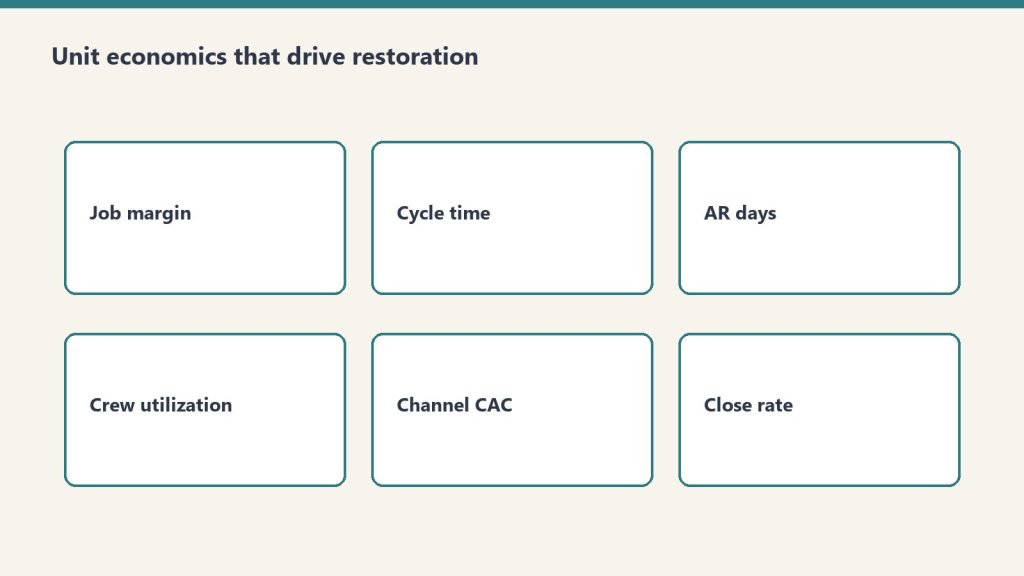
The unit economics that actually drive a restoration company
Unit economics that actually drive a restoration company.
The restoration industry’s unit economics are unusual in three specific ways that operators frequently miss until they are scaling and the math stops working.
Service-line gross margin is wildly different by line. Water mitigation typically runs 70-80 percent gross margin because equipment does most of the work — air movers and dehumidifiers run on 24-hour cycles with limited human labor — and the Xactimate price list rewards this with strong unit pricing. Mold remediation runs 40-50 percent gross margin because the labor content is heavier and the protective and disposal cost is real. Fire damage restoration runs 25-30 percent gross margin because the work is labor-intensive, slow, and contents-heavy. Reconstruction runs around 10 percent gross margin because it is a construction business with construction margins layered on top of the restoration relationship.
That spread — 70 percent on the front of the loss to 10 percent on the back — means that two restoration companies with the same revenue can have radically different profitability depending on the mix. A $5 million shop with 60 percent water and mold and 40 percent reconstruction makes meaningfully more money than a $5 million shop with 30 percent water and mold and 70 percent reconstruction, even if both are running competent operations. Mix is the single most important financial decision an operator makes, and it is rarely an explicit decision — it tends to drift based on what comes through the door. Treating mix as a deliberate strategic choice is the first move a finance-aware operator makes.
Net margin compresses as revenue grows. Independent industry references — including operator surveys cited by Restoration & Remediation Magazine and analysis from restoration-industry CFO advisors like Kiwi Cashflow — show that smaller restoration shops under $1M revenue can sustain gross margins near 70 percent, while shops over $50M typically run net margins in the 6 percent range and shops in the $30-50M band typically run net margins around 15 percent. The shape of the curve is consistent across multiple sources: the smaller the shop, the higher the gross margin and the more variable the net margin; the larger the shop, the more compressed the gross margin and the more stable but lower the net margin.
Why? Three structural reasons. First, smaller shops do less reconstruction proportionally — they pass it off — which keeps gross margin high. Second, smaller shops carry less overhead because the owner is doing the management work; larger shops require professional management layers that show up in SG&A. Third, larger shops carry more carrier-program exposure, which compresses pricing through preferred-vendor program rate negotiation. The implication for an operator is that the path to higher absolute dollars is real but does not produce proportional margin gains, and the operator who thinks scale will solve a margin problem is usually wrong.
Working capital intensity is brutal. Restoration is a cash-out, cash-in-much-later business. The work is performed in days or weeks; the cash is collected in months. The operator advances labor cost, equipment depreciation, materials, and subcontractor payments out of pocket and waits for the carrier to settle the claim. AR aging in the 60-120 day range is normal in commercial work and not unusual in residential work either. A shop growing 30 percent year over year is funding that growth with working capital — and a shop that grows faster than its working capital cycle can support runs out of cash even while showing strong P&L performance. This is the most common silent killer of growing restoration companies, and it is the subject of the first article in the cluster that follows.
The eight decisions that separate compounders from plateaued operators
Eight decisions that separate compounders from plateaued operators.
The cluster that follows takes each of these decisions in depth. Here is the at-altitude framing of each so the operator can see the system before drilling into the parts.
AR aging and the Xactimate-to-cash cycle. The well-run shop measures Days Sales Outstanding by carrier, by service line, and by job size. It identifies the carrier programs whose AR cycle is acceptable and the ones that are not. It chooses to take or decline work based on cash-cycle math, not just margin math. It builds a working-capital reserve sized to the actual AR aging profile rather than the optimistic version. It treats AR as a strategic asset rather than a back-office annoyance.
Gross margin by service line. The well-run shop knows its gross margin to within a few points on each service line and uses that knowledge to manage mix deliberately. It chooses which service lines to lead with, which to accept opportunistically, and which to refuse — and it makes those choices based on the gross margin profile and the overhead-absorption requirements of each line, not on which work happens to come through the phone today.
Equipment economics. The well-run shop runs an equipment economic model that distinguishes between owning, leasing, and renting. It tracks equipment utilization, depreciation, and reinvestment cadence. It avoids both under-investment (forcing crews to wait for equipment that should already be on hand) and over-investment (carrying equipment that sits idle and burns capital). It treats the equipment fleet as a financial asset whose ROI is measurable rather than as a vague necessary cost.
Crew structure and labor cost. The well-run shop has a deliberate org structure that includes lead-tech tracks, supervisor tracks, and project-management tracks with explicit progression criteria, compensation bands, and productivity targets. It measures revenue per technician hour by service line. It manages labor as the largest controllable cost and treats hiring, training, and retention as strategic activities rather than reactive ones.
KPI dashboards. The well-run shop runs on a dashboard that includes job-level revenue, gross margin, AR aging, equipment utilization, labor productivity, customer acquisition cost by source, retention by source, and the small set of operational metrics that drive financial outcomes. The dashboard is simple, current, and reviewed weekly. It is the difference between an operator who is reacting to last quarter’s numbers and an operator who is steering against this week’s.
Preferred-vendor program economics. The well-run shop knows the true economics of each carrier preferred-vendor program — the rate concessions, the volume commitments, the documentation overhead, the AR cycle, and the program’s strategic risk. It distinguishes programs that produce profitable revenue from programs that produce activity at margin levels that do not justify the operational overhead. It uses preferred-vendor work as one channel among several rather than as the foundation of the business, because the operator who is dependent on a single carrier’s program is one underwriting decision away from a revenue cliff.
Multi-location growth. The well-run shop knows that the second location is structurally different from the first, the fifth is structurally different from the second, and the model that worked at $5 million breaks at $15 million and again at $50 million. It scales deliberately by building management depth ahead of revenue growth, by standardizing operations and financial reporting before geographic expansion, and by recognizing that multi-location restoration is a different business — a portfolio of operating businesses rather than a single business with multiple offices.
M&A and the consolidator landscape. The well-run shop understands the consolidator landscape — the strategic acquirers including BluSky (Partners Group and Kohlberg), ATI Restoration (TSG Consumer Partners), BMS CAT (AEA Investors), BELFOR, First Onsite, ServiceMaster Restore, Paul Davis, PuroClean, DKI, and the broader set of more than fifty private-equity platforms that have entered restoration since 2018 — and the deal mechanics that drive valuations. It positions early so that when an exit makes sense, the company is sellable at a premium. Or it positions to acquire small competitors itself. Or it makes the deliberate choice to remain independent, with a clear understanding of what that choice means for the owner’s long-term wealth.
These eight decisions are not equally important to every operator at every stage. An operator at $2 million revenue should focus on AR cycle, service mix, and labor cost — KPI dashboards and M&A are premature. An operator at $30 million revenue should focus on multi-location structure, preferred-vendor program economics, and exit positioning — basic AR discipline should already be in place. The cluster takes each decision in turn and explains the moves that matter most at each stage.
What this pillar is not
This pillar is not a financial-modeling primer. There are good resources for that — restoration-industry CFOs like Kiwi Cashflow publish accessible content for operators, and broader trade publications like Restoration & Remediation Magazine and Cleanfax run regular benchmarking surveys. The cluster references these where useful and does not duplicate them.
This pillar is not a substitute for working with a CPA who understands the restoration industry. The tax structure of a restoration company — the choice of S-corp vs. C-corp, the equipment depreciation strategy, the inventory accounting for materials, the treatment of subcontractor versus W-2 labor — is jurisdiction-specific and operator-specific. An operator running a finance and operations discipline without a real CPA relationship is missing the most important piece of the system. Find one early.
This pillar is not financial advice for any individual company. The numbers cited in the cluster are industry references, not specific recommendations. Every operator’s economics differ based on geography, mix, scale, carrier exposure, and dozens of other variables. Use the cluster as a framework to think with, not as a template to copy from.
How to read the cluster
Read the cluster with the van in mind — field reality first.
The cluster of eight articles that follows can be read in sequence — and there is some logic to reading it that way, since AR cycle and service-line economics are the foundation that the later articles build on. But it can also be read selectively. An operator who already has clean AR discipline can skip article one. An operator at $3 million revenue can skip the multi-location and M&A articles for now. An operator who is exit-curious can skip directly to the M&A piece and work backwards from there.
The articles share a structural pattern. Each opens with the operator-level question the article answers. Each names the specific moves the well-run shop makes on the question. Each acknowledges where the answer is genuinely operator-specific and where the answer is industry-generalizable. Each ends with what to read next inside this cluster and what to read elsewhere on Tygart Media.
The cluster is meant to function as the operator’s reference library on the financial and operational side of running a restoration company — the way the Marketing Stack cluster functions as the reference library on the demand side, and the way the Specialty Restoration cluster functions as the reference library on commercial wedge strategy. Together those three clusters cover the major operating axes of the restoration business: how you get work, how you do high-margin commercial work, and how you run the company you have built.
Where the consolidator industry is going
A note on the broader industry context that frames the entire cluster, and especially the M&A article at the end. The restoration industry is in the middle of a consolidation cycle. As referenced by Cleanfax in operator coverage, approximately three brands operate above the $2 billion revenue threshold today, and industry leaders predict that by 2030 the count of $2 billion-plus brands will roughly double. Private equity has been active in the space for several years; industry M&A coverage from sources like The Deal Sheet and Hyde Park Capital identifies more than fifty PE platforms acquiring restoration operators since 2018, with deals at platform-level transacting in the 4x-7x EBITDA range and smaller-company deals transacting in the 3-4x range. The strategic acquirers — BluSky, ATI, BELFOR, BMS CAT, First Onsite, ServiceMaster Restore, Paul Davis, PuroClean, DKI — are buyers across multiple deal sizes. Carrier preferred-vendor programs reward national footprints, which structurally favors the consolidators. Insurance program economics increasingly require the documentation, technology, and reporting capabilities that smaller shops struggle to maintain.
For owner-operators, this trajectory matters in two ways. First, it raises the value of independent shops that have built defensible operations — clean financial reporting, defensible service-mix discipline, durable customer relationships that are not dependent on a single carrier program, professional management depth — because these are the targets the consolidators want to buy. Second, it raises the difficulty of staying independent in a commodity-restoration market position, because the consolidators have scale advantages on carrier-program economics, technology, and back-office cost. The defensible independent posture is to specialize, professionalize, and build differentiated capability — the specialty wedge from the prior cluster, plus the operational discipline this cluster discusses.
The owner-operator who reads this cluster should be doing so with a clear strategic intent. Either build to scale, build to exit, or build to remain durably independent in a defensible niche. All three are legitimate. None of them happen by accident, and all of them require the financial and operational discipline this cluster describes.
What does this cluster cover that the marketing stack and partner industries clusters do not?
The marketing stack covers demand generation — how a restoration company gets work in the door. The partner industries cluster covers referral relationships — how a restoration company gets work from adjacent service providers. The specialty restoration cluster covers the commercial-account wedge. This cluster covers what happens after work comes in: how the company is financed, how its operations are structured, how its profitability is managed, and how the owner positions the business for long-term value creation. All four clusters are needed to run a complete restoration business.
What revenue range is this cluster aimed at?
Primarily $2 million to $30 million in annual revenue — the owner-operator independent segment. The articles acknowledge what changes above $30 million and at $50-million-plus scale, particularly in the multi-location and M&A pieces, but the core advice is calibrated to operators who own the business they are running.
Why are the gross margin numbers cited so different from what I see in my own books?
Because every operator’s mix, geography, labor structure, and equipment posture is different. The numbers cited — water 70-80 percent, mold 40-50 percent, fire 25-30 percent, reconstruction around 10 percent — are industry directional ranges from public benchmarks and CFO commentary, not specific predictions for any individual company. Use them as a sanity check on your own numbers. If your water mitigation gross margin is 50 percent, that is a real signal worth investigating — likely a labor-cost issue, an Xactimate pricing issue, or an overhead-allocation issue. If your reconstruction margin is 25 percent, that is also a real signal worth investigating — likely a scoping or labor-attribution issue. The benchmarks are the start of a conversation, not the end of one.
Should I be running this cluster’s discipline before pursuing the specialty wedge from the prior cluster?
Yes, in most cases. The specialty wedge is a growth strategy for commercial accounts. The financial and operational discipline in this cluster is the foundation that lets a restoration company actually capture and sustain that growth. An operator who pursues commercial specialty work with sloppy AR, undisciplined service mix, and informal operations will win some accounts and then implode under the weight of work they cannot service profitably. The order is: get the operating system clean, then expand into commercial specialty. There are exceptions — operators who already have clean operations and are specifically growth-constrained should pursue the specialty wedge in parallel — but for most operators, the cluster sequencing is operations first, growth second.
Do consolidators pay enough that an exit makes financial sense for an owner-operator?
It depends on the company, the buyer, the structure, and the timing. Industry deal multiples in restoration vary widely — public references from Viking Mergers, Peak Business Valuation, and First Page Sage show small-shop SDE multiples typically in the 2.3x-3.5x range, smaller EBITDA deals in the 3x-4x range, and PE platform-level deals in the 4x-7x range, with the highest multiples reserved for differentiated, well-managed operators with national-scale appeal. The M&A article in this cluster covers what drives the spread and what an owner can do over a two-to-three-year horizon to position for the higher end. For most owner-operators, the answer is that exit is a real wealth-creation event when the company has been built deliberately for it, and a disappointment when the owner has run the business well operationally but never thought about exit value until they were ready to sell.
What if my company is already at $50 million-plus revenue — is this cluster useful?
The pillar and several articles still apply at any scale. The AR cycle, service-line economics, and KPI dashboard articles are scale-agnostic. The labor and crew article scales with adaptation. The equipment article scales with adaptation. The multi-location and M&A articles are written specifically for the upper end. The cluster is calibrated to the owner-operator segment but does not pretend that the lessons stop there.
Why is this published on Tygart Media rather than packaged as a paid product?
Because Tygart Media’s content thesis is that the most valuable operator-level intelligence in the restoration industry is given away to readers who become long-term operating partners with Tygart. The companies that read this cluster, find it useful, and hire Tygart for managed marketing operations are the ones who become five-year clients. The economics work. The cluster is free for the same reason the prior three clusters are free.
What should I read after this pillar?
Start with the AR aging and Xactimate-to-cash cycle article — it is the single highest-leverage operational improvement most restoration companies can make. From there, the gross margin by service line article naturally follows. After those two, sequencing is operator-dependent. An operator at $5 million should pick crew structure or KPI dashboards next. An operator at $25 million should pick multi-location growth or preferred-vendor program economics next. The cluster works in any order after the first two articles.
Is this cluster going to be updated as industry conditions change?
Yes. The restoration industry is in active consolidation, carrier-program economics are shifting, and the technology stack available to operators is changing rapidly. Tygart Media revisits the cluster on roughly an annual basis to update industry references, refresh the consolidator landscape, and incorporate new operator intelligence. Readers who subscribe via the email list at the bottom of any Tygart Media page will be notified when major updates occur.
What is the single most important takeaway from this pillar?
That a restoration company is a real business, not a service shop, and the operators who treat it as a real business — with deliberate financial discipline, deliberate operational structure, deliberate growth strategy, and deliberate exit positioning — compound their wealth at multiples of the operators who treat it as a service shop. The work is not glamorous. The discipline is not optional. The cluster that follows describes the work in detail.
Deux villes hôtes de la Coupe du Monde. Une frontière internationale. 230 kilomètres de Pacifique Nord-Ouest entre elles. Pour les supporters belges et les fans francophones dont les équipes jouent dans les deux villes — particulièrement les supporters du Groupe G dont les adversaires jouent à la fois à Seattle et à Vancouver — le couloir Seattle-Vancouver est le défi de voyage et l’opportunité de voyage déterminants du tournoi. Ce guide vous dit exactement comment le gérer.
Le Couloir Cascadia — Chiffres Clés
📍 Seattle (Lumen Field) → Vancouver (BC Place) : 230 km
🚆 Train Amtrak Cascades : environ 4 heures
🚗 En voiture : 2h30–3h sans délais à la frontière (ajouter 30–90 min les jours de match)
🛂 Frontière internationale : passeport obligatoire dans les deux sens
⚠️ Avertissement capacité Amtrak Cascades — Mis à jour le 29 avril 2026 : Les nouveaux trains Airo ne seront pas en service pour la Coupe du Monde — leur arrivée est repoussée à fin 2026. La ligne Seattle–Vancouver ne dispose actuellement que de 2 allers-retours quotidiens sur d’anciens trains de 150–250 places. Les trains seront complets des semaines à l’avance. Réservez sur amtrak.com le plus tôt possible.
Documents Nécessaires pour la Frontière
Pour Entrer au Canada depuis les États-Unis
Passeport valide — obligatoire pour toutes les nationalités
eTA canadienne (Autorisation de Voyage Électronique) — requise pour les ressortissants de la plupart des pays qui n’ont pas besoin de visa canadien, dont la France et la Belgique. Coût : CA$7. À demander sur canada.ca. Les citoyens américains n’ont PAS besoin d’eTA.
⚠️ Note importante pour les supporters belges : Votre ESTA américaine ne couvre pas l’entrée au Canada. Il vous faut une eTA canadienne séparée (CA$7). Si vous prévoyez de suivre la Belgique à Seattle ET à Vancouver, faites les deux demandes avant de partir.
Pour Re-entrer aux États-Unis depuis le Canada
Passeport valide
Votre ESTA ou visa américain valide — le même document que vous avez utilisé pour entrer aux États-Unis initialement
Comment Aller de Seattle à Vancouver
🚆 Train Amtrak Cascades (Le Plus Recommandé)
Le train Amtrak Cascades est la meilleure option pour les fans sans voiture — confortable, pittoresque et il vous dépose à la gare centrale de Vancouver.
Trajet : Seattle King Street Station → Vancouver Pacific Central Station
Durée : Environ 4 heures, arrêt frontalier inclus
Fréquence : 2–3 trains par jour
Réservations :amtrak.com — réservez tôt, les trains se remplissent vite
Processus frontalier : Les agents des douanes américaines montent dans le train à la frontière. Ayez votre passeport et vos documents à portée de main. L’arrêt dure environ 30–60 minutes.
💡 Conseil : Asseyez-vous côté droit pour les meilleures vues en allant vers le nord — le Puget Sound, les îles San Juan et les montagnes Cascade sont spectaculaires.
🚗 En voiture sur l’I-5 / Highway 99
Distance : 230 km
Temps normal : 2h30–3h
Avertissement les jours de match : Les temps d’attente à la frontière sur l’I-5 (Peace Arch / Blaine) peuvent atteindre 1–3 heures. Prévoir une large marge de temps.
Une option spectaculaire : hydravion depuis Lake Union à Seattle directement jusqu’à Coal Harbour dans le centre de Vancouver. Environ 35 minutes de vol. Onéreux mais inoubliable. Réservations : harbourair.com
✈️ Vol
Temps de vol : 45 minutes
Total porte à porte : 3h+ (transferts aéroports, sécurité, douanes)
Alaska Airlines et Air Canada opèrent la route fréquemment
Itinéraire Suggéré pour Supporters Belges — Groupe G
La Belgique joue à Seattle le 15 juin (vs Égypte) et potentiellement à Vancouver pour d’autres matches. Itinéraire recommandé :
Base à Everett (40 km au nord de Seattle, hôtels moins chers, train Sounder vers le stade en 50 min)
Match de Seattle : Train Sounder d’Everett vers King Street Station
Match(s) de Vancouver : Amtrak Cascades depuis King Street Station (4 heures)
Entre les matches : Excursion à la Péninsule Olympique depuis Everett — le meilleur usage d’une journée libre dans le couloir
Vancouver en Bref
BC Place se trouve dans le centre-ville de Vancouver, à proximité du SkyTrain. Le Canada Line depuis l’aéroport international de Vancouver (YVR) met environ 25 minutes pour rejoindre le centre. Le stade est à 10 minutes à pied de la station SkyTrain Main Street-Science World.
Vancouver est une ville cosmopolite de premier plan — Stanley Park, Granville Island, le front de mer, les restaurants asiatiques de renommée mondiale et les montages de la North Shore sont les points forts les plus pertinents pour une visite courte.
Note sur la Monnaie
Le Canada utilise le dollar canadien (CAD), pas le dollar américain. Environ 1 USD = 1,38 CAD. Les cartes internationales sont acceptées dans les deux pays. Ne supposez pas que les dollars américains sont acceptés dans les commerces et restaurants canadiens.
Questions Fréquentes
Mon ESTA américaine est-elle valable pour le Canada ?
Non. Pour le Canada, vous avez besoin d’une eTA canadienne séparée (CA$7) via canada.ca. Ce sont deux systèmes distincts.
Combien de temps prend la frontière les jours de match ?
Les passages terrestres peuvent prendre 1–3 heures les jours chargés. L’arrêt du train est typiquement plus prévisible, 30–60 minutes. Vérifiez les temps en temps réel sur cbp.gov avant de prendre la route.
Quelle est la meilleure option sans voiture ?
Amtrak Cascades. Réservez tôt sur amtrak.com. Asseyez-vous à droite pour les meilleures vues en allant vers le nord.
Puis-je baser mon séjour à Everett pour les matches de Seattle ET de Vancouver ?
Oui — c’est même la meilleure stratégie pour les supporters du Groupe G. Everett vous met à 50 minutes en train de Seattle et à 30 minutes en voiture de la gare King Street Station pour l’Amtrak vers Vancouver.
The All Whites are back. New Zealand returns to the FIFA World Cup for the first time since 2010 — sixteen years between appearances, and this time they’ve earned it through qualification. Group G puts them in the Western USA cluster: Seattle, Vancouver and Los Angeles. For Kiwi fans making the long trip from home, this guide covers everything from the visa to the match day to what to do in one of the world’s great corners of the planet.
New Zealand — Group G Fixtures
🇳🇿 Iran vs New Zealand — San Francisco Bay Area, Sunday 15 June
🇳🇿 New Zealand vs Egypt — Seattle, Friday 19 June (12:00 PM Pacific)
🇳🇿 Belgium vs New Zealand — Los Angeles, Thursday 25 June
⚽ Group G — Belgium, Egypt, Iran, New Zealand
Visa & Entry for New Zealand Fans
New Zealand is part of the US Visa Waiver Program. Kiwi fans need no visa — only a valid ESTA. Apply at esta.cbp.dhs.gov — $21 USD, typically approved within 72 hours. Apply well before travel.
New Zealand vs Egypt is played in Seattle on 19 June. Belgium vs New Zealand is in Los Angeles on 25 June. Iran vs New Zealand is in the San Francisco Bay Area on 15 June. Following the full group stage means moving between three cities — plan transport and accommodation well in advance.
Vancouver matches: If New Zealand advances to the knockout stage, some rounds may be played in Vancouver, Canada. Canada requires a separate Canadian eTA (CA$7) at canada.ca. New Zealand citizens are eTA-eligible.
New Zealand vs Egypt — Seattle, 19 June
The Seattle match — 12:00 PM Pacific time at Lumen Field — is the one most accessible from a Pacific Northwest base. If you’re arriving from Auckland or Wellington via Los Angeles, routing through Seattle first makes geographic sense.
Getting to Lumen Field
From Sea-Tac Airport: Link Light Rail direct to Stadium Station — 35 minutes, $3.50. Stadium Station is 2 minutes walk from the gates.
From downtown Seattle: 15 minutes walk from Pioneer Square, or 5 minutes on the light rail.
Match Day Essentials
Clear bag policy — transparent bags only, maximum 30×30×15cm
Cashless venue — cards and digital payments only
Gates open 2 hours before kick-off
Everett — The Smart Base for the Seattle Match
Hotels in Seattle during the World Cup will be expensive and booked out quickly. Everett, 40km north on the Sounder train (50 minutes to Lumen Field), offers significantly cheaper options with waterfront character and access to some of the best Pacific Northwest scenery — which should feel like home to Kiwis. Full Everett guide.
The Pacific Northwest — Built for New Zealand Fans
Kiwis are used to dramatic natural landscapes. The Pacific Northwest delivers in exactly the same register:
Olympic Peninsula — One Day, Unforgettable
An hour and a half from Seattle: temperate rainforest, glaciated mountains, wild Pacific coastline. The Hoh Rainforest feels like Fiordland but covered in moss instead of ferns. Ruby Beach on the Pacific has the same elemental quality as New Zealand’s West Coast beaches — giant driftwood, sea stacks, grey ocean. Olympic Peninsula day trip guide.
Mount Rainier
The enormous glaciated volcano visible from Seattle on clear days — 4,392m, bigger than anything in the North Island. 90 minutes south by car. The Paradise area at 1,600m has meadows and glacier views that will feel immediately familiar to anyone who’s been on the Tongariro Alpine Crossing.
Hood Canal and Belfair
Fresh oysters straight from the producer, calm fjord waters, mountains reflected in the water. Very Marlborough Sounds energy. Belfair & Mason County guide.
Getting Between the Three Match Cities
San Francisco → Seattle: Short-haul flight (2.5 hours) or drive up the I-5 (12 hours — scenic but long). Alaska Airlines and Southwest operate the route frequently.
Seattle → Los Angeles: Short-haul flight (2.5 hours) or Amtrak Coast Starlight (35 hours — beautiful but very slow). Flying is the only realistic option for most fans.
Practical Info for Kiwi Fans
Currency: US dollars. NZ$1 ≈ US$0.60 approximately. Cards accepted everywhere. Lumen Field is cashless.
Tipping: 18–20% at restaurants — expected, not optional. This surprises many New Zealand visitors.
Driving: Americans drive on the right. Roundabouts are rare. Speed limits in miles per hour.
Time zone: Seattle PDT is UTC-7. New Zealand NZST is UTC+12 in June — 19 hours ahead. The 12:00 PM Seattle kick-off is 7:00 AM the next day in Auckland.
Weather in Seattle: June is Seattle’s transition into its beautiful dry summer — 18–27°C, long days. Bring a light layer for evenings. Much milder than Auckland summers but drier.
New Zealand Diaspora in Seattle
Seattle has a small but present Kiwi and broader Antipodean community — the tech industry draws them. The British expat pubs and sports bars (particularly in Capitol Hill and Belltown) will likely show the matches and be natural gathering points for All Whites fans.
Frequently Asked Questions
Do New Zealand citizens need a visa for the USA?
No. New Zealand is in the US Visa Waiver Program. An ESTA ($21, esta.cbp.dhs.gov) is sufficient for stays up to 90 days.
Where does New Zealand play in Seattle?
New Zealand vs Egypt at Lumen Field, 19 June 2026, 12:00 PM Pacific time. Lumen Field is at 800 Occidental Ave S, Seattle, WA 98134.
Is Everett worth considering over Seattle for accommodation?
Yes — especially for Kiwis who appreciate natural surroundings over urban density. Everett is on the water, cheaper, and a straightforward train ride to the stadium.
Will the All Whites matches be broadcast back in New Zealand?
Check Sky Sport NZ and TVNZ for broadcast rights. The 12:00 PM Seattle kick-off is 7:00 AM the next morning in Auckland — a 5:00 AM Auckland wake-up for the LA match on 25 June.
Spain enters the 2026 FIFA World Cup as one of the tournament favorites — defending their 2024 Euro title and with a squad built around some of the best young talent in world football. Their Group H fixtures run through Atlanta and Miami, with knockout rounds potentially extending to Seattle, Los Angeles and San Francisco. This guide covers everything Spanish fans need for the Western USA leg of what could be a deep tournament run.
Spain — Group H Fixtures
🇪🇸 Spain vs Cape Verde — Atlanta, Monday 15 June
🇪🇸 Spain vs Saudi Arabia — Atlanta, Sunday 21 June
🇪🇸 Uruguay vs Spain — Guadalajara (Mexico), Friday 26 June
⚽ Group H — Spain, Cape Verde, Saudi Arabia, Uruguay
Knockout rounds from Round of 32 onwards: primarily Western USA cities including Seattle, LA, San Francisco
Visa & Entry for Spanish Fans
Spain is part of the US Visa Waiver Program. Spanish citizens need no visa — only a valid ESTA. Apply at esta.cbp.dhs.gov — $21, approved within 72 hours in most cases. Apply at least two weeks before travel.
If Spain advances to the knockout rounds in Seattle or Los Angeles, you may also want to cross into Canada for matches in Vancouver. Canada requires a separate Canadian eTA (CA$7) — apply at canada.ca.
Group Stage — Atlanta
Spain’s first two matches are at Mercedes-Benz Stadium in Atlanta, Georgia. Atlanta is a major hub city — easy flights from Madrid, Barcelona and other Spanish airports with connections through Miami or New York. Mercedes-Benz Stadium is one of the most modern venues in the tournament, located in downtown Atlanta near the CNN Center and Centennial Olympic Park.
Getting there: Hartsfield-Jackson Atlanta International Airport (ATL) → MARTA rail to downtown, about 20 minutes
Spanish community in Atlanta: Large and growing — Buford Highway corridor has Spanish-speaking restaurants and shops
Weather in June: Atlanta is hot and humid in June — 28–35°C. Very different from Seattle. Plan accordingly.
If Spain Advances — The Western Cluster
The knockout rounds from Round of 32 through the Semi-Finals are anchored in the Western USA. Seattle’s Lumen Field hosts Round of 32 (1 July) and Round of 16 (6 July). Los Angeles (SoFi Stadium) and San Francisco Bay Area (Levi’s Stadium) also host knockout matches.
For Spanish fans planning for a deep run, Seattle is the Western base that makes the most sense:
Seattle as a Knockout Stage Base
Direct flights from Atlanta to Seattle: about 5 hours, multiple airlines daily
Seattle has a significant Spanish-speaking community — Spanish is widely spoken in South Seattle and the Georgetown neighborhood
Lumen Field is 15 minutes from downtown by light rail
Everett — Smart Accommodation Base
If you’re arriving in Seattle for knockout matches, Everett (40km north, 50 minutes by Sounder train to the stadium) offers significantly cheaper hotels that will still be booking fast. Full Everett guide here.
Pacific Northwest Side Trips
If Spain is deep in the tournament and you’re based in Seattle for a week or more, the Pacific Northwest offers extraordinary natural experiences that will stay with you long after the football:
Mount Rainier — the massive glaciated volcano visible from Seattle on clear days, 90 minutes south by car
Vancouver, BC — 4 hours north by Amtrak, another World Cup city. Cross-border guide.
Spanish Food in Seattle
Seattle isn’t Madrid — but it has a good Spanish and Latin food scene. Georgetown, Rainier Valley and South Park have the strongest concentrations of Spanish-speaking restaurants. Pike Place Market has excellent seafood that translates well for Spanish palates — Pacific Dungeness crab and fresh oysters are the local equivalents of what you’d find at a good marisquería.
Practical Info
Currency: US dollars. Cards accepted everywhere. Lumen Field is cashless.
Tipping: 18–20% at restaurants — expected, not optional
Time zones: Atlanta is EDT (UTC-4), Seattle is PDT (UTC-7). Spain (CEST) is UTC+2 in summer. Atlanta matches are 6 hours behind Spain; Seattle matches are 9 hours behind.
Weather in Seattle: June–July is Seattle’s best season — 18–27°C, low rain, long days. A jacket for evenings.
Frequently Asked Questions
Do Spanish citizens need a visa for the USA?
No. Spain is in the US Visa Waiver Program. An ESTA ($21, esta.cbp.dhs.gov) is sufficient for stays up to 90 days.
Where does Spain play in the group stage?
Atlanta for the first two matches (15 and 21 June) and Guadalajara, Mexico for the third (26 June). Knockout rounds could extend into the Western USA cluster.
Is Seattle a realistic knockout round destination for Spain fans?
Yes — Seattle hosts Round of 32 on 1 July and Round of 16 on 6 July. If Spain finishes in the top two of Group H, Seattle is very much in play for the knockout stage.
⚠️ آخرین بهروزرسانی: ۲۹ آوریل ۲۰۲۶ — این صفحه هر روز بهروز میشود. همه لینکها به منابع رسمی هدایت میکنند.
✅ بهروزرسانی ۲۹ آوریل ۲۰۲۶ — ایران در جام جهانی بازی میکند: وزیر خارجه آمریکا روبیو در ۲۴ آوریل ۲۰۲۶ تأیید کرد که بازیکنان ایرانی مجاز به شرکت در جام جهانی ۲۰۲۶ هستند. تنها استثنا افرادی با ارتباط با سپاه پاسداران (IRGC) است. تیم ملی ایران طبق برنامه آماده شرکت میشود. منبع: الجزیره، ۲۴ آوریل ۲۰۲۶
یک بازی نادر. مصر در برابر ایران — در سیاتل، ۲۶ ژوئن ۲۰۲۶. تیم ملی ایران در جام جهانی است، اما اکثر هواداران ایرانی با گذرنامه ایرانی با محدودیتهای شدید سفر به آمریکا مواجهاند. این صفحه برای ایرانیان مقیم آمریکا است — کسانی که شهروند یا دارنده اقامت دائم آمریکا هستند و میتوانند حاضر باشند.
جزئیات بازی
📅 تاریخ: جمعه، ۲۶ ژوئن ۲۰۲۶
🕗 ساعت: ۸:۰۰ شب (وقت اقیانوس آرام) | ۷:۳۰ صبح روز بعد (تهران)
🏟️ ورزشگاه: Lumen Field، سیاتل، واشنگتن
📍 آدرس: 800 Occidental Ave S, Seattle, WA 98134
⚽ گروه G — بلژیک، مصر، ایران، نیوزیلند
وضعیت ورود هواداران ایرانی به آمریکا — حقیقت کامل
ایرانیان مقیم آمریکا (شهروند یا دارنده گرین کارت)
اگر شهروند آمریکا هستید یا گرین کارت دارید، هیچ محدودیتی برای حضور در این بازی ندارید. با گذرنامه آمریکایی یا کارت اقامت دائم میتوانید مثل هر بازی دیگری شرکت کنید.
ایرانیانی که در آمریکا هستند اما گذرنامه ایرانی دارند
وضعیت پیچیده است. بستگی به نوع ویزای موجود و تابعیت دارد. اگر ویزای معتبر آمریکایی دارید که قبل از محدودیتهای اخیر صادر شده، ممکن است بتوانید حاضر شوید. با یک وکیل مهاجرتی مشورت کنید.
هواداران ایرانی ساکن ایران
متأسفانه، در حال حاضر اکثر دارندگان گذرنامه ایرانی امکان دریافت ویزای B1/B2 توریستی آمریکا را ندارند. وضعیت میتواند تغییر کند — American Immigration Council اخبار را روزانه پیگیری میکند.
چرا این بازی تاریخی است
مصر در برابر ایران — دو ملتی که تاریخ مشترک و متفاوتی دارند، حالا در سیاتل در شب روشن ژوئن روبرو میشوند. برای ایرانیان مقیم آمریکا که سالهاست دور از وطن هستند، این بازی چیزی بیشتر از فوتبال است — فرصتی است برای یاد کردن از هویت، برای پوشیدن پیراهن سبز و سفید و قرمز در جمع، برای احساس تعلق.
رفتن به ورزشگاه
از فرودگاه Sea-Tac
Link Light Rail: مستقیم از فرودگاه به ایستگاه Stadium — ۳۵ دقیقه، حدود $3.50
از ایستگاه Stadium تا درب ورزشگاه: ۲ دقیقه پیاده
از مرکز سیاتل
Light Rail از Pioneer Square: ۵ دقیقه
پیاده از Pioneer Square: ۱۵ دقیقه
اطلاعات روز بازی
کیف شفاف: فقط کیفهای شفاف مجاز هستند (حداکثر ۳۰×۳۰×۱۵ سانتیمتر)
بدون پول نقد: Lumen Field فقط کارت اعتباری و پرداخت دیجیتال قبول میکند
ورودیها: دو ساعت قبل از بازی باز میشوند
اورت — پایگاه هوشمندانهتر
هتلهای سیاتل در دوران جام جهانی گران و پر هستند. اورت، ۴۰ کیلومتر شمال سیاتل، هتلهای ارزانتر با قطار Sounder (۵۰ دقیقه) به ورزشگاه دارد. راهنمای کامل اورت را بخوانید.
جامعه ایرانی در سیاتل
سیاتل جامعه ایرانی-آمریکایی فعالی دارد. Bellevue و Redmond (شرق سیاتل) بیشترین تمرکز ایرانیان را دارند — رستورانهای ایرانی، نانواییها، و فضاهای فرهنگی. قبل از بازی شب ۲۶ ژوئن، احتمالاً تجمعات غیررسمی در این مناطق برگزار میشود.