Paths change. People change. The mountain doesn’t.
Listen while you read
The track that opened the door to this piece.
I’ve spent a lot of time confusing the path with the mountain.
A path is only the route I can see from where I’m standing. It bends. It washes out. It disappears under weather. Sometimes I choose the wrong one and have to double back. Sometimes the people I thought would walk it with me take another turn.
The mountain is different. The mountain is the thing I’m here to do. It doesn’t move just because the route got harder or lonelier than I expected.
That distinction matters to me now.
01 — Weather
I stand in the iron rain.
There are seasons when every step sounds like metal hitting stone. The work is heavy. The silence is louder than it should be. You look beside you and notice who isn’t there.
I could spend the climb keeping count. I could turn absence into anger and carry it like proof. But resentment is weight, and the mountain is already steep enough.
So I let people be where they are. No names. No trial. No score to settle. The truth is simply that some parts of the climb are mine to make alone. That doesn’t make the whole journey a betrayal. It makes this stretch a test of whether I meant what I said about the summit.
The hunger is a blade. It curves a path through stone.
The route is made by moving. Not by waiting for the weather to agree.
02 — The Climb
I build the empire high. I stand here all alone.
Building alone can sound like a victory speech. Most days it isn’t. Most days it is quieter than that. It is opening the door before anyone is watching. Fixing the thing that broke. Learning what I don’t know. Making the next decision without applause.
The hunger helps, but hunger needs direction. Left alone, it will chase every trail, every bright idea, every voice calling from the valley. Focus is choosing the mountain again. Not the most exciting path. Not the path somebody else approves of. The one that still points toward the work.
I don’t need one perfect route. I need the nerve to keep finding the next honest foothold.
Success is a heavy crown. I wear it well.
03 — The Weight
A crown is not a finish line.
Success has weight because it asks me to become responsible for what I built. The view gets wider, but so does the distance I can fall. More people can depend on the choices I make. More of the work has my fingerprints on it.
I used to think the crown proved I had arrived. Now I think it is a reminder to stand up straight.
Wear it well. Stay useful. Keep the promises that matter. Don’t confuse being seen with being solid. And when the crown gets heavy, remember that I asked for a life big enough to carry it.
I thought I would fall. I thought I would fade. But look at the kingdom that I have made.
Not a kingdom of walls. A kingdom of work, relationships, lessons, wrong turns, returns, and things that are still standing because I kept showing up.
04 — The View
The path was never the promise.
Looking back, I can see routes I was certain would take me all the way. They didn’t. I can see people I thought were part of the destination. They weren’t. I can see versions of myself that had to be left below the tree line.
None of that means the climb was wasted.
The broken paths taught me how to read the ground. The storms taught me what holds. The lonely stretches taught me the difference between needing company and needing permission.
I’m grateful for the people who stayed. I’m grateful for the ones who met me for only a mile. And I can release the ones who weren’t able to come. The mountain never required me to make an enemy out of anyone. It only required me to keep climbing.
I still don’t know every turn ahead. I don’t need to. I know what I’m walking toward.
It’s the question every agency dreads. It shouldn’t be. It’s the best question a client can ask — because the honest answer is the whole business.
Here’s the honest answer: you’re not buying pages.
Pages are free now
An AI can produce a thousand service pages before lunch. Decent ones, even — clean structure, correct grammar, plausible advice. Page production, the thing agencies sold by the unit for twenty years, now costs approximately nothing.
So if your agency’s $995 buys you pages, you’re buying manufacturing in the age of the factory. That’s not a retainer. That’s a nostalgia subscription.
The agencies that survive already know this. The ones that don’t are still sending you a monthly report that says “we published 8 pages” like it’s 2019.
What the money actually buys
Strip out the manufacturing and what’s left is the part that was always the real product — it was just hiding inside the page count. The $995 buys five things:
1. The judgment of which questions to win. Anybody can publish fifty pages. Somebody has to decide which ten questions are yours — the ones your best customers ask right before they hire you, in the towns you actually serve. That’s a decision, not a deliverable. It requires knowing your business, your market, and your proof. AI can’t make it for you; it doesn’t know which jobs you want more of.
2. The proof operation. Cited pages win on verifiable detail — real job photos, real street names, real outcomes. Somebody has to collect that proof: get the photos off the techs’ phones, attach them to the right jobs, write down what happened in plain words. Nobody enjoys this work. That’s why it’s valuable.
3. The citation watch. Every month, somebody checks: which of your pages is the answer actually citing? Which ones held their position, which ones slipped, which questions got taken by a competitor? This is the ledger. Without it you’re publishing into the dark.
4. The consistency discipline. Same business name, same service area, same number — everywhere. Reviews answered, photos current, hours correct. Boring, relentless, and directly downstream of whether the answer trusts you at 2 AM.
5. A monthly report that means something. Not traffic. Not rankings. Cited questions, cited pages, persistence, losses, and the next question to win. One page, five numbers, and a decision about where the next month’s effort goes.
That’s the retainer. Not manufacturing — maintenance of a position.
What it doesn’t buy
It doesn’t buy vanity traffic reports. It doesn’t buy a blog schedule. It doesn’t buy a redesign every eighteen months. It doesn’t buy keyword rankings, which measured a game that ended.
If your agency’s monthly report leads with how much they made instead of what position you hold, you’re paying for the factory.
The reframe
Think of it like a lobbyist, not a factory. You don’t pay a lobbyist per meeting or per phone call — you pay for a maintained position. Access held, relationships warm, your name in the room when the decision gets made.
The $995 holds your position in the answer. The answer changes daily — competitors publish, engines update, questions shift. A position unattended decays. Somebody tends it, or nobody does.
The pages are just the visible part, the way a lobbyist’s suit is the visible part. Nobody’s paying for the suit.
The close
Ask any agency the $995 question. “What exactly am I paying for?”
If the answer is deliverables — pages, posts, reports — walk. Deliverables are free now.
If the answer is a position — which questions you’re winning, how long you’ve held them, what’s next — stay. That’s the thing that can’t be manufactured.
If you want to understand why some Claude Code rollouts compound and others quietly stall, stop looking at license telemetry and start looking at one artifact: the skill library. Every public 2026 case study with sustained productivity gains has the same shape — a committed skill kit, tight CLAUDE.md files, a handful of hooks, and a Friday retro cadence the team actually keeps. Teams that buy seats and skip the artifacts get install-only adoption and a dashboard that reads flat for a quarter.
The 30-engineer case that landed at 35% productivity lift
30-engineer case — productivity lift framing.
The cleanest recent case study comes from a Digital Applied write-up published May 15, 2026 — an anonymized composite tracking a Series-B SaaS shop with thirty engineers across six squads on a Node/TypeScript monorepo. The team had Claude Code seats for the better part of a year before the engagement started. Roughly half the engineers used the CLI weekly. Zero shared skills, no committed project settings, no hooks, two squads with no project memory at all.
The day-zero audit on a 50-point scorecard came in at 19/50. Ninety days later it hit 41/50 — a 22-point shift from late Stage 1 to mid-Stage 3. The headline number reported to leadership: a sustained 35% productivity lift, engagement-weighted, that held flat into month four.
The shipped artifacts behind that number:
22 shared skills, with authorship spread across 9 engineers
11 wired hooks across three archetypes (notification, audit, gate)
CLAUDE.md files pruned and held under 400 lines per repo
The most-invoked skill was commit, accounting for roughly a third of all invocations by month four. That kind of skew is normal in a mature library and tells you which workflow is actually being changed by the rollout.
Why CLAUDE.md hygiene predicts depth
CLAUDE.md hygiene predicts depth.
The single most actionable lesson from the case study is mechanical: cap CLAUDE.md at 400 lines and enforce it in PR review. Two squads in the engagement drifted past 800 lines in sprint two. Their skill-invocation rate ran roughly 40% lower than the four squads that held the line.
The hypothesized mechanism, validated in two follow-up retros: bloated memory causes the model to skim the file rather than internalize it, which produces more generic responses, which makes engineers reach for the tool less often, which drops invocation rates further. The cycle is self-reinforcing in either direction. When the team ran a month-four prune that cut the average CLAUDE.md from 520 to 340 lines, skill-invocation rate rose 12% across the team in the following two weeks.
The discipline: long-form content moves to .claude/docs/ as sub-docs with one-line summaries and links in the main file. The main file stays orientation-shaped — who the team is, what the repo does, where to look for the rest.
The productivity panel mistake every team makes first
Version one of this team’s productivity panel was wrong, and that wrongness taught the rollout more than any single milestone after it. The first panel tracked the metrics license telemetry already covered: total sessions opened per week, total tokens, average session length. It read flat for six weeks while the underlying capability of the team was visibly shifting in retros and PRs.
Version two, rebuilt in week eight, weighted around engagement signals:
Skill invocations split by skill
Subagent runs per week
Time-to-first-meaningful-output for new contributors
Audit-score deltas from the quarterly 50-point scorecard
PR-to-merge time on Claude-Code-assisted PRs versus baseline
By month four the panel showed roughly 410 skill invocations per week, 85 subagent runs per week, new-hire time-to-first-meaningful-output at -45% versus baseline, and PR-to-merge time -18% versus baseline. The 35% headline was an engagement-weighted composite of those signals, not a single measurement — and the team was careful never to frame it as “engineers ship 35% more code,” because that framing invites a debate the panel cannot win.
How this case lines up with the rest of the 2026 cohort
The Digital Applied 30-dev case is not an outlier. A companion case study from the same firm, dated May 13, 2026, covers a 100-developer engineering organization that sustained a 28% productivity lift with a 32-entry skill library over six months. That team ran Claude Code and Cursor side-by-side: Claude Code as the terminal/CLI surface for refactors, multi-file edits, codebase navigation, and review automation; Cursor as the in-editor surface for line-level completion and inline review.
The pattern that replicates across both engagements is the cadence, not the contents. Three ninety-day sprints — install, leverage, governance — plus an explicit sustain phase that starts at day 90 with the same owner and the same Friday retro cadence as the active sprints. Treating days 91+ as a vague quarterly review is the most common reason adoption drifts back to install-only inside two quarters.
What to actually do on Monday
What to actually do on Monday.
If you have Claude Code seats and want a rollout that compounds instead of stalls, the operational order matters more than the contents of your skill library:
Run the day-zero audit and write down the score. The 50-point rubric Digital Applied published is a defensible starting point; any scorecard that distinguishes install from artifacts from governance will do. The number is what makes the case for the engagement internally.
Name the rollout lead and carve 20-30% of their week. Less than that and the calendar slips. The role shape is enough seniority to enforce milestone discipline, enough engineering depth to write skills and hooks rather than just steward them, and enough calendar discipline to keep the cadence intact when product pushes back.
Calendar the four phase-end retros and the month-four review before sprint one opens. Friday retros are thirty minutes per squad per week — the cheapest part of the rollout and the most often skipped. The friction they catch in week three compounds silently for the rest of the sprint if you don’t.
Build the productivity panel deliberately badly in sprint two and rebuild it in sprint three. The version-two rebuild is structural, not incremental. Trying to ship the right panel on the first try usually delays the cadence rather than improving the signals.
Cap CLAUDE.md at 400 lines and enforce it in PR. This is the single highest-ROI hygiene rule in the engagement and the one teams skip most often because completeness feels safer than discipline.
The honest framing: a single-quarter Claude Code rollout takes you from Stage 1 to mid-Stage 3 on a defensible scorecard. Stage 4 — the optimized end-state with deeper subagent governance, a security cadence that catches drift, and a productivity panel that has been iterated against a full quarter of data — is a second-quarter project. The teams that get there are the ones whose sustain phase looks identical to the sprints that preceded it. The teams that drift are the ones whose Friday retro disappeared sometime around month two.
Model versions referenced throughout this piece reflect Anthropic’s current lineup as of May 2026: claude-opus-4-7 (flagship), claude-sonnet-4-6 (workhorse), and claude-haiku-4-5-20251001 (fast). If you are reading this six weeks from now, check the model docs before you copy any string into a config.
Every restoration owner who clears $5M in annual revenue eventually faces the same fork in the road: dominate the home market harder, or plant a flag in a second city. The wrong answer is not financially fatal — but it usually adds two or three years of expensive learning before the business starts compounding again. With private equity platforms now operating in 30+ states and the industry consolidating from roughly 15,000 firms toward fewer than 10,000 by 2030, that learning window is closing.
This is the operator-level decision underneath the M&A headlines. Here is the honest framework for it.
The PE backdrop you are competing against
Before deciding whether to open a second location, understand what the buyers up the food chain are doing. Reported industry coverage in 2025 and 2026 shows over $6 billion has been deployed across roughly 50+ restoration platforms since 2018, with quality operators trading in the 4x–7x EBITDA range. Fortify Companies — backed by Osceola Capital — combined Rytech Restoration and Insurcomm to serve more than 100 markets across 30+ states. LP First Capital launched Rewind Restoration with an explicit “partner with local leaders, then scale via acquisitions” thesis. Morgan Stanley Capital Partners acquired American Restoration, which operates across approximately 10 states through eight regional brands.
The pattern is the same in every deal: platforms are not opening locations. They are buying them. A platform spends 18 months building infrastructure, then acquires a $3M–$5M regional operator and bolts it on at a roughly 5x EBITDA multiple. If you are an owner expanding organically into a new market the slow way, you are competing for the same techs, the same referral relationships, and the same carrier slots against a buyer with cheaper capital and a centralized back office.
That does not mean organic expansion is wrong. It does mean you need to be honest about why you are doing it and what the finish line looks like.
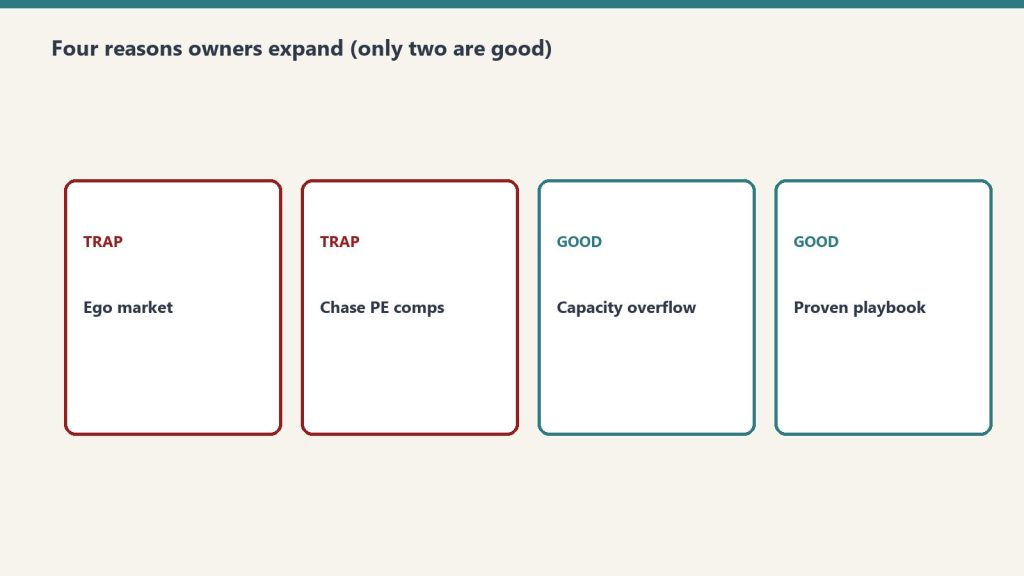
The four real reasons owners open a second location (only two are good)
Only two of the four expansion reasons are good.
In conversations across the industry, the rationales for a second location tend to cluster into four categories. Two of them tend to work. Two of them tend to bleed cash.
1. The carrier asked for it. Strong reason. If you are on a Contractor Connection, Alacrity, or Code Blue program and your performance metrics in market A have earned you a request to cover market B, the demand is already there before you sign the lease. The carrier is effectively pre-funding your CAC. This is the cleanest second-location case in restoration.
2. A key employee will leave if they do not get equity in something they can run. Reasonable reason. Promoting your best operations manager into a second-market GM role with a real P&L and a real equity slice is often cheaper than losing them to a competitor. The risk is that you are choosing the market for HR reasons, not market reasons. Mitigate it by making the GM put together a real go-to-market plan before you commit capital.
3. The home market feels “tapped out.” Usually wrong. Industry coverage of restoration economics in 2026 — including reporting from Push Leads and Paul Davis — repeatedly notes that most owners who feel tapped out have actually capped their CAC channels, not their market. A second location does not solve a Google Ads ceiling, an LSA neglect problem, or a referral program that has gone stale. It just spreads the same problem over two cities.
4. “It will be worth more at exit.” Almost always wrong on its own. Multi-location restoration platforms do command higher multiples, but the premium comes from diversified revenue and demonstrated systems — not from the existence of a second address. A second location that loses money for three years actively destroys exit value because it drags EBITDA and signals that the operator cannot run multi-site.
The financial test before you sign the lease
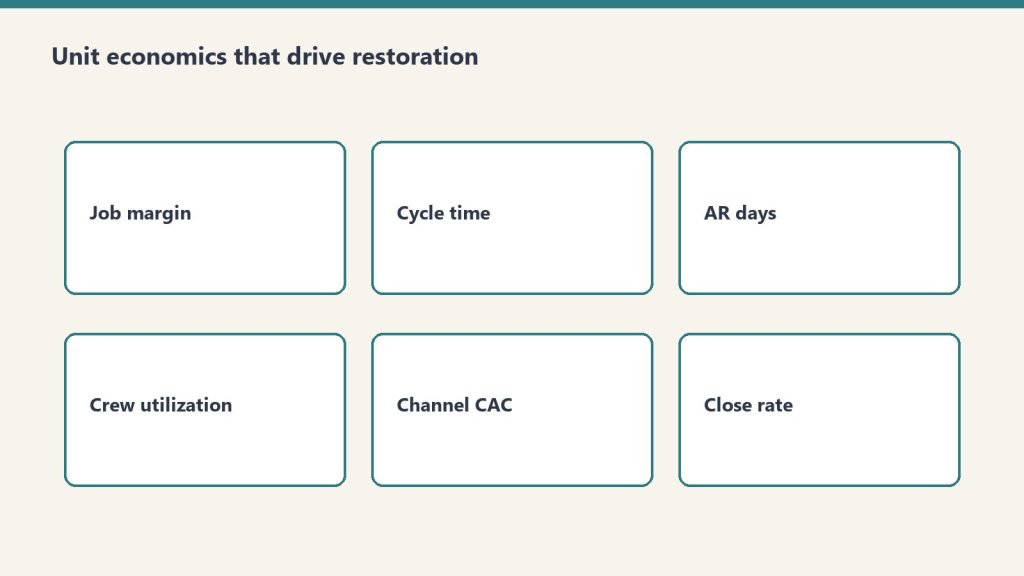
Financial test before the lease — unit economics first.
The math is unforgiving. Restoration industry reporting on unit economics generally points at the same benchmarks: water mitigation gross margins in the high 40s to mid 50s, blended company gross margins of roughly 38–45%, and net margins for healthy operators in the 8–15% range. Channel CAC tends to run roughly $100–$180 per acquired job on well-optimized Google Ads, $200–$400 on poorly run campaigns, and effectively the lowest CAC on agent and adjuster referrals.
Run this test before committing:
Home market net margin must be at least 10% on a trailing-twelve-month basis. If it is not, you do not have a scalable model yet. Fix the unit economics in market A before duplicating them in market B.
You must have at least 6 months of fully loaded operating cash for the new market. A new market typically does not break even on operating cash for 12–18 months. Most “failed” second locations actually ran out of patience before they ran out of demand.
CAC in the new market should be modeled at 2x your home-market CAC for the first year. No agent relationships, no adjuster history, no organic search ranking. Plan for it, do not be surprised by it.
You must have a designated GM willing to live in the new market. Owner-commuter second locations have a documented bad track record across the industry. The job is too relationship-driven for absentee leadership.
What the structure should look like in year one
The second-location org chart that tends to survive is lean and asymmetric. The home market keeps centralized accounting, marketing, estimating support, and Xactimate review. The new market gets a GM, two to three production crews, one project manager, and a dedicated office coordinator. Sales and BD belong to the GM full time — this is non-negotiable because nothing else recovers if local referral relationships are not being built.
Approximate revenue target in year one for a single new market: $1.2M–$2.0M, with a planned net loss in the first 6–9 months and a target of break-even monthly run-rate by month 12. If you cross break-even faster, the carrier-pre-funded scenario was real. If you are still bleeding past month 18, the most common honest answer is that the market choice was wrong — not that the team needs more time.
Single-market dominance: the underrated alternative
Single-market dominance is often the underrated alternative.
For a meaningful share of $3M–$8M restoration operators, the highest-return move is not a second location at all. It is doubling down on the existing market with a vertical-line expansion — adding contents cleaning, mold remediation, or reconstruction in-house — and grinding the home metro toward 6–10% market share.
The math favors this more often than owners assume. A second service line in an existing market shares overhead, shares referral relationships, and adds revenue at a lower marginal CAC than any new geography can. A $5M single-market shop with diversified service lines and clean books frequently exits at a higher multiple than a $7M two-market shop with one money-losing location, because buyers price systems and predictability, not address count.
The exit-aware framing
If your 5-year plan is to sell to a PE platform or a strategic buyer, the question is not “how many locations do I have.” The question is “how cleanly does my next location bolt onto a buyer’s system.” That means:
Standard chart of accounts across locations from day one
One CRM and one estimating workflow across all sites
Documented SOPs for water, fire, mold, contents, and reconstruction
Carrier program enrollment at the parent entity level, not the location level
GMs on real comp plans with documented KPI scorecards
If you cannot do those five things in your current single location, you are not ready for a second one. Buyers can tell within a single diligence meeting.
The bottom line
A second location is the right move when a carrier is pulling you into a new market, when you would otherwise lose a key operator, and when your home-market unit economics already produce 10%+ net margins and 6+ months of operating runway. It is the wrong move when it is a substitute for fixing CAC, when you are betting on multiple expansion alone, or when the GM does not actually live in the new city. Most owners would create more enterprise value by adding a service line in their existing market than by adding a city.
The window matters. With platforms still buying regional operators at reported 4x–7x EBITDA multiples and the operator base aging into exit-readiness, the next 3–5 years is the time to either build a defensible multi-market platform or to be the kind of clean, single-market operator that those platforms want to acquire. Both are good outcomes. The bad outcome is being stuck in the middle — two locations, neither profitable, three years older.
When should a restoration company open a second location?
When home-market net margins exceed 10% on a trailing-twelve-month basis, when you have 6+ months of fully loaded operating cash to fund the new market, and when either a carrier is requesting expansion or a key operator needs an equity-and-P&L opportunity to retain. Opening a second location to escape a CAC ceiling or to chase a higher exit multiple alone is generally a money-losing decision.
How long does a second restoration location take to break even?
Industry experience suggests 12–18 months to monthly operating break-even is normal for a new restoration market without a carrier program pre-funding the launch. With an active carrier program request, the timeline can compress materially. Owners should plan for a net loss in months 1–9 and budget cash accordingly.
Is it better to add service lines or open a second location?
For most restoration operators in the $3M–$8M range, adding service lines in the existing market — contents, mold, reconstruction — produces a higher marginal return on capital than geographic expansion, because overhead and referral relationships are already paid for. Geographic expansion makes more sense once a single market is diversified across service lines and approaching 6–10% local share.
What multiple do multi-location restoration companies sell for?
Industry reporting in 2026 generally cites a range of approximately 4x–7x EBITDA for quality restoration operators with diversified service lines, with sub-$2M shops trading closer to 2.8x–3.0x SDE. Location count alone does not drive the premium; diversified revenue, documented systems, clean financials, and demonstrated GM-led management at each site are what move the multiple.
If you own a restoration company doing somewhere between $2M and $10M a year, you are operating in the most actively consolidated environment this industry has ever seen. Reported figures put the U.S. restoration market at roughly $7.1B in 2025, growing in the 5–6% CAGR range, with 50+ private equity platforms reportedly acquiring operators at multiples in the 4x–7x EBITDA range. Quality scaled operators in the $8M+ range have reportedly traded at the upper end — approximately 6x–8x EBITDA — when the asset is built right.
Almost none of that value gets captured by accident. The org chart you build at $2M determines whether you can survive $5M. The systems you install at $5M determine whether $10M makes you or breaks you. And the structure at $10M determines whether a PE platform sees you as a bolt-on at a discount or a regional anchor at a premium.
Here is the honest breakdown of what the org should look like at each revenue milestone, what the typical owner gets wrong, and what an exit-aware growth path actually requires.
$2M: The owner-operator squeeze
At $2M, the owner is still the bottleneck of every consequential decision. A typical structure: the owner does sales, estimating, and major-loss oversight; one office admin handles AR/AP and scheduling; six to eight technicians split across two to three trucks; one lead tech runs supplements informally. Reconstruction is either non-existent or subcontracted ad hoc.
What this stage actually feels like: gross margins on mitigation can run in the reported 65–75% range, but the owner’s labor is uncosted. If you charged your own time at the rate of a real operations manager (approximately $80K–$110K fully loaded), most $2M shops would discover their actual margin is thinner than their P&L suggests.
The mistake at this stage: hiring more techs to grow revenue. More techs at $2M without a coordination layer creates more chaos, not more profit. The next hire is not a fifth tech. It is the first non-owner decision-maker.
$5M: The operations manager inflection
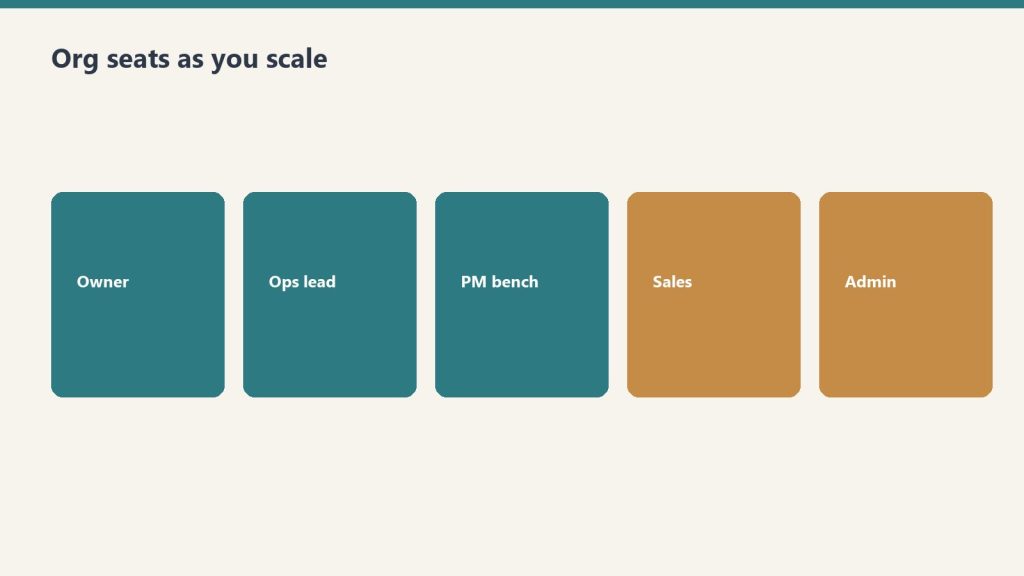
Seats change as revenue changes — titles are not the strategy.
$5M is where the structure has to change or the owner will burn out. The proven move is to hire a real operations manager — someone who owns the mitigation P&L day to day so the owner can focus on relationships, supplements, and growth. Reported compensation ranges for restoration operations managers cluster around $80K–$120K base plus variable, depending on market.
The $5M org typically looks like: owner; operations manager; one project manager for mitigation; one project manager (or a lead carpenter functioning as one) for reconstruction; office admin handling AR/AP; a dedicated estimator or supplement coordinator; 10–14 technicians across 4–6 trucks; one or two carpenters or subs handling reconstruction in-house.
This is also the stage where adding reconstruction matters disproportionately. Reported gross margins on reconstruction land in the 25–40% range — lower than mitigation but on much larger ticket sizes. A company that captures 25–30% of its mitigation revenue as in-house reconstruction by Year 3 of scaling tends to be substantially more valuable at exit, because reconstruction revenue is harder to replicate and stickier with carriers.
The mistake at this stage: the owner refuses to fully hand over the mitigation P&L. The operations manager becomes a dispatcher instead of a real GM. The org gets stuck at $5M for years.
$10M: The platform-decision stage
Platform-decision stage: managers own the week.
At $10M, the question is no longer “how do we grow?” — it is “what are we growing into?” There are two paths and they require different org structures.
Path A — single-market dominance. Stay in one metro, deepen TPA relationships (typically expanding from 2–3 carrier programs to 4–6), build a dedicated commercial division, and push toward $15M–$18M in a single footprint. Org: owner shifts to CEO role; operations manager promoted to COO; one mitigation manager; one reconstruction manager; commercial division lead; in-house controller or fractional CFO; dedicated marketing manager; office admin team of 2–3; 20–30 field staff.
Path B — multi-location expansion. Open a second branch in an adjacent market. This is where most $10M companies break. The org has to duplicate without doubling overhead: branch manager who reports to a regional operations leader; standardized SOPs, training, and KPIs; shared back-office (AR/AP, HR, marketing) from the home office; one finance function across both branches.
Reported industry experience is that the second location is the hardest. Branch three and four are dramatically easier if branch two is run with discipline. Most owners who fail at multi-location failed because they opened branch two as a bolted-on copy of branch one and did not build a real regional management layer in between.
$25M: Platform-ready
By $25M, the company is no longer a restoration business in the operational sense. It is a portfolio of branches with a central operating system. Org at this stage typically includes: CEO; COO; CFO (real, not fractional); VP of operations; regional operations managers (one per 2–3 branches); a dedicated commercial sales team; a marketing director; HR director; training manager; and 60–120+ field staff.
This is the structure PE platforms actually pay premiums for. The reported pattern: companies built around the owner trade at the lower end of the 4x–7x EBITDA range. Companies built around a system, with EBITDA visibility, repeatable branch economics, and a non-owner-dependent management team, trade at the upper end — approximately 6x–8x EBITDA, with some strategic transactions reportedly going higher.
The exit-aware framing
Exit-aware framing — org chart is part of the multiple.
Most restoration owners build the org chart they need today. Owners who exit well build the org chart their next buyer will want. The functional difference is small. The financial difference is enormous.
At $5M EBITDA of $1M, the difference between a 4x exit and a 7x exit is $3M. That gap is almost entirely a function of org structure, not revenue. Two restoration companies with identical revenue and identical margins will trade at different multiples if one is owner-dependent and the other is system-dependent.
Bottom line
The growth path is not a revenue chart. It is a sequence of structural inflection points. At $2M, the next hire is not a tech — it is a manager. At $5M, the next decision is not “more sales” — it is whether the owner will actually hand over the mitigation P&L. At $10M, the decision is single-market depth versus regional expansion, and the org has to be built before the second branch opens. At $25M, the company is either a platform asset or a glorified job shop — and the buyer can tell the difference in the first meeting.
The market is paying premium multiples for companies that look like platforms. Build the org that gets paid.
What is the right first non-tech hire for a $2M restoration company?
An operations manager or general manager who can own the mitigation P&L day to day, freeing the owner to focus on sales, supplements, and growth. Hiring another technician at this stage typically adds chaos, not profit, because the coordination bottleneck is the owner, not the field capacity.
When should a restoration company add in-house reconstruction?
Most owners benefit from adding reconstruction once they hit roughly $3M–$5M in mitigation revenue and have a stable operations manager in place. Reconstruction increases average ticket size, deepens carrier relationships, and is harder to replicate, which raises the exit multiple. Adding reconstruction before the org can support it usually just adds risk and overhead.
What EBITDA multiple do restoration companies sell for in 2026?
Reported ranges put quality restoration operators at 4x–7x EBITDA, with companies scaled to $8M+ in revenue and built around a system rather than the owner reportedly trading at the upper end of approximately 6x–8x EBITDA. Smaller operations under $500K in SDE often transact closer to 2.8x–3x on an SDE basis rather than an EBITDA basis. Numbers vary by region, carrier relationships, and quality of management team.
Is multi-location expansion or single-market depth the better growth strategy?
Both work, but they require different org investments. Single-market depth at $15M–$18M from one footprint can produce strong cash flow with less management complexity. Multi-location expansion produces higher exit valuations and platform optionality, but only if a regional management layer is built before the second branch opens. The most common failure mode is opening a second location without that layer in place.
Every restoration owner over fifty has the same question stuck in the back of their head: what is this thing actually worth? The honest answer in 2026 is somewhere between 2.3x SDE and 7x EBITDA — and the spread between those two numbers is not luck. It is the difference between a company a buyer wants and a company a buyer tolerates.
Here is what is happening in the market right now, what private equity is paying, and what kills the deal at the eleventh hour.
The 2026 Multiple Spread
Restoration M&A in 2026 sorts cleanly into three tiers. The cutoffs matter — they are not aesthetic.
Tier 1 — Sub-$2M revenue shops. Owner-operator businesses with one or two trucks, dependent on the founder for sales and crew leadership. These transact on Seller’s Discretionary Earnings (SDE), not EBITDA. Typical multiples: 2.3x to 3.0x SDE. The buyer is usually another restoration owner, a search-fund operator, or an industry veteran on their second act. There is no PE in this tier. The owner doing the work IS the asset, and that is exactly the problem.
Tier 2 — $2M to $5M revenue shops. The PE feeder zone. These get bought by platforms like BluSky, First Onsite, Belfor, ATI, and Code Red as bolt-on acquisitions. Multiples: 3.0x to 3.5x SDE, or 4x to 5x EBITDA if the company is clean enough to have real EBITDA at all. Purchase prices land between $900K and $2.5M. This is the sweet spot for industry roll-ups — large enough to have a real second-in-command, small enough to absorb without indigestion.
Tier 3 — $10M+ revenue, $2M+ EBITDA platforms. Now you are talking to PE directly, not through a strategic. Multiples: 5x to 7x EBITDA, occasionally higher for the right footprint. BluSky has announced 13 acquisitions in the last six years under Kohlberg & Company and Partners Group ownership. American Restoration rolled up 8 brands before exiting to Morgan Stanley. HighGround did 13 deals in five years before selling to Knox Lane. The playbook is well-documented. PE has put more than $6 billion into the space since 2018.
What Buyers Actually Pay For
Buyers pay for transferability — not heroic owners.
The multiple is a function of risk, not affection. Sophisticated buyers pay up for five things, in roughly this order:
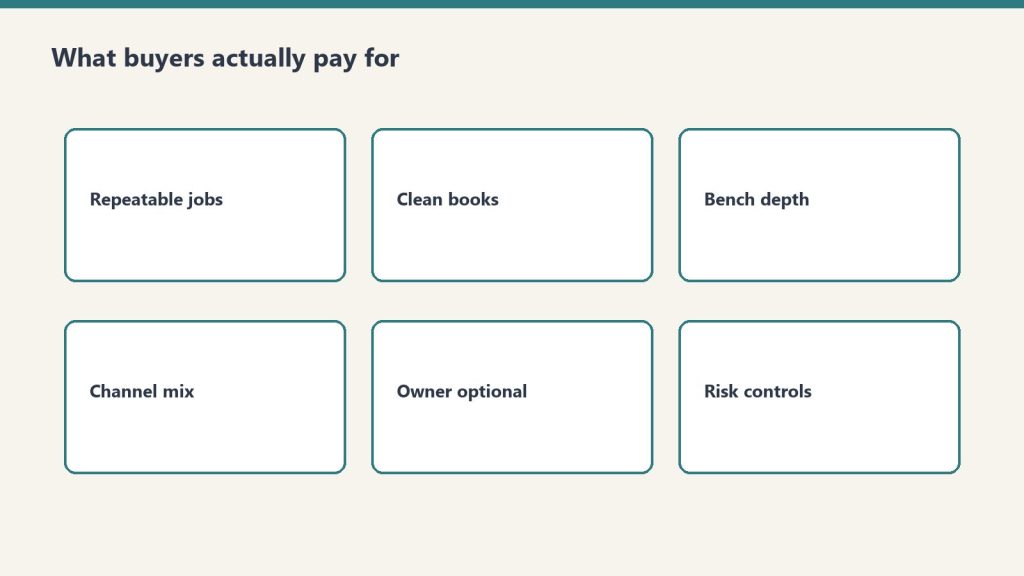
1. Insurance carrier preferred-vendor status. If you are on the panel for State Farm, Allstate, USAA, Liberty Mutual, or any TPA program — Contractor Connection, Alacrity, Code Blue — that contract is the asset. It is also the hardest thing to replicate. Buyers will pay a premium for it because they cannot buy it any other way except by buying you.
2. Mitigation-heavy revenue mix. Water mitigation runs gross margins around 70-80%. Reconstruction often runs 10% or less. A company that is 65% mitigation and 35% reconstruction is worth materially more than the same revenue split inverted. Buyers will pull your job-cost reports line by line during diligence to confirm the mix is real and not just how you are categorizing.
3. Management depth below the founder. If you can take a two-week vacation and revenue does not blink, your multiple goes up by half a turn. If the phones stop ringing the moment you leave, you are selling a job, not a business. Hire a real general manager 18 months before you list.
4. CAT exposure under 20%. Catastrophic event revenue is lumpy and cannot be modeled. If 40% of your last three years came from one hurricane season, buyers will discount that revenue heavily — sometimes valuing CAT-driven dollars at half the multiple of recurring carrier work. Diversify your revenue base before going to market.
5. Clean books with a Quality of Earnings opinion. Every PE-backed deal includes a QoE — an outside accounting firm that re-audits your trailing twelve months and normalizes EBITDA. If your books are run on a personal-finance app and your CPA does taxes once a year, expect the QoE to find $200K-$500K of EBITDA adjustments that go against you. Spend $40K on a CFO-for-hire and a real GAAP P&L two years before sale.
What Kills the Deal
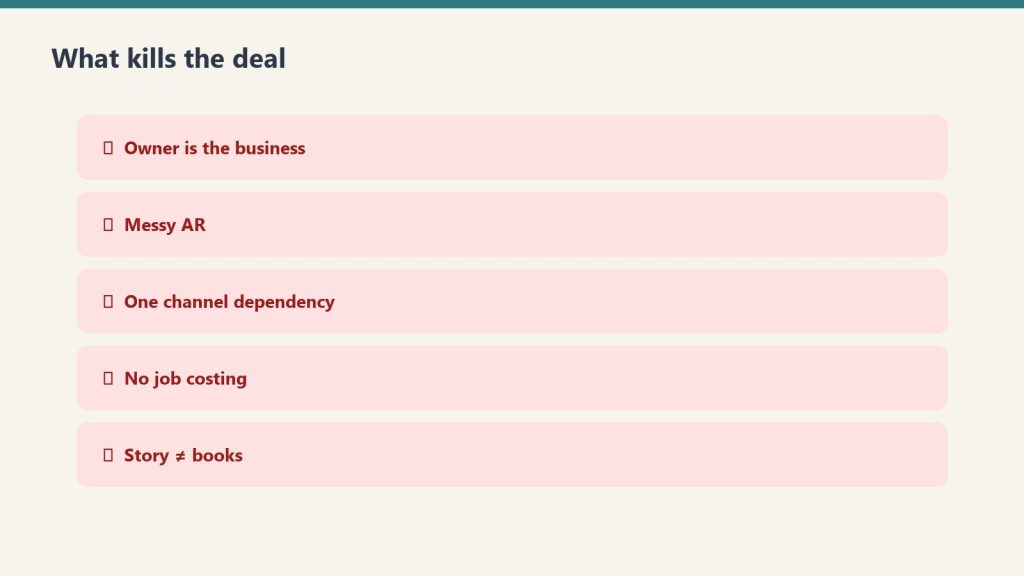
What kills the deal is usually quiet and operational.
Roughly 30-40% of restoration LOIs do not close. Almost always for reasons the seller could have prevented.
The biggest deal-killer is customer concentration. If one TPA program represents more than 35% of revenue, buyers panic. They have seen what happens when Contractor Connection decides to rebid a region — entire $8M revenue lines disappear in a quarter. Diversify before you list.
The second is uncollected aged receivables. Restoration AR over 90 days is not an asset, it is a write-down waiting to happen. Buyers will deduct uncollected AR from purchase price dollar-for-dollar. Aggressively collect or write off everything before you go to market.
The third is licensing and certification gaps. IICRC, state contractor licenses, mold remediation certifications by state — buyers run a full compliance audit. A single expired contractor license in a key state can cost $50K-$150K at close.
The fourth is founder dependency on first-call relationships. If the property manager calls you personally when there is a flood — not a dispatch number, not a sales rep — buyers will require an earnout structure that makes you stay another three to five years. Most owners hate earnouts because they convert sale price into deferred contingent comp. Build the dispatch infrastructure before you list, and you keep the cash up front.
The Honest Bottom Line
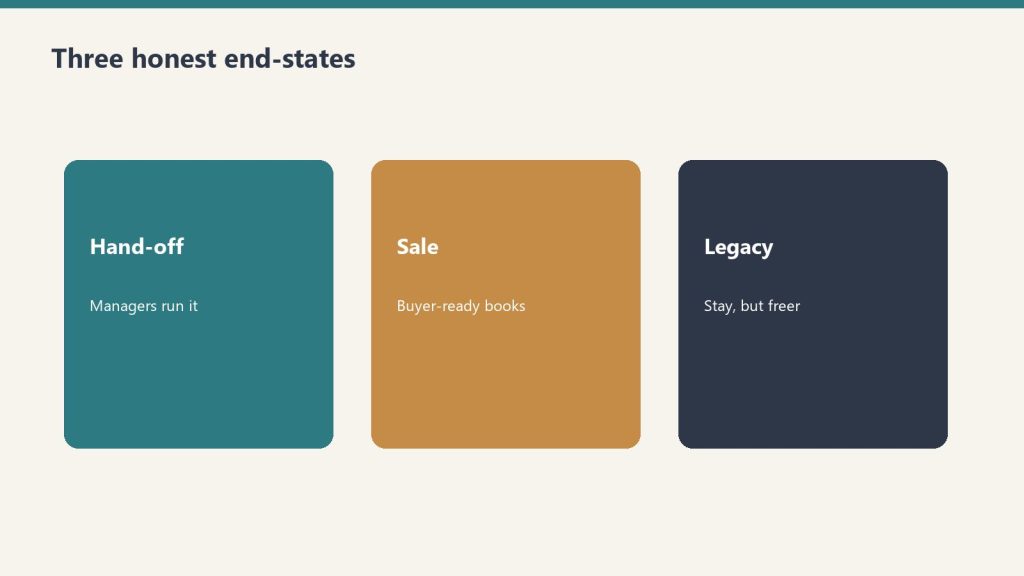
Honest bottom line: pick an end-state and work backward.
If you are a $3M revenue restoration company today and you want a clean exit at a real multiple, you have an 18-to-24 month preparation window. Use it to get the books on accrual, hire a GM, diversify off any single TPA, build mitigation revenue past 60% of mix, and get every certification current.
Do that, and a $3M shop running 18% EBITDA margins ($540K) sells at 4.5x to a strategic — about $2.4M cash at close. Skip it, and the same company sells at 2.6x SDE — closer to $1.4M, often with a punishing earnout attached.
The difference is one million dollars. The work to capture it is roughly nine months of operator focus. That is the highest-ROI work an exiting restoration owner can do.
Two Cowork capabilities that haven’t been written about here yet, despite being live since late April: Cowork Routines (always-on scheduled tasks that run when your laptop is closed) and Windows computer use (Claude operating your Windows desktop directly from within Cowork). Both shipped in the April 28–30 window alongside the Claude GA release. Both materially change what Cowork is.
Cowork Routines: The Laptop Can Be Closed
Cowork Routines — the laptop can be closed.
The original Cowork model required your laptop to be open and the Cowork desktop app to be running. Useful — but bounded by your hardware being available and powered on. Cowork Routines changes that.
Routines are cloud-hosted scheduled tasks that execute on Anthropic’s infrastructure regardless of your local hardware state. They run on a schedule you define. They execute when your laptop is off, sleeping, or in your bag on a plane. The task runs, the output lands where you configured it to land, and when you open the laptop you find the work done.
The practical scope of what runs well as a Routine:
Daily briefings: Pull sources, synthesize, write to Notion or email — delivered before you open your laptop each morning
Monitoring tasks: Check a source on a schedule, flag anomalies, log findings
Content pipeline steps: Recurring publication tasks, social scheduling prep, site audit runs
Report generation: Weekly status documents assembled from live data sources
Notification triggers: Watch a condition, fire an action when it’s met
We run our own Claude Newspaper Desk — a daily briefing that checks Anthropic’s news, release notes, GitHub releases, and external coverage, then writes a structured briefing to Notion before we start the day. That’s a Routine. The briefing that generated this article was produced by a Routine running on a schedule, not by someone manually triggering a task.
The architectural decision that makes Routines significant: the task reads its instructions from a Notion desk spec page at runtime, not from a baked-in prompt. Change the Notion spec, change what the Routine does — without touching the scheduled task itself. The shim file that triggers the Routine is thin by design; the intelligence lives in Notion.
Windows Computer Use: Claude Operates Your Desktop
Windows computer use — Claude operates your desktop.
Computer use in Claude — the ability for Claude to navigate desktop interfaces, click through UI, fill forms, and verify results — was previously available primarily in research preview and on macOS. The April 2026 Cowork release brought computer use to Windows as a generally available capability within the Cowork desktop app.
What this means in practice: Claude can open a native Windows application, navigate its interface, perform a sequence of actions, and hand the result back — without you needing to automate it through code or build an API integration. If there’s a tool that only has a Windows UI and no API, Claude can use the Windows UI directly.
The current state of computer use is honest about its scope. It’s good at:
Navigating well-structured desktop applications with clear UI hierarchies
Form completion across multiple-step workflows
Data extraction from desktop tools that don’t export well
Verification steps that require visual confirmation
It’s slower than direct API integrations when those exist. For tools with APIs, use the API. Computer use is the path when no API exists or when the integration cost exceeds the value of doing it properly.
The combination of Routines + Windows computer use means a scheduled task can now include a step that operates a Windows desktop application — unattended, while your laptop is running in the background. That’s a meaningfully different capability than what Cowork shipped with originally.
How We’re Using Both
How we’re using both.
Our Cowork architecture as of May 2026:
Cowork as execution layer — always-on laptop running scheduled tasks
Notion as control plane — desk specs, task queues, logs, and credential storage
GCP Cloud Run as action layer — WordPress publishing, API calls, content pipeline steps
Claude Code Routines as cloud fallback — tasks that need to run independent of local hardware
Routines handle the tasks where continuous availability matters more than local context: briefings, monitoring, scheduled publishing. Cowork handles the tasks where rich local context matters: multi-step sessions with file access, browser navigation, and tools that live on the local machine.
The practical division: if the task needs to run at 3am when the laptop is sleeping, it’s a Routine. If the task needs to interact with local files, a browser session, or a Windows app, it’s Cowork.
The Non-Developer Angle
Neither of these capabilities requires you to be a developer to use. Routines are configured through the Cowork interface with natural language task descriptions and a schedule. Computer use activates through the same conversational interface you’re already using.
The architecture underneath is sophisticated. The interface isn’t. You describe what you want done and when, and the system figures out the implementation. This is the progression that makes these capabilities meaningful for operations teams, executive assistants, knowledge workers, and small business owners — not just engineers building agent pipelines.
Singapore’s Foreign Minister Balakrishnan built his own version of this on a Raspberry Pi. The point isn’t to build your own — it’s that the underlying architecture (persistent memory, scheduled tasks, multi-channel input) is now accessible at multiple layers of sophistication, from DIY open source to fully managed product.
Cowork Routines are cloud-hosted scheduled tasks that run on Anthropic’s infrastructure regardless of whether your local Cowork laptop is on or available. They execute on a schedule you define — daily, weekly, or at specific times — and can perform any task Cowork handles: briefings, monitoring, content pipeline steps, report generation, and notification triggers. Each Routine reads its instructions from a Notion desk spec at runtime.
Does Windows computer use require coding to set up?
No. Computer use in Cowork activates through the standard conversational interface. You describe what you want Claude to do in the application, and Claude navigates the Windows desktop UI directly. No scripting, automation code, or API integration is required — though API integrations are faster when they exist. Computer use is the path for tools with no accessible API.
What’s the difference between Cowork and Cowork Routines?
Cowork runs on your local machine and requires the desktop app to be open and active. Routines run on cloud infrastructure and execute regardless of local hardware state. The practical division: tasks that need to run unattended on a schedule go to Routines; tasks that need local context, file access, or desktop UI interaction go to Cowork. Both read task instructions from Notion desk spec pages at runtime.
Is Cowork available on both Mac and Windows?
Yes. Cowork and computer use are available on both macOS and Windows as of the April 2026 general availability release. The Windows release also established PowerShell as the default shell (previously Git Bash was required), reducing a friction point for enterprise Windows shops.
Agency margins are bounded by what humans can produce per hour. Custom Agents change the unit economics. An agency that builds a per-client agent loadout — status reports, content production, intake triage, deliverable drafting — can serve more clients with the same headcount, or serve the same clients with better quality. The constraint shifts from “production capacity” to “exception handling capacity.” Agencies that figure this out first compound their advantage.
The per-client agent pattern
The per-client agent pattern.
For each client, build:
– A status report agent that produces the weekly client update from project data
– A deliverable draft agent customized to the client’s voice and brand
– An intake/inbox agent that handles their incoming work (if you manage their queues)
– A QA agent that runs deliverables through a client-specific checklist before they ship
Each agent is scoped to that client’s databases, voice samples, and brand guide. The setup is non-trivial — first client takes a week — but each subsequent client takes hours, not days.
What changes in agency economics
What changes in agency economics.
Pre-agent agencies: revenue = headcount x billable rate. Margins compressed by labor cost.
Post-agent agencies: revenue = (headcount x judgment work) + (agents x operational work). Margins expand because the operational work scales without headcount.
This isn’t speculative. The agencies running this pattern in 2026 are the ones quietly outperforming their peers on margin while charging similar rates.
Three pitfalls to avoid
Three pitfalls to avoid.
1. Selling agent-produced work as bespoke. Clients smell it. Don’t pretend a templated digest is hand-written. Be transparent about which work is agent-assisted and which is human; charge accordingly. 2. Skipping the QA layer. Agent output ships through a human gate. Always. The agency’s reputation rides on the QA gate, not the agent’s output. 3. Building one mega-agent instead of per-client agents. A single agent serving all clients hits voice and context boundaries hard. Per-client agents perform meaningfully better.
The pricing implication
After May 4, 2026, agency credit budgets become real. A client whose agent loadout consumes \$50/month in credits should see that in the cost of service. Agencies that absorb credit costs silently are eating into their own margin. Agencies that pass them through transparently (or bundle them into a “Custom Agent layer” line item) protect margin and educate clients.
Onboarding clients into this model
Three things to communicate during onboarding:
– Which deliverables are agent-assisted and which are human-led
– How the QA layer works (what gets reviewed, by whom)
– Why this produces better consistency than a junior staffer would (controlled vocabulary, standardized format)
Done well, “agent-assisted delivery” becomes a selling point, not a hidden cost.
What to read next
Notion AI for Content Teams, ROI Math, From Drafts to WordPress Publish.
You run a content and SEO agency. You manage 27 client sites across different verticals. Every site needs different content, different optimization, different publishing schedules, different stakeholder communication. Your team is capable. Your coordination overhead is enormous. Sound like anyone you know?
Agencies are the purest test of operational thinking. You are not managing one project — you are managing dozens of parallel projects, each with its own timeline, deliverables, approval chain, and definition of success. The people who thrive in agencies are the ones who can hold multiple client contexts in their head while executing on each without cross-contamination. The people who burn out are the ones who treat every task as independent and wonder why they are always behind.
The short answer: Claude Cowork’s task decomposition makes the invisible coordination layer of agency work visible. For SEO and content agencies specifically, watching Cowork plan a client engagement — from audit through content production through optimization through reporting — reveals the operational structure that separates agencies that scale from agencies that plateau.
The Agency Coordination Problem
The agency coordination problem.
Every agency hits the same wall. Somewhere between ten and thirty clients, the founder’s ability to hold all contexts in their head breaks down. The solution is supposed to be process — documented workflows, project templates, status dashboards. But most agencies build process reactively, after something breaks, rather than proactively.
Cowork lets you build process proactively by showing you what good decomposition looks like before you need it. Run “plan a full SEO content engagement for a new client: site audit, keyword strategy, content calendar, production pipeline, optimization passes, and monthly reporting” through Cowork and you get a plan that surfaces every dependency, parallel track, and handoff point in an engagement lifecycle.
What Agency Roles Learn From Cowork
What agency roles learn from Cowork.
Account Managers
Account managers are the client-facing lead agents. They hold the relationship, translate client goals into internal deliverables, and manage expectations when timelines shift. Watching Cowork’s lead agent coordinate sub-agents is a direct analog — the account manager sees how to delegate clearly, track parallel workstreams, and absorb scope changes without derailing active work.
SEO Strategists
SEO strategy is inherently a decomposition exercise: analyze the domain, identify gaps, prioritize opportunities, build the roadmap. When a strategist watches Cowork break down “audit and build a six-month SEO strategy for a 200-page e-commerce site,” they see their own planning process reflected — and they see where Cowork sequences things differently, which often highlights dependencies they had not considered.
Content Producers
Writers, editors, and content managers often work in isolation from the strategic layer. Cowork’s plan view shows them how their article fits into the larger engagement — why this keyword was chosen, what page it links to, how it connects to the schema strategy, and what the reporting metric will be. That context turns content from a deliverable into a strategic asset.
Technical SEO and Dev
Technical implementation — schema injection, redirect mapping, site speed optimization — often bottlenecks because it depends on decisions made by strategy and content. Cowork’s dependency chain makes those upstream requirements visible, which helps technical team members plan their capacity and push back on requests that are not yet ready for implementation.
The Meta Lesson: Agencies That Show Their Work Scale Faster
Here is the deeper insight. Cowork shows its work. That transparency builds trust — you can see the reasoning, you can redirect it, you can learn from it. Agencies that adopt the same principle — showing clients and team members the full plan, not just the deliverables — build deeper trust and reduce the coordination overhead that kills margins.
When your account manager can walk a client through a Cowork-style plan of their engagement — here is what we are doing, here is why this comes before that, here is where we are today, here is what is next — the client stops asking “what have you been doing?” and starts asking “what do you need from me to go faster?”
That shift changes the entire client relationship. And it starts with teaching your team to think in plans, not tasks.
A Practical Exercise for Agency Teams
A practical exercise for agency teams.
Pick your most complex active client. Run their engagement through Cowork as a planning exercise. Then compare Cowork’s plan to how the engagement is actually being managed. Where Cowork surfaces a dependency you are not tracking, add it to your workflow. Where Cowork parallelizes work you are running sequentially, ask why. Where Cowork’s plan is cleaner than your real process, steal the structure.
Repeat monthly. Your operational maturity will compound.
Can Claude Cowork actually manage client SEO engagements?
Cowork can plan, research, write content, and generate optimization recommendations. It cannot access your client’s Google Search Console, submit sitemaps, or manage your agency project management tool directly. Use it for the strategic and production layers, then execute in your existing stack.
How does this help with agency onboarding?
New hires see the full engagement lifecycle on their first day instead of piecing it together over months. Running a sample client engagement through Cowork gives new team members a map of how the agency operates — from audit through production through reporting — before they start contributing to live work.
Is this useful for agencies outside of SEO and content?
Yes. Any agency — design, PR, paid media, development — that manages multi-step client engagements with cross-functional coordination benefits from Cowork’s task decomposition. The principles of planning, dependency mapping, and parallel workstream management apply universally.
How does this compare to using agency project management software?
Project management tools track execution. Cowork teaches thinking. Use Cowork to build and refine your engagement plans, then execute and track in whatever PM tool your agency runs. The two are complementary, not competitive.
Content and SEO agencies sell a service that is, at its core, orchestration. A client says “get me more traffic” and the agency decomposes that into keyword research, content briefs, writer assignments, editorial review, optimization passes, publishing workflows, reporting cadences, and strategic adjustments. The people who do that decomposition well run profitable agencies. The people who do not burn hours and bleed margin.
That orchestration skill — the ability to take a vague client goal and turn it into a sequenced, dependency-aware production plan — is the skill most agency employees never formally learn. They learn their lane: the writer writes, the SEO specialist optimizes, the account manager manages the client relationship. But nobody shows them the full system.
Claude Cowork shows the full system. And it does it in a way that every person on an agency team can watch, absorb, and eventually replicate.
The short answer: Claude Cowork decomposes complex tasks into parallel workstreams with visible progress and dependency tracking. For a content or SEO agency, that means watching the exact orchestration process that turns a client goal into a sequenced production plan — the skill that determines whether an agency scales or stays stuck.
The Agency Scaling Problem
The agency scaling problem.
Most content and SEO agencies hit a ceiling. That ceiling is not about talent or clients. It is about the number of people who can orchestrate. Usually it is one person — the founder or a senior director — who holds the operational logic: how work gets planned, how production gets sequenced, how quality gets maintained across concurrent client workstreams.
Every other team member is a specialist executing within their lane. They are good at what they do. But they cannot plan a full campaign, sequence a production sprint, or manage the dependencies between research, creation, optimization, and publishing. So every new client adds load to the one person who can.
Cowork does not solve that by doing the work. It solves that by making the orchestration visible so more people can learn it.
How Cowork Maps to Agency Roles
How Cowork maps to agency roles.
The SEO Strategist
Give Cowork: “A new client in the commercial roofing space wants to rank for twenty target keywords within six months. They have an existing site with thin content and no internal linking strategy. Build me the complete SEO campaign plan from audit through month-six reporting.”
Cowork decomposes this into audit, keyword clustering, site architecture recommendations, content production sequencing (which topics first based on difficulty and business value), technical optimization tasks, internal linking plan, external authority building, and a reporting cadence with milestone checkpoints. The strategist sees the full lifecycle — not just “here are keywords, go write content.”
The Content Writer
Writers at agencies typically receive a brief and deliver a draft. Give Cowork: “Build me the complete workflow for taking a content brief from assignment through published, optimized, and internally linked article — including all the steps the writer touches and the steps that happen around the writer.”
Cowork shows the writer that their draft is one step in a longer chain: the brief was informed by keyword research and competitive analysis, the draft gets an editorial pass and an SEO optimization pass, the optimized piece gets schema markup and internal links before publishing, and after publishing it gets tracked for ranking performance that informs future briefs. The writer sees that their work quality affects every downstream step — and that understanding the system makes them a better writer, not just a faster one.
The Account Manager
Give Cowork: “We have eight active clients, each with a monthly content deliverable and a quarterly strategy review. Two clients just requested scope changes. One client’s site had a traffic drop that needs diagnosis. Build me the account management plan for this month.”
Cowork shows the account manager how to triage and sequence: which clients need immediate attention (the traffic drop diagnosis), which scope changes affect production timelines and need to be surfaced to the production team, where monthly deliverables can be batched for efficiency, and how to structure the quarterly reviews so they generate upsell opportunities rather than just recapping metrics. The account manager sees that client management is resource orchestration — not just relationship maintenance.
The Agency Founder
This is the meta-level. Give Cowork: “We want to onboard three new clients next month while maintaining quality for our existing eight clients. Our team is two strategists, three writers, one SEO specialist, and one account manager. Build me the capacity plan.”
Cowork exposes the capacity constraints and sequencing decisions that the founder usually does intuitively: which roles are at capacity, where onboarding tasks can be parallelized, which existing client work can be batch-processed to free up bandwidth, and what the risk profile looks like if one of those three new clients has a larger scope than estimated. The founder sees their own decision-making process externalized — and can use it to train their team lead or operations manager to make the same calls.
The Meta-Training Layer
The meta-training layer.
Here is what makes this particularly powerful for agencies: the skill Cowork trains is the skill that agencies sell. A content agency does not sell writing. It sells the orchestration of research, creation, optimization, and distribution into a system that produces results. The better every team member understands that system, the better the agency performs — and the less dependent it is on one person holding the whole thing together.
Cowork makes the system visible. And visible systems are learnable systems.
How does Claude Cowork help content and SEO agencies specifically?
Cowork decomposes agency workflows — campaign planning, content production, client management, capacity planning — into visible workstreams with dependencies. That orchestration visibility teaches every team member how the full system works, not just their individual lane.
Can Cowork help with agency scaling challenges?
Yes. The primary scaling bottleneck for agencies is that orchestration knowledge is trapped in one or two people. Cowork makes that orchestration visible and teachable, so more team members can learn to plan and sequence work — reducing the dependency on the founder or a senior director.
Is Cowork a replacement for agency project management tools?
No. Cowork trains the planning and decomposition skill. Use your existing tools — Asana, Monday, ClickUp, Notion — to execute and track the work. Cowork is the thinking layer that shows how plans should be structured before they go into your PM tool.
Which agency role benefits most from Cowork training?
Account managers and junior strategists benefit most. They are the roles most likely to be promoted into orchestration responsibilities without formal training in how to plan and sequence multi-track production work.