Client Verticals - Tygart Media

Category: Client Verticals

Industry-specific marketing strategies beyond restoration. Cold storage, lending, comedy, training, and more.

  • WordPress SEO Skill Pack – Pro

    WordPress SEO Skill Pack – Pro

    WordPress SEO Skill Pack – Pro

    $79

    Delivered by email after checkout.

    Buy Now →

    Secure checkout via Square — all major cards accepted

    You can copy this method and run the full three-layer stack yourself. Buy Now is the 14 packaged Claude skill files so your own Claude can do it on your WordPress site.

    Pro is the middle tier of the WordPress SEO Skill Pack. $79. The live sales page lists 14 skills: everything in Starter, plus wp-aeo-refresh, wp-geo-refresh, wp-schema-inject, wp-taxonomy-fix, wp-interlink, wp-full-refresh, wp-content-pipeline, content-brief-builder, and content-quality-gate. That is the production sequence Tygart Media uses on a single post: SEO, then AEO, then GEO, then schema, then interlink.

    Install and connect

    Same requirements as Starter. Claude Pro / Max / Team. Self-hosted WordPress. Application Password. Drop the skill files into Claude Desktop (Cowork) or Claude Code. Say “connect to my WordPress site.” wp-connect tests /wp-json/wp/v2/users/me. Stop if that is not a 200.

    The sales page’s operator line for this tier: “full refresh post 123.” That trigger is wp-full-refresh. It is the orchestrator. Do not start there on a site you have never audited.

    The 14 skills, in the order you should actually use them

    Foundation (from Starter)

    • wp-connect. Authenticate. Gateway.
    • wp-post-fetch. Load one post with context=edit.
    • wp-site-audit. Inventory, orphans, thin posts, missing meta, schema gaps. Run first on a new site.
    • wp-clean-meta. Strip excerpt pollution before you write new meta.
    • wp-seo-refresh. Title (about 60 characters), meta (about 155 to 160), slug, H2/H3, keyword in the first 100 words.

    Taxonomy, before you interlink

    wp-taxonomy-fix has two modes: one post, or site-wide. Design 3 to 7 top-level categories. Each post gets 1 to 2 categories (never Uncategorized) and 5 to 10 tags (topic, technology, use case, audience, format). Create missing terms via the API, assign, then normalize duplicate tags. Toolbox lists this as a prerequisite for wp-interlink. If categories are a junk drawer, your link graph will be a junk drawer.

    The same skill can write two-layer descriptions on category and tag archives: a 140 to 160 character meta excerpt, then a 400 to 600 word hub body with internal links to the top posts in that cluster. PATCH /wp/v2/categories/{id} and /wp/v2/tags/{id} on the description field. Most themes print that above the post grid.

    The three-layer refresh

    wp-aeo-refresh. Direct-answer opening, question H2s, FAQ pairs, list-shaped answers, FAQPage schema. SiteBoost existing-post copy uses a 40 to 60 word definition box and 6 to 8 FAQs. The older publish skill used 3 to 5. Use the PAA list in front of you, not a fake number.

    wp-geo-refresh. Entity saturation, factual density, context richness, source attribution, topical breadth, semantic clarity. Schema it adds: richer Article metadata, entity markup, Speakable. The citing-sources article is the house rule: name the organization, link the primary source, sources list at the bottom, visible last-updated, dateModified in schema. No fabricated stats.

    wp-schema-inject. Detect the type the post actually is and inject JSON-LD. The schema injection sprint’s menu: FAQPage, Article, HowTo, Service, LocalBusiness, Speakable, BreadcrumbList. Validate with Google’s Rich Results Test. Fix failures. Do not leave plugin-bloated invalid markup in the body.

    wp-interlink. Hub and spoke, orphan resolution, contextual links. The Copilot / cluster articles on tygartmedia.com use 3 to 5 related posts in the same topical group, descriptive anchors. Do this after the post has a real topic and a real category, not before.

    wp-full-refresh. Runs SEO + AEO + GEO + schema + interlink in that sequence on one existing post. This is the “do everything to this post” skill. Use it when the audit already said the post is worth the pass.

    New content, not just refreshes

    content-brief-builder. Keyword research to a brief, before anyone writes. Feeds the pipeline. A brief that cannot name the query, the intent, the PAA list, and the internal-link targets is not a brief.

    wp-content-pipeline. Draft to live: write → SEO → AEO → GEO → schema → taxonomy → interlink → publish. Toolbox order. Same six-step human workflow as the New Article Publishing page, encoded as a skill chain.

    content-quality-gate. Pre-publish. Unsourced claims and fabricated numbers get flagged. Run this before any publish, batch or single. The operator guide’s failure mode is the same: fake density backfires when an AI system checks you.

    A Pro session on one site

    1. Connect. Audit. Clean polluted excerpts.
    2. Fix taxonomy on the posts you are about to touch (and on the hub category if it has no description).
    3. For each chosen existing post: wp-full-refresh, or the layers by hand in SEO → AEO → GEO → schema → interlink order.
    4. For a new article: brief → pipeline → quality gate → publish.
    5. IndexNow on every URL you created or updated. Confirm in Bing Webmaster Tools.
    6. Log before/after: title, meta, word count, FAQ count, schema types, internal links added.

    The operator guide’s weekly rhythm still applies if you are using Pro on a real site: Monday audit, Tuesday to Thursday execute, Friday verify. Pro is the toolkit. It is not a retainer.

    What Pro still does not include

    Agency adds three reference guides (SEO, AEO, GEO), wp-content-expand (deepen thin posts without overwriting), and wp-new-site-setup (client onboarding). If you are onboarding other people’s sites every week, that is the Agency door. If you want Will to run the posts instead of running skills, that is SiteBoost.

    If you want the packaged files

    You can run every layer above in the block editor with a checklist. Buy Now is the 14 .skill files delivered by email after checkout. Same Square button at the top. $79.

    Starter is the five-skill on-page subset if you only need connect / audit / SEO refresh. Agency is this stack plus onboarding and expansion.

    Related: WordPress SEO Skill Pack. Also WordPress SEO Skill Pack — Starter.

  • WordPress SEO Skill Pack – Agency

    WordPress SEO Skill Pack – Agency

    WordPress SEO Skill Pack – Agency

    $149

    Delivered by email after checkout.

    Buy Now →

    Secure checkout via Square — all major cards accepted

    You can copy this method and run it across more than one WordPress site yourself. Buy Now is the 19 packaged Claude skill files plus the three reference guides, so your own Claude can onboard a site, expand thin posts, and run the full stack.

    Agency is the top tier of the WordPress SEO Skill Pack. $149. The live sales page lists 19 skills: everything in Pro, plus an SEO reference guide with schema templates, an AEO reference guide, a GEO reference guide, wp-content-expand, and wp-new-site-setup. The thesis on the launch page: genericized versions of the production wp- skills, no client credentials, placeholders you fill with your own Application Passwords.

    What “agency” means here

    Not a Tygart Media retainer. The pack is for someone who already has (or is about to have) more than one self-hosted WordPress site and wants the same connect → audit → refresh → publish machine on each. The 23-site stack article is the operating picture: one Application Password per site, one audit at the start, skills composed so a full refresh is a named sequence instead of a vibe.

    Requirements stay the same: Claude Pro / Max / Team, REST API on, Application Password, no plugin required. Install the files in Claude Desktop (Cowork) or Claude Code. Connect per site. Do not reuse one app password across clients.

    Onboard a site (wp-new-site-setup)

    The 23-site article times a new site at about 20 minutes: generate the Application Password, add the site to your registry, run the setup / audit skill, and the stack is usable. wp-new-site-setup is that onboarding workflow. By hand, the same steps are:

    1. Confirm /wp-json/wp/v2/ answers. Self-hosted only.
    2. Create an Application Password for an editor-capable user. Label it with the client and the date.
    3. wp-connect. users/me = 200.
    4. wp-site-audit. Full published-post inventory. Critical / High / optimization lists.
    5. Note the SEO plugin (Yoast, Rank Math, AIOSEO) because meta fields differ. A WeConvene audit note in Notion called this out: a skill that only knows Yoast / Rank Math will miss AIOSEO fields.
    6. Write the four baseline artifacts from the SiteBoost audit page: inventory, schema gaps, FAQ gaps, before numbers in Search Console.
    7. Agree the first ten posts or the first briefs before anyone writes. Agency without a queue is just a folder of skills.

    Toolbox rule you should keep: posts, not pages, unless the client put a Page in writing. Do not “clean up” the homepage on day one.

    Expand thin posts (wp-content-expand)

    This is the Agency skill Pro does not have. Never overwrite. Fetch with context=edit. Flag sections under 150 words, intros under 100, missing subtopics, missing examples, outdated stats, missing close. Add 250 to 400 words per new section. Append. Update the modification date because you actually changed the content. Report the word-count increase. The skill’s own bar: get the post over 500 words before you pretend it has SEO authority.

    Then run the Pro refresh stack on the expanded post. Expansion without SEO / AEO / GEO / schema is just a longer stub.

    The Pro stack, still the daily work

    Once a site is onboarded, Agency work is Pro work, repeated:

    • wp-seo-refresh → wp-aeo-refresh → wp-geo-refresh → wp-schema-inject → wp-interlink, or wp-full-refresh to run that chain.
    • wp-taxonomy-fix, including the two-layer category / tag descriptions if archive pages are stubs.
    • content-brief-builder → wp-content-pipeline → content-quality-gate for new articles.
    • wp-clean-meta whenever an excerpt is polluted.

    The three reference guides are the templates sitting next to those skills: SEO (on-page + schema templates), AEO (direct-answer / FAQ / PAA), GEO (entities, density, speakable, citations). Use them as the written standard when more than one person is allowed to run a refresh. If the guide and the skill disagree, the skill’s field list wins for execution; the guide wins for “what good looks like.”

    A week across more than one site

    Same rhythm as the operator guide, scoped to a roster:

    1. Monday: per-site audit score. What is still Critical. This week’s existing posts and this week’s briefs, named by URL and keyword.
    2. Tuesday to Thursday: expand anything under 500 words that you committed to, then full-refresh. New articles through the pipeline and the quality gate.
    3. Friday: Rich Results Test, IndexNow, log. One log line per URL. If you cannot say what changed, it did not ship.

    Monthly, not weekly: taxonomy health, orphan scan, meta-pollution scan, Search Console versus last month. That is the maintenance layer from the 23-site article. Do not burn a week on dashboards.

    IndexNow on every publish and every update. Official plugin or Rank Math / Yoast Instant Indexing. Confirm in Bing Webmaster Tools. Agency volume without a ping is a lot of work the engines have not been told about.

    What this pack is not

    • It is not SiteBoost. SiteBoost is Will (or Tygart Media) doing the work on the site. This pack is the skill files so you can do it.
    • It is not the $297 Connection and Audit service, the $597 pilot, or the $997 retainer. Those are done-for-you doors. The methods on those pages are the same layers. The deliverable is different.
    • It is not a prompt pack of 50 one-liners. The launch page’s distinction: workflows with error handling and a report, genericized from production skills.

    If you only have one site and you only need on-page, Starter is enough. If you have one site and you want the full refresh + pipeline, Pro is enough. Agency is the onboarding + expansion + reference-guide tier.

    If you want the packaged files

    You can run every step in this article with Application Passwords and a checklist. Buy Now is the Agency zip: 19 skills and the three reference guides, delivered by email after checkout, placeholders only, no one else’s credentials. Same Square button at the top. $149.

    If you would rather not run Claude at all, buy the matching SiteBoost service instead of this pack.

    Related: WordPress SEO Skill Pack. Also WordPress SEO Skill Pack — Pro.

  • The Profit Leak Scorecard

    The Profit Leak Scorecard

    The Profit Leak Scorecard

    $7

    Delivered by email after checkout.

    Buy Now →

    Secure checkout via Square — all major cards accepted

    You can copy this method and do it yourself. Score the 20 statements. Count the checks. Name your worst zone. Buy Now is the packaged Notion page you duplicate and fill in, so you are not rebuilding the scorecard from a blank doc.

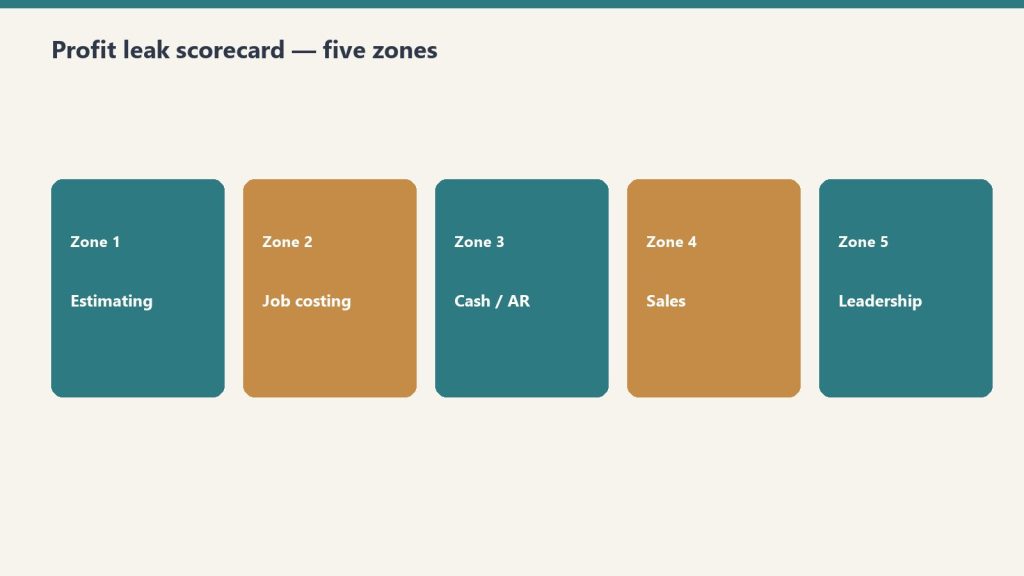
    Stop guessing. Start detecting. This is the entry diagnostic in the Profit Detective toolkit. Five revenue leak zones. Four statements each. Five minutes. You walk out with a Leak Index (0-100), your #1 zone, and a rough yearly dollar figure.

    How to score

    Check each statement that is true of your business today. Each check is a leak. Count them at the bottom. Total checks out of 20, then multiply by 5 to get your Leak Index.

    Zone 1: Estimating & scope

    Money left in the estimate. The leak here is invisible because you never see the dollars you did not ask for.

    • We regularly find scope we forgot to bill after a job closes.
    • Estimators don’t consistently capture every line item the carrier allows.
    • We rarely review estimate-vs-final variance by estimator.
    • We discount or eat change orders to keep the adjuster happy.

    Zone 2: Job costing & margin

    Jobs that cost more than you think. Most shops cannot name true margin on the job they finished last Tuesday.

    • We don’t know true gross margin on a job until weeks after it closes.
    • Labor hours routinely run over what we estimated.
    • Equipment and materials aren’t tracked back to specific jobs.
    • We’ve finished jobs that lost money and didn’t catch it early.

    Zone 3: Cash flow & collections

    Work done, cash not collected. You can be profitable on paper and still broke.

    • Carrier or TPA payments routinely take longer than they should.
    • We carry receivables we’ve quietly stopped chasing.
    • We’ve floated payroll on a credit line to cover slow collections.
    • We have no standard follow-up cadence for unpaid invoices.

    Zone 4: Sales & conversion

    Leads in, jobs lost. A conversion problem and a marketing problem have different fixes. You cannot tell them apart if you do not know the rate.

    • We don’t know our lead-to-job conversion rate.
    • Inbound calls sometimes hit voicemail during business hours.
    • We don’t track which marketing actually produced our best jobs.
    • We have no system to follow up on quotes that didn’t close.

    Zone 5: Leadership & overhead

    The owner is the bottleneck. This zone caps the whole pyramid, and it is the one owners least want to investigate.

    • The business can’t run a full week without the owner.
    • We don’t review one shared KPI as a team every week.
    • Overhead has crept up but we haven’t re-examined it in a year.
    • Every important decision funnels through one person.

    Your Leak Index

    Total checks: ___ / 20. Multiply by 5. That is your Leak Index (0-100).

    • 0-20 Tight ship. Minor seepage. Tighten the few gaps.
    • 21-45 Active leak. You are losing real money in 1-2 zones.
    • 46-70 Major leak. The profit is pouring out. Pick your worst zone now.
    • 71-100 Hemorrhaging. This is the #1 threat to the business.

    Estimate the dollars

    The scorecard’s teaching math: shops at your score typically leak about (Leak Index ÷ 100) × 14% of revenue. Multiply by your annual revenue for a rough yearly figure. Illustrative. Not a guarantee.

    Write down the zone where you checked the most boxes. That is where you start. One zone at a time. The owners who try to plug all five at once plug none.

    What to do with the result

    1. Write your Leak Index and your worst zone on a card. You will carry those two things into any later work.
    2. Pull your trailing-12 P&L and write your actual gross margin % (gross profit ÷ revenue). If you cannot find it in under 10 minutes, that is a finding.
    3. Write one sentence: the story you have been telling yourself about profitability that you are now going to test against evidence.
    4. If Zone 2 won, run last 10 closed jobs through a job-costing table (revenue, labor, equipment, materials, subs). If Zone 3 won, age your AR and total 60+ and 90+. If Zone 5 won, run an owner-dependency pass: what breaks if you vanish for 30 days.

    The playbook’s rule: every restoration shop leaks somewhere. The only variable is whether you are looking. Evidence over opinion. Follow the money. Assume a leak exists.

    If you want the packaged scorecard

    You can run the 20 statements on a napkin. Buy Now is the Notion page delivered by email after checkout. Duplicate it (··· → Duplicate), check the boxes, and the Leak Index and dollar estimate sit on the same page. Same Square button at the top of this page.

  • The Profit Detective Playbook

    The Profit Detective Playbook

    The Profit Detective Playbook

    $497

    Delivered by email after checkout.

    Buy Now →

    Secure checkout via Square — all major cards accepted

    You can copy this method and do it yourself. Pull your own P&L. Score the five leak zones. Cost ten jobs. Age the AR. Run a 90-day reset on one leak. Buy Now is the packaged course: seven modules, the linked tools, and the exercises so you are not assembling the curriculum from scratch.

    This is the self-paced DIY version of the Profit Detective Diagnostic. Restoration owners doing $1M-$15M who suspect they are leaving money on the table and want a repeatable way to find it before hiring a consultant.

    How it works

    Seven modules. Each one teaches a leak zone, then hands you a tool to do the detective work on your own business. Work one module a week or binge it. Do the exercises. That is where the money is.

    1. The Profit Detective Method (plus the Restoration Profitability Pyramid)
    2. Estimating & Scope Leaks
    3. Job Costing & Margin Leaks
    4. Cash Flow & Collections Leaks
    5. Sales & Conversion Leaks
    6. Leadership & Overhead Leaks
    7. The 90-Day Restoration Reset

    Think like a detective, not an optimist

    Most owners run on opinion. “We’re busy, so we must be profitable.” A detective wants evidence. The method’s three habits:

    1. Evidence over opinion. Pull the number before you defend the story.
    2. Follow the money. A dollar of revenue passes through five checkpoints before it becomes profit. Find which checkpoint it is escaping at.
    3. Assume a leak exists. You are not asking if. You are asking where and how big.

    The playbook’s teaching: in 150+ restoration companies, every one was leaking somewhere between 5% and 15% of revenue. Not because the owners were lazy. Because nobody was looking. A $4M shop leaking a conservative 8% is $320,000 a year. That is the method’s example math, not a promise about your shop.

    The Restoration Profitability Pyramid

    Four stacked layers. Revenue at the bottom. Gross margin above it. Net profit above that. At the top: owner freedom (cash, time, the ability to walk away from the truck).

    Most owners spend 90% of their energy on the bottom layer. More leads, more trucks, more revenue. The rule: climb the pyramid from the middle, not the bottom. A 3-point improvement in gross margin on $4M is $120,000, and it costs nothing in new marketing. Growing revenue 3 points to get the same dollars means more jobs, more risk, more chaos. Ask: can I make this dollar worth more before I chase another one?

    What “normal” looks like (starting case file)

    Pull two documents: trailing-12 P&L, and a job-costing report for your last 20-30 completed jobs (revenue, labor, materials, subs, equipment). If your software cannot produce job-level margin, that is your first finding.

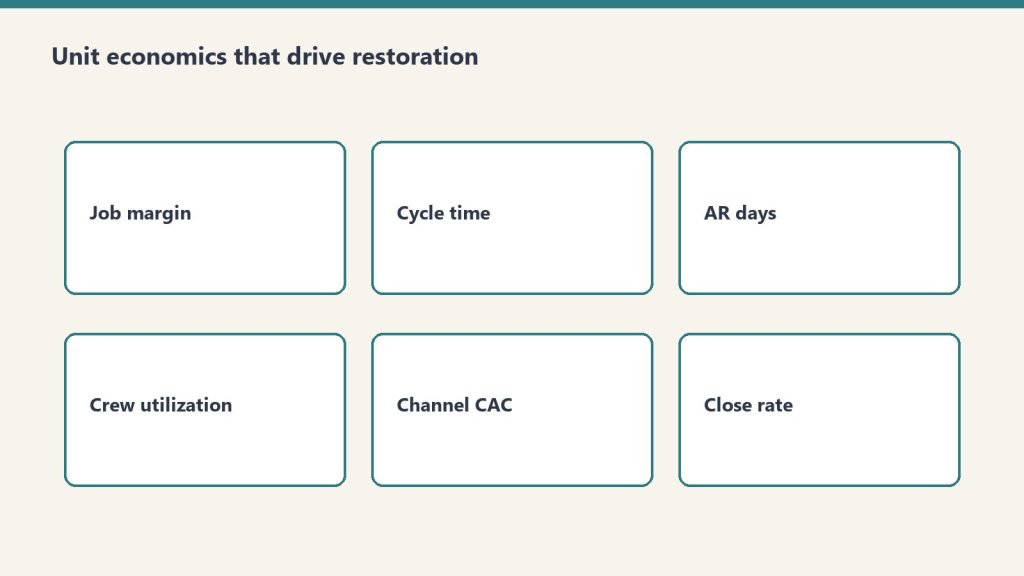
    • Gross margin: healthy mitigation 45-55%; blended with reconstruction 35-45%. Below 35% blended is a margin leak.
    • Net profit: a well-run shop nets 10-20%. Single digits means the leak is real and findable.
    • Overhead: if fixed overhead is eating more than 25-30% of revenue, Zone 5 is calling.
    • AR over 90 days: more than 15-20% of receivables past 90 is a Zone 3 bleed.

    Circle anything outside those ranges. That is spotting where the evidence disagrees with the story.

    The five zones, and how to work each one

    1. Estimating & scope

    Money left in the estimate. If it is not documented, you ate it. The line items that vanish most often: detach & reset, PPE, monitoring / daily site visits, containment, equipment days, after-hours / emergency service, content manipulation.

    The discipline: review every job’s final cost against the original estimate, tagged by estimator and job type. Filter jobs where the biggest leak is Scope/Estimate. Find the repeating miss, not the outlier. Coach that one habit.

    What good looks like: final cost within about ±5% of estimate on most jobs, because the scope was right the first time. A weekly variance review, by estimator.

    2. Job costing & margin

    Four cost buckets: labor, equipment, materials, subs. Labor is the #1 leak (hours over estimate, unbilled drive and idle time, milked T&M). Equipment sits on closed jobs, unbilled. Materials slip. Subs compress margin when the invoice exceeds what you billed the carrier.

    Run a mid-job margin check at the halfway point of every significant job. Close-out cost every job within 3-5 days of the final visit, not at month-end. Log last 10 closed jobs with all four buckets. Sort by true gross margin. Name the money-losers. Flag every job where actual labor beat estimate by more than 10%. Write one sentence on the worst one: what leaked, and in which bucket.

    3. Cash flow & collections

    You are the customer’s bank. DSO = (Accounts Receivable ÷ Total Credit Revenue) × Number of Days. Age the buckets: 0-30 leave it; 31-60 watch; 61-90 a human on the phone this week; 90+ is a write-off countdown.

    Collections cadence with a name and a day: Day 0 confirm receipt; Day 14 friendly status; Day 30 escalate by phone; Day 45 owner or controller in writing; Day 60 formal demand path. One person owns the list. Same standing time every week. Track submitted supplements to collection, not just to submission.

    4. Sales & conversion

    For the last 90 days, log qualified leads and jobs sold. Divide. That is your conversion rate. A rough number beats a shrug.

    Four leaks: missed business-hours calls; no source attribution on paying jobs; quotes that get zero follow-up; slow speed-to-lead on emergency work. The playbook’s rule: every estimate gets a touch within 24 hours, then day 4, then day 8. Three touches before it is dead. Answer live, or call back within 10 minutes during business hours. Track quote status: Sent / Followed-Up / Won / Lost.

    5. Leadership & overhead

    If you disappeared for 30 days and the business grinds to a halt, you own a job, not an asset. Tag a typical week: $15/hour work vs $1,000/hour work. Audit subscriptions, idle trucks, and roles that were created for a person, not a need.

    The highest-leverage move in this zone: build one middle manager who can own the daily run. Run an owner-dependency audit. Pick the top 3 bottlenecks. Hand each one through a 1-3-1 (one issue, three options, one recommendation). Drain overhead while you are in there.

    The 90-Day Restoration Reset

    You will find leaks in all five zones. You do not have five projects. Rank by dollars at stake. One zone per quarter.

    1. Weeks 1-2: Measure & pick. Put a real dollar figure on the top leak. Write today’s baseline.
    2. Weeks 3-4: Install the fix. The specific playbook from that zone. New estimate checklist, job-costing review, weekly AR block, or lead-follow-up rule with a name on it.
    3. Weeks 5-8: Make it an SOP. One page. Hand it to the person who owns it. Watch it run for a month without you.
    4. Weeks 9-12: Review & lock. Re-pull the same number. Fold the metric into the dashboard. Only then turn to the next zone.

    Once a month, 30 minutes, same five numbers: gross margin %, net %, AR over 90, conversion %, overhead % of revenue. Same day each month. When a number drifts, you catch it in weeks.

    The playbook’s compounding example: a 3-point margin gain on a $3M shop is $90,000, at zero new marketing. Recovered margin funds the next fix.

    What you should be able to say out loud

    • “My gross margin is ___ %.” An actual number.
    • “My worst leak zone is ___.” Named from the Scorecard, not a hunch.
    • “I’m fixing one zone at a time.”
    • A written 90-day plan with a measured baseline and a lock-in date.
    • A monthly diagnostic already on the calendar.

    If you want the packaged course

    You can run the method from the outline above. Buy Now is the playbook delivered by email after checkout: the seven modules, the linked tools (Scorecard, Gap-Finder, KPI Dashboard, Claims Command Center, Leadership tools), and the detective-work exercises. Same Square button at the top of this page.

    This is an operational course. Not legal, insurance, or licensing advice. The dollar examples in the modules are teaching math, not a guarantee.

  • SiteBoost — Pilot Bundle (Best Value)

    SiteBoost — Pilot Bundle (Best Value)

    SiteBoost — Pilot Bundle (Best Value)

    $597

    Delivered by email after checkout.

    Buy Now →

    Secure checkout via Square — all major cards accepted

    You can copy this method and run a ten-post pilot yourself. Buy Now is Will connecting the site, picking the ten, running the three-layer pass on each, and sending the 60-day impact report.

    The Square catalog names this SKU “Connection + 10 Posts.” The /siteboost/ hub calls it the best-value door at $597. The public vertical pages (law firms and the rest of the cluster) spell out the same package: Site Connection and Audit, ten existing-post optimizations, and a 60-day impact report. They price the pieces at $767 if you bought them separate ($297 audit + 10 × $47). The bundle is the cheaper way to get a first measured pass.

    What the pilot is, and is not

    It is a retrofit of ten published posts. SEO + AEO + GEO + schema on each. Changes via the WordPress REST API. No plugin left behind. Results looked at around day 60. It is not a retainer, not a redesign, and not ten brand-new articles. New Article Publishing is a different SKU. The monthly retainer is the ongoing door after you like the pilot.

    Self-hosted WordPress only. Squarespace, Wix, and Webflow are out. Posts, not Pages, unless you put a specific Page in writing.

    How to run the pilot yourself

    Week 0. Connect and baseline

    Do the connection and audit first. The method is on the Site Connection and Audit page. Short version:

    1. Create a WordPress Application Password (Users → Profile). Not the login password.
    2. Test GET /wp-json/wp/v2/users/me with that user and app password. If that fails, stop. Nothing else will work.
    3. Pull published posts (per_page=100, paginate if you have more). Inventory every post: title, slug, word count, excerpt/meta, categories, tags, featured image, internal links in, internal links out, schema present or not, FAQ present or not.
    4. Write four artifacts and keep them. Content inventory. Schema gap report. FAQ gap report. Before baseline (the numbers you will compare at day 60: rankings and impressions you can actually see in Search Console, plus a note on AI visibility if you check Perplexity / ChatGPT / AI Overviews on a few queries).

    wp-site-audit’s priority stack: Critical = taxonomy and metadata problems. High = SEO / AEO / content quality. Then link and expansion opportunities. Use that order when you pick the ten.

    Pick the ten

    Highest-opportunity existing articles, with your approval before anyone starts rewriting. That is the rule on the public SiteBoost pages. A practical pick list, from the same audit fields:

    • Posts that already get impressions but have empty meta, no FAQ, and no schema. Those move first.
    • Posts over 500 words that are still missing the AEO and GEO layer. Do not spend the pilot on stubs.
    • Posts that sit on a real query (you can name the keyword). Skip diary posts and leftover test content.
    • A mix across your actual topic pillars, not ten posts from one tag.

    Write the ten URLs down. Get a yes. Then do not swap them mid-pilot unless a post is broken.

    Weeks 1 to 3. Ten existing-post passes

    For each of the ten, run the same method as Existing Post Optimization:

    1. SEO: title 50 to 60, slug, meta 140 to 155, H2/H3, keyword in the first 100 words.
    2. AEO: 40 to 60 word definition box, question H2s with 40 to 60 word answers, 6 to 8 FAQ pairs, FAQPage JSON-LD.
    3. GEO: named entities, sourced facts, speakable blocks, LLMS.txt comment, last-updated + dateModified.
    4. Article schema. Validate. Two to five internal links into the rest of the cluster. IndexNow on the update.

    Sequence on a single post is SEO, then AEO, then GEO, then schema, then interlink. That is wp-full-refresh. Do not GEO a post whose title and meta are still empty.

    If a chosen post is under 500 words, expand it first (append real sections, do not overwrite) or swap it for a thicker post on the same topic. Thin content wastes a slot.

    Day 60. Impact report

    The public pages measure three things: traditional rankings and impressions, People Also Ask / snippet placements, and AI citation visibility. Pull Search Console for the ten URLs (and the queries they were aimed at) versus the before baseline. Recheck the same AI prompts you wrote down in week 0. Do not invent a win. If nothing moved, say so. The report is the point of a pilot. You are deciding whether a retainer is worth it.

    Traditional SEO on competitive terms is often 60 to 90 days. The same pages note that FAQPage / PAA and some AI crawlers can show sooner (they cite 2 to 4 weeks for PAA). Treat those as ranges from the public SiteBoost copy, not a guarantee.

    What you should have on disk at the end

    • Connection notes (site URL, that an app password was created, who holds it).
    • The four audit artifacts from week 0.
    • The list of ten URLs and the before/after for each (title, meta, word count, FAQ count, schema types).
    • The 60-day comparison. What moved, what did not, what you would do next (more existing posts, new articles, or stop).

    If you want Will to run the pilot

    You can do every step above with an Application Password and a spreadsheet. Buy Now is the packaged pilot: Will connects, audits, agrees the ten with you, runs the three layers on each post, and sends the 60-day impact report. Same Square button at the top. $597.

    After a pilot you like, the Monthly Retainer is 10 existing-post passes plus 4 new articles per month. If you only need the connection and the baseline, buy Site Connection and Audit. If you only need one post touched, buy Existing Post Optimization.

    Related: SiteBoost. Also SiteBoost — Site Connection & Audit.

  • SiteBoost — New Article Publishing

    SiteBoost — New Article Publishing

    SiteBoost — New Article Publishing

    $97

    Delivered by email after checkout.

    Buy Now →

    Secure checkout via Square — all major cards accepted

    You can copy this method and publish the article yourself. Buy Now is Will researching, writing, optimizing, and publishing one new WordPress post for you.

    SiteBoost New Article Publishing is a new post, not a refresh of something already live. The /siteboost/ hub prices it at $97 per article. The same three layers as an existing-post pass still apply. You just start from a brief instead of from a published URL.

    The six-step workflow

    This is the unified content workflow from the operator’s guide on tygartmedia.com. One draft. SEO, AEO, and GEO built in. Not three versions of the same piece.

    1. Keyword and intent

    Name the target query. Classify intent: informational, navigational, commercial, or transactional. Look at what already ranks and match the format Google is already rewarding. This step is ordinary SEO. Do not skip it because you are “writing for AI.”

    2. Question landscape

    Search the keyword. Collect People Also Ask questions, related searches, and autocomplete variants. Group them. Those groups become H2s and FAQ items. The operator guide budgets 15 to 20 minutes here. This is the AEO setup. If you skip it, you will write headings that feel like an outline and not like queries.

    3. Write with the direct-answer pattern

    Write the article once, with both SEO and AEO in the draft:

    • Primary keyword in the H1 and in the first 100 words.
    • Every major section is a question-shaped H2, then a 40 to 60 word answer, then the depth.
    • Internal links with descriptive anchors to posts that already exist on the site. If the site is new and there is nothing to link to, note the gaps. Do not invent destinations.
    • A 40 to 60 word definition box near the top.

    The WordPress Publish skill’s quality bar before anything goes live: title 50 to 60 characters with the primary keyword, meta 140 to 160 characters, a unique H1, at least one direct-answer section, a FAQ with 3 to 5 Q and As on a new article (SiteBoost existing-post passes use 6 to 8; for a new article start at 3 to 5 and add more if the PAA list is real), Article JSON-LD, FAQPage JSON-LD, and at least one cited fact per major section.

    4. GEO enhancement

    After the draft exists, do a factual-density pass. The operator guide budgets 20 to 30 minutes on a 1,500-word article. For every claim: a number, a date, a named organization, or cut it. The citing-sources article is the house rule:

    1. Name the organization in the text, not only in a hyperlink.
    2. Link the primary source. If it is paywalled, link a credible secondary that cites it.
    3. Put a sources list at the bottom.
    4. Show a last-updated date near the byline.
    5. Put datePublished and dateModified in Article schema.

    Do not add fake statistics to look dense. The operator guide calls that out as a backfire when AI systems cross-check you.

    5. Schema

    Minimum on a new SiteBoost article: Article (or BlogPosting) plus FAQPage. Add HowTo if the piece is genuinely step-by-step. Add BreadcrumbList if the theme does not already emit it. Add Speakable on the definition box and one other self-contained block. JSON-LD in the post, validated with Google’s Rich Results Test. The schema injection sprint is the same sequence: pick the type, generate valid JSON-LD, inject, validate, fix failures.

    SiteBoost content standards also embed an LLMS.txt HTML comment on the page. A short seed paragraph, not a second article.

    6. Pre-publish audit, then publish

    Run the three-layer checklist. Title, meta, headings, snippet readiness, factual density, schema validation, entity signals. Then publish as a post, not a page.

    The production pipeline used on Tygart Media sites is: brief (content-brief-builder) to draft to SEO to AEO to GEO to schema to taxonomy to interlink to publish (wp-content-pipeline). content-quality-gate sits in front of publish and flags unsourced claims. You can do that as a human checklist if you are not running Claude skills.

    Taxonomy and internal links

    Assign 1 to 2 categories that are real content pillars, never Uncategorized. Assign 5 to 10 tags that cover topic, use case, audience, and format. That is the wp-taxonomy-fix rule. Then place 3 to 5 internal links to related posts in the same cluster, plus outbound links to the sources you named. Hub and spoke. The new post should not be an orphan on day one, and it should not be a dead end.

    IndexNow

    On publish, ping IndexNow. Official plugin, or Rank Math / Yoast Instant Indexing. Confirm the URL in Bing Webmaster Tools. New posts that sit in a sitemap waiting for a crawl waste the first week.

    What “done” looks like on one new article

    1. Brief: target keyword, intent, PAA list, existing internal-link targets, sources you will actually cite.
    2. Draft written with definition box, question H2s, and sourced facts.
    3. Title 50 to 60, meta 140 to 160, slug clean.
    4. FAQ section + FAQPage schema. Article schema with both dates.
    5. Categories and tags set. 3 to 5 internal links. Sources list.
    6. Rich Results Test pass. IndexNow ping. Status = publish (or draft if you want a human read first).

    Self-hosted WordPress only. Squarespace, Wix, and Webflow are not this SKU. Do not modify existing Pages to “make room” for the article. Publish a post.

    If you want Will to write and publish it

    You can run the six steps in your own editor. Buy Now is the packaged, done-for-you article: Will writes it, runs the three layers, publishes it to your site, and emails you the URL. Same Square button at the top. $97 per article.

    A single new post next to a neglected library is a weak play. If the existing posts are empty of FAQ, schema, and meta, optimize those first (Existing Post Optimization, or the Pilot Bundle for ten). If the site is not connected yet, start with Site Connection and Audit.

    Related: SiteBoost. Also SiteBoost — Existing Post Optimization.

  • SiteBoost — Existing Post Optimization

    SiteBoost — Existing Post Optimization

    SiteBoost — Existing Post Optimization

    $47

    Delivered by email after checkout.

    Buy Now →

    Secure checkout via Square — all major cards accepted

    You can copy this method and do it yourself on one published WordPress post. Buy Now is Will running the same three-layer pass on that post and pushing the changes live for you.

    SiteBoost Existing Post Optimization is one post, already on your site. Not a new article. Not a redesign. The public SiteBoost pages call this the post-publish layer: SEO, then AEO, then GEO, written back through the WordPress REST API. No plugin install. Self-hosted WordPress only.

    What you are optimizing

    Pick one published post (post type post, not a Page). Fetch it. Read it as it sits today. Then run three passes in this order. The operator guide on tygartmedia.com is explicit: the layers are concentric, not three separate rewrites. One piece of content. Structure, density, and markup.

    Pass 1. SEO

    This is the foundation. Do not skip it to chase snippets or AI citations. The SiteBoost vertical pages and the wp-seo-refresh skill agree on the same fields:

    1. Title tag. Primary keyword front-loaded. Target 50 to 60 characters. This is the H1 / browser title, not a clever headline that hides the query.
    2. Slug. Lowercase, hyphenated, keyword-rich. Change it only if the current slug is junk. If the post already ranks on the old URL, leave the slug and add a redirect if you must change it.
    3. Meta description. 140 to 155 characters on the SiteBoost sales pages, 155 to 160 in the wp-seo-refresh skill. Write a real sentence a human would click. Empty meta is the most common miss.
    4. Heading structure. Real H2 / H3 hierarchy. No skipped levels. No H2 that is just a label with no answer under it.
    5. Primary keyword in the first 100 words.
    6. Note internal link opportunities. You will place them after the GEO pass, not while you are still rewriting the title.

    Workflow from wp-seo-refresh: fetch the post with context=edit, analyze current on-page SEO, name the target keyword from the actual topic, generate the new title / meta / headings, write the post back, then report what changed.

    Pass 2. AEO

    Answer Engine Optimization. Same post. Restructure so a featured snippet or a People Also Ask box can lift a clean answer.

    1. Add a 40 to 60 word definition box near the top. One sentence that answers “what is this?” without a wind-up.
    2. Turn implied questions into H2s. Under each H2, put a 40 to 60 word direct answer, then the depth.
    3. Add 6 to 8 FAQ pairs that match real People Also Ask questions for the topic. The older WordPress Publish skill used 3 to 5. The SiteBoost vertical pages use 6 to 8. Use 6 to 8 on a SiteBoost-style pass.
    4. Add FAQPage JSON-LD for those pairs. Question and acceptedAnswer. Valid markup, not a plugin dump.

    wp-aeo-refresh also looks for list-shaped answers and natural-language replies a voice result can read. If a section is a process, a numbered list beats a paragraph.

    Pass 3. GEO

    Generative Engine Optimization. Make the post citable by ChatGPT, Perplexity, Claude, Gemini, and Google AI Overviews.

    1. Entity saturation. Name the real organizations, standards, statutes, places, and tools the topic depends on. Entity density, not keyword stuffing.
    2. Factual density. Replace “many companies” and “studies show” with a named source and a number you can actually point to. If you cannot name the source, cut the claim. The citing-sources article on tygartmedia.com is the rule: name the organization in the text, link the primary source, put a sources list at the bottom.
    3. Speakable blocks. Short, self-contained sentences an AI or a voice assistant can lift without the rest of the page.
    4. LLMS.txt as an HTML comment. A seed paragraph the page can carry for LLM citation signals. SiteBoost content standards put this on every page.
    5. Visible last-updated date near the byline, and dateModified in Article schema that matches a real edit. Do not bump the date without changing the content.

    wp-geo-refresh also asks for context richness (define the term, do not just mention it) and semantic clarity (connect related concepts in the same section).

    Schema and IndexNow

    After the three passes, the post should carry Article JSON-LD (headline, author, publisher, datePublished, dateModified) plus FAQPage. BreadcrumbList if the theme does not already emit it. Validate with Google’s Rich Results Test before you walk away. The schema injection sprint on tygartmedia.com is the same rule: pick the type the content actually is, inject JSON-LD, validate, fix failures.

    Then tell the engines the URL changed. IndexNow: official WordPress plugin, or the IndexNow / Instant Indexing toggle in Rank Math or Yoast. Confirm the ping in Bing Webmaster Tools. A publish or an update that nobody recrawls is a pass you did for yourself.

    What you do not touch

    Posts, not Pages. SiteBoost does not rewrite service pages, bios, or the homepage unless someone asked in writing. Do not install a plugin to do this. Do not empty the excerpt into raw JSON. If the excerpt is polluted, strip it (that is the wp-clean-meta job) and write a real meta description.

    A honest one-post checklist

    1. Current title, slug, meta, word count, FAQ count, schema present or not. Write those six lines down. That is your before.
    2. SEO pass. Title, slug, meta, headings, first 100 words.
    3. AEO pass. Definition box, question H2s, 6 to 8 FAQs, FAQPage schema.
    4. GEO pass. Named entities, sourced facts, speakable lines, LLMS.txt comment, last-updated + dateModified.
    5. Two to five internal links to related posts on the same site, descriptive anchors, plus one or two outbound links to primary sources.
    6. Validate schema. Ping IndexNow. Write the after: new title, new meta, new word count, FAQ count, schema types.

    If the post is under 500 words, expand it before you call the SEO pass done. wp-content-expand’s rule: find H2s under 150 words, add 250 to 400 words of real section, append, do not overwrite. Thin posts do not earn the AEO or GEO layer.

    If you want Will to do this post

    You can run the three passes in the block editor this afternoon. Buy Now is the packaged, done-for-you version: Will connects, refreshes that one existing post through the REST API, and emails you what changed. Same Square button at the top of this page. $47 per post.

    If you have ten posts that all need this, the Pilot Bundle is the volume door. If you do not have a connection or a baseline yet, start with Site Connection and Audit. This SKU assumes the post already exists and you already know which one.

    Related: SiteBoost. Also SiteBoost — New Article Publishing.

  • Restoration Leadership Bench Builder

    Restoration Leadership Bench Builder

    Restoration Leadership Bench Builder

    $149

    Delivered by email after checkout.

    Buy Now →

    Secure checkout via Square — all major cards accepted

    You can copy this method and do it yourself. One row per key function. Name who runs it today, who could grow into it, the skill gap, and one observable 90-day action. Buy Now is the packaged Notion table you duplicate, so you are not rebuilding the bench from a blank spreadsheet.

    Tool #8 of the Restoration Leadership Toolkit. Build the leadership bench before you need it. Identify, develop, and track future leaders inside the company. A single real manager beats five people you are “keeping an eye on.”

    How to run it

    1. List the functions that actually move the company. One row each. If a function has no owner besides you, that is a finding.
    2. Fill every field. A blank candidate is itself a finding. Do not invent a name to make the row look finished.
    3. Go deep on ONE person this quarter. Have the conversation: “I want to grow you into running X. Here is what that looks like.”
    4. Hand them one area end-to-end. Set a weekly 30-minute 1-on-1 and protect it. Let them make a real decision. Coach the outcome instead of grading it.
    5. Review the table monthly. Move status Identified → Developing → Ready only when the evidence is observable.

    The fields (one row per function)

    Copy these columns onto a sheet, or use the packaged Notion table.

    • Role / Candidate. The seat. Name the function, not a vibe. “Production lead,” “estimating,” “office / AR.”
    • Current owner of the function. Who actually runs this today (often you). Name the human, not just the seat.
    • Future-leader candidate. The person you would develop into this leadership seat. Leave blank if there is no candidate yet. A blank here is itself a finding.
    • Backup depth. How deep is your bench for this function if the owner is out? None = single point of failure. Thin = one shaky backup. Solid = a trained, trusted backup.
    • Key skill gaps. What stands between the candidate and leading this function. Concrete gaps (estimating accuracy, holding crews accountable, reading a P&L), not vibes.
    • 90-day development action. ONE specific action to grow this person over the next 90 days. Make it observable and assignable: shadow X, own Y file end-to-end, run Monday huddle.
    • Delegation plan. What you will hand off and by when so this function stops running through you. The path from owner-does-it to candidate-owns-it.
    • Accountability rhythm. How often you and the candidate check in on the development plan. None / Weekly / Biweekly / Monthly. None means it will not happen. Pick Weekly until it is a habit.
    • Status. Identified = named a candidate. Developing = actively closing gaps. Ready = can lead this function without you.

    Starter rows

    If you do not know where to start, use the same functions as the Leadership Readiness Checklist:

    • Field production / crews
    • Estimating / scope
    • Project management / job files
    • Sales / lead intake
    • Office / admin / AR
    • Marketing / referral relationships
    • Finance / numbers
    • Hiring / people

    Add emergency response / after-hours dispatch if that still runs through you. Add vendor / sub relationships if the goodwill is in your name. You do not need twenty rows. You need the seats that break if you vanish for 30 days.

    How to fill a row without lying to yourself

    Current owner. If you still approve the work, you still own it. A title on someone else does not move the row.

    Candidate. Use the Middle Manager Evaluation Scorecard if you are torn between two people. Score ownership, communication, judgment, emotional maturity, coachability, follow-through, ability to train others, ability to handle conflict, alignment with company values. Great doers do not automatically become great leaders. Do not promote the wrong person to fill a blank.

    Backup depth. None means if that person (or you) is out, the function stops. Thin means someone could limp through a week with you on call. Solid means they have actually done it (vacation test). Name is not depth. Done-it-once is depth.

    Skill gaps. Write the gap in the work, not the personality. “Cannot hold a crew to a 7:00 start.” “Estimates miss moisture-map readings.” “Will not deliver a hard conversation without routing it to me.” Those you can train. “Doesn’t care” you cannot.

    90-day action. One action. Observable. Assignable. “Shadow me on two commercial estimates, then own the next file end-to-end.” “Run the Monday huddle for four weeks while I sit in.” “Close AR over 45 days on the current list and report the number every Friday.” If you cannot see it happen, it is not an action.

    Delegation plan. Write the handoff and the date. “By Week 8, scheduling is theirs. I do not take the board back.” Pair it with a Decision-Rights line: the dollar or scope threshold they can decide under without asking you.

    Rhythm. Weekly 30-minute 1-on-1, protected like a paying job. Monthly is for a Ready row you are only watching. None is how benches stay empty.

    Status. Identified is a name. Developing is a 90-day action in motion plus a standing 1-on-1. Ready is they led the function without you, on a real week, and the work held.

    Go deep on one person (Weeks 7-8 of the 90-day plan)

    1. Choose one person as your first real manager.
    2. Have the direct conversation: “I want to grow you into running X. Here is what that looks like.”
    3. Hand them one area to own end-to-end (a crew, a job type, scheduling, QC). Outcome, not task.
    4. Set the weekly 30-minute 1-on-1 and protect it.
    5. Name the 1-2 skills they most need and how you will help (ride-along, training, a stretch job).
    6. Let them make a real decision this phase. Coach the outcome instead of grading it.

    Phase done when one person owns one area end-to-end and has a standing 1-on-1 with you. Then have them run the weekly 15-minute huddle at least once while you sit in (Weeks 9-10).

    If you have not named the bottlenecks yet, run the Owner Bottleneck Self-Assessment and the Owner Dependency Audit first. Their top-3 list tells you which rows to open. The Leadership Readiness Checklist tells you whether accountability and decision rights already live below you, or whether you are still the only enforcer.

    What “ready” looks like

    • The function has a named owner who is not you, and they know they own it.
    • Backup depth is Solid, or at least Thin with a dated plan to get to Solid.
    • A written decision-rights line exists for that function.
    • The candidate has run the work on a week you were actually out.
    • Status is Ready, or Developing with a 90-day action you can observe this month.

    Re-score the Owner Dependency Audit after a quarter of bench work. The goal is High → Med → Low on the functions you just staffed. A blank candidate at the end of the quarter is still a finding. Hire, cross-train, or admit that function is you for another 90 days. Do not leave the row pretty and empty.

    If you want the packaged table

    You can run this as a spreadsheet. Buy Now is the Notion database delivered by email after checkout. Duplicate it so the master stays clean. The columns, the select options (backup depth, rhythm, status), and the field prompts are already laid out. Same Square button at the top of this page.

    Pairs with the Owner Dependency Audit (the backups you just named) and the 90-Day Doer-to-Leader Transition Plan (Weeks 7-8). Matching Claude skill: leadership-bench-builder. Coaching and operational tool only. Not legal or HR advice.

    Related: Restoration Leadership Toolkit — Claude Edition. Also Leadership Readiness Checklist.

  • Owner Freedom Kit

    Owner Freedom Kit

    Owner Freedom Kit

    $397

    Delivered by email after checkout.

    Buy Now →

    Secure checkout via Square — all major cards accepted

    You can copy this method and do it yourself. Audit where the business depends on you. Build a bench. Run a 12-week plan to step back. Buy Now is the packaged bundle: five Notion tools plus the matching Claude skills, so you are not assembling the doer-to-leader system from blank pages.

    This is the premium tier of the Restoration Leadership Toolkit. For owners serious about getting out of the truck, and eventually building something they can sell. The full system: audit, bench, 90-day plan, succession stress test, and the 1-3-1 handoff.

    What’s in the kit

    1. Owner Dependency Audit
    2. Restoration Leadership Bench Builder
    3. 90-Day Doer-to-Leader Transition Plan
    4. 5 Ds Succession Risk Checklist
    5. 1-3-1 Delegation Worksheet

    The matching skills from the Leadership Claude Edition: owner-dependency-audit, leadership-bench-builder, doer-to-leader-90-day, succession-5ds-checklist, delegation-1-3-1.

    Run them in this order. The 90-day plan is the spine. The other four feed it.

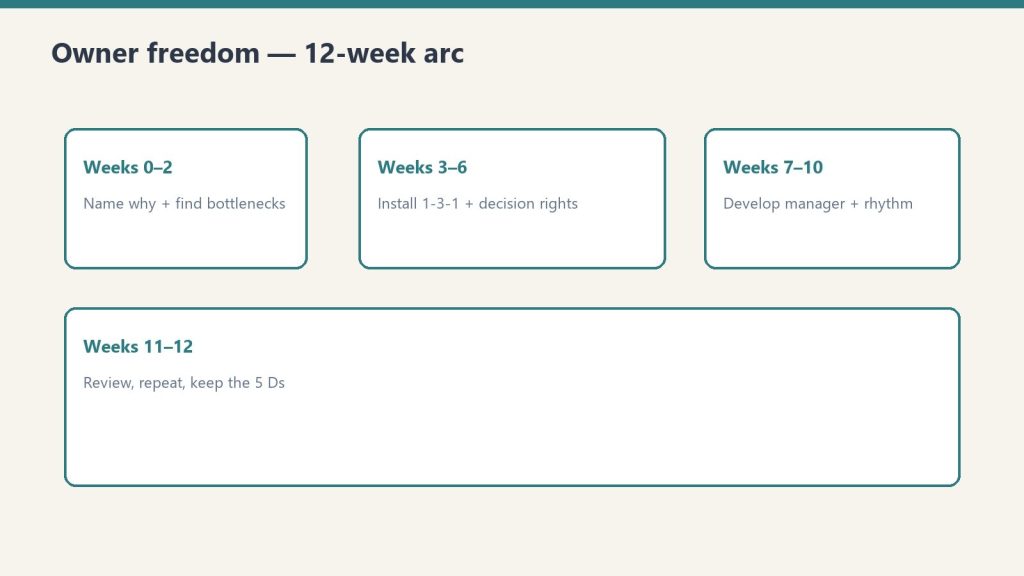
    Week 0: name why you are stepping back

    Before Week 1, write three lines:

    • My #1 reason to step back (what I would do with the time)
    • The one person I am betting on as my first real manager
    • Start date / target Week-12 date

    Block 30-45 minutes every Friday. Do not skip ahead. Each phase sets up the next.

    Weeks 1-2: identify the bottlenecks

    Run the Owner Dependency Audit. Rate Low / Med / High across nine areas: sales, production, finance, customer-issue resolution, hiring, vendor relationships, estimating / project management, emergency response, decision rights. Scoring: Low = 1 (runs without you; a real backup has done it), Med = 2 (limps; backup needs you on call), High = 3 (stops cold). Total is 9-27.

    For each area write: what happens if you are gone 30 days, who the backup is today, and what would have to be true for this to be Low.

    Then fill a Decision-Rights Map. Starter rows: approve a job estimate over $25k; authorize overtime / call-in crew; issue a refund or credit; hire or fire; approve a vendor / sub payment; take an out-of-area or unusual job; sign a contract or insurance scope; pull a crew off one job for another; spend on new equipment; set or discount a price. Who decides today vs who should.

    End of the phase: a written top-3 bottleneck list, and the team knows the shift is coming. Tell them: “I’m working a 90-day plan to push decisions down. Expect me to hand more back to you.”

    For one full week, tally every interrupt for a decision. Sort into Delegate now / Delegate after training / Keep (truly owner-only).

    Weeks 3-4: install 1-3-1

    Stop being the answer key. The old way: “The dehu on Maple St died. What do you want me to do?” You just took back the problem, the thinking, and the decision.

    The 1-3-1 way:

    • 1 issue. The fork in the road, one or two sentences. Not the whole story.
    • 3 real options. Each with pros, cons, and rough cost or effort. “Do nothing” can be one when it is honest.
    • 1 recommendation. The option they would pick if it were their call, and why in one line.
    • A default. What they will do if they do not hear back by a deadline, so the job does not stall.

    When someone brings a raw problem, ask: “What are your three options, and which do you recommend?” Then wait. Run at least five real 1-3-1 conversations this phase. Approve the recommendation whenever it is reasonable. Note who takes to it. That is a signal for your manager pick.

    Phase done when at least one person is bringing 1-3-1s without being reminded.

    Weeks 5-6: write decision rights

    List the 10-15 recurring decisions (refunds, equipment, scheduling, scope changes, hiring, pricing exceptions). For each: a dollar or scope threshold people can decide under without asking you, and who owns it when you are not in the room. Walk the team through it: “Under this line, you don’t need me. Decide and tell me after.”

    Hand off one decision completely this phase. Do not take it back.

    Weeks 7-8: develop one manager

    Open the Bench Builder. One row per key function. Fields: Role, current owner, future-leader candidate, backup depth (None / Thin / Solid), key skill gaps, 90-day development action (observable: shadow X, own Y file end-to-end, run Monday huddle), delegation plan, accountability rhythm (Weekly / Biweekly / Monthly), status (Identified / Developing / Ready). A blank candidate is itself a finding.

    Go deep on ONE person. A single real manager beats five people you are “keeping an eye on.” Have the conversation: “I want to grow you into running X.” Hand them one area end-to-end. Set a weekly 30-minute 1-on-1 and protect it. Let them make a real decision. Coach the outcome instead of grading it.

    Weeks 9-10: accountability rhythm

    Stand up a weekly 15-minute huddle with a fixed agenda: numbers, jobs at risk, who needs what. Pick 3-5 numbers the team reviews every week (jobs in WIP, days-to-dry, AR, callbacks, leads). Someone other than you owns each number. Have your developing manager run the huddle at least once while you sit in.

    Hold one real accountability conversation this phase. Issue, behavior that needs to change, what has already been allowed, the expectation, the consequence or support, what success looks like in 30 days. About the work, not the person.

    Weeks 11-12: review and repeat

    Re-run the Dependency Audit and compare to Week 1. Take a planned half-day fully off and note what broke. That is the next bottleneck. List what got delegated vs what bounced back, and why. Give the developing manager direct feedback. Raise one decision-rights threshold. Duplicate the 90-day page and start the next cycle.

    Success at 90 days: a full day off without the phone melting; the team brings 1-3-1s; a written decision-rights list; one person owns one area end-to-end; a huddle someone else can run; a lower dependency score; next quarter’s target already named.

    Run the 5 Ds while you are in it

    Succession is a what-if-tomorrow problem, not a retirement problem. Check a box only if it is true and current today. The five:

    1. Death. Will, funded buy-sell, key-person life, second check-signer, someone who can legally bind the company, a recoverable password place, a named person who can run production 30+ days.
    2. Divorce. Separate vs marital property actually confirmed, commingling cleaned up, a valuation method in writing, operating cash structured so a personal dispute cannot freeze payroll.
    3. Disease. Someone has actually run production on a vacation test. Backup estimator. Payroll / AP / AR without your hands. Disability and business-overhead coverage. A one-page interim chain-of-command.
    4. Drugs / dependency. Dual approval over a dollar threshold. A second set of eyes on the books. No single point of failure, including you. A trusted advisor allowed to tell you the truth.
    5. Departure / disaster. Tribal knowledge written down. Relationships not owned by one person. Off-site backups you have test-restored. A continuity plan for your own shop. Backup vendor / equipment list.

    45 boxes. Count the blanks. 0-6 resilient; 7-15 moderate; 16-27 high; 28+ you are the company. Pick the three blank boxes that would hurt most if the D hit tomorrow. Name an owner and a date. This is an awareness tool, not legal, financial, or insurance advice. Use it to walk into the attorney, agent, and CPA prepared.

    If you want the packaged kit

    You can run this from the outline above. Buy Now is the bundle delivered by email after checkout: the five Notion pages (duplicate each so the master stays clean), plus the matching Claude skills if you want the interviews walked. Same Square button at the top of this page.

    Coaching and operational tools only. Not legal or HR advice.

  • Owner Dependency Audit

    Owner Dependency Audit

    Owner Dependency Audit

    $99

    Delivered by email after checkout.

    Buy Now →

    Secure checkout via Square — all major cards accepted

    You can copy this method and do it yourself. Rate nine areas. Map who decides what. Write what breaks if you vanish for 30 days. Buy Now is the packaged Notion page you duplicate each quarter, so you are not rebuilding the audit from a blank doc.

    Tool #7 of the Restoration Leadership Toolkit. A deeper diagnostic of where you, the owner, are still embedded. The whole thing answers one question: if you disappeared for 30 days, what breaks first?

    How to run it

    1. Work top to bottom. For each of the nine areas, pick a dependency level, write the honest answer to “what happens if I’m gone 30 days?”, and name the backup.
    2. Fill the Decision-Rights Map. Who decides today vs who should.
    3. Total your score. Write your first move.
    4. Re-run it quarterly. The goal is High → Med → Low over time.

    Scoring key. Low = 1 (runs without you; a real backup exists and has done it). Med = 2 (limps along; backup needs you on call). High = 3 (stops cold, or only you can do it). Lower total = more freedom. Range is 9-27.

    The nine areas

    For each one, write four lines: dependency level (Low / Med / High); what happens if you are unavailable for 30 days; who is the backup today; what would have to be true for this to be Low.

    1. Sales

    Bidding, closing, key referral and adjuster relationships, the “yes” on big jobs.

    2. Production

    Crews, scheduling, job execution, quality on site, getting work out the door.

    3. Finance

    Cash flow, payroll, AR/AP, banking, payment approvals, signing checks.

    4. Customer-issue resolution

    The escalation call, the unhappy homeowner, the complaint only you can calm.

    5. Hiring

    Recruiting, interviewing, the final hire/fire call, who joins the crew.

    6. Vendor relationships

    Suppliers, subs, equipment rental, the accounts and the goodwill in your name.

    7. Estimating / Project management

    Scoping, writing estimates, Xactimate, change orders, running the job file.

    8. Emergency response

    After-hours calls, the 2 a.m. water loss, first-on-scene, the dispatch decision.

    9. Decision rights

    Who is actually allowed to decide and spend without calling you first.

    Decision-Rights Map

    The heart of the audit. List the decisions that actually move money, risk, or people. Be honest about who decides them today, then who should, so the gap becomes the delegation plan. Starter rows:

    • Approve a job estimate over $25k
    • Authorize overtime / call-in crew
    • Issue a refund or credit to a customer
    • Hire or fire a crew member
    • Approve a vendor / sub payment
    • Take on an out-of-area or unusual job
    • Sign a contract or insurance scope
    • Pull a crew off one job for another
    • Spend on new equipment
    • Set or discount a price

    Add your own. For each: who decides today, who should decide.

    Overall Dependency Score

    Score each of the nine (Low = 1, Med = 2, High = 3) and total them.

    • 9-13 Leader. The business runs without you. Use the freedom to grow it or build the next person. Protect this. Do not drift back into the work.
    • 14-19 Coachable bottleneck. A few areas still need you. Pick your two highest-scoring areas and build a real backup this quarter.
    • 20-27 You are the business. If you disappeared, it stops. Fragile and unsellable. Start with the single area that breaks first and delegate one decision this week.

    The 30-Day Disappear Test

    Write these five lines:

    • What breaks first (the #1 single point of failure)
    • Why it breaks (what only you do here)
    • The one person who would have to step up
    • The first thing I will delegate or document this week
    • Date I will re-run this audit

    The number does not matter as much as the trend. An owner who moves from 24 to 16 over two quarters has built a real company. One who stays at 24 has bought themselves a demanding job. Work the highest-scoring area first. Give one decision away at a time. Make sure every backup has actually done the task, not just been named.

    What to do with the result

    1. Circle the two or three highest scores. Those are this quarter’s targets.
    2. For each, write the 1-3-1 handoff: one outcome you want, three rules or boundaries, one check-in cadence. Then hand it off.
    3. Put the named backups on a bench list: role, current owner, candidate, skill gaps, one 90-day development action they can be observed doing, and a weekly or biweekly 1-on-1.
    4. If you want the full step-back, run a 12-week doer-to-leader plan on those same three bottlenecks. This audit is Weeks 1-2 of that plan.

    A prompt you can give your own Claude if you want it walked: “Walk me through an owner-dependency audit. Ask me what only I can do across sales, scheduling, quality, money, relationships. Then rank each by risk, and give the delegation or documentation move for the top 3, including what I must accept will be done 80% as well.”

    If you want the packaged audit

    You can run the nine areas on a legal pad. Buy Now is the Notion page delivered by email after checkout. Duplicate it (··· → Duplicate) so the original stays clean for next quarter. The nine sections, the Decision-Rights Map, the score table, and the 30-day test are already laid out. Same Square button at the top of this page.

    Pairs with the Restoration Leadership Bench Builder to develop the backups you just named, and the 90-Day Doer-to-Leader Transition Plan to step back on a schedule. Coaching and operational tool only. Not legal or HR advice.