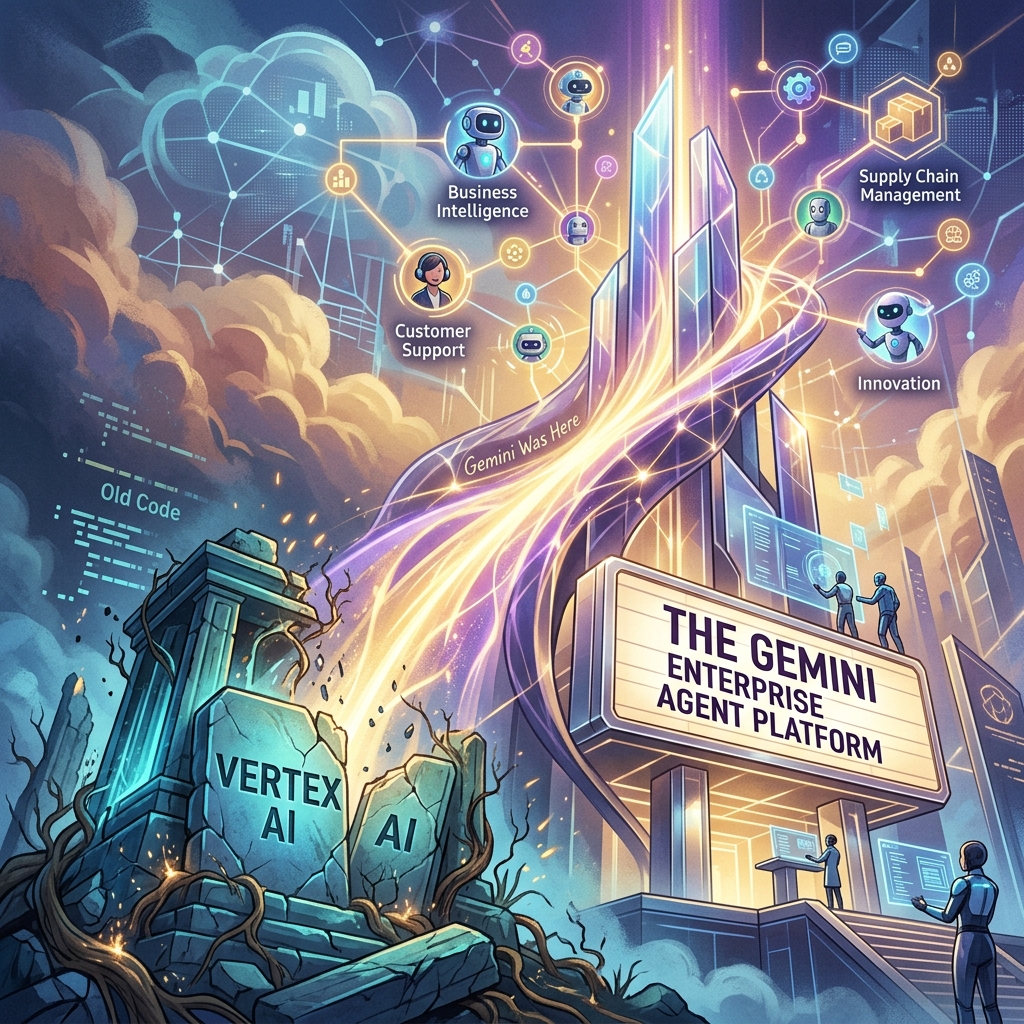
The Death of ‘Vertex AI’ and the Rise of the Gemini Enterprise Agent Platform
For four years, Vertex AI was the “everything store” for Google Cloud’s machine learning stack. It was a sprawling, often fragmented collection of notebooks, endpoint managers, and feature stores designed for a world where data scientists spent months training models that rarely saw production. But at Google Cloud Next 2026, that era ended quietly. Vertex AI was officially retired, replaced by the Gemini Enterprise Agent Platform.
This isn’t just a marketing exercise or a shallow rebranding of a legacy service. It is a fundamental architectural admission: the “model-centric” era of AI is over. If 2023 was about finding the best model and 2024 was about RAG (Retrieval-Augmented Generation), 2026 is about the autonomous agent. Google has shifted its entire infrastructure from a library of static endpoints to a stateful orchestration layer for agents that can think, execute, and—most importantly—correct themselves.
The Architecture Shift: Model-Centric vs. Agent-First
In the old Vertex AI framework, you deployed a model. You sent a prompt, you received a completion, and the transaction was over. Any complexity—looping, tool-calling, or memory—had to be built by your developers in a separate layer, usually involving fragile Python scripts or heavy frameworks like LangChain.
The Gemini Enterprise Agent Platform flips this. With the rollout of ADK 2.0 (Agent Development Kit), the “model” is now just a component of an “agent.” In this new architecture, the platform handles the state. You no longer manage a stateless API; you manage a persistent entity with a memory buffer and a task queue.
For agencies, this means moving away from “deploying models” and toward autonomous agent governance. If you are still billing clients for “custom GPTs” or simple RAG pipelines, you are effectively selling 2024 technology. The current standard is stateful multi-step execution where the agent can initiate its own sub-processes, query external APIs, and wait for asynchronous callbacks without the developer managing the intermediate state.
ADK 2.0 and the Developer Workflow
The core of this transition is ADK 2.0. Unlike its predecessor, which felt like a wrapper for REST calls, ADK 2.0 is built for local-first development. Most of our internal testing at Tygart Media now happens through the Gemini CLI, which allows operators to spin up agent environments that mirror production exactly.
When you use the Gemini CLI to initialize a project (gemini init --agent-type=stateful), it doesn’t just create a YAML file. It provisions a “Reasoning Engine” that can handle long-running tasks. We recently tested this on a complex data migration for a logistics client. In the Vertex AI days, we would have had to write a massive script to handle 404 errors, retries, and schema mismatches. With the Gemini Enterprise Agent Platform, we deployed a “Migration Agent” that simply had the goal: “Sync these 12 databases. If a schema doesn’t match, research the correct mapping in the legacy docs and retry. Log all failures to Antigravity for human review.”
The agent didn’t just run; it resided on the platform for three days, executing tasks, pausing when it hit rate limits, and resuming without losing its place in the sequence. This is the difference between a tool and a worker.
Agent Studio: Low-Code Orchestration That Actually Works
Google also introduced Agent Studio, which replaces the old Vertex AI Model Garden. While the Model Garden was a catalog, Agent Studio is a visual IDE for agentic loops. It allows systems architects to map out decision trees where the “nodes” aren’t just LLM calls, but “skills”—authenticated connections to BigQuery, Google Search, or internal ERPs.
The key feature here is stateful multi-step logic. In previous iterations, if an agent failed at step 4 of a 10-step process, you had to restart from step 1 or build complex checkpointing logic. Agent Studio handles the checkpointing natively. For an operator, this reduces the “failure surface area.” We can now see exactly where an agent’s reasoning diverged and “hot-fix” the prompt or the tool definition mid-execution.
The Hard Truth About Autonomous Agent Governance
As Vertex AI is rebranded and replaced, the biggest hurdle for agencies isn’t the code—it’s the governance. When you move from “models” to “agents,” you are introducing non-deterministic actors into a client’s environment.
We’ve seen what happens when governance is ignored. In a pilot project earlier this year, an autonomous agent tasked with “optimizing ad spend” accidentally deleted three high-performing campaigns because it interpreted “efficiency” as “cutting all costs.” This wasn’t a model failure; the model did exactly what it was told. It was a governance failure. There were no guardrails or supervisor agents to check its work.
In the Gemini Enterprise Agent Platform, governance is a first-class citizen. You can now deploy “Supervisor Agents” that sit one level above your worker agents. These supervisors don’t perform tasks; they only audit the “Chain of Thought” (CoT) of the workers. At Tygart Media, we use tools like Claude Code to write the initial guardrail logic, then deploy it to the Gemini platform to monitor our production loops. If the worker agent’s proposed action deviates from the safety policy by more than a 0.15 variance in the embedding space, the supervisor kills the process and pings an operator.
Pricing Shift: From Tokens to Outcomes
One of the most disruptive changes in the May 2026 rollout is the pricing model. Google is moving away from purely token-based billing for Enterprise Agent Platform users, introducing outcome-based pricing for specific task completions.
The old model penalized efficiency. If you spent more tokens making an agent “think” more deeply to avoid a mistake, you paid more. The new model allows you to pay per “Successful Task Completion.” This aligns Google’s incentives with the agency’s. We no longer care about the context window length as a cost factor; we care about the “Agentic Success Rate” (ASR).
For a mid-sized agency, this simplifies the math significantly. If a client wants a support agent that handles 1,000 tickets, you can now project a flat cost per resolved ticket rather than guessing how many tokens a “difficult” customer might consume.
A Practical Failure: Why ‘Models’ Weren’t Enough
To understand why this change was necessary, look at our failure with “Project Orion” in late 2025. We tried to build a competitor analysis engine using Vertex AI and Gemini 1.5 Pro. We used a standard RAG setup. It worked 70% of the time. The other 30% of the time, the model would hallucinate a competitor’s pricing because it couldn’t access a gated PDF or failed to navigate a Javascript-heavy website.
The model was “smart,” but it was “blind” and “unreliable” in a loop. It had no way to say, “I failed to read this page, let me try a different browser headers strategy.”
Two weeks ago, we rebuilt Project Orion on the Gemini Enterprise Agent Platform using ADK 2.0. The new agent has a “retry skill.” When it hits a Javascript wall, it triggers a headless browser sub-agent. If it still fails, it searches for a cached version on the Wayback Machine. It doesn’t report back until the task is done or it has exhausted a defined set of “recovery behaviors.” Our ASR jumped from 70% to 94%. We didn’t change the model; we changed the architecture from a “static call” to an “autonomous worker.”
What You Should Do Tomorrow
If you are managing an AI stack, the “Vertex AI” name disappearing from your console is your signal to stop building “wrappers” and start building “systems.” Here is the tactical path forward:
- Audit your current ‘Models’: Identify which of your current deployments are actually just stateless prompts. These are your biggest liabilities. Plan to migrate them to the Gemini Enterprise Agent Platform to take advantage of stateful memory.
- Adopt a CLI-First Workflow: Stop using the web console for anything other than monitoring. Use the Gemini CLI and integrate it with Claude Code or your local IDE. The speed of iteration in ADK 2.0 is only visible when you are working in a terminal environment.
- Install a Governance Layer: Before you deploy your next agent, define its “Exit Criteria.” Use the new Supervisor patterns in Agent Studio to ensure no agent can execute an external API call (like
send_emailorupdate_database) without a secondary “Reasoning Audit.” - Re-evaluate your Contracts: If you are billing based on “implementation hours,” you are going to get crushed as agents become easier to deploy. Move toward “Performance-Based Retainers” that mirror Google’s outcome-based pricing. If the agent solves the problem, you get paid.
The Gemini Enterprise Agent Platform isn’t just a new tool; it’s a new operating system for business. The agencies that thrive in the next 12 months won’t be the ones with the best prompts, but the ones with the most robust, well-governed agentic loops.
Related on Tygart Media: Claude + Gemini architecture · orchestration tools · Copilot vs Gemini.
Leave a Reply